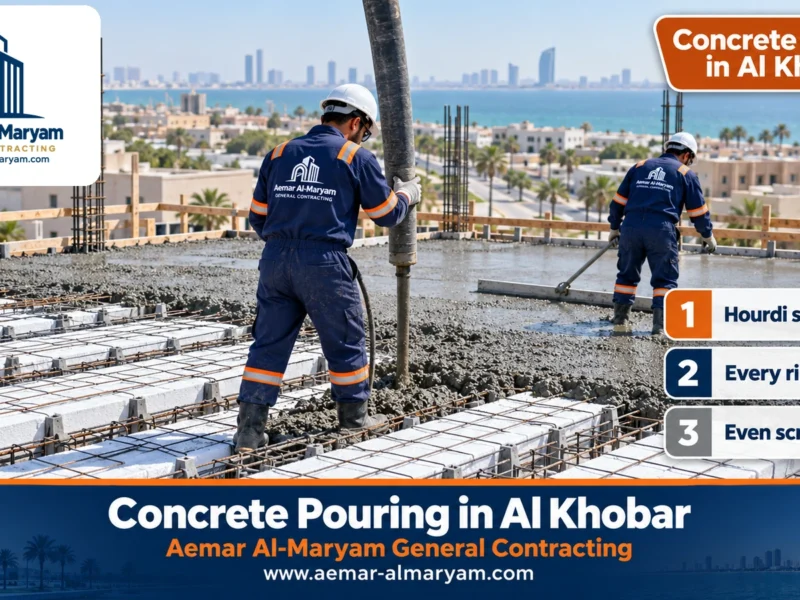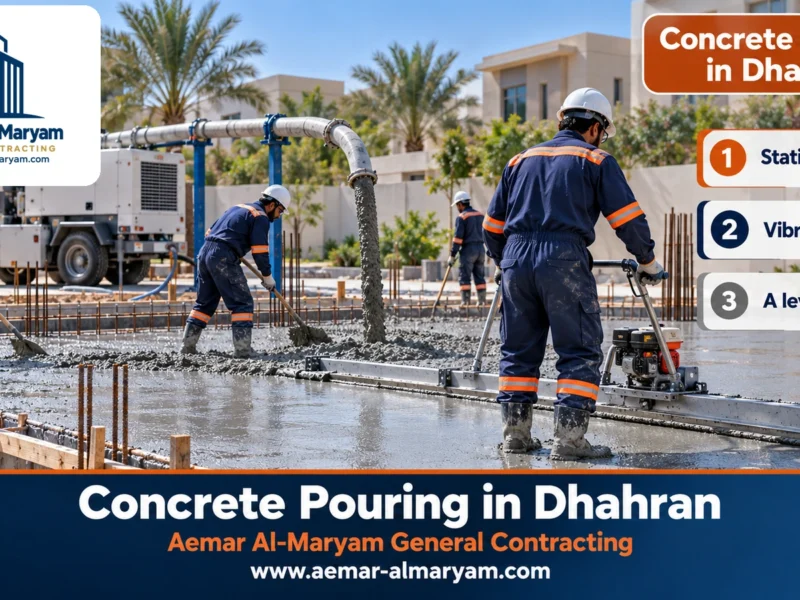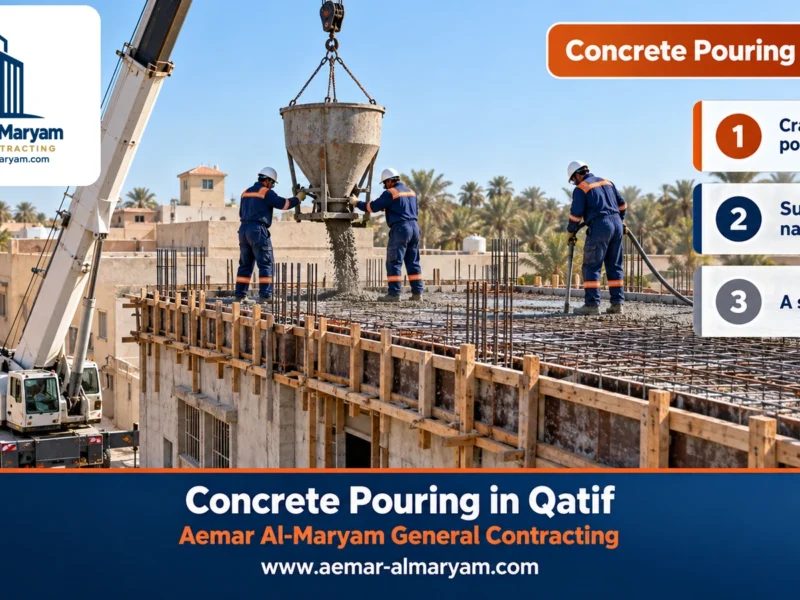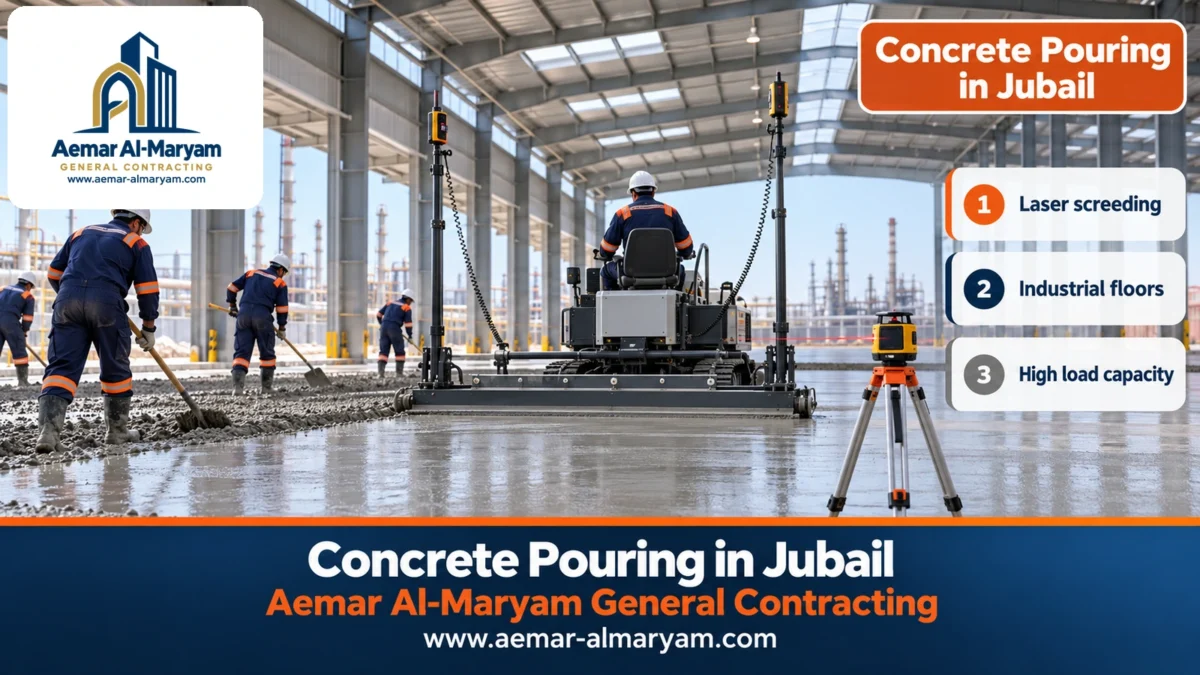
Concrete pouring in Jubail usually means one of two very different jobs. In Jubail Industrial City it is a warehouse or workshop floor that has to be flat under racking and forklifts, or an equipment base whose anchor bolts must land within millimetres of the vendor drawing. In Jubail Al-Balad it is a walkway in front of a house, a yard or an annex roof. Aemar Al-Maryam General Contracting does all of these: we prepare the base, formwork and steel, order ready-mix from a nearby licensed plant, then place, vibrate, level, trowel or broom, and water-cure. Our lowest rate is SAR 14 per square metre for laying blinding; a 10 cm reinforced yard with all its materials runs from SAR 46 a metre, and so does a power-trowelled floor, whereas heavy warehouse floors, equipment bases and roof slabs are worked out from the drawings after a visit. Every figure here is a starting point that we confirm on site; phone or WhatsApp 0547879578.
Our crews reach Jubail from Dammam on booked visits, and our first question is always the same: where exactly is the site? Is it behind a factory gate in the Royal Commission’s Industrial City, or on a residential street that answers to the municipality? That one detail decides who issues the permit, when trucks may enter and which way they come in, and often what concrete and surface finish the job calls for. This page explains the three jobs we are asked for most in Jubail, namely laser-screeded warehouse floors, equipment plinths with anchor bolt templates and broom-finished walkways, then covers every other type of pour under its own heading, and closes with our rates and a costed Al-Balad yard.
In short: concrete pouring in Jubail
- Warehouse floors: laser screed on large areas, power-trowel finish, joints sawn at the right time.
- Equipment bases: steel template holding the anchor bolts, axes and levels checked before the pour, systematic vertical vibration.
- Jubail Al-Balad: broom-finished walkways and yards, annex roof slabs, house footings.
- What a metre costs: blinding 14 labour only; reinforced yard or path 46 and trowelled floor 46, both with materials; foam falls 17, mortar falls 23; stamped 110. SAR, minimum figures.
- Material invoices: the plant’s concrete bill, pump hire and lab fees are passed on as issued, with no margin.
- Authority: the Royal Commission inside Jubail Industrial City; the municipality through Balady in Jubail Al-Balad.
- To book: phone and WhatsApp 0547879578; travel from Dammam set at inspection.
Warehouse floor pouring in Jubail: why a laser screed?
Warehouse floor pouring in Jubail differs from pouring a house yard in one essential respect: flatness. High racking and forklifts do not forgive small dips and humps. A rack that leans slightly at its foot leans much more at its top, and forklift wheels bounce over an uneven floor, which wears the load, the truck and the slab. So we treat a warehouse floor as a structural element with a defined level and a defined finish, not as a layer of concrete that is spread and left.
On large areas we use a laser screed. A rotating laser transmitter stands on a tripod at the edge of the building and sweeps a fixed reference plane. Receivers on the machine head read that plane continuously, and the hydraulics raise or lower the screed head automatically. The head itself combines a strike-off blade with a vibrating plate, so each strip comes out levelled and compacted in a single pass, without the forest of side forms and string lines that drift as the day goes on. Because the reference is a beam of light rather than forms that can be knocked, the level does not accumulate small errors from one end of the floor to the other.
When we use the laser and when straightedges are enough
A laser screed has mobilisation and running costs, so it does not make sense in a small workshop. On medium floors we divide the area into bays with steel forms set to level, strike off with long straightedges and a vibrating screed, then power-trowel. In every case we decide the method once we know three things: the area, the type of traffic on the floor and the flatness the owner or designer requires. The price difference between the methods becomes clear at inspection, not before.
| Method | Where it suits | What it needs |
|---|---|---|
| Laser screed | Warehouses and distribution centres with large areas and high racking | A compacted, level sub-base, safe access for the machine and an uninterrupted concrete supply |
| Bays with steel forms and a vibrating screed | Workshops, medium stores and service halls | Forms set accurately to level and a crew large enough to spread and strike off |
| Hand strike-off then trowelling | Small store rooms and annex floors | Enough floor, around 50 m², for the standard trowelling rate |
Power-trowelled (helicopter) floors in Jubail
A power-trowelled floor is the next step after levelling. Once the slab will bear the trowel’s weight without the blades digging in, the trowel blades spin over the surface, closing and polishing it until it is dense and easy to clean. Timing changes with heat and humidity. In Jubail the coastal humidity sometimes slows the surface down, while summer wind can dry it out quickly, so the crew reads the slab itself instead of working to a fixed clock. With materials, a trowelled floor costs from SAR 46 a square metre on floors of around fifty square metres or larger.
Polythene and joints under a warehouse floor
Under the floor we lay polythene with generous overlaps on a compacted sub-base, so the ground does not draw water out of the mix and moisture and salts cannot rise from below. After the pour, control joints are sawn at the time the contractor judges right, so the natural shrinkage of the slab happens along a straight planned line rather than as a random crack in the middle of a forklift aisle. Joint spacing and the reinforcement of a heavy floor are set by the designer from the loads, which is why they sit in the “after inspection” row of our price table.
A warehouse floor pour in Jubail, day by day
A warehouse floor does not start on the day the trucks arrive. There are days of preparation before and days of curing after, and quality is made in those days more than in the hours of pouring.
- 1Sub-base
Level and compact the sub-base in layers to formation, and check falls if the floor drains to a door or gully. - 2Polythene and steel
Lay overlapped polythene, set the mesh or bars on chairs at the specified height, and fix the bay edge forms. - 3Services and sleeves
Fix conduits, drains and equipment sleeves before the pour and photograph them, because opening them later means sawing or coring. - 4Supply plan
Number of trucks and the interval between them, a dawn start, and a back-up crew for spreading and levelling on large bays. - 5Placing and levelling
Continuous pour of the bay, laser or vibrating-screed strike-off, then a wait for the right set. - 6Trowelling and joints
Power-trowel in passes, then saw the control joints on time. - 7Curing
Water, polythene sheeting or curing compound for at least seven days, and no heavy traffic until the engineer allows it.
⚠ A forklift floor is not a yard slab
If your warehouse floor will carry forklifts or high racks, do not ask for the “mesh-reinforced yard slab” rate; that is a system for yards and light paths. An industrial floor needs its thickness, reinforcement and joints designed, and we price it from the drawings.
Equipment foundations in Jubail: anchor bolts first
Equipment foundations in Jubail are a regular request from factory yards and workshops: a base for a pump, an air compressor, a generator, a tank or a production machine. The base itself is a reinforced concrete block, but what decides whether it works is the set of anchor bolts cast into it. If a single bolt moves a centimetre out of place, the equipment baseplate will not drop over it, and after the concrete has hardened the remedy is breaking out or drilling and chemical anchoring, both expensive and both needing the engineer’s approval.
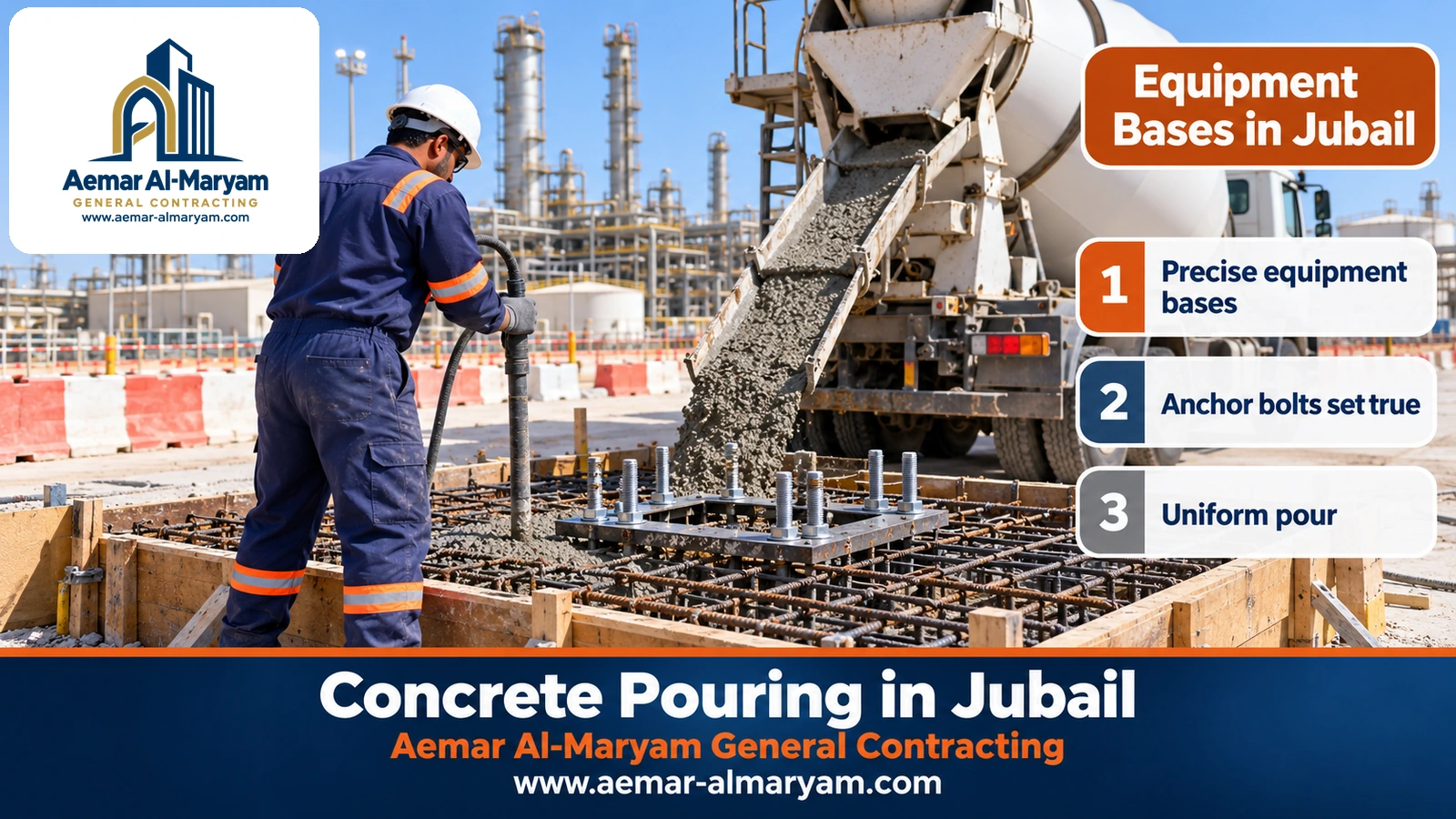
That is why we never just wire the bolts to the reinforcement and hope they stay put. We fix them in a drilled steel template that matches the baseplate holes on the vendor drawing, with nuts above and below, and tie the template to the timber side forms so it cannot shift under the weight of the concrete or the vibration. Then we mark the template axes on fixed forms so that re-measuring is quick.
- 1Vendor drawing
We take the base and anchor-bolt drawing, the top-of-concrete level and the bolt projection from the owner or vendor. - 2Forms and steel
We build the timber forms, place the dense reinforcement on spacers at the specified cover and leave clear room for the bolts. - 3Bolt template
Bolts are double-nutted in the steel template, the template is fixed to the forms and the threads are wrapped against concrete. - 4Check before pouring
We re-measure axes, bolt spacing, levels and the plumb of each bolt and record them before the truck is called. - 5Placing and vibration
Concrete goes in layers and is vibrated vertically, keeping the poker away from the bolts, with the template checked during the pour. - 6After the pour
At least seven days of water curing, template left until the engineer decides, and a surface handed over ready for installation.
Grout under the equipment
Much equipment is set on a base cast slightly below its final level, with the gap under the baseplate filled with non-shrink grout. If the vendor drawing calls for this, we cast the base to the stated level and roughen the top as instructed; setting the equipment and grouting are done with the installation team.
Equipment bases inside an operating facility
If the base goes inside a working plant, an existing floor may first need to be cut to form the pit, or cored for the equipment services. We do this work too; see our pages on cutting concrete in Jubail and Jubail core drilling. We then pour the new base and tie it into the floor as the engineer instructs.
Concrete work in Jubail Industrial City: the Royal Commission and Marafiq
Jubail Industrial City runs on its own system. The Royal Commission administers the city and issues its building, alteration and work permits instead of Balady, while Marafiq provides the power and water. Before setting the pour date we ask the owner or facility management for the work permit and access requirements, and agree truck and pump access hours and parking positions with them, because a mixer waiting at a gate in the heat is concrete losing workability before it even reaches the forms.
■ Before the pour
Work permit, names of workers and equipment for gate access, truck route, and the pump position inside the site.
■ Services
Conduits and pipes under floors laid and tested before the pour; connections to the Marafiq network follow its own procedures.
■ Safety
Site PPE and rules respected, with barriers around open pits and equipment bases during the work.
■ Records
A delivery ticket for every truck, slump results, and cube samples labelled with the plant and truck number.
Over in Al-Balad, whether in Al Hamra, Al Dabab or Ghirnatah, the authority is the municipality through the Balady platform, as in Dammam. In residential areas belonging to the Industrial City, such as Al Fanateer, it is the Royal Commission. If you are unsure which applies, ask when you apply for the permit, before any structural pour.
Concrete walkways in Jubail Al-Balad: the broom finish
Concrete walkways in Jubail Al-Balad are a common request in front of and around houses: a walk from the street gate up to the front door, a side path to the back yard, or a paved strip around the building. An outdoor path gets washed and catches coastal damp and dust, and a smooth trowelled surface turns slippery. So we broom-finish outdoor paths: after levelling, and once the bleed water has gone from the surface, a wide broom is drawn across the fresh concrete, leaving fine regular ridges that grip the foot.
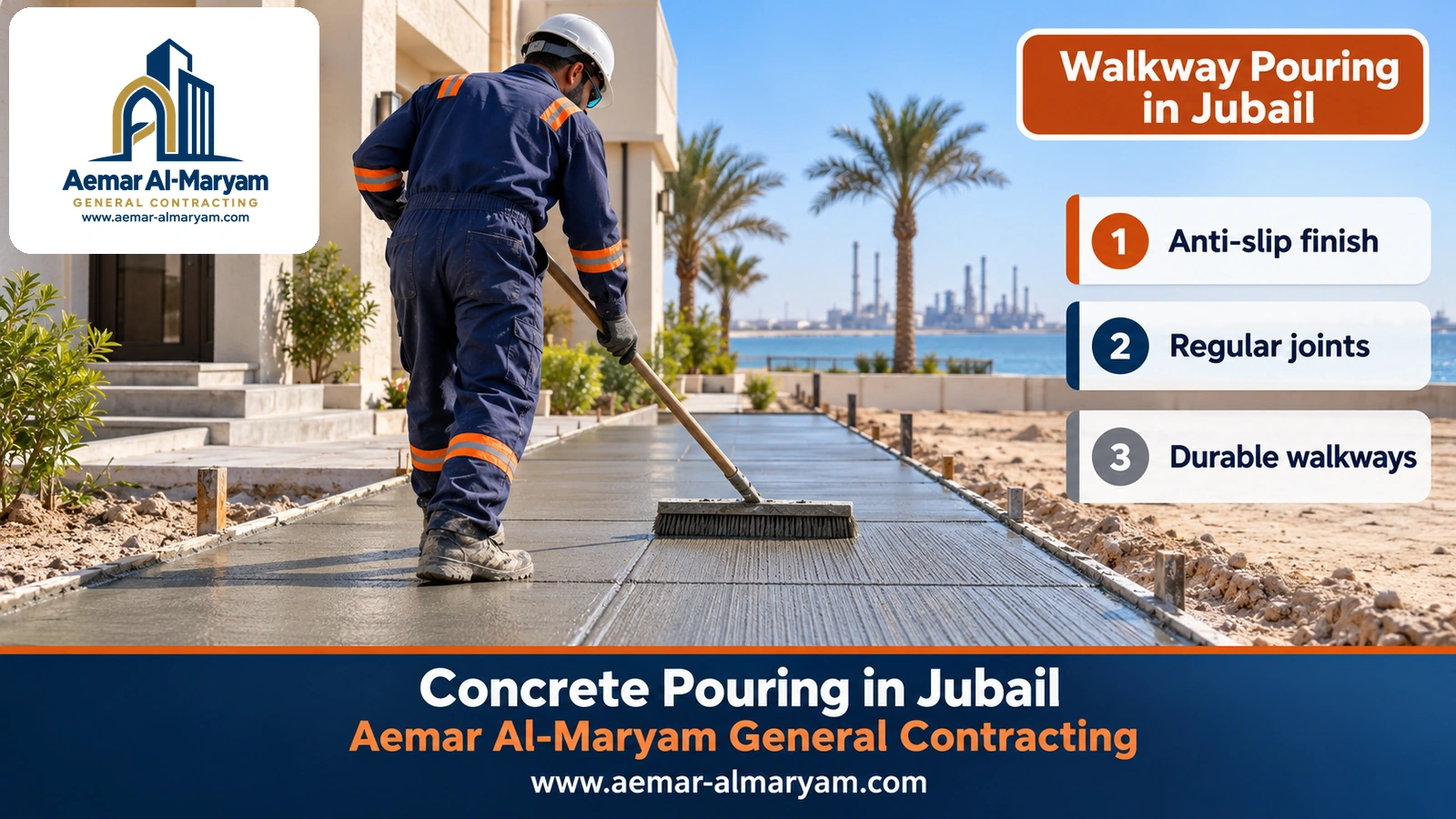
- Direction: across the line of walking, in one continuous stroke from edge to edge without going back over it.
- Timing: after the bleed water has gone; brooming too early tears out fine aggregate and weakens the surface, too late leaves no texture.
- Joints: tooled at regular intervals set by the contractor according to the path width, so shrinkage goes to them.
- Falls: a gentle fall away from the house wall so washing water does not stand against the foundation.
- Edges: straight edge forms fixed with stakes and an edging tool so the arris does not chip.
If you prefer a decorative surface, stamped concrete starts from SAR 110 per m², or interlock paving in Jubail may suit you should you want paving you can take up and put back. For wide car entrances there is also asphalt in Jubail.
Roof slab pouring in Jubail, footings and ground beams
Roof slab pouring in Jubail covers houses, annexes and rooftop rooms, and we pour only after checking the formwork and steel against the approved drawings: props and shores firm, panel joints tight, bars on spacers at the right cover, services and sleeves in place. The pour itself is usually a single day, with a boom pump where the street allows it or a line pump on tight sites. For a complete annex from foundations to roof, see annex and majlis building in Jubail.
Footings and ground beams in Jubail
Footings and ground beams in Jubail start with excavation to level and compaction of the formation, then blinding, then footing steel on chairs, column starter bars set accurately, then necks and ground beams, waterproofing and backfill. In a coastal city such as Jubail the soil report matters even more, because it decides whether buried concrete is ordinary, sulphate-resisting or blended, and what cover is needed. Concrete in contact with soil is coated with bitumen before backfilling; waterproofing details are in waterproofing in Jubail.
Blinding concrete in Jubail
Blinding is a thin layer of plain concrete under footings and ground beams, usually 5 to 10 cm as drawn, giving a clean level surface on which steel can be placed off the soil. We lay it from SAR 14 per square metre, while its concrete is billed by the plant.
Yard slabs in Jubail
A yard slab in Jubail Al-Balad is a complete system: compact and wet the soil, apply termite treatment, lay overlapped polythene, set 8 mm mesh on chairs, pour about 10 cm of concrete, then form joints and falls and cure with water. With every material in, it costs from SAR 46 a square metre, a little more in very cramped yards where set-up costs do not shrink.
Ready-mix concrete in Jubail: where it comes from and who orders it
Ready-mix concrete in Jubail is ordered by us from the licensed plant nearest the site. There are ready-mix plants in Jubail and Ras Al-Khair, so haul times are normally short, which matters in the heat. With the plant we agree the grade on the drawings, the cement type, any additions, the slump suited to the placing method, the number of trucks and the gap between them, so that no truck waits in the sun and the pour does not stop long enough to form a cold joint. You pay the plant’s own invoice for the concrete; as a yardstick, the statistics authority’s national average sits near SAR 214 a cubic metre for plain grade 350 and near SAR 224 for the sulphate-resisting version.
| What goes on the order | Example in Jubail | Who decides |
|---|---|---|
| Grade | 250 for blinding; 350 for slabs and industrial floors on many drawings | The designer |
| Cement type and additions | Sulphate-resisting or blended for buried elements near the coast | The designer, from the soil report |
| Slump | Higher for pumping; suited to the laser screed on floors | Plant and designer; we measure it on site |
| Retarder | In the summer months and on long pours | We decide with the plant according to the weather |
Concrete pumps in Jubail
Where the boom can swing over a roof from the road or a factory yard, a boom pump is quickest; rear yards and set-back plots need a line pump; open warehouse floors and equipment bases are often filled directly off the mixer’s chute. The pump is charged at cost by type and hours, and we choose it at inspection after seeing the access, overhead cables and ground bearing.
Concrete that stands up to the Jubail coast
Jubail sits on the sea, and its concrete faces salts from two directions: from soil and groundwater under the foundations, and from moist, salt-laden air above ground. The Saudi concrete code places sites near the coast in more severe exposure classes, and in sabkha areas it demands a low water-cement ratio and protection of exposed faces by tanking or an epoxy-based coating. What matters on site is that we apply what the designer specifies precisely: correct cover, no water added to the mix, compaction good enough to prevent honeycombing, and full curing.
| Where the steel sits | Lowest common cover in the references |
|---|---|
| Underside of a footing cast straight onto the soil | 75 mm |
| Member touching soil or outside air, bar diameter 19 mm or more | 50 mm |
| Member touching soil or outside air, bar diameter up to 16 mm | 40 mm |
| Beam or column inside the building | 40 mm |
| Slab inside the building, away from weather | 20 mm |
Sulphate-resisting cement alone is not enough
Sabkha studies from KFUPM in Dhahran showed that switching to sulphate-resisting cement still left the steel corroding under chloride attack, and that blended mixes containing silica fume or slag corroded much less. So cement type and additions are the designer’s decision from the soil report, not a quick choice when the truck is ordered.
Pouring in Jubail heat and humidity
A summer pour in Jubail combines heat with coastal humidity and, at times, wind. The Saudi code’s hot-weather requirements are clear: the mix may be no warmer than 35 °C as it goes into the forms, its slump may not fall under 75 mm, a retarded load must be emptied inside two hours, nobody adds water at the site, and wet curing runs for a week or more. So we start at dawn or at night, soak the forms and subgrade beforehand so they cannot steal mixing water, and have water and hessian ready before the first truck arrives.
- ✓Before the pour: wet the forms, polythene and ground; vibrators and lighting ready for night pours.
- ✓At each truck: check the ticket and batching time, measure slump, and reject late loads or loads with added water.
- ✓During the pour: cover finished areas or fog-spray if wind dries the surface quickly.
- ✓After the pour: water, wet hessian or polythene for seven days, or a white curing compound on wide floors.
When to strip formwork in Jubail
Sides of footings, columns and beams after about a day; slab props on short spans after about 7 days; props under long beams between 14 and 21 days. These are guide periods the engineer adjusts for span and load. Equipment bases are not loaded with the equipment until the engineer agrees, after reviewing the cube results.
Slump and cube tests in Jubail
We measure slump on arrival, and cube samples taken during the pour go to the lab for crushing at one week and four weeks; acceptance rests on every run of three successive 28-day results averaging at or above the specified strength. In industrial facilities the owner or consultant usually asks for these results, and the lab bills its own fee.
Concrete pouring prices in Jubail
Concrete pouring prices in Jubail follow our Dammam rate card with one difference: the drive to Jubail, which we cost on the first visit from the job size and how often we must return. The table is a guide to be confirmed on site, and concrete, pump and laboratory are charged at the plant, hirer and lab price on the day.
| Work in Jubail | Starts at | What the price covers |
|---|---|---|
| Blinding under footings and ground beams | SAR 14 per m² | Spreading and levelling only; the concrete is paid on the plant invoice |
| Yard or path slab, 8 mm mesh, 10 cm thick | SAR 46 per m² | Compaction, termite treatment, polythene, mesh, concrete and labour; very tight yards cost a little more per metre |
| Workshop or store floor, power-trowelled | SAR 46 per m² | Materials and trowelling; standard rate from about fifty square metres |
| Roof falls in foam concrete | SAR 17 per m² | The screed alone, without the waterproofing layers |
| Roof falls in cement mortar | SAR 23 per m² | A heavier, harder screed, waterproofing extra |
| Stamped concrete path or terrace | SAR 110 per m² | With the protective sealer |
| Forklift and high-racking warehouse floor | From the design | Priced after the visit on loads and flatness |
| Equipment base with anchor bolts | From the vendor drawing | Priced per base after the visit |
| House or annex roof with formwork and steel | From the quantities | Priced after the visit |
| Footings, necks, ground beams, columns | From the drawings | Quoted once we have visited |
| Bitumen coat on concrete before backfill | — | Set after the visit |
| Ready-mix concrete | Plant invoice | National average for plain 350 is roughly SAR 214 a cubic metre |
| Pump hire and lab cubes | At their cost | Depends on pump type, hours and number of cube sets |
| Travel from Dammam | Agreed at the visit | Its share falls as more work is grouped |
Worked example: a 9 × 14 m house yard and path in Jubail Al-Balad
An illustrative example of the arithmetic only: a house in Jubail Al-Balad wants a mesh-reinforced concrete slab for its yard and side path, 9 × 14 m in total, 10 cm thick, with a broom finish on the path.
| Item | Calculation | Result |
|---|---|---|
| Area | 9 × 14 | 126 m² |
| Estimated “from” price | 126 × SAR 46 | SAR 5,796 |
| Concrete volume | 126 × 0.10 | 12.6 m³ |
| Volume with about 5 % waste | 12.6 × 1.05 | about 13.23 m³ |
| Concrete cost at the national benchmark (plain 350) | 13.23 × 214.10 | about SAR 2,833 |
So roughly half of the all-in price is the concrete itself, and the rest covers compaction, termite treatment, polythene, mesh, labour and curing. Travel is added at inspection, and the figure moves with truck access and with any old slab that has to be removed first through demolition in Jubail.
Mistakes we see in concrete pouring in Jubail
- Warehouse floor without a design: a forklift floor poured at yard thickness cracks under the wheels within months.
- Bolts hung on tie wire: they move during vibration, the equipment does not fit, and the fix is breaking out or chemical anchors.
- Brooming too early: tears up the surface and leaves loose grains.
- Water in the truck: pushes up the water content, costs strength and lets salts in more easily, which is why the code bans it.
- Late joints: sawing after shrinkage has started means the crack beat the saw.
- One day of curing: the surface dries fast, plastic-shrinkage cracks and dusting follow; repairs are covered in crack repair in Jubail.
Why choose Aemar Al-Maryam for a Jubail pour?
■ Labour separate from materials
You see the concrete and pump invoices as they are, with labour itemised for each element.
■ Work that understands industry
We read vendor drawings and handle facility rules and permits inside Jubail Industrial City.
■ Hot-weather discipline
35 °C maximum, no water on site, dawn or night pours, and seven days of curing.
■ Related services
Cutting, coring, demolition, waterproofing and renovation in the same city when you need them.
Where we pour concrete in and around Jubail
We pour across Jubail Al-Balad, including Al Dabab, Al Hamra and Ghirnatah, in Jubail Industrial City and its residential areas such as Al Fanateer under Royal Commission requirements, and reach other Eastern Province towns from our Dammam base. More on the city: our services in Jubail; the full pouring guide: concrete pouring contractor in Dammam; and the nearest cities in this series: concrete pouring in Ras Tanura and concrete pouring in Abqaiq.
How to book concrete pouring in Jubail
Message 0547879578 on WhatsApp with these points and an estimate comes back before anyone drives out:
- ✓Where: Industrial City or Al-Balad, plus the facility or district name.
- ✓Element: warehouse floor, equipment base, walkway, yard, roof slab, footings.
- ✓Drawings: structural drawings or the vendor drawing for the equipment, or approximate sizes.
- ✓Use: forklifts, racking or light traffic, so we know whether the floor is normal or heavy.
- ✓Photos: the access, truck and pump positions and any overhead cables.
- ✓Date and permit: your preferred date and whether the work permit is ready.
- 1WhatsApp message
With photos and the drawings or dimensions. - 2Estimate
Labour, plus an estimate of concrete volume and expected plant price. - 3Visit in Jubail
We measure, check levels, access and permits, and set the travel charge. - 4The pour
At a time suited to the heat, with slump checks and cube sampling. - 5Curing and handover
At least seven days of curing, formwork struck on time, and the lab results.
Is your Jubail site ready to pour?
Send the drawings or sizes and site photos; we line up the plant and pump and write the labour figure separately from the expected concrete bill.
More of our work in Jubail
Tags