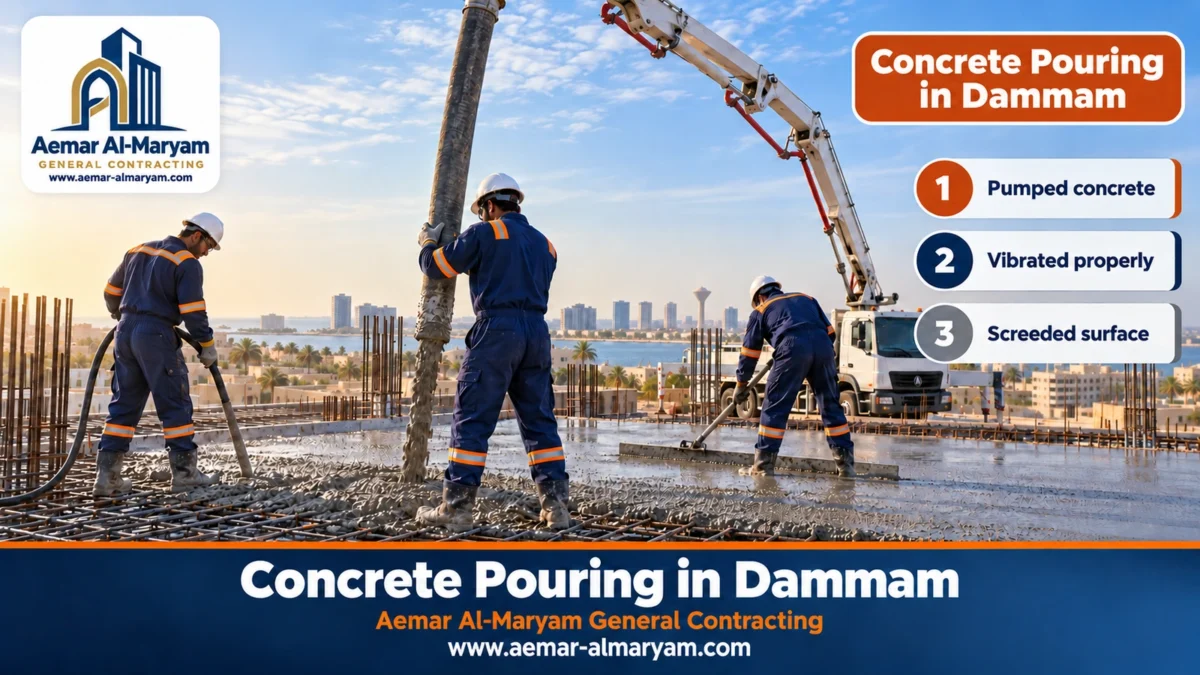
Aemar Al-Maryam General Contracting works as a concrete pouring contractor in Dammam: our crews set up the site, the formwork and the reinforcement, order ready-mix concrete from a licensed plant, then place, vibrate, level and water-cure it. We pour blinding layers, footings and ground beams, columns, roof slabs, yard and warehouse floors, and roof slope screeds. Labour and materials are priced separately and openly: blinding labour starts from SAR 14 per square metre, a 10 cm mesh-reinforced yard slab including materials from SAR 46 per square metre, a power-trowelled floor including materials from SAR 46, and a foam-concrete slope screed from SAR 17. Roof slabs, footings and columns are priced from the drawings after an inspection. Ready-mix, the pump and cube testing are charged at the plant’s, the hire company’s and the laboratory’s own price on the day, with nothing added. Every price here is provisional, firmed up after a site visit. Call or WhatsApp 0547879578.
Homeowners hiring a pouring crew in Dammam tend to ask three things: do you handle my element, what will it cost, and how will I know the concrete was placed properly? Below, each type of pour gets its own section, followed by the Saudi code’s hot-weather limits, curing, striking times, slump and cube tests, and a price table with a worked example.
Quick answers: pouring concrete in Dammam
- What we pour: blinding, isolated and strip footings, column necks, ground beams, columns, solid and hollow-block (hordi) roof slabs, annex and rooftop-room slabs, stairs, yard and parking slabs, power-trowelled warehouse floors, roof slope screeds, and stamped concrete for paths.
- Prices start from: SAR 14/m² blinding labour; SAR 46/m² for a 10 cm mesh-reinforced yard slab including materials; SAR 46/m² for a power-trowelled floor including materials; SAR 17/m² for a foam-concrete slope screed; SAR 23/m² for a cement-mortar screed; SAR 110/m² for stamped concrete. Slabs, footings, columns and stairs are priced after inspection.
- Materials at cost: ready-mix, pump and lab fees are billed at the supplier’s price on the day, and you see the invoice.
- Dammam heat: summer pours at dawn or at night, concrete no hotter than 35 °C at placing, and no water added on site.
- Curing: spraying or wet hessian for at least 7 days.
- Testing: a slump test on the trucks and cube samples crushed by a laboratory at 7 and 28 days.
- Coverage: all Dammam districts; beyond the city we pour in Khobar, Saihat, Dhahran, Jubail, Qatif, Al-Ahsa and further afield in the province.
- To book: phone or WhatsApp 0547879578 with the drawings or dimensions and photos of the site entrance.
Concrete pouring in Dammam: what exactly do we do?
We cast plain and reinforced concrete in place for every structural element of a building and for outdoor slabs, from the first blinding layer under the footings to the slope screed on the roof. The work normally covers formwork (shuttering), steel fixing, coordinating the pump and the trucks, placing, vibrating, levelling and curing, or whichever part of that list your project needs.
You might already have a main contractor for the whole frame and need only a pouring crew to take over finished shuttering. You might be adding a small annex on the roof and want one team to handle the whole slab. Or you might have a dirt yard that you want turned into a clean concrete base before tiles or interlock go down. Each of those jobs has a different scope and a different price, so our first question is always which element you need and what state it is in today; then we agree what we supply, what the plant supplies and what others handle.
■ Foundations
Blinding; isolated, combined and strip footings; column necks; ground beams; and waterproofing of buried concrete before backfilling.
■ Frame
Columns, beams, solid and hordi slabs, concrete stairs, and slabs for annexes, rooftop rooms and majlis extensions.
■ Floors
House yards and parking areas, power-trowelled warehouse and workshop floors, stamped-concrete paths.
■ On the roof
Slope screeds in lightweight foam concrete or cement mortar, ready for waterproofing.
■ Supply and coordination
Ordering ready-mix in the right grade, booking the pump, scheduling the trucks, taking samples.
■ After the pour
Water curing, striking formwork on time, cleaning the site and following up the lab results.
If your project is a complete house from excavation to handover, that falls under our construction service. This guide concentrates on the pour itself: how each element is done and what you should be watching. A short overview of the service is on the concrete pouring service page.
Concrete contractor in Dammam: cast-in-place, not precast barriers
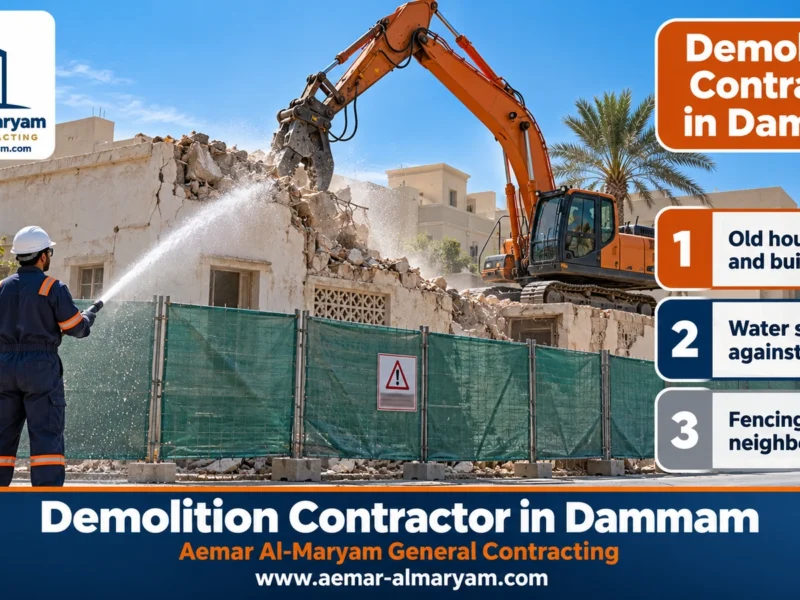
A concrete contractor in Dammam, in our sense, is someone who casts fresh concrete in its final position inside formwork: a roof slab, a blinding layer, a yard. That is our work. In the Eastern Province, though, the Arabic word for “pours” is also used for precast concrete road barriers, the heavy blocks placed along roads and around sites. Those are factory products moved by crane, and we neither supply nor rent them.
Concrete company or concrete contractor in Dammam?
A concrete company and a concrete contractor in Dammam usually mean the same trade; the real difference between two offers is the written scope, not the name. Does the price include shuttering and steel? Who orders the concrete and who pays the plant? Who books the pump? Who sprays the slab afterwards, and for how many days? When you compare quotations, get an answer to each of those questions item by item, because a cheap offer that leaves out curing or striking can end up costing more.
Ready-mix concrete in Dammam: ordered from licensed plants, placed by us
Ready-mix concrete in Dammam is concrete batched at a plant to a designed mix and delivered in revolving mixer trucks; it is what we use for every structural pour. We are not a plant. We are the contractor who works out the quantity and the grade, orders it from a licensed plant near your site, receives it, rejects anything that does not match the order, and places it.
Many people who search for ready-mix discover that buying from the plant is only half of the job. The truck arrives and someone has to discharge it, the pump needs an operator and a hose crew, the concrete needs vibrators, labour, a screed and finishing, and then a week of water. That is why we suggest ordering and pouring through one party who is answerable for the result. Licensed plants operate in Dammam, Qatif and Saihat, Jubail and Al-Ahsa, so we order from the closest one to keep haul time short, which matters a great deal in summer.
How we order ready-mix for your site in Dammam
We order ready-mix in Dammam once the volume is worked out from the drawings or a site measurement, with the grade and cement type taken from the structural engineer’s specification. We then agree with the plant on the time of the first truck, the interval between trucks and the type of pump.
- ✓Volume: the element’s volume from the drawings plus a small waste allowance; the last load is ordered after measuring what is actually left.
- ✓Grade: 250, 300, 350 or higher, using the plants’ usual naming, as shown on the drawings.
- ✓Cement: ordinary, sulphate-resisting or blended, according to the soil report and the designer’s instructions.
- ✓Admixtures: a retarder in summer and a plasticiser where needed, added by the plant, never by a labourer on site.
- ✓Timing: dawn or night in the hot months, with enough lighting confirmed for the site.
- ✓Acceptance: we read every delivery ticket (grade, batching time, volume) and run a slump test before discharge.
Ready-mix price per cubic metre in Dammam
The ready-mix price per cubic metre in Dammam is set by the plant on the day of the order; no official body publishes a Dammam-specific figure. The general reference available is the national average published by the General Authority for Statistics, which most recently stood at about SAR 194.53 per cubic metre for ordinary grade 250, SAR 214.10 for ordinary grade 350, SAR 202.67 for sulphate-resisting grade 250 and SAR 223.67 for sulphate-resisting grade 350.
Those are average material prices only. In practice the distance from the plant, the pump, chemical admixtures and sometimes small-load or night-pour charges are added. That is why our table has no “from” figure for ready-mix: we order it at the plant’s price on the day and put the invoice in front of you, and our labour is a separate, known line.
| Grade (plant naming) | Published national average (SAR/m³) | Typical use |
|---|---|---|
| Ordinary 250 | 194.53 | Blinding and some non-structural slabs, as drawn |
| Sulphate-resisting 250 | 202.67 | Blinding or elements in contact with sulphate-bearing soil, per the report |
| Ordinary 350 | 214.10 | Slabs, columns and beams above ground on many drawings |
| Sulphate-resisting 350 | 223.67 | Footings, necks and ground beams in aggressive soil, per the soil report |
How we handle the cost of concrete
We obtain the plant’s quotation before the pour and tell you the price and volume. The invoice is in your name, or charged to you at face value. Our labour is written as a separate line, so you know exactly what went on material and what went on work.
Blinding concrete in Dammam: the first layer under footings and floors
Blinding concrete in Dammam is a thin layer of plain concrete, usually 5 to 10 cm thick, placed on compacted soil to give a clean, level surface for setting out the footing reinforcement and formwork. It keeps steel out of the dirt and stops dry ground from drawing water out of the structural concrete above. Our blinding labour starts from SAR 14 per square metre (spreading and levelling, with the concrete at plant price), an estimate until inspection.
Blinding carries no structural load, but it is not a detail you can skip. Without it, the reinforcement sits on soil that may be damp or salty, the correct gap between the bars and the underside of the footing gets lost, and thirsty ground sucks water out of the bottom of the footing and weakens it. In Dammam, where groundwater is shallow in many districts, this layer is the minimum separation between structural concrete and the soil.
Blinding under footings and ground beams in Dammam
Under footings, we pour blinding once the pit is excavated to level, its base compacted and dampened. The blinding extends beyond the footing on every side by enough to fix the formwork. It is then left to firm up, and the footing positions are marked on it with string lines and pins. The usual mix is ordinary grade 250, or sulphate-resisting where the designer asks for it because of the soil.
Yard “blinding” in Dammam
What many people in Dammam call yard blinding is the concrete base laid across a courtyard before tiles, marble or interlock. Strictly speaking it is a mesh-reinforced ground slab rather than blinding in the structural sense. It is normally around 10 cm thick, laid on a polythene sheet over soil treated against termites, with the mesh lifted on chairs so that it sits inside the concrete rather than underneath it. Details and prices are in the yard-slab section below.
Before any slab on the ground
Run drainage, water and electrical conduits under the floor first, test them, and photograph their routes before they disappear under the concrete. If you later need a hole through a finished floor, the clean answer is core drilling in Dammam, not breaking.
Footings and ground beams in Dammam: the foundation you only pour once
Pouring footings and ground beams in Dammam means building the foundations of the house: reinforced concrete footings under the columns, necks rising from them to ground level, and ground beams that tie the footings together and carry the ground-floor walls. We build them to the approved structural drawings and the soil report, and price them after inspection from the quantities, because no two sets of drawings are the same.
Footings come in several types: isolated pads under single columns, combined footings under two close columns, strip footings under a wall or a row of columns, and, on weak ground, a full raft chosen by the designer. We never change the type, size or reinforcement of a footing from what is drawn; anything we notice on site goes back to the engineering office before the pour.
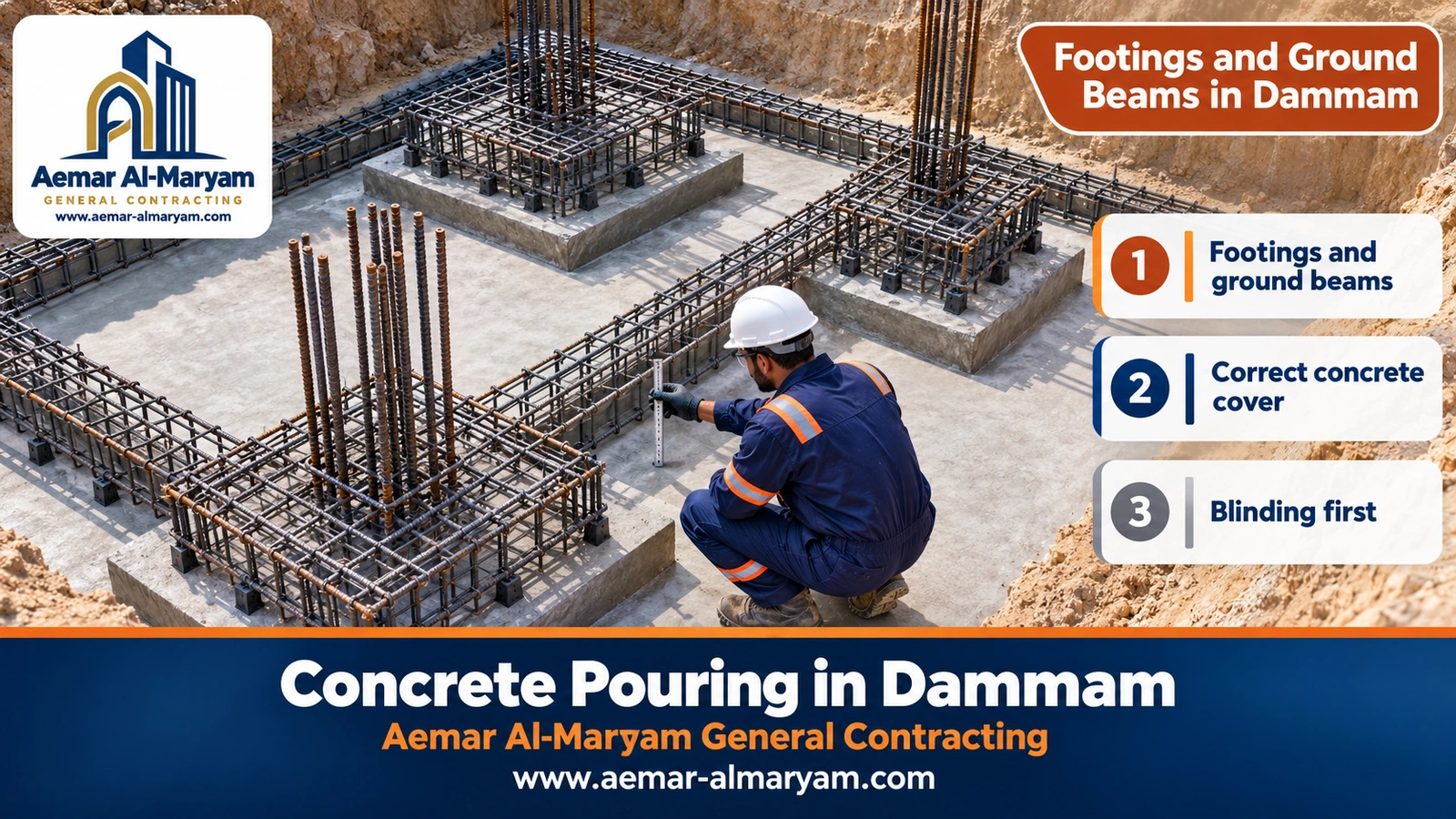
Our sequence for foundations is: excavate to level and compact the base, blinding, fix the footing steel on chairs at the correct cover, set the column starter bars precisely on their grid lines, shutter the footing sides, then pour. After that come the necks, then the ground beams with their formwork and reinforcement, then waterproofing and backfill. Between stages the supervising engineer inspects the steel before concrete goes in.
Most foundation problems are not caused by the concrete but by what surrounds it: starter bars off their grid that are only noticed after the pour, steel lying on the soil with no cover at all, or a ground beam cast in stages with the construction joint never cleaned. These are hard faults to put right once the concrete has hardened, so a final walk-round is scheduled before the pump turns up.
Excavation, backfill and protecting buried concrete in Dammam
Waterproofing the footings, necks and ground beams before backfilling is an essential step in Dammam, because buried concrete sits against damp, salt-bearing soil. After stripping the foundation formwork we clean the surfaces and apply a bituminous coating, or whatever system the designer specifies, to every face that will touch the ground. We then backfill in layers, wetting and compacting each one, and never backfill with debris or soil containing organic matter. The waterproofing systems are explained in foundation and roof waterproofing in Dammam, and waterproofing before backfill is priced after inspection.
Pouring columns in Dammam: plumb first, then vibration
Pouring columns in Dammam means filling a narrow, steel-packed vertical form, so the mix needs suitable workability and thorough vibration to avoid honeycombing at the base. Before the pour we check that each column form is plumb in both directions and braced, and that its foot is clear of sawdust and offcuts of tie wire.
We fill the column in lifts of not much more than half a metre at a time, insert the vibrator into each lift until it overlaps the one below, and tap the sides of timber forms gently to release trapped air near the face. If the drop height is large, we use a hose or a tremie so that the stone does not separate from the mortar on the way down.
Column side forms usually come off after about a day, but the column is not loaded until it has gained enough strength. Any column that shows honeycombing when stripped goes to the engineer before it is repaired; it is never simply plastered over. Existing columns damaged by rusting steel and spalling are a different job, which we handle under structural renovation in Dammam.
Roof slab pouring in Dammam: from shuttering to curing water
Pouring a roof slab in Dammam is the biggest single step of any floor. The timber or steel shuttering goes up on its props, the beam and slab reinforcement is fixed, electrical conduits and plumbing are run, and then slab and beams are usually cast in one day with a pump. Our labour for a roof slab (shuttering, steel fixing, pouring and curing) is priced after inspection from the drawings and quantities, with the concrete at plant price.
The day of the pour is the result of days of preparation. Nothing is poured before the engineer signs off the steel, the shuttering is at the right level and flat, its gaps are sealed so mortar cannot leak, and every conduit and electrical box is where it should be. During the pour one team is on the vibrators, another on the screed and finishing, and one person watches the shuttering from below for any prop that leans or board that bows.
Hordi or solid slab in Dammam?
A hordi slab in Dammam is a ribbed slab with lightweight hollow blocks between concrete ribs; it is lighter, uses less concrete per square metre than a solid slab and suits medium spans. A solid slab is concrete through its full depth: simpler to build and easier to open up later, but heavier and more concrete-hungry. The choice belongs to the structural designer, not the contractor, and we build whichever is drawn.
| Item | Solid slab | Hordi slab |
|---|---|---|
| Make-up | Full-depth concrete slab | Concrete ribs with hollow blocks between, and a concrete topping |
| Concrete per m² | More | Less |
| Load on the columns | Heavier | Lighter |
| Openings later | Relatively easy by sawing or coring | The ribs must be located first |
| Heat insulation | Depends on the roof insulation | Hollow blocks add a little |
Annex slab in Dammam and the cost of pouring a room roof
Pouring an annex or rooftop-room slab in Dammam follows the same steps on a small scale: shuttering for one or two rooms, slab and beam steel, a small or medium pump, and roughly half a day of pouring. The cost of a room roof has three parts: the concrete at plant price, the steel at market price, and our labour for shuttering, steel fixing and pouring, which we set once we have seen the drawings, the room’s position and the floor level.
To give a sense of scale, a 5 × 6 m room with a 15 cm solid slab needs about 4.5 m³ of concrete for the slab alone, about SAR 963 at the national average for ordinary grade 350, before beam concrete, waste and the pump. When the slab belongs to a complete annex (walls, roof and finishes), see the all-in floor-area rate on the Dammam annex and majlis page, where the room is costed as a single project.
An extra slab needs a permit and an engineer
Casting a new room roof on an existing building adds load to old columns and footings and is treated as an addition to the building. We do not pour an additional slab or column without a permit and drawings from an engineering office that has checked the building can carry it.
Pouring stairs with the slab in Dammam
A concrete staircase in Dammam is usually cast with the slab it serves or right after it, on its own sloping shuttering with timber risers and reinforcement tied into the slab and beam steel. What matters most is fixing the riser height and tread depth before the pour, because a step that differs from the rest is felt underfoot before it is seen, and tiles cannot hide it. Staircase labour is priced after inspection.
Formwork, rebar and concrete cover in Dammam
Formwork and steel fixing in Dammam are what give concrete its shape and its strength: the form sets the dimensions and flatness, the bars carry the tension.
In formwork we look at three things: that it is strong enough for the weight and pressure of wet concrete, the workers and the pump hose; that its joints are tight so mortar does not leak and leave bare stone; and that props stand on firm ground at regular spacing. In steel fixing we look at bar sizes, lengths, laps and links as drawn, at cleaning off flaking rust and oil, and at tying everything firmly so nothing shifts while concrete is placed and walked on.
Concrete cover and spacers in Dammam
Concrete cover is the thickness of concrete between the reinforcement and the surface of the element, and it is the first protection the steel has against moisture and salt. The Saudi concrete code is based on the American ACI 318 with local modifications, and its usual minimum cover values are below; designers increase them in aggressive environments.
| Element and exposure | Usual minimum cover |
|---|---|
| Cast against and permanently in contact with the ground (underside of footings) | 75 mm |
| Exposed to ground or weather, bars 19 mm and larger | 50 mm |
| Exposed to ground or weather, bars 16 mm and smaller | 40 mm |
| Interior slabs and walls, not exposed | 20 mm |
| Interior beams and columns, not exposed | 40 mm |
Cover is not achieved by good intentions. It comes from spacers (concrete or plastic blocks and chairs of a set size) tied to the steel at regular spacing before the pour, so that bars cannot sag onto the form or rest on the soil. We check cover with a rule at random points before the pour, especially in footings and under beams.
Yard and warehouse floor slabs in Dammam
Pouring a yard slab in Dammam turns a dirt courtyard into a mesh-reinforced concrete slab, about 10 cm thick for houses, with gentle falls to the drains, ready to be used as it is or tiled later. A 10 cm yard slab with 8 mm mesh, including materials (compaction, termite treatment, polythene, mesh and pumped concrete), starts from SAR 46 per square metre, an estimate until inspection. Very small yards (under about 50 m²) cost more per metre, because the pump and set-up costs stay the same.
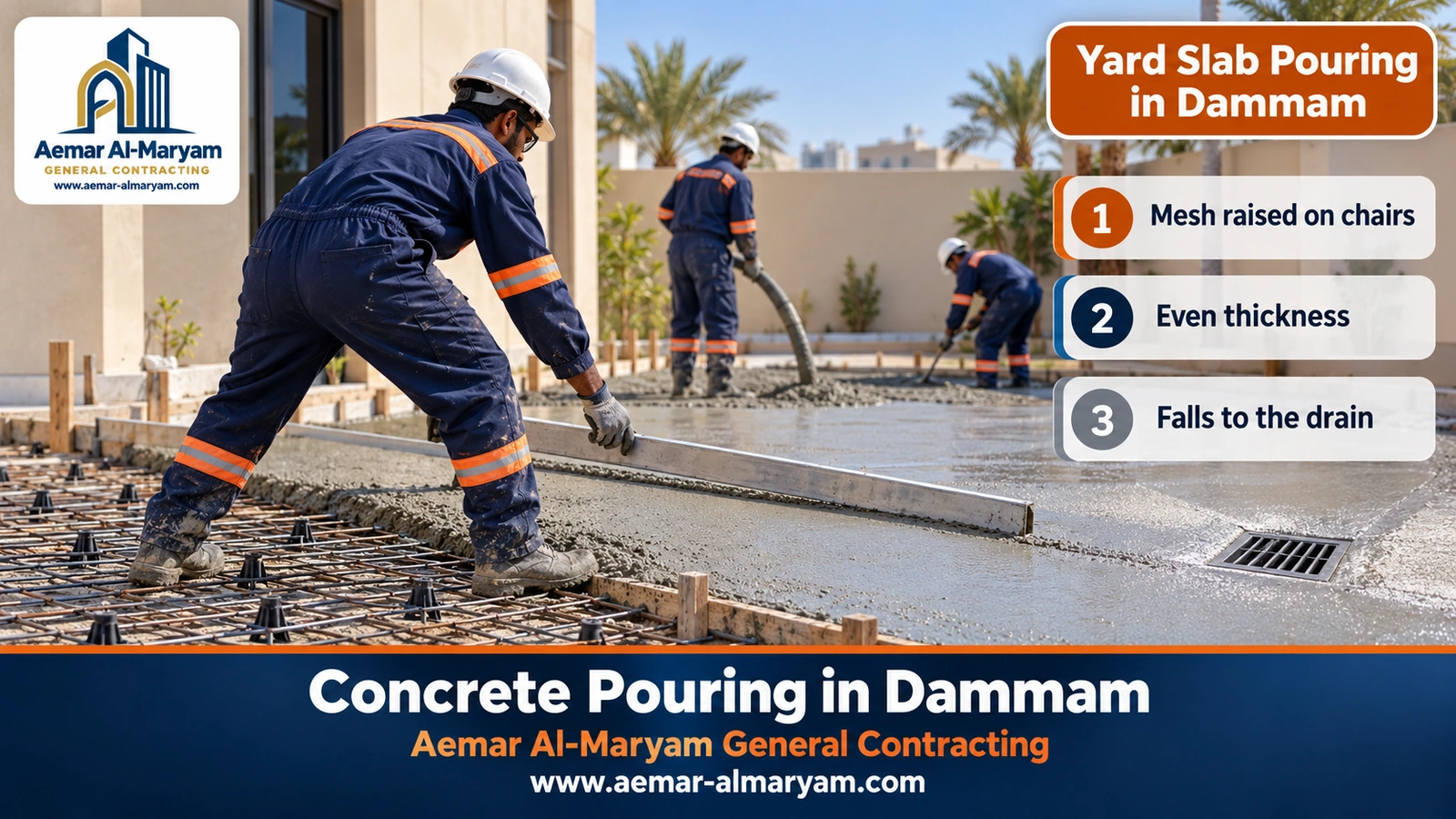
Our steps for a yard: strip the weak topsoil, level, wet and compact the ground, spray termite treatment at roughly 1 kg per square metre following the product instructions, lay heavy polythene with overlaps, set the mesh on chairs, fix edge forms at the agreed levels, then pour, screed and water-cure. Movement joints are laid out on site according to the area and shape of the yard, so that any cracking runs along a planned straight line rather than wandering across the slab.
Falls in a yard matter more than most people think. A yard without enough fall holds wash water and rain against the house wall, damp creeps up the base of the wall and salts start to bloom on the plaster. So we agree on the direction of drainage before the forms go in, and set the levels with a laser or a water level.
If the yard has an old, broken slab, we take it out first through demolition in Dammam; if you only want part of it removed along a clean straight line, concrete cutting in Dammam is the precise way. And if you are weighing concrete against other surfaces for a yard or driveway, compare it with asphalt in Dammam and interlock paving and kerbs in Dammam.
| Yard surface | Where it suits | Note |
|---|---|---|
| Mesh-reinforced concrete | A base for tiles, or a hard-wearing surface for washing and small cars | Needs joints, falls and curing |
| Stamped concrete | Paths and outdoor seating with a decorative finish | Needs a protective sealer renewed periodically |
| Interlock | Parking and paths you may want to lift and relay later | Needs a compacted sub-base and kerbs |
| Asphalt | Wide entrances and parking areas | Sensitive to extreme heat and oil |
Power-trowelled (helicopter) floors in Dammam
A power-trowelled floor in Dammam is a concrete slab polished while still fresh by a machine with rotating blades (called a power trowel or helicopter), leaving a smooth, dense, abrasion-resistant surface for warehouses, workshops, covered parking and some yards. Standard floors start from SAR 46 per square metre including materials, with a minimum area of about 50 m²; heavy warehouse slabs with special thickness and reinforcement are priced after inspection.
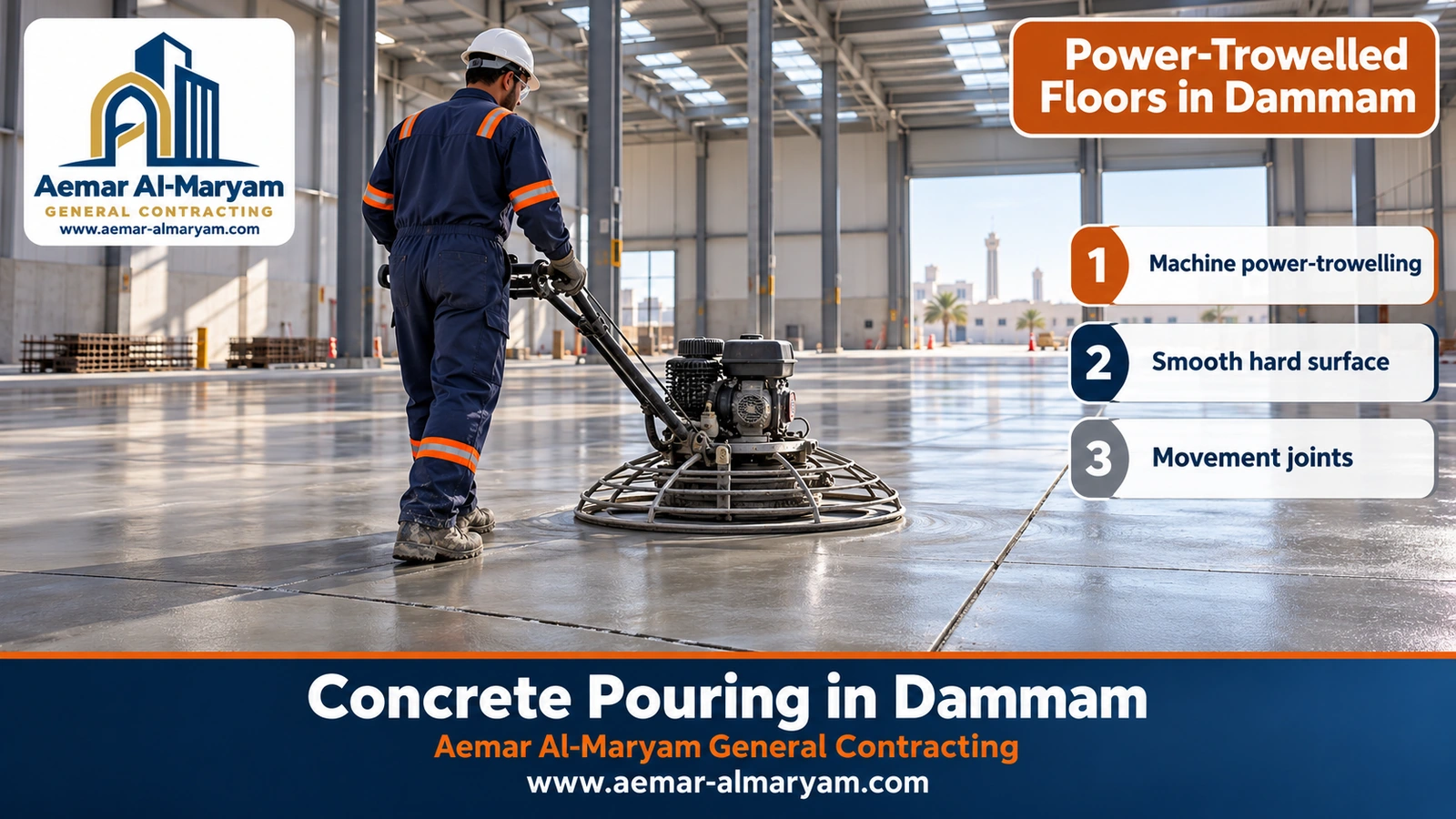
Timing is the secret of this floor. The machine cannot go on until the surface is firm enough to carry it without sinking, and trowelling cannot be left until the surface has dried hard. That window closes quickly in a Dammam summer, so we divide the pour into areas the crew can finish, and spray a curing compound or cover the surface immediately after trowelling. Control joints are then sawn at the right time so the floor does not crack at random.
Before pouring a warehouse floor we ask about loads. Will a forklift run on it? Are there tall racks with concentrated feet? Will lorries drive inside? The answers decide thickness, reinforcement and grade, and those are an engineer’s decisions; we do not rely on a “usual” thickness.
Stamped concrete in Dammam
Stamped concrete in Dammam is a concrete surface coloured and imprinted while fresh with mats that give it the look of stone, tiles or timber, then finished with a glossy protective sealer. Prices for paths and outdoor seating begin at SAR 110/m², confirmed after a site visit. It suits anyone who wants a continuous surface with few joints, but the sealer needs renewing every few years, and fine hairline cracks appear over time as in any concrete. If you want a surface that can be lifted and relaid during maintenance, interlock is the better fit.
Roof slope screed in Dammam: the layer that decides where water goes
A roof slope screed in Dammam is a layer placed over the roof slab to give a continuous fall to the drains, usually 1 to 2 %, so water never stands on the waterproofing. We lay it in lightweight foam concrete from SAR 17 per square metre or in cement mortar from SAR 23 per square metre, estimates until inspection.
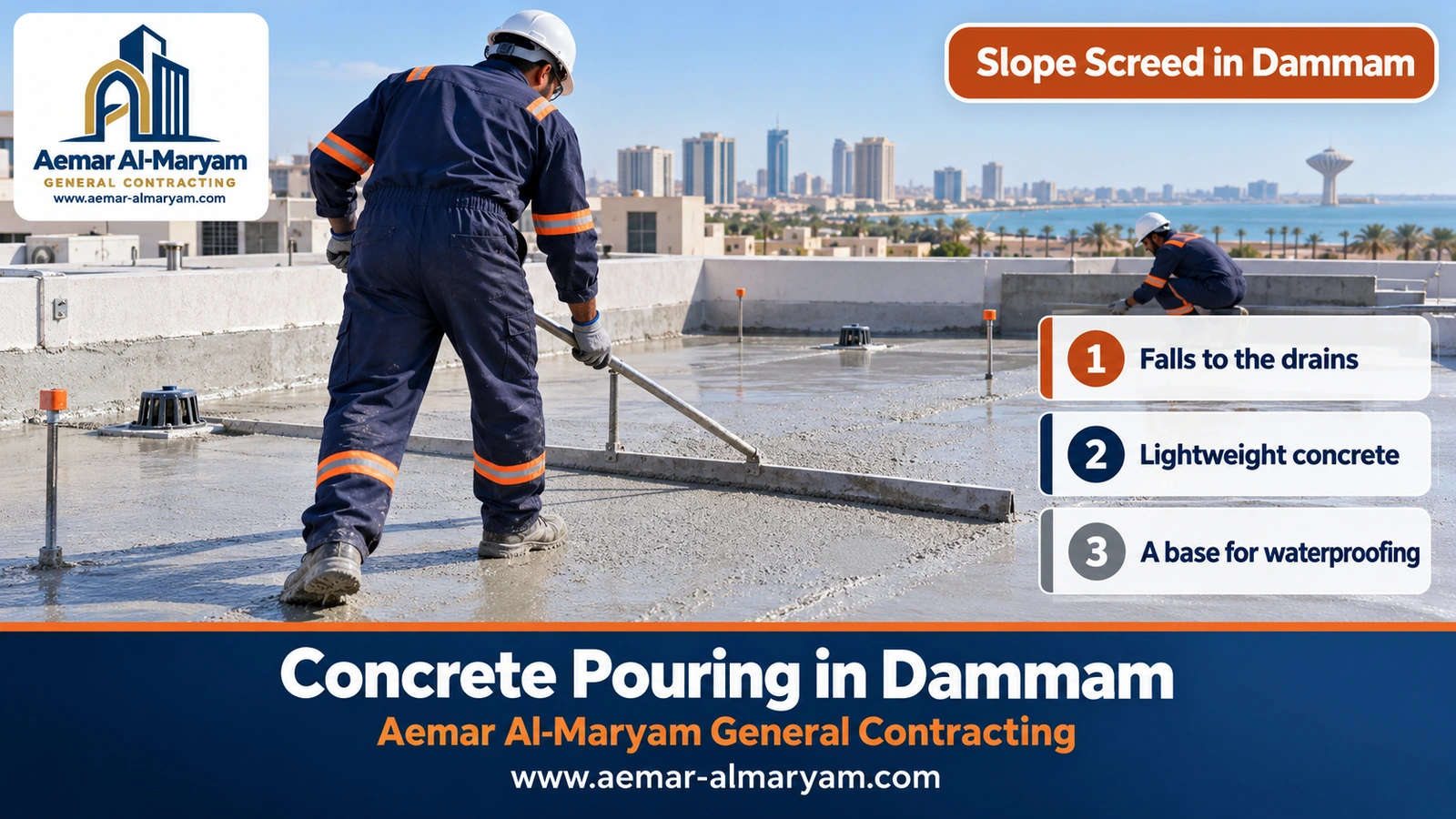
Foam concrete is light (roughly 300 to 600 kg/m³ depending on the mix), so it adds little load to the slab and fills varying depths easily. Cement mortar is heavier with a tougher surface and suits small areas or roofs that will carry foot traffic. We start by surveying the roof levels and locating the drains, fix level pegs, then pour and screed from the far edge down to each drain, and keep the layer damp while it hardens. It is not normally walked on for about two days.
A slope screed is not waterproofing
Falls carry water to the drain; they do not stop it soaking in. A complete waterproofing system, turned up the parapet walls and reinforced around drains, must go on top. See roof waterproofing in Dammam and choose the system before we pour the screed, because some systems need a particular finish on the screed surface.
Concrete pumps in Dammam: boom or line pump?
Concrete pumps in Dammam come in two main types: a truck-mounted boom pump that reaches over the roof and places concrete directly, and a stationary line pump that pushes concrete through pipes laid along the ground or up walls over long distances. We book the type that suits the slab height, its distance from the street and the space available to set up, and the hire is charged at actual cost according to type and hours.
| Type | When we choose it | What the site needs |
|---|---|---|
| Boom pump | Floor and annex slabs the boom can reach from the street, fast pours | Room to spread the outriggers, firm ground, no overhead cables |
| Line (stationary) pump | Tight sites or sites set back from the road, rear yards | A safe, secured pipe route and extra time to set up and wash out |
| No pump (truck chute) | Footings and ground slabs the truck can reach directly | An access route that can take a loaded truck |
Coordination saves real money here. A truck that waits on site because the pump is not set up, or because the shuttering has not been approved, may attract waiting charges, and concrete that sits in the drum loses workability. So we do not call the first truck until the pump is ready, the crew is in position and the steel is signed off.
Ready-mix grades and sulphate-resisting cement in Dammam
Ready-mix grades in Dammam are quoted with numbers such as 250 or 350, which in the plants’ usual naming refers roughly to compressive strength in kilograms per square centimetre; grade 350 is close to 34 MPa. The grade and cement type are set by the structural designer on the drawings, never chosen by the contractor or owner to save money.
“Resistant” concrete normally means a mix made with sulphate-resisting cement, used where soil or groundwater carries high sulphates. In the published national averages it costs about 4 to 5 % more than ordinary concrete of the same grade (SAR 223.67 against SAR 214.10 per cubic metre at grade 350). But resistant cement is not the answer to everything in Dammam, as the next section explains.
| What goes on the order | What it means | Who decides |
|---|---|---|
| Grade (250 / 300 / 350 / 400) | Required compressive strength at 28 days | The designer, on the drawings |
| Ordinary / resistant | Cement type according to sulphates in the soil | The designer, from the soil report |
| Additions (silica fume, slag) | Mixes with lower permeability to salts | The designer and the plant |
| Retarder | Keeps concrete workable for longer in the heat | The contractor with the plant, depending on the weather |
| Target slump | The consistency that suits the element and placing method | The designer and plant; we check it on site |
Concrete for Dammam’s saline ground
Concrete in Dammam’s ground needs its cement type, water content and cover chosen from the soil report, because groundwater is shallow in many districts, typically within 1.5 m of ground level, rises by capillary action about 75 cm, and carries chlorides that can range from 80 to 2,000 mg/L. Those salts attack the steel first and then the concrete itself, and damage to unprotected foundations can begin within 10 to 15 years.
In sabkha areas (the flat salt ground near the coast) the Saudi concrete code places concrete in a very severe exposure class, requires a water to cementitious-material ratio of no more than 0.35, and calls for exposed surfaces to be protected by tanking or an epoxy-based coating. Sabkha soils can hold five to six times the chlorides and sulphates of seawater.
The point many people miss: sulphate-resisting cement alone does not protect the steel from chlorides. Work published by a KFUPM team in Dhahran, testing concrete exposed to sabkha, showed that sulphate-resisting cement stood up to sulphate attack but its reinforcement corroded at rates close to ordinary cement, while blended mixes with slag or silica fume corroded far less (about 38 times less with 10 % silica fume in that study).
- ✓What the designer decides: cement type and additions, water ratio, grade and cover, after reading the soil report.
- ✓What we hold to on site: no extra water in the mix, correct cover with spacers, and thorough vibration that leaves no voids for salts to enter.
- ✓What we add before backfill: bituminous waterproofing, or the designer’s system, on all buried concrete.
- ✓What we avoid: pouring footings into water standing in the pit; we pump it out and protect the base first.
Concrete pouring steps in Dammam, from sign-off to curing
The steps of a concrete pour in Dammam are the same for every element; only the details change: shuttering and steel sign-off, site preparation, receiving and checking the concrete, placing in layers, vibration, levelling, then curing.
- 1Inspection and quantities
We read the drawings or measure, fix the volume, grade, pump type and truck route, and write down the scope and price. - 2Formwork and steel
Forms and props go up, steel is fixed on spacers, conduits are laid, and the supervising engineer approves before a pour date is set. - 3Booking the plant and pump
Dawn or night in summer, the truck interval, and the retarder needed. - 4Preparing pour day
Wetting timber forms and soil, lighting, spare vibrators, screeds and finishing tools, hessian, polythene and water ready for curing. - 5Acceptance on site
Read the delivery ticket, run the slump test, take cube samples, and reject any late load or one with water added. - 6Placing and vibration
Even layers, each vibrated until it knits into the one below, without dragging concrete sideways with the vibrator. - 7Levelling and finishing
Screed to level, then finish to suit the element (rough for roofs that will be waterproofed, smooth for floors). - 8Curing
Spraying or wet hessian from the first hours, kept up for at least 7 days. - 9Striking and follow-up
Side forms and then props come out on schedule, and the cube results come back from the lab.
Pre-pour checklist in Dammam
The pre-pour checklist is the last review we run in Dammam before calling the first truck, because whatever is forgotten now will have to be drilled or broken out later:
- ✓Steel: approved by the engineer, clean, tied, with spacers in place.
- ✓Shuttering: at the right level, gaps sealed, props firm on solid ground.
- ✓Conduits and sleeves: electrical and plumbing pipes and sleeves for AC and drain openings fixed in position, which spares you concrete cutting later.
- ✓Access: pump and truck positions marked, neighbours or the street informed if needed.
- ✓Equipment: at least two vibrators plus a spare, a generator or power supply, lighting for night pours.
- ✓Weather: wind and temperature checked, covers ready for rain or dust-laden wind.
- ✓Permit: structural work licensed and drawings approved.
Vibration and compaction in Dammam: not too little, not too much
Vibration in Dammam means inserting an electric poker vibrator into fresh concrete to drive out trapped air so it fills the form and wraps the steel. Concrete that is under-vibrated leaves voids and honeycombing that show up when the forms come off, the commonest defect in columns and beams.
We insert the vibrator vertically on a tight, regular grid, with points no further apart than one and a half times its radius of action, let it sink under its own weight about 15 cm into the previous layer, hold it for roughly 5 to 15 seconds, and withdraw it slowly so it leaves no hole. We never use it to push concrete sideways, because that separates stone from mortar. Over-vibration is a fault too, as it can bring water and paste to the surface and weaken it.
Hot-weather concreting in Dammam: what the code requires
Pouring in Dammam’s heat is governed by the hot-weather provisions of the Saudi concrete code: fresh concrete must be no hotter than 35 °C at placing, slump must be at least 75 mm at placing, a truck may be discharged within two hours provided a retarder is used, no water may be added to restore workability, and the concrete must be cured for at least 7 days.
The average daily maximum in Dammam is about 43.8 °C in June, 45.2 °C in July and 44.8 °C in August, with low relative humidity on many summer days. Water therefore evaporates from fresh concrete very quickly. Once evaporation passes about 1 kg per square metre per hour, plastic shrinkage cracking becomes a strong possibility, and protective measures are advised from about 0.5 kg.
| Requirement or measure | Value or practice |
|---|---|
| Concrete temperature at placing | No more than 35 °C |
| Slump at placing in hot weather | At least 75 mm |
| Discharge time | Within two hours with a retarder |
| Adding water on site | Not allowed |
| Curing period | At least 7 days; if moist curing stops after 3 days, covers or a curing compound |
| Pour time | Dawn or night in the summer months |
In practice we pour at dawn or at night, ask the plant for temperature-controlled concrete with a retarder, wet the forms and ground beforehand so they do not drink the mix water, shield large surfaces from wind where possible, and start curing as early as the surface allows. We turn away any truck later than agreed, and no one on our crew adds water to “loosen” the mix; that water lowers strength and increases shrinkage.
Curing concrete with water in Dammam: at least 7 days
Curing concrete with water in Dammam means keeping its surface moist for at least 7 days after the pour, by spraying, ponding or covering with wet hessian or polythene, so the cement keeps reacting with water and the concrete develops its strength. Where continuous wetting is not possible we use a white curing compound sprayed on the surface, which seals water in and reflects part of the sun’s heat.
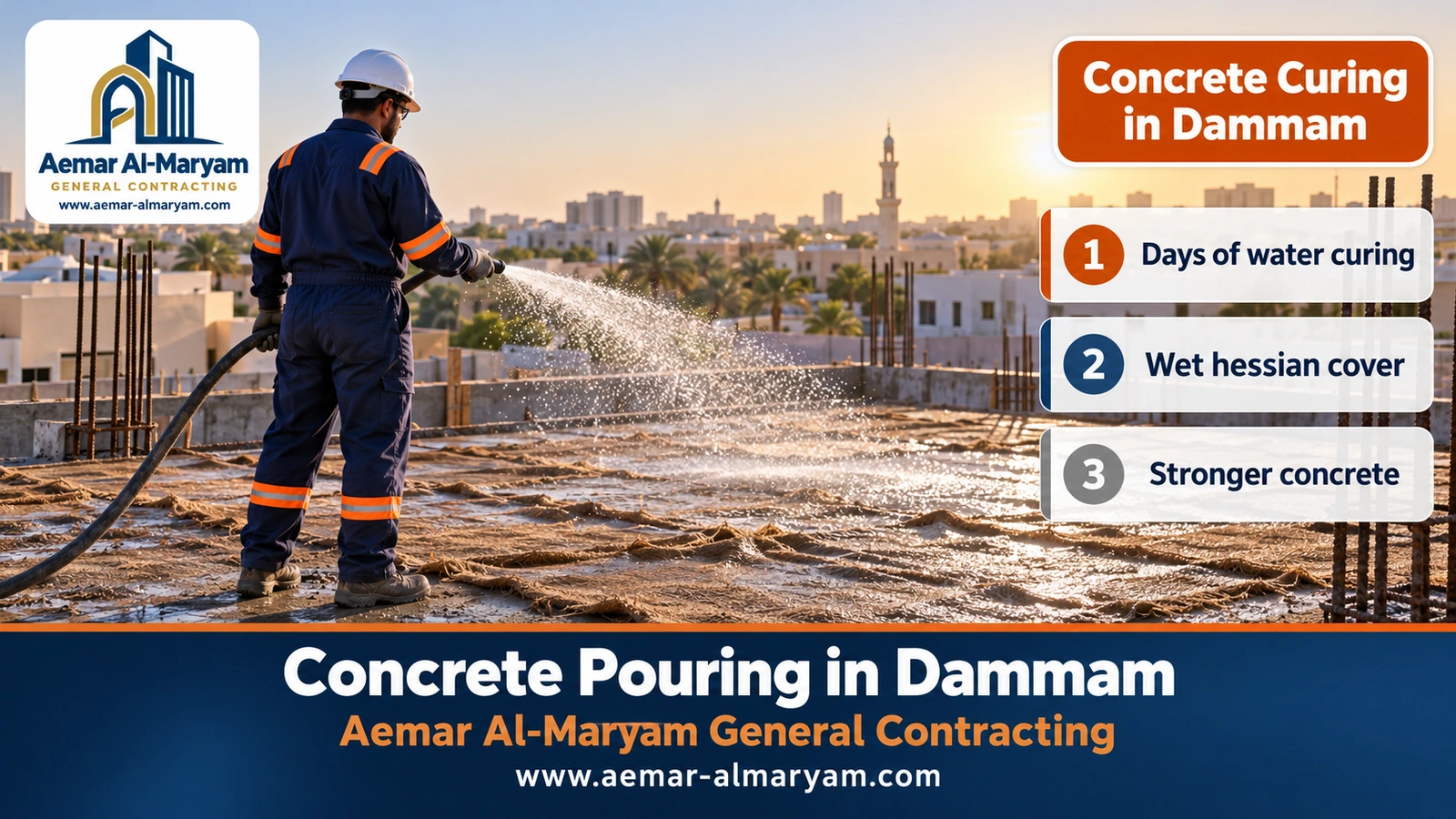
We start curing as soon as the surface resists marring, which in a Dammam summer is a few hours after the pour; before that we protect the surface from rapid drying by covering it. The water should be clean and as close as practical to the temperature of the concrete, because very cold water on a hot slab can cause thermal shock.
- ✓Spraying: several times a day, more often around midday, never letting the surface dry out between rounds.
- ✓Wet hessian: holds moisture longer, re-wetted whenever it starts to dry.
- ✓Polythene: traps moisture, with its edges weighted so the wind cannot lift it.
- ✓Curing compound: practical for large areas or where spraying is not possible, but it must suit whatever goes on top, such as waterproofing or tiles.
- ✓Blinding and yards: need curing too; one or two sprays are not enough.
The owner is often the first to notice poor curing, because he sees the site over the following days. A white, dry slab at midday a day or two after the pour is not normal, and many of the fine cracks that appear later in roofs and floors go back to those days. For existing cracks, see crack repair in Dammam.
When to strip formwork in Dammam
Formwork in Dammam is struck in two stages: the sides of columns, beams and walls after about a day (12 to 24 hours in most guides), and slab props after at least 7 days for short spans, rising to 14 to 21 days under long beams, as directed by the supervising engineer. Heat speeds up strength gain somewhat, but loads on the slab (stacked materials, casting the next floor) may call for props to stay longer.
| Part | Common guide period |
|---|---|
| Sides of columns, walls and beams | About 12 to 24 hours |
| Slab props, span under 6 m | About 7 days |
| Slab props, span over 6 m | About 10 to 14 days |
| Beam props, span under 6 m | About 14 days |
| Beam props, span over 6 m | About 21 days |
These are guide values from published manuals, and the decision rests with the engineer based on cube results and loads. The usual mistake is pulling props early to reuse the timber on another site, or loading the slab with blocks and sand too soon, which shows up as a sag or cracking at mid-span. We never remove all props at once; they come out in the order the engineer sets, and re-propping under large spans may be required.
Slump and cube tests in Dammam
A slump test in Dammam is a quick site check of the concrete’s consistency before a truck is discharged, and a cube test measures its strength once hardened: samples are taken during the pour in cube moulds and sent to a laboratory that crushes them at 7 and 28 days. Lab fees are charged at the laboratory’s own cost.
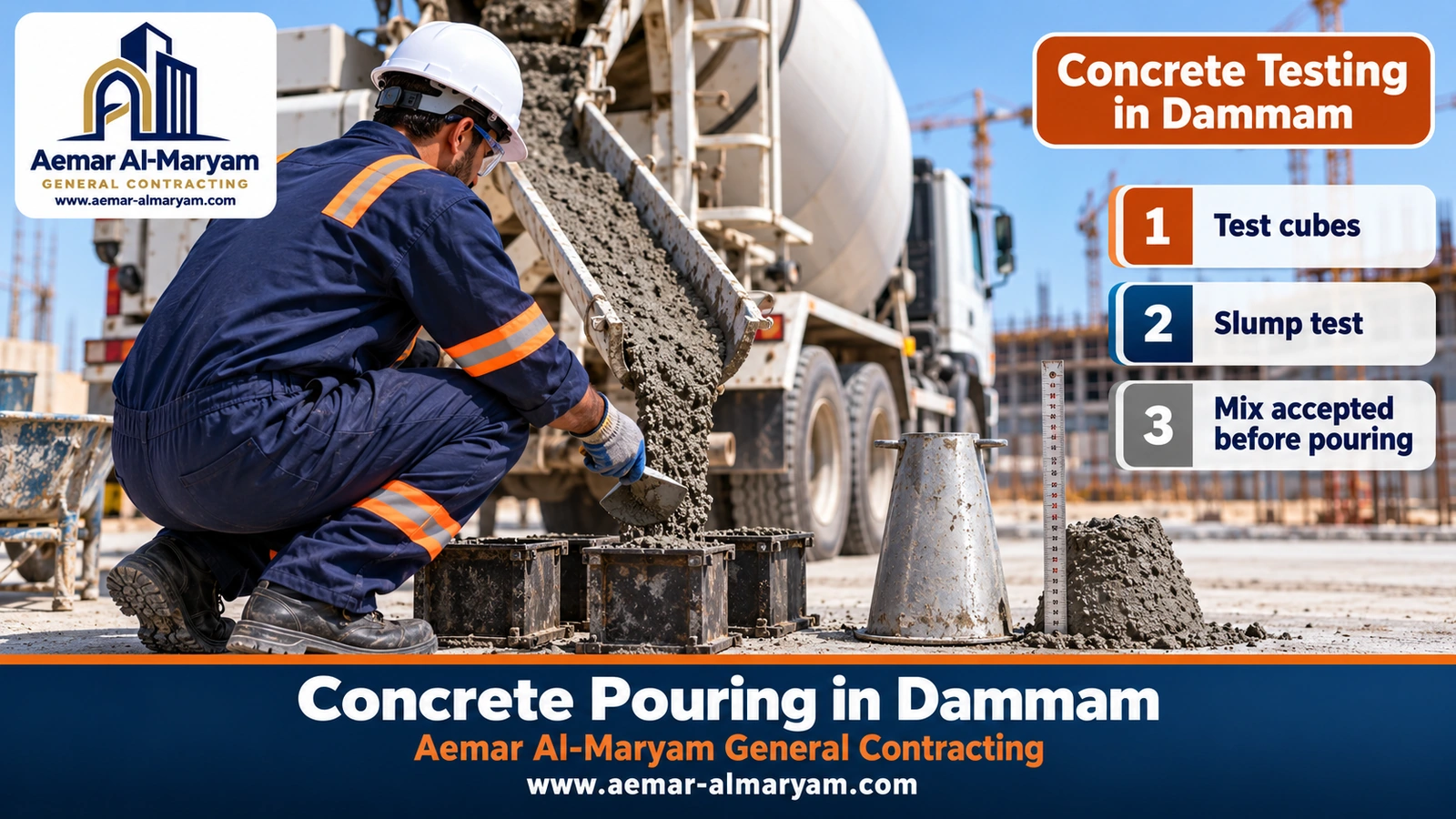
In the slump test a metal cone is filled with concrete in layers, then lifted, and the drop of the concrete is measured. A very low slump means concrete that is hard to place and vibrate; a very high one may mean too much water. Common guide values are about 25 to 75 mm for footings and slabs and 25 to 100 mm for beams, columns and walls, with a minimum of 75 mm at placing in hot weather; pumped mixes or mixes with plasticisers are designed by the plant for higher values.
Cubes are taken, under the code, at least once for each day of pouring, for each roughly 115 m³ of concrete, and for each roughly 465 m² of slab or wall surface. Concrete is accepted when every average of three consecutive tests equals or exceeds the specified strength and no single result falls below it by more than about 3.5 MPa for normal grades. The 28-day result is the reference; the 7-day result is an early warning.
Why we insist on samples even on small pours
Because the cube is the only evidence after the pour that what reached your site is the grade you paid for. If a result comes back low, the engineer decides the next step, and samples logged against the plant and the truck protect your position.
Concrete pouring prices in Dammam: “from” price table
Concrete pouring prices in Dammam are quoted by us with labour and materials kept apart: some items are all-in per square metre, some are labour only, and structural elements are priced from the drawings. Treat the figures below as provisional until our visit; ready-mix, pump and lab fees go through at the supplier’s own rate on the day.
| Item | Unit | Price from | Note |
|---|---|---|---|
| Blinding labour (spreading and levelling) | m² | SAR 14 | Concrete at plant price |
| 10 cm yard slab with 8 mm mesh, materials included | m² | SAR 46 | Very small yards cost more per m² |
| Power-trowelled concrete floor, materials included | m² | SAR 46 | Minimum about 50 m² |
| Foam-concrete roof slope screed | m² | SAR 17 | Waterproofing on top is a separate item |
| Cement-mortar slope screed | m² | SAR 23 | Heavier, tougher surface |
| Stamped concrete for yards and paths | m² | SAR 110 | Includes the sealer |
| Roof slab labour (shuttering, steel, pouring, curing) | m² | After inspection | From drawings and quantities |
| Footings, ground beams and columns labour | m³ / element | After inspection | From drawings |
| Concrete stairs | — | After inspection | Riser and tread set out first |
| Heavy warehouse floor with special thickness and reinforcement | — | After inspection | Depends on loads |
| Bituminous waterproofing of buried concrete before backfill | — | After inspection | All faces touching soil |
| Ready-mix supply | m³ | Plant price on the day | National reference about 214 for ordinary 350 |
| Concrete pump | pour / hour | At cost by type | Boom or line |
| Cube testing | set | At laboratory cost | Crushed at 7 and 28 days |
For items priced after inspection, send the drawings or dimensions and site photos on WhatsApp 0547879578 for an estimate, which we confirm after the visit. Rates for our other trades sit together on the price guide page.
How to calculate the concrete you need in Dammam
The concrete volume for a pour in Dammam is area multiplied by thickness: a square metre at 10 cm needs 0.1 m³, and at 15 cm needs 0.15 m³. A 100 m² solid roof slab 15 cm thick therefore needs 15 m³ for the slab alone, plus the downstand beam concrete from the drawings and around 3 to 5 % for waste. A hordi slab needs less per square metre because of the blocks, and the designer calculates it from the drawings.
As a rule of thumb, each cubic metre covers 10 m² at 10 cm thick or 20 m² at 5 cm. A cubic metre of plain concrete weighs about 2,200 to 2,400 kg and reinforced concrete about 2,400 to 2,500 kg, a figure that matters when you check the load of a new annex slab on an existing building.
Worked example: an 8 × 15 m yard slab in Dammam
An illustrative example for a yard in Dammam measuring 8 × 15 m, mesh-reinforced with 8 mm mesh, 10 cm thick, materials included:
| Item | Calculation | Result |
|---|---|---|
| Area | 8 × 15 | 120 m² |
| Estimated “from” price | 120 × SAR 46 | SAR 5,520 |
| Concrete volume | 120 × 0.10 | 12 m³ |
| Volume with about 5 % waste | 12 × 1.05 | about 12.6 m³ |
| Concrete share at the national average (ordinary 350) | 12.6 × 214.10 | about SAR 2,698 |
The example shows that concrete alone is close to half the all-in price of a floor slab; the rest is compaction, levelling, termite treatment, polythene, mesh, the pump, labour and curing. It is for illustration only; the real price is fixed after inspection, depending on the existing ground level, pump access and whether an old slab has to come out first.
What pushes up the cost of a pour in Dammam?
- ✓Access: a site the pump can reach only through long pipelines, or a narrow street with no room for trucks.
- ✓Height: a slab on an upper floor that needs a longer boom.
- ✓Small volumes: pump and set-up costs are fixed, so they spread over fewer metres.
- ✓Timing: night pours or specific days can raise plant or pump charges.
- ✓Specification: a higher grade, sulphate-resisting cement, admixtures, or more thickness and steel.
- ✓Existing conditions: an old slab to break out and remove, or ground that needs replacing and extra compaction.
- ✓Finish: power trowelling, stamping or special curing compounds.
Does a concrete pour in Dammam need a Balady permit?
Structural pours need a permit: a new building needs a building permit with approved drawings, and adding a slab, a room or columns to an existing building goes through the “add or modify building components” service on the Balady platform via a contracted engineering office. Pouring a yard slab within your own plot as maintenance generally does not need a permit, but it is best to confirm on Balady for your property.
We carry out structural pours to the approved drawings and the supervising engineering office’s instructions, and we do not cast an additional slab or column without a permit. Inside Jubail Industrial City or Ras Al-Khair, the Royal Commission, not the municipality, issues approvals. Annex and rooftop-room rules are covered on our annex building page.
Common concrete pouring mistakes in Dammam
Most pouring mistakes in Dammam repeat for the same reasons: haste, saving money in the wrong place, or pouring at the wrong hour. Here are the faults that keep turning up on sites we are later asked to repair:
- ✓Adding water on site: easier placing, lower strength, more cracking.
- ✓Midday pours in summer: hot concrete loses its water fast and cracks before it sets.
- ✓Neglected curing: a spray on day one and then nothing, leaving a weak, cracked surface.
- ✓No spacers: steel touching the form or the soil, rusting years later until the concrete spalls.
- ✓Poor vibration: honeycombing at the base of columns and under beams.
- ✓Props pulled early: a sag at mid-span or cracks under beams.
- ✓Forgotten sleeves and conduits: holes and cutting in a brand-new slab.
- ✓Yard slab without falls or joints: standing water and random cracks.
- ✓Backfilling without waterproofing: foundations in direct contact with salty soil.
If an element already shows honeycombing, rust or spalling after the pour, the repair belongs to building renovation in Dammam, and it starts with an engineer’s assessment, not with covering the defect.
Pouring within annexes, renovation and cutting work in Dammam
Concrete pouring in Dammam is often one part of a bigger project, so we coordinate it with the other trades to avoid doing anything twice:
■ An annex or rooftop room
The slab, columns and footings are part of the annex project; see annex and majlis building in Dammam.
■ An opening in an existing slab
A new stairwell or skylight in a slab needs sawing, then edge beams and strengthening; see concrete cutting in Dammam.
■ Service holes
AC and drain openings through finished concrete are done by core drilling in Dammam.
■ Repair and recasting
Removing damaged concrete and recasting it falls under renovation in Dammam.
■ Falls, then waterproofing
The slope screed comes before roof waterproofing in Dammam.
■ After the frame
Plaster mesh where blockwork meets concrete, part of plastering in Dammam.
Pipes under floors and inside slabs must come before the pour, so we coordinate with plumbing first-fix and electrical first-fix. And where a bathroom is being rebuilt, the floor fill and screed before waterproofing are part of bathroom renovation in Dammam.
Concrete pouring beyond Dammam: Khobar, Dhahran, Qatif and neighbouring cities
Pours outside Dammam, whether in Khobar, Saihat, Dhahran, Jubail, Qatif or Al-Ahsa, follow the same method, with concrete ordered from the licensed plant closest to the site; plants operate in Dammam, Saihat, Jubail, Al-Ahsa and elsewhere. For distant cities the travel cost is priced at inspection, and grouping several pours into one visit lowers the cost per pour.
- ✓Al Khobar: districts such as Al Aqrabiyah, Al Hada, Al Thuqbah, Al Olaya and South Khobar; near the sea the designer sets the exposure class for airborne salts. City page: Al Khobar; for renovation there: renovation contractor in Al Khobar.
- ✓Dhahran: part of the Dammam, Khobar and Dhahran metropolitan area, served by the same plants. Dhahran.
- ✓Qatif and Saihat: areas we serve include Tarout, Sanabis, Darin, Al Rida and Al Shati in Qatif, and Al Dirah, Al Khisab and Al Noor in Saihat. Qatif and Saihat.
- ✓Jubail and Ras Tanura: coastal and industrial; sites in Jubail Industrial City are permitted through the Royal Commission. Jubail and Ras Tanura.
- ✓Al-Ahsa and Abqaiq: Al-Ahsa lies roughly 160 km away by road and has local plants; travel is priced at inspection. Al-Ahsa and Abqaiq.
- ✓Khafji and Hafr Al-Batin: Khafji is about 298 km from Dammam; we group work into planned visits. Khafji and Hafr Al-Batin.
Dammam districts where we pour concrete
Our pours reach every part of Dammam; recent call-outs have come from districts such as Al Rawdah; Ibn Khaldun; Al Shulah; Taibah; Al Firdaws; Al Mazruiyah; Al Nada; Uhud; Al Anud; Badr; Al Qadisiyah; Al Jamiyin; Al Hamra; Al Faisaliyah; Al Rayyan; Al Dabab; Al Athir; Al Khaleej; Ghirnatah; Al Fursan; Al Badiyah; Al Manar; Al Noor; Al Itisalat; Al Jalawiyah; Al Shati; and King Fahd Suburb. In districts with narrow streets we plan the pump position before pour day. City page: Dammam; photos of our work are in the projects gallery.
How to book a concrete pour in Dammam: what to send on WhatsApp
You can book a concrete pour in Dammam by WhatsApp or a call to 0547879578. Include the following with your message so the estimate you receive before the visit is as close as possible:
- ✓Element: blinding, footings, slab, yard, warehouse floor, slope screed or something else.
- ✓Drawings or sizes: a photo of the structural drawing if there is one, or approximate lengths and widths.
- ✓Grade: if it is written on the drawings (250, 350, resistant and so on).
- ✓Site photos: the entrance, the street and the likely pump position.
- ✓Floor level: ground floor or the roof of the first or second floor.
- ✓Current state: bare soil, an old slab, shuttering ready, steel fixed.
- ✓Preferred date: and how flexible you are about dawn or night pours.
- 1Send the details
Photos, drawings and dimensions on WhatsApp 0547879578. - 2Receive an estimate
For the labour, with an estimate of the concrete volume and the expected plant price. - 3Site inspection
We measure and check access, levels, shuttering and steel. - 4Agreement and booking
We order the concrete and pump and fix the pour time. - 5Pour, cure and hand over
The pour, at least 7 days of curing, formwork struck on schedule, and the cube results.
You prepare the site, we take care of pour day
Send the drawings or the element’s dimensions and photos of the site entrance. We work out the volume, suggest a pour time that suits the Dammam heat, and send you the estimated labour cost together with the expected plant price for the concrete.
Related services in Dammam
- ➤ Concrete pouring service
- ➤ Interlock paving and kerbs in Dammam
- ➤ Asphalt contractor in Dammam
- ➤ Sawing and cutting existing concrete
- ➤ Annex and majlis building in Dammam
- ➤ Coring holes through slabs
- ➤ Renovation contractor in Dammam
- ➤ Roof and foundation waterproofing in Dammam
- ➤ Demolition in Dammam
- ➤ Construction service
- ➤ Ask for a site visit
- ➤ Price guide for all services
Tags