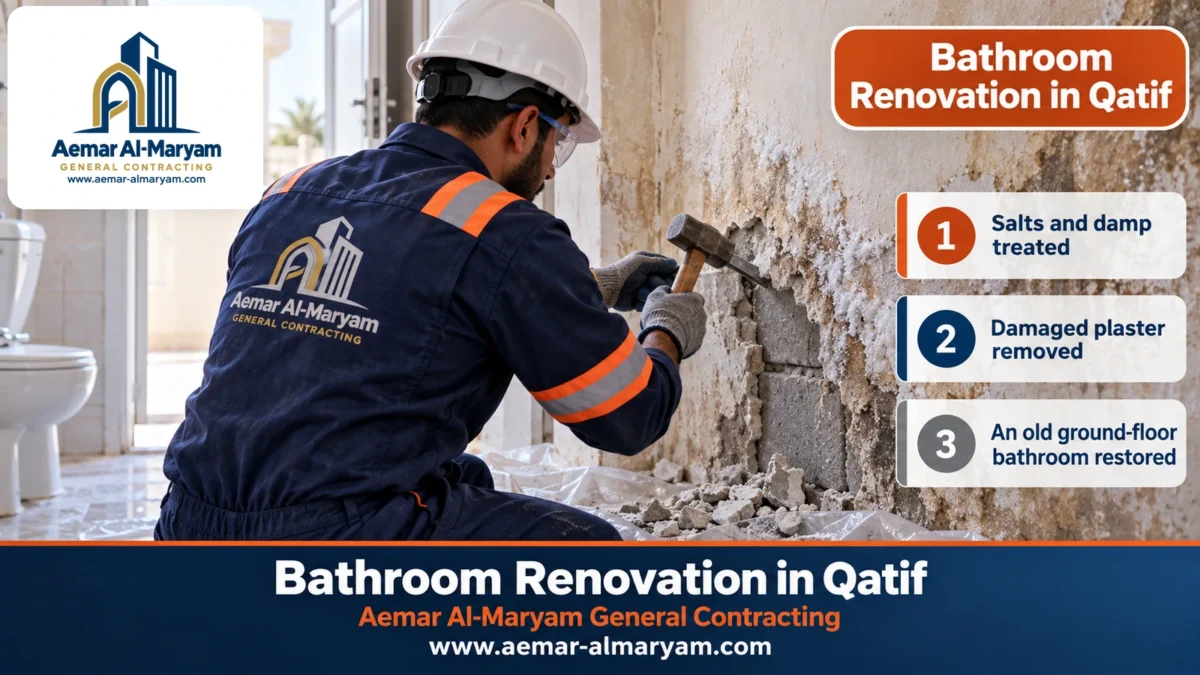
In the older houses of Qatif a bathroom’s story usually begins at the foot of the wall: a white line of crystallised salt, render that has swollen and drops away when you touch it, and damp that never dries however long the window stays open. For us, bathroom renovation in Qatif doesn’t start with new tiles. It starts with finding where that water comes from: the ground beneath the bathroom, a rusted iron pipe inside the wall, or a shower membrane that reached the end of its life. Then we chip off the salt-laden render down to the blockwork, replace the old pipes, waterproof the floor and flood test it, and only then render, tile and fit the fixtures. Aemar Al-Maryam General Contracting does this work in Qatif city, the governorate towns and Tarout Island. Our lowest starting point is SAR 2,300 for a small bathroom whose floor stays within about 4.5 m², using economy materials, and we fix the figure once we’ve seen the wall and agreed what is broken out and replaced. To call or WhatsApp: 0547879578.
Walk down almost any Qatif street and an old family house sits beside a new villa, and their bathrooms have completely different problems. The older house usually has its bathroom on the ground floor, galvanised iron supply pipes, and one or two bathrooms added over the years. The modern villa’s trouble is usually its waterproofing or finishing. And on the farms around the towns there are rest houses whose toilets are used hard at the weekend and left shut the rest of the week. This guide is written for those three situations as we meet them on inspection visits.
Bathroom renovation in Qatif in brief
- Older ground-floor bathrooms: we deal with the source of the damp and salts first, then chip off the damaged render and replace it with cement render before any tiling.
- Iron pipework: galvanised iron supply is replaced with modern pipe, and the old lines are disconnected for good.
- Rest-house toilets: sound waterproofing and drainage, a separate line for well water, and ventilation that stops smells during the closed days.
- Starting points: small bathroom SAR 2,300, medium SAR 4,600, large SAR 6,400, with economy materials; new render after chipping SAR 18 a square metre, flood-tested membrane SAR 26 a square metre.
- Travel: the trip from Dammam to Qatif and its towns is assessed at inspection; grouping several bathrooms into one visit lowers each one’s share.
- To order: photos of the lower walls and any visible pipes on WhatsApp 0547879578.
Damp and salts at the foot of ground-floor bathroom walls in Qatif
When a ground-floor bathroom in Qatif shows white crystals low on its walls, that is the mark of water rising through the wall and evaporating, leaving behind whatever it carried. In the Eastern Province groundwater lies close to the surface and is saline in many places, so it climbs by capillary action into the foundations of houses that were never properly damp-proofed, bringing chlorides and sulfates that break up render and push tiles off the wall. That is why ground-floor bathrooms in older houses so often have hollow tiles in the first and second rows above the floor, and swollen render behind tiles that still look fine from the front.
But salts don’t always come from the ground. The source may be a pipe that has been seeping inside the wall for years, or a failed membrane under the shower letting water run down into the base of the next wall. The difference matters, because each source has its own cure, and a wrong diagnosis means the salts come back through the new render within months.
| What we see on inspection | Most likely source | What we do |
|---|---|---|
| Salts at a similar height on every wall of the bathroom and the next room | Rising damp from the ground | Treat the source and seal the wall base before any render |
| A patch concentrated behind the shower or under the basin | A leaking pipe or membrane | Find the leak, then open the area and repair it |
| Salts that grow after use and fade during holidays | Water from use, not the ground | Waterproofing under the tiles and around the drain |
| Damp only at the base of the bathroom’s outside wall | Water from the courtyard or rain | Courtyard drainage and treatment of the outside wall |
How we treat a salt-damaged wall before tiling
We chip off all the damaged render down to the blockwork, going a safe margin above the last trace of damp, because any salty patch left under new render brings the problem straight back. Then we let the wall dry, brush the salts off its face, treat the source according to what the inspection showed, and render with a cement render suited to wet rooms; we never use gypsum plaster in a bathroom. Bathroom wall render starts from SAR 18 per square metre, while treating the source of rising damp itself is priced after inspection because it varies from house to house. There is more in our guides to a plastering contractor in Qatif and waterproofing and leak detection in Qatif.
New tiles over a salty wall
Tiling over render that still holds salts hides the problem for a few months at most. The salts keep crystallising behind the tiles, push them off and the hollow rows come back along the bottom of the wall.
Replacing galvanised iron pipes in older Qatif bathrooms
Galvanised iron pipes in older Qatif houses rust from the inside over the years. Scale narrows the bore and pressure drops, rust shows in the water first thing in the morning, and eventually the joints start to weep. Coastal humidity speeds up corrosion of any exposed sections. Once a house reaches that stage we don’t just fix the joint that is leaking, because the rest of the line is in the same condition.
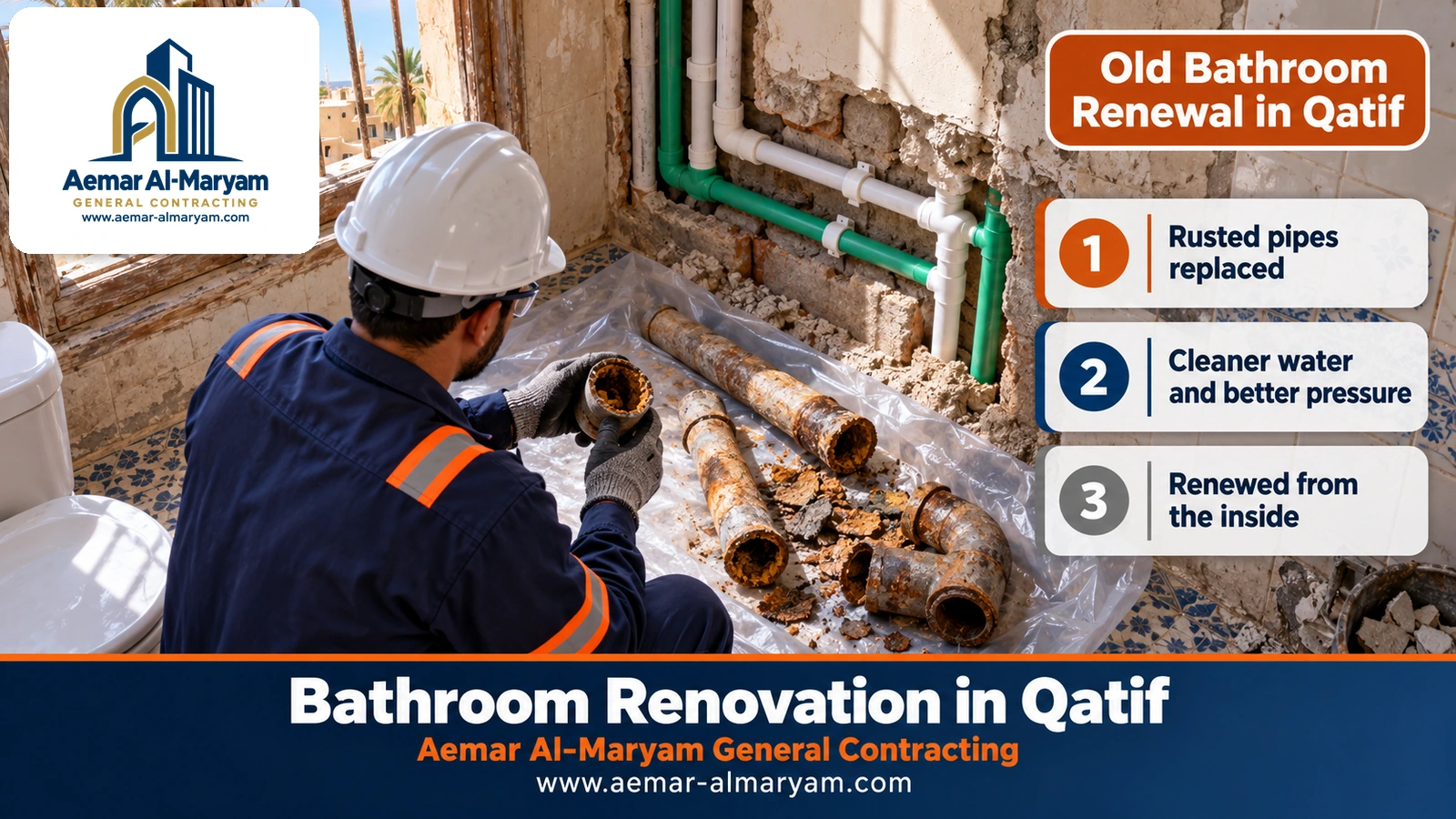
We open the pipe routes in the bathroom walls, take out the old iron, and run new hot and cold supply in heat-fused pipe with as few joints inside the wall as possible and a dedicated isolation valve for the bathroom. Then we disconnect the old lines from the tank completely, so they can’t stay behind as a hidden leak in the wall. The new system is pressure tested at no less than working pressure while still exposed, and the drains are tested with a column of water before anything is closed. Re-piping a bathroom costs from SAR 460 in labour; see plumber in Qatif for the wider picture.
- ✓Signs the pipes are finished: weak pressure in the bathroom while the kitchen is fine, water running brown first thing, and seepage at old valves.
- ✓Drainage in older bathrooms: we check the drains too; some are narrow or laid with too little fall, and we renew them if our breaking out reaches them anyway.
- ✓The whole house or just the bathroom? If the whole system is old iron we suggest a plan for the house, starting with the bathrooms and then the kitchen.
Ask about the main line
In some older houses the supply to an upstairs bathroom or the kitchen runs through the wall of the ground-floor bathroom. We trace every line before breaking out, so no part of the house loses water once we close up.
Signs that a bathroom in your Qatif house needs renovating
Some signs show in the bathroom itself and some in the rooms around it, and all of them deserve a check before they spread:
- ✓Wall bases: white salts, swollen render, or paint flaking in the corridor that shares a wall with the bathroom.
- ✓Tiles: a bottom row that sounds hollow when tapped, tiles that move, or joints that crumble.
- ✓Water: weak pressure, brown water after a pause, or the sound of a leak in the wall at night.
- ✓Smell: a drain smell that comes back despite cleaning, especially in toilets that aren’t used daily.
- ✓Floor: water collecting by the door instead of running to the drain.
- ✓Ceiling: spalling concrete or exposed steel in the bathroom ceiling after years of trapped steam.
The last sign in particular needs a structural look before any finishing, because exposed steel in a ceiling corrodes, expands and breaks up the concrete cover around it, and that repair comes before any board or paint.
Bathroom renovation company in Qatif: what we carry out
A bathroom renovation company in Qatif has to bring damp treatment, plumbing, waterproofing and tiling together in one orderly job, because an older house’s problem runs through all of them. We carry out:
■ Breaking out and chipping
Removing tiles, bedding and salt-laden render back to blockwork and slab, with the house protected.
■ New plumbing
Modern supply in place of iron, drains at the right sizes and falls, and testing before anything is closed.
■ Waterproofing and testing
Two flexible coats across the floor and turned up the walls, then water left standing on it for one to three days.
■ Render and tiles
Cement render, then porcelain or ceramic on a suitable adhesive with low-absorption grout.
■ Fixtures and ceiling
Fitting the fixtures you choose, a moisture-resistant ceiling and a fan venting outdoors.
Bathroom renovation contractor in Qatif
A bathroom renovation contractor in Qatif takes the bathroom from diagnosis to handover, so the owner isn’t left between a plumber blaming the waterproofing and a waterproofer blaming the plumbing. We write the items down once: what is broken out, what is replaced, how high the render is chipped, which membrane is used, and how long the test lasts.
Washroom renovation and bathroom breaking out in Qatif
Washroom renovation in Qatif covers the small toilets near majlis rooms and in annexes. We also accept a breaking-out-only job if the owner will finish with someone else, though we recommend keeping the whole bathroom with one contractor. Lifting tiles with their mortar bed is SAR 14 a square metre upwards. Where the lane is too tight for a vehicle we bag rubble by hand and walk it out to wherever the pickup can park. Wider breaking out in the house is covered in our guide to a demolition contractor in Qatif.
Bathrooms in Qatif’s newer villas
Not every bathroom in Qatif is old. In the newer districts there are villas built only a few years ago, and their bathroom trouble is rarely salts or iron. More often it is a membrane laid in a hurry under the shower, a drain that was never sealed properly, or ordinary grout in the wet zone. In these villas we begin by finding the source of the damp, open only the wet zone where we can, waterproof it, flood test it, and re-tile it to match the rest as closely as possible. If you still have spare tiles from the original build, keep them: they are the easiest route to a repair that doesn’t show.
Desalinated water and the heater
Mains water in Qatif and Saihat comes from desalination plants and leaves less scale than well water, but heaters and mixers still wear over time. We fit the heater’s relief valve with a safe discharge, leave an access hatch to reach it, and recommend flushing it periodically. Rest houses that rely on well water need more attention to their mixers and heater.
Partial or full renovation for a bathroom in an older Qatif house?
In an older house a full renovation is the right call in most cases, because the pipes, the waterproofing and the render are all the same age. There are still cases where a partial job is enough:
- ✓Partial is enough: when the pipes were replaced before, the damp is confined to one patch with a known cause, and the tiles are firmly bonded everywhere else.
- ✓Partial is also enough: when the problem is failed grout, worn-out silicone or a trap that lets smells back.
- ✓Full is unavoidable: iron pipes in every wall, salts around the whole room, or a failed shower membrane combined with a wish to change the layout.
Bathroom renovation without breaking tiles in Qatif: when does it work?
Renewing without breaking works in a modern villa whose waterproofing is sound: regrouting, changing fixtures and mixers, renewing silicone, ceiling and lighting. In a ground-floor bathroom carrying salts at the base of its walls, any money spent on a surface refresh is lost, because the salts will push the tiles and paint off from behind.
Waterproofing a ground-floor bathroom in Qatif, with a flood test
A ground-floor bathroom in Qatif still needs a membrane against its own daily water; ours costs from SAR 26 per square metre, with the flood test built in. Once the floor is prepared we apply the primer and reinforcing tape at the corners, around the drain and around the pipes, then two coats of a flexible membrane made for use under tiles, rising roughly 1.8 m behind the shower and a hand’s span, about 300 mm, on the other walls. Then we flood the floor for 24 to 72 hours.
This membrane does not stop rising damp from the ground under the house, which has its own treatment at the wall bases and foundations. So we separate the two clearly in the written items: the bathroom membrane keeps the bathroom’s water from going down, and the rising-damp treatment keeps the ground’s water from coming up. If the inspection shows a crack in the slab or wall, we repair it before waterproofing, as in crack repair in Qatif.
Falls and tiles in Qatif bathrooms
Shower floors need about a 2% slope to the gully; the remainder of the room, between half and one percent. In older houses we often find the drain away from the lowest point, or a floor sloping towards the door, so we rebuild the falls from scratch. Tiling is SAR 36 a square metre upwards in labour. For the floor we choose matt porcelain with water absorption of 0.5% or less and a slip-resistant face, ceramic or porcelain on the walls, and either epoxy or a reduced-absorption grout where the shower splashes. Tile installer in Qatif has the finer points.
How we change bathroom tiles in an older house
Changing bathroom tiles in an older house isn’t a matter of peeling tiles off and sticking new ones in their place, because the wall behind is rarely flat or sound. Our method: remove the tiles and bedding together and look at the wall. If the render is firm and dry we level it and tile onto it; if it is salty or hollow we chip it off and renew it. Then we start tiling from a laser-set horizontal line, not from the old sloping floor, keep the joints even and put silicone in the corners. We don’t accept tiling over old tiles in an older ground-floor bathroom, because the old tiles themselves are usually hollow behind.
Rest-house and farm toilets in Qatif
A rest-house toilet on a Qatif farm lives a different life from a house bathroom: it is used heavily for a day or two a week and then locked up, its water sometimes comes from the farm well, its drainage may run to a private holding tank, and the air around it is humid from irrigation and palms. So we renovate it in a way that suits that pattern of use.
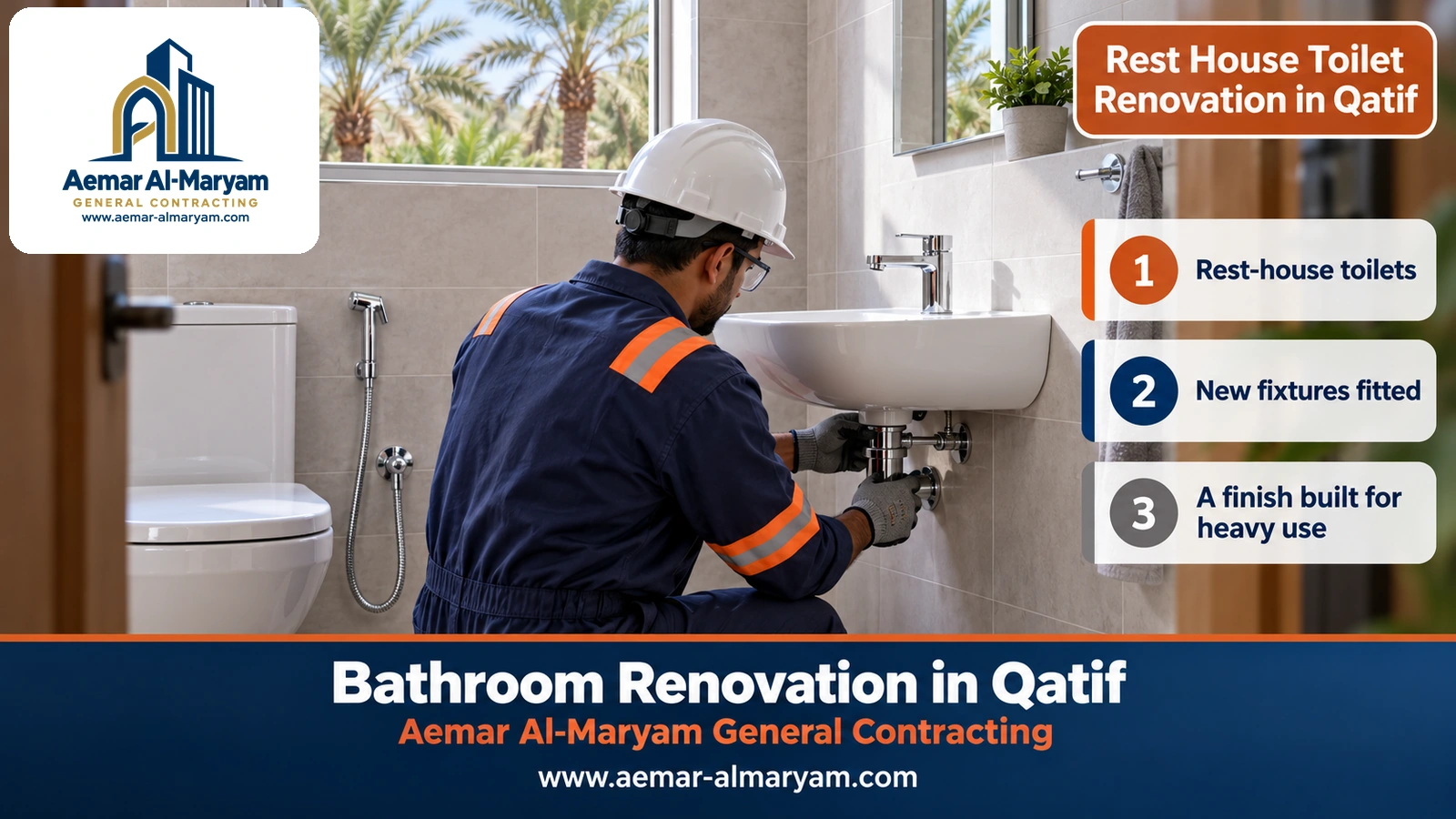
- ✓Well water: kept on a dedicated pipe for the palms and hosing down, with no link at all to drinking water or the domestic tank. If the toilet is fed from it we note that and fit fittings that can cope with that water.
- ✓Smells after closing: a trap that dries out during the closed days opens a path for sewer gas, so we make sure every point and floor drain has a sound trap, and check the venting of the drain line.
- ✓Holding tank: we check the fall of the line into it and its vent before we connect any new point.
- ✓Ventilation: an extract fan or an opening window, because a toilet shut for days traps moisture and mould appears in the grout and ceiling.
- ✓Tiles: a matt, slip-resistant floor, because people come in from the garden and the pool with wet feet.
- ✓Outdoor majlis rooms: building a new toilet next to the rest-house majlis is construction, not renovation; see our guide to an annex and majlis builder in Qatif.
Squat pan to sit-down WC in Qatif houses
Swapping a squat pan for a sit-down WC is among the requests we hear most in older Qatif homes, especially as parents get older and squatting becomes hard. The old pan and its mortar come out, a 110 mm branch is laid at a proper gradient to the spot the WC will occupy, and the floor is sealed and tiled before the pan is set, often with a hand spray and a grab bar beside it. If the drain depth doesn’t allow it, we raise part of the floor. Conversions are priced after inspection.
Bathroom ceiling, ventilation and electrics
In an older house the bathroom ceiling is often bare concrete spalling from steam, so we repair it and then fit a moisture-resistant gypsum board ceiling beneath it, from SAR 74 per square metre, where the room is ventilated, or cement board where steam is heavy, with an access hatch for the heater. The fan discharges directly outdoors. Electrically, the bathroom circuits sit behind a 30 mA RCD, keep sockets out of the wet zones and put the heater switch outside the room; more in our guide to an electrician in Qatif.
Bathroom renovation prices in Qatif
Bathroom renovation prices in Qatif are no different from ours in Dammam: a small house bathroom whose floor stays inside about 4.5 m² begins at SAR 2,300, rooms between five and nine square metres at SAR 4,600, and bigger ones at SAR 6,400, all with economy materials. What differs is the road: the crew’s trip from Dammam to Qatif, Tarout or Safwa is worked out at inspection rather than given a fixed number, and the more you put into the same visit, two bathrooms or a bathroom and a kitchen, the thinner it is spread across each item. Every figure stays an estimate until we’ve inspected and agreed.
| Item in an older bathroom | From | Charged |
|---|---|---|
| Whole small bathroom, economy materials | SAR 2,300 | Per bathroom up to about 4.5 m² |
| Medium bathroom, complete | SAR 4,600 | Per bathroom of roughly 5 to 9 m² |
| Spacious bathroom, complete | SAR 6,400 | Per bathroom over 9 m² |
| Stripping tiles with the bedding beneath | SAR 14 | Per square metre |
| Fresh render where the salty render was | SAR 18 | Per square metre |
| New supply and drains in place of the iron | SAR 460 | Per bathroom, labour |
| Under-tile membrane tried with water | SAR 26 | Per square metre |
| Setting tiles on walls and floor | SAR 36 | Per square metre |
| Gypsum ceiling that copes with humidity | SAR 74 | Per square metre |
| Fitting one mixer | SAR 75 | Per mixer |
| Basin with its mixer | SAR 90 | Per basin |
| Heater fitted with its relief valve | SAR 140 | Per heater |
| Electrical feed for a heater or fan | SAR 65 | Per point |
| Carting rubble out of the district | SAR 90 | Per load, trip assessed at inspection |
| Treating rising water and salts at the wall base | After inspection | Per house |
| Squat pan to western WC, or bath to shower | After inspection | Per bathroom |
Finding a leak is diagnosis rather than renovation, so it has no line here; we agree it once we hear the symptoms. For our other trades, see the price list.
Worked example: an older 1.6 × 2.2 m ground-floor bathroom with salts at the wall base
An illustrative bathroom in an older Qatif house, with a 1.6 × 2.2 m floor (3.52 m²), tiles to 2.4 m and salty render on every wall:
- ✓Tiled wall area: (1.6 + 2.2) × 2 × 2.4 = 18.24 m² minus the door 0.8 × 2.0 = 1.6, leaving 16.64 m²; with the floor the tiled area is about 20.16 m².
- ✓Tile removal: 20.16 × 14 = about SAR 282.
- ✓New render after chipping off the salts: 16.64 × 18 = about SAR 300.
- ✓Waterproofing: 3.52 m² of floor, the shower’s two walls to 1.8 m (2 × 0.9 × 1.8 = 3.24 m²) and a 300 mm turn-up on the other 5.0 m of wall (7.6 − 1.8 − 0.8), i.e. 1.5 m²; 8.26 m² at SAR 26 is about SAR 215.
- ✓Plumbing rough-in replacing the iron: SAR 460. Tiling: 20.16 × 36 = about SAR 726.
- ✓Fixtures: SAR 90 for the basin, SAR 150 for a pair of mixers, and SAR 180 to cart away two loads.
- ✓Total: roughly SAR 2,403 of labour, then economy materials, with the rising-damp treatment and travel assessed at inspection.
Notice that this small bathroom has already passed the first figure in the table, because chipping and re-rendering the walls and replacing iron pipes are items a modern bathroom doesn’t need. That is the real cost difference in older houses.
Steps to renovate a bathroom in an older Qatif house
- 1Diagnosis
We pin down the source of the damp and salts, trace the pipes and measure the room. - 2Protection and breaking out
We protect the house, remove the fixtures, and strip tiles and salty render back to blockwork. - 3Treating the source
We deal with the rising damp or the leak we found, and let the walls dry. - 4Plumbing
New supply in place of the iron, checked drains, and testing before closing. - 5Render
Cement render on the chipped walls. - 6Membrane and flood test
A flexible membrane with reinforcement, then a flood test of one to three days. - 7Falls and tiles
Correct falls to the drain, then tiles, grout and silicone. - 8Fixtures and handover
Fixtures, ceiling and fan, with every point tried in front of you.
How long does an older bathroom take?
An older house’s bathroom takes a few days longer than a modern one, because a chipped wall has to dry before rendering and the render needs time before tiling. It is usually between one and two and a half weeks depending on how damp the walls are, and we write the schedule down after inspection.
Mistakes that bring the damp back after renovation
- ✓New render over a wall that still holds salts and moisture.
- ✓Repairing a single iron joint and leaving the rest of the rusted line in the wall.
- ✓Leaving the old lines connected to the tank after the new ones are run.
- ✓A membrane that doesn’t go up the wall, or has no reinforcing tape around the drain.
- ✓Skipping the flood test to keep to a date.
- ✓Ordinary grout in the shower, and grout instead of silicone in the corners.
- ✓Gypsum plaster or non-moisture-resistant boards inside the bathroom.
Handing over a renovated bathroom in Qatif
Before we leave we go through these points with you and hand over the stage photos:
- ✓The chipped wall back to blockwork before rendering, the new pipes under test, and the water standing during the flood test.
- ✓No salts or patches on the new render in the adjoining corridor after a few days of use.
- ✓Water reaches every point at good pressure, with no drips at the valves.
- ✓Water runs away to the drain, with no smell when the shower and basin are used.
- ✓No hollow-sounding tiles, and continuous silicone in the corners.
- ✓The old pipes are disconnected from the tank, and we show you where.
Bathroom renovation before and after in Qatif, and permits
The before-and-after photos that matter in an older house aren’t of the new tiles; they are of the salty wall before chipping and the rusted pipes before they come out, followed by the new wall, the membrane and the test. Every bathroom gets that photo record, and past jobs are in our project gallery. As for permits, renovating a bathroom inside by changing tiles, pipes and waterproofing usually needs none, because it is maintenance; structural changes to a bearing wall or slab, or an extra bathroom, go through an engineering office and Balady.
Areas of Qatif where we renovate bathrooms
Our Qatif work covers the city itself, Al Rida, Al Fath, Al Sadafa, Al Sawari and Al Shati among them; Tarout Island with Darin, Sanabis, Al Zour, Al Rabiyah and Tarout proper; and the towns of Safwa, Al Awamiyah, Al Qudaih and Anak, with nearby towns sharing one day of visits. We work on concrete and block houses only; heritage buildings of mud or stone need specialists and the approval of the competent authority. Our Qatif page brings our services in the governorate together. Flat owners next door can turn to bathroom renovation in Saihat; villa owners to bathroom renovation in Dhahran; and our longest guide is bathroom renovation in Dammam. A whole-house job begins with our renovation contractor in Qatif page, and kitchens with kitchen renovation in Qatif.
Why Aemar Al-Maryam for Qatif bathrooms?
- ✓We start with the source of the water: ground, pipe or membrane, before any tile.
- ✓Straight talk about older houses: we tell you when a partial job is enough and when the money would be wasted on it.
- ✓Old lines disconnected: no rusted iron left connected inside the wall.
- ✓A photo trail: bare block after chipping, pipes under pressure, membrane, standing water.
- ✓Clear travel terms: assessed at inspection, and lower when jobs are grouped into one visit.
How to order a bathroom renovation in Qatif
- 1Photograph the bathroom
The floor, the lower walls, any salts or flaking, the ceiling and under the basin. - 2Photograph the pipes
Any visible part of the pipes or valves, and the water meter if you can. - 3Send the dimensions
The room’s three measurements, which storey it is on, and roughly when the house was built. - 4Say where it is
The town or district, and whether the bathroom is in a house, a rest house or an annex. - 5Inspection
We visit, diagnose the source and write the items and the cost.
Salty bathroom wall? We start from the cause
Send photos of the lower walls and the pipes; we’ll tell you whether the source is the ground or the bathroom and give you an outline and estimated cost before the visit.
Further reading for Qatif
Tags