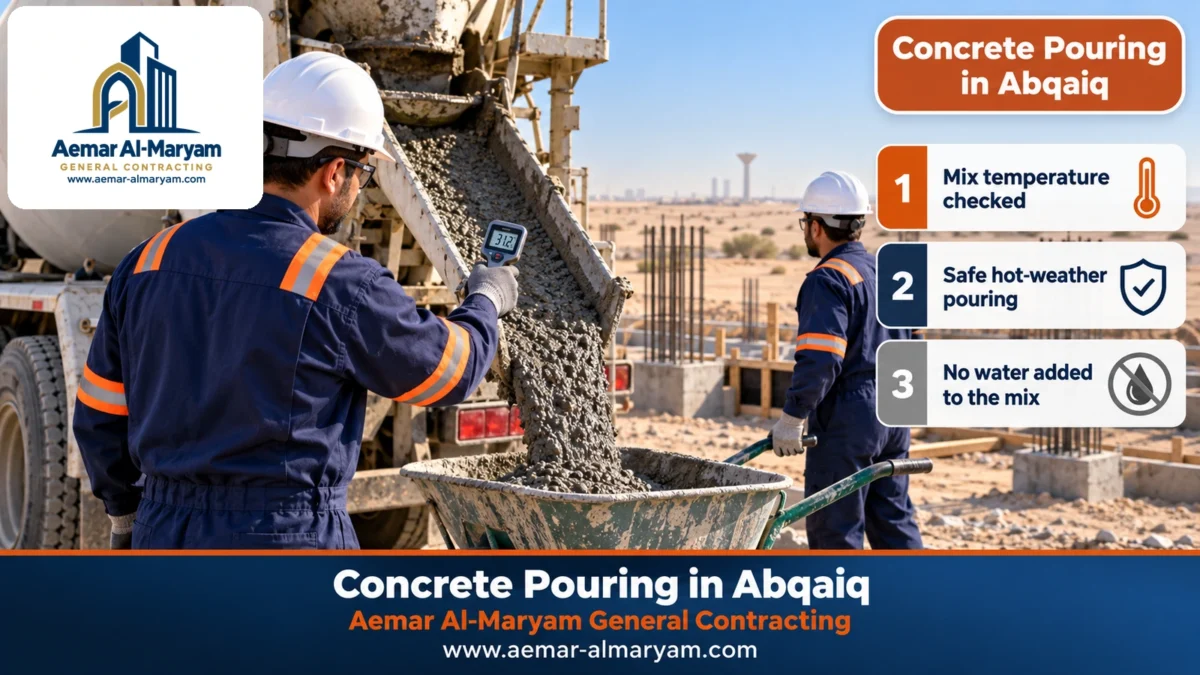
Before the first load goes into the forms, our engineer pushes a probe thermometer into the concrete coming down the mixer chute. That minute is what sets concrete pouring in Abqaiq apart in summer: Abqaiq is an inland desert town on the Dhahran road, and concrete there can be close to its temperature limit before the pour has even started. Aemar Al-Maryam General Contracting pours floors, roof slabs, footings and yards in Abqaiq with a temperature check on every truck, polythene and mesh on chairs under ground-floor slabs, and ponding cure on roofs. A square metre of blinding costs from SAR 14 in labour, a reinforced yard with materials from SAR 46 and foam roof falls from SAR 17; roofs and footings are costed from the drawings, and the run out from Dammam is agreed when we inspect. These are opening figures, confirmed only after the visit. Phone or WhatsApp 0547879578.
We begin at the point of delivery: what we check on every truck and when we turn a load away. Then it goes down to the ground-floor slab and how we stop the steel sinking to the bottom of it, and up to the roof and the ponding cure. After that come the other types of pour under their own headings, the price table and a worked example for a house roof in Abqaiq.
In short: concrete pouring in Abqaiq
- At the chute: batching time read from the ticket, temperature (35 °C maximum) and slump measured, late loads or loads with added water rejected.
- Ground-floor slab: compacted soil, thick overlapped polythene, mesh on chairs and walking planks so nobody stands on the steel.
- Roof: ponding cure for at least seven days, then slope screed and waterproofing.
- Starting rates: roof falls 17 foam or 23 mortar, yard or trowelled floor with materials 46, blinding labour 14, stamped paths 110 (SAR per m²).
- No margin on materials: you pay the plant, pump and lab bills exactly as issued.
- The trip from Dammam: agreed at inspection.
- To book: phone and WhatsApp 0547879578.
Checking concrete temperature at delivery in Abqaiq
Checking concrete temperature at delivery in Abqaiq is not a formality. For hot days the Saudi concrete code draws clear lines: 35 °C is the most the mix may reach at the moment of placing, slump stays at 75 mm or above, no more than two hours may pass from batching to discharge and only with a retarder, and nobody pours water into the mix on site. Concrete hotter than that starts to stiffen while it is still in the drum or on the chute and loses water from its surface quickly, so it ends up weaker and more likely to crack.
So we treat every truck as a separate load. An engineer or supervisor stands at the chute, reads the ticket, takes a sample from the first concrete out, pushes the metal probe of the thermometer into it until the reading settles, and then runs the slump test with the cone. If the truck is one of those designated for cube sampling, the cubes are taken at the same time.
| What we check | How | When we reject |
|---|---|---|
| Batching time | From the delivery ticket | If the agreed discharge time with retarder has passed |
| Concrete temperature | Metal probe in a sample from the chute | If it is above 35 °C |
| Slump | Slump cone | If it is outside the specified range, or below 75 mm in hot weather |
| Grade and type | Ticket matched to the order | If the grade or cement type differs from the drawings |
| Added water | Asking the driver and checking the ticket | If water has been added outside the mix design |
| Appearance | A look at the mix | Segregated stone or hardened lumps |
How to read a delivery ticket
Every truck arrives with a small slip that many people ignore, but it is the identity of the load: the plant name, truck number, grade and cement type, quantity in cubic metres, batching time and sometimes the admixtures. We read the batching time first and compare it with the clock, so we know how much of the allowed window is left. Then we match the grade and type against our order and the drawings. We keep every ticket in order with the slump and temperature readings and the number of each cube set, so if a laboratory result comes back low we know which truck it was and which part of the slab or floor it went into.
What we prepare before the first truck
Reasonably cool concrete is not enough if what it lands on is hot. Timber formwork and steel that have stood in the sun since morning, and dry ground, all raise the concrete temperature and pull water from it on first contact. So we wet the forms, steel and ground just before the pour without leaving pools, shade what can be shaded on small pours, and have the thermometer, slump cone and cube moulds ready beside the chute so no truck waits while we look for tools.
What happens when the concrete is too hot?
If the temperature is over the limit we do not place the load, and we tell the plant straight away. Plants have well-known ways of bringing mix temperature down: chilled mixing water or crushed ice in place of part of the water, shaded and sprayed aggregates, set-retarding admixtures and light-coloured trucks that reflect the sun. We ask for these on the following trucks and adjust the pour programme if needed. Some local guidance recommends aiming a little below the limit, around 32 °C, to keep a margin for the journey and the sun.
⚠ Do not accept “a splash of water” in the truck
The most common thing we see when concrete arrives stiff is water added “to loosen it”. The code forbids it, and it raises the water-cement ratio, so the concrete is weaker and more permeable. If the consistency needs adjusting, it is done with a plant admixture within the design, or the load is rejected.
Travel time from the plant to Abqaiq
We order concrete from the licensed plant nearest the site and work out the journey time before agreeing quantities. The rule is discharge within two hours of batching with a retarder, and in summer we prefer much less. So we space the trucks so each arrives when the crew is ready for it, and no truck stands at the site in the sun waiting for the one before it to finish. We start at dawn so most of the pour is done before midday.
Plastic shrinkage cracks and evaporation
In hot, dry, windy air, water can leave the surface of the concrete faster than it rises from inside, so the surface shrinks while it is still soft and short parallel or branching cracks appear in the first hours. Hot-weather references regard such cracking as likely when water evaporates from the surface faster than roughly 1 kg per square metre each hour, and advise precautions from about half that rate. In Abqaiq that means in practice: pour at dawn, put up windbreaks where needed, fog-spray above the surface without letting water pond, and cover every area as soon as its finishing is done.
Sand and wind during the pour
Abqaiq is surrounded by sand, and wind can carry fine sand onto fresh concrete or into the forms before the pour. So we clean the forms and excavations on the morning of the pour, not the day before, cover the polythene and mesh if the wind picks up, and wash off sand stuck to the surface after initial set rather than sweeping it while the concrete is soft. If the wind is very strong at the planned time, delaying the pour by a few hours is better than a weak surface full of sand.
Ground slab pouring in Abqaiq: polythene and mesh on chairs
Ground slab pouring in Abqaiq starts with the soil: it is levelled, compacted and wetted, termite treatment is applied, and thick polythene is laid with clear overlaps between rolls and turned up the walls a little. On top, the steel mesh is set on chairs at the specified height so that the steel ends up within the slab depth, not lying under it. Drain and conduit pipes under the slab are laid, tested and photographed before any of this.
Why so much attention to what goes under the slab? Because dry soil in the heat soaks water from the bottom of the concrete like a sponge, so the lower layer loses water before it hardens and bonds poorly with the ground. Well-laid polythene prevents that, and wetting the compacted soil before laying it cools the ground. It is also a barrier against moisture and salts that could otherwise rise into tiles and walls over time.
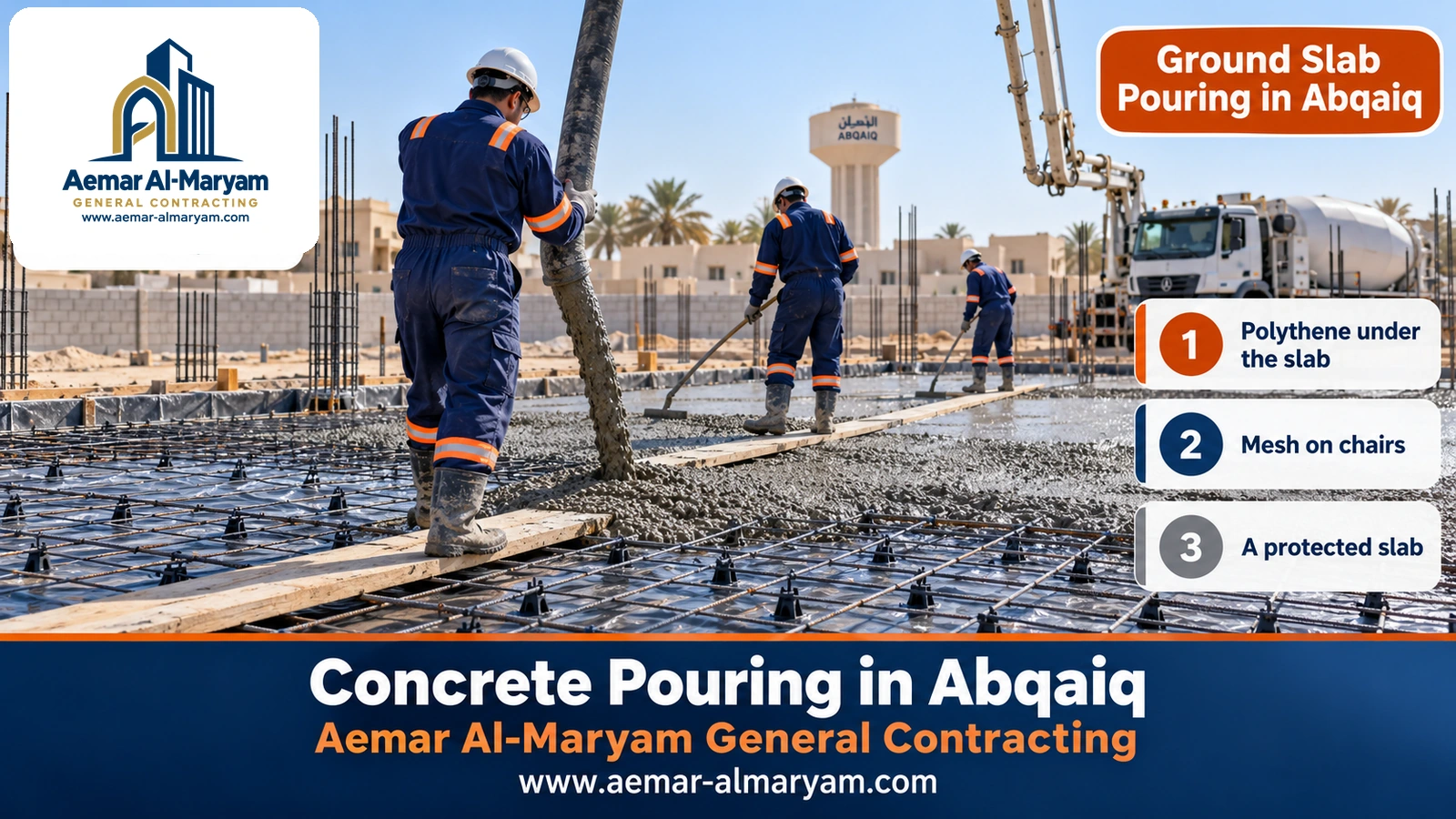
During the pour we walk on timber planks laid over the mesh, never on the mesh itself. The reason is simple: every step on the mesh pushes it down until it touches the polythene, and after the pour nobody can see where it went. Mesh at the bottom of a slab does not control cracking as it should and ends up close to the damp. The hose is moved gently over the mesh, and concrete is spread with shovels and a straightedge without dragging the steel with it.
- Polythene: thick, overlapped between rolls, with any tear patched before the steel goes down.
- Chairs: concrete or plastic at the required height, close enough that the mesh does not sag between them.
- Planks: walkways over the mesh that are moved forward as the pour advances.
- Edges: an isolation joint where the slab meets walls and columns, as drawn.
- Falls: on external slabs and yards, towards the drains.
Will the slab be tiled?
If the slab will be tiled later, agree its finished level now, allowing for tile and bedding thickness, so you do not need a thick levelling screed or breaking out at doorways. Tiling is covered under tile installer in Abqaiq.
Ponding cure for roof slabs in Abqaiq
Ponding cure for roof slabs in Abqaiq is our preferred method for flat roofs in dry heat. Once the new roof surface has hardened enough, we build small mortar bunds that divide it into ponds and fill them with clean water. The surface then stays under water all the time, instead of being sprayed in the morning and drying in the sun until evening. Intermittent spraying in extreme heat puts the surface through wetting and drying cycles; ponds prevent that.
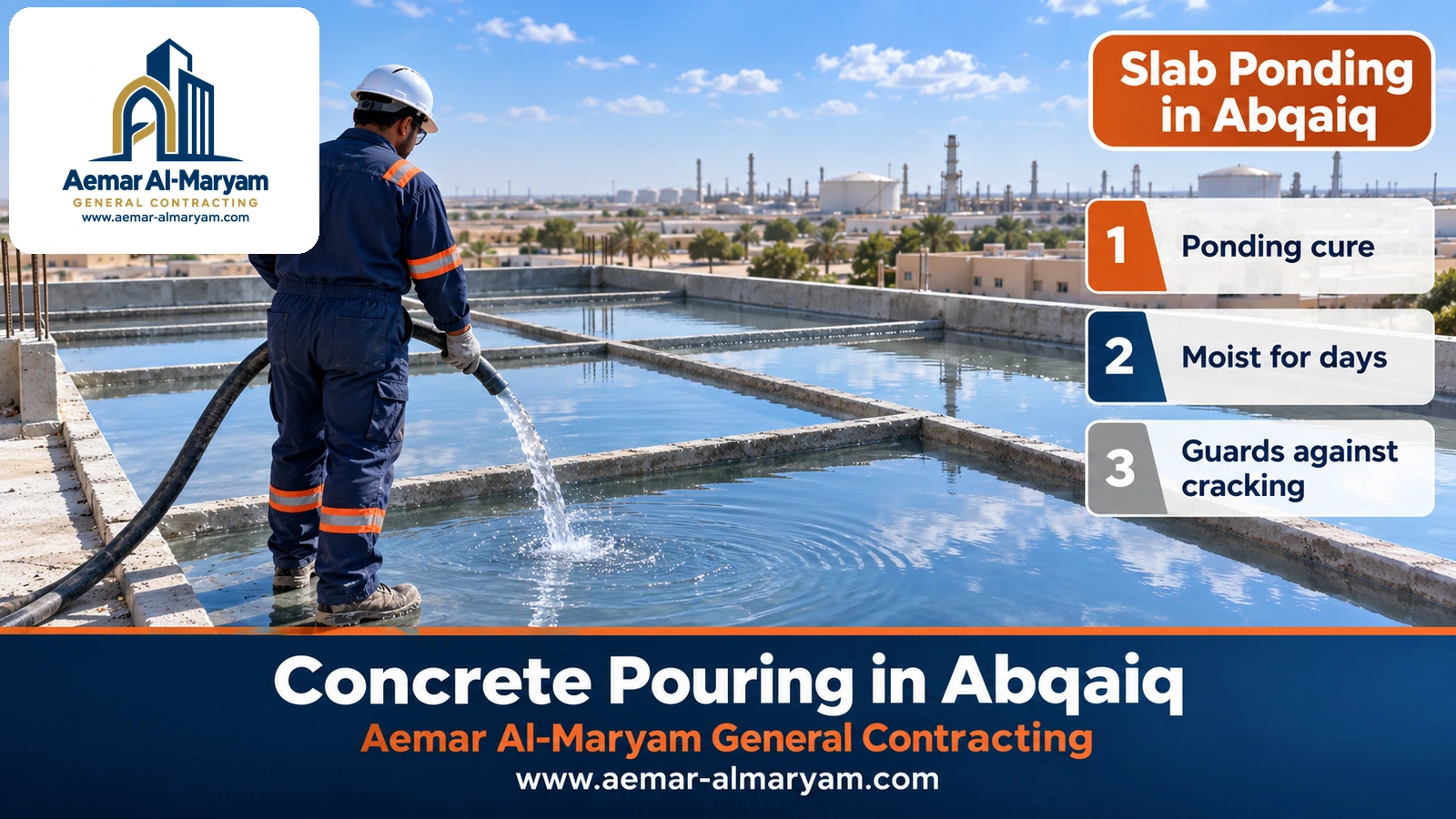
- 1Start of curing
We cover or fog-spray the surface in the first hours, then build the bunds once the surface can take them without marking. - 2Dividing the roof
Small mortar bunds split the roof into ponds that follow its falls, so the water depth stays even. - 3Filling
Clean water close to the concrete temperature, not very cold, to avoid thermal shock at the surface. - 4Daily checks
Top up what evaporates, repair any leaking bund and clear sand blown in by the wind. - 5Duration
At least seven days, as the hot-weather rules require. - 6Finishing
Drain the water, remove the bunds and clean the surface before the slope screed and waterproofing.
Ponding does not suit every surface: roofs with marked falls and vertical faces are cured with wet hessian, polythene or curing compound. If moist curing cannot continue after the third day, the code allows suitable covers or a curing compound. What matters is that the surface does not dry out in the first days, because water it loses then does not come back.
Why spraying once a day is not enough
Concrete does not gain strength by drying; it gains strength as cement reacts with water, and that reaction goes on for days as long as there is enough water in the concrete. If the surface is sprayed in the morning and then left to sun and wind, it dries in an hour or two and stays dry for the rest of the day, so its top layer stops gaining strength and becomes weak, dusty and prone to hairline cracks. That top layer is the one that will carry the slope screed and waterproofing and face the sun for the life of the building. So on flat roofs we prefer ponds, and elsewhere wet hessian covered with polythene, with a daily log of when the surface was wetted and who checked it.
Slope screed in Abqaiq after curing
Once curing is finished, the slope screed goes on to direct water to the outlets: in foam concrete from SAR 17 per m² or in cement mortar from SAR 23. A slope screed is not waterproofing; the waterproofing and insulation on top are a separate item, covered under roof waterproofing in Abqaiq.
Concrete pouring prices in Abqaiq
Our Abqaiq figures are the Dammam figures; the one extra is the trip out, which we estimate once we know the size of the job and how many times we need to attend. Read the table as indicative until inspection and agreement, with concrete, pump and lab paid on their own bills.
| Type of work in Abqaiq | Pricing basis | Figure |
|---|---|---|
| Foam-concrete roof falls after curing | Per m², waterproofing separate | SAR 17 upwards |
| Mortar roof falls | Per m², waterproofing separate | SAR 23 upwards |
| Yard on polythene with 8 mm mesh on chairs and 10 cm of concrete | Per m², all materials in | SAR 46 upwards |
| Trowelled workshop or store floor | Per m² with materials, from about 50 m² | SAR 46 upwards |
| Blinding | Placing and levelling per m² | SAR 14 upwards |
| Stamped concrete paths | Per m² with sealer | SAR 110 upwards |
| Whole roof from formwork to curing | From the drawing quantities | After the visit |
| Footings, ground beams and columns | Per element from the drawings | After the visit |
| Stairs | Once the steps are set out | After the visit |
| Waterproofing buried concrete before backfill | By the faces in contact with soil | After the visit |
| The concrete itself | Plant invoice on the day | National benchmark near 214 per m³ |
| Pump and laboratory | At the hirer’s and lab’s cost | By type and number |
| The trip from Dammam | Costed at inspection | Less when jobs are grouped |
Worked example: a 12 × 14 m house roof in Abqaiq
Purely to show the arithmetic, take a house roof in Abqaiq of 12 × 14 m, a solid slab 15 cm thick (beams excluded, as they come from the drawings), with foam roof falls laid over it.
| Item | Calculation | Result |
|---|---|---|
| Roof area | 12 × 14 | 168 m² |
| Slab volume | 168 × 0.15 | 25.2 m³ |
| With about 5 % waste | 25.2 × 1.05 | 26.46 m³ |
| Slab concrete at the national average (ordinary 350) | 26.46 × 214.10 | about SAR 5,665 |
| Foam slope screed “from” | 168 × SAR 17 | SAR 2,856 |
Beam concrete from the drawings is added to this, plus formwork, steel, pouring and curing labour at inspection, the pump at cost and travel from Dammam. The example is there to show the volume and approximate cost of concrete before the trucks are ordered, and to make clear that 26 cubic metres means several trucks whose spacing has to be planned carefully on a hot day.
A summer pour day in Abqaiq: the schedule we work to
A successful summer pour is planned from its end: when must we be finished before the sun is at full strength? From that we work out when to start, how many trucks we need and at what interval. This is a typical day for a roof or floor pour in Abqaiq:
- 1Late night
The crew arrives and does a last walk over formwork and steel or polythene and chairs, damping forms and ground and setting up lights. - 2The pump
Set up on firm ground, overhead cables checked, line tested before the concrete arrives. - 3First truck
Ticket read, temperature and slump measured, cubes taken, then placing. - 4Following trucks
The same checks on each, and the plant told immediately of any rise in temperature or delay. - 5Finishing
Strike-off and floating, with each finished area covered or fog-sprayed. - 6After the pour
Ponds built or wet hessian laid once the surface can take it, and the daily curing log started.
How travel to Abqaiq is set
Abqaiq is on the Dhahran road, and we come from Dammam on scheduled visits. Travel has no fixed price because jobs differ: a small ground slab may need an inspection, a pour day and one follow-up, while a roof with beams needs a visit to check the formwork and steel before the pour and follow-up for curing and striking after it. We count the visits at inspection and show travel as a separate line. The easiest way to reduce it is to group jobs that fall close together, such as blinding and footings in one week, or the ground slab and yard on a single day.
Other pours in Abqaiq
Roof slab pouring in Abqaiq
A roof pour in Abqaiq begins with comparing the shuttering and reinforcement with the approved drawings: solid props, sealed joints, bars on spacers, sleeves and services where they belong. Most house roofs go in on one day by boom or line pump, starting at dawn with a temperature check on every truck, then the ponds go on. Side forms come off after roughly a day, short-span slab props after about a week, and props under long beams after two to three weeks as the engineer decides.
When to strip formwork in Abqaiq
- Vertical faces: column and beam side forms usually come off after 12 to 24 hours.
- Short-span slabs: up to 6 metres, props stay roughly a week.
- Longer slabs: over 6 metres, ten days to two weeks.
- Beams up to 6 metres: props for about two weeks.
- Longer beams: around three weeks.
Heat speeds up early strength gain, but it does not justify striking before the engineer decides, especially if curing has been poor. After column and beam sides are struck, we keep their exposed faces wet too so curing is completed.
Annex and rooftop-room slabs in Abqaiq
We pour annex and rooftop-room slabs in Abqaiq after confirming the permit and structural drawing, with the same delivery and curing rules. Because the area is small, the concrete may be one or two trucks, which makes checking each load easier and also more critical, since rejecting one truck means postponing the whole pour. So we agree cooling and retarder with the plant in advance. Annex projects are covered on the annex page linked below.
Footings and ground beams in Abqaiq
Excavation to level and compaction, blinding, reinforcement lifted on chairs to give the right cover (75 mm for concrete cast against soil), column starters, necks and ground beams, then bitumen on faces in contact with soil and backfill in layers. The soil report guides the designer’s choice of cement for anything buried, and sulphate-resisting cement alone does not protect steel from chlorides where they are present.
Soil and cement type in Abqaiq
We never assume the soil type on any site or choose the cement by guesswork. The soil report shows whether sulphates or chlorides are present and how deep the water is, and from it the designer sets the grade, cement type, water-cement ratio and cover. Our job is to order exactly what is written, confirm cover with spacers of the right size and waterproof buried concrete before backfilling. If you have no soil report for a new house, the engineering office requests one before the design.
Blinding concrete in Abqaiq
An unreinforced layer, usually five to ten centimetres, separating footing and ground-beam steel from the soil. Our placing rate starts at SAR 14 per square metre, with the concrete paid to the plant. We pour it straight after preparing the bottom so the wind does not fill the excavation with sand again.
Column pouring in Abqaiq
Columns are poured after their plumb is set, in layers with vertical vibration, without dropping concrete from a height. In the heat we wet column forms before the pour, cover the column heads afterwards and keep the sides wet after striking.
Yard slabs in Abqaiq
A yard slab follows the same logic as the ground-floor slab, with falls to the drains: compaction and wetting, termite treatment, polythene, 8 mm mesh on chairs, about 10 cm of concrete, joints and curing. A metre with every material costs from SAR 46. To compare other yard surfaces, see asphalt in Abqaiq or interlock paving in Abqaiq.
Workshop and store floors in Abqaiq
Car workshops and small stores in Abqaiq need a dense concrete floor that is easy to clean of oil and dust. A power-trowelled floor including materials starts from SAR 46 per m² with a minimum of about 50 m², and the same rules on polythene, chairs and joints apply. If the workshop will carry lifts or heavy equipment, its thickness and reinforcement come from the designer and it is priced at inspection.
Ready-mix concrete and pumps in Abqaiq
We book the ready-mix at the strength on the drawings, with a summer retarder, and you pay what the plant invoices. As a rough guide, the national statistics average runs close to SAR 214 a cubic metre for plain 350, with the sulphate-resisting mix some ten riyals dearer. Roofs within reach of the road take a boom pump, cramped plots a line pump, and many footings and floors are filled straight from the mixer.
Slump and cube tests in Abqaiq
The slump test is run at the chute with the temperature check on every truck. Cube samples are taken during the pour and broken in the lab at one and four weeks, and the concrete passes when any three successive four-week results average the design strength or better. The minimum sampling in the reference standards is at least once a day, once for every 115 m³ or so, and once for every 465 m² or so of slab. Laboratory fees are charged at cost.
Common concrete pouring mistakes in Abqaiq
- Accepting without measuring: placing a hot or late load because nobody read the ticket or took the temperature.
- Pouring at midday: fast evaporation and plastic shrinkage cracks in the first hours.
- Standing on the mesh: the steel ends up at the bottom of the slab, where it does not work.
- Torn polythene: dry soil draws water from the bottom of the mix.
- A single morning spray: the surface dries all day; ponds or wet hessian are better.
- Bunds left under waterproofing: pond bunds must be removed and the surface cleaned before the slope screed.
- Cracks after the pour: have them assessed; repairs are covered in crack repair in Abqaiq.
Why Abqaiq clients choose Aemar Al-Maryam
■ Every truck checked
Temperature, slump and batching time before a load goes into the forms.
■ Slab details
Polythene, chairs and walking planks that keep the steel where it belongs.
■ Real curing
Ponding on roofs for at least seven days.
■ Open costs
Our labour on one line, material bills as issued, the trip fixed on the first visit.
Where we pour concrete in and around Abqaiq
We pour concrete in Abqaiq and its residential neighbourhoods and reach the rest of the province from there and from Dammam. Abqaiq page: our services in Abqaiq; the detailed guide: concrete pouring contractor in Dammam; the coastal neighbours: pouring in Ras Tanura and pouring in Jubail. For a full annex: annex building in Abqaiq; for openings in existing concrete: concrete cutting in Abqaiq.
Booking a pour in Abqaiq
Send the following on WhatsApp to 0547879578:
- ✓Element: ground-floor slab, roof slab, footings and ground beams, columns, yard, slope screed.
- ✓Drawings or sizes: with the grade if it is written on them.
- ✓Current state: bare soil, formwork ready, steel fixed, or whether we should do everything.
- ✓Site: photos of the access, street and pump position.
- ✓Timing: and how flexible you are for a dawn or night pour.
- 1Get in touch
With photos, drawings and dimensions. - 2A first figure
For labour and concrete quantity. - 3Visit in Abqaiq
With travel, placing method and pump agreed. - 4Pour day
At dawn, with temperature and slump checked on every truck. - 5Curing and handover
Ponds or hessian for seven days, formwork struck on time, and cube results.
Planning a pour in Abqaiq this summer?
Send the drawings and site photos; we plan a dawn pour with the plant and pump and send our labour figure with the expected concrete volume and the trip cost.
Also available in Abqaiq
Tags