Concrete pouring in Al Khobar is what we do at Aemar Al-Maryam General Contracting, from our base in Dammam for Khobar villas, apartment buildings and driveways: hollow-block (hourdi) roof slabs placed by pump, apartment-building columns filled from a crane bucket, cast-in-place staircases, footings and ground beams in the salty ground near the coast, and yard and driveway slabs, including stamped concrete. Blinding labour starts at SAR 14 a square metre, a yard slab with mesh and materials at SAR 46 a square metre and stamped concrete at SAR 110 a square metre. Roofs, footings, columns and stairs we price once we have read the drawing and seen the site. Ready-mix, pump hire and cube crushing pass to you at the plant, hire firm and lab invoices unchanged. All numbers here are estimates pending a site visit and agreement; phone or WhatsApp 0547879578.
A request for a concrete pour in Khobar sounds different depending on the district. Someone finishing a new villa in Al Hada or in Al Hizam Al Akhdar (the Green Belt) asks about the hourdi roof: how many cubic metres it needs and when the props can come out. A landlord building flats in Al Aqrabiyah or Al Thuqbah needs a crew that can pour columns floor after floor without honeycombing. Someone building in Al Khobar Al Janubiyah, close to the shore, worries that salt will eat the footing steel within a few years. And a homeowner in Al Olaya wants a driveway that looks like stone, not another layer of cracked tiles. This page is written for all four: every element has its own heading, followed by what happens on the day, the figures the Saudi concrete code sets, our starting prices and a stamped-driveway calculation.
Concrete pouring in Al Khobar at a glance
- Elements: blinding, footings, ground beams and column necks, apartment-building columns, hourdi and solid roof slabs, staircases, annex roofs, yard and parking slabs, power-trowelled floors, roof slope screeds, stamped concrete.
- Prices from: blinding (labour) 14, mesh-reinforced 10 cm yard with materials 46, power-trowelled floor 46, slope screed 17 in foam or 23 in mortar, stamped driveway 110 (all SAR per m²).
- Priced after inspection: labour for roof slabs, footings, columns, stairs and the bitumen coating of buried concrete, because these come from drawings and quantities.
- Materials at cost: ready-mix from the nearest licensed plant, plus pump and laboratory, all at the actual invoice on the day.
- Near the sea: the designer sets cement type, water–cement ratio and cover from the soil report, and we coat every buried surface before backfilling.
- Summer: pours at first light or after dark, a 35 °C ceiling on mix temperature, never extra water on site, and a week or more of wet curing.
- Contact: call or WhatsApp 0547879578 with a photo of the drawing, rough sizes and a picture of the street outside.
Concrete pouring in Al Khobar: what we pour, and in which buildings
Concrete pouring in Al Khobar, as we do it, means casting structural and ground-bearing elements in place inside formwork. We either build the formwork and fix the steel ourselves or take over formwork and steel that someone else has prepared, then order ready-mix at the grade written on the drawing, place it, vibrate it, level it and cure it until it gains its strength. Because Khobar’s building stock is so varied, we organise the work by building type rather than by concrete type alone.
■ Two-storey villas
Hourdi roof slabs placed by pump, an internal staircase, footings and ground beams, then a yard and driveway at the end of the job.
■ Apartment buildings
Columns poured floor by floor from a crane-hung bucket, repeated floor slabs, water tanks and roof rooms.
■ Plots near the coast
Footings and ground beams in damp, saline ground, with a mix set by the designer and a bitumen coat before backfilling.
■ Driveways and yards
Mesh-reinforced slabs, stamped concrete with a stone pattern, and parking areas with falls to the drains.
■ Annexes and roofs
Annex and roof-room slabs, and a slope screed on the roof ahead of waterproofing.
■ Shops and small warehouses
Power-trowelled (helicopter) floors from about 50 m² upward.
You might need the whole element from us, from formwork to curing, or you may already have a shell contractor and only need a pouring crew that takes over the formwork and steel once the engineer has signed them off. Either way, we write down the scope before we start: what is ours, what the plant supplies, and what stays with the owner or his contractor. If your project is a whole house from excavation to handover, it falls under our construction service; the short service description is on the concrete pouring page.
Concrete pouring contractor in Al Khobar: what our contract covers
A concrete pouring contractor in Al Khobar should own pour day and everything around it, not just stand next to the truck. Our contract normally covers reading the structural drawing and working out quantities, building timber or steel formwork and propping it, fixing the rebar on spacers and chairs, booking the ready-mix and the pump, receiving and checking each truck, placing, vibrating and screeding, curing with water, and striking the formwork on time. Material items (concrete, steel, pump, laboratory) are written as separate lines at their real cost.
Two things are outside our work. First, we do not supply the precast concrete barriers that some people in the Eastern Province also call «sabbat»; they are made in factories and lifted into position, whereas everything we do is cast where it stands. Second, we do not design structural elements. The engineering office sets the design, the grade and the reinforcement, and we build to the approved drawing.
Concrete company or shell contractor in Al Khobar?
A concrete pouring company in Al Khobar is useful when the element is defined: a roof, a set of footings, a yard, a staircase. A shell (عظم) contractor takes on the whole frame with blockwork and concrete. Many Khobar villa owners sign with a shell contractor and then bring in a separate pouring crew for the roof or the yard, or they build a roof annex and only need its slab. We take on both kinds of job, and at the site visit we make clear where our work starts and stops, so no gap opens between two contractors.
Roof slab pouring in Al Khobar: hourdi villa roofs placed by pump
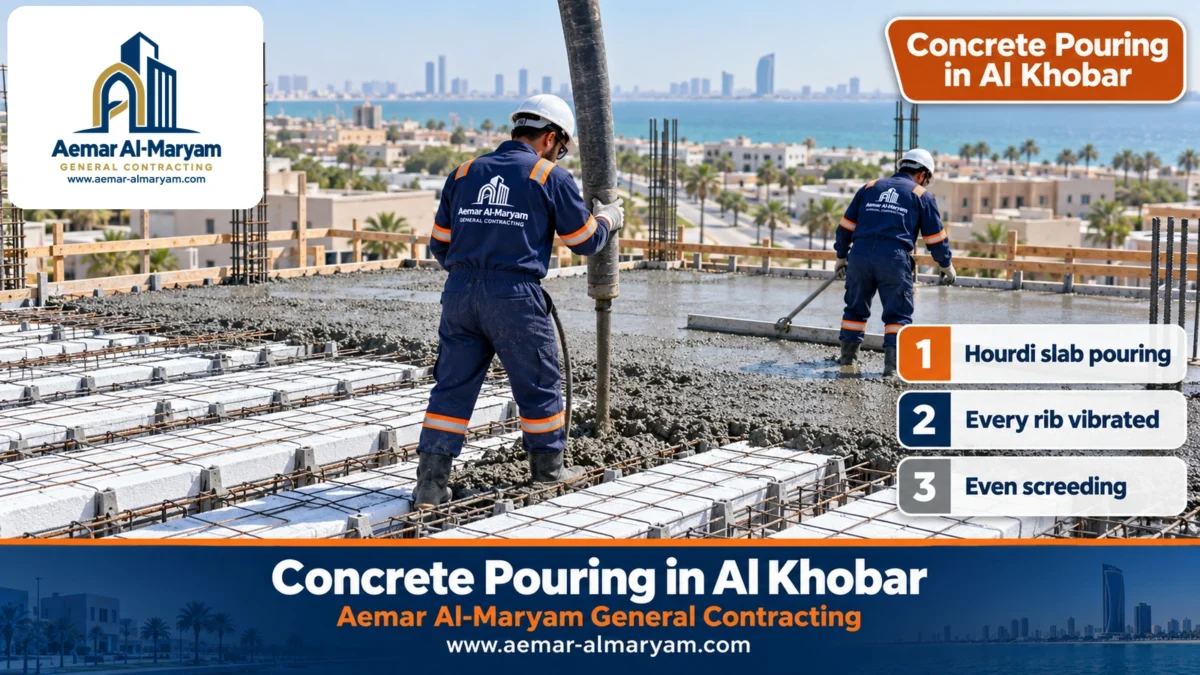
Roof slab pouring in Al Khobar’s new villas usually means an hourdi slab placed by a boom pump from the street. The pour itself takes a single day for one floor of an ordinary villa, but it sits between several days of formwork and steel fixing beforehand and at least 7 days of curing afterwards, with props staying in for a week or more depending on the span. That is the scene in this article’s main image: rows of blocks between the ribs, the top mesh on chairs, and the concrete advancing from one edge of the slab.
Hourdi slabs in Al Khobar: what they are and why villas use them
An hourdi slab in Al Khobar is cast over rows of hollow blocks (cement or expanded polystyrene foam) laid between reinforced concrete ribs; the ribs and blocks are then covered by a concrete topping that carries a steel mesh. The blocks fill space the slab does not need structurally, so the roof is lighter and needs less concrete per square metre, and foam blocks also reduce heat transfer through the roof. Whether a roof is hourdi or solid is the designer’s decision, not the contractor’s, because it depends on spans, loads and beams.
| Comparison | Hourdi slab | Solid slab |
|---|---|---|
| Concrete per m² | Less, because of the blocks | More, the whole slab is concrete |
| Weight | Lighter | Heavier |
| Set-out | Blocks laid accurately on rib lines, then steel | Flat deck, bottom and top mesh |
| Vibration | Vertically into the ribs, carefully so blocks do not shift | On a regular grid across the slab |
| Electrical conduits | In the topping or between blocks, per design | Laid inside the slab before the pour |
| Who decides | The engineering office, from spans and loads | The engineering office |
On an hourdi roof we check that blocks are whole, because a cracked block lets concrete pour into its cavity; that cement blocks are wetted before the pour so they do not draw water out of the mix; that rib width and rib steel match the drawing; and that the top mesh sits on chairs at the right height rather than being trodden flat onto the blocks.
Running an hourdi pour day in Al Khobar
- 1Formwork and steel sign-off
The supervising engineer checks forms, props, rebar, spacers and services. We do not fix a pour time until he approves. - 2Clean and wet
We clear timber off-cuts and tie wire from the deck and wet the forms and cement blocks so they do not pull water out of the fresh concrete. - 3Pump and trucks arrive
The pump position is agreed the day before, and trucks are spaced so none waits in the sun. - 4Beams and ribs first
We start at one edge, filling the downstand beams and ribs, with the poker vibrator inserted vertically into every rib. - 5Topping and screed
We complete the topping over the blocks to the specified thickness, screed it with an aluminium straightedge and check levels. - 6Start curing
Once the surface resists marring we start spraying or lay wet hessian, and keep it up for at least 7 days.
Before the roof is poured
Ask about AC openings, drain penetrations and conduit routes now, not after the pour. A sleeve set before the pour costs far less than a hole drilled later; if you do need one afterwards, the answer is core drilling in Al Khobar, not breaking the slab.
Pre-pour checklist for a roof slab in Al Khobar
The pre-pour checklist for a roof slab in Al Khobar is the last thing we go through the evening before, because any gap found while the pump is standing costs both time and money:
- ✓Props and bracing are firm and spaced to carry wet concrete, workers and the pump line.
- ✓Form joints are sealed so grout does not leak and leave exposed aggregate.
- ✓Spacers and chairs are in place and the top mesh has not been flattened.
- ✓Conduits, sleeves and service openings are fixed and their ends capped.
- ✓At least two working vibrators plus a spare, and a generator if site power is not available.
- ✓Enough lighting for a night pour, and water, hessian and polythene ready for curing.
- ✓A clear route for the pump and trucks, and the neighbours told about the pour time.
Annex or roof-room slab in Al Khobar
Pouring an annex or roof-room slab in Al Khobar first needs an addition permit through an engineering office, and a check that the columns below can carry the extra load. The quantity is often small, so a pump can still work out cheaper than hand placing when the roof is high. For the annex itself, walls, insulation and finishes, see annex and majlis building in Al Khobar.
How many cubic metres does a Khobar villa roof need?
Roof concrete is worked out as area times thickness, plus the beams. A 200 m² solid slab at 15 cm needs 30 m³ for the slab alone, then the downstand beams from the drawing, then roughly 3 to 5 % for waste. An hourdi slab needs less per square metre because the blocks take up part of the volume; the exact figure comes from the bill of quantities on the drawing. For a quick weight check, a cubic metre of reinforced concrete weighs about 2,400 to 2,500 kg.
Column pouring in Al Khobar apartment buildings: crane bucket and internal vibration
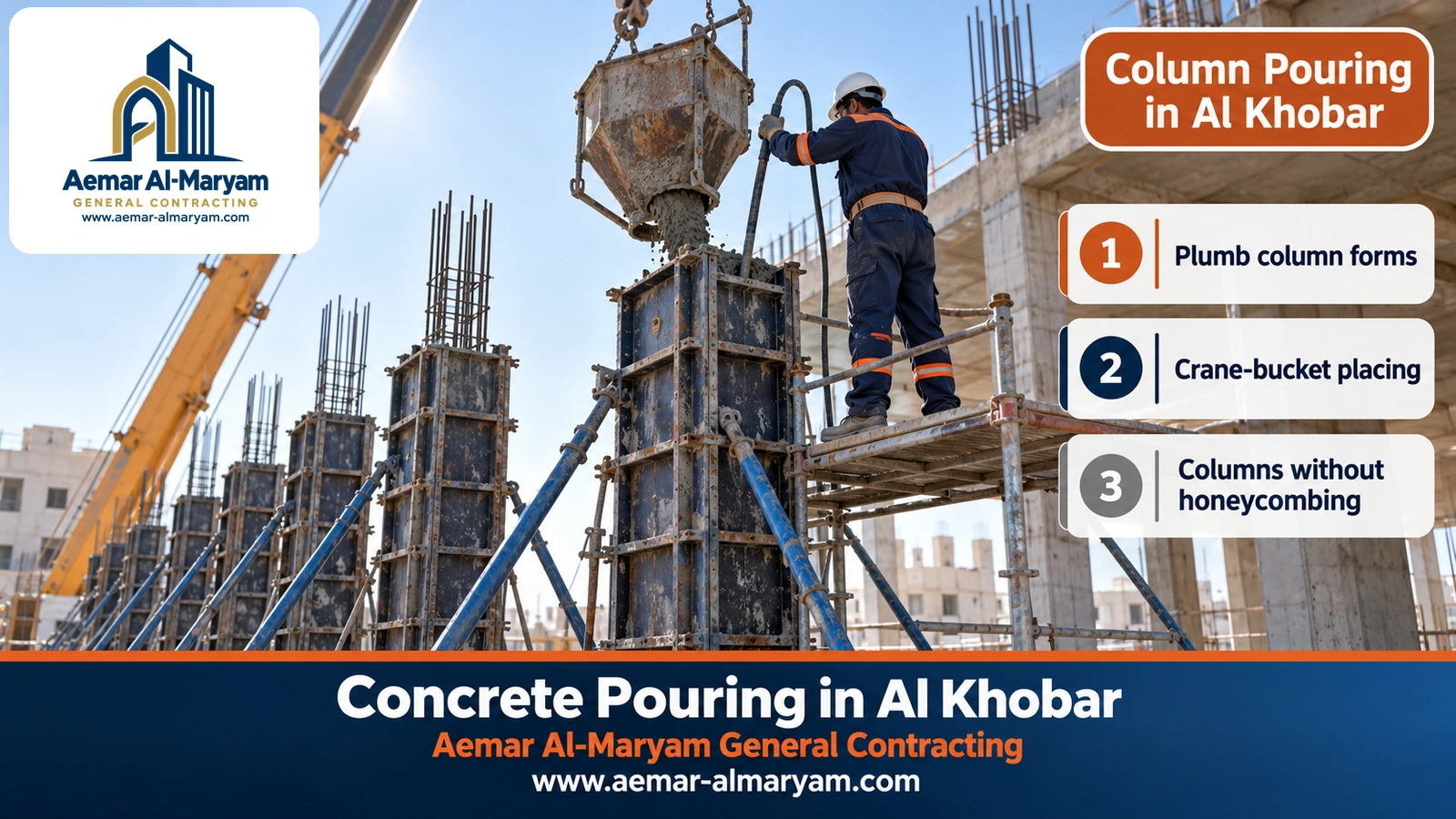
Column pouring in Al Khobar apartment buildings is usually done with a concrete bucket hung from the tower crane and discharged into the top of the column, or with the pump hose when the volume is large and access allows. The bucket suits columns because each one takes a small quantity at a time, and because a column has to be filled in layers, each vibrated before the next one goes in.
Why columns are filled in layers
A column is tall and narrow. Dropped in one go from the top, concrete separates, the coarse aggregate gathers at the bottom, and the column comes out honeycombed at its base. So we fill in layers of no more than about 50 cm, lower the internal vibrator vertically so it reaches about 15 cm into the layer below, hold it for 5 to 15 seconds per insertion and withdraw it slowly. We never use the vibrator to push concrete sideways, because that separates the mix.
As a guide to consistency, ACI tables suggest a slump of 25 to 100 mm for columns, beams and reinforced walls, but in hot weather the Saudi concrete code requires at least 75 mm at placing. Where the mix is designed with superplasticiser for pumping, the plant sets the value.
Columns before the slab, or with it?
In Khobar apartment buildings columns are normally poured a day or more before the slab, and the slab formwork is then built over them. That lets us inspect the columns once their sides are struck and deal with any defect before the slab covers them. In some small villas a column is poured together with the slab on the same day if the design allows, but that needs extra care with vibration because the column is filled from above through the pump hose. Either way, the column is stopped at the beam soffit level the engineer sets, and the joint is cleaned and wetted before the next pour so the two parts bond.
What sets apartment buildings apart is repetition: the same columns and the same slab every few weeks. So we fix a repeating cycle for each floor covering steel, formwork, pour, curing and striking, reuse the steel column forms after cleaning and oiling them, and keep cube results floor by floor so the owner knows the upper floors match the lower ones.
Plumb and cover in apartment columns
- ✓Plumb: checked with a plumb line or laser before and straight after the pour, because a lean doubles its effect on the floors above.
- ✓Raking props: hold the form from at least two sides so wet-concrete pressure does not push it out of line.
- ✓Concrete cover: 40 mm for columns not exposed to weather in the ACI 318 table that the Saudi code is built on; the designer increases it in aggressive exposure.
- ✓Striking the sides: column sides usually come off after about 12 to 24 hours, then wetting or polythene wrapping starts at once.
- ✓Cube samples: taken from the trucks that fed that floor’s columns and crushed at 7 and 28 days.
Staircase pouring in Al Khobar: an inclined form and steps poured from the bottom
Staircase pouring in Al Khobar needs an inclined form at the drawing’s pitch and a riser board for every step. The stair is poured either with the slab on the same day or separately afterwards at a construction joint the engineer specifies. We always start at the bottom and work up, because fresh concrete placed from the top slides down to the lower steps and leaves the upper ones short.
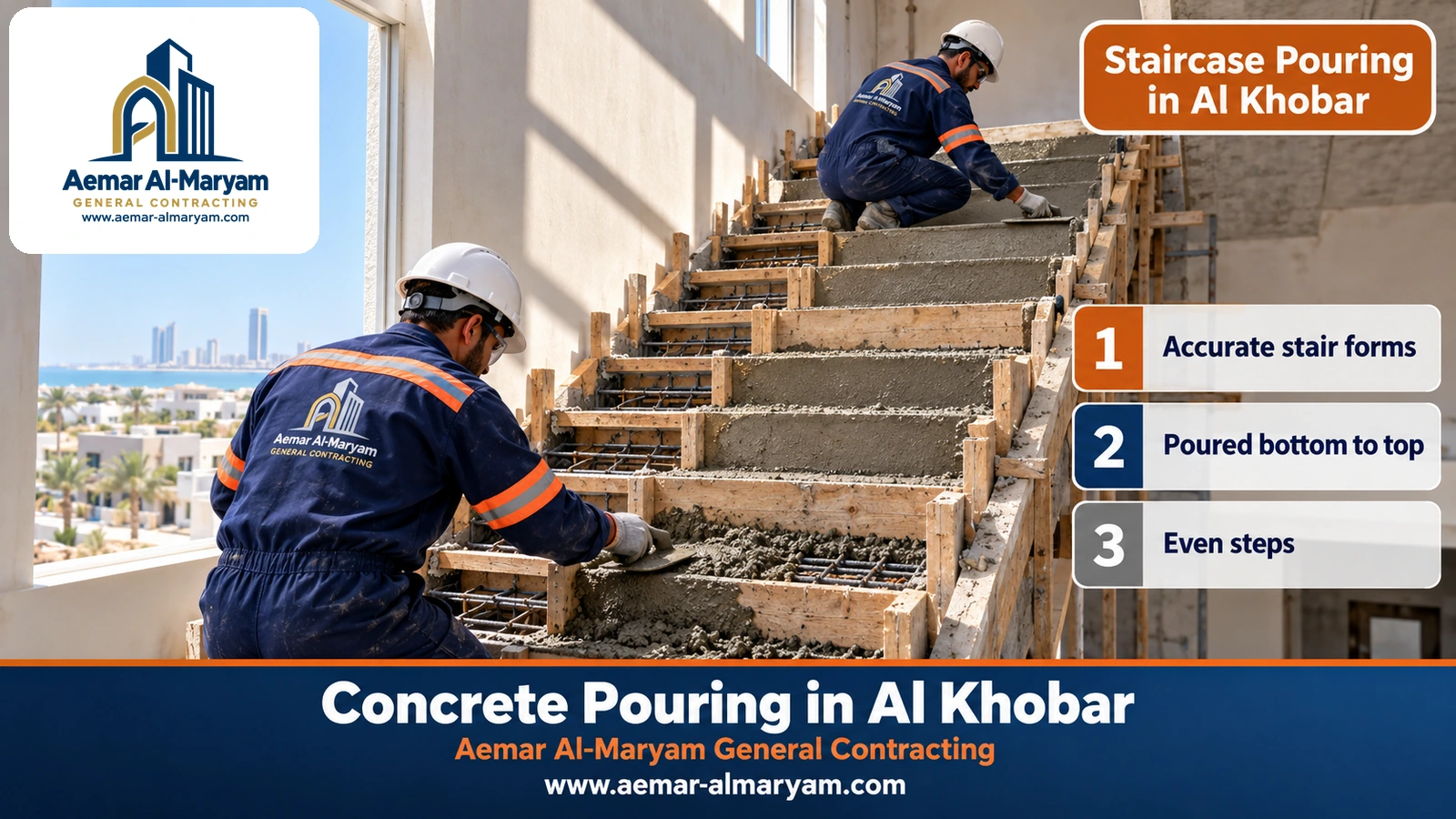
What matters to you as the owner is that every riser height and every tread depth is the same, as drawn. Even a small difference is felt by anyone climbing the stairs, and it is hard to correct with tiles later. So we check the riser boards before the pour, fix them so they do not bulge under the concrete pressure, and allow for the thickness of the tile or marble that will finish the stair so the first and last steps come out equal after finishing. If you plan marble cladding, talk to the tile installer in Al Khobar before the pour to agree levels.
Stair props stay in for about as long as slab props, at least 7 days for short spans, and the engineer decides when they come out depending on the length of the flight and the load on it. The stair should not be used to carry heavy materials before the concrete has gained enough strength.
Footings and ground beams in Al Khobar near the coast: start with the salty ground
Footings and ground beams in Al Khobar start with a question few people ask: what is in the soil and groundwater under this plot? Over large parts of the Eastern Province groundwater sits shallow and may carry chlorides and sulphates, and districts near the sea such as Al Khobar Al Janubiyah are also exposed to airborne salt. So we do not pour before we have seen the soil report and the concrete specification the designer wrote from it.
Blinding concrete in Al Khobar under footings and ground beams
Blinding concrete in Al Khobar is a thin lean-concrete bed, normally between 5 and 10 cm, placed on compacted soil at the bottom of the excavation. It gives a clean, level surface on which the footing steel is fixed and the spacers are set, and it keeps soil out of the footing concrete. Our labour for this bed starts at SAR 14 a square metre; the concrete itself is billed at the plant price.
Pouring footings, necks and ground beams
After blinding come isolated, combined or strip footings according to the design, then the column necks, then the ground beams linking footing to footing, which also support the ground-floor blockwork. We vibrate each footing on a regular grid, pour the necks in layers as we would a column, and keep slump within the 25 to 75 mm range ACI tables give for footings, subject to the code’s 75 mm minimum in hot weather.
Sulphate-resisting cement in Al Khobar: is it enough on its own?
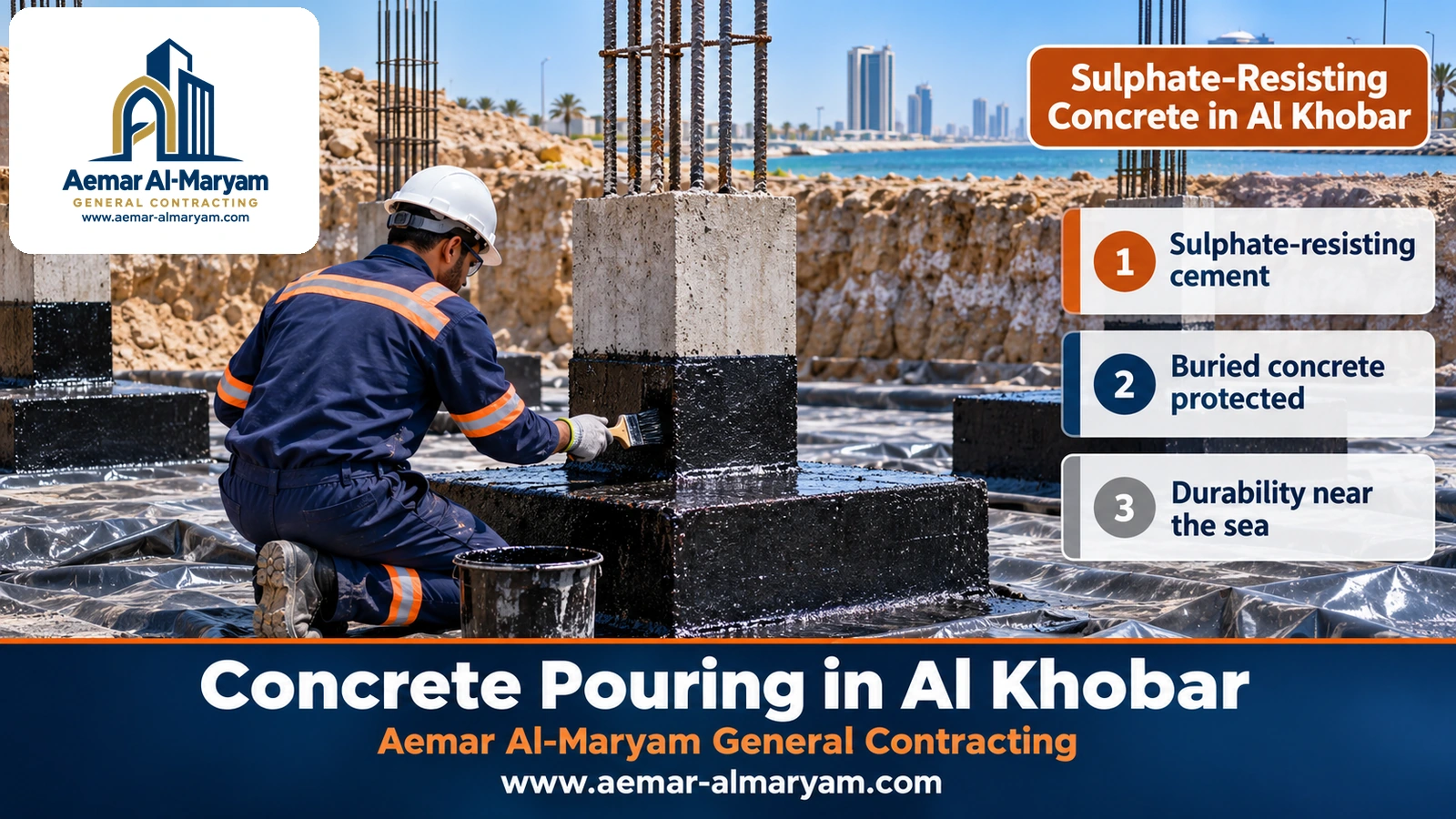
Sulphate-resisting cement (Type V, sold by plants as «resistant» concrete) protects the concrete itself from sulphate attack, but it does not protect the reinforcing steel from chlorides. A published study from a King Fahd University of Petroleum and Minerals team, testing concrete buried in Eastern Province sabkha, showed this clearly: corrosion currents in steel inside Type V concrete were close to those in ordinary cement, while blends with slag or silica fume cut them sharply; with 10 % silica fume the reduction was around 38 times.
The Saudi concrete code classes sabkha as very severe exposure and requires a water–cementitious ratio of no more than 0.35 there, with exposed surfaces protected by full tanking or an epoxy-based coating. Where sulphates and chlorides occur together, the lower water ratio and the higher cement content of the two tables apply. In the ACI 318 sulphate classes, moderate class S2 calls for Type V cement and a ratio no higher than 0.45, and class C2 (chlorides with moisture) calls for no more than 0.40.
What we do and what the designer decides
We do not choose the cement type or the water ratio ourselves. From the soil report the designer sets the exposure class, the cement (ordinary, resistant or blended), the water ratio, the cover and the protective coating. Our job is to order the mix to that specification, reject any truck that does not match it, add no water on site, and coat the buried concrete before backfilling.
Concrete cover to footing steel in Al Khobar
| Element | Minimum cover in the ACI 318 table | Note |
|---|---|---|
| Cast directly against earth | 75 mm | Footings on soil with no blinding |
| Exposed to weather or earth, bars 19 mm and larger | 50 mm | Necks and ground beams after backfill |
| Exposed to weather or earth, bars 16 mm and smaller | 40 mm | Boundary walls and external elements |
| Columns and beams, not exposed | 40 mm | Inside the building |
| Interior slabs, not exposed | 20 mm | Internal roof slabs |
These are minimums, and the designer raises them in aggressive ground. We fix concrete spacers of the right size before the pour, because steel that touches the form or the soil is the first to rust.
Bitumen coating of buried concrete before backfilling
Once the footing and neck forms are struck, and before backfilling, we coat every surface that will touch the soil with bitumen, or wrap it in the membrane the designer specifies, and lay polythene under ground slabs. This stage is priced after inspection. For full roof and foundation waterproofing and insulation we refer you to roof waterproofing and insulation in Al Khobar.
Ready-mix concrete in Al Khobar: from the plant to your formwork
Ready-mix concrete in Al Khobar is ordered by us from the nearest licensed plant at the grade on the drawing, and we carry out the pour; we are not a plant and do not sell concrete on its own. The cubic metre is charged at the plant’s invoice on the day with nothing added by us, and labour is written as a separate line.
Ready-mix price per cubic metre in Al Khobar
No official price is published for Khobar specifically, but the national averages published by the General Authority for Statistics give a close reference: ordinary 250 averages about SAR 194.53 a cubic metre, ordinary 350 about 214.10, resistant 250 about 202.67 and resistant 350 about 223.67. Haul distance, admixtures such as retarders, and the pump come on top.
| Plant grade name | Kingdom-wide average, SAR per m³ | Where it usually goes |
|---|---|---|
| Ordinary 250 | 194.53 | Lean bed under footings, light ground slabs |
| Ordinary 350 | 214.10 | Roof slabs, columns and beams above ground |
| Resistant 250 | 202.67 | Light elements in sulphate-bearing ground |
| Resistant 350 | 223.67 | Footings and ground beams in aggressive ground |
The number after the grade (250 or 350) is compressive strength in kilograms per square centimetre in market usage, so grade 350 is roughly 34 MPa. The actual grade for each element is set by the designer.
Receiving the truck on site
- ✓Delivery ticket: we read the grade, cement type and batching time before the truck starts to discharge.
- ✓No water after discharge starts: the Saudi code forbids retempering, and ASTM C94 forbids adding water once discharge has begun.
- ✓Delivery time: in hot weather discharge within two hours is allowed only with retarding admixtures; late loads are rejected.
- ✓Slump test: measured from the trucks, and loads outside the required range are turned away.
- ✓Samples: cubes taken during the pour and crushed in a laboratory.
Concrete pumps in Al Khobar: boom or line pump?
A boom pump with its long arm suits villa and apartment roofs when it can stand near the building. A line (stationary) pump pushes concrete through pipes over long horizontal runs, which suits back yards and spots the boom cannot reach. Before pour day we check where the pump and trucks will stand, overhead cables and trees, and whether trucks can pass without blocking a neighbour’s entrance. The pump is charged at the hire cost by type and hours, and trucks kept waiting cost extra, so the site is ready before the first truck arrives.
Floor and yard slab pouring in Al Khobar: yards, parking and driveways
Floor slab pouring in Al Khobar covers villa yards, car parking, garden paths and house entrances, as well as shop and small warehouse floors. Every external slab starts from the same place: what lies beneath it. Services go in first, get tested and have their routes photographed, the soil is compacted and wetted, and only then do we pour.
Mesh-reinforced yard slab in Al Khobar
A 10 cm yard slab in Al Khobar reinforced with 8 mm mesh on chairs starts at SAR 46 a square metre with materials: soil compaction and wetting, termite treatment, heavy polythene, the mesh, pumped concrete, screeding and curing. Very small yards cost more per square metre because the pump and truck costs are much the same. We leave gentle falls toward the drainage points, and movement joints spaced by the installer according to the area, so the slab does not crack at random.
If the yard is going to be tiled or laid with interlock, a light blinding may be enough instead of a reinforced slab. Compare the options with interlock paving in Al Khobar and, for larger parking areas, the asphalt contractor in Al Khobar.
Before any slab on the ground
Drain, supply and electrical pipes under the yard must be tested before they disappear under concrete. Ask the plumber and the electrician to finish and photograph their work, and then we set the pour date.
Stamped concrete driveways in Al Khobar
Stamped concrete in Al Khobar starts from SAR 110 per square metre. It is a concrete slab that is coloured and pressed with rubber pattern mats while still fresh, giving the look of stone or tile, then washed and sealed. It suits car entrances and paths around villas, and gives the appearance of stone without the many joints where weeds take hold or pavers sink.
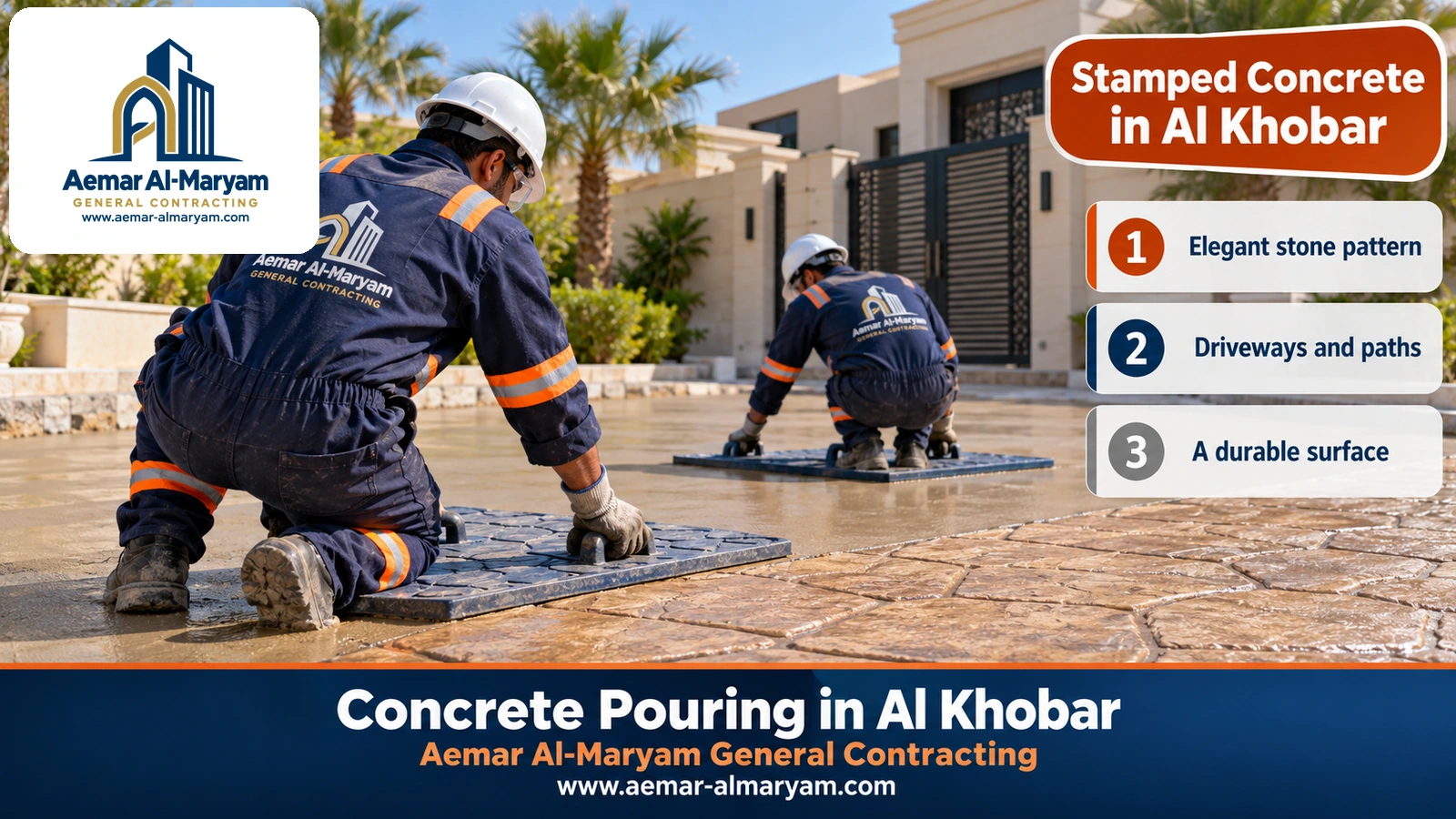
Timing matters more than anything here. Stamp too early and the mats sink and blur the pattern; stamp too late and the pattern will not take. So in summer we pour driveways in the early morning and run two crews, one placing and levelling and one stamping. The guidance commonly given by stamped-concrete installers is foot traffic after about 24 hours, cars after 3 to 7 days, and resealing every 3 to 5 years. Hairline cracks are normal in concrete; a crack wider than 3 mm deserves a closer look.
Power-trowelled (helicopter) floors in Al Khobar
A power-trowelled floor in Al Khobar is priced from SAR 46 a square metre all-in, for an area of about 50 m² or more, and suits shops, small warehouses, workshops and building car parks. After placing and screeding we wait until the concrete has stiffened enough, usually somewhere between half an hour and an hour and a half depending on the heat, then the helicopter machine trowels the surface until it is smooth and dense, and a curing compound is sprayed straight after. Heavier warehouse slabs, with thicker sections and extra steel for racking or forklifts, are priced on site.
Roof slope screed in Al Khobar: on the roof, before waterproofing
A roof slope screed in Al Khobar sits on top of the structural slab and creates the falls that carry rain to the outlets. Prices begin at SAR 17 a square metre in lightweight foam concrete and SAR 23 in heavier, harder cement mortar. Typical falls are 1 to 2 % toward each outlet, and it can usually be walked on after about 48 hours. A slope screed is not waterproofing: the membrane goes on top, which is covered in roof waterproofing in Al Khobar. Water standing on a roof with poor falls is the most common way roofs fail in the Eastern Province.
Pouring in Khobar’s summer heat: what the code requires
Pouring in a Khobar summer needs planning the day before, not decisions on site. The mean daily maximum in neighbouring Dammam is close to 45 °C in July, and sun and wind pull water out of the concrete surface fast, so plastic shrinkage cracks can appear within hours of the pour. The Saudi concrete code is clear about hot-weather concreting:
| Requirement | Value | What we do |
|---|---|---|
| Mix temperature as it is placed | 35 °C maximum | Ask the plant for chilled water or ice; pour at dawn or night |
| Time from batching to discharge | Up to two hours if a retarder is used | Space the trucks to a schedule |
| Slump at placing | At least 75 mm | Measured for each truck |
| Retempering with water | Not allowed | Reject the truck rather than add water |
| Moist curing period | A week as a minimum | Spraying, wet hessian or polythene |
| If moist curing stops after day 3 | Curing paper, reflective sheeting or curing compound | Keep the surface covered, never bare |
ACI hot-weather guidance treats plastic shrinkage cracking as a strong possibility once evaporation exceeds 1 kg per square metre per hour, with precautions from 0.5. On days like that we put up windbreaks, fog-spray over the surface and start covering early.
Curing concrete with water in Al Khobar: a week as the minimum
Curing concrete with water in Al Khobar means the surface stays wet for no less than a week after pouring, starting as soon as the surface resists marring. The methods are spraying or ponding, wet hessian, polythene sheeting, or a white curing compound where spraying is not practical, since the white pigment reflects part of the sun’s heat. ACI guidance keeps moist curing for 7 days or until the concrete reaches 70 % of its specified strength, and recommends curing water close to the concrete’s own temperature rather than very cold.
Who does the curing? We write it into the agreement. If the site is away from your daily routine we handle it with regular visits; if the owner lives next door and prefers to spray himself, we explain the timing and method. What matters is that the surface is never left to dry out in the first days.
When to strip formwork in Al Khobar
Formwork in Al Khobar comes down in stages: vertical faces go first, roughly half a day to a day after the pour; slab shores follow after a week or more on short spans; beam shores stay two to three weeks according to span. These are guide values from ACI practice manuals and the Indian standard used in the table below, and the supervising engineer decides on your project.
| What is struck | Guide period after the pour |
|---|---|
| Vertical faces (columns, walls, beam sides) | Half a day to one day |
| Shores under slabs spanning less than 6 m | One week |
| Shores under slabs spanning more than 6 m | Ten days |
| Shores under beams spanning less than 6 m | Two weeks |
| Shores under beams spanning more than 6 m | Three weeks |
Heavy construction loads on the slab, such as blocks stacked for the next floor, can call for longer. We never pull all the props at once; we work from mid-span out toward the supports.
Slump and cube tests in Al Khobar
The slump test measures the consistency of the concrete on site before it is placed; the cube test measures its strength once it has hardened. Samples are taken during the pour and crushed in a laboratory at 7 days as a check and at 28 days for acceptance. ACI 318 sets well-known sampling frequencies: at least one set per day of pouring, per roughly 115 m³ and per roughly 465 m² of slab or wall. Acceptance requires every average of three consecutive results to equal or exceed the specified strength, with no single result more than about 3.5 MPa below it. Laboratory fees are charged at their invoice.
Concrete pouring prices in Al Khobar
Concrete pouring prices in Al Khobar are the same as our Dammam prices, and they separate labour from materials: some items are priced per square metre with materials included, one is labour only, and the structural elements are priced from the drawings. All of these are estimates that we confirm after the site visit and agreement.
| Work | Measured per | Starting price | Comment |
|---|---|---|---|
| Blinding labour | m² | SAR 14 | Concrete at the plant invoice |
| Yard slab, 10 cm, 8 mm mesh, with materials | m² | SAR 46 | Higher rate on very small yards |
| Helicopter-finished floor, with materials | m² | SAR 46 | Minimum area around 50 m² |
| Slope screed in foam concrete | m² | SAR 17 | Membrane not included |
| Slope screed in cement mortar | m² | SAR 23 | Harder and heavier |
| Stamped concrete for driveways and paths | m² | SAR 110 | Sealer included |
| Roof slab labour, hourdi or solid | m² | After inspection | Worked out from the BOQ |
| Labour for footings, ground beams, columns | m³ or per element | After inspection | Depends on count and floor |
| Concrete staircase | — | After inspection | By number of steps and shape |
| Heavy-duty warehouse floor | — | After inspection | By loading |
| Bitumen coating of buried concrete | — | After inspection | Every surface touching soil |
| Ready-mix concrete | m³ | At the plant invoice | National reference about SAR 214 for ordinary 350 |
| Pump | per hour or per pour | At hire cost | Type chosen for the site |
| Cube testing | per set | At the lab invoice | Crushed at 7 and 28 days |
Anything marked «after inspection» we can still estimate in advance from the drawing and a few site photos on WhatsApp 0547879578, then firm up at the visit. Our other services are listed with their starting prices in the price guide.
Worked example: a 6 × 9 m stamped concrete driveway in Al Khobar
This is an illustration of how the starting price is built up, not a final quote. A villa driveway 9 m long and 6 m wide:
- ✓Area: 6 × 9 = 54 m².
- ✓Starting price for stamped concrete: 54 × 110 = SAR 5,940 «from».
- ✓Concrete volume if the drawing says 10 cm: 54 × 0.10 = 5.4 m³, or about 5.67 m³ with roughly 5 % allowance.
- ✓Approximate concrete share at the national average for ordinary 350: 5.67 × 214.10 ≈ SAR 1,214, which is part of the all-in price, not added to it.
- ✓What can change the figure: removing an old surface, special falls, a more complex pattern, or two colours instead of one.
If the driveway has old tiles or cracked concrete that must come out first, that is a separate item with demolition in Al Khobar, or a clean saw-cut edge from concrete cutting in Al Khobar.
Why one Khobar pour costs more than another
- ✓A very small quantity that still carries the cost of a full pump and truck.
- ✓A high roof or a back-of-plot location that needs a long boom or a long pipeline.
- ✓A resistant or specially blended mix required by the soil report.
- ✓A summer night pour with chilled water and retarder.
- ✓Complex formwork: many downstand beams, a curved stair, projections.
- ✓Removing an old slab or unsuitable soil before pouring.
Does a concrete pour in Al Khobar need a permit?
Any new structure requires a building licence issued against approved drawings. Adding a slab, columns or a roof room counts as adding or altering building components, applied for through a contracted engineering office on the Balady platform, which usually takes about 10 days. Pouring a yard slab inside your plot as maintenance generally needs no permit, but check Balady for your own plot. On our side, structural concrete is only placed from an approved drawing under the engineering office’s supervision, and we decline to pour any added slab or column that has no licence.
Common concrete pouring mistakes in Al Khobar
■ Adding water to the truck
It makes placing easier but raises the water ratio, weakens the concrete and lets salts in faster, and the code forbids it.
■ Pouring at midday in summer
Concrete temperature passes 35 °C and water evaporates fast, so cracks follow.
■ Too little or too much vibration
Too little leaves honeycombing; too much separates paste from aggregate. We follow a regular grid.
■ Forgetting spacers
Steel without cover rusts first, and near the Khobar coast it happens sooner.
■ Backfilling without coating
Buried concrete with no bitumen in salty ground is the start of a problem a few years later.
■ Striking props too early
It causes sagging or cracking in the slab, which costs far more to repair later.
If cracks or honeycombing show up in existing concrete, the answer lies with crack repair in Al Khobar or the renovation contractor in Al Khobar, not a new pour over the defect.
Pouring alongside our other work in Al Khobar
A pour is one link in a chain: excavation and services before it, plastering, waterproofing and finishes after it. Because we do this work in Khobar too, we can put it on a single programme instead of leaving you to coordinate several contractors:
- ✓Plastering in Al Khobar: mesh at block-to-column and block-to-beam junctions once the frame is up.
- ✓Roof waterproofing in Al Khobar: membrane over the slope screed, and foundation protection.
- ✓Core drilling in Al Khobar: service holes through existing slabs.
- ✓Concrete cutting in Al Khobar: openings or alterations in cast concrete.
- ✓Annex building in Al Khobar: a complete roof annex or outdoor majlis.
- ✓Interlock in Al Khobar: the alternative to a concrete slab in yards and paths.
Why Aemar Al-Maryam for concrete pouring in Al Khobar?
■ Close to your site
Khobar is a short drive from our Dammam base, so curing checks and striking visits are easy to keep up.
■ Itemised prices
Labour separate from materials, with concrete, pump and laboratory at their invoices.
■ Working to the code
35 °C limit on concrete temperature, no water on site, 7 days of curing, and cube samples.
■ Used to coastal ground
We order the mix as the designer wrote it and coat buried concrete before backfilling.
■ Many elements, one contractor
From blinding to stamped concrete, plus plastering, waterproofing and cutting.
■ Direct contact
Phone and WhatsApp 0547879578, with an estimate once you send photos and dimensions.
Khobar districts we pour in, and nearby cities
Districts where we pour in the city include the Green Belt (Al Hizam Al Akhdar), Al Hada, Al Olaya, Al Aqrabiyah, Al Thuqbah, Madinat Al Ummal and Al Khobar Al Janubiyah, and other neighbourhoods besides. We also pour in Dammam, where we are based, in neighbouring Dhahran, and in Qatif, Saihat, Jubail and the rest of the Eastern Province. For the full pouring guide with more on blinding, pumps and floor types, see concrete pouring in Dammam, and for photos of our work, the projects gallery.
How to book concrete pouring in Al Khobar
You can book concrete pouring in Al Khobar by calling or sending a WhatsApp message to 0547879578. Pricing is quicker if you include:
- ✓The element: hourdi roof, columns, stairs, footings, yard, stamped driveway, slope screed.
- ✓The drawing: a photo of the structural drawing or bill of quantities if you have one, or approximate sizes.
- ✓District and site: the Khobar district name, and photos of the street, the entrance and where a pump could stand.
- ✓Soil report: if the plot is near the coast or the pour is for foundations.
- ✓Level: ground floor, first or second-floor roof, or the top roof.
- ✓Timing: your preferred date and whether a dawn or night pour suits you in summer.
- 1Send the details
Photos, drawing and sizes on WhatsApp. - 2Estimate
Labour cost, plus an estimate of concrete quantity and the expected plant price. - 3Site visit
Measuring and checking access, formwork, steel and levels. - 4Confirm and schedule
Concrete and pump are booked and the pour hour is set. - 5Pour, cure, hand over
Placing, vibrating and screeding, a week of wet curing, timely striking and the cube report.
Your Khobar roof or driveway starts with a message
Send the drawing or sizes and site photos; we work out the quantity, suggest the right pour time and send you the labour cost with the expected concrete price.
Useful links before a pour in Al Khobar
- ➤ Concrete pouring service
- ➤ Concrete pouring guide for Dammam
- ➤ Annex and majlis building in Al Khobar
- ➤ Roof waterproofing and insulation in Al Khobar
- ➤ Interlock paving in Al Khobar
- ➤ Asphalt contractor in Al Khobar
- ➤ Core drilling for services in Al Khobar
- ➤ Renovation work in Al Khobar
- ➤ Construction
- ➤ Price guide
- ➤ Book a site visit
Tags