Concrete pouring in Dhahran is what Aemar Al-Maryam General Contracting delivers from our base in neighbouring Dammam. On a typical villa we treat the soil against termites and lay the blinding, pour the footings, ground beams and columns, place the ground-floor slab with a stationary line pump and a vibrating screed, then cast the roof slabs and strike their formwork in the order that protects them. The lowest labour rate is SAR 14 for each square metre of blinding; a yard slab with mesh at 10 cm costs from SAR 46 a square metre with all materials in, and foam-concrete falls on a roof from SAR 17 a square metre. Other elements are measured from the drawings. Ready-mix, the pump and the laboratory are charged at the plant’s, hire company’s and lab’s price on the day, and all of these remain estimates until we have inspected and you have approved the work. Call or text 0547879578.
The bulk of the Dhahran requests we handle come from families building a villa or adding an annex, and the questions repeat themselves. Who makes sure the ground is treated before it disappears under concrete? How does concrete reach a ground-floor slab when the boundary wall is already up? When is it safe to take the props out from under a new roof without harming it? This page is organised around those questions. It carries the same price table we publish for Dammam and a worked example for the blinding of a villa’s foundations, so you can see where the money goes before you book a visit.
Concrete pouring in Dhahran at a glance
- What we pour: blinding, footings, necks and ground beams, columns, ground-floor slabs, solid and hordi roof slabs, annex slabs, stairs, yards, power-trowelled floors and slope screeds.
- Foundation sequence: compact the soil, spray termite treatment, pour the blinding, then fix the steel and the forms.
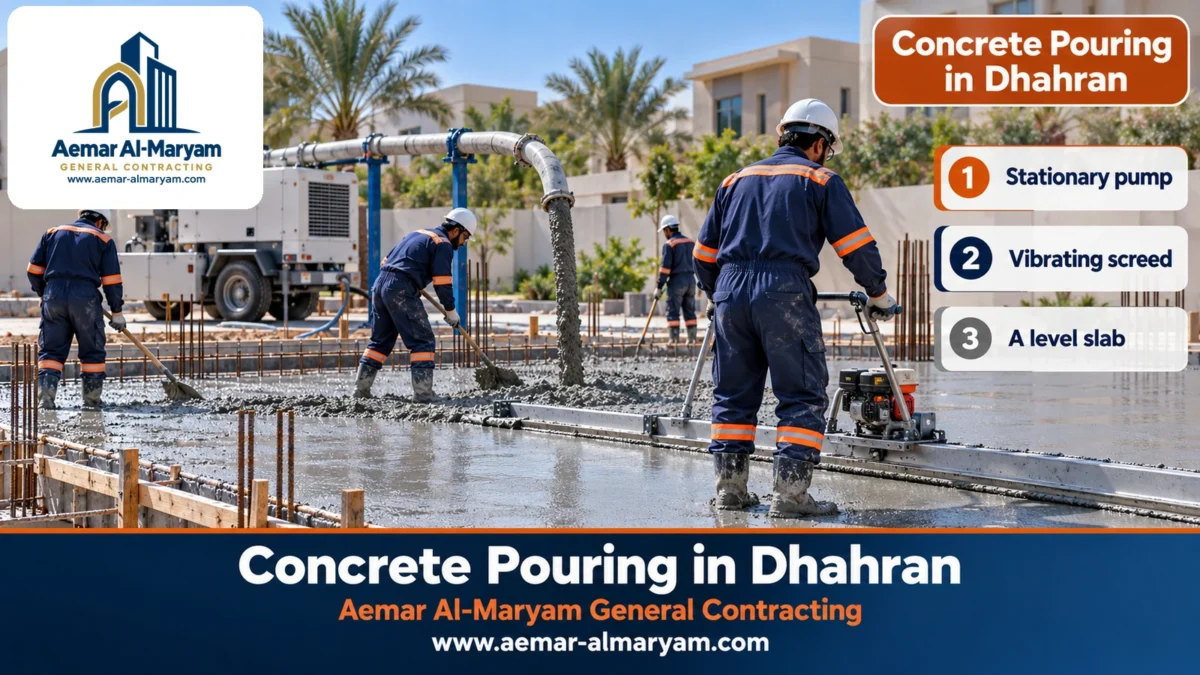
- Villa ground slabs: a stationary pump with a steel pipeline across the courtyard and a vibrating screed riding on the edge forms.
- Starting rates per m²: blinding labour 14, reinforced yard with materials 46, helicopter-finished floor 46, foam falls 17, mortar falls 23, stamped concrete 110 (SAR).
- Striking order: sides first, then slab panels with props left in, then slab props, then beam props, and cantilevers last.
- Access: Dhahran sits in our near zone with Dammam and Al Khobar, so there is no separate travel charge.
- To book: 0547879578 with your drawings and photos of the gate and boundary wall.
Concrete pouring in Dhahran: from the foundation pit to the last roof
We pour every concrete element a villa or an annex in Dhahran needs, and we can take on the whole package, from shuttering and steel fixing to curing, or only the pour itself if your structural contractor has already built the forms. What changes from one plot to the next is how the concrete reaches each element and the order in which the stages follow each other, so the first thing we ask is how far the job has progressed.
■ Below ground
Soil compaction, termite treatment, blinding, footings, necks and ground beams, and waterproofing of buried faces before backfill.
■ Ground-floor slab
A slab on compacted ground over polythene, placed by a stationary pump, levelled with a vibrating screed and then cured.
■ The frame
Columns, beams, solid or hordi slabs, and stairs cast with the slab or after it.
■ Outside the villa
Yards and parking areas, stamped concrete paths, and roof slope screeds ahead of waterproofing.
Concrete contractor in Dhahran or a concrete company?
A pouring contractor works on site: builds the forms, fixes the reinforcement, coordinates the pump and trucks, places, vibrates, finishes and cures. A ready-mix company is the plant that batches the concrete and delivers it. We are a pouring contractor in that sense and do not own a plant. Many people who search for a “concrete company in Dhahran” actually need both, so we place the order with a plant and run the coordination on the client’s behalf.
Building the entire villa, shell and finishes, is handled by our construction service; here we stay with the pour. The concrete pouring service page gives the brief version.
Ready-mix concrete in Dhahran: who supplies it and who places it?
For Dhahran jobs we buy ready-mix from whichever licensed Dammam-area plant is closest, at the grade written on your drawings. We agree the quantity, the arrival time of each truck and the type of pump with the plant in advance. We do not sell concrete and we add nothing to its price: the plant’s invoice is shown to you untouched, and what we charge for labour appears as its own entry.
Ready-mix price per cubic metre in Dhahran
No official price is published for Dhahran on its own. The closest published benchmark is the Kingdom-wide average in GASTAT’s bulletins: close to SAR 214 per m³ for ordinary 350 and roughly SAR 224 for the sulphate-resisting version of that grade. The price on the day can be higher or lower depending on grade, admixtures, haul distance and the pump, which is why we request the plant’s quotation before the date and pass it to you.
Site-mixed or ready-mix concrete for a villa?
Mixing in a small drum mixer on site works for small, non-structural quantities such as a lamp-post base or a patch on a path. Footings, slabs and roofs are poured with ready-mix: its proportions are controlled at the plant, it arrives in volumes that let an element be cast in one continuous operation without weak stop joints, and the laboratory can test samples taken from it. For a villa structure, site mixing saves little and costs a great deal of certainty.
Blinding concrete in Dhahran, with termite treatment before it
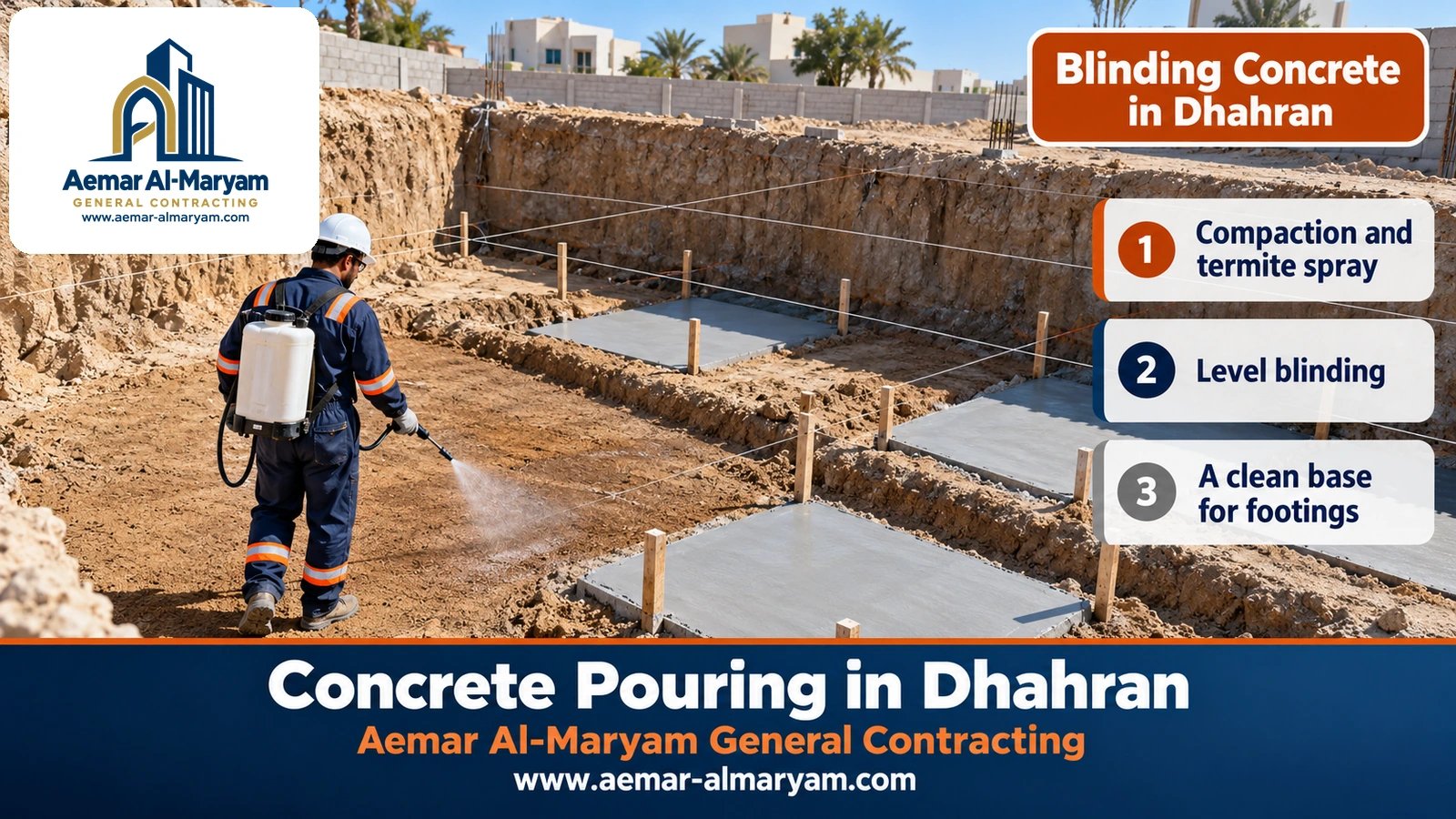
Blinding is lean, unreinforced concrete laid 5 to 10 cm deep, as a rule, under footings and ground beams. It leaves a flat, tidy face for marking out the setting-out lines and the steel placed, and it stops soil from mixing into the footing concrete. On Dhahran villas there is one step before it that must not be postponed: spraying the compacted soil with termite treatment. Once the blinding is down, that soil can never be reached again.
The order of work in a Dhahran villa foundation pit
- 1Excavate and trim
We dig to the level on the drawings, remove loose soil from the bottom, and fix level pegs and gridline strings. - 2Compact and moisten
The base is compacted with a plate or rammer after light wetting so it is firm and will not settle under the concrete. - 3Spray termite treatment
We apply an approved product at the rate on its label, evenly over the bottom and sides of the excavation, and keep traffic off the treated soil. - 4Pour the blinding
The layer is placed at the specified thickness, struck off level, and kept slightly wider than the footing above it. - 5Set out the footings
Once it has hardened, each footing and neck is marked on the blinding and the steel fixer starts.
Treatment does not replace compaction
Loose soil settles under concrete however well it is treated, and the chemical loses its effect if the soil is scraped away afterwards. That is why spraying follows compaction directly, and the blinding follows spraying as soon as possible.
Yard “blinding” in Dhahran
Many owners call a concrete yard floor a “blinding”, but it is really a mesh-reinforced slab, usually about 10 cm thick, laid over polythene on compacted, treated soil. Structural blinding under footings is charged as labour only, from SAR 14 a square metre, while the concrete is billed by the plant; a reinforced yard slab begins at SAR 46 a square metre with every material included. The yard section below explains the build-up.
Footings and ground beams in Dhahran
Footings and ground beams are the part of a villa nobody pours twice, so we treat them with extra care. Before a truck arrives we check the size and level of every footing, the height of the spacer blocks under the bars so the steel keeps enough concrete cover, and that each column neck and its starter bars sit exactly where the drawing puts them. A starter bar out of position at this stage becomes a column out of position on every floor above.
We usually pour footings straight from the truck chute when it can reach the edge of the excavation, or by pump when the boundary wall or the neighbouring plot keeps the truck away. Every footing is compacted with a poker vibrator until no more air escapes and the top stops settling, without overdoing it to the point where the coarse aggregate separates from the mortar.
Waterproofing buried concrete before backfill in Dhahran
Every concrete face that will touch the soil after backfilling, whether footings, necks or ground beams, receives a bituminous coating once it is dry and before any soil goes back around it. Sulphate-resisting cement protects concrete against one family of salts, but on its own it does not protect the reinforcement against chlorides, and an external coating reduces how much reaches the concrete. Our page on roof waterproofing and insulation in Dhahran also covers foundation waterproofing.
Pouring columns in Dhahran
Before any column is poured we check that it is plumb in both directions and that the form is braced so it cannot bulge. We place column concrete in layers and vibrate each one, because dropping a tall column’s concrete from height in one go separates the stones and leaves honeycombing at the base. Column sides come off after about a day, and curing starts at once with water or by wrapping the column in hessian or plastic sheeting.
Villa ground slabs in Dhahran with a stationary pump and a vibrating screed
The ground-floor slab of a villa is a wide slab placed on compacted soil, and a truck often cannot reach it because the boundary wall is built and the ground-floor walls are already standing. In that situation we use a stationary (line) pump that stays in the street, with a steel pipeline running across the courtyard and into the villa, so the concrete reaches the furthest room without a loaded truck crossing the yard.
Stationary pump or boom pump?
| Type | When we choose it in Dhahran | What the site must provide |
|---|---|---|
| Stationary (line) pump | Ground-floor slabs inside the boundary, rear yards, sites set back from the road | A safe, supported pipe route, and time to set up and wash out after the pour |
| Boom pump | Upper-floor and annex roofs within the boom’s reach from the road | Firm ground for the outriggers and no overhead cables |
| Direct from the truck chute | Footings and ground slabs a truck can drive up to | An access route that can carry a loaded truck |
The vibrating screed on the edge forms
A vibrating screed is a long beam that slides along the edge forms or level rails and vibrates the surface of the concrete while striking it off. On large areas it gives a flatter floor than hand screeding. We set the level of the forms with an instrument before the pour, because the screed copies any error in them across the whole floor. On slabs thicker than usual we also use a poker vibrator inside the concrete before the screed passes.
Cold joints: when they happen and how we avoid them
A cold joint is a weak plane that forms when the first concrete starts to set before fresh concrete is placed against it. It usually happens when a truck is late or a pump breaks down. We avoid it by scheduling truck arrivals with the plant, by placing in successive strips so no edge is left exposed for long, and, if we must stop, by stopping where the engineer specifies and preparing that face before the pour resumes.
Before the ground-floor slab is poured
Make sure drainage and supply pipes under the slab have been laid, tested and photographed, and that electrical conduits are in place. Changes after the pour mean cutting or core drilling in Dhahran. Our plumber in Dhahran page covers services laid before a pour.
Roof slab pouring in Dhahran
A roof pour is preceded by days of shuttering and steel fixing, followed by the pour itself, then at least a week of curing and several weeks before the props come out. On a villa roof the pour normally takes part of a single day, and in the hot months we plan it to start at first light.
Hordi or solid slab in Dhahran?
A solid slab is concrete at full thickness. Hordi construction runs concrete joists between rows of hollow blocks under a thin concrete topping. Hordi weighs less and needs a smaller volume of concrete for each square metre, whereas solid slabs are simpler if you need an opening later, because you do not have to locate the ribs first. The choice belongs to the structural designer, and we build what is on the drawings.
Annex or rooftop room slab in Dhahran
An annex roof is small, but it needs the same accuracy. If it sits on top of an existing roof it is an addition to an older building and requires a permit and an engineering office’s drawings, which check the existing columns and footings. Everything about annexes is covered in annex and majlis building in Dhahran.
Pouring stairs with the slab
Concrete stairs are cast with the slab or after it, depending on the drawings. We mark riser heights and tread widths on the formwork before the pour, because correcting steps afterwards means breaking concrete or applying thick render.
Formwork, reinforcement and concrete cover in Dhahran
Good formwork does not move under the load of wet concrete, the crew and the pipeline; its joints are sealed so mortar cannot leak; its face is clean and coated with release oil. The reinforcement is tied with the diameters and spacing on the drawings and held off the forms by spacer blocks and chairs, because the concrete cover is what protects the steel from rust in the Gulf climate.
| Position of the steel | Usual minimum cover |
|---|---|
| Bottom of a footing poured straight onto the ground | 75 mm |
| Ground- or weather-facing concrete with 19 mm bars or thicker | 50 mm |
| Ground- or weather-facing concrete with 16 mm bars or thinner | 40 mm |
| Slabs and walls kept indoors, away from soil and weather | 20 mm |
| Beams and columns kept indoors | 40 mm |
These are the values of the American concrete code table that the Saudi code adopted, and designers increase them in aggressive environments.
Yard slab pouring in Dhahran
A concrete yard floor is built in stages: compact and wet the soil, spray termite treatment, lay thick polythene, place 8 mm steel mesh raised on chairs, then pour about 10 cm of concrete with gentle falls towards the drain, cut joints at spacings the contractor sets according to the area, and cure. You end up with a tough floor that takes hosing down and light cars, or that can be tiled over later.
Power-trowelled (helicopter) floors in Dhahran
A floor finished with a power trowel suits large garages, stores and service rooms. Prices begin at SAR 46 a square metre, materials in, and we need roughly 50 square metres or more because running the machine over a tiny area is not worthwhile. Floors for heavy loads are priced after inspection according to thickness and reinforcement.
Stamped concrete for paths in Dhahran
Stamped concrete gives garden paths and outdoor seating areas a decorative finish, from SAR 110 a square metre with the sealer coat. Where you want pavers you can take up and put back, compare interlock paving in Dhahran, and for wide car entrances, asphalt contractor in Dhahran.
Roof slope screeds in Dhahran before waterproofing
A slope screed goes over the structural roof to steer rainwater to the outlets, at falls of about 1 to 2 percent. Foam concrete is light and starts from SAR 17 per square metre; cement mortar is heavier, gives a harder surface and starts from SAR 23 per square metre. A screed is not waterproofing: the membrane on top is a separate item covered in roof waterproofing and insulation in Dhahran.
Concrete grades and resisting cement in Dhahran
Plants name concrete by strength: 250, 300, 350 and above, and the designer sets the grade for each element. There are “ordinary” and “sulphate-resisting” mixes, and the choice comes from the soil report. Across the Eastern Province many plots sit over a high, salty water table that carries both sulphates and chlorides. Studies from KFUPM in Dhahran itself showed that sulphate-resisting cement resists sulphates but leaves the bars exposed to chloride corrosion of the reinforcement, and that blended mixes with additions such as silica fume performed better. So we pour exactly what the designer specifies and never swap a grade for a cheaper one.
- ✓Ordinary 250: usually blinding and some non-structural slabs.
- ✓Ordinary 350: many roof slabs, columns and beams above ground.
- ✓Sulphate-resisting 250 or 350: footings, ground beams and necks where the soil report shows sulphates.
- ✓Blended mixes: where the designer wants concrete with lower permeability to salts.
Hot-weather pouring in Dhahran: what the code requires
Summer heat in the Eastern Province speeds up evaporation from the concrete surface and shortens its working time. Under the Saudi concrete code, fresh concrete may not exceed 35 °C at the moment of placing, a slump of at least 75 mm in hot weather, discharge within two hours when a retarding admixture is used, no water added on site to restore workability, and at least 7 days of curing.
- ✓In summer we start roof and large floor pours at first light, with lighting ready if the work runs on.
- ✓We order a retarder from the plant and space the trucks so none waits in the sun.
- ✓We dampen the forms and the subgrade ahead of time, so dry timber and dry soil cannot suck mixing water from the fresh concrete.
- ✓We protect the surface from drying in the first hours and do not leave the slab exposed to wind.
Curing concrete with water in Dhahran
Curing means keeping concrete moist so the cement keeps reacting and the concrete approaches its design strength. We start as soon as the surface is firm enough not to be marked by hand, spraying it with water or covering it with wet hessian or plastic sheeting, and we continue for at least 7 days. If moist curing has to stop after day three, we sheet the slab or spray a white curing compound which seals in the moisture and throws back part of the solar heat.
Fine cracks that appear a few hours after a pour are usually caused by rapid evaporation before curing started. If they appear, repair is covered in crack repair in Dhahran; prevention happens in the first minutes after finishing.
When to strip formwork in Dhahran, and in what order
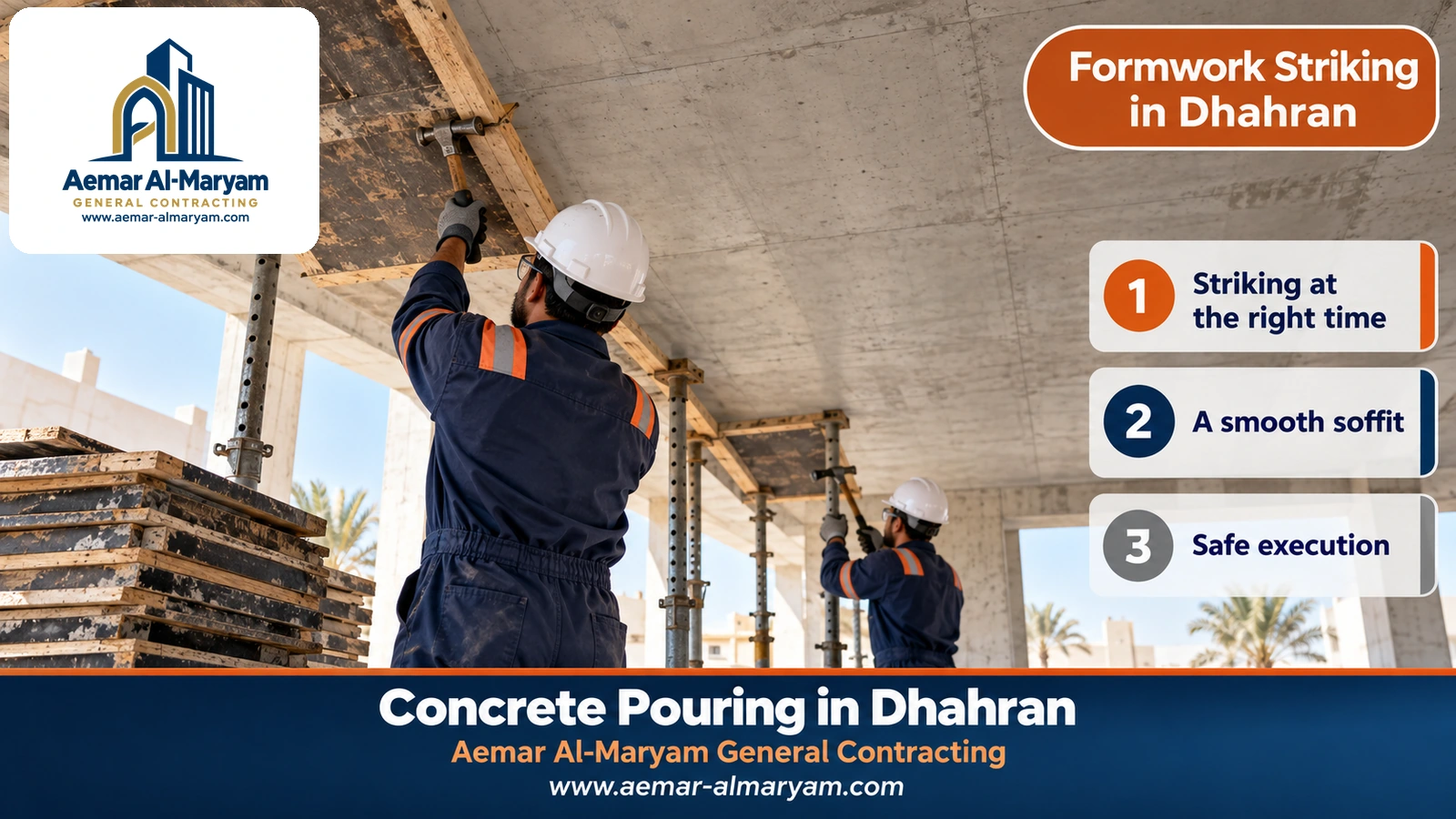
Formwork comes off in stages, and the question is not only “when” but “in what order”. Random stripping, such as pulling beam props before slab props or starting with a cantilever, suddenly transfers load to concrete that has not reached its strength. Unless the engineer specifies otherwise, this is the sequence we follow on Dhahran villas:
- 1Column and beam sides
After about 12 to 24 hours, since they carry no load, and curing of the exposed faces starts immediately. - 2Slab panels with props left in
With some formwork systems the panels are lowered after a few days while load-bearing props stay in place at regular spacing. - 3Slab props
Roughly a week where the span is below 6 m, 10 to 14 days where it is longer, working from mid-span towards the supports. - 4Beam props
After about 14 days for spans under 6 m and about 21 days for longer spans, again from the centre outwards. - 5Cantilever and overhang props
Last of all, because an overhang has no support at its free end.
Do not load the slab too early
Stacking blocks or cement bags on a slab that is only days old, or casting the next floor above it after its props have gone, is one of the most dangerous things that happens on site. On multi-storey work, props stay under at least two floors below the one being poured.
Slump and cube tests in Dhahran
The slump test is done when a truck arrives: a cone is filled with concrete, lifted, and the drop measured, which shows whether the consistency suits the element and the placing method. For cubes, specimens are cast on the day and sent for crushing at 7 and 28 days. Under the code a set is taken on each pour day at minimum, with extra sets each time roughly 115 m³ or 465 m² of slab is exceeded, and the concrete passes when any three results in a row average at least the strength on the drawings. Laboratory fees are charged at cost.
Concrete pouring prices in Dhahran
Dhahran is billed at Dammam rates with nothing added for travel, since the city lies in our near zone. Labour and materials are kept apart, and each figure is provisional pending a visit and an agreed scope:
| What we pour at the villa | Starting price | Basis | Worth knowing |
|---|---|---|---|
| Lean concrete beneath footings and tie beams | SAR 14 | Per m², labour only | The plant bills the concrete directly |
| Footings, necks, ground beams and columns | After inspection | Per m³ or per element | Quantities read from the structural drawings |
| Bitumen coating on faces to be buried | After inspection | By the area in contact with soil | Applied before backfill, never after |
| Floor or annex roof with shuttering and steel | After inspection | Per m² from the drawings | Includes placing and curing |
| Concrete staircase | After inspection | By number and width of steps | Risers fixed on the forms first |
| Yard with 8 mm mesh and 10 cm of concrete | SAR 46 | Per m², all materials | Very small areas cost more per m² |
| Garage or store floor finished by power trowel | SAR 46 | Per m², with materials | About 50 m² minimum |
| Floor for heavy loads | After inspection | By thickness and steel | Needs a load calculation |
| Stamped concrete paths | SAR 110 | Per m², sealer included | Sealer renewed every few years |
| Foam-concrete roof falls | SAR 17 | Per m² | Membrane priced separately |
| Mortar roof falls | SAR 23 | Per m² | Heavier, harder surface |
| Ready-mix | Plant price | Per m³ on the day | GASTAT average near 214 for plain 350 |
| Line or boom pump | At cost | Per hour or per pour | Chosen from your site photos |
| Laboratory cubes | At cost | Per set | Crushed at 7 and 28 days |
Worked example: blinding for a villa’s foundations in Dhahran
An illustration for a villa with 16 isolated footings, each with a 2.2 × 2.2 m blinding pad, plus a 0.6 m wide blinding strip under ground beams totalling 90 m, all at 10 cm thick:
| Item | Calculation | Result |
|---|---|---|
| Blinding area under footings | 16 × 2.2 × 2.2 | 77.44 m² |
| Blinding area under ground beams | 0.6 × 90 | 54 m² |
| Total area | 77.44 + 54 | 131.44 m² |
| Labour “from” price | 131.44 × SAR 14 | about SAR 1,840 |
| Concrete volume | 131.44 × 0.10 | 13.144 m³ |
| Volume with about 5 % waste | 13.144 × 1.05 | about 13.8 m³ |
| Material cost at GASTAT’s average for plain 250 | 13.8 × 194.53 | about SAR 2,684 |
The termite treatment and a pump, if one is needed, are added at cost. Treat it as a picture of how labour and material divide the bill, not as the price of your own villa.
Factors that move a Dhahran pouring price
- ✓Access: a villa inside a finished boundary wall needs a line pump and pipeline; open ground can be reached by the truck.
- ✓Quantity: a tiny yard carries nearly the same set-up as a big one, so its rate per m² comes out higher.
- ✓Grade and cement type: sulphate-resisting and blended mixes cost more than ordinary concrete.
- ✓Height: high roofs need taller shoring and a boom pump.
- ✓Timing: dawn pours in summer need advance arrangement with the plant.
Does a pour in Dhahran need a Balady permit?
A new villa is built under a building permit with approved drawings, and we pour to those drawings and the instructions of the supervising engineering office. Adding a slab, a column or a rooftop room to an existing building is treated as an addition and modification of building components, processed by an engineering office through Balady. Pouring a yard within your own plot does not normally require a permit, though Balady is the place to confirm it. No additional structural element is poured by us without one.
Mistakes we see on Dhahran pours
- ✓Pouring blinding on uncompacted soil, or before the termite treatment.
- ✓Adding water to the truck at the gate to loosen the mix, which costs strength.
- ✓Forgetting spacer blocks, so the steel touches the forms or the soil and rusts early.
- ✓Too little vibration, leaving honeycombing, or too much, which separates the stones.
- ✓Leaving the surface without water in the first hours, so shrinkage cracks appear.
- ✓Removing roof props early or in the wrong order, or loading the slab with materials too soon.
- ✓Pouring the ground-floor slab before the plumbing beneath it has been tested.
If you have older concrete with honeycombing or visible rust, that is work for our renovation contractor in Dhahran. If an old slab must come out before a new pour, see demolition contractor in Dhahran or concrete cutting in Dhahran.
How to book concrete pouring in Dhahran
- 1Send what you have on WhatsApp
The structural drawings or sizes, which element you need cast, and photos of the villa gate, the boundary wall and the street outside. - 2We choose the delivery method
Direct from the truck, a line pump or a boom pump, according to what the photos show. - 3Inspection and pricing
We visit, calculate quantities and write our labour separately from materials. - 4Pour date
We fix the day and time with the plant, the pump and the laboratory, and finish the forms and steel beforehand. - 5Pour, cure and strike
We place, vibrate and finish, cure for at least 7 days, and strike the formwork in sequence.
Why Dhahran owners hand their pours to us
■ Close to your site
Dhahran is in our direct zone with Dammam and Al Khobar, so early-morning pours are easy to arrange.
■ Materials at cost
You see the plant’s own invoice; our labour sits on its own line.
■ Order before speed
Termite treatment before blinding, testing before the ground slab, and striking in sequence.
■ Numbers from the code
35 °C maximum concrete temperature, 7 days of curing, and cube samples for every pour day.
Dhahran districts where we pour concrete
We work on villas and residential compounds across Dhahran, including:
The Dhahran area page lists all our services there. We also pour in the neighbouring cities: concrete pouring in Qatif, where rooftop room slabs in older neighbourhoods are the typical job, and concrete pouring in Saihat, where we move roof pours to the late afternoon in the heat. The full guide to the service is concrete pouring contractor in Dammam.
A villa or annex in Dhahran that needs pouring?
Send the drawings and photos of the gate and boundary wall, and we will work out how concrete reaches each element, the volumes involved and a budget figure before we come out.
Further reading for Dhahran
Tags