Paving jobs in Jubail split into two very different kinds from day one: a warehouse yard or a factory road in Jubail Industrial City with heavy trucks crossing it all day, and a building car park or a house yard in Jubail Al-Balad used by residents’ cars. As an asphalt contractor in Jubail, Aemar Al-Maryam General Contracting handles both: we level the ground, build a compacted base course, spray the prime coat, lay and roll hot mix, mill cracked layers on factory roads and repave them, and hand-lay around planters and columns in building car parks. Indicative rates in Jubail: SAR 37/m² for a 5 cm car-park surface over an existing base, SAR 41/m² for a 7 cm truck surface, SAR 38/m² to mill off and relay a worn plant road (estimates until inspection and agreement). Call or WhatsApp 0547879578.
We come to Jubail from Dammam on scheduled visits, and the first thing we ask is where the job actually is. Is it inside a facility in the Industrial City run by the Royal Commission, or in a residential district under the municipality? The answer decides the permits, how we get in, the working hours and even how the hot-mix truck reaches the site. Below we walk through the Jubail jobs we take on, why a dock apron and a residents’ car park get different build-ups, how we decide between milling and a full rebuild on a plant road, and what a 900 m² warehouse yard comes to.
In short: asphalt contractor in Jubail
- Jubail Industrial City: logistics warehouse yards, internal factory roads and gate aprons, at 7 cm and up, plus milling and resurfacing, under Royal Commission requirements.
- Jubail Al-Balad: building car parks in Al Dabab, Ghirnatah, Al Hamra and other districts, house yards and house fronts, with hand work around planters.
- Build-up: graded and rolled subgrade; crushed stone roughly 15 cm under car parks and 23 cm under truck lanes; MC prime on new stone; RC tack on anything milled; hot mix on top.
- Indicative rates: car-park surface 5 cm SAR 37/m²; truck surface 7 cm SAR 41; bare plot with base SAR 74; modified binder at gates SAR 55; mill-and-relay SAR 38; cold stop-gap patch SAR 46. Mobilisation from Dammam costed at the visit.
- To order: phone and WhatsApp 0547879578 with photos, sizes and vehicle type.
Asphalt contractor in Jubail: Industrial City or Al-Balad?
An asphalt contractor in Jubail first needs to know which authority the site sits under, because Jubail is really two neighbouring cities run in two different ways. Jubail Industrial City answers to the Royal Commission for Jubail and Yanbu, whose rules govern permits and site work inside its fence line, while Marafiq supplies its power and water. Jubail Al-Balad — the older town with homes in Al Dabab, Ghirnatah, Al Hamra and beyond — is municipal territory, handled through Balady like any other Eastern Province town.
Why does that matter if you only want a yard paved? Because paving is often preceded by a little digging: extending a drainage pipe, moving a manhole, raising the level at a gate. Any digging near utility lines in the Industrial City has to be coordinated with Marafiq and the site management before machines move, and entering facilities there usually needs a work permit and a safety induction for the crew. We arrange this with your site management before the work day, so the hot-mix truck is not left waiting at the gate for clearance while the mix cools.
■ Warehouse yards
Loading and unloading yards at logistics warehouses, built for trucks and trailers.
■ Factory internal roads
Milling the cracked layer and repaving it, or rebuilding sections whose base has failed.
■ Building car parks
Residents’ parking in Jubail Al-Balad, with hand-laid curves around planters, columns and corners.
■ Yards and house fronts
House yards and garage entrances with falls that keep water off walls and gates.
■ Patching and maintenance
Pothole repair and crack sealing on existing yards and roads.
■ Line marking
Bays, arrows and walkways in car parks and yards.
A general description of the service is on our asphalt service page, and our local information is on the Jubail area page.
Warehouse yard asphalt in Jubail Industrial City
Warehouse yard asphalt in Jubail Industrial City starts with the base, not the asphalt. We level the ground to the set levels, lay a crushed-stone base of about 23 cm for heavy loads and compact it in two layers, spray the prime coat and let it cure, then lay hot mix at 7 cm as a minimum, more in loading and turning zones. These yards barely stop working, and a loaded truck standing at a dock or turning on the spot is the hardest test asphalt will ever face.
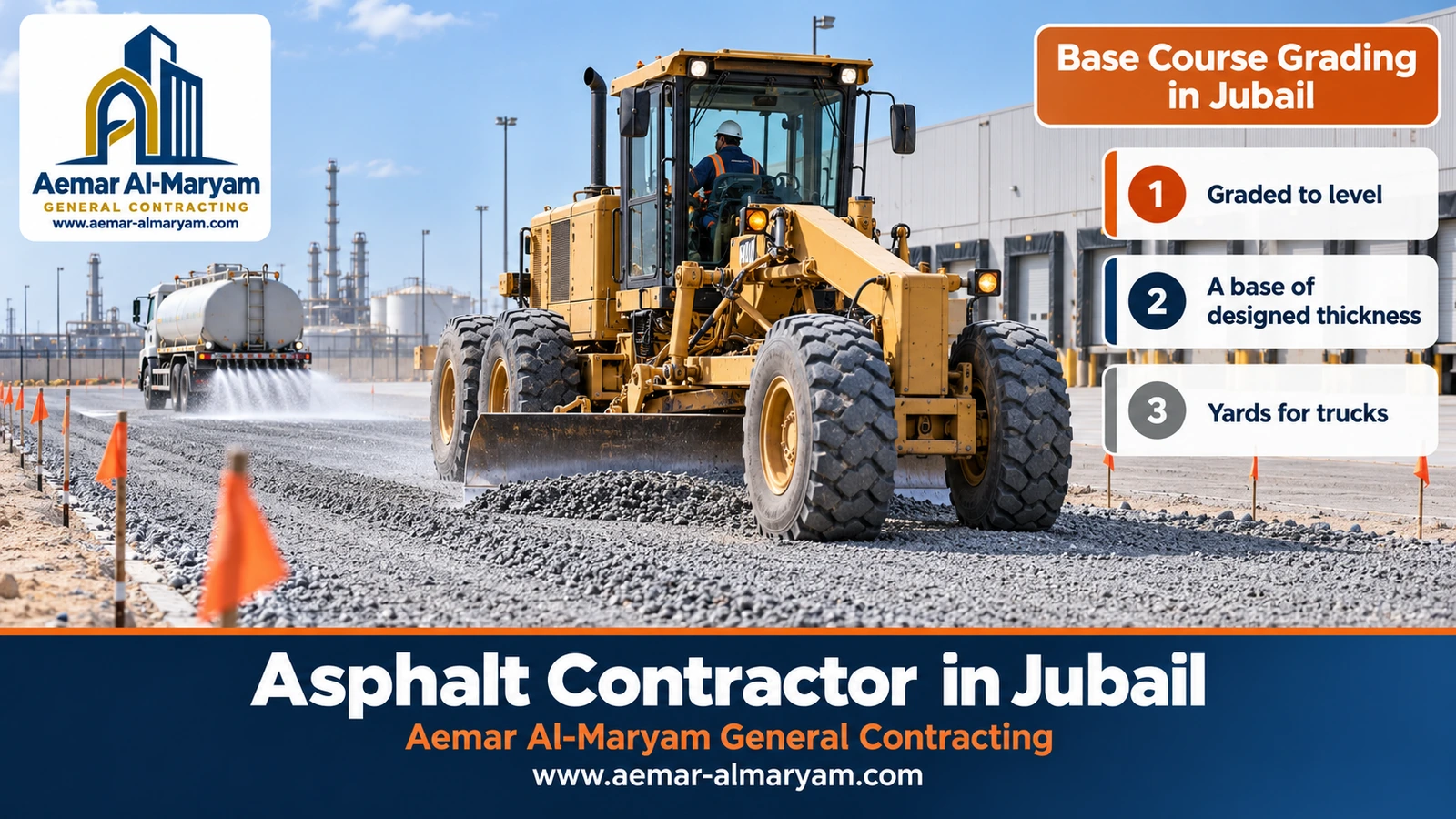
The photo shows the stage most people overlook. The grader cuts the high spots and fills the low ones until the base matches the pegs, while the water tanker dampens the layer, because dry stone will not knit together. Then the vibratory roller passes until the layer locks. Any level error here becomes a puddle in front of the warehouse door later on: asphalt follows the shape of what is under it, it does not correct it.
On new industrial plots we also look at the ground under the base. Near the coast, ground can be salty or damp, and some coastal soils that look firm when dry lose part of their strength when wetted. Load tests by KFUPM researchers on salt-crusted coastal ground showed it could carry roughly a third less once water had washed its salts out. When we see white salt patches or moisture a short way down, the treatment — removal and replacement, a geotextile layer or a thicker base — is decided and priced at inspection.
Why 7 cm and not 5 for truck yards in Jubail?
Because asphalt thickness decides how a wheel load spreads before it reaches the base. Five centimetres is fine for a family car, but dual truck wheels press it into clear ruts within months, especially in summer. So 7 cm is our minimum for any yard trucks use, and in very heavy sections the total asphalt goes to about 12 to 14 cm. Since a single layer should not be much more than about 8 cm after compaction, those thicknesses go down in two layers with a light tack coat between them.
| Zone in the yard | What happens there | What we suggest |
|---|---|---|
| Entry and exit lanes | Constant slow traffic | 7 cm on a 23 cm base |
| Loading and unloading dock | Long standing, static loads | Greater thickness in two layers, polymer-modified mix where needed |
| Trailer turning area | Tyres twisting on the spot | Modified mix and supported edges |
| Staff car parking | Cars only | 5–6 cm on a 15 cm base |
| Walkways | Light load | Thinner, per inspection |
Polymer-modified mix at Jubail warehouse gates
At the gate and the loading dock a truck can stand for a long time on asphalt that is already hot from the midday sun, and its wheels slowly sink in. This is where we suggest a polymer-modified mix: pavement studies at KFUPM concluded that the east of the Kingdom generally needs a modified binder if asphalt is to perform under its heat. Modified asphalt starts from SAR 55 per m² as an estimate, and there is no need to use it across the whole yard; we keep it to the zones that need it so the cost stays reasonable.
Asphalt milling and resurfacing on factory roads in Jubail
Asphalt milling on factory roads in Jubail means removing the cracked top layer to a depth of 3 to 5 cm with a milling machine, spraying a tack coat on the milled surface and laying a new layer of the same thickness, so the road returns to its original level without rising at kerbs and gates. It starts from SAR 38 per m² as an estimate, and it is the most economical fix when the damage is on the surface and the base is sound.
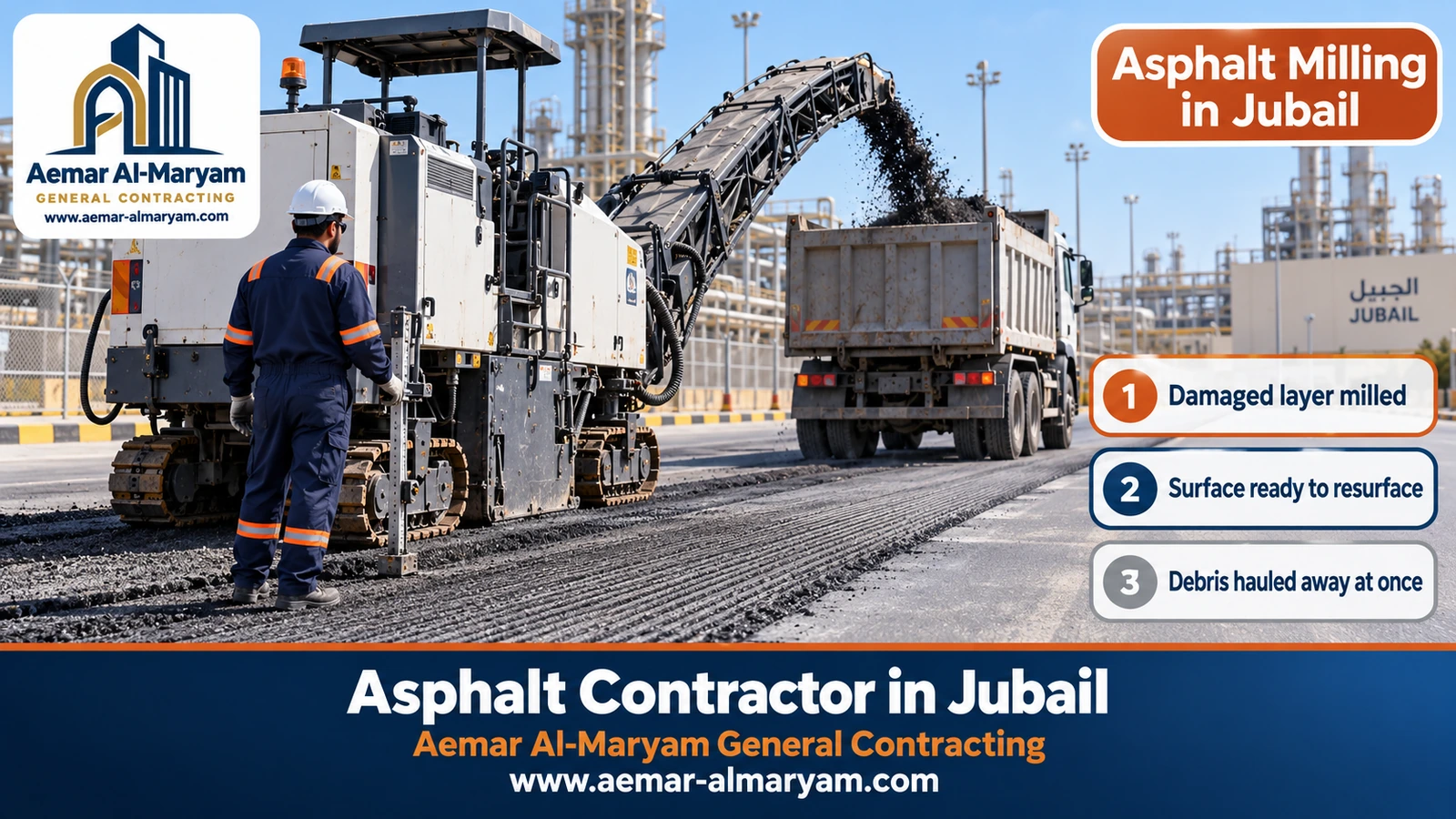
Why not simply lay a new layer on top of the old one? Because every overlay raises the road, until it sits above manholes, gate thresholds and kerb edges and the water starts going the wrong way. Milling also removes the oxidised, cracked layer, so its cracks are not copied into the new surface, and it leaves an even grooved texture that the new mix grips well once the tack coat is on.
When milling is enough, and when the base must be rebuilt
- ✓Milling is enough: scattered longitudinal and transverse cracks, surface ravelling, light rutting in the wheel paths, a faded oxidised colour.
- ✓The base must be rebuilt: interconnected crocodile cracking in the truck path, clear depressions that hold water, mud or water pumping out of cracks after rain.
- ✓We check before deciding: we open a small trial hole at the worst point to see the asphalt thickness and the condition of the base underneath.
- ✓Both when needed: milling along the whole road, with full-depth rebuilding only in the failed patches.
Tack coat (RC) after milling
Once the milling machine has passed, the grooved surface is swept and blown free of fines, and RC tack goes on as a thin mist — 0.25 L/m² is the ceiling — with the kerb faces and manhole collars painted too. Too much tack makes the new layer slide; too little leaves it unbonded from what is underneath. If paving is delayed more than three days, we re-spray.
An asphalt company in Jubail that works inside running facilities
An asphalt company in Jubail works inside facilities that do not stop, so organisation matters more than paving speed. Before the work day we agree with site management on the work permit, the crew list and safety induction, the area to be closed, the route of the mix trucks inside the site, and the window when loading trucks are not moving. Then we split the yard or road into phases: we close half the road and keep the other half for traffic, or pave one part of the yard each day.
- 1Access arrangements
Work permit, crew safety induction and any Royal Commission or facility requirements. - 2Phasing
Which part closes first, where traffic runs, and how mix trucks arrive without cutting across the loading line. - 3Protecting services
Manholes and buried lines located with site management and Marafiq before any milling or digging. - 4Execution
Milling or base preparation, then spraying, laying and rolling, and checks on level and falls. - 5Reopening
Each section opens to traffic once fully cooled, then we move to the next phase.
⚠ No milling before you know what is under the road
Factory roads carry plenty of cables and pipes beneath them, some closer to the surface than people expect. We do not start deep milling or edge saw-cutting until site management has marked the buried services.
Where a warehouse threshold slab has to be sawn or a cable trench opened before we pave, that goes to our concrete cutting team in Jubail handles it, and breaking out old slabs and removing the debris is done by our demolition contractor in Jubail.
Building car park asphalt in Jubail Al-Balad: hand work around planters
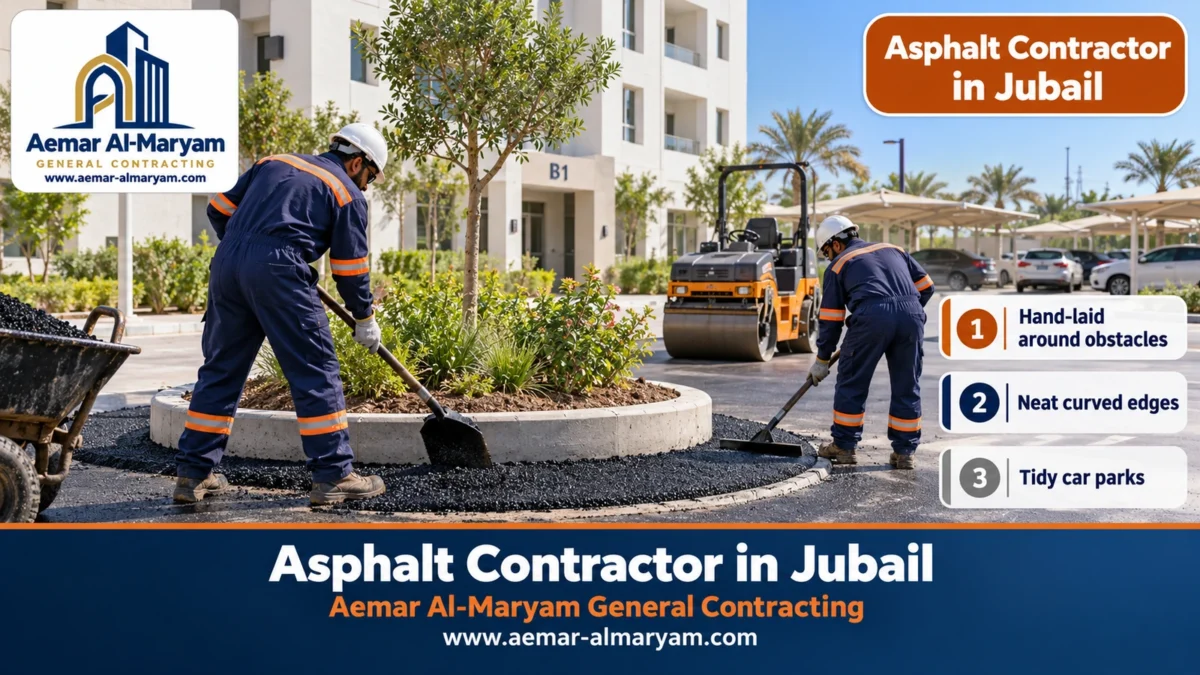
Building car park asphalt in Jubail Al-Balad differs from industrial yards in thickness and in method. Residents’ cars in Al-Balad need no more than a 5–6 cm compacted surface over roughly 15 cm of crushed stone, yet these car parks are full of detail: round planters in the middle, canopy columns, sloping entrances and curved kerb lines. A paver and a large roller cannot reach those corners, so we lay them by hand.
With hand laying, the crew moves the hot mix by shovel and spreads it with lutes to the right loose depth, then a small roller or a rammer compacts it along the curved edge. Speed is everything here, because a small quantity cools faster than a paver mat, so we bring enough hands to roll the corners while they are still hot. We also tack the face of the planter kerb that meets the asphalt, so no gap opens between them for irrigation water to seep through.
- ✓Irrigation water: planters are watered daily, and water that gets under the asphalt weakens the base, so the falls run away from the planter and the edge is sealed tight.
- ✓Columns and canopies: a clean edge around each column base, without building up the level against it.
- ✓Sloping entrance: we shape the transition from the street to the car park so car undersides do not scrape.
- ✓Accessible bays: near the lobby door, kept flatter than 2% whichever way you measure.
Most of these car-park jobs come from residential blocks in Al Dabab, Ghirnatah and Al Hamra. If the building needs more than its car park, paving can be scheduled together with the work of our renovation contractor in Jubail.
Asphalt in front of houses and yards in Jubail
Asphalt in front of houses in Jubail means paving the yard or the owned area in front of the garage with a compacted base and 5 to 6 cm of hot mix, with a fall that takes water towards the street or a drain and away from the wall. In a humid coastal city like Jubail, drainage matters more than usual: a yard that holds water after rain or after washing the car dampens the bottom of the wall and weakens the base under the asphalt at the same time.
Sort out services before paving
If you plan to run an irrigation pipe or a lighting cable across the yard, do it before we build the base. If plumbing or electrical work is under way in the house, coordinate with our plumber in Jubail or electrician in Jubail so the yard runs are finished first.
In some older houses the yard is covered with cracked concrete or broken tiles. After inspection we decide either to remove it and build the layers afresh, or to use it as a base if it is solid and its level leaves room for asphalt without rising above the door threshold.
Asphalt layers in Jubail: base, prime and tack
The asphalt layers in Jubail are the same on every site, but their thickness changes with the load: the subgrade rolled to roughly 95% of its maximum dry density, crushed stone placed in lifts no thicker than 15 cm and rolled to full (100%) density, MC prime, and finally the hot mix.
| Layer | Building car park or yard | Truck yard |
|---|---|---|
| Natural ground | Level, compact and remove soft material | Level and compact, and check moisture and salts near the coast |
| Base course | About 15 cm | About 23 cm in two layers |
| Spray | Prime MC at 0.65–1.75 L/m², at least 24 hours before paving | Prime on the base, and a light tack RC between asphalt layers |
| Asphalt after compaction | 5–6 cm | 7 cm and up, to 12–14 cm in two layers |
Mixing up prime and tack is one of the most common mistakes in the market. On a new granular base you spray prime, because it soaks into the stone and seals it; tack belongs on old asphalt, a milled surface or between two layers. Spraying a thin tack on a new base saves a little today and costs you the bond a few months later.
As for the mix itself, we check its temperature when the truck arrives. A load that reaches the gate under roughly 139 °C goes back, and the rollers must be done with each strip before it cools towards 90 °C — on a big yard that means pacing deliveries carefully. And because the roller squeezes the loose mat down by a fifth to a quarter, the figure written in a Jubail contract is always the rolled thickness.
Hot, cold or millings: which asphalt suits Jubail?
The asphalt that lasts in Jubail is plant-made hot mix laid on a compacted base. We use cold mix only for temporary patches, and millings — ground-up old asphalt — suit a spare yard or a back service road where looks do not matter, not a truck yard that works every day or a building frontage.
| Type | Where it fits in Jubail | From |
|---|---|---|
| Hot mix, 5 cm | Residents’ car parks and house yards | from SAR 37/m² over sound stone |
| Hot mix, 7 cm | Warehouse lanes and plant roads | from SAR 41/m² over sound stone |
| Polymer-modified | Gates, loading docks and turning zones | SAR 55/m² |
| Cold mix | Temporary patch until the permanent repair | SAR 46/m² |
| Millings | Spare yards and back service roads | At inspection |
Millings also need proper compaction in two layers and can soften in summer heat. We do not sell them as a material; we spread and compact them when requested, after inspection.
Asphalt patching and crack sealing in Jubail
A lasting patch in a Jubail yard is a small rebuild: we saw a neat rectangle round the pothole into solid asphalt, empty it of water and grit, paint the walls and floor with tack, then fill it with hot mix rolled slightly proud so it settles flush under truck traffic. When a lane cannot close, a cold-mix stop-gap (SAR 46/m²) keeps trucks moving until the proper saw-cut repair, which we price on site.
In Jubail’s industrial yards we often see potholes coming back in the same spot after every patch. That means the problem is under the asphalt: a weak base, or water leaking from a nearby manhole. The answer is not another patch but a full-depth repair of that spot. Fine scattered cracks we seal with hot rubberised sealant after blowing them clean, so water cannot reach the base through them.
Car park line marking in Jubail after paving
Car park line marking in Jubail waits until the new surface is cold right through; we paint bays, arrows, walkways and accessible bays to the site layout. In warehouse yards the marking focuses on truck lanes, no-standing zones in front of gates and safe pedestrian routes; in building car parks it focuses on the number of bays and easy turning around the planters. Hot-applied thermoplastic lasts longer in busy areas, while cold paint is quicker and cheaper. The price is set at inspection, since it depends on line lengths and the number of symbols.
Asphalt price per square metre in Jubail
The asphalt price per square metre in Jubail depends first on the load: residents’ parking at 5 cm over a sound base begins at SAR 37, warehouse lanes at 7 cm begin at SAR 41, and a bare plot that needs grading, a crushed-stone base, prime and asphalt begins at SAR 74. Jubail sits beyond our Dammam–Al Khobar–Dhahran base area, so mobilising crew and plant up the coast is costed at the site visit, and on a big industrial yard that cost shrinks to very little per metre. Treat every number here as estimates until inspection and agreement.
| From | What we do in Jubail | Unit |
|---|---|---|
| SAR 37 | Al-Balad car parks and house yards, 5 cm over a sound base | m² |
| SAR 41 | Warehouse lanes and truck yards, 7 cm over existing stone | m² |
| SAR 74 | Bare plot: grading, rolled stone base, MC prime, 5 cm surface | m² |
| SAR 55 | Polymer-modified binder at gates, docks and turning circles | m² |
| SAR 46 | Cold-mix stop-gap patch to keep a lane open | m² |
| SAR 38 | Plant road: mill off 3–5 cm and relay | m² |
| At inspection | Saw-cut hot-mix patch, full depth where the base failed | — |
| At inspection | Salty or wet ground near the shore | — |
| At inspection | Stone base alone, yard markings, kerbs, crack filling, millings | — |
| At inspection | Bringing crew and plant up from Dammam | — |
Lines without a figure get one once we have walked the yard; photos, rough sizes and the heaviest vehicle on WhatsApp 0547879578 are usually enough for a first number. Figures for our other services are listed in the price guide.
Worked example: a 900 m² warehouse yard in Jubail Industrial City
This is an illustration for a logistics warehouse yard of 30 × 30 m = 900 m², with an existing granular base that is sound after re-grading, and a gate and loading-dock zone of 120 m² where we suggest the modified mix:
| Item | Calculation | Estimate from |
|---|---|---|
| Rest of the yard at 7 cm | (900 − 120) × 41 = 780 × 41 | SAR 31,980 |
| Gate and loading dock, modified mix | 120 × 55 | SAR 6,600 |
| Estimated total | 31,980 + 6,600 | SAR 38,580 |
| Approximate mix tonnage (density about 2.3 t/m³) | 900 × 0.07 × 2.3 | about 145 tonnes |
If the whole yard were standard mix, it would be 900 × 41 = SAR 36,900, so putting the modified mix only in the critical zones adds SAR 1,680. Travel from Dammam, any base repair that shows up after grading, and line marking are all on top and priced at inspection. Note the tonnage, too: around 145 tonnes means several truckloads, which is why we agree delivery times with site management in advance.
Illustrative only — on a real Jubail yard the number moves with what the base turns out to be, the final thickness, the binder chosen and how the gate and loading schedule allow us in.
Public streets in Jubail: who paves and repairs them?
Who owns the road decides who fixes it. Al-Balad’s public streets belong to the municipality — report a pothole there on 940 or in Balady — while the Royal Commission runs the public roads of the Industrial City. Our work is inside property boundaries: the yard, the building car park, the warehouse yard and the factory’s internal roads. If the job runs into the street reserve — say, a link between a warehouse gate and the public road — we only carry it out with the approval of the relevant authority.
Digging in the street for a service connection
When a building needs a new service run under the public road, it is the utility that applies for the dig, and reinstating that trench is a condition of its permit — a private paving contractor has no role there.
Mistakes we see in Jubail yards and car parks
- ✓5 cm in a truck yard: it ruts at the dock and the gate in the first summer.
- ✓Layer on layer without milling: the road climbs above manholes and thresholds and the water changes direction.
- ✓A cold patch that becomes permanent: it crumbles and the pothole returns bigger.
- ✓Ignoring drainage near planters: irrigation water seeps under the asphalt and weakens the base.
- ✓Skipping the ground check near the coast: salty or damp ground is judged at inspection, not assumed to be fine.
- ✓Opening the yard to trucks before the asphalt has cooled: wheels leave marks that never go away.
Asphalt paving steps in Jubail
- 1Inspection and measuring
We measure, set levels and water direction, check the ground or existing asphalt, and confirm which authority the site falls under. - 2Coordination
Entry and safety permits for industrial facilities, and convenient times for residents in building car parks. - 3Preparation
Removing or milling the old surface, or levelling, compacting and building the base course. - 4Spraying
Prime on a new base and waiting for it to cure, or a light tack on a milled surface. - 5Laying and rolling
Receiving the mix and checking its temperature, laying by paver or by hand in corners, and rolling before it cools. - 6Checks and handover
Edge depth measured, a 4 m straightedge run across, a water test on the slopes, and the yard swept clean.
At handover, check for yourself: no water standing after a hose test, straight clean edges, no roller marks or loose stones, and manholes flush with the asphalt — neither proud nor sunk.
What sets our Jubail asphalt crews apart
■ We know the two-city split
We ask about the Royal Commission or the municipality before we book, and sort out access in advance.
■ Thickness to suit the load
A truck yard does not get yard thickness, and a house yard does not pay for truck-yard thickness.
■ Milling, not stacking
We bring the road back to its level instead of raising it layer after layer.
■ Care in the corners
Hand laying and small-roller compaction around planters and columns in building car parks.
■ Published starting prices
Car-park surfaces in Jubail begin at SAR 37 a metre; everything else is itemised after the visit.
■ Clear line items
Every Jubail job sheet states rolled thickness, each layer, and exactly what the figure includes.
Areas we serve in and around Jubail
On the Al-Balad side our crews pave in Al Dabab, Ghirnatah, Al Hamra and the neighbouring residential streets; on the Royal Commission side we work in Al Fanateer and in plant and warehouse yards once the gate pass is sorted. We also work in nearby cities on our visit schedule:
Nearby, we also pave in Ras Tanura and Abqaiq; for the deeper technical background, see the Dammam reference page on our asphalt contractor in Dammam work.
How to order an asphalt contractor in Jubail
Booking an asphalt contractor in Jubail starts with a short WhatsApp to 0547879578 covering the points below; back comes a proposed build-up, a first figure and a visit slot:
- ✓Location: Jubail Al-Balad or the Industrial City, the district or facility name, and a map pin.
- ✓Photos: wide shots of the yard, the gate and any spot where rain sits.
- ✓Dimensions: rough length and width, or the site plan.
- ✓Vehicles: residents’ cars, trucks and trailers, or forklifts.
- ✓Current surface: soil, cracked asphalt, concrete, or a granular base.
- ✓Working conditions: whether the site keeps running during the work, and any entry and safety requirements.
Give your Jubail yard the thickness its trucks need
Tell us what drives over it and how big it is, and we will come back with a build-up, a figure and a visit date.
More on our work around Jubail
Tags