What separates a roof slab that stays flat and sound for decades from one that shows weak patches and cracks after its first summer? In Khafji the answer starts before the concrete arrives: formwork cleared of the sand the wind has blown onto it, reinforcement free of flaking rust, then a steady pour with a vibrating screed and proper water curing. That is what we deliver with concrete pouring in Khafji at Aemar Al-Maryam General Contracting: roof slabs for apartment buildings and villas, plinths for rooftop water tanks, slope screeds, blinding, footings, ground beams and yard slabs. A foam roof screed costs from 17 riyals per m², a meshed 10 cm yard with materials from 46 riyals and blinding labour from 14 riyals; roofs and footings are worked out from their drawings once we have seen the building. The plant, the pump firm and the laboratory bill at their own rates with nothing added, and the trip north is costed at the visit. Until inspection and agreement, treat every number as an estimate. Phone or WhatsApp: 0547879578.
Khafji sits on the Gulf at the top of the Eastern Province, some 300 km north of Dammam and roughly 10 km from the Kuwaiti border. Most of what is built there is small apartment buildings, villas, houses and rooftop annexes, and the pour requests we see most often are roof slabs when an extra floor is added, plinths for tanks on the roof, and house yards. Being on the coast brings two things: wind that carries sand and dust onto open building sites, and air that carries salt to the concrete and the steel. This article explains how we deal with both in practice.
Khafji pours in brief
- Apartment and villa roof slabs: clean formwork, steel on chairs, and a twin-beam vibrating screed with poker vibrators at the beams.
- Tank plinths: raised concrete plinths on the roof, set dead level and coordinated with the waterproofing.
- Before the pour: blowing sand off the deck and wire-brushing flaking rust off the bars.
- Numbers: roof screed in foam from SAR 17 a square metre or in mortar from SAR 23; yard with materials from SAR 46; trowelled shop floor from SAR 46; stamped paths from SAR 110; blinding labour from SAR 14. Roofs, footings and tank plinths are quoted after we see them.
- The trip: about 300 km; costed at the visit, and cheapest per job when the roof, plinths and screed go into a single programme.
- Get started: WhatsApp roof photos and drawings to 0547879578.
Roof slab pouring for apartment buildings in Khafji: how we use the vibrating screed
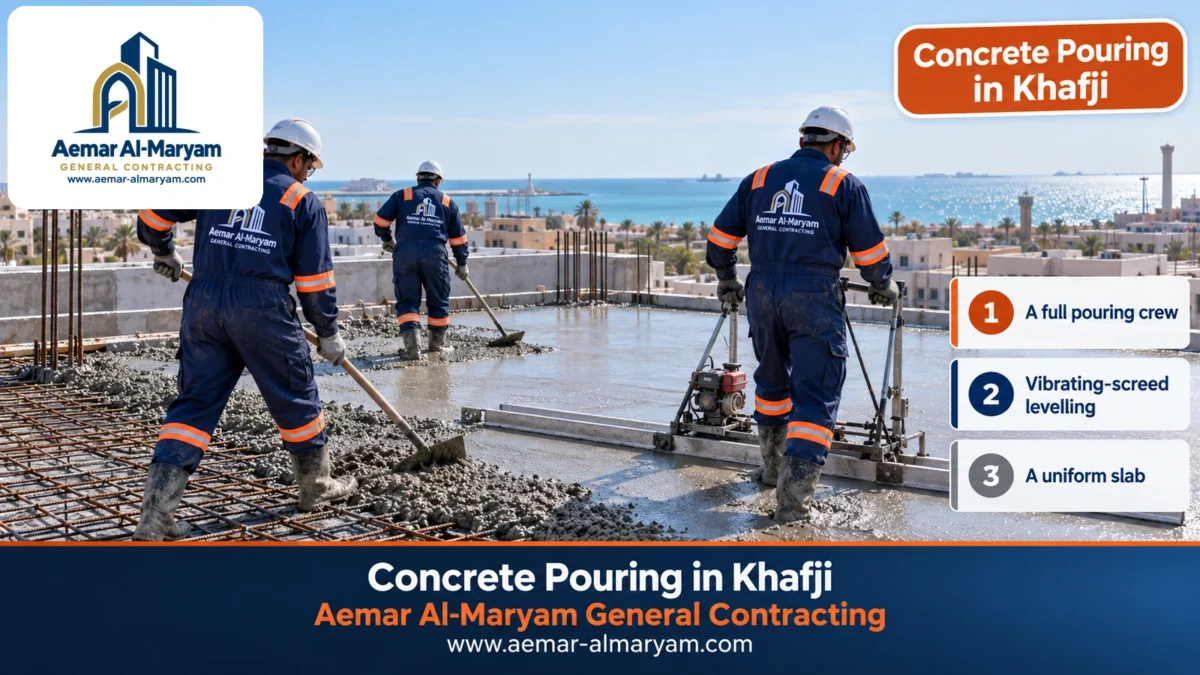
Pouring an apartment roof slab in Khafji means casting the whole floor slab in one day, once the formwork, steel and services are ready, using a pump to lift the concrete to roof level, a twin-beam vibrating screed to level the surface and compact its upper layer, and poker vibrators at the beams and edges. It is priced from the drawings and quantities after inspection, with the concrete at plant price.
A vibrating screed is a double metal beam with a vibrating motor, pulled by two workers across the fresh concrete on guides set to a fixed level, so that it levels the surface and drives air out of the top layer in a single pass. On apartment roofs its advantage is that the area is fairly large and what is needed is a flat surface of constant thickness, with no high spot that will collect water later and no thin spot where the cover over the steel is reduced. But the screed does not reach the depth of downstand beams or the corners crowded with steel, so a poker vibrator always works alongside it, inserted vertically at regular spacing in those places and withdrawn slowly.
The order of the pour also matters. We start at the end furthest from the pump and work back towards it, pour beams and slab together in each section so that no unplanned joint forms, and make sure the pour does not stop in the middle of the roof. If we are forced to stop, the joint goes where the engineer has decided, not wherever the concrete ran out.
■ Level guides
Pegs or bars set to the finished roof level for the screed to run on, so the thickness comes out even.
■ Enough hands
A team to spread, a team on the screed, one on the vibrator and one finishing behind them.
■ The right pump
A boom that reaches the furthest point of the roof, or a line pump if the street is narrow.
■ A stop plan
The position of a contingency construction joint agreed with the engineer in advance.
Roof slab pouring in Khafji: solid or hordi?
In Khafji a solid roof is concrete through its whole thickness; a hordi roof replaces part of that concrete with hollow blocks laid between narrow ribs, which saves weight and material. The designer chooses according to spans and loads. In either case we make sure before the pour that the blocks are wetted, the ribs are filled with vibration, and the rows are straight so the ribs do not drift from the drawing.
Pouring the stairs with the slab in Khafji
In an apartment building the stair flight is usually poured with the slab it reaches, or straight after it. We mark the height and depth of every step on the form before pouring, because a one-centimetre error on a single step is felt by everyone who climbs it, and we leave the projecting bars to tie the stair into the next floor as drawn.
Adding a floor on top of an existing building in Khafji
Pouring an extra floor on an existing building in Khafji starts with an engineering decision, not a site decision: can the existing columns and foundations carry the weight of another storey? The engineering office answers that from the original drawings and an inspection of the building, then issues the structural drawing for the addition. Then our part begins. We expose the old column starter bars on the roof, if there are any, and check their condition. If they are rusted, cut off or missing, the engineer specifies how the new columns are to be connected, for example new starter bars bonded with epoxy into holes drilled in the old columns.
Next we strip from the old roof whatever would stop the new concrete bonding: tiles and old waterproofing over the positions of new columns and beams, dust and oil, and we dampen the old concrete before pouring so the old surface does not suck moisture out of the fresh pour. If parts of the old roof have to be cut out, or an opening made for a new staircase, see concrete cutting in Khafji. Throughout the job we protect the residents of the floors below: we do not flood the roof with water before checking that the old waterproofing is not leaking, and we route the pump line so its hose does not pass over the flat entrances.
Roof pour day in Khafji, hour by hour
- ✓The evening before: a final check of formwork and steel with the engineer, confirmation of the plant and pump booking, and notice to neighbours about when the street will be closed.
- ✓Before sunrise: sand blown off the deck, timber dampened, screed and vibrators tested, and floodlights set up if we start early.
- ✓First truck: slump and temperature measured, cube samples taken, then the pour starts at the far end.
- ✓During the pour: trucks follow one another without long waits, the screed moves behind the spreaders, and a vibrator works at every beam.
- ✓After levelling: the surface is finished, then wetting or covering starts once it can be touched.
- ✓The next seven days: water curing at least morning and evening, with no traffic or loads on the slab.
Clearing sand and rust from the formwork before pouring in Khafji
Cleaning the deck before a pour in Khafji is a step we never skip, because wind from the sea or from the open land leaves a layer of sand and dust on the formwork during the days of carpentry and steel fixing, and damp, salty air leaves rust on the surface of the bars. We blow the sand off the deck with an air blower on the morning of the pour and remove flaking rust from the steel with a wire brush.
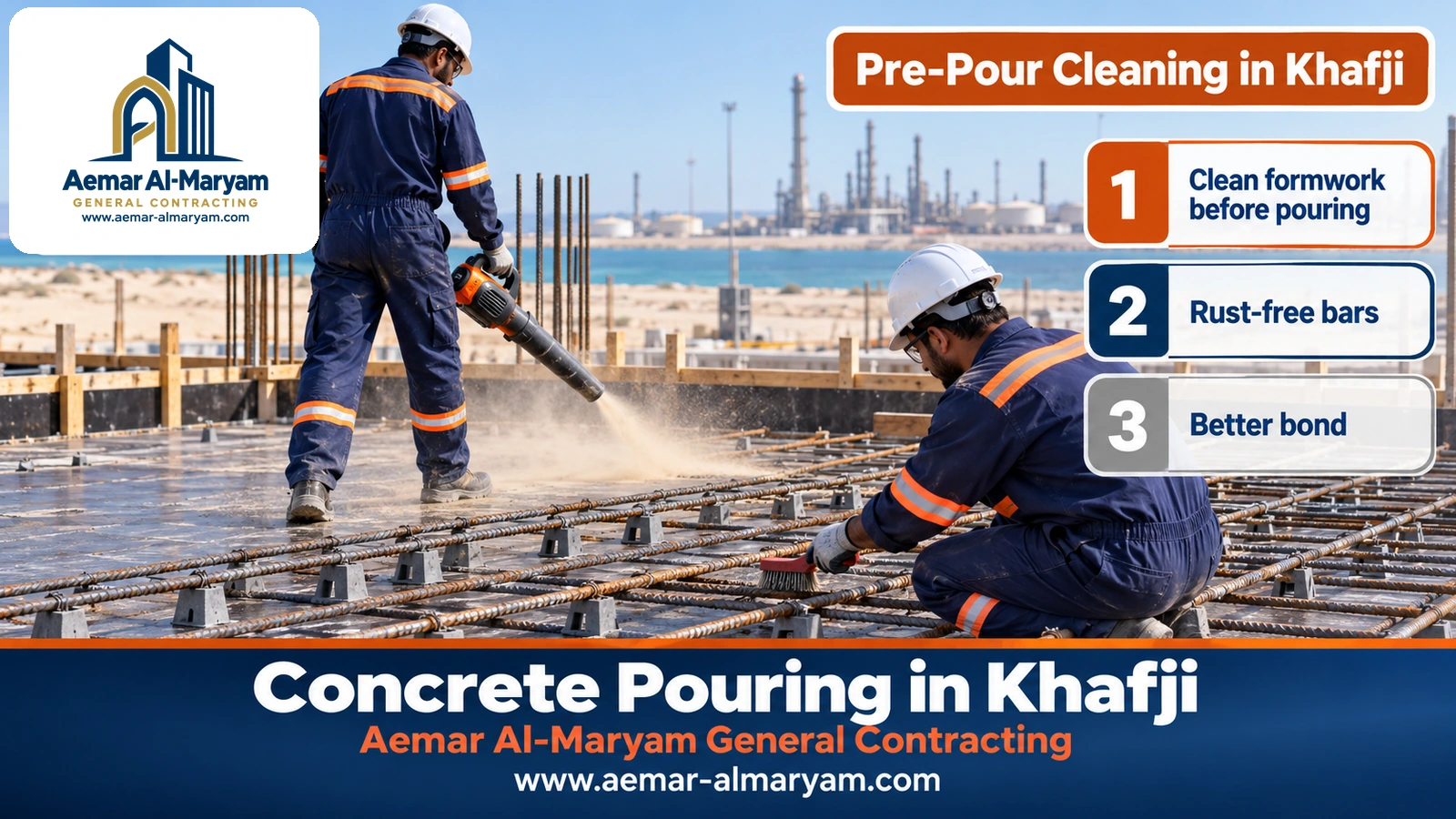
Why does sand matter? A layer of sand between the timber and the concrete stays on the underside of the slab after striking, as weak, crumbly patches, and if it collects at the bottom of a beam or at a joint it stops the new concrete bonding to the old. That is why we blow the deck on the morning of the pour rather than two days before, and we cover the prepared areas if strong wind is expected before pour day.
As for rust, the code accepts light, tightly adhering rust on reinforcement, because it does not reduce the bar section or stop it bonding with the concrete. It does not accept loose scale and flaking rust, nor mud, oil or paint on the steel. So we scrub flaking spots with a wire brush, replace bars that have clearly lost section, and never pour over steel covered in sand or mud.
Pre-pour checklist in Khafji
- ✓Formwork: level, braced with props that carry the weight of concrete, workers and pump line, with gaps sealed so the paste does not leak out.
- ✓Steel: matching the drawings, on chairs and spacers of the right thickness, clean of sand and flaking rust.
- ✓Services: electrical conduits, plumbing and sleeves for openings in place and photographed before the pour.
- ✓Site: pump and truck positions marked and the street clear at pour time.
- ✓Crew and kit: vibrating screed and poker vibrators tested, with a spare vibrator ready.
- ✓Curing: water and hessian or polythene ready before the first truck arrives.
If you need openings for pipes through the slab after it is cast, read about core drilling in Khafji, but it is always better to place the sleeves before the pour.
Rooftop water tank plinths in Khafji
Tank plinths in Khafji are raised concrete blocks cast on the roof of a house or apartment building to lift the water tanks off the roof surface, protecting them from standing rainwater, making their pipework easier to reach, and spreading their weight onto the slab. They are priced at inspection according to number and size, and we usually combine them with a roof pour or a slope screed on the same visit.
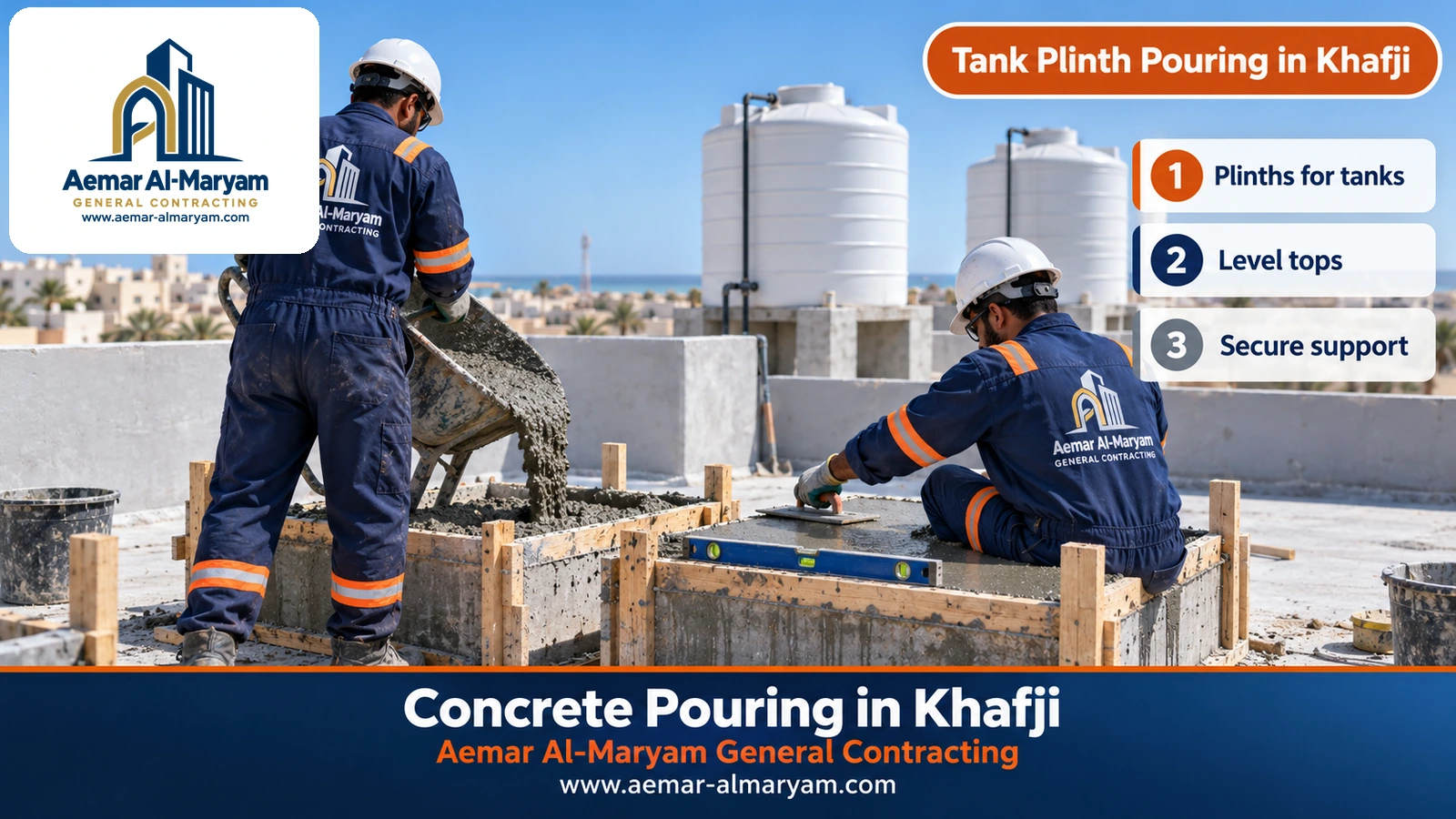
Weight is the first thing we work out. A cubic metre of water weighs about a tonne, so a full 2,000-litre tank weighs more than two tonnes, and a building with several tanks puts several tonnes onto a small area of roof. We therefore place the plinths over beams or close to columns as the engineer decides, never in the middle of a slab panel far from any support. Then we set the top of each plinth level with a spirit level, because a tilted tank presses on one side of its plinth and strains its pipes.
We handle the waterproofing carefully. The best approach is to cast the plinths before the roof is waterproofed and then turn the membrane up their sides, or to cast them on a membrane protected by a screed without puncturing it. We never fix a plinth with anchors through the membrane without sealing the spot. If the roof will be waterproofed after the plinths, see roof waterproofing and insulation in Khafji.
Group the tanks in one place
If your roof will carry more than one tank, ask the engineer to designate a single zone over the beams for all of them, instead of scattering them wherever there is space. It makes maintenance and waterproofing easier and protects the slab from concentrated loads in weak spots.
Khafji’s coast and salt: which concrete do we choose?
Concrete near the Khafji coast is exposed to salt carried inland on the sea air, and the designer sets the exposure class according to how close the building is to the shore, choosing from it the concrete grade, the water-cement ratio and the cover over the steel. Our role is to build exactly what was specified: spacers of the stated thickness, full vibration so that no voids are left for salt to reach the steel, and full curing so the surface layer is dense.
■ Cover to exposed elements
50 mm for bars of about 19 mm and above and 40 mm for bars up to 16 mm, in the ACI 318 cover table that underlies SBC 304.
■ Cover to interior elements
Indoor slabs 20 mm, beams and columns 40 mm; the designer adds more where exposure is aggressive.
■ Sulphate-resisting cement
Resists sulphates, but on its own does not stop chloride-driven corrosion of the steel.
■ Additions
Mixes with additions such as silica fume resist chlorides better; the designer chooses them.
Roof slope screeds in Khafji
A Khafji slope screed shapes the roof so rain and air-conditioner condensate run off, normally at a gradient between 1% and 2%. In foam concrete the rate is from SAR 17 a square metre, in sand-cement mortar from SAR 23, both confirmed at inspection. It goes on after the tank plinths and before the waterproofing, so that the falls wrap around the plinths and water does not pond behind them.
Worked example: a 12 × 18 m apartment roof in Khafji
An illustrative example of an apartment roof of 12 × 18 m = 216 m², with a 15 cm solid slab and a foam concrete slope screed on top:
| Item | Calculation | Result |
|---|---|---|
| Roof slab concrete | 216 × 0.15 | 32.4 m³ |
| Plus about 5% waste | 32.4 × 1.05 | about 34 m³ |
| Concrete at the GASTAT average, ordinary 350 | 34 × 214.10 | about SAR 7,279 |
| Foam slope screed (from) | 216 × 17 | SAR 3,672 |
| Alternative: cement mortar screed (from) | 216 × 23 | SAR 4,968 |
The beams add their own volume from the drawings, and what you finally pay for concrete is whatever the plant invoices that morning. Slab labour, tank plinths, pump hire and travel are set at the inspection.
This calculation helps in two ways. You know how much to order so that a truck is not missing at the end of the roof, and you see that the concrete is only part of the cost, not all of it. In Khafji especially it matters that the quantity is right, because running short on a roof far from the plant can mean a long wait and an unplanned joint.
Concrete contractor in Khafji: the rest of our work
A concrete contractor in Khafji does not only pour roofs. We build the concrete element from the first layer in the ground to the last layer on the roof:
- ✓Blinding beneath footings, ground beams and yards, labour priced from SAR 14 a square metre.
- ✓Foundations for new apartment blocks, villas and annexes: footings, stub columns and ground beams to the drawings.
- ✓Columns cast in plumb, propped forms, placed in lifts and vibrated.
- ✓Yards and car parks as meshed 10 cm slabs, materials included, from SAR 46 a square metre.
- ✓Trowelled floors for shops and stores, from 46 riyals per m², materials included.
- ✓Stamped paths and seating areas, from SAR 110 a square metre.
Concrete company in Khafji or a batching plant?
The batching plant mixes concrete and drives it to the gate; what happens after the chute opens is the job of a concrete company like ours. We book the licensed plant closest to Khafji, track each truck, pass its invoice to you untouched and show our own work as its own line.
Yard and building car-park slabs in Khafji
A yard slab in Khafji, or the parking area in front of or behind an apartment building, is a slab of around 10 cm with 8 mm mesh, priced with all materials from SAR 46 a square metre, subject to inspection. The ground is wetted and rolled, treated against termites and sheeted with polythene; the mesh goes up on chairs, and level pegs set the fall to the gully or the road. Yards next to the sea or open land we pour on a calm day wherever possible, and cover straight after finishing so that blown sand does not stick to the surface and roughen it. If the job is a car park with heavy daily traffic, asphalt in Khafji may also suit you, and we will help you compare.
Blinding and footings in Khafji
Close to the coast the soil may be damp and saline, so the designer picks the cement and the cover after reading the soil report; for our part, every buried face gets a bitumen coat before the fill goes back in compacted lifts. The minimum cover for concrete cast directly against soil is 75 mm.
Ready-mix concrete in Khafji: where from and at what price?
Ready-mix concrete in Khafji is ordered from the nearest licensed plant, and we agree with it on grade, admixtures, slump and the truck sequence. Nobody publishes a Khafji price. As a rough guide only, the latest GASTAT figures for the Kingdom put grade 350 ordinary concrete at SAR 214.10 per cubic metre and grade 350 sulphate-resisting at SAR 223.67, falling to SAR 194.53 and SAR 202.67 respectively at grade 250. Those are material-only figures before pumping, admixtures and a long haul; the invoice from the plant on the day is what counts.
We turn away any truck that has sat too long in traffic or has had water added on site, because the Saudi concrete code forbids adding water to restore workability.
Concrete pumps in Khafji: boom or line pump?
A boom pump in Khafji has a long arm that carries the delivery hose to any point on the roof, and suits apartment buildings where the street is wide enough for it to park and spread its outriggers. A line pump pushes concrete through pipes run up to the roof, and suits narrow streets or sites the boom cannot reach. The pump is billed at the hire firm’s cost, and we choose the type at the inspection after seeing the street and the building height.
At the inspection we also look above the street, not just at its width: power or telephone lines that could foul the boom, trees and canopies, and the entrances of neighbouring buildings that must stay open. We ask you to tell the neighbours the day before when the pump and trucks will park, because an hour’s street closure early in the morning is far easier than a dispute that stops the pour halfway.
Concrete contractor in Khafji: cast in place, not precast barriers
The Arabic search term often used for concrete work can mean two quite different things: concrete poured in place for roofs, footings and yards, which is what we do, or ready-made precast concrete barriers placed along roads and around sites, which are made in precast factories and which we do not sell. If you are looking for a contractor to pour your apartment roof or house yard in Khafji, you are in the right place; if you need precast barriers, order them direct from the factories that make them.
Hot-weather pouring in Khafji
Pouring in a Khafji summer follows the same Saudi code requirements: concrete no warmer than 35 °C at placing, slump of at least 75 mm, and no water added on site. Khafji’s average July high is around 41 °C, a little lower than Al-Ahsa or Dammam, but wind across open roofs speeds up evaporation from the surface, so we start early in the morning, fog-spray when needed, and put up windbreaks on the exposed side.
Vibration and compaction in Khafji slabs
Poorly vibrated concrete leaves voids around the steel, and in a coastal town those voids are a short cut for moisture and salt to reach the bars. We insert the poker vibrator vertically at close, regular spacing and hold it for a few seconds until air bubbles stop rising and the surface around it glistens, then draw it out gradually so no hole is left behind. Over-vibration is a fault too, because it drives the coarse aggregate down and brings water and weak paste to the surface.
Curing concrete with water in Khafji
We keep the surface moist for at least 7 days by sprinkling or with wet hessian or polythene, beginning once a finger leaves no mark. Covers on exposed roofs are weighted so the sea breeze cannot lift them. Where wetting is impractical beyond day three, reflective sheeting or a white curing membrane takes over.
When to strip formwork in Khafji
We strip column and beam sides after roughly a day, leave the roof props in for at least a week on short spans and for two or three weeks beneath long beams, all on the supervising engineer’s instruction. We do not put loads such as blocks or tanks on a new slab until the engineer allows it.
Slump and cube tests in Khafji
We measure the slump of every truck as it arrives to confirm the consistency is what we ordered, and cast cube samples that the laboratory crushes after one week and again at four weeks, at its own fee, and we recommend it for every apartment roof, because the result is a record for you and for anyone who buys or rents later.
Concrete pouring prices in Khafji
Our concrete pouring prices in Khafji are the same as everywhere in the Eastern Province; the difference is the travel cost we set after the inspection.
| Khafji job | From (SAR) | Per | What it covers |
|---|---|---|---|
| Apartment or villa roof | quoted after the visit | m² of roof | shuttering, steel, placing and curing; concrete invoiced separately |
| Rooftop tank plinths | quoted after the visit | plinth | forms, concrete and levelling the top |
| Concrete staircase | quoted after the visit | flight | steps set out before pouring |
| Foam concrete roof screed | 17 | m² | screed only, membrane extra |
| Sand-cement roof screed | 23 | m² | heavier layer, harder face |
| Yard or car park, 8 mm mesh, 10 cm | 46 | m² | compaction, termite treatment, sheet, mesh and concrete |
| Trowelled shop or store floor | 46 | m² | materials included, areas from about 50 m² |
| Stamped walkways | 110 | m² | colour, pattern and gloss sealer |
| Blinding | 14 | m² | spreading and levelling only |
| Footings, ground beams, columns | quoted after the visit | m³ or element | per the structural drawing |
| Bitumen on buried concrete | quoted after the visit | job | before backfilling |
| Trip to Khafji | quoted after the visit | visit | shared by all the work on that trip |
Concrete, pump and laboratory charges sit outside these figures and are paid on their invoices. Prices are estimates until inspection and agreement. Our complete list is on the prices page.
Making the Khafji trip cheaper
Khafji is about 300 km away, so we organise the work to get as much as possible done in one trip. Combine the roof slab, the tank plinths and the slope screed, or the yard slab with blinding for an annex, into a single programme and the trip is shared between them. Before the visit we send you a list of what must be ready on site, so that no trip is wasted for want of one item.
Does a roof pour in Khafji need a permit?
Pouring the slab of a new floor or a rooftop annex alters the structure, so an engineering office must first show by calculation that the columns and foundations can take it and then obtain the permit through Balady. A yard or a few small plinths count as maintenance in most cases, though your property’s status is worth checking. No extra slab gets poured by us before its permit is issued. For complete annexes see annex and majlis building in Khafji.
Common roof pouring mistakes in Khafji
- ✓Pouring over sandy formwork: leaving weak patches on the slab soffit.
- ✓Leaving flaking rust on the bars: which weakens the bond with the concrete.
- ✓The vibrating screed on its own: with no poker vibrator at beams and corners, so honeycombing follows.
- ✓Tank plinths mid-panel: far from beams, concentrating load in a weak spot.
- ✓Drilling through the membrane to fix plinths: so leaks start around them.
- ✓Stacking blocks on the new slab too early: before the engineer allows it, causing cracks and deflection.
If cracks appear in an existing slab, read crack repair in Khafji or renovation in Khafji.
How to book concrete pouring in Khafji
- 1Send photos
On WhatsApp 0547879578: photos of the roof or site, the street in front of the building, and any drawings you have. - 2Quick figures
Anything with a published rate is priced straight away; anything that needs measuring, we say so. - 3Khafji visit
Measuring the roof, picking the pump and where it parks, and pricing the trip. - 4Written agreement
Items, quantities and pour date. - 5Preparation and check
Formwork, steel and services, then cleaning sand and rust on the morning of the pour. - 6Pour and curing
In the morning with testing, then 7 days of water curing.
Useful to include: a picture of the roof taken from each corner, the number and size of the tanks if plinths are part of the job, the structural drawing, the floor level, and your preferred date.
What Khafji clients get from us
■ Clean before every pour
Sand blown off and flaking rust removed on the morning of each pour, not days before.
■ Flat slabs
A vibrating screed on level guides, with poker vibrators at the beams.
■ Loads worked out
Tank plinths over beams and coordinated with the waterproofing.
■ Clear figures
The plant invoice as issued, our labour separate, and travel set before you commit.
The concrete pouring service page has more detail, and finished jobs are shown under our projects.
Our coverage in Khafji
We cover the whole of Khafji: apartment blocks in the residential quarters, homes and villas near the sea, and shops on the main commercial roads. The Khafji area page lists all our services there, and we also pour in Hafr Al-Batin and Al-Ahsa.
Also worth reading
Roof slab or tank plinths in Khafji?
WhatsApp a few roof photos and the drawing to 0547879578, and we will answer with first figures and how we would plan the trip.
Article tags