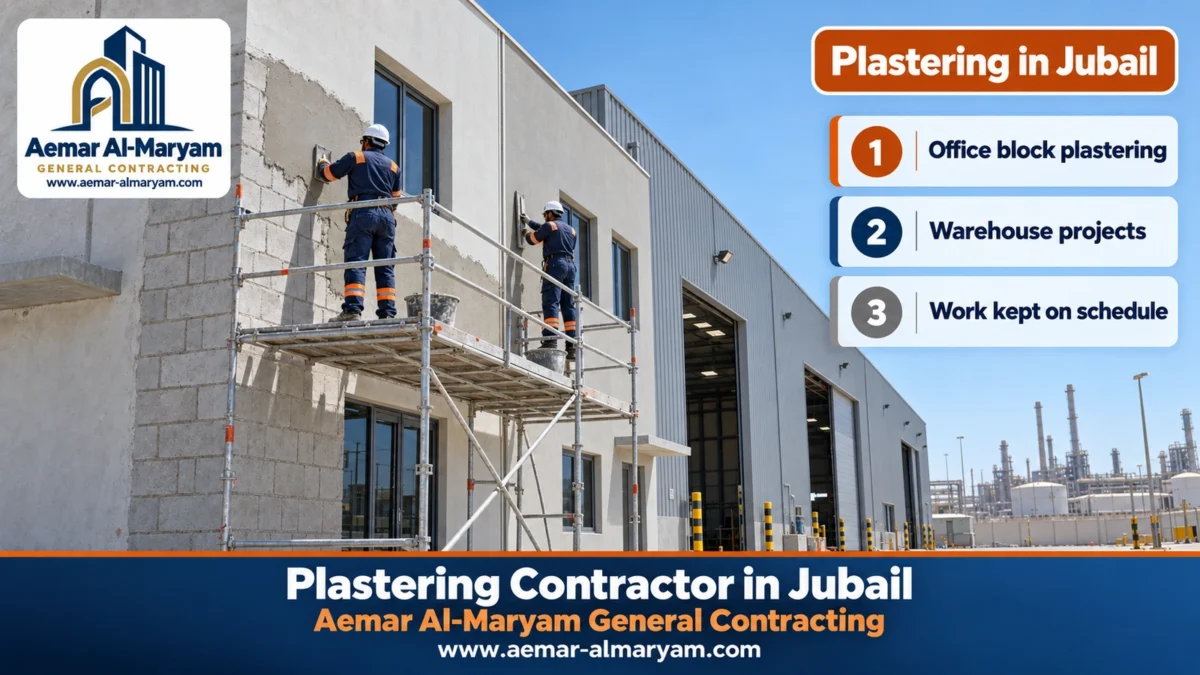
Our plastering contractor in Jubail team at Aemar Al-Maryam General Contracting works on both sides of the city: Jubail Al-Balad, where most jobs are homes, villas and shops, and Jubail Industrial City, where we plaster offices, admin blocks and service buildings attached to warehouses and workshops. We plaster walls, ceilings and corridors inside, render facades and boundary walls outside, and strip and re-plaster old walls that have gone hollow or salty. If you buy the cement and sand, our interior labour is SAR 6.5 a square metre at the lowest; with dots, screeds and corner beads it is SAR 11; on facades our labour is SAR 14, or SAR 18 when we bring the materials. Treat these as floor prices that we confirm after seeing the walls. Phone or WhatsApp 0547879578.
Two things make plastering in Jubail different from plastering in a typical inland town. The first is administrative: a house in Al-Balad sits under the municipality like any other Eastern Province city, while a building inside Jubail Industrial City sits under the Royal Commission and, inside a facility, under the site owner’s own access and safety rules. The second is physical: Jubail is on the coast, so the air is often humid and carries salt that settles on exposed walls, and the commercial buildings here tend to have long, continuous facades where the choice between hand plastering and machine-sprayed plaster really matters. This page walks you through how we handle both, what we charge as a minimum, and how to work out your own wall area before you call.
In short: plastering in Jubail with Aemar Al-Maryam
- Two systems: Jubail Al-Balad for homes, villas and shops; Jubail Industrial City for offices and buildings inside facilities, each with its own permits and site-access routine.
- What we do: internal plaster for walls, ceilings and corridors, facade rendering on screeds, movement beads on long facades, re-plastering, gypsum plaster for dry interiors and coloured render for boundary walls.
- Floor prices per m²: interior labour 6.5, screeded interior with beads 11, interior supplied-and-fixed 13, facade labour 14, facade supplied-and-fixed 18 (SAR). Confirmed only after inspection.
- Large facades: we compare hand plaster and machine-sprayed plaster for you; machine work is priced at inspection, by area and how continuously the site lets us work.
- After plastering: water curing for about 7 days, at least twice a day, and shade from sun and dusty wind.
- To order: send photos, rough sizes and whether the site is in Al-Balad or the Industrial City on WhatsApp 0547879578.
Plastering contractor in Jubail: Al-Balad and the Industrial City are not the same job site
A plastering contractor in Jubail has to know from day one which Jubail the job is in, because the trade itself stays the same while everything around it changes. Permits inside Jubail Industrial City come from the Royal Commission that governs it, not from the Balady platform, whereas the old town of Al-Balad deals with the municipality like any other city. Inside an industrial facility, the facility management adds its own rules on gate passes, protective equipment, working hours and where waste goes. None of that changes how a wall is plastered, but all of it changes how many days the job takes and how we plan the crew.
| Item | Jubail Al-Balad | Jubail Industrial City |
|---|---|---|
| Typical buildings we plaster | Houses, villas, flats, shops and annexes | Admin offices, service blocks attached to warehouses and workshops, housing |
| Who issues permits | The municipality, through Balady | The Royal Commission in Jubail |
| Site access | Arranged with the owner | Per facility rules: gate passes, worker and equipment registration |
| Working hours | Agreed with the household and neighbours | Set by the facility, sometimes weekends only |
| Waste | Collected and removed daily | Taken to the point the facility designates |
| What we need from you | Photos, sizes and location | Photos, sizes, any safety requirements sheet, and the site contact |
Plastering is a finishing trade and does not change the structure, but anything that comes with it, such as demolition, new openings or added rooms, needs a permit from the right authority. We tell you which applies when we inspect.
Working inside a facility in Jubail Industrial City
When the building is an office block or service building next to a warehouse inside a facility, we sit down with the site contact before anything else. We confirm the days and hours we may work, the protective equipment required, where the scaffold may stand, and where we may mix mortar so that dust and water never reach stored goods or equipment. We plan the sequence so that the corridor staff use every day stays open, and we fence off the area we are working in with clear barriers. These details never appear in a price per square metre, yet they decide the programme, which is why we ask about them in the very first message.
Homes in Jubail Al-Balad: Al-Dabab, Ghirnatah, Al-Hamra and beyond
Across Al-Balad, in Al-Dabab, Ghirnatah, Al-Hamra and neighbouring districts, the job is usually one of three things: a new house waiting for plaster once its electrics and plumbing are in, an occupied home where the family wants one room, a majlis or a boundary wall redone, or an older wall whose plaster has blown at the base. Where the family is living in the house, we finish one room before opening the next, cover floors and glazing, clear rubble daily and keep to hours the household is comfortable with.
Plasterer in Jubail: what sets a capable one apart?
A plasterer in Jubail worth trusting with your walls will explain how he will keep them straight before he tells you his price. Ask three questions. Will he set dots and screeds with a level, or work by eye? Will he apply a scratch coat on smooth concrete columns, beams and soffits before plastering? Will he fix a mesh strip where blockwork meets concrete? Three clear yeses are a good sign; hesitation on any of them is worth noting. Ask to see a wall he has finished under strong side light, because waviness hides in ordinary photos and shows up immediately under raking light.
Plasterer phone number in Jubail
To reach our plastering team for Jubail, use our only number, 0547879578, by phone or WhatsApp. Send photos of the walls, their length and height, and whether you are in Al-Balad or the Industrial City, and we will reply with the method we recommend and an initial cost before booking an inspection visit.
Plasterer in Jubail on a day rate or by the square metre?
A day-rate plasterer in Jubail suits small jobs with no clear area, such as filling cable chases or rebuilding a broken corner. For whole rooms, corridors and facades, pricing per square metre is clearer and fairer to both sides. On a day rate you pay for time, so any delay costs you; per square metre you know the total before the first bag is opened and slow work becomes the contractor’s problem.
■ Day rate suits
Patching after the plumber or electrician, and scattered repairs that are hard to measure.
■ Per m² suits
A room, a flat, a corridor or a full facade, where the area can be measured accurately.
■ Inside facilities
We prefer per m² with a fixed day plan, because access and hours are set in advance.
Jubail’s humid coastal air: what it changes in plastering
Jubail is a coastal city, humidity is high on many days of the year, and with the humidity comes sea salt that settles on walls, scaffolding and any material left in the open. In practical terms this changes three things in plastering: how clean the materials must be, how the background is prepared, and how drying is watched. Sand has to be washed and water clean and free of salt, because salt mixed into the mortar itself comes back later as white patches on the surface. A wall that has stood bare in the sea air for months is washed and brushed before we start, to remove deposits that weaken the bond.
Drying is the other side. Humid air slows evaporation from fresh plaster on some days, yet sun and wind on an exposed facade can dry it fast on others, and both can happen within the same day between morning and noon. So we do not follow a fixed spraying timetable; we watch the colour of the surface. When it lightens and starts to dry from the edges we spray it, and while it is still dark and damp we leave it. On facades facing the sea or close to it we recommend a damp-resisting admixture in the external coats when the engineer or the specification calls for one.
⚠ Salt at the base of a wall is not just a plaster problem
White salt or swelling plaster near the floor usually means rising damp or a leak. Re-plastering without dealing with the source brings the same problem back within months, so we look for the cause first, and the job may need a renovation contractor in Jubail before the plasterer.
Internal plastering in Jubail: homes, offices and long corridors
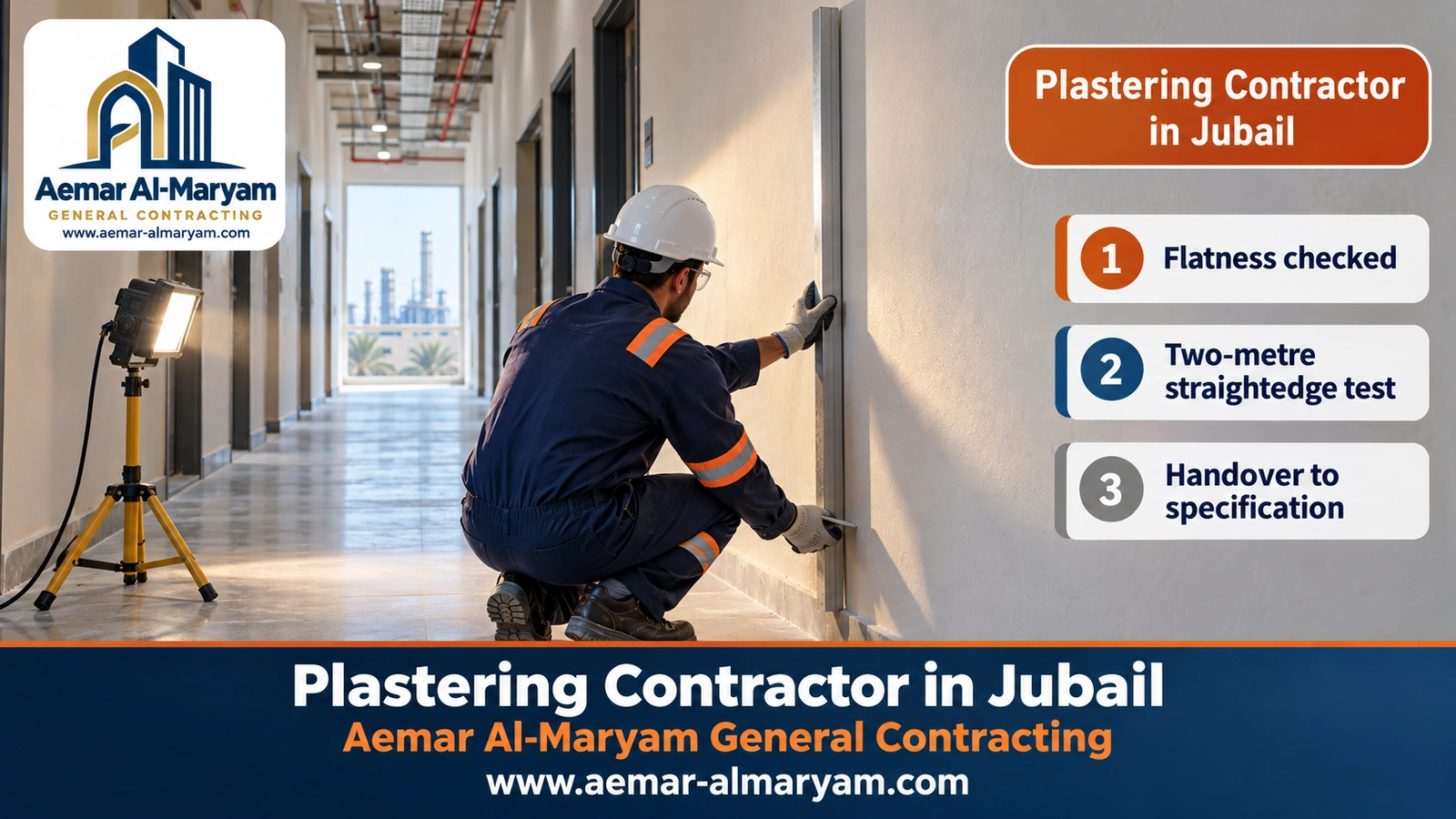
Internal plastering in Jubail is usually a single cement coat, between 12 and 15 mm thick when the blockwork is reasonably true, spread between screeds set with a level and levelled off with a long aluminium rule. It leaves a dense, even surface ready for filler and paint or for tiles. In homes we pay particular attention to majlis rooms and living halls, where lighting exposes every deviation. In admin buildings the hardest wall is the long corridor: a wall tens of metres long under a continuous run of ceiling lights shows the slightest wave, so the screeds there are set closer and checked more often.
In kitchens and bathrooms we always use cement plaster, never gypsum, because these are wet rooms, and we leave a slightly rougher surface wherever tiles will go so the adhesive grips well. Cable and pipe chases get packed with mortar and bridged with mesh tape ahead of the plaster coat; skip that and you will see their outline after the paint dries.
Ceiling plastering in Jubail
A concrete soffit is smooth, absorbs little water and asks the mortar to work against gravity. So the soffit gets a cement-rich scratch coat first, left to harden, and the plaster over it is kept lighter than on walls; a heavy single layer overhead is the one most likely to drop. In offices that will receive a gypsum board suspended ceiling, the concrete above may not need full plaster at all; we point this out at inspection so you do not pay for work nobody will see.
Corner beads in corridors and entrances
External corners in corridors and office entrances get knocked by trolleys and furniture, so we fix metal corner beads before plastering. They keep the arris straight and protect it from chipping. Each bead is plumbed with a level before it is bedded, because a bead fixed out of true passes its lean to the whole wall.
External rendering and facade plastering in Jubail
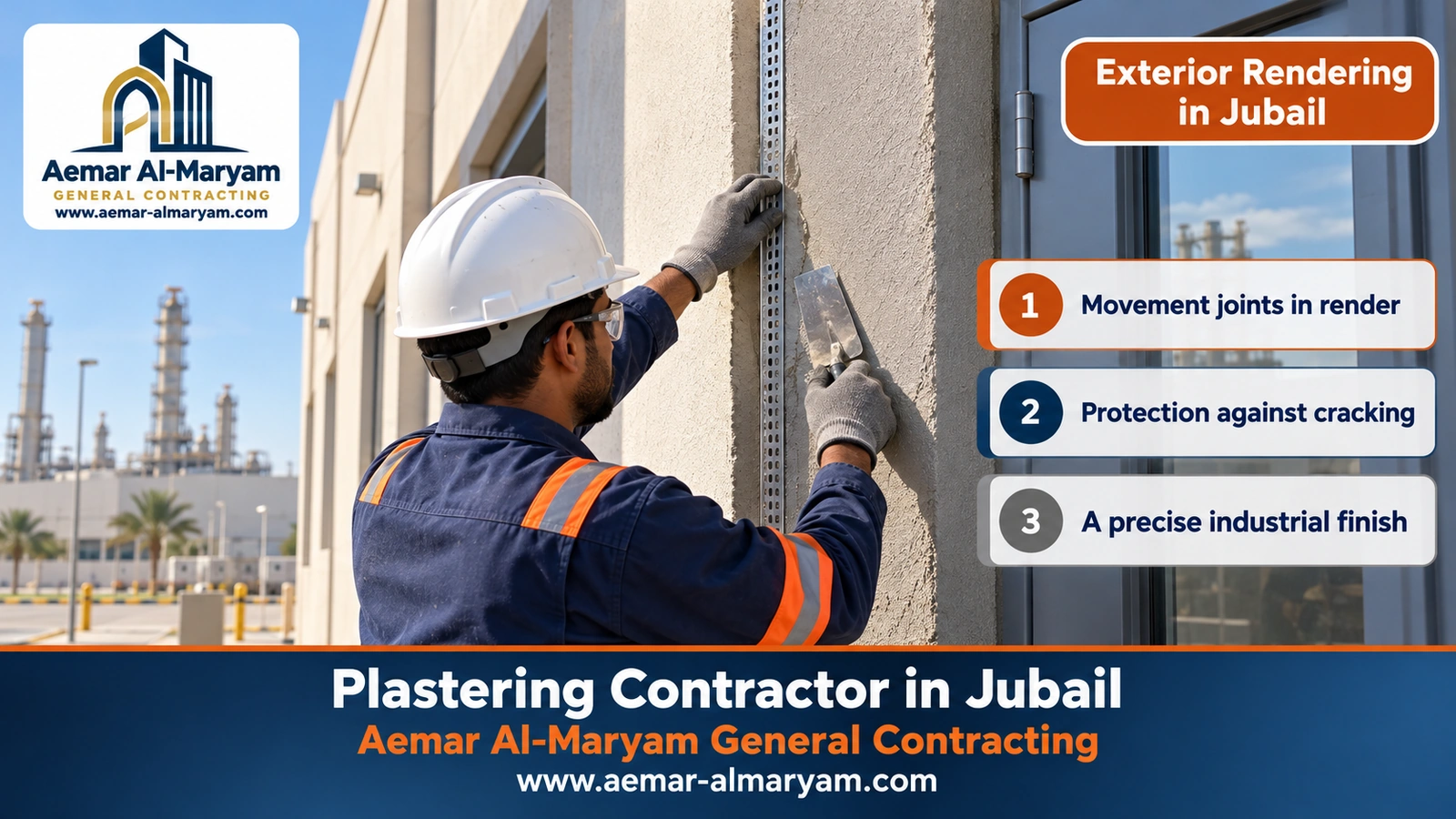
External rendering in Jubail is applied in two coats adding up to somewhere between 15 and 20 mm, with more cement in the mix than we use indoors, because a facade faces sun, humidity and salt at the same time. The first coat fills and levels, the second gives the final surface, and the first is left long enough to firm up before the second goes on. Concrete columns and beams get a scratch coat first, and every junction between blockwork and concrete gets a mesh strip before the first coat.
In the Industrial City we often see a two-storey office block attached to a steel-framed, clad warehouse. The render goes on the blockwork only, with careful detailing where block meets steel door frames and metal cladding. These edges need a clean stop and a proper joint, or the render cracks because steel and blockwork move differently.
Movement joints on long facades in Jubail
A long, continuous facade expands in the heat of the day and contracts at night; without a joint it relieves that movement by cracking wherever it is weakest. On long elevations, and at block-to-column junctions on some sites, we therefore bed a vertical metal movement bead into the render. It leaves a deliberate straight line that absorbs the movement. Joint positions come from the drawings or are agreed with the project engineer.
Coloured render in Jubail
Coloured render is a cement finish whose colour comes from the mix itself, so there is no painting afterwards. Owners choose it for long boundary walls and some facades where owners want less maintenance. On our price list it is SAR 32 a square metre at minimum, materials included. We recommend a small trial panel on the wall before approving the colour, since dry render looks noticeably lighter than wet mortar.
Machine-sprayed or hand plaster in Jubail? Facade size decides
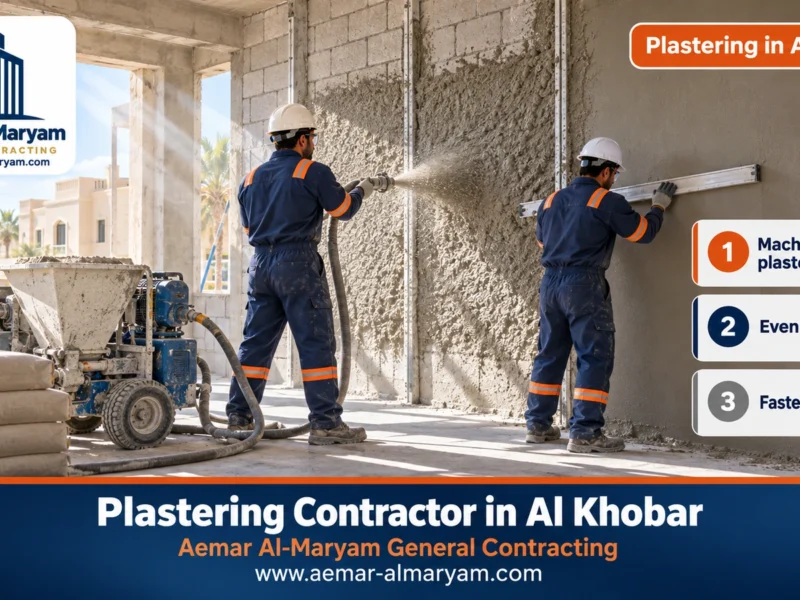
Machine plastering in Jubail uses a pump that pushes a factory-blended mortar down a hose to a spray nozzle; once the mortar is on the wall, the crew rules it flat between screeds just as they would by hand. Its strengths are speed and a consistent mix over large, repetitive areas such as admin-building facades, warehouse offices and long office corridors. Its weaknesses are that it needs continuous work without long stops so the machine does not block, and it needs setting up, moving and cleaning, which is why it rarely pays on one or two rooms.
| Comparison | Hand plaster | Machine-sprayed plaster |
|---|---|---|
| Best for | Rooms, repairs and occupied homes | Facades, corridors and large buildings |
| Mortar | Cement and sand mixed on site | Ready pumpable mortar |
| Speed | Slower | Faster on continuous areas |
| Straightness | Depends on screeds and straightedge | Also depends on screeds and straightedge |
| Our price | From SAR 6.5/m² labour | At inspection, by area and site set-up |
When do we suggest the machine in Jubail?
When the area is large and continuous, the site allows several consecutive working days without interruption, and there is space for the machine and materials close to the facade. Otherwise hand plaster remains the better choice, and in both cases a straight wall comes from the screeds, not the machine.
Scratch coat, dots and screeds in Jubail
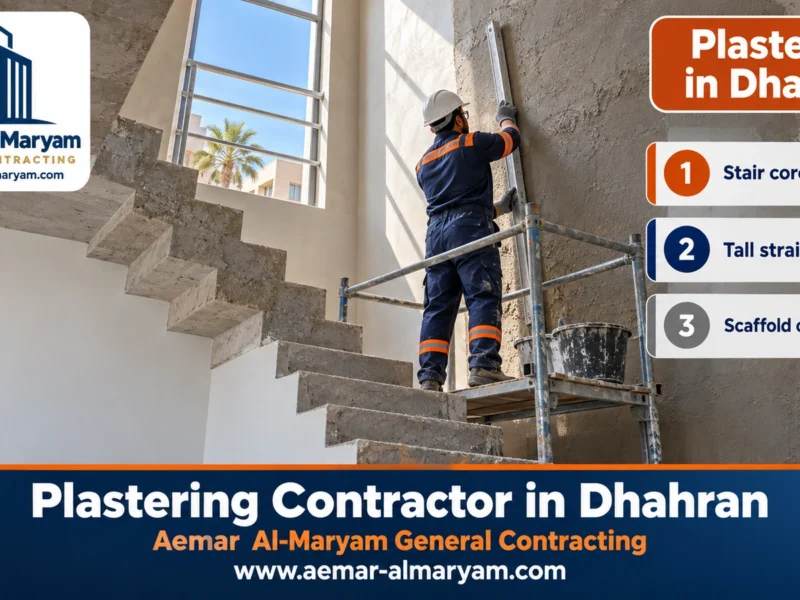
Before any plaster coat goes on, three preparatory jobs decide how straight the wall will be. On smooth concrete, a cement-rich scratch coat is flicked on hard and left rough to give a key. Across the wall, small mortar pads called dots are levelled to mark the finished face. Between the dots, vertical bands of mortar called screeds are formed, and the rule slides along them.
- 1Clean the wall and wash off salt
We remove dust and salty deposits from walls left exposed, and dampen absorbent blockwork without soaking dense concrete. - 2Scratch-coat the concrete
Roughly 1:2 cement to sand on columns, beams and soffits, left rough and kept moist for at least a day. - 3Dots
Set roughly 1.5 m apart and plumbed with a level to fix the finished surface. - 4Screeds and beads
We join the dots with vertical strips and fix metal beads on corners and movement beads on facades. - 5Mesh
A mesh strip about 15 cm wide goes over every block-to-concrete junction and over service chases.
Plaster mix ratios and thickness in Jubail
Common cement-to-sand ratios for plaster run from 1:4 to 1:6, external mixes are usually richer than internal ones, and the scratch coat is richer still. The rule we never break is that an outer coat must not be stronger than the coat beneath it: a stronger coat shrinks more and pulls the weaker one away until it lets go.
| Coat | Approx. ratio (cement:sand) | Approx. thickness |
|---|---|---|
| Scratch coat on concrete | About 1:2 | Thin, rough layer |
| Single-coat internal plaster | 1:4 to 1:5 | About 12 to 15 mm |
| External render in two coats | Near 1:4; admixture against damp if specified | Roughly 15–20 mm overall |
| Ceilings | Close to internal | Thinner than walls |
Rule of thumb: one 50 kg bag of cement covers roughly 10 m² at 2 cm thickness with a 1:4 mix. A wall that needs more than about 25 mm to come true is corrected first instead of being loaded with one thick coat.
Plaster with mesh in Jubail: columns, openings and chases
Plastering with mesh in Jubail means embedding a strip of mesh inside the plaster wherever two different materials meet. Heat and moisture make blockwork and concrete swell and shrink unequally, and the line where they meet is where the crack shows. A strip about 15 cm wide is centred on the joint, fixed before plastering and buried in the coat. We also use it around the corners of doors and windows in long walls and over electrical chases. Walls prone to more movement can be meshed edge to edge with fibre mesh, priced from SAR 20/m².
⚠ Mesh does not fix a structural crack
A crack that runs through both plaster and blockwork, keeps widening, or runs diagonally from a door corner needs assessing before any plaster goes on. Read crack repair in Jubail to see when a crack is only skin-deep.
Gypsum plaster or cement plaster in Jubail?
Gypsum plaster in Jubail suits dry interior walls only, such as offices, bedrooms and halls, when time is short. It sets in roughly half an hour, needs no water curing, shows very little shrinkage cracking and can be painted within a few days. It is not suitable for facades, bathrooms, kitchens or the base of walls exposed to damp, and in a humid city like Jubail we are especially careful about where it goes.
| Comparison | Gypsum plaster | Cement plaster |
|---|---|---|
| Where | Dry interior walls | Inside, outside and wet rooms |
| Water curing | Not needed | About 7 days |
| Painting | After about 3 to 4 days | Once properly dry; up to about 28 days for ordinary paints |
| Lowest price with us | 41 SAR/m², supplied and fixed | 13 SAR/m² indoors, supplied and fixed |
Re-plastering old walls in Jubail
Re-plastering old walls in Jubail starts with tapping the wall to map the hollow areas that have come away from the blockwork. We cut these back to a sound edge, clean the block of salt and dust, apply a scratch coat and re-plaster in coats. We do not advise putting new plaster over old hollow plaster, because the new coat simply falls with the old. Taking off old plaster with nothing put back costs from SAR 7.5/m²; taking it off and plastering again costs from SAR 23/m². If the building needs more than plaster, see our renovation service.
Older homes in Al-Balad often show the same pattern: sound plaster at head height, hollow and salty plaster in the bottom metre. That pattern points to moisture from below, and it is the reason we check the source before quoting for new plaster. Fixing the cause first is cheaper than re-plastering the same strip twice.
Curing plaster with water in Jubail’s climate
Curing plaster with water in Jubail means keeping cement plaster damp for about 7 days after it is applied, with a light spray at least twice a day, morning and evening, and protecting it from direct sun and wind. Cement needs water to gain strength, and fast drying leaves hairline cracks that appear after painting. On exposed south- and west-facing facades we spray more often on hot days, and on humid days we watch the surface and do not spray a wall that is still dark and damp.
- Spray as a fine mist, never a jet that washes the surface away.
- In air-conditioned offices, turn strong airflow away from fresh walls for the first days, because it dries the surface quickly.
- Painting waits until cement plaster has properly dried; see timing in painting contractor in Jubail.
- On external render, leave at least two days between the first and second coats.
Plaster defects in Jubail: cracks, hollowness and salts
Most plaster defects in Jubail have a clear, avoidable cause: drying too fast, the wrong mix, an unprepared background, or moisture from the ground. This table summarises the common ones:
| Defect | Usual cause | Remedy |
|---|---|---|
| Fine map cracking (crazing) | Fast drying, a cement-rich finish coat or dirty sand | Proper curing, filling hairlines, redoing a badly crazed finish |
| Straight crack beside a column | No mesh over the block-to-concrete junction | Open the crack, add mesh, re-plaster |
| Hollow sound when tapped | No scratch coat on concrete, a dry dusty background, or one over-thick coat | Cut back to a sound edge, scratch coat, re-plaster in coats |
| White salts | Moisture carrying salts through the wall, or salty sand and water | Stop the water, let it dry, brush off |
| Wavy surface | Work without screeds, or rushing | Screeds and straightedge, correction before the final coat |
Plastering price per square metre in Jubail
In Jubail our square-metre rate begins at SAR 6.5 when we supply only labour indoors, SAR 13 when we also supply the materials indoors, and SAR 18 for a supplied-and-fixed facade render. We found no plastering contractors in Jubail publishing figures, so we built the table from the nearest published prices in Dammam and the Eastern Province and set ours below them. The final price is fixed once we have seen the wall, its height and access, and, inside facilities, the access rules and working hours.
| Item | Unit | From | Jubail note |
|---|---|---|---|
| Internal plaster, labour only (client materials) | m² | SAR 6.5 | New houses before finishing |
| Internal labour with dots, screeds and beads | m² | SAR 11 | Best for long corridors |
| Internal plaster with materials (cement, washed sand) | m² | SAR 13 | Washed sand and clean water |
| Ceiling plaster | m² | SAR 14 | After scratch-coating the soffit |
| External render, labour | m² | SAR 14 | Scaffold and height at inspection |
| External render with materials | m² | SAR 18 | Damp-resisting admixture where needed |
| Smooth paint-ready finish | m² | SAR 17 | Offices and majlis rooms |
| Plaster with fibre mesh over the whole wall | m² | SAR 20 | Walls that move more |
| Kitchen and bathroom walls | m² | SAR 18 | Always cement-based |
| Stripping old plaster only | m² | SAR 7.5 | Back to a sound edge |
| Strip and re-plaster an old wall | m² | SAR 23 | After treating the cause |
| Room crack treatment before painting | room | SAR 140 | Surface cracks only |
| Gypsum plaster with materials | m² | SAR 41 | Dry interiors |
| Coloured render with materials | m² | SAR 32 | Boundary walls and facades |
| Machine-sprayed plaster | — | At inspection | Large areas |
| Hollow or detached plaster | — | At inspection | After tapping and checking |
| Rising damp and salts at wall bases | — | At inspection | Source first |
Prices are estimates until inspection and agreement. A poor background, extra thickness, working height or awkward access push them up; a large area brings them down. Our full rate card is on the prices page.
Worked example: a 5 × 6 m office in Jubail
An illustrative office or majlis measuring 5 × 6 m with a 3 m ceiling, one door of about 2.2 m² and two windows of about 2.25 m² each. All three openings exceed 2 m², so under the common rule they are deducted:
| Calculation | Result |
|---|---|
| Wall area: (5 + 6) × 2 × 3 | 66 m² |
| Less door and two windows: 2.2 + 4.5 | 6.7 m² |
| Net walls | 59.3 m² |
| Ceiling: 5 × 6 | 30 m² |
| Total | 89.3 m² |
| Basic labour: 89.3 × 6.5 | about SAR 580 |
| Screeded with beads: 59.3 × 11 + 30 × 14 | 652.3 + 420 = about SAR 1,072 |
| Including materials: 89.3 × 13 | about SAR 1,161 |
| Approx. cement at 2 cm | about 9 bags |
Example: an office facade in Jubail Industrial City
A blockwork facade of 220 m² net of openings: external labour from 220 × 14 = SAR 3,080, and external render including materials from 220 × 18 = SAR 3,960. Scaffolding, height and movement joints are added after inspection, and if the area suits a machine we price both methods side by side so you can compare.
How is plaster measured?
Multiply each wall’s length by its height and add the results, then deduct the large openings. The usual practice is that openings over 2 m² are deducted and smaller ones are not, because their edges take extra work. Whatever rule you use, agree it in writing before the first working day.
How long does plastering take in Jubail?
A small room usually takes about a working day of plastering, a large hall or complex room two to three days, and a facade depends on its area, height and the number of coats. Add the curing days after that, and, inside facilities, any days lost to access arrangements. The programme comes with the price, day by day.
Can you paint without plastering in Jubail?
You can skip plaster only when the surface is already true, such as well-formed fair-faced concrete or gypsum board, with a suitable skim of filler. Ordinary blockwork and facades need plaster, because paint does not hide block joints or protect the wall from moisture and salt, and in Jubail’s coastal air paint applied straight to blockwork peels quickly.
How plastering is carried out in Jubail, step by step
- 1WhatsApp first
Photos and rough sizes come to us and tell us whether the site is in Al-Balad or the Industrial City; we reply with an initial cost. - 2Inspection
We tap and level-check the walls, mark where mesh, beads and scratch coat are needed, and agree on materials. - 3Site arrangements
In facilities: gate passes, safety and where the machine or mixing area goes. In homes: floor and window protection. - 4Preparation
Cleaning and washing off salt, scratch coat, dots and screeds, beads and mesh. - 5Plastering
One internal coat or two external coats, ruled off with the straightedge and finished as agreed. - 6Curing
Water spraying for about 7 days, with shade from sun and wind. - 7Handover
We check the walls together with the rule and by tapping, then leave the site swept.
Accepting finished plaster: what to check
- ✓Straightedge: lay a 2 m rule against the wall vertically, horizontally and diagonally, and look for light under it.
- ✓Raking light: shine a lamp along the wall from the side; it shows waves far better than looking straight on.
- ✓Tapping: knock with a knuckle or a wooden handle; a hollow sound means debonded plaster.
- ✓Corners: check that arrises are plumb and unchipped.
- ✓Edges: around switches, sockets and door frames the plaster should finish cleanly.
- ✓Curing: ask how many days the plaster was sprayed and who sprays it after handover.
Common plastering mistakes in Jubail
- Plastering a wall that stood bare in the coastal air without washing off the salt first.
- Using unwashed sand or doubtful water in the mix.
- Rendering a long facade without movement joints, so random cracks appear.
- Putting one thick coat on a facade instead of two.
- Skipping mesh at columns and around steel door frames.
- Stopping the spraying after a day or two because “the air is humid anyway”.
- Breaking new plaster weeks later for forgotten services; finish all chases before plastering.
How to order a plastering contractor in Jubail
To order a plastering contractor in Jubail, send the following to WhatsApp 0547879578 and you will get our suggested method and a first figure:
- ✓Location: Al-Balad or the Industrial City, plus the district, facility name or a map pin.
- ✓Photos: one wide shot of each wall or facade, plus close-ups of any hollow, salty or cracked areas.
- ✓Sizes: wall lengths and heights, or the facade’s width, height and number of floors.
- ✓Scope: new internal or external plaster, or strip and redo; and whether the building is under construction, occupied or a working facility.
- ✓Materials: whether you want us to supply them or you will.
- ✓Site rules: for facilities, the permitted working hours, safety requirements and a contact person.
Why Aemar Al-Maryam for plastering in Jubail?
■ Both Jubails
We run homes in Al-Balad the residential way and facilities in the Industrial City by their rules.
■ Published prices
The minimum for every item is on this page; the final figure is written after inspection.
■ Big facades
We compare hand and machine plaster with numbers before you decide.
■ Facade detailing
Mesh at columns, movement beads and metal corner beads.
■ Before the plaster
We deal with cracks, damp and services first, as a general contractor.
■ Past work
Examples from our jobs in the projects gallery.
Where we work in and around Jubail
We cover Jubail Al-Balad districts such as Al-Dabab, Ghirnatah and Al-Hamra, and offices and admin buildings inside Jubail Industrial City under each facility’s rules, travelling from our Dammam base on planned days. For our other Jubail services, open the Jubail page, and the full plastering guide is at plastering contractor in Dammam. We also work as a plastering contractor in Ras Tanura and a plastering contractor in Abqaiq.
Plaster your office or home in Jubail
Send photos of the walls and facade and tell us where you are in Jubail, or call us; we will suggest the right method, give an initial cost and book an inspection.
Useful pages for plastering in Jubail
Article tags