In Al-Ahsa our pour day does not start at sunrise; it starts an hour or more before it. The floodlights are on over the slab, the pump is set up, and the first mixer truck arrives while the air is still relatively cool. That is how we handle concrete pouring in Al-Ahsa at Aemar Al-Maryam General Contracting: wide rest-house courtyards among the palm farms, underground reinforced-concrete water tanks for farms and homes, and the usual structural work of blinding, footings, ground beams, columns and roof slabs, all with ready-mix from a licensed plant close to the site. We charge blinding from 14 riyals per m² of spreading and levelling, and a meshed 10 cm courtyard or yard with materials supplied from 46 riyals per m², while plant concrete, pump hire and lab fees are passed on at whatever they cost that day. All of this is an estimate until inspection and agreement, while the cost of bringing the crew roughly 160 km from Dammam is set at the inspection. Call or WhatsApp 0547879578.
Al-Ahsa is one of the largest oases in the world, with more than two and a half million palm trees fed by a large underground aquifer and many springs and wells. That setting creates its own kind of concrete work: rest houses and courtyards poured over large areas in one go, underground tanks built to store irrigation or drinking water, and foundations on plots near farmland where the water table can be closer than the owner expects. Add a summer in which the average July high is around 46 °C, and the timing of a pour and the way the concrete is cured afterwards become part of the quality of the job rather than a side detail. This guide explains how we deal with all of that, what it costs, and how to book.
Al-Ahsa pours at a glance
- What we pour: rest-house courtyards and house yards, underground water tanks, blinding, footings and ground beams, columns, solid and hordi roof slabs, annex slabs, slope screeds, power-trowelled and stamped floors.
- Tanks: waterstops at every construction joint, tie rods with water bars, and a fill test before waterproofing and backfill.
- Timing: in the hot months we start at dawn under floodlights and never place concrete warmer than 35 °C.
- Starting rates: courtyard slab with materials SAR 46 a square metre, trowelled floor SAR 46, stamped concrete SAR 110, foam screed SAR 17 or mortar screed SAR 23, and blinding labour SAR 14; tanks, roof slabs and footings are quoted after a site visit.
- The drive: roughly 160 km from Dammam; we cost the trip when we inspect, and adding more jobs to the same trip lowers the share each one carries.
- First step: send site photos and drawings or dimensions on WhatsApp 0547879578.
Concrete pouring in Al-Ahsa: what work do we carry out?
Concrete pouring in Al-Ahsa, for us, means delivering the whole concrete element on your site: preparing the ground or the formwork, fixing the steel and spacers, ordering the ready-mix, then placing, vibrating, finishing and water-curing it. We do not sell the concrete itself. The plant batches and delivers it; we are responsible for everything that happens to it from the moment it leaves the truck until it has hardened and is handed over to you.
- ✓Rest-house courtyards and house yards: mesh-reinforced slabs laid to falls towards drains, small or very large.
- ✓Underground concrete water tanks: for farms, rest houses and villas, with base, walls, roof slab and an access opening.
- ✓Blinding: under footings and ground beams, and under yard slabs.
- ✓Footings, ground beams and stub columns: for new villas, annexes and majlis buildings.
- ✓Columns and roof slabs: solid or hordi, with the staircase where the drawings include one.
- ✓Roof slope screeds: foam concrete or cement mortar, before the waterproofing.
- ✓Power-trowelled and stamped floors: for stores, workshops, walkways and outdoor seating areas.
Concrete contractor in Al-Ahsa or concrete company?
In Al-Ahsa the concrete contractor is the crew on your plot: formwork, steel fixing, placing and curing. What people search for as a “concrete company” may be a ready-mix plant that only sells and delivers the material, or it may be a contractor like us. The difference matters. If you buy concrete from the plant on your own, you still need someone to receive it, place it, compact it and cure it. If you hire a contractor, the contractor arranges the quantity, the grade and the delivery schedule with the plant. We work the second way, we hand you the plant’s invoice exactly as issued, and our labour is a separate line you can see.
Rest-house courtyard slabs in Al-Ahsa: a big surface that stays sound
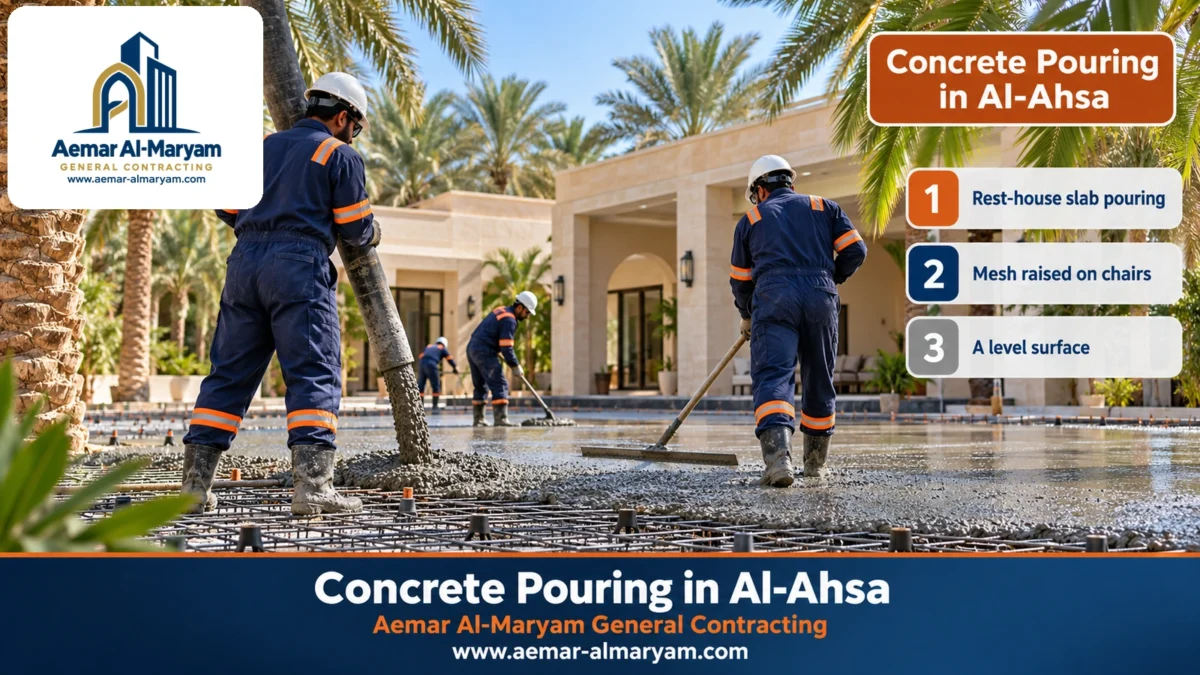
Pouring a rest-house courtyard in Al-Ahsa means replacing a wide earth courtyard with a concrete slab of roughly 10 cm, tied together by steel mesh, with planned falls towards the drainage points, ready to use as it is or to be tiled later. A standard slab with every material supplied costs from 46 riyals per m², an estimate that the inspection confirms.
A rest-house courtyard differs from a small house yard in three ways. The first is size. A courtyard can run to several hundred square metres, so we never pour it as one monolithic block. We divide it into panels with expansion and control joints, placed by the installer according to the dimensions, so that the concrete cracks at the joint we chose rather than in the middle of the courtyard. The second is drainage. A wide courtyard collects washing water, rain and irrigation run-off from a large area, so we set out the falls before the pour and fix level pegs that carry water to the drains or to the planted edges. The third is use. Many rest houses drive cars into the courtyard, and some put up tents or heavy seating there, which changes the thickness and reinforcement needed where the loads sit.
Before the pour we compact and dampen the soil, apply termite treatment, lay the polythene sheet, and then lift the mesh onto plastic or concrete chairs so that it sits in the middle of the slab rather than lying on the sheet. This small step is skipped surprisingly often: mesh lying on the bottom does nothing, and the concrete cracks above it as if it were not there. After the pour we strike the surface off with a straightedge and then with a long-handled bull float, which covers a wide area without anyone walking on the fresh concrete.
Courtyards that take vehicles
Tell us before the inspection whether cars or small trucks will drive into the courtyard and where they will park. We thicken the slab or add reinforcement along that route only, instead of loading the whole courtyard with a cost it does not need.
Yard slab pouring in Al-Ahsa for houses and villas
A house yard in Al-Ahsa is simpler than a rest-house courtyard but needs the same care: falls towards the drain or the yard gate, a level slightly above the street so that rainwater does not run in, and a joint between the slab and the house wall so that movement is not transferred. Very small yards (under roughly 50 m²) cost a little more per square metre than SAR 46, because pump hire and site set-up are almost fixed whatever the area. For a surface you can take up and put back when a pipe needs work, see interlock paving in Al-Ahsa, and if the yard is a driveway, compare it with asphalt in Al-Ahsa as well.
Power-trowelled (helicopter) floors and stamped concrete in Al-Ahsa
A power-trowelled floor in Al-Ahsa is finished, while the concrete is still green, by a machine whose spinning blades give it the local nickname “helicopter”; the result is a smooth, tight surface that takes wear. Ordinary floors with materials start at 46 riyals per m² once the area reaches roughly 50 m², and the finish suits farm stores, maintenance workshops and equipment shelters. Heavy warehouse floors with special thickness and reinforcement are priced at inspection. Stamped concrete for walkways and outdoor seating is priced from SAR 110 a square metre and needs its protective sealer renewed every few years.
Underground concrete water tanks in Al-Ahsa for farms and rest houses
Pouring an underground concrete water tank in Al-Ahsa is structural work unlike any other pour, because the concrete is not only carrying load: it holds water in from the inside and resists damp ground on the outside. A tank is cast in stages: a reinforced base, then the walls, then a roof slab with an access opening. Each stage meets the previous one at a construction joint, and that joint is the weakest point if it is not detailed and built properly. Tanks are priced at inspection from their size and design.
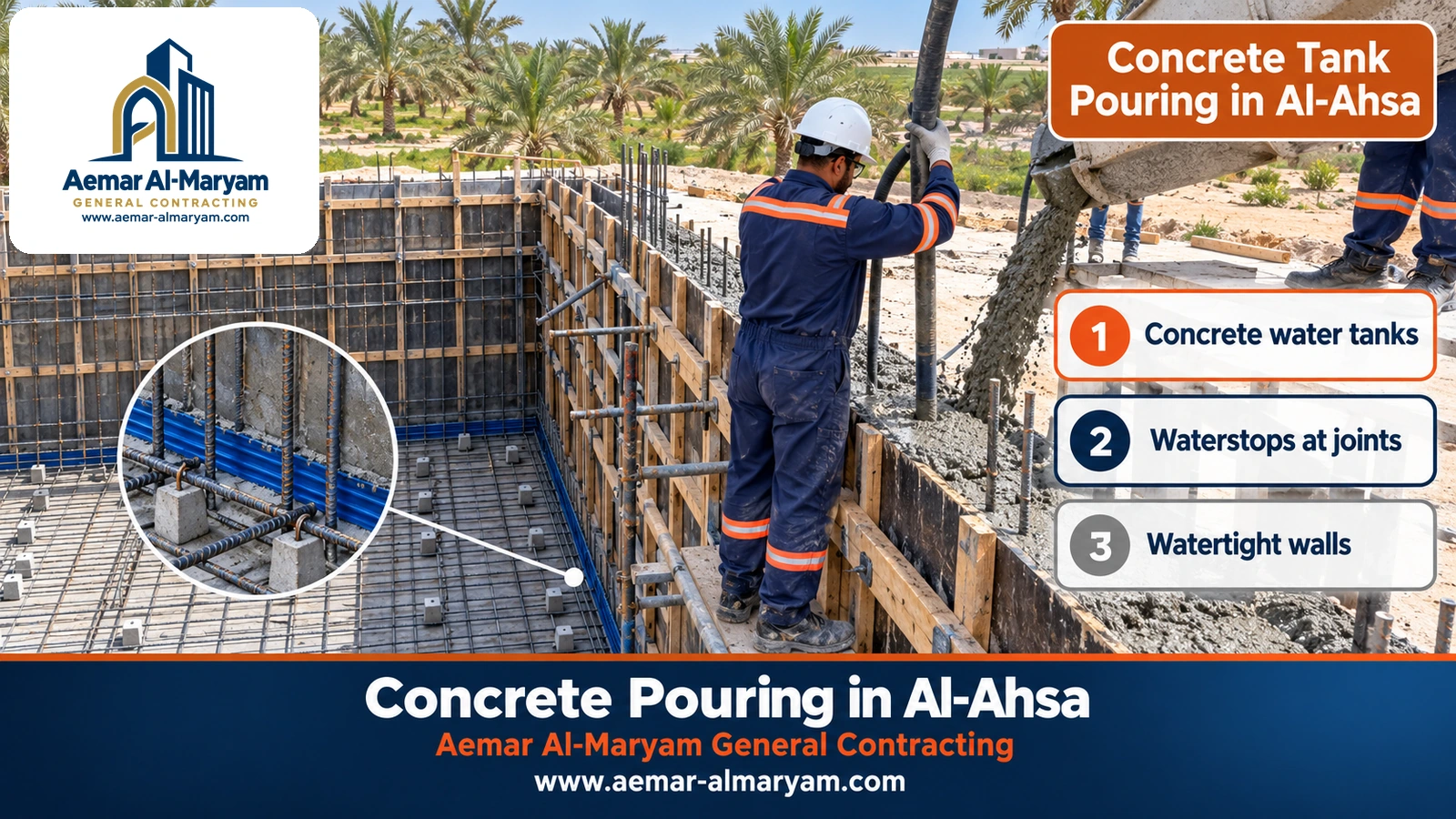
Waterstops at the tank’s construction joints
A waterstop is a flexible strip, usually PVC, or a strip that swells on contact with water, fixed in the middle of the construction joint between base and wall, half in the first pour and half in the second, so that it cuts off any path for water trying to pass through the joint. Common practice is to cast a short upstand of the wall, a “kicker” at least 150 mm high, together with the base and to fix the waterstop in it, which puts the joint above the base level where it is easier to build and to clean. What we watch most closely while pouring the wall is that the waterstop stays straight and in position, without folding under the pressure of the concrete, and that the concrete around it is fully vibrated so no void is left beside it.
Tie rods in tank walls
The two faces of the timber wall form are held together by tie rods that pass through the wall thickness, so that the form does not burst under the pressure of fluid concrete. In an ordinary wall these rods are not a problem. In a tank, each rod is a potential route for water from inside to outside. So in tank walls we use tie rods fitted with a water bar, a sealing collar, in the middle, and after striking the forms we fill the recesses at both ends with non-shrink mortar on both faces. We do not run open plastic sleeves through tank walls, as is sometimes done in ordinary walls.
Pouring and vibrating tank walls in layers
A tank wall is relatively tall and narrow, and the steel inside is dense, so concrete is never dropped in from the top all at once. We place it in layers of no more than about half a metre and lower the poker vibrator vertically into each layer so that it penetrates about 15 cm into the layer below, then withdraw it slowly. Honeycombing inside a tank wall usually cannot be seen from outside, but it shows itself the first time the tank is filled, as damp patches or leaks.
Fill test before waterproofing and backfill
Before the outside of the tank is waterproofed and backfilled, we fill it with water in stages and watch the level and the outside faces of the walls for a period set by the supervising engineer. Any damp patch or leak that appears now is easy to fix; after backfilling it means digging again. Once the test is passed, the external surfaces in contact with soil are waterproofed, and the inside receives a coating suited to the stored water, one approved for drinking water if the tank will hold it. Details of tank and roof waterproofing are in roof waterproofing and insulation in Al-Ahsa.
Never backfill a tank before testing it
Backfilling straight after striking the forms saves two or three days, but it hides any leak under the soil. On damp farmland you may not know whether the water around the tank is leaking out of it or into it until months later.
Worked example: the concrete in a farm tank in Al-Ahsa
An illustrative example only: an underground tank with internal dimensions of 4 × 3 m and an internal height of 2.5 m, giving a capacity of about 30 m³ (about 30,000 litres), with 25 cm walls, a 30 cm base and a 20 cm roof slab. The external plan of the base and roof is 4.5 × 3.5 m.
| Element | Calculation | Quantity |
|---|---|---|
| Base | 4.5 × 3.5 × 0.30 | 4.725 m³ |
| Walls | wall centre-line perimeter 15 m × 0.25 × 2.5 | 9.375 m³ |
| Roof slab | 4.5 × 3.5 × 0.20 | 3.15 m³ |
| Total | 4.725 + 9.375 + 3.15 | 17.25 m³ |
| Plus about 5% waste | 17.25 × 1.05 | about 18.1 m³ |
| Concrete cost at the Kingdom-wide average, resistant 350 | 18.1 × 223.67 | about SAR 4,048 |
Wall centre-line perimeter = 2 × (4.25 + 3.25) = 15 m. We priced the concrete at the published national average for sulphate-resisting grade 350 because designers often choose it for concrete in contact with damp ground; what you pay is the plant’s invoice, and the designer may specify a different mix.
That figure is for the material only. Steel, formwork, waterstops, tie rods, labour, pump hire, testing and waterproofing are added on top, all priced after inspection from the drawings. The point of the example is to show you how much concrete the tank needs, so that you can check the quantity written in any quote you receive. An error of two or three cubic metres in the order means either a truck short halfway up the wall pour or surplus concrete you pay for.
Ready-mix concrete in Al-Ahsa: from the nearest licensed plant
Ready-mix concrete in Al-Ahsa is available from licensed plants inside the governorate, including plants in Hofuf, so we order from the plant closest to your site rather than from Dammam. A shorter haul means less time for the concrete inside the drum, which matters a great deal in the heat. There is no official Al-Ahsa price list. The closest published reference is the averages the General Authority for Statistics releases for the whole Kingdom:
| Grade and cement | Kingdom-wide average per cubic metre |
|---|---|
| 250, ordinary cement | SAR 194.53 |
| 350, ordinary cement | SAR 214.10 |
| 250, sulphate-resisting | SAR 202.67 |
| 350, sulphate-resisting | SAR 223.67 |
These averages cover the material alone, not pumping, admixtures or haulage. What you actually pay is the local plant’s invoice, which we hand over unchanged.
When ordering, we agree with the plant on the grade shown in the drawings, the cement type, the admixtures (a set retarder in summer in particular), the target slump and the time of each truck. We ask for trucks to arrive in sequence so that none stands waiting in the sun, and we reject any load that has been delayed too long or has had water added outside the mix design.
Blinding, footings and ground beams in Al-Ahsa near farmland
In Al-Ahsa blinding means a skim of lean, unreinforced concrete, typically 5–10 cm deep, laid over the compacted formation beneath footings and ground beams so the steel and forms sit on something clean and flat. Spreading and levelling it is charged from 14 riyals per m², and the concrete is charged on the plant’s invoice.
Footings and ground beams in Al-Ahsa and the water table
Pouring footings and ground beams in Al-Ahsa starts with reading the soil report, especially on plots next to farms or in low-lying spots, because groundwater can be close to the excavation level. If water appears in the excavation we pump it out before the blinding and never pour onto saturated mud, and we leave the decisions on cement type, water-cement ratio and cover thickness to the designer. One point many owners do not know: sulphate-resisting cement on its own does not protect reinforcement from salts. Research carried out at KFUPM in Dhahran showed that blends containing silica fume or slag held off chloride corrosion of the bars much more effectively. That is why the designer chooses the mix from the soil report rather than from habit.
■ Cover to footings
75 mm for concrete cast directly against soil, per the ACI 318 table on which the Saudi code is based.
■ Waterproofing before backfill
Bitumen coating on every concrete surface that will be in contact with soil.
■ Backfill in layers
Clean fill compacted in layers, not building debris and not tipped in one go.
■ Services before the pour
Drainage and electrical pipes that cross ground beams are fixed in place before pouring.
Columns and roof slabs in Al-Ahsa
Pouring columns in Al-Ahsa starts with plumbing the form with a spirit level on two faces and bracing it with raking props, then placing the concrete in layers with vibration. A roof slab follows the shuttering, the fixing of bottom and top steel on chairs and a check of services and openings, and it is priced from the drawings after inspection.
Hordi or solid slab in Al-Ahsa?
A solid slab in Al-Ahsa is a full-depth concrete slab, while a hordi slab has hollow blocks between concrete ribs, which cuts the volume of concrete and the weight and helps with thermal insulation. The choice belongs to the designer, based on spans and loads. What matters to us on site is that the blocks are laid in straight rows, soaked beforehand so they leave the mix its water, and that the ribs are filled completely with vibration.
Annex or majlis roof slab in Al-Ahsa
Pouring the roof of an annex or majlis at a rest house or home in Al-Ahsa first needs a permit and a structural drawing; then we build the shuttering, steel and pour as for any slab. If you are building the whole annex, it is better to read annex and majlis building in Al-Ahsa, where the project is priced as one job.
Formwork and steel fixing before the pour
Formwork means preparing timber or steel forms for columns, beams and slabs, and steel fixing means cutting, bending and tying the bars to the drawings. Between steel and form we place concrete spacers of the thickness the designer specifies: the code minimum is 20 mm for interior slabs and 40 mm for beams and columns, and the designer increases it in aggressive environments.
Dawn pours under floodlights in Al-Ahsa: why we start before the sun
We pour in the Al-Ahsa summer at dawn because the Saudi concrete code requires fresh concrete to be no warmer than 35 °C at placing, sets a minimum slump of 75 mm, and forbids adding water to restore workability. In a city where the average July high is around 46 °C, the midday hours are simply out of the question.
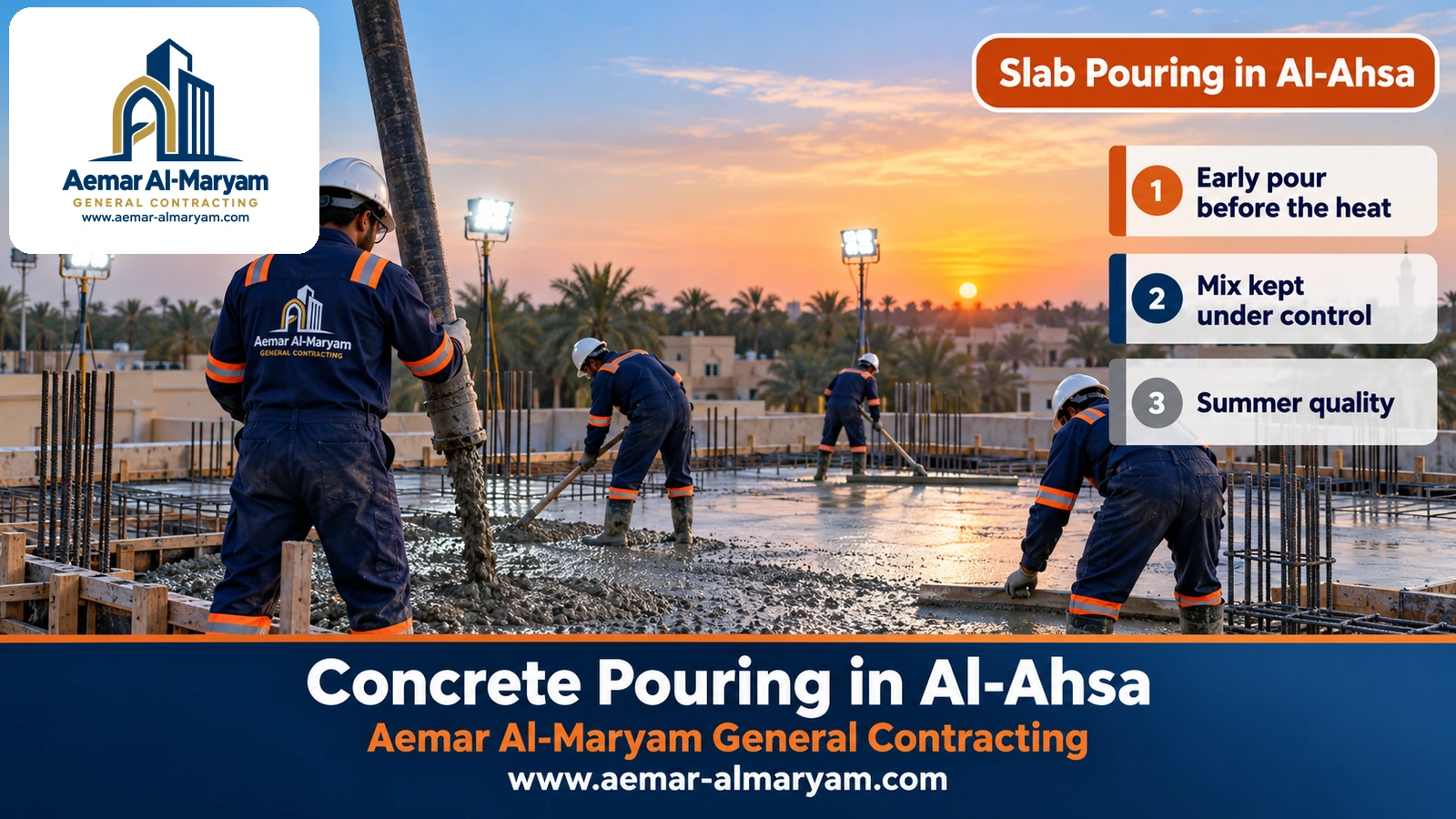
Starting before sunrise takes preparation the day before: floodlights spread so they light the whole slab rather than part of it, a lit and marked route for the pump and trucks, vibrators tested, and every worker knowing his place. We ask the plant for a set retarder that gives us time to finish before the concrete stiffens, and we dampen the forms and the ground beforehand so they do not draw water from the mix. By the time the sun is up, most of the slab is done and curing starts immediately.
- ✓Concrete temperature: no more than 35 °C at placing, checked as each truck arrives.
- ✓Slump: at least 75 mm at placing in hot weather.
- ✓Water: never added on site to restore workability.
- ✓Evaporation: when heat, dry air and wind combine, we fog-spray and put up windbreaks, because rapid evaporation causes plastic shrinkage cracks within hours.
Curing concrete with water in Al-Ahsa
Water curing in Al-Ahsa means the slab never dries out during its first week at the very least: we sprinkle it, pond it, or keep it under soaked hessian or polythene sheeting. We start as soon as the surface can be touched without marking, rather than waiting for the evening. If continuous wetting cannot be kept up after the first three days, we cover the surface with reflective sheets or spray a white curing compound that reduces solar heat gain.
When to strip formwork in Al-Ahsa
Column and beam side forms can usually be struck the next day. Slab props stay in for at least seven days over short spans, and for 14 to 21 days below long beams, with the supervising engineer having the final word. Hot weather is not a reason to strip faster: concrete that lost its water early may be weaker, not stronger.
Roof slope screeds in Al-Ahsa
A slope screed in Al-Ahsa builds a gentle gradient, generally between 1% and 2%, across the roof slab so rain runs to the outlets instead of sitting on the membrane. Lightweight foam concrete costs from 17 riyals per m², sand-cement mortar from 23, both estimates until we inspect. Foam concrete is lighter on the slab and adds some thermal insulation; mortar is heavier and gives a harder surface. On roofs built with metal sheeting we first check that the structure can carry the screed before deciding anything. The screed is not waterproofing; the membrane is a separate layer on top.
Slump and cube tests in Al-Ahsa
The slump test is carried out on site on a sample from each truck using a metal cone. It measures the consistency of the concrete: if it arrives much stiffer or much wetter than ordered, we know the mix has changed before it goes into the structure. For cube tests we fill steel moulds from the same loads, and the laboratory crushes them one week and four weeks later to report the strength actually achieved. Testing is billed at the laboratory’s cost. For tank pours in particular we insist on taking samples, because the strength and density of the concrete are the first line of defence against leaks.
Concrete pouring prices in Al-Ahsa
Concrete pouring prices in Al-Ahsa match our Dammam rates; the only addition is the cost of the trip, fixed when we inspect. Concrete, pump and laboratory charges are not marked up: you see their invoices.
| What we pour | Starting estimate | Charged per | Worth knowing |
|---|---|---|---|
| Rest-house courtyard or house yard, 10 cm with 8 mm mesh, materials supplied | SAR 46 | square metre | small areas push the rate up a little |
| Store or workshop floor, machine-trowelled, materials supplied | SAR 46 | square metre | from roughly 50 m² upwards |
| Stamped walkways and seating areas | SAR 110 | square metre | glossy sealer included |
| Lightweight foam roof screed | SAR 17 | square metre | membrane not included |
| Sand-cement roof screed | SAR 23 | square metre | heavier and harder |
| Spreading and levelling blinding (labour only) | SAR 14 | square metre | concrete on the plant’s invoice |
| Underground water tank | after the visit | whole tank | depends on capacity and design |
| Complete roof slab: shuttering, steel, pour, curing | after the visit | square metre | from the drawing quantities |
| Footings, ground beams, columns | after the visit | cubic metre or element | from the structural drawing |
| Store floor for heavy loads | after the visit | project | depends on expected weights |
| Bitumen coat on buried concrete | after the visit | project | before backfilling |
| Crew trip to Al-Ahsa | after the visit | trip | shared by the combined jobs |
Prices are estimates until inspection and agreement. Our full rate card is on the prices page.
Keeping the Al-Ahsa travel cost down
The road to Al-Ahsa is around 160 km, and the journey costs the same time and fuel whether we pour a small yard or a whole rest-house courtyard. So we recommend combining work. If you plan to pour the courtyard, the blinding for a new annex and plinths for tanks, put them into one continuous plan, and the travel cost is spread across every item. We set the full cost at the inspection, before you commit to anything.
Why might an Al-Ahsa pour cost more?
- ✓Difficult access: narrow earth tracks between farms that a truck or pump cannot reach easily.
- ✓Small areas: pump hire and set-up are almost fixed.
- ✓Groundwater: the need to pump water out of excavations before pouring.
- ✓Special mixes: resistant cement or admixtures specified by the designer.
- ✓Night pours: some plants charge extra for deliveries outside working hours.
Does a concrete pour in Al-Ahsa need a permit?
New buildings need a building permit with approved drawings. Adding a structural element such as a new slab, columns or an annex falls under “adding and modifying building components”, which an engineering office you appoint applies for through Balady. A courtyard or yard slab within your own plot is normally treated as maintenance with no permit, though it is worth confirming your property’s status on the platform. We will not cast a new structural element until its permit is in hand.
Common concrete pouring mistakes in Al-Ahsa
- ✓Pouring at midday: to save a day, so the concrete cracks before it hardens.
- ✓Adding water on site: to make placing easier, which weakens the concrete without showing at first.
- ✓Mesh on the ground: instead of raised on chairs in the middle of the slab.
- ✓Backfilling a tank before testing it: so the leak disappears under the soil.
- ✓A large courtyard without joints: so the crack chooses its own place.
- ✓Leaving curing to chance: one spray a day and the worker leaves, while Al-Ahsa concrete in summer needs much more than that.
If cracks appear after a pour, read crack repair in Al-Ahsa, and if an old slab has to be broken out before a new one is poured, see demolition in Al-Ahsa.
How to book concrete pouring in Al-Ahsa
- 1Send photos and drawings
On WhatsApp 0547879578: site photos, drawings or dimensions, and the element (courtyard, tank, footings, roof slab). - 2We price what we can
We send the estimate for the priced items and tell you what needs an inspection. - 3Inspection in Al-Ahsa
We visit, measure, check the route for trucks and pump, and set the travel cost. - 4Agreement
Items, quantities and dates agreed in writing. - 5Preparation
Excavation or formwork, steel and services, then a check before the pour. - 6Pour and curing
At dawn in the hot months, with testing, followed by 7 days of water curing.
What exactly should you send? Site photos from several angles, a photo of the access road, the structural drawing if there is one, the concrete grade if it is written on it, the floor level to be poured, and the date that suits you.
What Aemar Al-Maryam brings to Al-Ahsa pours
■ The plant invoice in your hands
Concrete, pump and lab at their actual price, with our labour as a separate line.
■ Experience with tanks
Waterstops, sealed tie rods and a fill test before backfilling.
■ Timed pours
Dawn starts and 7 days of curing through the Al-Ahsa summer.
■ No hidden decisions
What we cannot price yet, we say is priced at inspection, rather than giving a number and changing it later.
You can see some of our work on the projects page, service details under concrete pouring, and if your project is a whole house, see construction work.
Our coverage in Al-Ahsa
Our crews pour across Hofuf, Mubarraz and Al-Oyun, in neighbourhoods such as Al Muhammadiyah, Al Kut, Al Na’athil and Al Rashidiyah, as well as Al Rawdah, Al Mazru’iyah, Al Salihiyah, Mahasin Aramco, Al Khalidiyah, Al Fadiliyah and Al Shu’bah, and out on the farms and rest houses between the towns. See our Al-Ahsa area page for everything we do in the governorate.
Related pages
- ➤ The Dammam concrete pouring guide
- ➤ Pouring on the northern coast: Khafji
- ➤ Pouring inland: Hafr Al-Batin
- ➤ Renovating an older Al-Ahsa home
- ➤ Cutting openings in Al-Ahsa concrete
- ➤ Service holes by core drill, Al-Ahsa
- ➤ Pipework before the slab: Al-Ahsa plumbing
- ➤ Rendering walls after the frame, Al-Ahsa
Concrete pouring in Al-Ahsa: start with photos
Photograph the courtyard, the plot or the tank position, attach the drawing and WhatsApp it to 0547879578; we reply with rough figures and a suggested visit day.
Article tags