
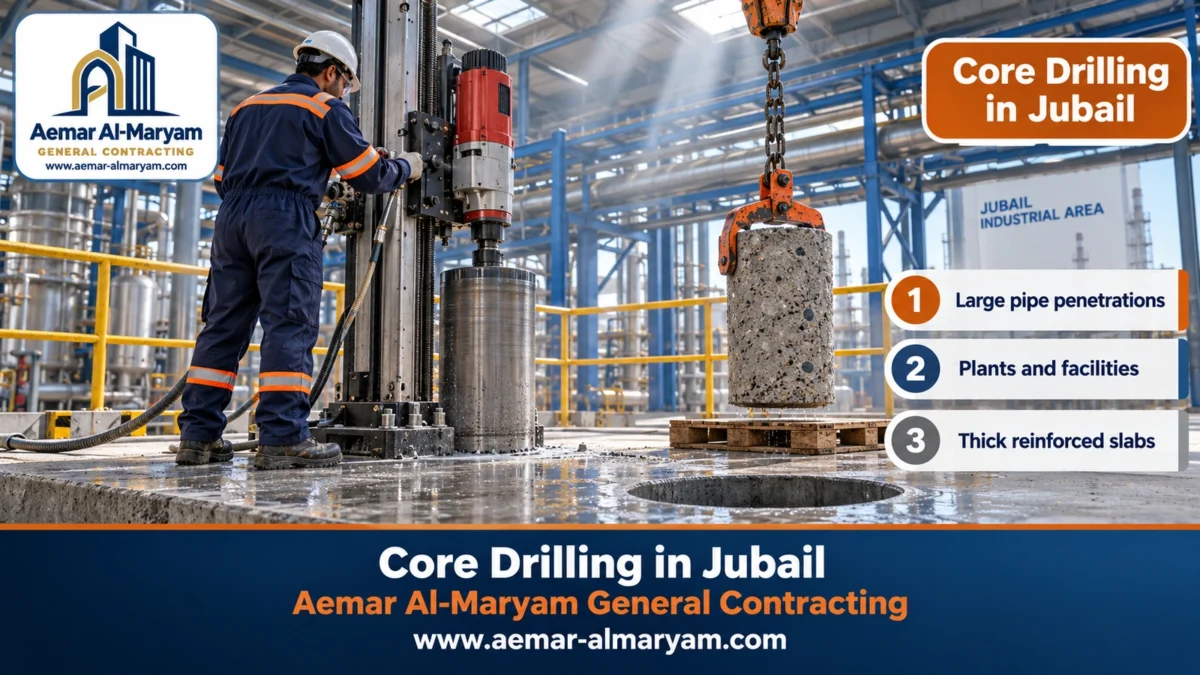
Core drilling in Jubail usually means one of two jobs for us: a large-diameter hole for a process pipe or a fire-main through a thick slab or wall inside a plant or warehouse in Jubail Industrial City, or a neat hole for an AC line, a drain or an extractor in a home or flat in Jubail Al Balad. At Aemar Al-Maryam General Contracting we handle both with stand-mounted diamond core rigs, a rebar and services scan before every hole, continuous wet vacuuming, and a lifting plan whenever the core is heavy. Pricing follows the diameter: the entry price is SAR 90 for holes up to roughly 100 mm (AC holes fall here), a 5-to-6-inch core costs from SAR 140, 8-inch cores start at SAR 230 and 10-to-12-inch cores at SAR 320, while anything larger is quoted after a look at the site. Treat each number as a starting estimate that we firm up on inspection. To book, call or WhatsApp 0547879578.
The difference between the two kinds of job is not only the size of the machine. In an industrial facility the drilling is preceded by a work permit and a safety induction, the hole is often in a thick slab, a fire-rated wall between storage bays or a ceiling several metres up, and the real question is how to get a concrete cylinder weighing tens or even hundreds of kilograms out without dropping it on anyone. In a home the question is how to make the hole without soaking the majlis or hitting a buried pipe. This page is organised around that split, so jump to the part that matches your site.
Core drilling in Jubail in brief
- Industrial work: large cores for process, water and compressed-air pipes through thick slabs; sprinkler and service holes in firewalls between warehouse bays; cable holes drilled from below ceiling slabs.
- Residential work: split and central AC holes, drain holes between floors, and kitchen and bathroom extractor outlets in Al Fanateer, Al Hamra, Ad Dabab and Gharnatah.
- Method: wet diamond drilling on an anchored stand, a scan for rebar and buried services, and a water-collection ring with a wet vacuum for overhead work.
- Prices from: SAR 90 for holes up to about 100 mm; SAR 140 at 5–6 inches; SAR 230 at 8 inches; SAR 320 at 10–12 inches. Bigger or thicker work is quoted on site, and the listed numbers are estimates pending our visit.
- Who approves: structural changes inside Jubail Industrial City go to the Royal Commission; in Jubail Al Balad the reference is the municipality through Balady.
- To order: send photos, the diameters, the slab or wall thickness and the type of facility on WhatsApp 0547879578.
Core drilling in Jubail: what changes between a plant and a home?
Core drilling in Jubail produces round holes through concrete or block using a hollow diamond bit, and what separates an industrial request from a residential one is the diameter, the thickness, the permit and how the core is taken out. The bit grinds away only a thin ring of material and releases a solid cylinder from the middle, so the finished hole has smooth sides and the exact diameter you asked for, with no breaking around it. That is precisely what a facility needs when it cannot tolerate hammering next to running equipment, and what a family needs when it does not want cracked floor tiles.
■ Jubail Industrial City
thick ground and suspended slabs, firewalls between bays, large diameters, a permit before entry, and coordination with the site safety officer.
■ Warehouses and workshops
holes for fire mains, water lines and compressed air, often drilled at height from a lifting platform.
■ Offices and admin buildings
cable and service holes between floors, often drilled from underneath with the rig mounted upside down.
■ Homes in Jubail Al Balad and Al Fanateer
small and medium holes for AC, drainage and extractors inside occupied houses.
Large-diameter cores for process pipes through thick slabs in Jubail
In Jubail plants we drill large-diameter cores for vertical process pipes, water, air and drainage lines through thick slabs and plinths, using heavy core rigs bolted directly to the slab with anchors. The larger rig classes reach diameters of roughly 500 to 650 mm depending on the model; anything bigger is opened by stitch drilling a ring of overlapping cores around the perimeter and cutting out the middle, or by diamond wire sawing. Which route is right is decided at the inspection, once we have seen the thickness, the access below and the reinforcement.
How do we drill a slab that is thicker than the bit?
On a stand-mounted rig, a standard diamond bit can bore roughly 450 mm before it runs out of length. When the slab or plinth is thicker, we drill in stages: we drill to the full bit depth, snap the core at its base and pull it out, then fit an extension and continue down the same line. Where the underside is accessible we sometimes drill from both faces and meet in the middle. Either way the stand must not move by a millimetre between stages, because a process pipe needs a hole that is straight and true, not one that wanders.
Lifting the concrete core out: how heavy is it?
Large cores are heavy, and this is the point most often underestimated on Jubail sites. Concrete weighs about 2.4 tonnes per cubic metre, so a core’s weight can be estimated from its diameter and length. Some approximate examples:
| Hole diameter | Slab thickness | Approximate core weight | Usual way to remove it |
|---|---|---|---|
| 200 mm (8 inch) | 300 mm | about 23 kg | by hand after snapping the base |
| 300 mm (12 inch) | 400 mm | about 68 kg | two operatives or a simple pulley |
| 400 mm | 500 mm | about 150 kg | a lifting point set in the core and a chain hoist |
| 500 mm | 600 mm | about 280 kg | a chain hoist or the facility crane under a lift plan |
Note: weights are approximate and for concrete only; reinforcement adds a little. Bigger sections are split or lifted under a plan approved by the site supervisor.
In a suspended slab the core drops the moment the bit breaks through, so we barricade the area below, stop all traffic there, and either set up something to receive the core or secure it from above before break-through. In a ground slab the core stays where it is, still bonded at its base, so we snap it with a wedge and lift it out. Each case gets its own arrangement, agreed with the facility supervisor before the working day.
⚠ Never core above a walkway or running equipment
Any hole in a ceiling or a platform over a pedestrian route or an operating machine needs a barricade below and a person watching the drop zone until the core is out. It is part of the method statement we send the facility, not an optional extra.
Concrete coring in Jubail inside a working facility
Concrete coring with a diamond rig is the method working facilities in Jubail normally accept, because rotary drilling does not hammer the concrete and does not throw dry dust over the equipment. The older alternative, drilling a ring of small holes and breaking out the centre, shakes the slab, leaves a ragged edge with bent and exposed bars, and needs a wide repair around the pipe afterwards.
| What the facility cares about | Diamond core drilling | Drilling and breaking out |
|---|---|---|
| Vibration near equipment | rotation only, no impact | repeated hammering carried through the slab |
| Dust | turned into slurry and vacuumed | dry dust spread across the hall |
| Fit for the pipe | diameter set to the millimetre | oversized and irregular |
| Reinforcement in the hole | cut cleanly inside the bore | exposed and bent around the edge |
| Time the area is isolated | short and predictable | longer, with more clean-up |
Because cooling water is what keeps the drilling clean, we ask the facility in advance where the slurry may go and whether it can be removed in drums. In some halls water is not allowed into floor drains at all, so we collect everything with the wet vacuum and take it off site.
Core holes through firewalls between warehouse bays in Jubail
A concrete wall that separates two bays in a Jubail warehouse is usually a fire-rated wall, and any core hole through it for a sprinkler main, a water pipe or cables has to be closed after the pipe is installed with a fire-resistant sealing system, so that it does not become a path for fire and smoke. We drill the hole to the diameter that the specified firestop system requires, not simply to the diameter of the pipe.
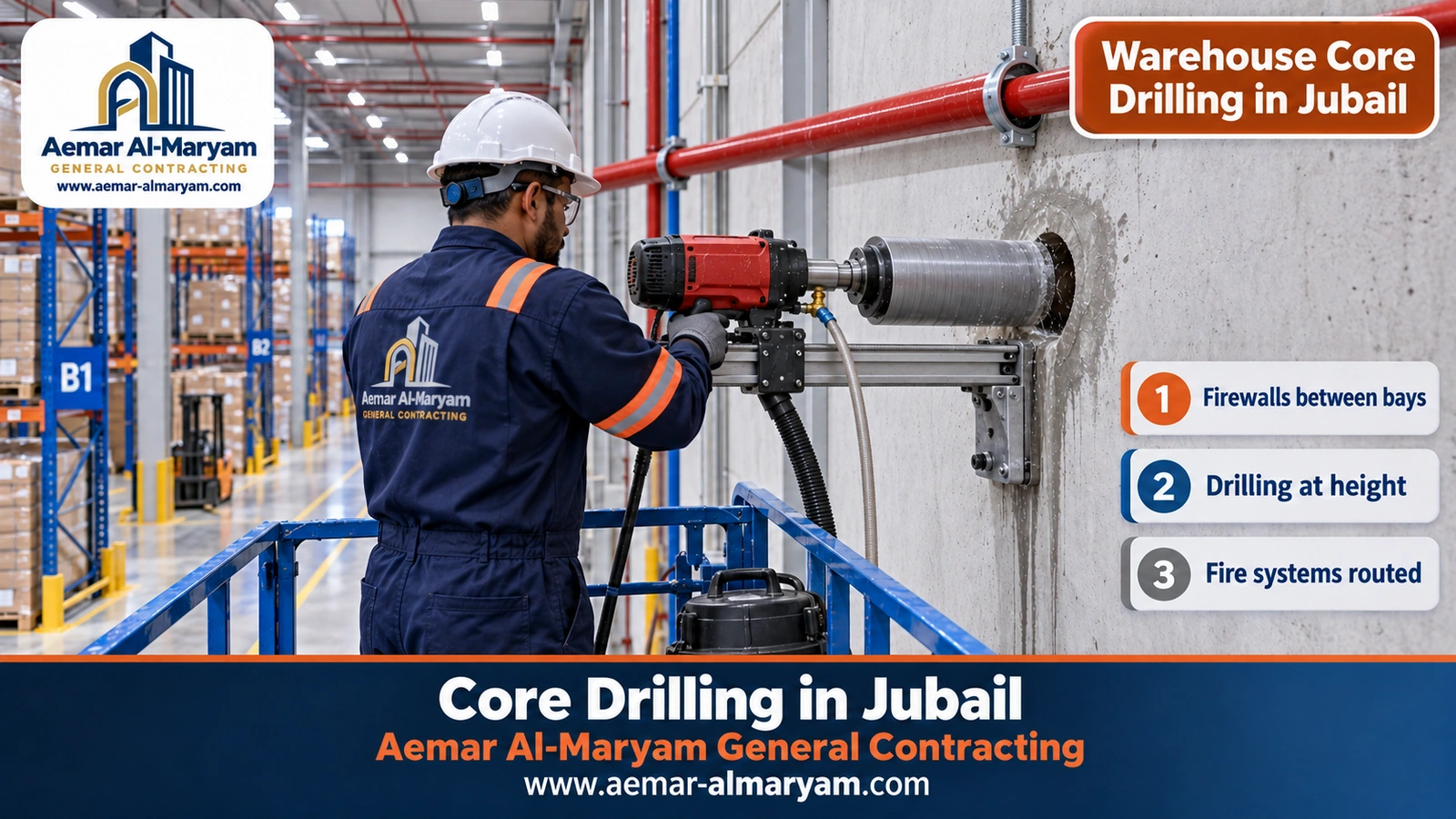
Firestopping the hole once the pipe is through
Tested firestop systems, such as intumescent sealants, acrylic sealants and purpose-made foams, come with specific conditions: the size of the annular gap around the pipe, whether the pipe is metal or plastic, and the thickness of the wall. So before drilling we ask for the penetration detail or the name of the approved system, and we choose the diameter from it. If the gap ends up larger than the system allows, the seal no longer matches its test; if it is too small, the sealant cannot go in at the required depth.
Who installs the firestop?
We hand over the hole clean, with dry edges, ready to seal. We can install the seal with the product the consultant specifies when that is part of our scope, or the project’s fire-protection contractor does it. What matters is that no hole is left open around a pipe in a fire-rated wall.
Drilling at height from a scissor lift
Sprinkler mains usually run close to the roof, so we fix the rig to the wall and work from a scissor lift standing on level floor. The rig is tied off with a safety line, the area under the platform is barricaded, and water is caught with a collection ring and a suction hose so that it does not run down onto stock or racking. If the platform belongs to the facility, we ask for it to be operated by its own certified operator.
Ceiling and slab core drilling in Jubail: coring from below
Slab coring in Jubail is done from above when the upper floor is accessible, and from below, with the rig mounted inverted on the underside of the slab, when it is not: equipment above, occupied offices, or an insulated roof that should not be opened. Inverted coring is common in Jubail office and administration buildings when new cable routes are run between floors, and it needs more preparation than ordinary drilling.
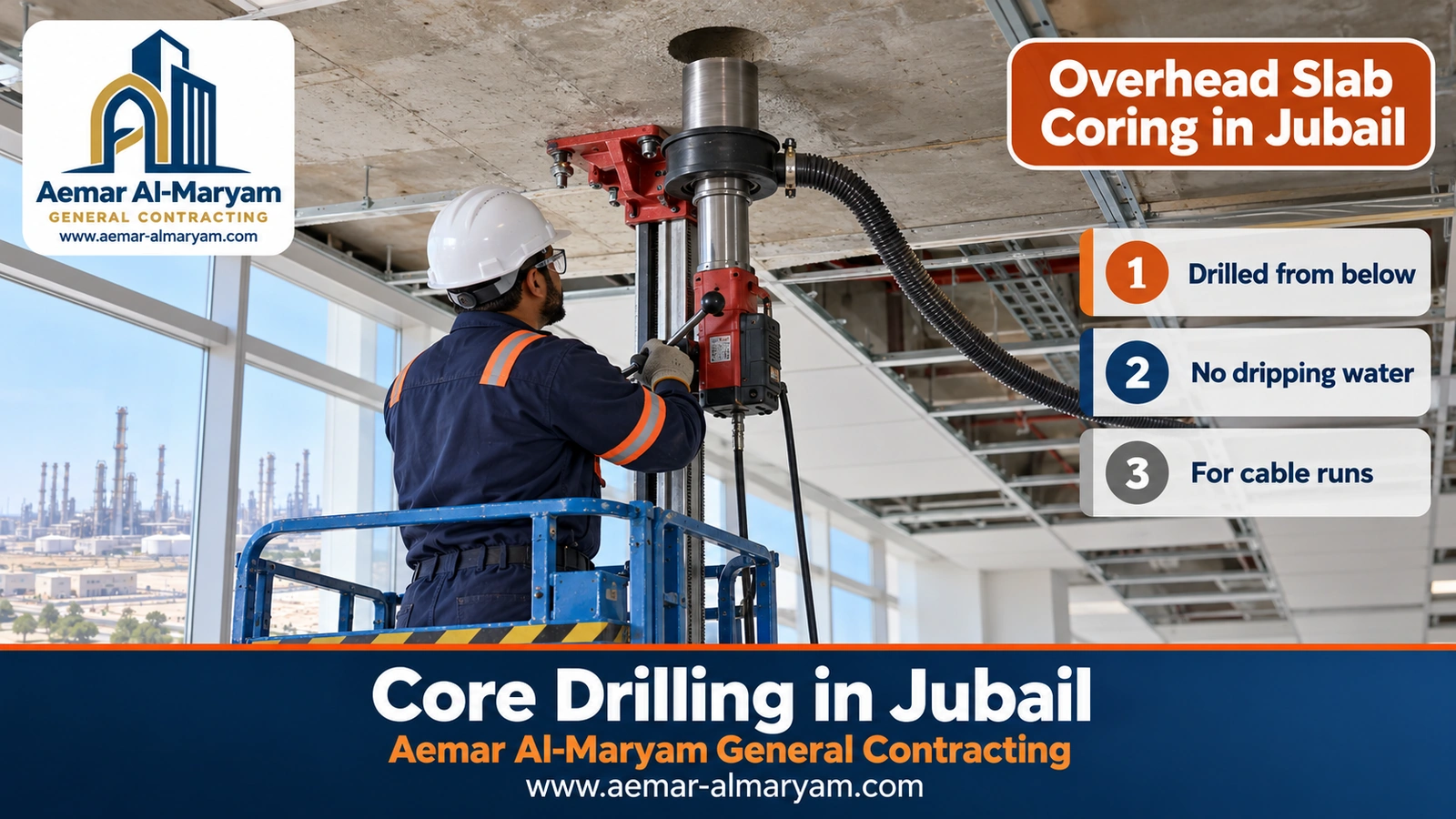
Where does the water go when you drill overhead?
Drilling from below sends water and slurry straight down onto the operator and the floor, so a collection ring is clamped around the bit and piped to a wet vacuum, and cover the floor and furniture underneath with waterproof sheeting. We remove only the suspended-ceiling tiles around the hole and protect cables and ducts above them before we start.
Securing the core before it falls
In inverted drilling the core comes out downwards towards the operator. We decide in advance whether it will stay jammed in the bit or drop free, set something underneath to catch it, and tell the people on the floor above to keep clear of the break-through point. Cable-hole cores are light, but when a whole row is being drilled the same routine is repeated for every hole.
Cable holes between floors in offices
When a row of cable holes is needed, we set out every position from above and below together, leave enough concrete between holes so the strip between them is not weakened, and stay clear of beams.
Drilling holes in walls in Jubail: concrete or block
Drilling a hole through a wall in Jubail starts with knowing what the wall is made of. Reinforced concrete gets cored wet with the rig on its stand after a rebar scan; block walls are often drilled dry with dust extraction, because block soaks up water and wets the plaster. Houses in Jubail Al Balad commonly combine concrete external walls with block partitions, so one house can need two different drilling methods in neighbouring rooms.
- External concrete wall: wet drilling, with a slight fall to the outside when the hole is for an AC line or a drain.
- Internal block wall: dry drilling or minimal water, direct extraction and gentle feed pressure so the hollow cells do not burst.
- Wall clad in stone or tiles: we start slowly through the cladding before reaching the wall itself so the edge does not chip.
- Thick wall in a warehouse: a long bit or two-stage drilling, with the stand bolted to the concrete rather than held by vacuum.
If the opening you need is rectangular, or too big for one core, it is closer to wall sawing than to core drilling; see concrete cutting in Jubail for that work.
AC core holes in Jubail homes and flats
A split AC core hole in Jubail is drilled to the diameter given in the unit’s installation manual, angled a few degrees down to the outside, letting condensate drain away from the room. The manual for many wall-mounted splits asks for a 65 mm bore sloping downwards to the outside; larger units can need a bigger hole. We agree the position with the AC technician before drilling so the hole sits exactly behind the indoor unit.
In the villas of Al Fanateer and in Al Hamra, Gharnatah and Ad Dabab in Jubail Al Balad, we are regularly asked to move AC units from windows to walls or to add units in upstairs rooms. A former window-AC opening is seldom the right shape for a split system, so we drill a new core and leave the decision about closing the old opening to you. Central AC in villas needs larger holes for ducts and refrigerant pipework, which we size with the AC contractor from the route drawing.
Before the coring crew arrives
Mark where the indoor unit will hang and check the outside face: is there a place for the outdoor unit, and does the hole need a ladder or scaffold outside? Those answers decide how long the visit takes and what it costs.
Kitchen and bathroom core holes in Jubail
Kitchen and bathroom work in Jubail involves two kinds of hole: wall holes for extract fans and slab holes for drain pipes between floors. Domestic bathroom fans are mostly made for a 100 mm duct while a kitchen hood is frequently ducted at 150 mm, which puts the holes at roughly 4 inch and 6 inch respectively; the appliance manual has the final word. A 110 mm drain pipe, the size plumbers call “4 inch”, is cored slightly oversize to leave a ring for the sealant, which usually lands in the 5-inch class.
In Jubail homes where a bathroom is being re-planned or a kitchen moved, we drill the new drain hole in step with the plumbing works and close the old hole with non-shrink mortar if it is no longer needed. In commercial kitchens and restaurants the flue holes are bigger and are sized with the hood supplier.
Core hole sizes in Jubail by use
The right core size comes from the outside diameter of whatever passes through, plus space for the seal or firestop system, not from a fixed number. This table covers the uses we see in both halves of Jubail:
| Use | Approximate hole diameter | Note |
|---|---|---|
| Cable or small pipe | up to 2 inch | common in offices and electrical rooms |
| Split AC | typically 65 mm (check the unit manual) | drilled with a fall to the outside |
| Bathroom extract fan | about 4 inch | for a 100 mm duct |
| Kitchen hood or 110 mm drain | 5–6 inch | depending on the appliance and the seal |
| Sprinkler or water main in a warehouse | pipe size plus the firestop gap | we ask for the penetration detail |
| Air duct or process pipe | 8–12 inch and up | larger sizes set at inspection |
| Large process pipes | up to about 500–650 mm on heavy rigs | beyond that, stitch drilling or wire sawing |
Rebar scanning before core drilling in Jubail
Every hole we drill in reinforced concrete in Jubail starts with a scan: we locate the bars and any buried services, then place the centre of the hole between them wherever possible. A diamond bit will cut any bar in its path, so the aim is simply not to meet a main bar, a live cable or a pipe. In industrial buildings this matters even more, because slabs can carry buried power cables and pipes that show nothing on the surface.
- ✓Drawings first: we ask the facility for structural and buried-services drawings where they exist and compare them with the site.
- ✓Scanning on site: a cover meter for shallow bars, and ground-penetrating radar where post-tensioning cables or deeper pipes have to be located.
- ✓Post-tensioned slabs: some long-span slabs are post-tensioned, and a severed tendon puts both the slab and anyone nearby at serious risk, so we only drill them once the tendons are mapped and the engineer approves.
- ✓Final mark: we mark and photograph the centre of every hole and get the site supervisor’s sign-off before the rig starts.
Work permits and safety: Jubail Industrial City versus Jubail Al Balad
Procedurally, Jubail is two cities. Inside Jubail Industrial City, administered by the Royal Commission for Jubail & Yanbu, building work and alterations are referred to the Royal Commission rather than to Balady, while Jubail Al Balad works like the rest of the province, with the municipality and the Balady platform as the reference. Small service holes do not usually need a permit; holes that touch a structural element need an engineering office before any drilling.
Inside plants and warehouses
Most facilities in Jubail Industrial City will not let a contractor in without a daily work permit, a safety induction for the crew and specified personal protective equipment. So before the visit we send the usual paperwork, and on site we keep to the permit hours and area.
- Names of the crew and a list of the drilling, vacuum and electrical equipment.
- A short method: scan, anchor, wet drill, lift the core, clean up.
- How water and slurry will be collected and where they will be disposed of.
- Barricading below overhead holes and the arrangements for work on platforms.
- Safe electrical connection of the rig where water is in use.
In homes and apartment buildings
An AC, extractor or drain hole in a house in Jubail Al Balad or Al Fanateer normally needs nothing more than the owner’s agreement, plus coordination with the building management in an apartment block. A large hole in a slab, in a load-bearing wall or near a beam is a different matter: an engineer looks at it first, and only then do we drill.
Core drilling prices in Jubail
In Jubail the cheapest core, an AC hole or similar small bore, is SAR 90, and the price climbs with the diameter, the thickness, the density of reinforcement, the working height and the facility’s requirements. Read them as starting estimates, confirmed once we have inspected:
| Hole | Starts from | What moves the price |
|---|---|---|
| AC hole or other bore up to ~100 mm | SAR 90 | wall thickness, need for a scaffold |
| 5–6 inch core | SAR 140 | wall or slab, material |
| 8 inch core | SAR 230 | rebar density and height |
| 10–12 inch core | SAR 320 | thickness and core lifting |
| Larger diameters, thick slabs and plinths, or firestop holes to a specified system | quoted after the site visit | photos and dimensions get you a first figure |
Please note: treat every figure as an estimate; the final price is fixed after the site visit and our agreement. Other services appear on the prices page.
How we price rows of holes on projects
When a warehouse or plant needs dozens of holes, each diameter is priced at its own rate, and we then take account of what continuous work saves: the rig is set up once per row, there is one permit and one trip from our base in Dammam. The more holes are grouped into one schedule, the lower the share of the overheads each one carries. Waiting time at the gate, or stoppages requested by the facility, are agreed in advance so they never come as a surprise on the invoice.
Keeping the cost down in Jubail
Group AC, plumbing and cable holes into one visit, have the work area cleared and the ceiling tiles removed before we arrive, and send the drawings in advance so we bring the right bits the first time.
Core drilling or concrete cutting in Jubail: when does the job need a saw?
Core drilling in Jubail is enough whenever the requirement is a round hole for a pipe, a cable or a duct. A square or rectangular opening, an opening bigger than the rig can drill, or a long trench in a warehouse floor needs saw cutting. Often the two are combined: we drill cores in the corners of a square opening so that the saw stops exactly at the corners, then cut between them.
- Rectangular duct opening in a ceiling: four corner cores first, then saw cuts joining them.
- Drainage trench in a workshop floor: floor sawing, with cores at the gullies.
- An old machine plinth to be removed: diamond wire saw, sometimes preceded by cores to thread the wire.
- A new doorway between two bays: wall sawing.
Saw work of every kind is covered in concrete cutting in Jubail plus our concrete cutting service overview. Where the coring belongs to a larger repair programme, our renovation contractor in Jubail page covers that side.
Core drilling contractor in Jubail: what a facility should ask for
The right core drilling contractor for a Jubail facility turns up with a stand-mounted rig that can handle the diameter, scans before drilling, collects the water, knows how to lift a heavy core, and supplies the safety paperwork the facility asks for without delay. For a home it is enough that the crew protects the room, cleans up and fixes the price before starting. Useful questions when comparing quotes:
- ✓What is the largest diameter your rigs can drill? And how do you handle a slab thicker than the bit?
- ✓How will you get the core out? Do you have what it takes to lift heavy cores?
- ✓Where does the water go? Especially when drilling overhead or above stored goods.
- ✓Will you drill to suit the firestop system? Or only to the pipe diameter?
- ✓Do you charge per hole according to its size? And does that cover the clean-up and the sealing?
Ordering core holes in Jubail, step by step
Share these points with us on WhatsApp (0547879578). You get back a cost estimate and a list of the documents your facility will ask for, and then we agree a date:
- 1Photos of the location
both faces of the wall if possible, and the area underneath if the hole is in a slab. - 2Diameters and number
the size of each hole or what will pass through it, and how many holes per wall or slab. - 3Thickness and height
the slab or wall thickness and the height of the holes above the floor. - 4Type of site
plant, warehouse, office or home, and which part of Jubail. - 5Entry requirements
work permit, safety induction or fixed working hours. - 6Drilling and handover
we drill and clean up, then check the diameter, position and alignment with you before we leave.
If you prefer not to use WhatsApp, fill in the site visit request form and we will call you back.
Why Jubail sites choose Aemar Al-Maryam for coring
- Stand-mounted rigs for a range of diameters: from small cable holes to large pipe cores, with long bits and extensions.
- Core lifting and barricading planned in advance: a step we plan before drilling, not after.
- Clean drilling in plants and homes: wet drilling with continuous vacuuming, and a collection ring for overhead work.
- Starting prices on the page: each diameter carries a published starting price, fixed for your job after inspection and agreement.
- Coordination with the other trades: AC, plumbing and fire protection, so each hole is in the right place at the right size.
For the full picture on diameters, machine types and sealing, read our in-depth guide to core drilling in Dammam. A shorter overview sits on our core drilling service page, and finished jobs can be seen under projects.
Jubail areas we cover for core drilling
We serve both halves of Jubail, scheduling visits from our Dammam base around facility permit windows and around family routines in homes:
Read next
Have holes to drill in Jubail?
Send photos, diameters and thicknesses on WhatsApp 0547879578 and we will reply with an estimate and the paperwork the facility will want before the visit.
Tags