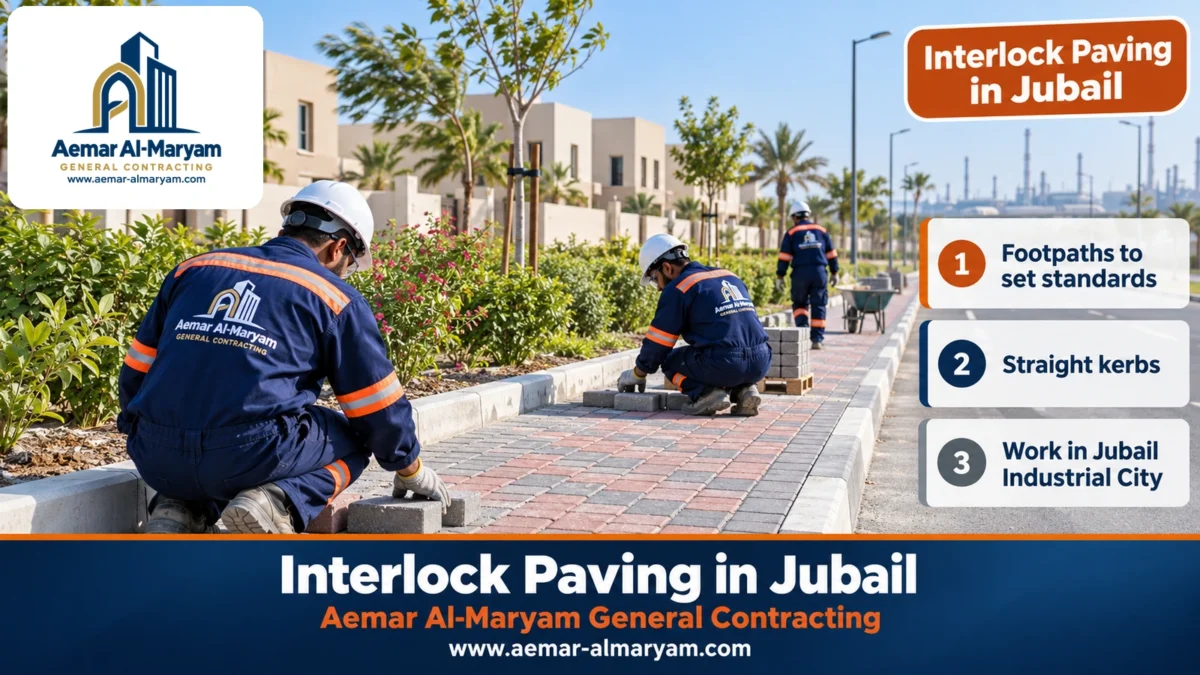
A footpath in a residential district of Jubail Industrial City and a carport in a house yard in Jubail Al-Balad are both paved with interlock, but each is planned differently. The first runs between a garden and a front door and falls under the rules of the Royal Commission and the housing office; the second carries a car every day and needs a thicker unit and a stronger base. We at Aemar Al-Maryam General Contracting take on both kinds of interlock paving in Jubail, along with cladding entrance steps with rounded edge units, kerb installation and re-laying of sunken interlock. A grey 6 cm path runs from SAR 37 a square metre and an 8 cm carport floor from SAR 55, both estimates to be confirmed after a site visit; call or text 0547879578.
Our crews travel up from Dammam on dates fixed with you, and we bundle what you need into one visit: path, carport, steps and kerbs together. This page explains how work differs between the Industrial City and Al-Balad, which thickness suits each spot, how steps are clad, what goes under the pavers, and our prices with a worked example for a house in Jubail Al-Balad.
In short: interlock paving in Jubail
- Jubail Industrial City: Wide two-tone footpaths between gardens and entrances, inside the plot, after the owner’s or housing office’s approval, and coordination with the Royal Commission and Marafiq near the pavement or utilities.
- Jubail Al-Balad: 8 cm herringbone interlock under carports in house yards and at house fronts, with kerbs on a concrete bed.
- Steps: Risers and treads clad in interlock fixed with mortar, with rounded edge units and equal riser heights.
- Layers: Crushed-stone base compacted to 10–15 cm under walkers and 15–20 cm under cars, roughly 3 cm of bedding sand, and a 2% fall.
- Prices: Per m²: laying only 14, grey path 37, two-tone path 46, 8 cm carport 55, bare-soil path with all layers 64 (SAR).
- To order: WhatsApp 0547879578 with a few photos, approximate measurements and whether a car will park there.
Interlock paving in Jubail: two towns, two kinds of job
Interlock paving in Jubail starts with one simple question: where is the house? Inside the Industrial City, permits and site rules are issued by the Royal Commission for Jubail and Yanbu, and the power and water networks are Marafiq’s. The older town, Jubail Al-Balad, answers to the municipality, and applications there go through Balady like anywhere else in the Eastern Province. That difference does not change how we lay a paver, but it changes what we arrange before the working day.
■ In Jubail Industrial City
Planned residential districts with footpaths and gardens. Many homes are employer housing or units in compounds whose management sets working hours, crew access and where debris goes.
■ In Jubail Al-Balad
Mostly owner-occupied houses with yards used for cars and seating, where the owner alone decides what is paved inside the property.
■ What they share
Humid coastal air, and ground near the sea that can be damp or salty, so we check the soil when we dig before deciding the base thickness.
An interlock company in Jubail or a day-rate installer?
An installer who only comes to lay pavers starts from a surface someone else prepared. If the base is weak or the fall is wrong, the mistake shows a few months later. An interlock company in Jubail that runs the whole job digs, compacts, builds the base, casts the kerb beds, sets the falls, then lays, compacts and cleans up, and is responsible for the whole result. We offer both: a laying-only rate from SAR 14 per m² if your pavers and sand are already delivered and the formation is prepared, or the complete job with materials.
Footpaths in the residential districts of Jubail Industrial City
Footpaths are what we are asked for most in the Industrial City: a path from the gate to the front door, a side path that wraps round the garden to the back door, or a broad walk beside a planted strip. These are pedestrian paths with no cars on them, so 6 cm interlock on a 10–15 cm base is enough, and a two-tone design works well: one colour for the field and a lighter one for the border, held by straight garden kerbs.
- ✓Path width: About 1.20 m or more for the main path so two people or a pushchair pass easily, and 60–80 cm for side paths in the garden.
- ✓Pattern direction: On long paths we lay rectangles in rows across the walking direction, which makes the path look wider and tidier.
- ✓The garden edge: A low garden kerb on a concrete bed separates the paving from planting soil and stops irrigation water washing out the sand.
- ✓Irrigation: We point sprinklers away from the path where possible, because repeated water at the edge flushes out the joint sand.
Plot boundary and public pavement in the Industrial City
The path we lay is inside the plot. The street pavement beyond the boundary wall is part of the public infrastructure managed by the Royal Commission, and we do not alter it or drop its kerb without the Commission’s approval. If the house is employer housing or in a managed compound, please confirm that the management approves the work and its timing before our visit, or give us the responsible person’s number so we can coordinate directly.
Before digging near utility lines
Electricity and water lines in Jubail Industrial City belong to Marafiq. If a path has to be dug deeper near a meter, an inspection chamber or a known line, we stop digging at that point until the line is located and the work is coordinated with the right party. Path excavation is usually shallow, but care here costs less than any repair.
Carport interlock in Jubail Al-Balad
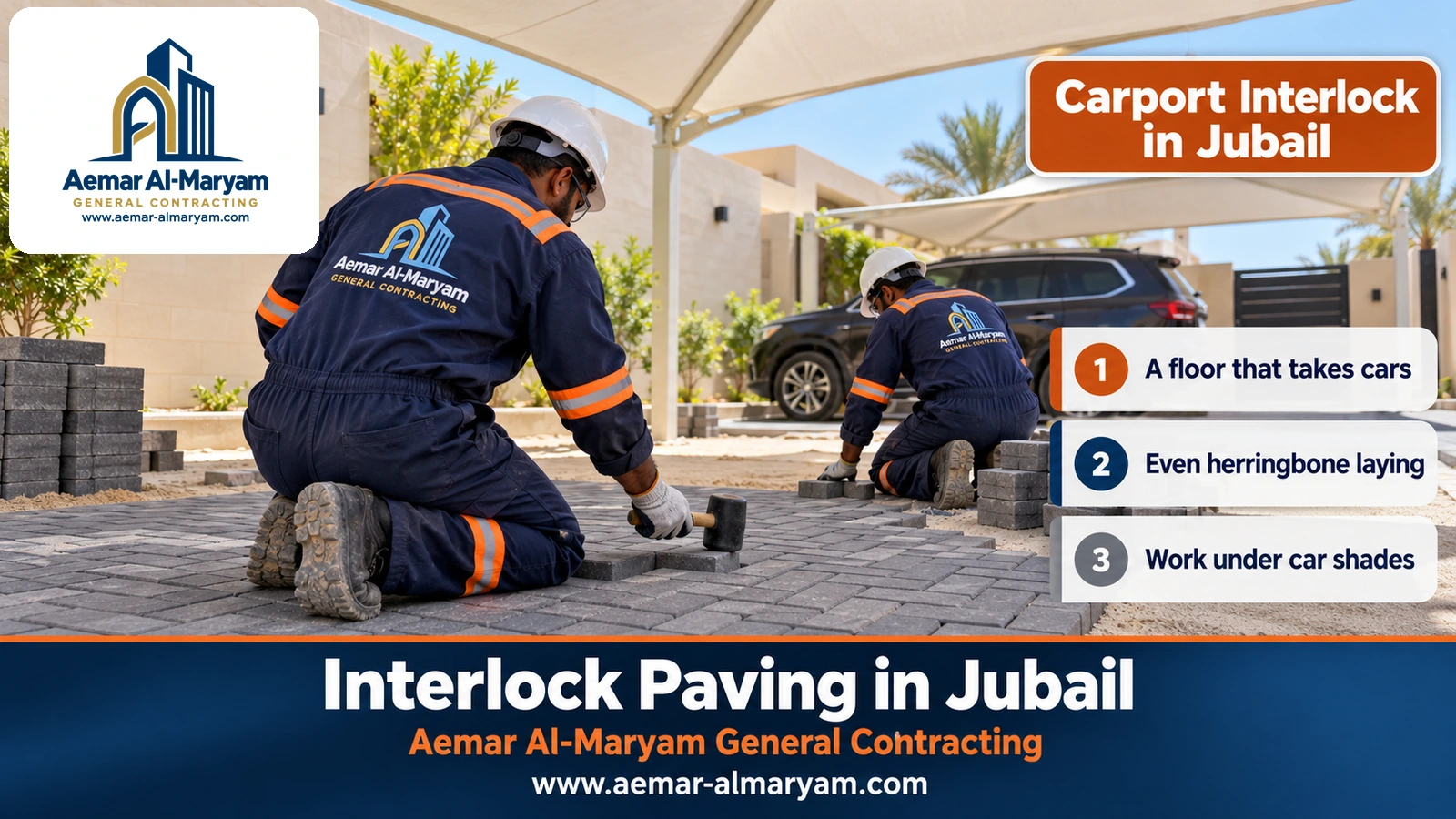
Carport interlock is the most common request in the yards of Jubail Al-Balad: a fabric or metal shade over one or two parking spaces, with bare soil or cracked old tiles underneath. Here we lay 8 cm interlock in herringbone on a compacted base that is usually 15 cm or more depending on the soil, because the car comes and goes every day and the wheels turn on the spot when it parks.
Why herringbone under a carport?
In herringbone the units cross at 45 or 90 degrees, so there is no continuous joint line in the direction a wheel travels. Braking and turning forces are spread over more units, so rows do not slide and joints do not open over time. The well-known paver application guides recommend this pattern for areas under continual vehicle traffic, and units whose length is no more than three times their thickness.
Carport footings: before or after the interlock?
If the carport is new, its column footings are cast first and given time to harden; then we build the base and lay the interlock around them with precise cuts. If the carport already stands, we dig carefully round the footings so we do not expose them more than necessary, and compact the base around them with a small compactor. To cast footings, or a concrete slab under the carport instead of interlock, see concrete pouring in Jubail.
Oil under the car
Drips of oil or coolant stain any surface. The advantage of interlock is that a stained unit can be prised out and swapped for a spare from the same production run, which is why we leave you a few extra units.
Interlock steps in Jubail: cladding entrance steps
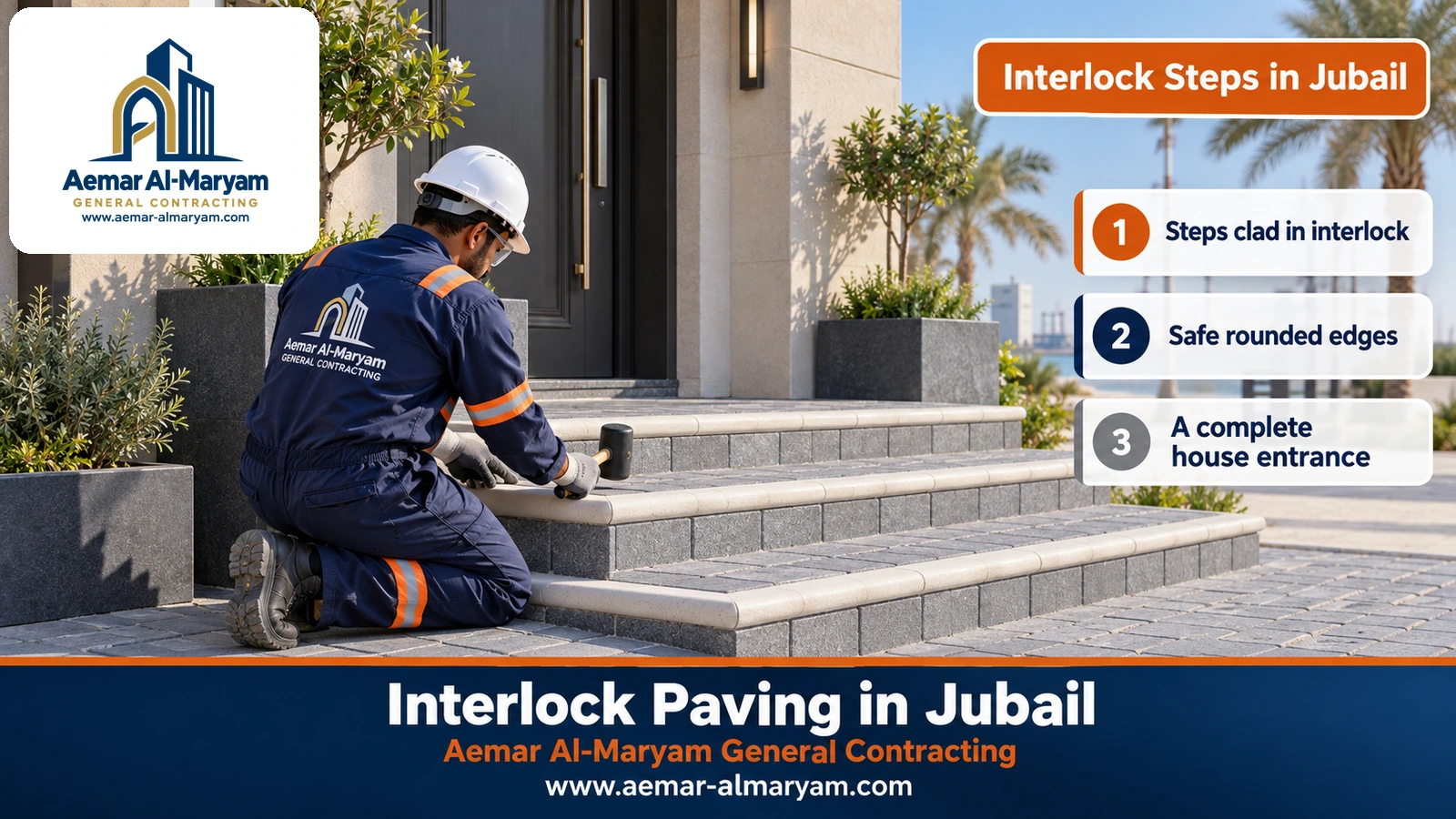
Interlock steps in Jubail means cladding existing or new entrance steps with the same interlock as the yard, so the entrance flows into the path in one colour. We clad the riser and tread of each step and set a rounded edge unit on the nose of each one in a contrasting colour, usually a creamy white, so the step edge is clearly visible by day and night and people are less likely to trip.
Is interlock laid on sand on steps?
No. Interlock in a yard stays put because it is locked between kerbs and compacted on sand, but a step is open at the front and the sides. So we fix the units to the concrete or block step core with cement mortar, after cleaning the old surface thoroughly so the mortar bonds to it. If the steps have no solid core, we build one first and then clad it, and that can mean casting new steps.
Riser heights after cladding
Every layer of cladding raises the tread by the unit plus the mortar. On the middle steps the effect evens out, but the first step from the yard and the last one at the door threshold change. So we measure the whole flight before starting, and either raise the path level in front of the steps or adjust the top step, so the risers stay equal. We also give each tread a slight fall to the front so water does not sit on it.
Steps into a majlis or annex
If the steps belong to a new majlis or annex in the yard, it is better to design them with the building and clad them afterwards. We do this together with our annex and majlis builders in Jubail.
Interlock supply and installation in Jubail: what we buy and how we check it
When we supply as well as lay, everything (pavers, bedding sand, crushed stone) is bought by us and brought to your house in Jubail, and one square-metre rate covers it all. Thickness, colour and shape are agreed with you first, and the full quantity comes from one production run, since two runs can differ a shade and a long path shows it.
- ✓Lab sheet: A laboratory report for the run showing crushing strength and how much water the units soak up; the familiar American paver benchmark asks for an average of at least 55 MPa and absorption no higher than 5%.
- ✓Thickness: We measure a sample from each pallet; a 6 cm unit delivered in place of 8 cm is a mistake that costs a re-lay.
- ✓Count: Fifty 10 × 20 cm rectangles fill a square metre; for other shapes we go by the maker’s data and order around 5% over to allow for cutting.
- ✓Storage: We place pallets near the work area without blocking the house entrance or the pavement.
If you have bought the pavers yourself, our laying-only rate from SAR 14 a square metre applies, once we have checked that their thickness suits the location.
House front interlock in Jubail
By house front interlock in Jubail we mean the area between the boundary wall and the front door, or between the gate and the carport. It is the first thing a visitor sees. We usually choose two colours for it: a calm field colour and a lighter border that marks the path, and we tie it in with the carport and steps so the entrance reads as one piece. If the car crosses part of this area, that strip goes down in 8 cm and the remainder in 6 cm of matching colour, so nobody notices the difference except below ground.
White marks on new interlock
In the first months a light white haze may appear on the pavers. Moisture draws lime out of the cement in each unit and leaves it to dry on the face. In a coastal city like Jubail you may notice it more on humid mornings. It is not a structural defect, it fades gradually with time and weather, and it should not be washed with strong acids, which damage the colour of the paver.
6 cm or 8 cm interlock in Jubail?
The answer depends on what will go over the paving: 6 cm for people on foot, 8 cm where a car parks or enters every day. The base under the pavers matters as much as their thickness; 8 cm interlock on uncompacted soil sinks faster than 6 cm on a good base. Here is a short table of what we use in Jubail homes:
| Location | Paver thickness | Base underneath | Pattern |
|---|---|---|---|
| Footpath in the Industrial City | 6 cm | 10–15 cm compacted | Rows or a two-tone border |
| Yard seating and garden | 6 cm | 10–15 cm | Hexagonal or square with rectangle |
| Carport in Al-Balad | 8 cm | 15 cm or more, depending on soil | Herringbone |
| Gate entrance for the car | 8 cm | 15–20 cm | Herringbone with a dropped kerb |
| Entrance steps | By unit | Concrete core | Fixed in mortar with edge units |
The layers under interlock in Jubail, from soil to joint sand
What sits under the interlock decides how long it lasts. We start by removing weak soil and compacting the formation, then build the crushed-stone base in compacted layers, none thicker than 15 cm, then level roughly 3 cm of clean bedding sand with a straightedge, then lay the pavers and brush fine sand into the joints as the plate goes over.
- 1Soil
We remove clay or soil mixed with debris and compact the bottom. If we find damp or salty ground near the sea, we stop and decide on a treatment. - 2Base course
10 to 15 cm after compaction for foot traffic, 15 to 20 cm for cars; the fall is shaped in this layer. - 3Sand bed
About 3 cm before compaction, of clean graded sand, not walked on after screeding. - 4Pavers
Laid in the agreed pattern and cut at edges, columns and inspection chambers. - 5Filling the joints
Dry fine sand brushed over the surface into the gaps while the plate makes three or more passes.
Jubail is a coastal city, and some ground near the sea in the Eastern Province is damp or salty; the salts can weaken the soil when it gets wet. We do not assume this for every house, but if we see it when digging we propose replacing the soil, or laying geotextile and thickening the base, priced at inspection. That case is explained in detail on our page about interlock paving in Ras Tanura.
Kerb installation in Jubail
Kerb installation in Jubail is an essential part of any interlock job, because the pavers hold together through sideways pressure and any open edge without a restraint lets the outer units creep. We set each kerb on a concrete bed of at least 15 cm with concrete haunching behind it, and let it harden before screeding the sand and compacting the pavers next to it.
Garden kerbs
Smaller, low-profile units that separate the path from planting in Industrial City homes, slightly raised or flush with the paving by design.
Pavement kerbs
A 50 cm long, 30 cm high, 15 cm wide unit, used where wheels scrape the edge: round carports and wide yards.
Dropped kerbs
At the car gate the kerb drops so its top sits just 2.5 cm or so above the paving, so tyres roll over smoothly.
We also install kerbs on their own if you have existing interlock with no edge or a broken one. Each linear metre is priced once we know the kerb type and its bed, so send us the length and a photo.
Falls and drainage in Jubail yards
Rain in Jubail is light, but water in a yard does not come from rain alone: car washing, yard cleaning, air-conditioner condensate and garden irrigation all add up. So our yards fall at roughly 2%, two centimetres in every metre, from the walls and doors toward the street or a gully, a slope shaped in the crushed stone itself. Around each gully the paving is left a few millimetres proud of the grating, so water drops in rather than pooling round it. If the yard needs a new drain run, we arrange it with a plumber in Jubail before the base goes down.
Interlock types and shapes available in Jubail
Shape affects stability and the amount of cutting, not only appearance. Rectangles and squares in two tones suit Industrial City paths; rectangles or zig-zag units in herringbone suit carports; hexagons suit yard seating areas. Open-cell grass pavers can create extra planted parking, but they need watering and care.
■ Rectangle
The most flexible: rows for paths, herringbone for cars.
■ Zig-zag
Its wavy sides increase interlock; suits carports and entrances.
■ Hexagon
A calm look for seating areas, with more cutting at the edges.
■ Rounded edge units
For step noses and terrace edges, in a contrasting colour for visibility.
Interlock prices in Jubail
Interlock prices in Jubail, per square metre: laying your own pavers costs from SAR 14; a grey 6 cm path with our materials from SAR 37 where the ground is already level and compacted; a coloured or two-tone path from SAR 46; an 8 cm carport floor over an existing base from SAR 55; and a bare-soil path built up through every layer from SAR 64. Treat these as guide figures that firm up after a site look and an agreed scope. What moves them is the size of the job, the paver thickness and colour, how much ground preparation is needed, how many kerbs there are and how easy access is. Getting the crew from Dammam to Jubail is priced when we visit.
| Job in Jubail | What the figure covers | SAR, from |
|---|---|---|
| Laying only, per m² | Laying, cutting and plate compaction of your own pavers and sand on prepared ground | 14 |
| Grey 6 cm path, per m² | Pavers, sand, laying and compaction over level, compacted ground | 37 |
| Two-tone or coloured 6 cm path, per m² | As above with coloured units or a contrasting border | 46 |
| 8 cm carport floor, per m² | Herringbone over a base that is already in place | 55 |
| Path on bare soil, per m² | Dig, level, compact, crushed-stone base, sand, 6 cm units and falls | 64 |
| Carport on bare soil | 8 cm units over 15 cm or more of base, depending on the soil | Quoted on site |
| Interlock-clad steps | Step core if needed, mortar bed, rounded edge units | Quoted on site |
| Kerbs, per linear metre | Units with concrete bed and haunching | Quoted on site |
| Fixing sunken paving | Lift, repair the base, fresh sand, relay the same units | Quoted on site |
| Removing old yard tiles, per m² | Tiles lifted together with their mortar | 14 |
| Carting debris | SAR 90 a load inside Dammam; Jubail by distance | Quoted on site |
| Damp or salty ground | Soil replacement or geotextile | Quoted on site |
Jobs below roughly 50 m² come out dearer per square metre, since transport for people and plant does not shrink with the job. For anything marked “quoted on site”, WhatsApp 0547879578 with pictures, measurements and whether a car will use it, and a price follows. Our other rates are listed on the prices page.
Worked example: a carport and path at a house in Jubail Al-Balad
A house in Jubail Al-Balad has a two-car carport of 6 × 6 m = 36 m², and a path from the gate to the door 1.2 m wide and 15 m long = 18 m². The ground is level and compacted and the base under the carport is ready. Illustrative only:
- ✓Carport: 36 m² × 55 = SAR 1,980 for 8 cm herringbone.
- ✓Path: 18 m² × 37 = SAR 666 for grey 6 cm.
- ✓Estimated total: 1,980 + 666 = SAR 2,646 “from” for the paving, over 54 m² in all.
- ✓Not included: Kerbs per linear metre, step cladding and the crew’s trip, all set at inspection.
- ✓Quantities: Bedding sand about 54 × 0.03 = 1.6 m³ plus waste, and 54 m² of pavers plus about 5% for cuts.
If the path were two-tone instead of grey it would be 18 × 46 = SAR 828 instead of 666, only SAR 162 more.
What raises or lowers the price of interlock in Jubail?
- ✓Ground condition: Level compacted ground costs less than soil that needs digging and a base; damp or salty ground adds treatment.
- ✓Thickness and colour: 8 cm costs more than 6 cm, and coloured more than grey.
- ✓Amount of cutting: Planters, columns, inspection chambers and curves add cuts and waste.
- ✓Access: A narrow entrance that machines cannot pass means longer hand carrying.
- ✓Grouping the work: Path, carport, steps and kerbs in one visit spread the trip from Dammam across more square metres, and the per-metre share drops.
How long does the work take?
A path and carport at an ordinary house on ready ground take a few working days. If the yard needs digging, a new base and kerb beds, the concrete has to set before we compact pavers next to it, so we fix the duration after inspection and write it into the agreement. A car can stand on the interlock after the final compaction with joint sand, provided the kerb concrete has set.
Re-laying sunken interlock in Jubail
Re-laying sunken interlock in Jubail is one of our most frequent maintenance jobs, mostly under carports or next to inspection chambers. The cause is rarely the pavers themselves: a base that was never compacted, a thick sand bed, 6 cm units under a car, a broken kerb, or water from a pipe or AC drain washing out what lies beneath. The repair starts with finding the cause; then we lift the area, remove the wet sand, rebuild and compact the base, and re-lay the same sound units, replacing only the damaged ones.
Repeated sinking in the same spot
If interlock sinks again in the same place after a repair, look for water before anything else: a broken pipe under the yard or an AC drain pointed at the ground. Repairing the paving without stopping the water does not last.
Interlock, asphalt or tiles for a yard in Jubail?
| Criterion | Interlock | Asphalt | Tiles on mortar |
|---|---|---|---|
| Appearance | Colours, patterns and borders | Uniform black surface | Smooth and varied |
| Under cars | Excellent at 8 cm | Suits large areas | Cracks unless designed for it |
| Repair | Lift and reuse the same units | Patches that show | Break out and replace |
| Heat | Does not soften in summer | Heats up and softens | Depends on the tile |
| Best for | Carports, paths and yards | Large yards and internal roads | Covered seating areas |
For large yards and building car parks see our asphalt contractor in Jubail, and for seating-area and indoor floors our tile installer in Jubail. If old tiles or concrete have to come out before the interlock, our demolition contractor in Jubail handles it, and for cutting an old slab in a straight line to run a drain, concrete cutting in Jubail.
Mistakes we see in Jubail interlock
- ✓Sand instead of a base: A thick sand bed straight on soil, so ruts appear under the first car.
- ✓6 cm under a carport: Path units under a daily car, so edges break and joints open.
- ✓Steps without mortar: Units laid on sand over steps, which move with the first footsteps.
- ✓One step higher than the rest: Cladding that raises the top step without adjusting levels, so people trip at the door.
- ✓Fall toward the wall: Washing water heads for the house foundation instead of the street.
- ✓Compacting near an open edge: Running the plate along an edge with no kerb pushes the units outward.
Receiving interlock in Jubail: a checklist
- ✓Water: Hose the yard down and watch: water should run away from the house with no puddles.
- ✓Flatness: Lay a long straightedge in several directions; do not accept obvious dips.
- ✓Units: No unit rocks underfoot, joints are even and full of sand.
- ✓Kerbs: Straight and solid, with their concrete haunching visible behind them.
- ✓Steps: Equal riser heights, and edge units that do not sound hollow when tapped.
- ✓Clean-up: Surplus sand and debris removed from the site.
How to order interlock paving in Jubail
- 1Pictures first
Photos of the spot, approximate dimensions, the district name, and Industrial City or Al-Balad. - 2What it is for
Walking only, a carport, a car gate, or steps. - 3Tell us about approvals
If the house is employer housing or in a compound, the number of the person who approves the work. - 4Initial estimate
We send the proposed thickness, layers and an estimated cost. - 5Inspection and agreement
We visit, take levels and check the soil, then sign off items and timing and get going.
Why Aemar Al-Maryam for interlock paving in Jubail?
Because we plan each spot by what will travel over it, rather than selling one thickness for the whole yard. And since we are a general contractor rather than a paving gang, lifting old tiles, casting column footings and kerb beds and building a step core can all happen in the same visit. Past jobs are shown under our projects, and the service itself under interlock paving and kerbs.
- ✓Thickness by location: 6 cm for paths, 8 cm under carports.
- ✓Steps done properly: Mortar, edge units and equal risers.
- ✓Published prices: A clear “from” price, everything else at inspection.
- ✓Advance coordination: With the housing office and the relevant authorities before the working day.
Jubail districts we cover and nearby cities
In the Industrial City we work across its housing districts such as Al Fanateer; in Al-Balad, in neighbourhoods like Al Hamra, Ghirnatah and Al Dabab. For our full menu of local services, see the Jubail area page. Neighbouring towns get their own pages: for Ras Tanura we focus on wet coastal soil and white bloom, for Abqaiq on summer heat and mosque courtyards, and the complete reference stays our Dammam interlock guide.
Your path or carport in Jubail: one photo is enough to start
Snap the spot, jot down its rough size and tell us if a car will stand on it. We answer with a suggested build-up and a ballpark figure, and book a day to see it.
More for Jubail homes
Tags