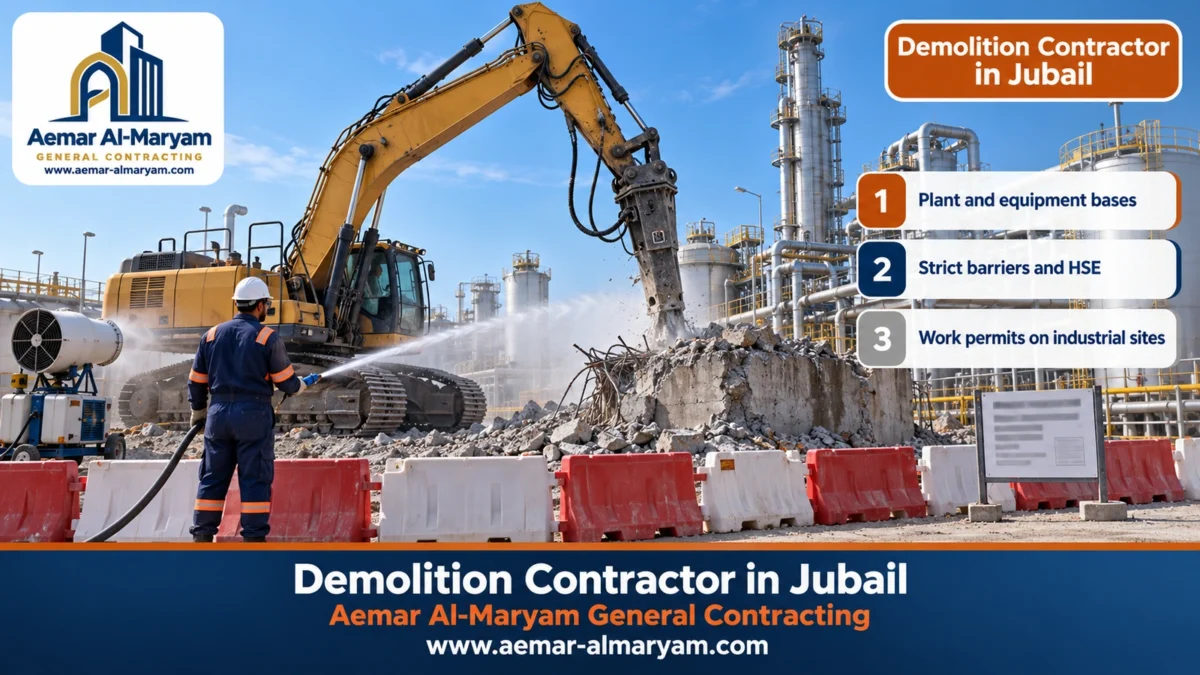
A demolition contractor in Jubail works in a city with two very different faces. On one side is the industrial city, where reinforced concrete equipment bases and steel sheds are removed under strict safety rules and permits to work. On the other is the older residential town of Jubail Al Balad, where houses are knocked down and walls and floors are broken out ahead of renovation. At Aemar Al-Maryam General Contracting we break plant bases with large hydraulic breakers, dismantle steel sheds with demolition shears and sort the steel for scrap, and take down houses and villas, fully or in part, in Al Dabab, Ghirnatah, Al Hamra and Al Fanateer. Published entry prices run from SAR 185 for taking out a partition, through SAR 7,400 for a single-storey house, to SAR 13,900 for a home on two floors; anything industrial is priced only after we have walked the site. Phone and WhatsApp: 0547879578.
What separates the two goes well beyond machine size. In a plant, nobody lifts a tool until a signed permit is in place, the lines around the work area are isolated and the crew has been inducted into the site rules, and every hour is planned around the production schedule. In a house, the main concerns are the neighbour next door, the dust in the street and a lane that may be too narrow for a large excavator. So this guide follows both routes separately. Start with the section that matches your site, then move on to prices, timings and how to request a visit.
In short: demolition and breaking in Jubail
- For industrial sites: breaking equipment bases and concrete floors, dismantling steel sheds and warehouses, and sorting steel and cladding for scrap.
- For houses and villas: full or partial demolition, and interior strip-out before refurbishment: false ceilings, partitions and tiles.
- Who approves: inside Jubail Industrial City the reference is the Royal Commission plus the facility’s own permit system; in Jubail Al Balad the demolition permit comes from the Balady platform.
- Entry prices: a partition from SAR 185, old tiles from SAR 14 a square metre, a one-floor house from SAR 7,400, a home on two floors from SAR 13,900, and bigger buildings from SAR 46 for each square metre across all floors. Every figure is an estimate pending inspection and agreement.
- Debris: hauled by a licensed carrier to approved sites; steel is separated and its value deducted.
- To order: site photos and the type of work on WhatsApp 0547879578.
Demolition contractor in Jubail: two routes in one city
A demolition contractor in Jubail needs to know where the job is before asking how big it is, because procedures, tools and timing change completely between a site inside Jubail Industrial City and a house in Jubail Al Balad. This table sums up the differences we see on real sites:
| Item | Industrial site (plant, warehouse, workshop) | House or villa |
|---|---|---|
| Approval | Royal Commission plus the facility’s internal permit to work | Balady demolition permit through an engineering office for full demolition |
| Before starting | The facility isolates power and process lines; the crew is inducted into site rules | Temporary removal of the electricity meter; water and drains capped |
| Main equipment | Large excavator with a hydraulic breaker, demolition shear, wire saw where needed | Mid-size excavator with a crusher jaw, electric breakers, skid-steer loader |
| Paperwork | Method statement, risk assessment, crew and equipment lists | A clear contract covering scope, debris and scrap |
| Biggest risk | Live lines and running equipment beside the work zone | The adjoining neighbour and dust in the street |
In both cases the principle stays the same: inspect, disconnect, demolish from the top down, separate what can be sold and haul the rest away properly. For the general scope of the service see our demolition and breaking service, and for everything else we do in the city see our Jubail page.
Breaking equipment bases and reinforced concrete in Jubail Industrial City
Breaking equipment bases in Jubail Industrial City means removing the reinforced concrete blocks that once carried a pump, compressor, tank or structure after it has been moved, and handing the area back clean for new equipment or another use. These bases are far heavier than anything in a house: they can be more than a metre thick, with two or more layers of reinforcement and anchor bolts cast deep inside. We work on them with a large excavator carrying a heavy hydraulic breaker, cut the exposed bars each time a block separates, and load the pieces as we go so they do not pile up around the work zone.
The hardest part is usually not the concrete but what surrounds it. Very often the base sits a few metres from live pipework, buried cables or another base that has to stay intact. In that case we do not let the breaker work on the near edge. We first separate the block with a cut line made by a diamond saw or a wire saw, break the far part freely, and lift the near part out in cut sections. Wire sawing inside facilities is explained in our guide to concrete cutting in Jubail.
- 1Receive the site from the facility
We collect the permit to work, confirm with the facility’s representative that lines and power around the base are isolated, and mark the limits of the work area. - 2Barriers and mist
Linked safety barriers around the zone and a mist cannon to keep down dust that could otherwise drift onto running equipment. - 3Check for buried services
We ask for the drawings and expose the ground around the base by hand before digging wherever cables or pipes may be present. - 4Separate, then break
Cut at the sensitive edges, then work the hydraulic breaker on the block from the top down. - 5Steel and loading
Cut the bars and anchor bolts, separate steel from concrete, and load the rubble into covered tippers. - 6Backfill and handover
Backfill the pit with the agreed material, compact it and hand the area back to the facility with a signed record.
Concrete breaking in Jubail: floors, trenches and plinths
Concrete breaking in Jubail is not limited to equipment bases. We also break workshop floors to change levels or add drainage channels, old tank plinths, concrete fences and barriers, and cracked car-park slabs. On mesh-reinforced floors we start by saw-cutting the slab into regular squares, so each square breaks on its own and cracks do not travel into the part that stays. If all you need is a passage for pipes, the better answer is core drilling in Jubail rather than breaking.
Dismantling steel sheds and warehouses in Jubail
Demolishing a steel shed in Jubail is dismantling before it is demolition. We strip the roof and wall cladding sheets first, then cut the steel frame with a hydraulic demolition shear mounted on an excavator, so columns and beams come down in measured lengths that are easy to load and sell. This keeps the crew on the ground and away from working at height, and it stops the frame from collapsing in one go onto whatever stands next to it.
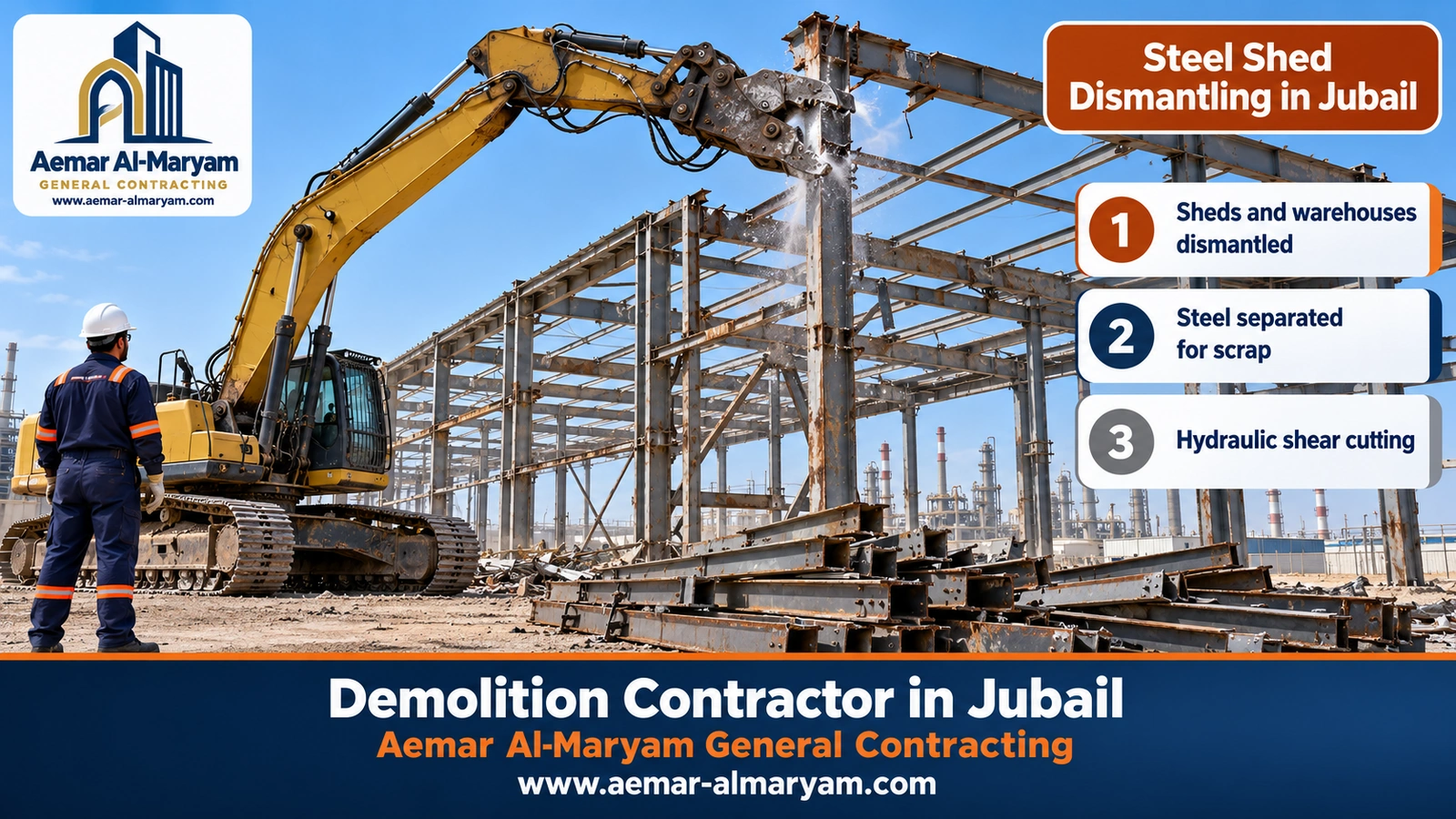
The cutting order matters here just as much as the demolition order in a concrete building. We start with purlins and secondary members, then the trusses, then the columns, leaving the bracing that holds the frame together until the very end so that no side can lean over. If the shed adjoins a working building or a production line, we cut from the far side towards the near side and use a crane to lower long members instead of letting them fall.
Warehouse demolition in Jubail and service buildings inside facilities
Not every building inside a facility is a steel frame. Many warehouses, site offices and old switch rooms are block and concrete buildings with reinforced roofs. Taking these down combines both methods: we first strip what can be removed, such as doors, air conditioners, cables and racking, then break the roof and walls from the top with an excavator and crusher jaw, and either leave the concrete floor or break it, depending on what the facility plans next. Where the building touches another that stays in service, we cut a separation line between them before breaking so that vibration and cracks do not reach the shared wall.
With these buildings in particular, we ask about services before anything else. Is there still a cable feeding another unit? Does a drain or a fire-water line run beneath the slab? The answers sit with the facility’s team, and we ask for them in writing as part of the site handover.
Sorting scrap and deducting its value from the price
Structural steel and cladding from sheds have a clear value on the scrap market, and they are among the biggest factors that lower the net cost of demolition on industrial sites. So we sort on site: beams and columns in one pile, cladding in another, cables and aluminium on their own, and concrete and block kept apart. During the site visit we put a figure on the steel and show it in the offer as a deduction. If you would rather keep the steel yourself, we hand it over stacked on site.
⚠ Old cement sheets on a shed roof
Some older sheds and canopies are roofed with fibre-cement sheets that may contain asbestos. Where we have doubts, that section of the roof is left alone: the sheets stay whole and uncut while a specialised, licensed firm takes them off, and only then does dismantling resume.
Working under HSE rules and Royal Commission permits in Jubail
Within the boundaries of Jubail Industrial City, permits for building, demolition and alteration are a Royal Commission matter rather than a municipal one, and every facility layers its own permit-to-work system over that. In practice, the facility owner or its main contractor submits the applications, and we prepare what is normally asked of a demolition contractor before entering the site:
- ✓Method statement: the breaking or dismantling sequence, the equipment, the limits of the work area and how loading will be done.
- ✓Risk assessment: nearby lines, work at height, dust, noise and machine movements inside the site.
- ✓Crew and equipment details: names and roles of the workers, and details of the machines that will enter.
- ✓Protective equipment: helmets, glasses, gloves, safety boots, high-visibility clothing and hearing protection for the whole crew.
- ✓Supervision: a supervisor from our side throughout the work, in contact with the facility’s safety officer.
We advise any facility not to accept a contractor who wants to “start today and sort the paperwork later”. The real delays on industrial sites come from work being stopped after it has started because a permit is missing or a safety rule has been broken. That is why we start the paperwork at the inspection and fix the start date only once it has been approved.
Demolition permit in Jubail Al Balad through Balady
In Jubail Al Balad, outside the Royal Commission’s area, demolishing a whole building requires a demolition permit issued online through the Balady platform. Using the national login, the owner picks the property’s building permit or survey decision, appoints an engineering office that fills in the technical data and prepares the drawings, and signs a pledge that nobody, person or animal, will be inside while the structure comes down. Balady works out the fee with its own calculator once the request is in, and its service card gives an issue time of one to ten days.
Does partial demolition or breaking a wall need a permit in Jubail?
Stripping tiles or knocking out a block partition that carries nothing is treated as upkeep, so a demolition permit is not usually involved. Taking away an annexe or a roof-top room, or touching anything structural, is another matter: the engineering office decides which permit applies, through Balady for Jubail Al Balad or through the Royal Commission when the property sits within its area, as homes in Al Fanateer do.
Building demolition in Jubail Al Balad: homes in Al Dabab, Ghirnatah and Al Hamra
Building demolition in Jubail Al Balad is mainly residential work: one- and two-storey houses, villas, small apartment blocks and annexes added over the years. In districts such as Al Dabab, Ghirnatah and Al Hamra we build the plan around three questions. Does the building touch its neighbour? How wide is the street? And what does the owner want to keep: the boundary wall, the water tank or the foundations?
Old house demolition in Jubail
Old house demolition in Jubail starts on the inside. We remove doors, windows, air conditioners and roof tanks and sort anything saleable, then the roof is nibbled away with a crusher jaw, calmer than a hammer, then the walls follow, spraying water the whole time. Where the house shares a wall with its neighbour, we leave the last strip beside that wall for hand breaking and photograph the neighbour’s house before we start.
Villa demolition in Jubail and Al Fanateer
Villas in Jubail are mostly reinforced concrete, and some in Al Fanateer stand near the sea and fall within the Royal Commission’s area. A villa takes more effort to bring down than an older block house, since its columns, beams and slabs are knitted together by dense reinforcement, and there may be a high concrete boundary wall, a pool or an outbuilding. We handle each element as a stage of its own, and we separate the steel with shears because the quantity in a modern villa lowers the net price once its value is deducted.
Partial demolition in Jubail: an annexe, rooftop room or canopy
Partial demolition in Jubail means removing one defined part while the rest stays sound, for instance a tired room on the roof, a yard annexe or the concrete canopy over a front door. We separate the part with a straight saw cut, set props under the remaining slab, break by hand and lower the pieces rather than throwing them down. Should a new annexe follow, the same team can build it under our construction service page.
Breaking contractor in Jubail: interior strip-out of false ceilings, walls and tiles
An interior strip-out removes the old finishes back to the structure before a villa or flat is refurbished, and it is the job we are asked for most often in Jubail Al Balad homes. It covers gypsum false ceilings, non-load-bearing partitions, tiles and ceramics, and sometimes complete kitchens and bathrooms. Its advantage is that it reveals what was hidden: leaks above the false ceiling, rust in the slab reinforcement and old wiring or pipework that needs replacing.
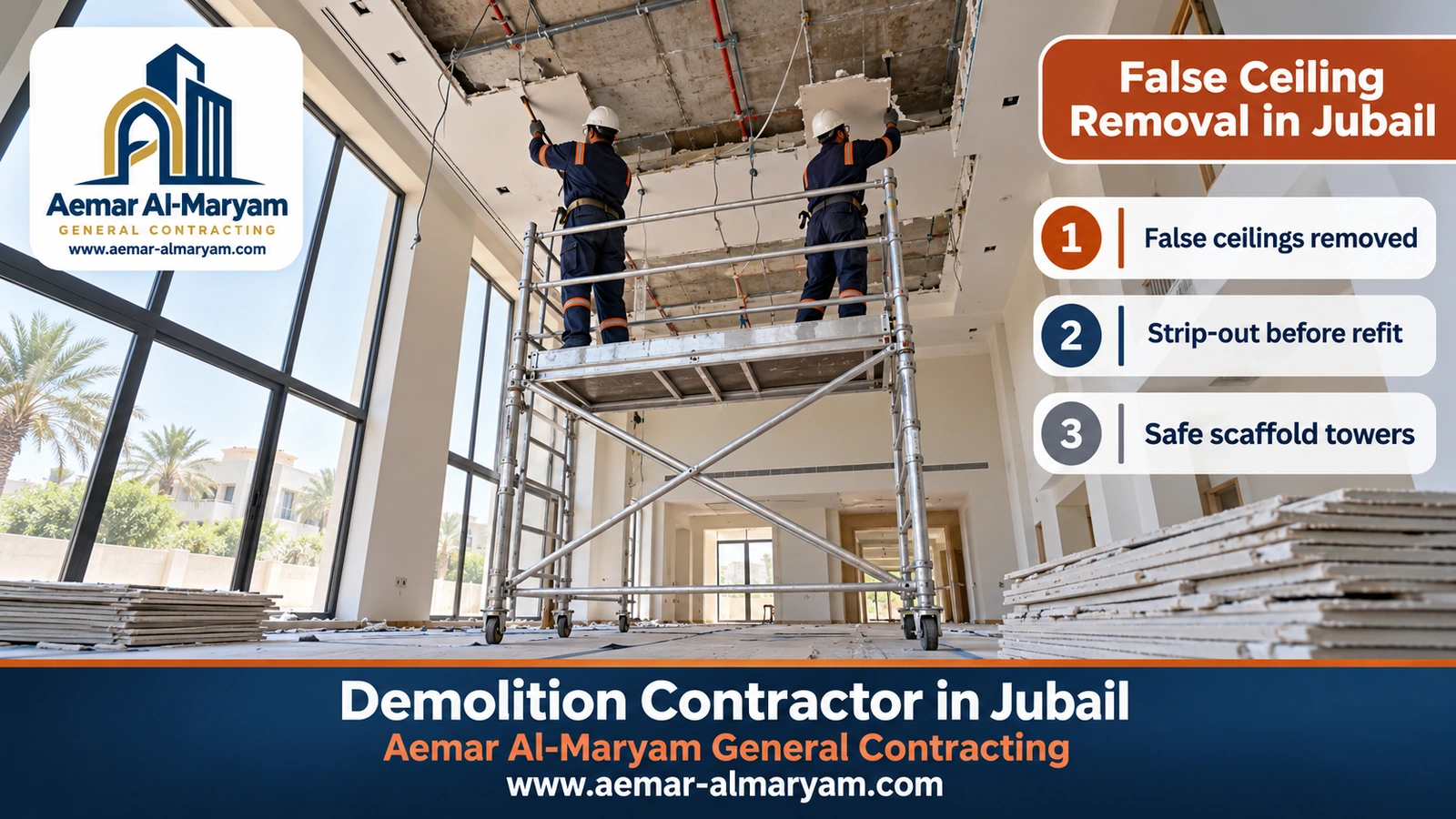
We take down false ceilings from a mobile scaffold tower with guard rails, not from loose ladders, and lower the boards in stacks rather than smashing them onto the floor. We disconnect the recessed lighting before it comes down, then photograph the exposed concrete slab and show you any crack or rust before a new ceiling closes it up again.
Wall breaking in Jubail and removing the wall between two rooms
Removing the wall between two rooms in Jubail is normally a one-day job if the wall is plain blockwork sitting under an exposed concrete beam. First we check the wall’s thickness, whether a beam runs above it, whether a column is hidden inside, and which sockets and pipes it carries. A concrete wall, or one the slab bears on directly, is a decision for a civil engineer and often calls for temporary shoring and a replacement beam. After removal we agree with you whether we patch the floor strip and plaster along the old wall line.
Tile and floor breaking in Jubail
Tile breaking in Jubail means removing the tiles together with the bedding mortar down to a sound surface, because laying new tiles over hollow mortar only brings the problem back. In bathrooms we go further, through the fill and the old waterproofing to reach the pipes. We hold the light breaker at an angle so it lifts the tile without hammering the slab beneath or hitting buried pipes, and the debris leaves the house in sacks at the end of each day.
Wall breaking with a hand cutter (the “rocket”) in Jubail: real limits
The hand-held disc cutter, nicknamed the “rocket” (صاروخ) locally, earns its place for scoring lines and slicing through block or protruding bars. Its limit is depth: around 125 mm even on the biggest models, which leaves a thick concrete wall or a plant base far beyond its reach. We use it to set the limits, then break inside them with a breaker, and we always use water or extraction, because dry cutting throws up dense silica dust.
Cutting without breaking in Jubail
When an opening for a door or window has to go through concrete with no vibration, or need part of a slab removed next to expensive finishes, diamond-saw cutting is the answer, not breaking. Details and prices are in concrete cutting in Jubail and on our concrete cutting service page.
Renovation and breaking in Jubail: when breaking is the first step of a repair
Many people searching for “renovation and breaking” in Jubail need both under one contract: break out the damaged or outdated part, then rebuild and finish it. Typical examples are spalling render that has exposed rusty steel, a bathroom floor that has leaked into the ceiling below, or a cracked section of boundary wall. When we do both stages, we break to regular edges that make the repair easier and inspect the exposed steel before it is covered again. Structural damage is covered in depth by our renovation contractor in Jubail article and the renovation service.
Debris removal and waste sorting in Jubail
Debris removal in Jubail is part of the demolition contract, because the permit holder is legally responsible for disposing of it. The construction and demolition waste requirements issued by the Ministry of Municipalities and Housing say that every load leaving the site moves on a truck whose operator is licensed by the National Center for Waste Management, heading only where the competent authority has designated; the supervising engineering office checks this and submits the final receipt certificate. Inside industrial facilities we also follow whatever the facility sets for the route and documentation of waste leaving the site.
- Steel and cladding: sorted and sold or handed to the owner, never mixed with concrete.
- Concrete and block: kept as clean as possible, since they can be recycled.
- Gypsum, timber and plastics: bagged separately from interior strip-outs.
- Transport: tippers covered with mesh, and the road at the site entrance kept clean.
Demolition and breaking prices in Jubail (starting from)
For homes in Jubail the scale opens at SAR 185 for a partition, sets floors of SAR 7,400 for a one-floor house and SAR 13,900 for a house on two floors, and then moves to SAR 46 for every square metre added up across all floors. Equipment bases and shed dismantling are always priced after a visit, because thickness, reinforcement, scrap value and site conditions differ from one facility to the next.
| Work in Jubail | Charged | Price starts from |
|---|---|---|
| Partition wall (plain block) knocked out | each | SAR 185 |
| Old floor or wall tiles stripped, bedding included | each m² | SAR 14 |
| One-floor older house | whole job | SAR 7,400 |
| House or villa on two floors, up to about 300 m² combined | whole job | SAR 13,900 |
| Bigger concrete buildings | each m² of all floors | SAR 46 |
| Equipment bases and heavy reinforced concrete in plants | — | after a site visit |
| Dismantling steel sheds and warehouses | — | after a site visit, steel value deducted |
| Annexe, rooftop room or canopy (partial demolition) | — | after a site visit |
| Debris loads in Jubail | per load | set by the approved disposal site |
Please note: treat each number as provisional until the site visit and our agreement. They move with the construction type, the floor area, what sits next to the site (houses or live lines), machine access and the volume of debris. Moving equipment from Dammam is priced after the visit, and the more jobs you group into one trip, the less each one carries.
Cost of demolishing an old house in Jubail
The lowest figure for a small single-storey house is SAR 7,400, rising with floor area, annexes and an adjoining neighbour who forces hand breaking. Surprises below ground, a buried water tank or a disused soakaway, are agreed as extra lines before we touch them.
Two-storey house demolition cost in Jubail
Our floor for a home on two floors is SAR 13,900 while both levels together stay near 300 m²; past that, each extra square metre is billed at SAR 46. Purely as an illustration: two floors of 180 m² each give 360 m², or about SAR 16,560 for the demolition, with debris loads added and the value of the steel taken off.
Villa demolition cost in Jubail
A villa of about 300 m² of floors starts at SAR 13,900, with larger villas charged per square metre. Concrete boundary walls, pools and outbuildings are priced once we have seen them, while the steel in a modern villa reduces the net figure once its value is deducted.
Wall removal cost in Jubail
Plain blockwork partitions start at SAR 185 with the sacking of debris included. Walls in concrete, or walls that hold up the floor above, wait for an engineer to report, since the job then means temporary supports and perhaps a new beam rather than simple breaking.
How long does demolition take in Jubail?
In Jubail the type of site decides the timing before its size does. A house is usually done within days once the permit is issued, while an industrial site adds the time needed to approve permits and the work windows the facility allows. These are typical times on site; the final schedule follows the inspection:
| Job | Typical time on site | What extends it |
|---|---|---|
| Taking out a partition wall | from a few hours to a day | sockets and pipes inside it, or floor patching afterwards |
| Villa strip-out (ceilings, tiles, partitions) | several days | number of bathrooms and kitchens, amount of gypsum |
| Small house | a few days | adjoining neighbour, narrow street |
| Two-storey villa | about one to two weeks | concrete boundary wall, pool, foundation removal |
| One equipment base | one to several days per base | thickness, steel density, nearby live lines |
| Steel shed | days to two weeks | area, height, adjoining working buildings |
Safety and protecting neighbours when demolishing homes in Jubail
Safety in house demolition starts with disconnecting the services before the first blow: the Saudi Electricity Company removes the meter temporarily, the water supply is shut and the drains are sealed. Then comes a meshed fence around the plot, warning signs, water spray during breaking and loading, and never stacking rubble against the neighbour’s wall. Demolition always runs from the top down, so no part is ever left hanging without support.
Asbestos in older buildings
The Saudi Cabinet has banned asbestos use, import and manufacture, and its decisions direct that existing asbestos in buildings be swapped out and disposed of safely. If we find sheets or pipes we suspect, in a house or a shed, we stop work on that part and refer it to a specialised contractor; we do not offer asbestos removal ourselves.
Demolition equipment we bring to Jubail sites
We pick the machine after the inspection, based on what it has to break and what stands beside it, not on its size. On an open industrial site a large excavator may be faster and safer because it keeps the operator well away from the block; in a villa hall, only what can be carried by hand will fit. This is how we split the equipment between the two routes:
■ Large excavator with heavy breaker
for equipment bases and thick reinforced blocks on open industrial sites.
■ Hydraulic demolition shear
for cutting shed columns and beams and separating steel from concrete without sending workers up high.
■ Mid-size excavator with crusher jaw
for nibbling houses and villas down floor by floor with less noise than a hammer.
■ Diamond and wire saws
for separating edges near live lines and parts that must stay.
■ Electric breakers and mobile towers
for interior strip-outs: gypsum ceilings, partitions and tiles.
■ Mist cannon, loader and tippers
for keeping dust down and collecting and loading debris into covered trucks.
Demolish and rebuild in Jubail: when is demolition the better deal?
Demolition and rebuilding wins over renovation when the damage is structural and widespread: column and slab steel corroded in many places, concrete that keeps spalling despite repairs, or settlement in the foundations. Jubail is a humid coastal city and its older buildings are exposed to salts that speed up steel corrosion, but the decision should never be made by eye. It needs an engineer’s report comparing the cost of repair with the cost of a new build. Damage confined to finishes, or to a handful of cracks, nearly always makes repair the cheaper path.
Going down the rebuild route? Get the engineering office to finish the new drawings first, settle whether every old footing is to be dug out, and require a flat, swept plot at handover so the surveyor can set out straight away. Our construction team can pick up the project from there.
Choosing a demolition contractor in Jubail: what to check before you agree
You should choose a demolition contractor in Jubail on the clearest offer, not the lowest number. An offer that states one price without details leaves the door open to later claims: extra debris loads, foundations that were never mentioned, or steel the contractor took without deducting it. Before signing, make sure the contract states:
- ✓Exact scope: what is demolished, what stays, and whether bases and foundations are removed or the work stops at ground level.
- ✓Debris: who hauls it, with which licensed carrier, and when the disposal certificate is handed over.
- ✓Scrap: who owns the steel, cladding and aluminium, and how much is deducted for them.
- ✓Safety: who requests line isolation or meter removal, and how neighbouring buildings are protected.
- ✓Payments: linked to completed stages, not to days.
- ✓Handover: a level, clean site, photos after completion and a signed handover record.
How to request demolition or breaking in Jubail
Send whatever fits your type of site on WhatsApp 0547879578, and we will arrange the inspection from Dammam:
| For an industrial facility | For a house or villa |
|---|---|
| Photos of the base or shed from several angles, with rough dimensions | Photos of each façade, the roof and the walls shared with neighbours |
| What surrounds the work area: lines, running equipment, adjoining buildings | The district, street width, number of floors and area |
| The name of the safety officer or main contractor | Anything to keep: boundary wall, tank, footings |
| Permitted work windows and permit requirements | Building permit or survey decision in hand, and the engineering office you use |
- 1First message
You send photos and the location; we reply with the proposed method and an initial estimate. - 2Inspection
We visit, measure, and decide on equipment, barriers and the number of loads. - 3Offer and paperwork
A detailed offer itemising each line and the scrap deduction, plus the facility paperwork or permit file. - 4Execution
We take over the site and work in the agreed sequence under constant supervision. - 5Handover
A clean, level site, photos after completion and proof of waste disposal.
Demolition company in Jubail: why Aemar Al-Maryam?
■ We know a plant is not a house
We prepare facility paperwork and risk assessments before the date, and work in homes in a way that respects the neighbours.
■ Equipment for both routes
Heavy hydraulic breakers and demolition shears for industrial sites; electric breakers and mobile towers for strip-outs.
■ Scrap deducted openly
The value of steel and cladding appears as a visible line in the offer.
■ Demolition, cutting and repair
One team breaks, cuts and repairs, so responsibility is never split. See our projects.
Areas of Jubail we cover
We reach Jubail Al Balad and its districts as well as the industrial city and its residential areas, with crews travelling up from Dammam on booked days:
We publish similar guides for other Eastern Province cities, including demolition contractor in Ras Tanura and demolition contractor in Abqaiq, and the main guide, demolition contractor in Dammam.
Is your Jubail site ready for demolition or breaking?
Photograph the site and send the pictures with the type of work. We will come back with a method and an estimated figure, then fix the visit.
More on Jubail and related services
Tags