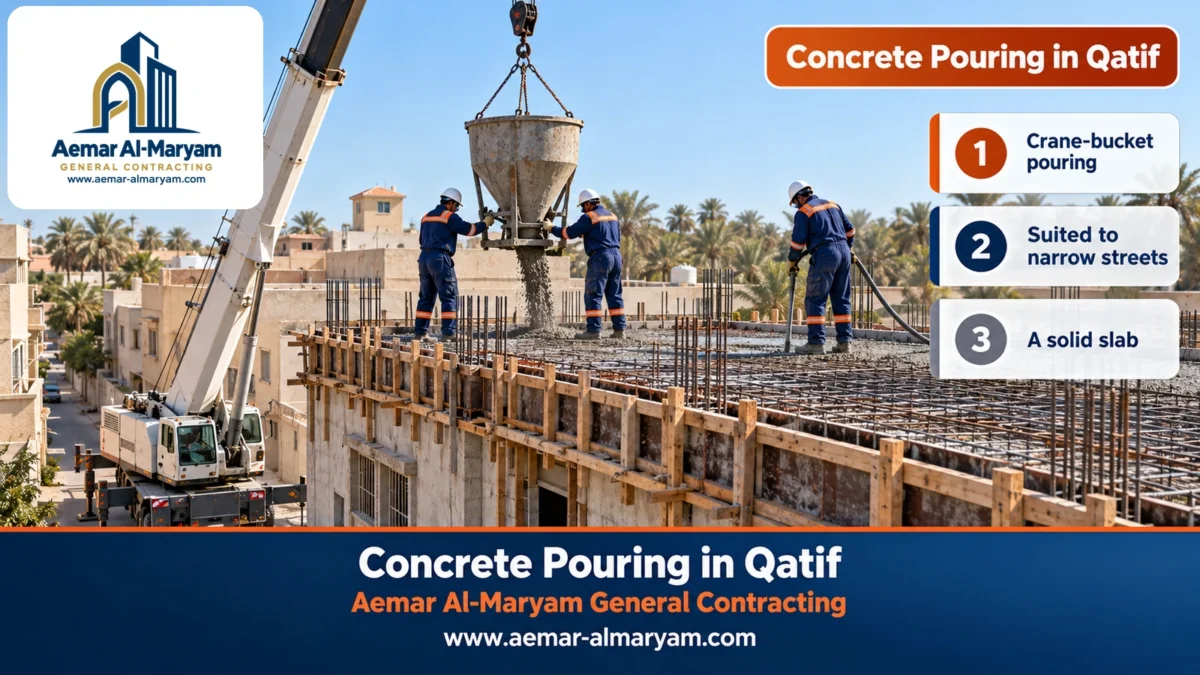
A two-storey house in an older neighbourhood, a new room planned for the roof, and a street too narrow for a boom pump to spread its outriggers: that is the situation we meet most often when we are called for concrete pouring in Qatif. At Aemar Al-Maryam General Contracting we solve it with a concrete bucket lifted by a mobile crane over the street. On plots at the edge of the farms we pour footings inside polythene-lined excavations since the water table there is only a short way down, and on roofs we lay cement-mortar slope screeds ready for waterproofing. Mortar screeds start from SAR 23 per square metre and foam screeds from SAR 17; blinding labour starts from SAR 14, and a reinforced yard slab with all materials from SAR 46 per square metre. Roofs and footings are priced once we have read the drawings. The trip out to Qatif is costed when we visit, and the concrete, crane and laboratory are passed on at their own prices. None of it is fixed before a site visit and your sign-off. Ring or WhatsApp 0547879578.
Qatif offers several very different kinds of site. There are older, closely packed houses on narrow lanes, newer homes at the fringe of the palm groves and farms, and the towns on Tarout island. Each changes how the concrete gets to the element and how the footings have to be protected, so this page follows what a homeowner actually faces, and closes with a worked example for a rooftop room slab.
The short version for a pour in Qatif
- Narrow streets: rooftop room slabs go in by crane bucket, or by a line pump where there is a route for the pipes.
- Near the farms: footing excavations are lined with heavy polythene, water is pumped out before the pour, and nothing is cast into standing water.
- On the roof: a cement-mortar slope screed set out with level dots and screed strips towards the outlet, followed by waterproofing.
- Entry prices, SAR per m²: 23 for mortar falls, 17 for foam falls, 14 for blinding labour, 46 for a yard slab with its materials, 46 for a trowelled floor, 110 for stamped work.
- Travel: priced at the inspection; combining several jobs in one visit lowers the share each one carries.
- Supply: from the nearest licensed plant, and Qatif governorate itself has ready-mix plants in Saihat and Safwa.
- To book: photos of the street, the roof and the stair access to 0547879578.
Rooftop room slabs in Qatif by crane bucket
When a pump cannot get in, we lift the concrete in a bucket hung from a mobile crane parked at the widest point of the street. The bucket rises full from the truck to the roof, a worker opens its gate over the reinforcement, and it comes back down empty to be refilled. It is slower than pumping, but it reaches houses nothing else can, and it suits the room and annex roofs whose volume is only a few cubic metres.
Why a bucket and not a boom pump?
A boom pump needs space to open its outriggers on both sides, firm ground beneath them and clear air above, free of power lines. Many older streets in Qatif offer none of that. A line pump is another answer if we can find a safe route for its pipes up the stairwell or the façade; a crane needs only one standing point and a jib long enough to clear the building.
| Delivery method | Suits in Qatif | What it needs |
|---|---|---|
| Crane and bucket | Rooftop room and annex roofs on narrow streets | A standing point for the crane, and coordination with neighbours and traffic if required |
| Line pump with pipes | Roofs where pipes can be run up the stairs or the façade | Pipes clamped and propped along their run, plus set-up and cleaning time |
| Boom pump | Houses on wide roads and open plots | Room for the outriggers and no cables overhead |
| Barrows on timber runs | Footings workers can reach but trucks cannot | Fixed plank walkways and enough hands |
Parking the crane in the neighbourhood: arranging it beforehand
The crane occupies part of the street for the hours of the pour, and in tightly built neighbourhoods its jib sometimes swings over the houses next door. So we visit a day or more ahead, agree the standing point and the jib path with you, and let the neighbours know the pour time so cars are moved from in front of the house. We pick an early hour when traffic is light, and keep a worker in the street directing movement around the crane and the truck throughout. If the site needs permission from the relevant authority to occupy the road, we tell you before fixing the date.
Pouring a roof by bucket, step by step
- 1Prepare the roof the day before
We check the shuttering, props, steel and spacer blocks, clean the forms, and mark where each bucket will be emptied. - 2Position the crane
It is set up at the agreed point and the jib path is planned away from cables and the neighbours’ roofs. - 3Fill the bucket
The truck discharges into the bucket at street level, and we start at the point of the roof furthest from the crane. - 4Discharge over the steel
The gate is opened gradually and close to the reinforcement; a bucket is never dumped as a single heap. - 5Vibrate and level
Each load is vibrated vertically with a poker, then struck off with a straightedge before the next bucket arrives. - 6Finish and cure
After the last load we level and float the surface, and begin keeping it wet once it has firmed up.
Agree the timing with the plant
A bucket is slower than a pump, so we ask the plant for truck sizes and arrival times that match the lifting rate, with a retarder in hot weather, so no truck circles the street while its concrete stiffens.
A room on an old house: permit and loads first
We do not cast a roof on an old house without drawings and a permit
A rooftop room puts new load on columns and footings designed many years ago. Adding it goes through an engineering office that checks the building’s capacity and issues drawings, and the request is lodged on Balady under additions and alterations to a building. Many older houses need repairs to their columns or existing roof first, which is work for our renovation contractor in Qatif.
The room may be part of a complete annex project with walls and finishes, covered in annex and majlis building in Qatif. If you need a doorway from the old roof into the new room through a concrete wall, that is done by sawing, not breaking, as described in concrete cutting in Qatif.
Hordi or solid slab for a Qatif rooftop room?
Hordi is lighter, which matters on top of an older building, but the direction of its ribs and the position of the blocks must be set out precisely. A solid slab is simpler to build and easier to open later for an air-conditioning sleeve or a flue. The designer chooses according to the span, the loads and what the old columns can carry.
Footings near the farms in Qatif
Houses built at the edge of Qatif’s farms and palm groves often stand over groundwater close to the surface, and water can appear at the bottom of an excavation a few hours after digging. Concrete placed into standing water or onto muddy ground loses some of its cement and mixes with silt at its edges. On these plots we add steps before the truck arrives.
Polythene around the footings: why and how
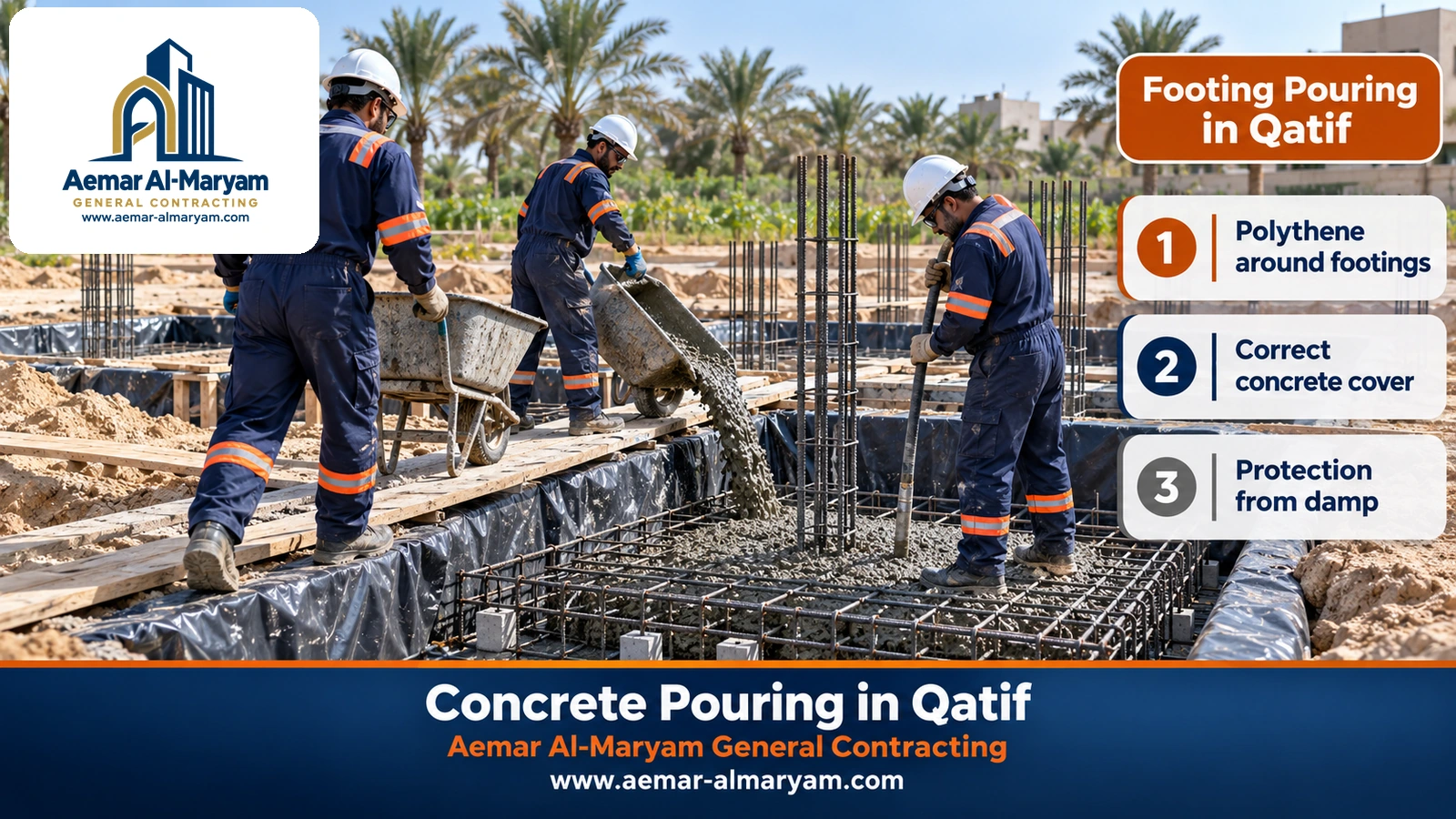
We line the bottom and sides of each excavation with heavy polythene before the cages go in. It separates fresh concrete from wet soil, keeps thirsty soil from robbing the mix of its water, and keeps silt away from the edges of the footing. Sheets are lapped at the joints, and the cages sit on concrete spacer blocks so they neither puncture the polythene nor touch the soil.
Pumping out water before the pour
If water collects in an excavation we pump it out until the bottom is dry and pour straight afterwards, without a long wait. If the water returns quickly, the water table is above the excavation level, and the engineer decides how to deal with it. We do not pour into standing water, however tight the programme.
Cement and additions for footings in Qatif
Groundwater in the Eastern Province is saline on many sites and carries sulphates and chlorides together, and because Qatif lies on the Gulf coast, exposed elements also face salt-laden sea air. The designer sets the exposure class and the cement type from the soil report: ordinary, sulphate-resisting or blended with additions. What matters for an owner is this: sulphate-resisting cement resists sulphates, but KFUPM researchers working on Eastern Province soils showed that by itself it does not prevent chloride-driven rusting of the reinforcement, and that mixes with silica fume and similar additions gave much better protection.
- ✓We order exactly the grade and cement type written on the drawings.
- ✓We reject a truck that has had water added or has arrived later than agreed.
- ✓Every face that will be buried receives a bituminous coating once dry, before backfilling.
- ✓We keep the cover under the bars: 75 mm for concrete cast against the ground.
Building on the footings: when the next stage can start
A footing is not left alone after the pour. We keep it moist for several days, as we do a slab, and strike its timber sides after about a day. Backfilling waits until the concrete has gained enough strength and its bitumen coat has dried, and the necks are not loaded with heavy column shuttering the same day. On wet ground we delay backfill a little longer to be sure the coating has bonded, since damp soil will surround that footing for the life of the house. If striking reveals honeycombing at a footing edge, we show it to the engineer before backfilling, because a repair is far easier while the concrete is still exposed.
Blinding concrete in Qatif
Blinding is plain concrete about 5 to 10 cm thick, spread over the compacted bottom to give a clean bed for setting-out marks and spacer blocks. On wet plots it does an extra job, keeping the footing steel away from damp soil while the work is prepared. Our labour for it begins at SAR 14 a square metre, and the plant is paid directly for its concrete.
Ground beams, necks and columns
Ground beams follow the footings as the drawings require; column starter bars are left exactly in position; columns are poured in layers with vibration, their sides struck after about a day and curing started. We avoid cold joints by scheduling the trucks so concrete never stops halfway through an element.
Slope screeds in Qatif with cement mortar
The slope screed is the layer that decides where rainwater goes on a roof. On the Qatif houses we work on we often choose cement mortar, because it gives a hard surface that takes foot traffic, light loads and maintenance work on the roof; it starts from SAR 23 per square metre. The foam alternative is lighter, starts from SAR 17, and suits roofs where the weight of the layer on an old slab has to be kept down.
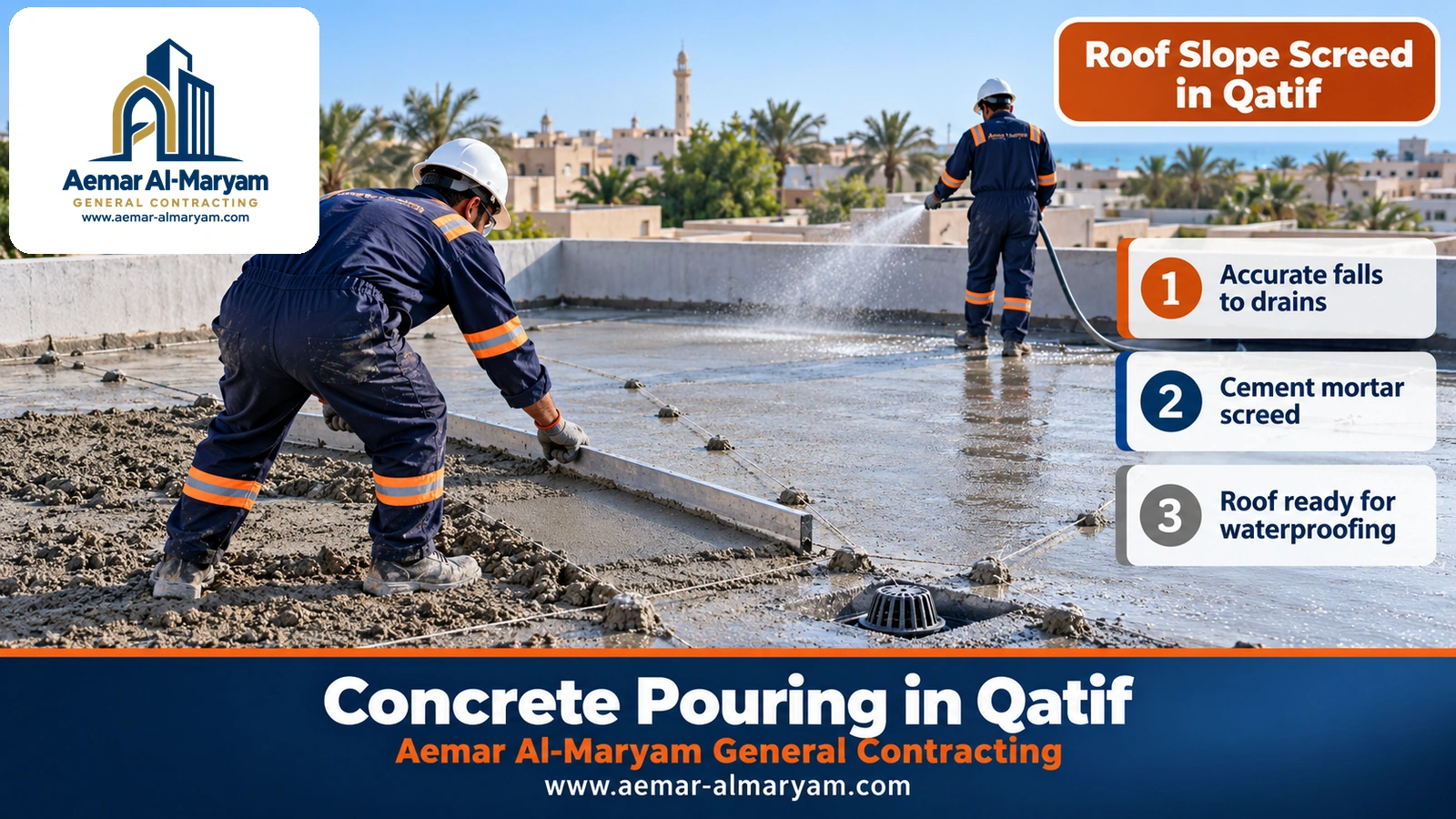
How we lay a mortar slope screed
- 1Clean and dampen the roof
We remove dust and old mortar and wet the slab so it does not draw water from the new layer. - 2Level dots
Small mortar dots are fixed at calculated heights, falling towards each outlet at about 1 to 2 percent. - 3Strips and strings
The dots are joined with mortar strips and taut strings that act as guides for the straightedge. - 4Spread and pull
Mortar is spread between the strips and pulled level with a long aluminium straightedge, filling low spots until the fall is true. - 5Upstands and outlets
We form coved fillets where the roof meets the parapet walls and lower the level around each outlet. - 6Keep it wet
The finished layer is misted for several days so it does not crack, then left to dry before waterproofing.
A screed is not waterproofing
The mortar layer guides water but does not stop it leaking through; the membrane and thermal insulation go on top. The order of layers and their prices are on roof waterproofing and insulation in Qatif. If the roof carries an old, cracked or broken screed it has to come off first, which may call for our demolition contractor in Qatif.
Concrete pouring in Qatif: everything we pour
Beyond those three situations, we pour every concrete element of a house in Qatif and Tarout, either complete with shuttering and steel fixing or as a pour-only job:
■ Foundations
Blinding, isolated and strip footings, necks and ground beams, with polythene and bitumen coating on wet plots.
■ The frame
Columns, beams, solid and hordi slabs and stairs, for new houses and added floors.
■ On the roof
Room and annex roofs, and slope screeds in mortar or foam concrete.
■ Floors
Yards and parking areas, power-trowelled floors, and stamped concrete paths.
Concrete contractor in Qatif or a ready-mix company?
A ready-mix company batches and delivers; a pouring contractor prepares the site, places the concrete and cures it. We are the second kind. We order the concrete from the plant at the grade you need and show you its invoice as issued, and our labour stays a separate figure you know from the start. If you are building a whole house from foundations to finishes, that is our construction service; the brief version of pouring is on the concrete pouring service page.
Ready-mix concrete in Qatif: where it comes from and what it costs
Plants are not far from Qatif: licensed ready-mix plants operate in Saihat and Safwa inside the governorate, with more in Dammam. We order from the nearest one that supplies the required grade, which shortens the haul, and that matters in summer when the time between batching and placing is limited.
Ready-mix price per cubic metre in Qatif
No official figure is published for Qatif. The reference is the Kingdom-wide average issued by the General Authority for Statistics, in the region of SAR 214 per m³ for grade 350 plain concrete and SAR 224 for the sulphate-resisting version. Your price on the day may differ slightly with the plant, admixtures and whether a pump or crane is used, and we tell you before the pour.
Mixing on site: when does it make sense?
A small mixer on site is enough to patch a path or cast a small non-structural base. Roofs and footings are poured with ready-mix, because its proportions are consistent, it can be sampled for the laboratory, and it arrives in quantities large enough to cast an element without a break.
Yard and floor slabs in Qatif
For SAR 46 per m² upwards, materials supplied, a reinforced yard is built like this: the soil is wetted and compacted and treated for termites, polythene goes down, 8 mm mesh is lifted on chairs, then roughly 10 cm of concrete falling towards the drain, joints according to the area, and curing. On plots near the farms we pay closer attention to the slab level, keeping it high enough above the street and the surrounding ground that water does not gather against it.
Power-trowelled floors in Qatif
Warehouses, large garages and workshops get a concrete floor finished with a helicopter machine after the pour. Rates begin at SAR 46 per m² including materials, on areas of roughly 50 m² and above. Heavy-duty floors have their thickness and reinforcement calculated and are priced after inspection.
Stamped concrete in Qatif
Garden paths and seating areas can be finished in stamped concrete from SAR 110 a square metre including the protective sealer. If you prefer pavers that can be lifted and relaid, see interlock paving in Qatif, and for farm tracks and wide entrances, asphalt contractor in Qatif.
Before the yard is poured
Lay, test and photograph the drainage, water and electrical runs beneath the slab. If a pipe is forgotten, the answer afterwards is core drilling in Qatif rather than breaking up the floor; yard services are covered on plumber in Qatif.
Formwork, steel and concrete cover in Qatif
Shuttering must carry the concrete, the workers and the impact of a bucket being emptied, and that point matters for crane pours because the concrete arrives in heavy batches at one spot. So we add extra support under the discharge points, seal the panel joints and coat the faces with release oil. Each bar goes in at the size and centres shown on the drawing, lifted on chairs and spacer blocks so the cover is kept.
| Where the steel sits | Usual minimum cover |
|---|---|
| Face of a footing cast on the ground | 75 mm |
| Member facing soil or weather, bars 19 mm or more | 50 mm |
| Member facing soil or weather, bars 16 mm or less | 40 mm |
| Slab or wall indoors | 20 mm |
| Beam or column indoors | 40 mm |
For houses near the sea, the designer may call for more than these minimum values, depending on the exposure class set.
Pouring in the Qatif summer
Heat and wind speed up evaporation from the concrete surface, and bucket pours keep concrete on site longer, so planning matters more. The Saudi concrete code sets these hot-weather conditions: concrete no hotter than 35 °C when placed, slump of 75 mm or more at placing, discharge within two hours with a retarder, a ban on re-watering stiffened concrete, and a curing period of 7 days or more.
- ✓During the hot months rooftop room pours begin at dawn so they finish before the sun is high.
- ✓Truck loads are matched to the speed of the bucket so none waits long.
- ✓We soak timber shuttering beforehand, since dry plywood pulls water out of fresh concrete.
- ✓The surface is shielded from wind and sun in the first hours with light misting or covers.
Curing concrete in Qatif
Concrete in Qatif is kept damp for a week as a minimum, beginning when a hand pressed on it leaves no mark: water spray, wet hessian or plastic sheeting that holds the moisture in. If wetting cannot continue past three days, we use covers or a curing compound. Columns are wrapped in hessian or plastic once their sides are struck. Fine surface crazing that shows up on the evening of the pour is normally the result of drying before curing got going; repair methods are on crack repair in Qatif.
When to strip formwork in Qatif
Sides of columns and beams are released after half a day to a day. Props under a rooftop room slab with a span below 6 m normally stay about a week, longer spans 10 to 14 days, and beam props 14 days for short spans and 21 for long ones. We strip from mid-span towards the ends and leave overhang props until last. These are guide periods, and the engineer may extend them.
Do not rush to load the new roof
Do not stack blocks or cement bags on a rooftop room slab before it has completed its period and the engineer has approved removing the props. A small slab is harmed by early loading just as a large one is.
Slump and cube tests in Qatif
We check the consistency of each truck with a slump cone on arrival and cast cube specimens during the pour, which the laboratory crushes at 7 days and again at 28 days. The code asks for a set at least on every pour day, and for each 115 m³ or so and each 465 m² or so of slab, and accepts the concrete when the average of any three consecutive results reaches the required strength. A small rooftop room slab usually needs just one set, charged at the laboratory’s price.
Concrete pouring prices in Qatif
Qatif uses the same figures as Dammam, with a travel element on top, set during the visit depending on whether you are in the city or out on Tarout island. As always, labour and materials are kept apart, and everything below is provisional until inspection and agreement:
| Work in Qatif | From | Charged per | Note |
|---|---|---|---|
| Cement-mortar slope screed | SAR 23 | m² | Hard surface that takes foot traffic |
| Foam-concrete slope screed | SAR 17 | m² | Lighter on older slabs |
| Roof of a rooftop room or annex, formwork and rebar included | After inspection | m² from the drawings | Once the permit and engineer’s drawings are in place |
| Blinding | SAR 14 | m², labour | Concrete on the plant’s invoice |
| Footings with their necks, tie beams and columns | After inspection | m³ or element | Including polythene and pumping out if needed |
| Bitumen coating for buried concrete | After inspection | Area touching soil | Before backfilling |
| Concrete stairs | After inspection | Number of steps | Set out on the forms before the pour |
| Yard with 10 cm concrete and 8 mm mesh | SAR 46 | m², with materials | Very small areas cost more |
| Power-trowelled (helicopter) floor | SAR 46 | m², with materials | From about 50 m² |
| Floor for heavy loads | After inspection | Thickness and steel | Needs a calculation |
| Stamped concrete | SAR 110 | m² | Includes the sealer |
| Ready-mix | Plant price | m³ | About 214 nationally for plain 350 |
| Crane and bucket, or pump | At cost | Pour or hour | Chosen from photos of the street |
| Cube specimens | At laboratory cost | Set | 7 and 28 days |
Travel to Qatif and Tarout
Qatif lies outside our near zone of Dammam, Al Khobar and Dhahran, so a travel charge applies, worked out on site from the address and how many days we will be there. The more nearby work you add to the same visit, such as the room roof and then the screed above it, or annex footings together with a yard slab, the smaller the share of that cost each job carries.
Worked example: a 4 × 5.5 m rooftop room slab in Qatif
An illustration for a rooftop room with a 15 cm solid slab, placed by bucket and then given a mortar slope screed. Beams are taken from the drawings and are not included here:
| Item | Calculation | Result |
|---|---|---|
| Roof area | 4 × 5.5 | 22 m² |
| Slab volume | 22 × 0.15 | 3.3 m³ |
| Volume with about 5 % waste | 3.3 × 1.05 | about 3.47 m³ |
| Lifts with a half-cubic-metre bucket | 3.47 ÷ 0.5 | about 7 lifts |
| Slab concrete at the national average (plain 350) | 3.465 × 214.10 | about SAR 742 |
| Approximate slab weight (about 2,450 kg/m³) | 3.3 × 2,450 | about 8 tonnes |
| Mortar slope screed on top, “from” price | 22 × SAR 23 | SAR 506 |
Labour for the roof, with shuttering, steel and the crane, is added after inspection. The weight line shows why an old building must be checked before a room is added: eight tonnes for the slab alone, before beams, walls, screed and waterproofing.
What changes the cost of a pour in Qatif?
- ✓The street: a narrow one means a crane and bucket or a line pump; a wide one allows a boom pump.
- ✓Groundwater: polythene lining and pumping out add time and labour on plots near the farms.
- ✓Distance: travel to Tarout or the edges of the governorate is assessed at the inspection.
- ✓Grade: a resisting or blended mix is dearer per cubic metre than a plain one.
- ✓Quantity: very small jobs cost more per square metre because set-up is fixed.
Mistakes we see on Qatif pours
- ✓Pouring a footing into an excavation holding water, or onto mud that has not been pumped out.
- ✓Emptying a whole bucket at one point on the shuttering, overloading it and segregating the mix.
- ✓Building a rooftop room without checking the old columns or obtaining a permit.
- ✓Leaving a slope screed unwatered in the sun so it cracks before waterproofing.
- ✓Adding water to a truck that has waited too long in the street.
- ✓Forgetting to coat buried concrete before backfilling on wet ground.
How to book concrete pouring in Qatif
- 1Photograph and send
Pictures of the street in both directions, the roof and stair access, and the drawings or dimensions, on WhatsApp 0547879578. - 2We choose the delivery method
Crane and bucket, line pump, boom pump, or barrows for footings. - 3Inspection and pricing
We visit, measure, and write our labour and travel separately from the materials. - 4Fix the day
We coordinate the plant, the crane and the laboratory, and complete the forms and steel beforehand. - 5Pour and after
We pour, cure for at least 7 days, strike the props in order, then lay the screed if you have asked for it.
Why Qatif homeowners call us for their pours
■ Answers for narrow streets
We do not turn away a house a pump cannot reach; we get there by bucket or by pipeline.
■ Respect for groundwater
Polythene, pumping out and coating before backfill, and no pouring into standing water.
■ Clear invoices
Concrete and crane on their own invoices, with our labour separate.
■ The whole roof, in order
Slab first, then the screed, coordinated with the waterproofing so the roof is not left exposed.
Qatif neighbourhoods and towns we serve
We pour across Qatif city and its neighbourhoods, including:
All our Qatif work is listed on the Qatif area page. Nearby, see concrete pouring in Saihat for late-afternoon roof pours and curing compound on yard slabs, and concrete pouring in Dhahran for villa ground slabs placed by line pump. The full technical guide is concrete pouring contractor in Dammam.
A rooftop room or footings in Qatif?
Photograph the street and the roof or the foundation pit and add the sizes; we will reply with whether a bucket or a pump will reach you, with a budget figure before we visit.
Useful links for Qatif
Tags