
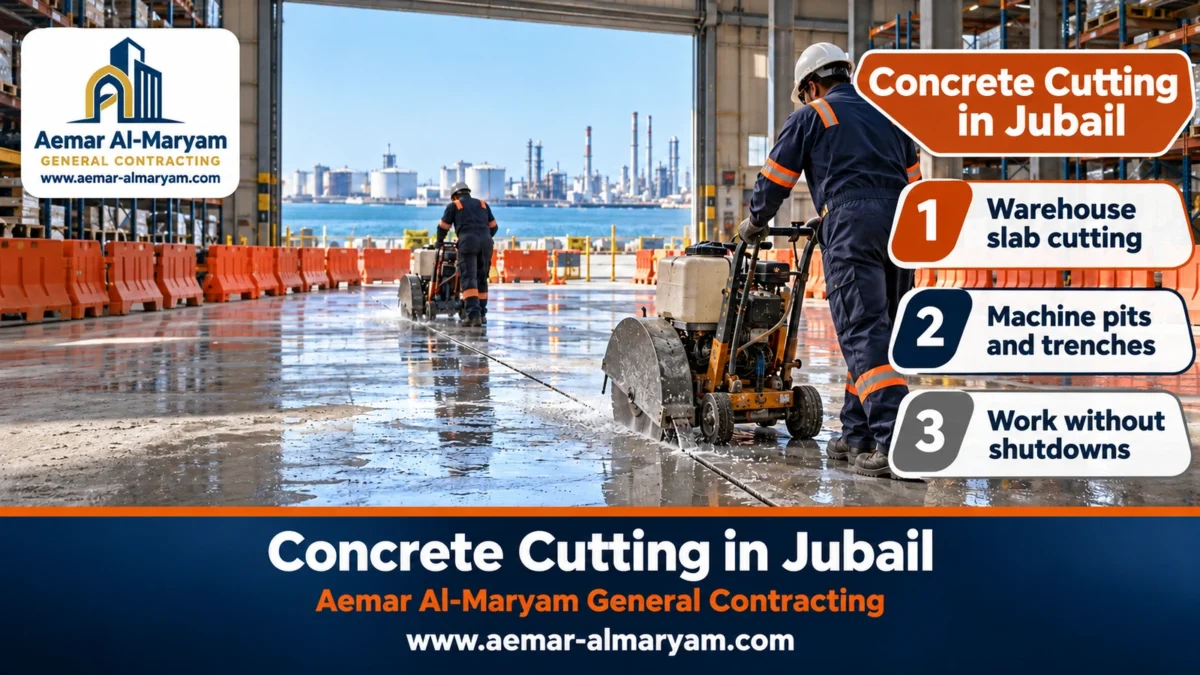
Concrete cutting in Jubail covers two very different kinds of work. In Jubail Industrial City we saw warehouse and workshop slabs for trenches and machine pits, take apart thick reinforced equipment bases with a diamond wire saw, and core large holes through pump-room walls for new pipework. In Jubail Al Balad and the residential districts we open doorways and windows in concrete walls and drill neat cores for air conditioners, drainage and extract fans in homes and apartment buildings. Aemar Al-Maryam General Contracting travels from Dammam with water-cooled diamond equipment and plans each visit around the site: a facility that needs a work permit and a safety induction, or a family home that needs its floors and furniture protected. A small core costs from SAR 90 and sawing from SAR 75 a linear metre; treat both as estimates until inspection and agreement. Phone or WhatsApp: 0547879578.
The person searching for concrete cutting in Jubail might be a maintenance manager who needs a cable route under a workshop floor, a contractor fitting out a warehouse for a new production line, or a homeowner in the old town who wants a wider doorway into the majlis. The machines overlap, but the way the job is organised does not. That is why this page is split by type of work: industrial jobs first, then homes, then prices, permits and how to book.
Jubail at a glance: what you need to know
- Industrial sites: floor sawing for trenches, joints and machine pits; diamond wire sawing for thick equipment bases; large-diameter cores through walls and slabs for pipes and ducts.
- Homes and shops: door and window openings in concrete walls, AC and drainage cores, and stair openings in slabs once an engineer has signed off.
- Cutting depth: a floor saw goes roughly 24 cm down, a rail-mounted wall saw roughly 73 cm in a single-sided cut, and the wire saw has no blade-size ceiling at all.
- Inside facilities: we follow each site’s permit-to-work and safety induction system and send crew and equipment details in advance when asked.
- Cost: SAR 90 upwards for small cores, SAR 75 upwards per sawn metre, SAR 140 upwards for a doorway or window; heavy industrial jobs are quoted after a visit.
- Fast pricing: send photos, sizes and the type of site to 0547879578 by phone or WhatsApp.
Concrete Cutting in Jubail: Plant Floors on One Side, Family Homes on the Other
The requests we receive from Jubail fall into two clear groups. The first comes from the industrial city, Al Fanateer and the surrounding areas: warehouses, workshops and service buildings inside facilities, where slabs are thicker than in houses, reinforcement is denser and every job has to fit an operating schedule and a safety system. The second comes from Jubail Al Balad and districts such as Al Dhabab, Ghirnatah and Al Hamra: villas, flats, apartment blocks and shops, where the typical job is a doorway, a window or an AC core, and the main worry is keeping the house clean.
Each group needs a different set-up. For a facility we bring a floor saw or wire saw, a heavy core rig and, if needed, a generator and water supply, and we prepare the paperwork the gate will ask for. For a home we bring a wall saw, a light core drill, protection sheets and a wet vacuum. So the first question we ask when you call is simple: is the site an industrial or commercial facility, or a residence?
■ Warehouses and workshops
Slab cutting for drainage and cable trenches, control joints and pits for new machinery.
■ Old machine foundations
Thick reinforced bases cut into liftable blocks with a diamond wire saw.
■ Pump and service rooms
Large-diameter cores for pipe and duct penetrations, drilled with a wall-mounted rig.
■ Mezzanines and upper slabs
Hoisting hatches and new stair openings, with temporary propping below.
■ Homes in the old town
New doorways and windows, widening existing openings, AC and plumbing cores.
■ Shops and apartment blocks
Service openings, floor cuts for new pipework and changes to stairwell openings.
Floor Sawing for Warehouses and Workshops in Jubail Industrial City
A warehouse floor in Jubail is cut with a diamond floor saw, a walk-behind machine that rolls across the slab and cuts a dead-straight line to a depth of about 24 cm on common models, with a constant water feed that cools the blade and keeps dust down. It is the right tool whenever you need a trench of a set width running for tens of metres without turning the whole floor into rubble.
Industrial slabs are usually thicker than residential ones, often carry two layers of reinforcement or heavy mesh, and may have a hard-wearing topping or epoxy coating. Those details decide the blade we fit, how many passes we make and how fast we can advance, which is why we ask for any information you have on slab thickness, or a structural drawing, before the visit.
Trenches for drainage, pipes and cables
The request we see most often in workshops is a long trench to run a drain line, process pipework or power cables under the floor. We cut two parallel lines at the required width, cross-cut the strip between them into small sections, lift those out and leave the excavation to the depth set by the services contractor. The result is a pair of straight, clean edges that are easy to reinstate after the services go in, instead of ragged broken edges that need wide patching.
Control joints and correcting random cracking
Large slabs need joints that decide where shrinkage and thermal cracking will happen. When a new warehouse floor or yard is poured, or when meandering cracks appear in an existing slab, joints are sawn with the floor saw at the depth and spacing set by the project engineer, then sealed with a suitable joint filler. We cut to the specified layout; we do not choose the spacing ourselves.
Pits for new machine foundations
When a heavy machine or a new production line is installed, the supplier often asks for a foundation that is separate from the floor slab. We saw a rectangle to the required size, divide it into pieces and lift them out so excavation and pouring can start. Sawn edges stay square and clean, which makes it easier to isolate the new base from the existing slab as the design intends.
A tip for maintenance managers in Jubail
If the warehouse stays in operation during cutting, tell us which aisles must remain open and where cutting water may be drained or collected. We barrier off the work zone and pick up slurry with a wet vacuum, but knowing the forklift routes in advance saves a lot of time on the day.
Reinforced Concrete Cutting in Jubail With a Diamond Wire Saw
For heavy reinforced sections in Jubail, think redundant machine bases, pump plinths or anything thicker than a blade could ever reach, we switch to the diamond wire saw. Its cutting rope is a steel cable threaded with diamond beads; it is looped around the block through drilled holes and guide pulleys and tensioned by a hydraulic drive unit, so it cuts through concrete and steel together while water keeps it cool.
Because the cutting element is a loop rather than a disc, block thickness stops being the constraint, and it does so with much less vibration than breaking. That matters inside a plant with sensitive equipment close by, or in a building that should not take repeated blows from heavy breakers. Once the cuts are complete, the block is divided into pieces sized for the crane or forklift available on site, then lifted and removed.
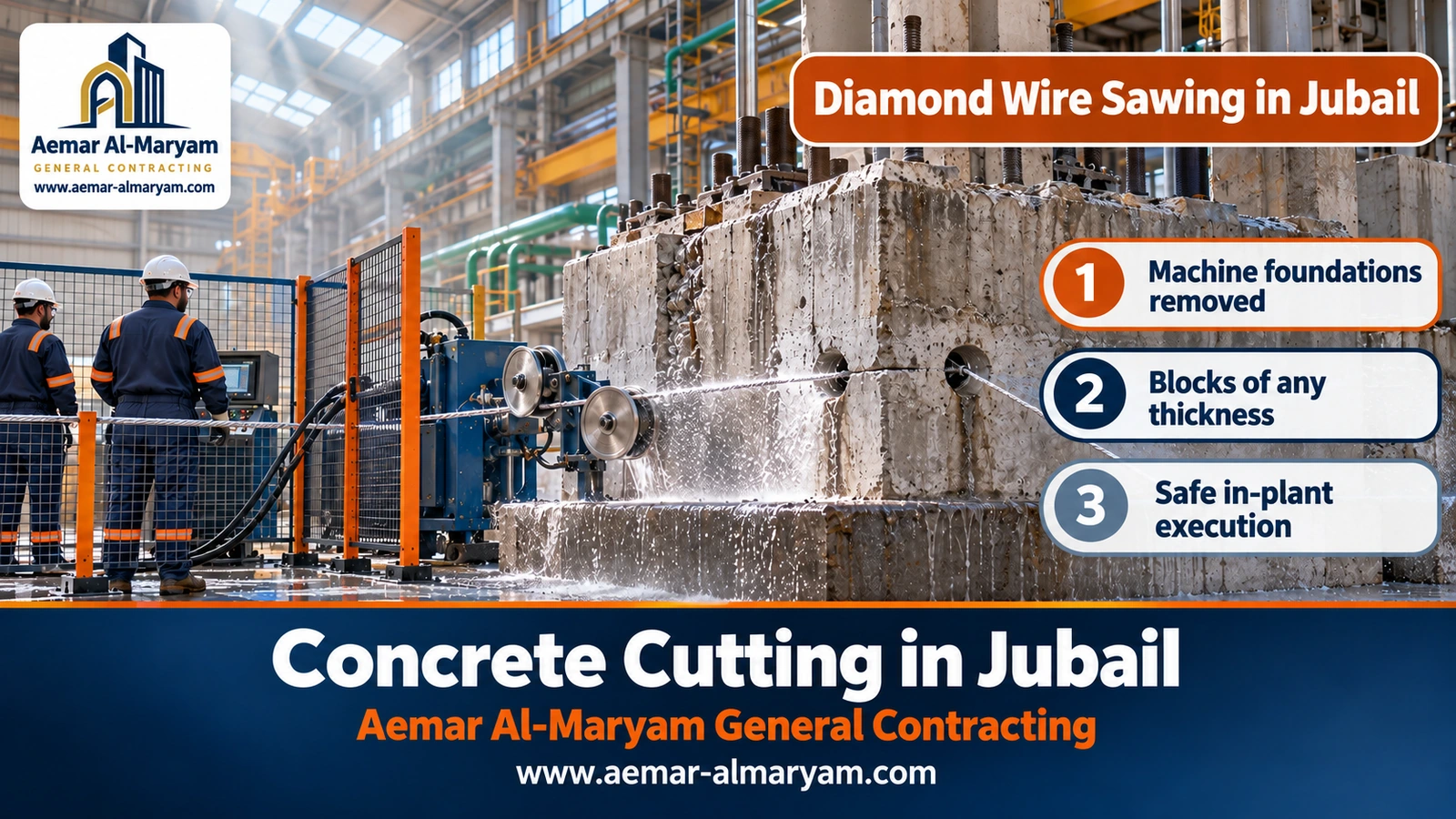
Before cutting any equipment base we need to know what is inside it and what runs beside it. Are there deep anchor bolts? Are there buried cables or pipes alongside? Is it tied into the floor slab or independent? The site drawings or the facility engineer answer these questions, and we confirm them with a rebar and services scanner before drilling. Columns and beams are never cut unless an approved engineering design for demolition or alteration calls for it.
| Job | Suitable method | Note |
|---|---|---|
| Thick old machine base | Diamond wire saw | Divided into blocks sized for the lifting gear |
| Warehouse slab trench or pit | Diamond floor saw | Up to about 24 cm deep per pass |
| Concrete wall within roughly 73 cm | Rail-mounted wall saw | Deeper walls: two-sided cut or wire |
| Round hole for pipe or duct | Anchored core rig | 12 mm up to 500 mm on common rigs |
| Shallow cut or edge trimming | Hand-held cut-off saw | Maximum depth about 12.5 cm |
Figures are taken from the specifications of widely used machines and vary slightly with the model and blade.
Diamond Cutting vs Breaking in a Working Facility
Concrete cutting and coring in Jubail is the controlled alternative to breaking with hammers and compressors. In a running facility the question is not only how fast the concrete comes out, but what the work does to everything around it. Vibration can upset precisely calibrated equipment, dry dust drifts into switchboards and stored goods, and constant noise disrupts neighbouring sections. Water-cooled diamond cutting reduces all three and leaves clear boundaries that stay exactly where the engineer drew them.
| Factor | Diamond cutting and coring | Breaking with hammers |
|---|---|---|
| Vibration | Low, suitable near equipment | High, spreads beyond the work area |
| Dust | Limited because cutting is wet | Heavy dry dust, needs wide isolation |
| Opening edges | Straight and to the marked size | Irregular, often larger than intended |
| Reinforcement | Cut in the same line as the concrete | Left exposed, needs separate cutting |
| Making good afterwards | Minimal, edges are ready | Usually more because of over-breaking |
That does not mean breaking is never used. After the perimeter is sawn we may break out the core of a very large block if that is faster and cheaper; what matters is that breaking stays inside the sawn lines and never spreads into the concrete that will remain.
Concrete Coring and Core Drilling in Jubail: Pipe Penetrations and AC Holes
Core drilling in Jubail means cutting a clean round hole with a hollow diamond bit whose rig is anchored to the wall, ceiling or floor. The rig removes a solid concrete core and leaves a clean, round bore for the pipe or sleeve. Diameters start at a few millimetres and reach about 50 cm on common rigs; anything larger is done by stitch drilling or by sawing.
Pipe penetrations through pump-room walls
In industrial facilities, concrete walls around pump rooms, generator rooms and utility areas often need new openings for pipework or ventilation ducts. These walls tend to be thick with dense reinforcement, so we use a heavy core rig bolted horizontally to the wall, drill with a long barrel and constant cooling, and collect the water at a single point so it never reaches nearby electrical panels.
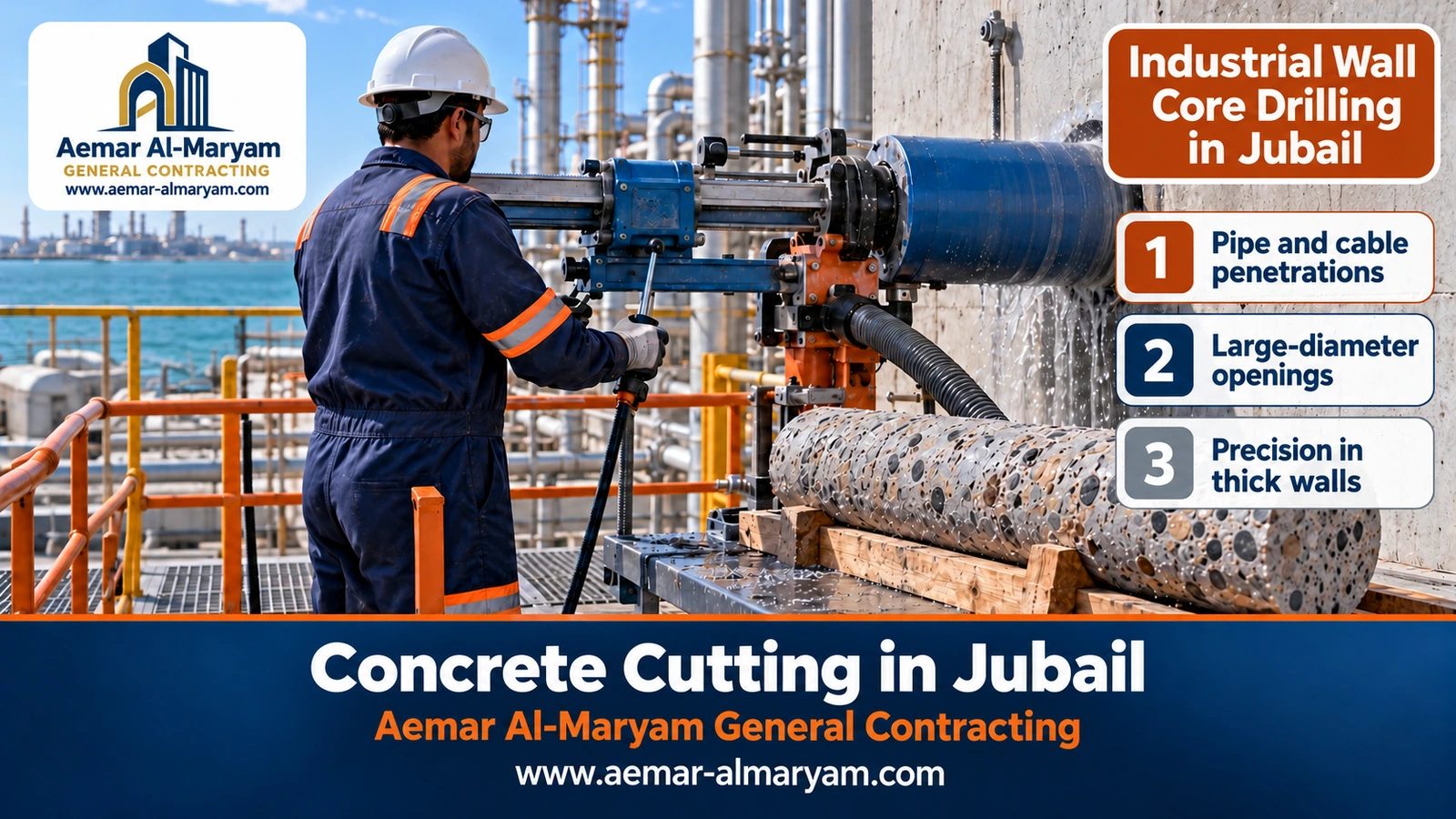
Before drilling, the exact position is agreed with the facility engineer and the wall is scanned for rebar and embedded services, because cutting a buried cable in a working plant can stop an entire line. If the hole would pass through main reinforcement, the engineer decides whether to move it or add strengthening.
AC cores in Jubail Al Balad homes
In homes the most common request is the hole for a split air conditioner. Installation manuals call for a hole of about 65 mm, angled slightly downward to the outside so condensate runs away from the room. We drill it with a light core rig, a wet vacuum and a floor cover, so no water seeps into the inner wall finish or onto furniture.
Coring through slabs and floors
Slab cores are needed for drainage between floors, fire-fighting pipework and ventilation ducts in workshops and shops. We scan the slab first to locate the reinforcement, and if the slab is post-tensioned we do not drill until the tendon positions have been located with the appropriate scanning, because cutting a stressed tendon is dangerous for the slab and for people nearby.
| Use | Approximate diameter | Price from |
|---|---|---|
| Split AC, small electrical or plumbing line | Up to about 100 mm (AC about 65 mm) | SAR 90 |
| Medium pipe | About 125 mm (5 inch) | SAR 140 |
| Extract fan or small duct | About 150 to 160 mm (6 inch) | SAR 140 |
| Drain line or larger duct | About 200 mm (8 inch) | SAR 230 |
| Industrial pipe penetrations | 250 mm and above | Priced after inspection |
Indicative figures only, confirmed on site: wall thickness, steel density, working height and hole count all move the final number.
Slab Cutting in Jubail: Stair Openings and Hoisting Hatches
Cutting a concrete slab in Jubail means opening a rectangle in an existing floor for a new staircase, an equipment hoisting hatch or a large duct. This is a structural alteration, so it starts with a structural engineer who fixes the opening dimensions and how the edges are reinforced. Props go in underneath first; the slab is then sawn, by floor saw or rail saw depending on access, and divide it into pieces that are lowered under control.
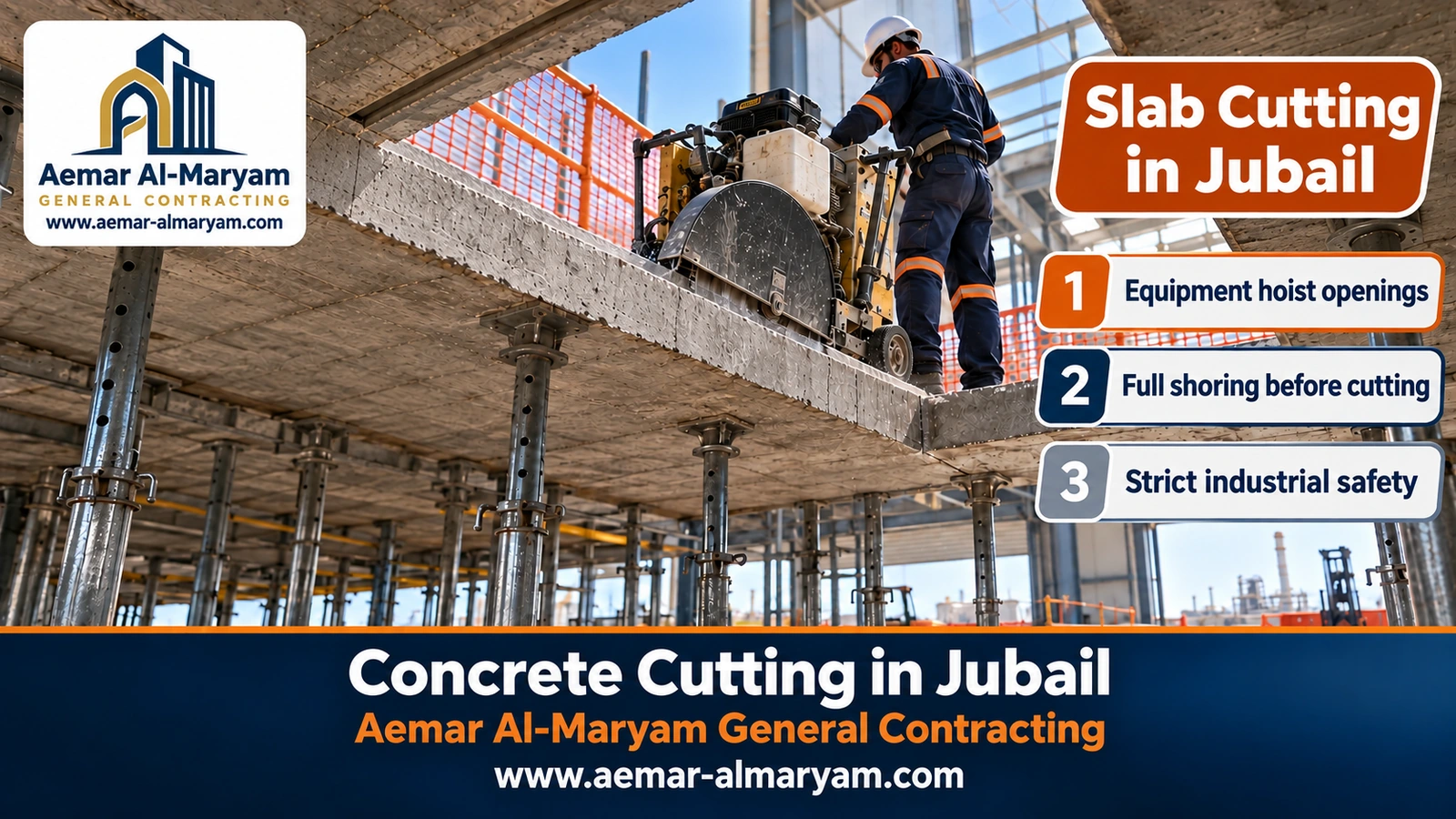
Stair cutting in Jubail: a new staircase between two floors
In shops and villas being converted to a new use, and in offices built inside warehouses, we are often asked to open a slab for an internal staircase. The key is not to cut until the opening size is approved and the beams that will carry it are defined, because any change after cutting is expensive. We work in this order:
- 1Approved opening drawing
Size, position and edge strengthening issued by an engineering office. - 2Props under the slab
Adjustable steel props on the floor below, under and around the section to be removed. - 3Cutting in stages
The perimeter is cut first, then the area is divided into small, controllable pieces. - 4Controlled lowering
Each piece is supported and lowered or lifted; no block is ever allowed to drop. - 5Clean edges handed over
Straight edges ready for strengthening works or the stair structure.
⚠ Never cut a slab without engineering advice
A stair or hoisting opening changes how loads travel through the slab. In homes this may require a licence through the Balady platform; in facilities it requires approval from the site’s engineering department. We do not start slab cutting without a drawing or report that sets the size and strengthening.
Wall Sawing in Jubail and Door Openings in Concrete Walls
A concrete wall in Jubail is cut without breaking by using a track-mounted diamond wall saw: a rail is bolted to the wall and a cutting head with a large blade travels along it, producing a perfectly straight cut and leaving the surrounding wall free of cracks. Once all four sides are sawn, the block is split and lifted out in pieces, and the opening appears at its final size.
New doorways in concrete walls of Jubail homes
In villas and flats in Al Dhabab, Ghirnatah and Al Hamra we regularly open a doorway between the living room and the majlis, widen a kitchen door or add a side door to the courtyard. We agree the exact position with the owner, check whether the wall is load-bearing and, where the engineer requires it, install a lintel before the block is removed. More detail is on our door and window openings service page.
Opening a window or enlarging an existing one
Adding a window to an outside wall alters the building’s elevation, and depending on the property the municipality may need to approve it. Widening a window you already have, or extending it down into a door, is done with the wall saw to the same precision and handed over with edges ready for the frame.
Widening workshop and warehouse doors
In facilities we are sometimes asked to widen a door opening so larger equipment can pass, or to fit a new roller shutter in a concrete wall. This is done with the wall saw; if the wall is thicker than the blade can reach, we cut from both sides or switch to the wire saw.
Before opening any doorway
Tape the outline onto the wall, stand back and take a picture with an extended tape measure in the frame, then WhatsApp it to us. It settles most of what we would otherwise ask during the inspection.
Laser Wall Cutting in Jubail: What You Actually Get
Many people search for laser wall cutting in Jubail when what they want is a precise, clean cut with no breaking. Lasers do not cut reinforced concrete on building sites. The cutting is done by diamond wall saws and wire saws; lasers appear in the measuring and levelling instruments that set out the lines on the wall before cutting. Research on lasers and concrete has been limited to stripping the surface a few millimetres deep in specialised projects.
If someone offers to cut your concrete wall with a laser, ask for the machine name and the cutting depth, and you will find they mean a diamond saw with laser set-out. That is exactly what we provide: lines marked with a laser instrument, cut with a diamond saw, giving the accuracy you were looking for. For the full explanation, read laser wall cutting in Dammam.
Concrete Saws in Jubail: Which Machine Suits Your Site?
Choosing the right concrete saw in Jubail comes down to three questions: is the element a wall, a floor or a block; how thick is it; and is the site an occupied home or a running facility? Once those are answered the right machine is obvious, and on industrial sites we usually bring more than one because the job mixes several types of cut.
■ Track-mounted wall saw
Walls and soffits with a big blade; a single-side cut reaches roughly 73 cm with square edges.
■ Floor saw
Warehouse and yard slabs, for trenches, joints and pits, up to about 24 cm deep.
■ Diamond wire saw
Plinths, heavy blocks and sections too deep for any blade, with very little vibration.
■ Core drilling rig
Round holes from small sizes up to about 50 cm, horizontal or vertical.
■ Hand-held cut-off saw
Trimming, shallow cuts and blockwork; depth no more than about 12.5 cm.
■ Rebar and services scanner
Scans the wall or slab before cutting to locate steel, pipes and cables.
We do not turn up at an industrial site with household tools. A facility expects equipment sized to the job, and technicians who know how to anchor a rig and control water and slurry in an environment full of live power and operating machinery.
Cutting a Wall With a Grinder in Jubail: When It Works
The hand-held cut-off saw, often called a grinder, is a useful tool with a hard limit on depth: the largest common models cut to about 12.5 cm. That covers internal blockwork, edge trimming, a small vent through a boundary wall or a scoring cut before breaking. A typical reinforced wall of around 20 cm, though, is simply deeper than the blade.
Trying to cut a reinforced wall with a grinder from both sides usually produces two cuts that do not meet, broken edges, a lot of dust and then breaking to finish what the blade could not reach. In a home that means bigger repairs; in a facility it may not be allowed at all because of the dust and vibration. We use the cut-off saw where it fits and the wall saw where it is needed.
Working Inside Jubail Industrial Facilities: Permits and Safety Induction
Most industrial facilities in Jubail will not let a contractor in until their own procedures are complete. The details vary from site to site, but it is common to need a work permit for each task, a safety induction for the crew before work starts, registration of the equipment brought in and specific personal protective equipment. We do not assume the requirements; we ask the facility contact for their list and prepare everything before the visit date.
- ✓Crew and equipment details: we send technician names and an equipment list in advance if the facility needs them to issue gate passes.
- ✓Risk assessment and method statement: we describe the cutting, cooling, slurry collection and lifting steps in whatever format the facility uses.
- ✓Safety induction: the crew attends the induction the site requires and follows the instructions of the safety officer on the day.
- ✓Isolation of power and services: we do not start near live panels or lines until the facility confirms they are isolated or their routes are marked.
- ✓Water and slurry: we agree in advance where cutting water is collected or discharged, because some facilities do not allow it into their drains.
What we need from the facility coordinator
The name of the person responsible for the work inside the facility, permitted entry times, the list of documents required and whether power and water are available on site or we should bring a generator and tank. With this information we can plan the visit from Dammam as one day instead of two.
Concrete Cutting Company in Jubail: What to Check Before You Choose
Choosing a concrete cutting company in Jubail is slightly different from choosing one in a purely residential city, because much of the work happens inside facilities with their own rules. Ask these questions of anyone who quotes you, and compare the answers before you compare the numbers:
- ✓Which machine will you use for this exact job? A clear answer names a floor saw, wall saw, wire saw or core rig, not just “modern equipment”.
- ✓How will you handle the cutting water? In warehouses and plants there should be a wet vacuum and a plan for collecting slurry, not water running into the drains.
- ✓Will you scan before drilling? A rebar and services scan is essential before coring any wall or slab in a working building.
- ✓Do you know facility entry procedures? A contractor with industrial experience asks about permits and inductions before asking about dates.
- ✓What does the price include? Lifting and loading of blocks? Water and power? Agree this before work begins.
- ✓Who decides on structural elements? A serious contractor asks for a drawing or engineering opinion for any slab or load-bearing wall and does not decide alone.
Concrete Cutting Prices in Jubail
Our Jubail rates open at SAR 90 for an AC hole or similar small core, SAR 75 for each linear metre sawn through walls or slabs of ordinary thickness, and SAR 140 when we open a doorway or window. All of these are estimates until inspection and agreement, with the real figure depending on the thickness of the element, the amount of steel inside it, the floor level or working height, access, and whatever procedures the facility requires.
| Service | Price from | Note |
|---|---|---|
| Hole of 100 mm or under | SAR 90 a hole | AC cores and small electrical lines |
| 5 inch core (about 125 mm) | SAR 140 | Depends on thickness and steel |
| 6 inch core (about 150 mm) | SAR 140 | Extract fans and small ducts |
| 8 inch core (about 200 mm) | SAR 230 | Drainage and larger ducts |
| Wall or floor cutting per linear metre | SAR 75 per metre | Typical sections; heavy ones quoted after the visit |
| Door or window opening in a wall | SAR 140 | Excludes lintel and finishing works |
| Complete wall cutting job | SAR 280 | Depends on floor level and size |
| Machine bases, wire saw jobs, stair and hatch openings, cores beyond 10 inch | Quoted per site | Share photos and dimensions by WhatsApp |
Starting points for budgeting in Jubail; we fix the actual figure with you once the site has been seen.
On industrial sites the cost also reflects the time procedures take: waiting for the permit at the gate, working within fixed hours, and supplying a generator or water tank if none is available. That is why industrial work is priced after a visit or after we receive a clear drawing. For houses, it pays to collect every opening you need into a single booking: rig set-up and the drive up from Dammam are then spread across all of them. See the full guide on our estimated prices page.
Engineering Approval and Permits for Wall and Slab Cutting in Jubail
The practical rule is straightforward. Coring for a refrigerant line or a pipe rarely alters how the structure behaves, provided we scan the spot first and stay clear of main reinforcement. It is different when you open a door in a wall that carries a slab, cut part of a floor, or come near a beam: you are changing the load path, and the reference is a licensed engineering office that writes a report and specifies the strengthening. For residential buildings you may also need a licence through the Balady platform, either a restoration permit or the service for modifying building components. Our crews follow the stamped drawing, and columns are off-limits.
Inside industrial facilities the decision usually sits with the facility’s own engineering department, which signs off where the opening goes and how big it is and issues the work permit. We ask for that approval in writing before cutting, because it protects everyone involved.
■ Usually no permit
Small AC and plumbing cores, and taking out a block partition that carries nothing.
■ Needs an engineer
A door in a load-bearing concrete wall, enlarging a big opening, or cutting a base tied into the structure.
■ May need a licence
Slab cutting for stairs or a lift, a window that changes the facade, or altering structural elements.
Common Mistakes on Warehouse and Home Cutting Jobs
In our experience across the Eastern Province, most problems that appear on cutting day come from a small detail nobody asked about beforehand. These are the ones we see most in Jubail:
- ✓Describing the opening from memory: a size given verbally that turns out on the day to clash with a beam or pipe. Mark it on the wall and photograph it with a tape measure.
- ✓Ignoring what lies under the slab: cutting a workshop floor without knowing where old cables or drains run. Ask maintenance or find the drawing before the visit.
- ✓Booking a date without a permit: arriving at the facility gate before the permit is issued means a lost day and extra cost.
- ✓No lifting route planned: a sawn block with no crane or path to take it out. Decide in advance how the pieces will leave the site.
- ✓Leaving furniture in place: in homes, moving furniture away from the wall beforehand saves protection time and reduces any risk of damage.
- ✓Hand cutter on a heavy wall: progress looks quick until the disc runs out of depth, and the rest gets hammered out.
What to Send on WhatsApp for a Jubail Concrete Cutting Estimate
Good information up front means fewer surprises later. Use the list that matches your site:
Facility or warehouse
Wide photos of the area, the size of the cut or opening, slab or wall thickness if known, entry and permit requirements, available power and water, and the hours you are allowed to work.
Home or shop
Pictures showing each face of the wall or both sides of the slab, the opening dimensions, which floor and whether a lift exists, whether anyone lives there now, and your Jubail district.
How to Order Concrete Cutting in Jubail, Step by Step
- 1Contact us
Call or WhatsApp 0547879578 with photos, sizes and the type of site. - 2Estimated cost
You get a proposed method and a budget figure, plus questions on anything unclear. - 3Plan the visit
We fix a Jubail day and complete the entry paperwork if the site is an industrial facility. - 4Inspect and confirm
We measure and scan the element and confirm the final price before starting. - 5Cut and clean up
We cut, lift the pieces, collect the slurry and leave the area clean as agreed.
Why Jubail Clients Choose Aemar Al-Maryam
- ✓Equipment for industrial scale: floor, wall and wire saws plus heavy core rigs, not just hand-held cutters.
- ✓Respect for facility systems: we prepare the details and documents a site asks for and follow its safety instructions on the day.
- ✓Care in homes: sheeting over floors and furniture, and the slurry picked up as we go in lived-in houses.
- ✓Published starting prices: a clear table from SAR 90, with the price confirmed after inspection.
- ✓Scanning before cutting: rebar and services detection before any coring or sawing to avoid surprises.
- ✓Planned trips from Dammam: we group Jubail jobs on set days to keep travel cost down for clients.
Past jobs are shown in our project gallery. You can also read about the concrete cutting service and core drilling service. If cutting is followed by breaking out a larger section, see our demolition and breaking service.
Jubail Areas We Cover for Cutting and Coring
We cover both the industrial and the residential sides of Jubail, with visits planned from our base in Dammam:
We also work in the nearby Eastern Province cities. If your site is in Ras Tanura, read concrete cutting in Ras Tanura; if it is in Dammam, the main guide is concrete cutting in Dammam. Our city page is services in Jubail.
Get your Jubail site ready for cutting
Photograph the area, note the sizes and the type of site, and send them over. We suggest the right machine, estimate the cost, then fix a visit day and prepare entry documents whenever the facility asks for them.
Useful links before you book in Jubail
Tags