A tile installer in Jubail with Aemar Al-Maryam General Contracting covers two very different places: Jubail Industrial City, with its laid-out housing districts and company compound flats, and Jubail Al-Balad, the older town of family houses, villas and shop-front buildings. We lay ceramic and porcelain in rooms and halls, tile commercial kitchen floors with anti-slip surfaces and epoxy grout, clad building entrances and stairs in granite, and retile bathrooms and courtyards. Workmanship is priced from SAR 23 a square metre on ceramic floors, SAR 32 on porcelain to 60×60 and SAR 92 on marble or granite; treat them as guide prices until we have visited. Call or WhatsApp 0547879578.
Most people looking for a tiler in Jubail fall into one of three groups. The first lives in a compound flat in the Industrial City and wants old tiles replaced or a bathroom refreshed before settling in. The second owns a house in Al-Balad and wants a bigger, cleaner porcelain floor in the hall and majlis, often with the courtyard and bathrooms done in the same visit. The third is opening a restaurant, café or catering kitchen and needs a floor that copes with hot water, grease and daily washing. Each group asks different questions: the first about permission and working hours, the second about sizes and falls, the third about slip resistance and joints. This guide answers each in its own section and then brings prices, steps and booking together at the end.
In short: tiling in Jubail
- Where we work: Jubail Industrial City and its residential districts such as Al Fanateer, and Jubail Al-Balad, where we work in Al Hamra, Ghirnatah, Ad Dabab and neighbouring areas.
- What we install: ceramic and porcelain floors and walls, large porcelain up to 120×120, commercial kitchen floors with epoxy grout, granite and marble entrances and stairs, skirting and courtyards.
- Starting prices: ceramic floors SAR 23 a metre, wall ceramics 27, porcelain to 60×60 at 32, 60×120 at 37, a bathroom’s floor and walls 36, marble and granite 92, and stairs 46 per metre of stair surface.
- Travel: we work from our base in Dammam; the trip to Jubail is costed at the inspection, based on the workload and days on site.
- To book: WhatsApp 0547879578 with photos, the area and the tile you have chosen, and say whether the property sits in the Industrial City or in Al-Balad.
Tile installer in Jubail: Industrial City or Al-Balad?
A tile installer in Jubail first needs to know which Jubail the job is in, because in practice there are two. The Industrial City is administered by the Royal Commission for Jubail and Yanbu. Its residential districts are planned, and many of its flats and compounds belong to employers or property companies that rent them to staff, so each compound has a management office with its own rules on access, working hours and debris. Jubail Al-Balad is the older town of homes and shops, administered by the municipality, where houses are usually owner-occupied and the owner alone decides.
That difference does not change how a tile is bedded, but it changes everything around it: when we can start, how materials come in, where we are allowed to cut, and who has to approve the change. So the first question we ask on the phone is simple: is the property in the Industrial City or in Al-Balad, and who owns it?
■ Compound flats in the Industrial City
Room and hall floors replaced, bathrooms and kitchens refreshed, all arranged in advance with the compound office.
■ Houses and villas in Al-Balad
Halls, majlis rooms, courtyards and stairs, with old floors levelled and tired tiles removed.
■ Restaurants and cafés
Commercial kitchen floors with anti-slip tiles falling to drainage channels, epoxy grout and coved skirting.
■ Building and shop entrances
Textured granite for landings and outside steps, and marble or porcelain for the lobby.
Retiling compound flats in Jubail Industrial City
Retiling a flat in a Jubail Industrial City compound is usually purely internal work: old ceramic swapped for porcelain, a bathroom renewed or a kitchen floor changed. We plan it so it does not disturb the neighbours or break compound rules, because the flat is part of a building, and often of a district, that someone else manages.
Royal Commission rules and compound management
Swapping the tiles inside a flat counts as maintenance and finishing. Anything that touches the structure or the facade, or adds building work, needs approval from the Royal Commission in the Industrial City, which is the permitting authority there rather than the Balady platform. On top of that, compound managements set their own rules: whether work is allowed on Fridays, when the working day must end, where debris goes, and whether the names of the technicians must be registered in advance.
So before the visit we ask you to check these points with the management or the landlord, or to give us the contact person so we can arrange it directly. If the flat is rented, the owner’s written consent to the new tiles protects you when you hand the flat back.
Choosing new tiles for a rented flat
Ask the owner which colours and sizes they accept. Some owners prefer one standard tile across all their flats so later repairs match, and some ask for a few spare boxes of the same tile to be left behind.
Porcelain installation in Jubail on upper floors
Porcelain installation in Jubail on an upper-floor slab differs from a ground floor: there is no sand fill, and the height available is limited by door thresholds and the bathroom level. In flats we therefore prefer a thin bed of improved cementitious adhesive (class C2) on a flat surface, instead of a thick mortar bed that raises the floor and loads the slab. When the old tiles are completely sound and fully bonded with no hollow sound, it is sometimes possible to lay over them after roughening and cleaning, as long as the extra height is checked against doors and drains.
The bigger the tile, the flatter the floor must be. Once any side of the tile reaches about 38 cm, a 3-metre straightedge laid on the floor should show no gap deeper than 3 mm. That is what we measure in the flat before agreeing to 60×120; if the floor fails the check, we either level it first, from SAR 14 per square metre, or suggest a smaller tile.
Diagonal layouts and clean cuts at the walls
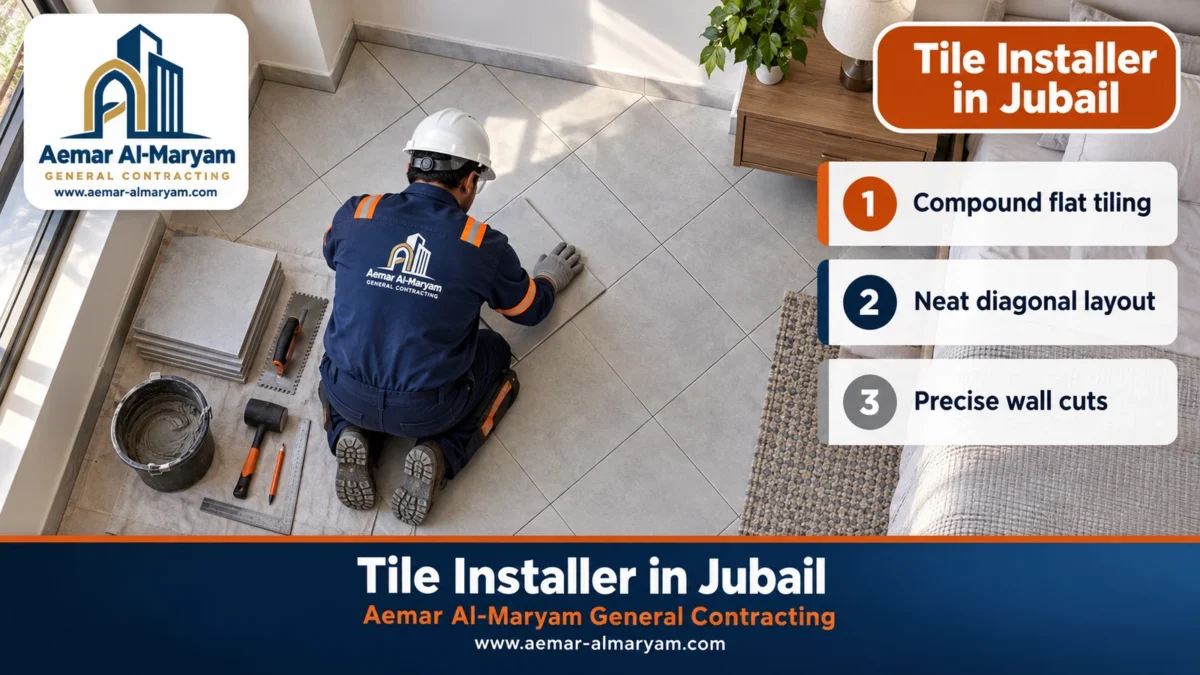
Many flat residents ask for a diagonal layout in bedrooms because it makes the room feel wider, but it creates more waste and more cutting at every wall. We start from a centre line and balance the cuts so opposite walls get matching pieces, with no sliver on one side and a big piece on the other. A diagonal layout needs a higher waste allowance than a straight one, and we tell you the figure before you buy the tiles.
Tiler in Jubail Al-Balad: houses, villas and old floors
A tiler in Jubail Al-Balad usually meets houses that families have lived in for years: small old tiles, ground floors laid over sand fill, courtyards where water collects in a corner, and inside stairs with worn edges. In Al Hamra, Ad Dabab and Ghirnatah the request is often the same: take up the old tiles, put larger porcelain in the hall and majlis, and refresh the bathrooms and courtyard during the same visit.
Here the work starts with removing the old tiles (from SAR 14 per square metre), and then we see what lies underneath. Loose bedding or settled fill is fixed before any new tile goes down, because new tiles on a tired base bring the same problem back within months. If damp or white salts appear at the foot of the walls, that is rising moisture, which is common in the Eastern Province, and we deal with its source before tiling, not after.
⚠ Never tile over damp
White salts on joints or at the base of a wall mean water is rising and carrying salts from the soil. New tiles will not stop it; the salts will come out through the new joints within months. We find and treat the source first, which may mean waterproofing or changing levels, and only then tile.
Ceramic tile installation in Jubail for walls and home kitchens
Ceramic tile installation in Jubail on kitchen and bathroom walls starts with a straight, smooth wall; ceramic does not hide crooked plaster, it shows it. We fix a level batten above the floor line and start the first row from it, using a class T adhesive that does not let the tile slip more than 0.5 mm before it sets. Cuts around outlets and switches are made with diamond tools so the edges stay clean. If the plaster is in poor shape we recommend repairing it first with a plastering contractor in Jubail.
Commercial kitchen tiling in Jubail: less slipping, easier cleaning
Commercial kitchen tiling in Jubail is a steady request as restaurants, cafés and catering kitchens open in the Industrial City and along Al-Balad’s commercial streets. A commercial kitchen floor is not just a bigger home floor. It takes hot water, oil, strong detergents and trolleys every day and is washed down several times a day, so the materials and details are different.
Anti-slip floors that fall towards drainage channels
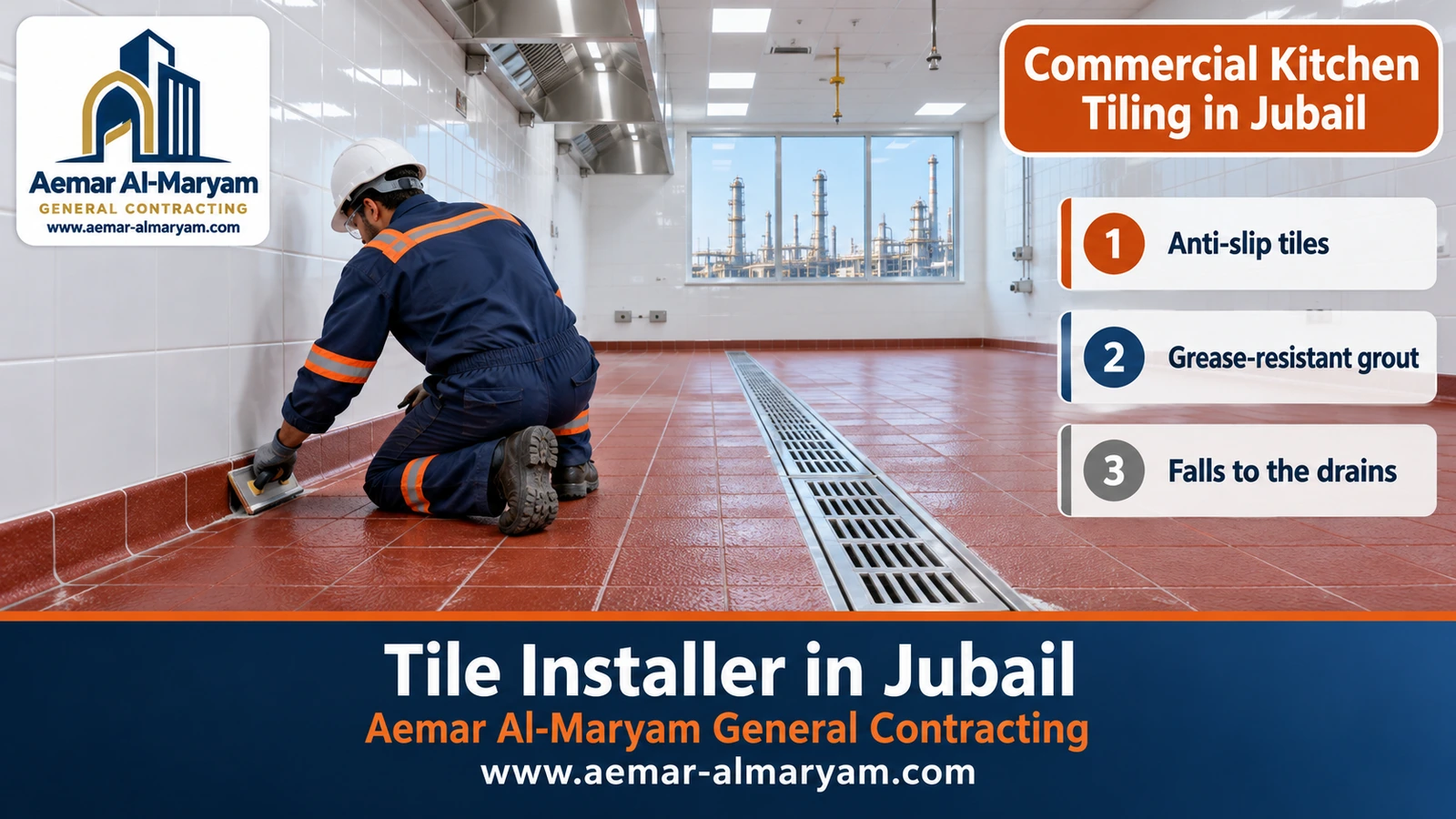
For a commercial kitchen we choose industrial tiles or porcelain with a textured anti-slip surface, because a floor wet with water and oil is the main cause of falls in kitchens. The whole floor falls towards drainage channels or floor drains with stainless-steel grates so washing water never sits under the equipment. We set the falls in the screed before tiling, not with mortar under each tile, so the slope stays even and water reaches the channel from every side.
Epoxy grout instead of cement grout
Joints are the weakest part of a kitchen floor. Ordinary cement grout is porous, so it soaks up grease and turns black, and it wears away under strong cleaners until the joints open and water gets under the tiles. Epoxy grout is a resin material that does not absorb water or grease and stands up to detergents, which is why it is the usual choice in commercial kitchens. It has to be worked faster and the tile face cleaned before it cures, and it costs more than cement grout, so we price it at inspection according to the area and the joint width.
Coved skirting where floor meets wall
A sharp right angle between floor and wall collects dirt and defeats a squeegee. In commercial kitchens we therefore fit a coved skirting that joins the floor to the wall with a smooth curve, and clad the walls in white ceramic that washes easily. The authorities require food premises to have floors and walls of easy-to-clean materials that do not absorb grease; for the detailed requirements we follow the current rules of the responsible authority and the kitchen designer, which in the Industrial City means the Royal Commission and in Al-Balad the municipality.
When should a commercial kitchen be tiled?
Before the equipment arrives and after the drainage, gas and electrical runs in the floor are finished. Give us the layout showing equipment positions and drainage channels, because some heavy equipment needs a concrete plinth or a fixed floor level. Connections to the public water and sewer network in the Industrial City are handled by Marafiq and arranged by the designer or the relevant contractor.
Drain runs inside the kitchen and connections for sinks and floor drains are plumbing work that we line up before tiling with a plumber in Jubail, and equipment loads with an electrician in Jubail, so new tiles are never broken open for a forgotten pipe or cable.
Granite entrances in Jubail: landings and steps that handle sun and humidity
Granite is what we recommend for building landings, outside steps and shop entrances in Jubail, because it is hard, unaffected by weak acids, and copes with wear and sun better than marble. What matters at an outdoor entrance is not the colour but the surface. Polished granite is beautiful but slippery in coastal humidity and after washing, so outside we choose a flamed or textured anti-slip finish and keep polished stone for the inside lobby.
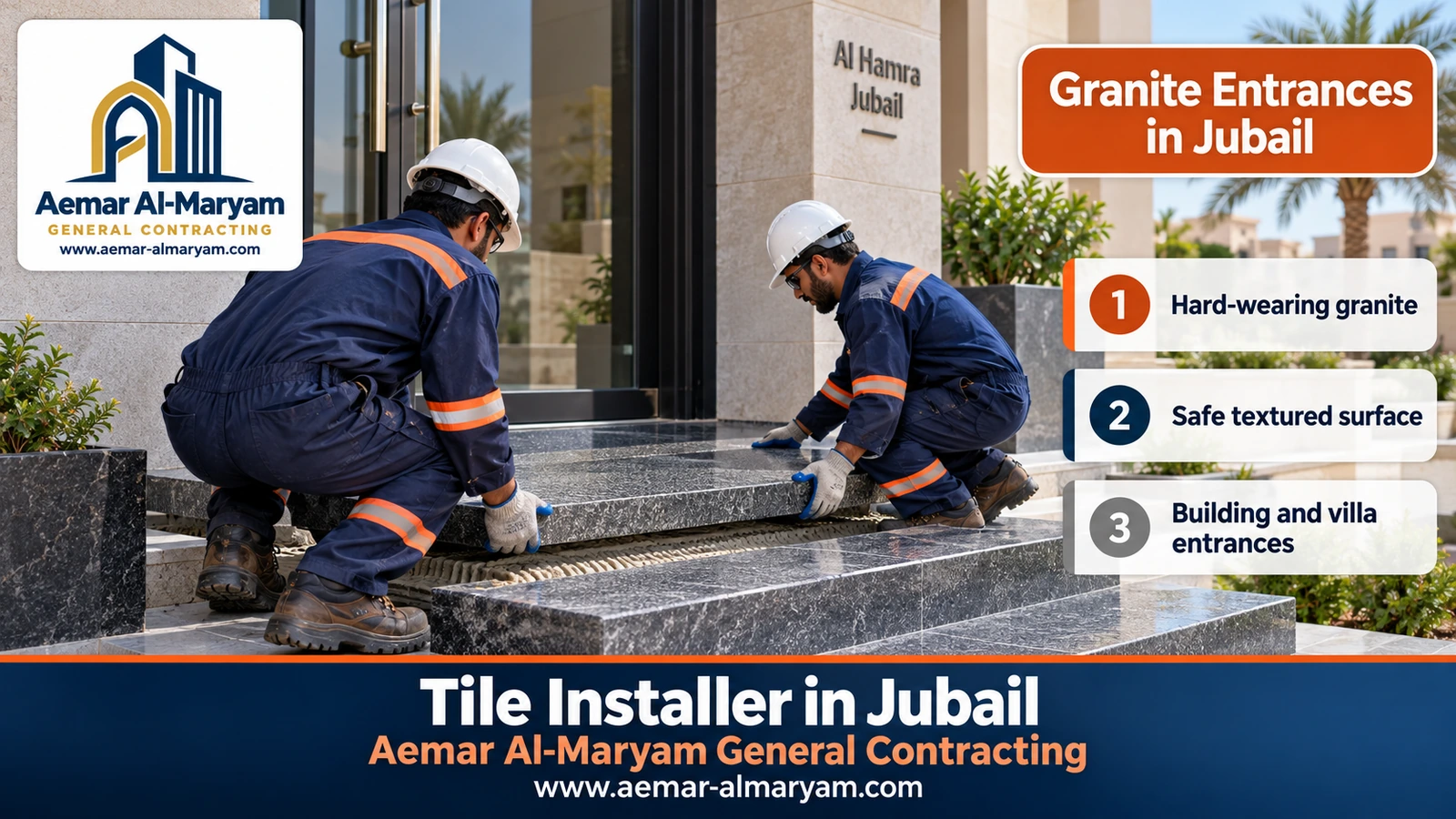
On an outdoor landing we build in a gentle fall that takes rain and washing water away from the door, and leave a flexible joint between the granite, the threshold and the wall. Heavy granite slabs are bedded with full back coverage, because granite stuck on dabs starts to sound hollow and then its edge breaks underfoot.
Marble stairs in Jubail and cladding existing steps
Marble stairs in Jubail villas and buildings are set after measuring every step, because the difference in riser heights within one flight must stay very small, around 9.5 mm. When cladding an existing staircase we account for the thickness of the marble and the adhesive so the first step does not end up taller than the rest and the last one shorter. Cladding a staircase costs from SAR 46 for each square metre of treads and risers, with the marble itself priced on your choice.
Marble installation in Jubail homes
Laying marble in Jubail halls and inner lobbies costs from SAR 92 a square metre in labour. Two rules apply every time. White and light marble is set with a white adhesive so no grey shadows show through, and some green and white marbles are moisture-sensitive and curl if set in a slow-drying material, so they are fixed with a fast-setting cementitious or a reaction-resin adhesive instead. For kitchen floors and worktops we steer clients to granite instead, since lemon juice, vinegar and some cleaners leave dull marks on marble.
Ceramic, porcelain or granite? Choosing by location in Jubail
In Jubail the choice follows the location before the taste, because coastal humidity, sun and use decide how long a floor lasts. This table sums up what we usually recommend:
| Location | What we recommend | Why |
|---|---|---|
| Bedrooms in flats | Ceramic or 60×60 porcelain | Light traffic; porcelain lasts longer if you prefer |
| Halls and majlis rooms | 60×120 porcelain or larger | Fewer joints and a wider look, provided the floor is flat |
| Bathrooms | Matt porcelain on the floor, ceramic on the walls | Low water absorption and less slippery |
| Commercial kitchens | Industrial or anti-slip porcelain with epoxy grout | Water, oil and detergents every day |
| Building entrances and landings | Textured granite | Hard and handles sun and wear |
| Courtyards and outdoor paths | Matt outdoor porcelain or stone | Laid to falls with movement joints for the sun |
Because porcelain is denser than ordinary ceramic, it absorbs no more than 0.5% water, and that is what makes it right for bathrooms and open-air floors. Ask the showroom for the tile’s data sheet before paying.
Tile installation in Jubail: adhesive and joints in a coastal climate
Tile installation in Jubail depends on two things nobody sees after handover: the adhesive under the tile and the joint between tiles. The right adhesive is what prevents hollow tiles, and the right joint is what prevents chipped edges and tiles lifting. In Jubail’s humid heat, adhesive dries at a different speed in the morning than at midday, so we only comb out what can be covered in minutes, and lift a tile now and then to check the coverage on its back.
| Code on the adhesive bag | Meaning | Where we use it in Jubail |
|---|---|---|
| C2 | Improved cementitious adhesive, at least 1 N/mm² bond | Porcelain, large formats, bathrooms and kitchens |
| T | Holds a wall tile in place, sliding 0.5 mm at most | Wall ceramics and commercial kitchen walls |
| E | Stays workable for half an hour or more after spreading | Large areas and work in the heat |
| S1 | Deformable adhesive that takes slight movement | Courtyards and outdoor landings in the sun |
Joint width should be no less than triple the real difference in size between the tiles in the delivery; as a general guide around 3 mm for rectified tiles and around 5 mm for pressed tiles. There is no genuine “jointless” installation: even precise porcelain needs a small joint. Inside flats we leave a flexible movement joint at every wall, hidden under the skirting, and in large areas a field joint about every 7.6 metres, closer where sunlight from wide windows reaches the floor.
We aim for adhesive contact of at least 80% under the tile in dry areas and 95% in bathrooms, kitchens and outdoors, with corners and edges fully supported. That is why we comb adhesive onto the floor and also back-butter large tiles, and never stick tiles on scattered dabs.
Bathroom retiling in Jubail
Bathroom retiling in Jubail starts by breaking out down to the concrete slab, not by sticking new tiles over old ones in a wet room. After removal we check the pipework and fix any leak, lay a screed with falls to the drain, apply waterproofing on the floor and up the walls, and then fill the floor with water for 24 to 48 hours to prove it holds before it disappears under the tiles. Then we tile with an improved adhesive, grout, and seal around the sanitary fittings.
We give the shower area a fall of roughly 2%, two centimetres in every metre down to the drain, and keep the rest of the floor to a gentle 0.5% to 1%. Labour for tiling a bathroom’s floor and walls begins at SAR 36 per square metre, while stripping, waterproofing and retiling a small bathroom with economy tiles begins at SAR 2,300. The waterproofing itself is covered under roof waterproofing and insulation in Jubail, and full bathroom renewal with sanitary ware under our bathroom and kitchen renovation service.
Courtyard tiles and skirting in Jubail
Courtyard tiles in Jubail Al-Balad face strong sun by day and humidity by night, which makes movement joints essential rather than optional. Outdoors we leave a flexible joint about every 2.4 to 3.6 metres and at every wall; without them the tiles tent up in the first summer. Falls run between 1% and 2% towards the drains, and we choose a matt or anti-slip surface. A courtyard or walkway laid to falls is charged from SAR 37 a square metre. If you prefer interlock pavers for a courtyard or path, see our interlock and kerbs service.
Skirting is the strip that protects the base of the wall from water and mops and covers the gap left between tiles and wall. We fit it from the same tile or from ready-made pieces, with a straight top line and a constant height, from SAR 14 for each running metre.
Marble polishing and hollow tile repair in Jubail
Marble polishing in Jubail brings back the shine of dull marble and removes slight lippage between pieces, using diamond pads that start coarse and get finer step by step to a gloss, followed by a protective coat. Polishing begins at SAR 14 per square metre and comes down to SAR 9 when the area reaches 200 m² or more, as in a building lobby or a company’s offices. Dull marks caused by lemon or acidic cleaners are removed by polishing, not by more cleaning products.
If you have cracked tiles or hollow tiles that ring when tapped, we lift them, clean underneath and re-bed them with full coverage; this limited job starts from SAR 92 depending on the number of tiles. Always keep a few spare tiles from every installation, because matching the same colour years later is hard. If a crack runs through several tiles in one long line, it may be in the concrete below, and then we check it together with crack repair in Jubail.
How much does a tiler cost per square metre in Jubail?
A tiler in Jubail charges from SAR 23 a square metre to lay ceramic floor tiles, workmanship only, and the rate climbs with tile size, tile type and where the tiles go. In Jubail we charge the same rates as in Dammam and add the cost of bringing the team up from Dammam, which we cost when we visit. The final figure for each job depends on the tile you choose, the condition of the floor underneath, the quantity, the floor level and how materials get in, so treat every number as an estimate until the visit is done and the work list is signed off.
| What you need in Jubail | Starting price | Charged per | Materials |
|---|---|---|---|
| Ceramic floors for rooms and halls | SAR 23 | square metre | Supplied by the client |
| Porcelain for flats, up to 60×60 | SAR 32 | square metre | Supplied by the client |
| Large 60×120 porcelain | SAR 37 | square metre | Supplied by the client |
| 100×100 and 120×120 porcelain panels | SAR 46 | square metre | Supplied by the client; bigger slabs after inspection |
| Wall ceramics for kitchens and basins | SAR 27 | square metre | Supplied by the client |
| A whole bathroom, floor and walls | SAR 36 | square metre | Supplied by the client |
| Small bathroom stripped, waterproofed and retiled | SAR 2,300 | bathroom | Economy tiles and waterproofing included |
| Economy tiles with adhesive, fitted | SAR 37 | square metre | Tiles and adhesive included |
| Granite entrances or marble floors | SAR 92 | square metre | Stone supplied by the client |
| Marble or tiled steps | SAR 46 | square metre of stair surface | Marble of your choice |
| Courtyards and paths laid to falls | SAR 37 | square metre | Supplied by the client |
| Skirting around rooms | SAR 14 | linear metre | Supplied by the client |
| Levelling before tiling | SAR 14 | square metre | Deep fills priced after inspection |
| Taking up old tiles and their bed | SAR 14 | square metre | Long-distance haulage not included |
| Fixing cracked or hollow-sounding tiles | SAR 92 | small job | Varies with the number of pieces |
| Marble or tile polishing | SAR 14 | square metre | Polishing compounds included |
| Lobby or office polishing, 200 m² upwards | SAR 9 | square metre | Polishing compounds included |
| Epoxy joints and coved skirting in a commercial kitchen | After inspection | project | Set by area and joint width |
| Stone or marble facade cladding | After inspection | project | Set by the stone and fixing method |
| Travel from Dammam to Jubail | After inspection | project | Set by job size and number of days |
Anything without a figure gets a number from us after a look at your photos: message the space, its measurements and the tile you picked to WhatsApp 0547879578. The site-wide rate card is on the prices page.
Does a Jubail tiler’s price include the tiles?
For most lines, no. The rate per metre is for workmanship, so the tiles, adhesive and grout stay with you, as do levelling and stripping the old floor if the job needs them, unless we agree otherwise. The exception in the table is economy tiles with adhesive, fitted, from SAR 37 per metre. If you are buying the tiles yourself, we calculate the quantity with a waste allowance before you visit the showroom.
Worked example: new floors in a Jubail Industrial City compound flat
Suppose a resident of a compound flat in Jubail Industrial City wants the old ceramic taken up and 60×60 porcelain laid with new skirting, and the floor is flat once the old tiles are removed:
- ✓Areas: bedroom 4×4 = 16 m², bedroom 3.5×4 = 14 m², hall 6×5 = 30 m², corridor 1.2×5 = 6 m²; total 66 m².
- ✓Removing the old tiles: 66 × 14 = SAR 924.
- ✓Laying the porcelain: 66 × 32 = SAR 2,112.
- ✓Skirting: 58 linear metres measured after deducting doors × 14 = SAR 812.
- ✓Estimated labour total: 924 + 2,112 + 812 = SAR 3,848, before tiles, adhesive and travel.
This is a worked illustration, not a quote; we confirm the sum after measuring the flat and seeing the slab once the old tiles come up.
Tile installation steps in Jubail, from first call to handover
- 1Your message
Pictures, rough square metres and the chosen tile, plus whether you are in the Industrial City or the old town. - 2Inspection and measuring
We check flatness with a straightedge, set the falls and movement-joint positions, and calculate quantities and waste. - 3Coordination
With the compound office, the owner or the restaurant operator: the date, working hours, where to cut and where debris goes. - 4Preparation
Old tiles removed, the surface cleaned and levelled, wet areas waterproofed and water-tested. - 5Installation
The right adhesive for the size and place, full back coverage, even joints, and a levelling system for large tiles. - 6Grout and clean-down
Once the adhesive has cured for its stated period, joints are filled with cement or epoxy grout to suit the room. - 7Handover
We check flatness, joints, the sound of the tiles and water running to the drains with you.
Receiving your tiles: what to check yourself
- ✓Even sound: tap the floor with a screwdriver handle; any patch that rings hollow needs redoing.
- ✓Flush edges: run your hand across the joints; no tile edge should stand above its neighbour.
- ✓Water that runs: pour water in the bathroom, kitchen or courtyard and make sure it reaches the drain instead of standing.
- ✓Full, clean joints: no gaps in the grout and no adhesive left on the tile face.
- ✓Spare tiles: ask for a few pieces of each tile to be left for future repairs.
Why Aemar Al-Maryam for tiling in Jubail?
■ We know both Jubails
In the Industrial City we work to compound and Royal Commission rules; in Al-Balad, to the needs of the house.
■ Measurements before promises
We measure flatness and falls and explain what your chosen tile size needs before we start.
■ Commercial kitchen experience
Anti-slip tiles, epoxy grout, coved skirting and plumbing coordination before tiling.
■ Clear prices
A published “from” table, with every line stating whether materials are included.
You can see previous work on our projects page, and the full tiling guide with all its figures in tile installer in Dammam.
Jubail districts we cover and nearby cities
Our crews reach the Industrial City’s housing districts, Al Fanateer among them, and the old town’s neighbourhoods of Al Hamra, Ghirnatah and Ad Dabab, on trips we schedule from Dammam. We are also available as a tile installer in Ras Tanura and a tile installer in Abqaiq, and elsewhere in the province. Our Jubail area page lists what else we do there.
- Jubail Industrial City and its residential districts, including Al Fanateer
- Jubail Al-Balad: Ad Dabab, Ghirnatah, Al Hamra
- Restaurants, cafés and shops in Jubail
- Entrances of residential buildings
How to book a tile installer in Jubail
Our tiler’s number is the company number: 0547879578 for calls and WhatsApp. To give you an early estimate that is close to reality, send us:
- ✓Location: Industrial City or old town, the compound or district, which floor, and lift or stairs.
- ✓Photos: wide shots of the rooms or walls, plus a close-up of the old tile if one is still there.
- ✓Sizes: room lengths and widths, or the approximate area in square metres.
- ✓Your tile: its type and size, and whether it is already bought or you would like us to source it.
- ✓Constraints: working hours allowed in the compound, or the restaurant’s opening date.
Tiles for your home or commercial kitchen in Jubail
Send photos and sizes on WhatsApp or give us a call; we reply with an estimate and book the inspection.
Related pages for Jubail tiling
Article tags