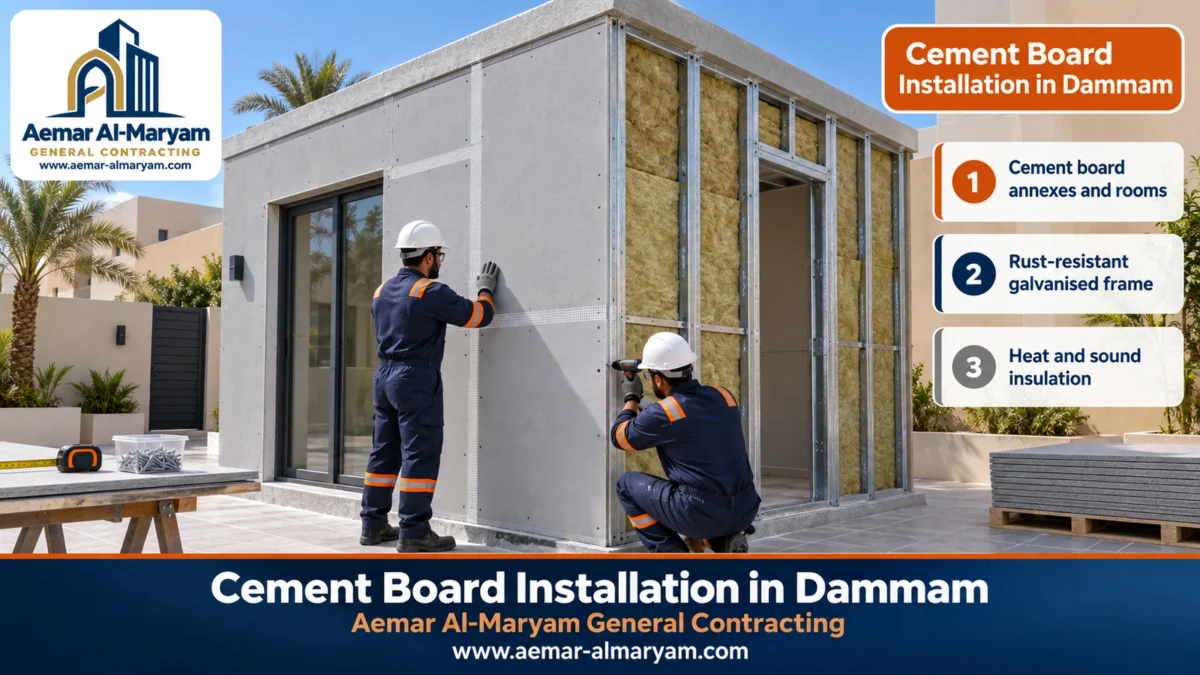
Cement board installation in Dammam gives you a tough exterior wall or an extra room without the weight of blockwork or the wait for concrete to cure: fibre-reinforced cement sheets are screwed to a galvanised steel frame, the cavity is filled with rock wool, and the joints are reinforced and finished before painting. Our crews at Aemar Al-Maryam General Contracting fit cement board in Dammam and across the Eastern Province: walls for rooftop and courtyard rooms, exterior cladding for facades and boundary walls, interior partitions, exterior ceilings, driver rooms and storerooms. An insulated cement board wall starts from SAR 185 per m² supplied and fixed, and facade cladding from SAR 148 per m². These are estimates until we inspect the site and agree the scope. Call or WhatsApp 0547879578.
People who search for cement board usually want three answers: will it work in my space, what does a square metre cost with installation, and how do I know the joints will not crack after the first summer? This guide takes those questions in order. It explains the board, its thicknesses and sheet sizes; then the correct build-up layer by layer; then prices, with worked examples for a 4×4 room and other sizes; and finally the mistakes that ruin an installation. It also draws a clear line between what we do, which is complete installation, and what we do not do, which is selling loose boards.
Cement board in Dammam at a glance
- What we install: walls for light rooms and annexes, facade and boundary-wall cladding, interior partitions, exterior ceilings and canopies, tile backing in bathrooms, rooftop rooms, storerooms and driver rooms.
- The system: a galvanised steel frame with studs 40 to 60 cm apart as the board maker specifies, usually 12 mm boards outside and 9 mm for partitions, rock wool in the cavity, and 3 to 5 mm joints reinforced with alkali-resistant mesh in a base coat.
- Prices start from: SAR 185 per m² for an insulated wall, SAR 185 for an interior partition, SAR 148 for facade cladding, SAR 120 for a suspended ceiling, SAR 125 for a sandwich-panel roof, and SAR 46 per m² to install materials the client supplies. Estimates until inspection and agreement.
- A 4×4 room: roughly SAR 10,880 for an insulated frame-and-board shell topped with sandwich panel, as an illustrative example, before the door, window, electrics, floor and paint.
- Timing: the frame and boards of a small room take a few days, followed by joint treatment and painting; the schedule is set after inspection.
- Quick estimate: send photos and rough measurements to 0547879578 by call or WhatsApp.
Cement Board in Dammam: The Material, Its Uses and Why Owners Choose It
Cement board is a flat sheet made of cement, silica sand and reinforcing fibres. It comes in fixed sizes and is screwed to a light frame instead of being laid course by course like blocks. Arabic adverts spell it several ways, but they all mean the same product. It has spread in Dammam because it combines three things Eastern Province owners need: it copes with moisture far better than gypsum, it weighs much less than blockwork, and it goes up quickly, with no pouring and no curing time.
Cement board plays a different role in Dammam than it does in a dry inland city. Summer nights and winter mornings bring high humidity that swells exposed gypsum and timber, while a cement sheet shrugs it off. Roofs get so hot in summer that a lighter, faster build matters, because the frame of a room can be up and enclosed in days instead of weeks of work in the sun. On the other hand, salty air near the coast is hard on steel and screws, which is why we insist on galvanised sections and corrosion-resistant fixings.
In homes you will find cement board in four roles: as the outer wall of a light room or annex, as cladding over an existing facade or boundary wall, as an interior partition dividing a hall or a storeroom, and as a rigid backing under tiles in bathrooms and kitchens. Each role needs a different thickness, frame and joint treatment, which is why “installation” means much more than driving screws into a sheet.
What a Cement Board Is Made Of, and the Main Types
Two main products are sold under the same name. The first is fibre-cement board: cement, silica sand and cellulose or synthetic fibres, cured with steam under pressure so the sheet comes out smooth and dimensionally stable. It is the usual choice for facades and partitions. The second is cement-bonded particle board, cement mixed with wood particles. It is heavier and denser and is often used for raised floors and impact-resistant cladding. Within these families you will see smooth boards for painting, boards with a wood-grain texture, and high-density boards for areas that take knocks.
Fibre-cement flat sheets have an adopted Gulf standard, based on the European product standard, which sets the test methods for strength, bending and dimensional stability. We therefore ask suppliers for the board’s technical data before delivery, and we turn down boards of unknown origin however cheap they are. The price gap between a good board and a poor one is small compared with the cost of rebuilding a wall.
Cement Board Sheet Sizes and Thicknesses Used in Dammam
The standard cement board sheet is 1.2 × 2.4 m, or 1220 × 2440 mm in exact construction sizing, and some suppliers stock 3 m lengths for tall facades. Thickness is the most important choice, because it decides how stiff the wall is, how much it weighs and what it costs. To give a sense of scale, one manufacturer lists its 12 mm, 1.2 × 2.4 m fibre-cement sheet at about 45 kg, so two installers carry it on edge, never flat, to avoid cracking it.
| Thickness | Typical use | Note from the site |
|---|---|---|
| 6 – 8 mm | suspended ceilings, canopy and walkway soffits | light on the hangers, never an exterior wall |
| 9 – 10 mm | interior partitions, inner face of a light room | 9 mm is one of the most asked-about prices |
| 12 mm | exterior walls, facades and boundary walls | the thickness we normally use outside in Dammam |
| 15 – 18 mm | impact-resistant cladding, floor underlay | heavier, needs a stronger frame |
| 20 mm and up | mezzanine floors and platforms | treated as a structural element designed by the engineer |
The right thickness depends on where the board goes, the stud spacing and the maker’s instructions, not on price alone.
Cement Board Installation in Dammam: The Work We Do
For us, cement board installation in Dammam means handing over a finished wall, room or cladding, either ready for paint or painted, not fixing sheets and leaving the rest. We measure, choose the board thickness and frame, supply the materials, build, insulate and treat the joints, and coordinate painting and electrics with our other teams. Details of our dry-lining work are on the gypsum and board services page. These are the jobs we are asked for most:
■ Walls for light rooms
a rooftop room, a courtyard room or a driver’s room, with cement board outside, a lining board inside and insulation between them.
■ Exterior cement board cladding
over an existing facade or part of it, or around exterior columns and beams, with joint treatment and an exterior finish.
■ Boundary walls and screens
raising or covering an existing wall or steel fence with a rigid board painted to match the house.
■ Interior partitions
dividing a hall, storeroom or office with a partition stronger than gypsum and tolerant of humidity.
■ Exterior ceilings and canopies
soffits for walkways, seating areas and entrances exposed to humidity and sea air.
■ Bathrooms and kitchens
a rigid backing behind tiles instead of gypsum, with waterproofing in shower areas.
We Install Cement Board; We Do Not Sell Loose Sheets
We say this up front because many people searching for cement board in Dammam are looking for a shop or a factory. We are an installation contractor. We supply boards, frames and materials as part of a job we carry out, but we do not sell sheets for collection. If you have already bought boards and steel sections yourself, we can install them on a labour-only basis once we have checked the materials, including the board thickness, the quality of the sections and the screws. We will not fix materials outdoors if we do not trust how they will perform. The price section below lists published sheet prices so you can compare clearly.
Exterior Cement Board in Dammam
Exterior cement board in Dammam is usually a 12 mm sheet fixed to a galvanised frame, with its joints and corners reinforced by alkali-resistant mesh embedded in a base coat, then covered with an exterior finish that protects it from rain and sun. An exterior wall is the most demanding place to use cement board. It faces summer heat, coastal humidity and dust-laden wind, and any weakness in the joints or fixings shows up as a fine crack within months. Here is how we build it, layer by layer.
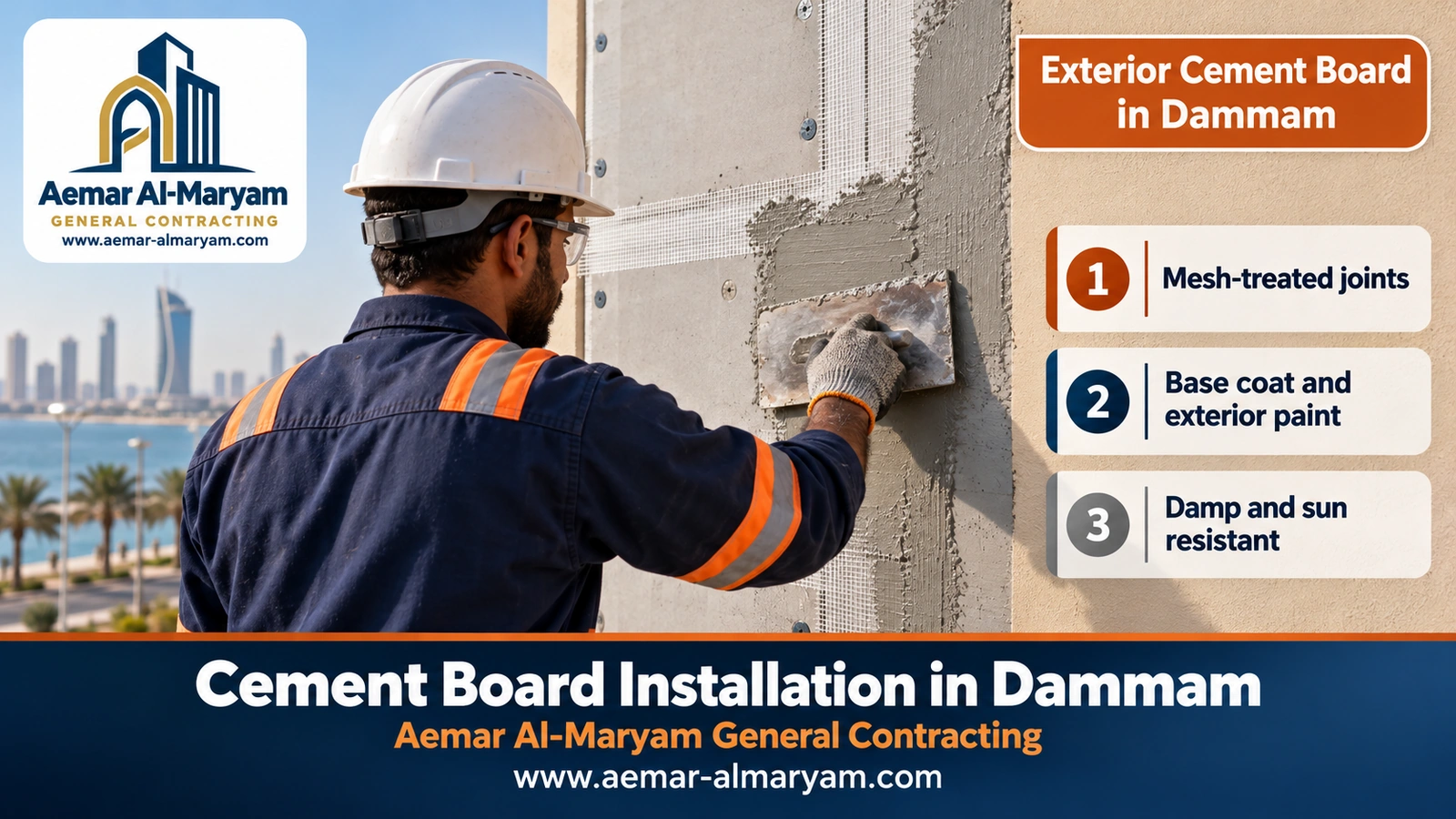
Layers of an Exterior Cement Board Wall, Outside to Inside
- 1Exterior finish: flexible exterior paint, textured render, spray finish, or light stone cladding, depending on the facade.
- 2Base coat and mesh: a polymer-modified cement coat with alkali-resistant glass-fibre mesh embedded over joints and corners, and over the whole surface on exposed facades.
- 3Cement board: usually 12 mm, with 3 to 5 mm joints, laid in a staggered brick pattern so four corners never meet at one point.
- 4Water and air barrier: a membrane or barrier layer behind the board where the board maker’s system calls for it, so any water that gets past the face cannot reach the frame.
- 5Galvanised frame and insulation: galvanised steel studs 40 to 60 cm apart, with rock wool between them.
- 6Inner face: a 9 mm cement board, or gypsum board in dry rooms, then filler and paint.
Treating Cement Board Joints With Mesh and Base Coat
The joint between two sheets is where the whole job is tested. Boards expand and contract slightly as humidity and temperature change. If they are butted tightly together, or the joint is filled with an interior gypsum compound, a crack appears exactly along the joint line. Our method is to leave a 3 to 5 mm gap and fill it with a flexible filler or the base coat, depending on the system. We then bed a strip of alkali-resistant mesh into the base coat, using a wider strip on external corners and around openings. On facades that take full sun we prefer mesh over the whole surface rather than the joints alone, and we let the base coat dry before the next layer goes on.
Ordinary mesh does not survive in cement
Cement-based coatings are alkaline, and over time they eat away untreated mesh until it loses its strength and the crack returns. That is why we use alkali-resistant mesh and exterior-grade fillers, and we refuse to use interior gypsum filler on any outside surface, whatever finish will go over it.
Exterior Finishes and Cement Board Decoration
Once treated, the board becomes a cementitious surface that accepts most exterior finishes. In Dammam the most popular is flexible exterior paint, which tolerates slight movement and reflects some of the sun’s heat. Next comes textured render or spray finish for owners who want a texture that hides minor waviness, then lightweight stone cladding or patterned panels for a more distinctive facade. Boards can also be cut into shapes and openings for simple exterior details such as window surrounds and light cornices. We coordinate exterior painting with our painting team.
When cladding beats repair
If a block wall is structurally sound but its plaster is tired and it looks dated, cladding it with cement board on a light frame gives a new facade without demolition. If it has structural cracks or rising damp, the cause must be treated first, as we explain on the renovation contractor in Dammam page, and the cladding comes after.
Building a Cement Board Room in Dammam
A cement board room in Dammam has a galvanised steel frame, cement board walls outside with a lining board inside, rock wool in between, and an insulated sandwich-panel roof laid at a slight fall to shed rain. Owners choose this system when weight or time matters more than the mass of blockwork: on top of an existing roof, in a narrow side passage, or for a service room the household needs quickly.
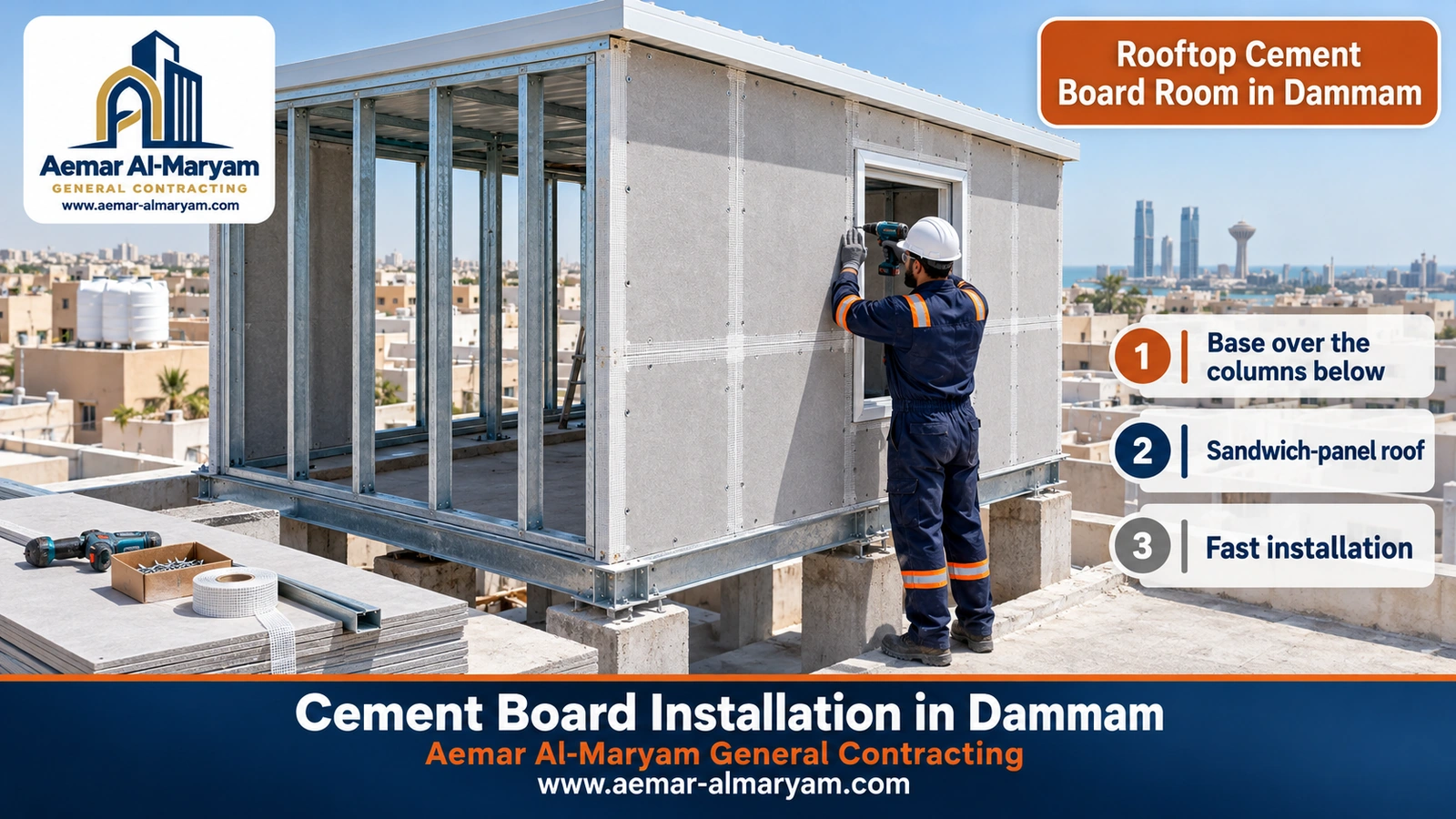
Rooftop Cement Board Rooms in Dammam
Rooftop rooms are the most common cement board rooms, because the light system makes them possible on buildings that cannot take block walls. Being light does not cancel the basic rule, though: every load from the room has to be carried down through the columns and beams already there, never dropped onto the open span of the slab. The room therefore starts with a steel base or runners fixed over the column lines after an engineer has given his opinion. The studs go up from there, and the room is tied to the roof so it resists wind. The Balady permit, the rules for upper annexes and how the engineer checks the roof are covered in detail in our guide to annex and majlis building in Dammam.
The practical details matter too. Materials have to be lifted to the roof, so we plan deliveries and cutting areas in advance to avoid damaging stairwells and the existing waterproofing. Water tanks, AC units and drain outlets often share the roof, and the room must leave room to reach them for maintenance. Lastly, the roof’s rain must still reach its drains once the room is built. Where the room cuts across a fall, we reroute the falls or add an outlet before the base goes down.
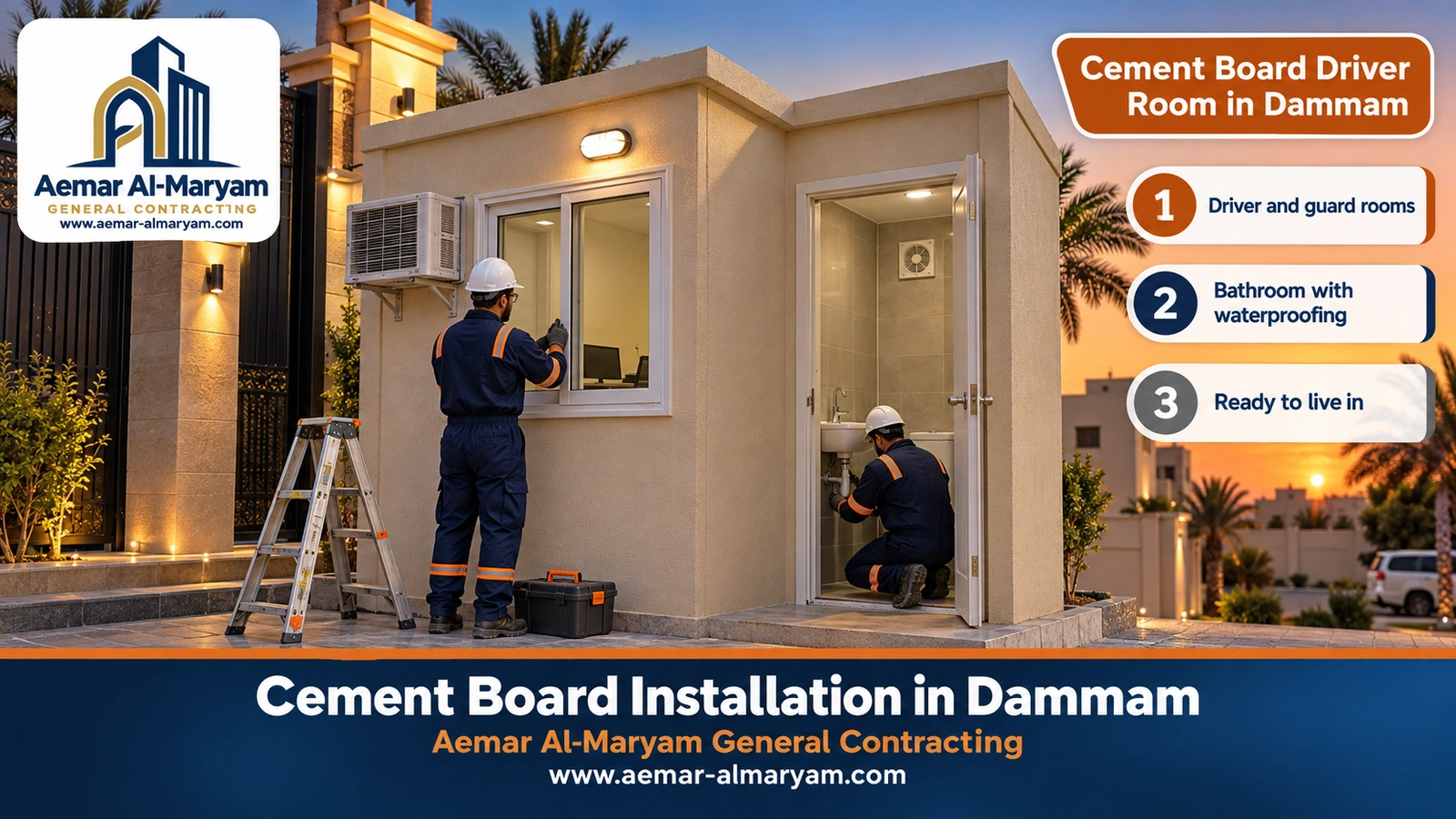
Cement Board Driver Rooms With a Bathroom
Few jobs suit the system better than a driver’s room beside the gate: it is small, and the household usually wants it ready quickly. We build it on a concrete base slightly above the courtyard floor and keep the bottom edge of the boards clear of the paving so they never sit in washing water or rain. Part of the room becomes a bathroom, where cement board goes behind the tiles and the floor and lower walls are waterproofed. We fix the positions of the AC unit, water heater and basin from the start, so backing can go into the frame before it is closed.
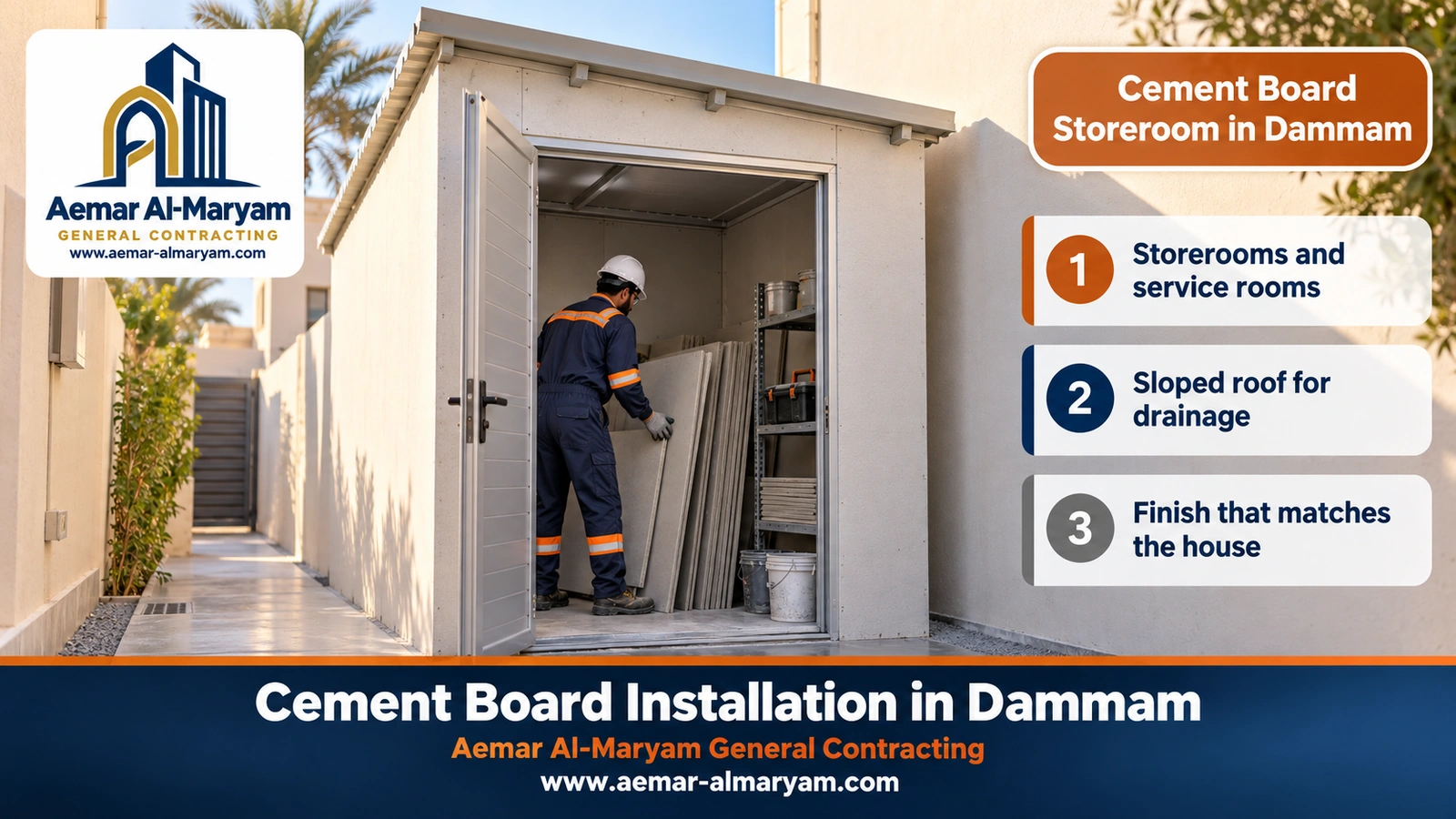
Cement Board Storerooms and Service Rooms
A small storeroom in a side passage or behind the house needs walls that take knocks and humidity but little sound insulation, so cement board on a galvanised frame suits it well, with a slightly sloping roof and an aluminium door. We keep the passage’s rain outlets clear and never build the store over a manhole cover or a drain line you may need to reach later.
Cement Board Annexes in Dammam
Cement board annexes in Dammam work well for a sleeping annex, a small majlis or a service annex, provided the annex is designed as a complete project and not as walls alone. That means a footing or base, a frame designed for wind, an insulated roof, services and finishing. We build the cement board walls and sandwich-panel roofs within these projects. Choosing between block, cement board and sandwich panel for the whole annex, full annex and majlis prices, and the permit route are covered in our annex and majlis builder in Dammam guide and on the annexes and majlis service page. For a full storey or a conventional build, see the construction service page.
Cement Board Partitions and Ceilings Inside Dammam Homes
Cement board partitions in Dammam are light interior walls, boarded on both faces over a galvanised frame with insulation between, chosen instead of gypsum where the space is damp or the wall will take knocks: a storeroom, a laundry room, a service corridor or a kitchen. A 9 mm board is usually enough, and the partition can run up to the ceiling or stop at a set height. For partitions and ceilings in dry rooms such as majlis and bedrooms, gypsum board is the better choice because it is lighter and easier to finish. Our gypsum board service covers that work.
If you plan to hang a TV, a cabinet or heavy shelves on the partition, tell us before it is closed. We add an extra stud or a backing plate between the studs at that spot so the screws bite into steel, not just into the board. Thin cement board ceilings (6 to 8 mm) suit canopies, outdoor walkways and bathrooms, hung on galvanised hangers at closer centres than a gypsum ceiling.
Cement Board in Bathrooms and Kitchens
In a bathroom, cement board is the rigid backing the tiles are bonded to, because it does not break down in humidity the way ordinary gypsum does. It is water-resistant, though, not waterproof. If water finds a way through the joints it will reach the frame. So we treat the joints and screw heads, apply a waterproofing layer over the board in the shower zone, on the floor and up the lower walls before tiling, and tie it into the floor drain. Waterproofing details are on the waterproofing and insulation service page.
Cement Board Installation Steps in Dammam
Installing cement board takes ten steps, and each step is checked before the next begins. This is the sequence we follow for exterior walls and rooms. Interior partitions skip some of it:
- 1Survey and measure: we measure areas and heights, check the floor or roof the frame will stand on, and mark doors, windows and services.
- 2Choose thickness and frame: we set the board thickness, the section sizes and the stud spacing to suit the height, wind exposure and the board maker’s instructions.
- 3Base and tracks: we fix the bottom track to a concrete base or to runners over the column lines, with a separating strip between the steel and damp concrete.
- 4Stand the studs: we plumb the studs, add framing around openings and fit backing where fixtures will hang.
- 5Services: cables run in conduit inside the cavity, and AC and water points are prepared before closing.
- 6Insulate: we fit the moisture barrier where needed and fill the cavity with rock wool, leaving no gaps.
- 7Fix the boards: corrosion-resistant screws every 20 to 30 cm along the studs and 15 to 20 mm from the edges, with 3 to 5 mm joints and a staggered layout.
- 8Treat joints and corners: alkali-resistant mesh in base coat over joints, corners and around openings, plus corner beads on external angles.
- 9Finish: a primer suitable for cementitious surfaces, then paint, textured render or cladding.
- 10Inspect and hand over: we check flatness, joints and openings, water-test the roof fall on rooms, then hand over.
Cutting Cement Board and Silica Dust
Cutting fibre-cement sheets with an ordinary saw and no extraction releases fine dust containing crystalline silica. US occupational safety guidance (NIOSH) notes that some fibre-cement products contain up to about half crystalline silica. We therefore score and snap thin boards wherever possible, cut thicker boards with a saw fitted with a dust shroud connected to an industrial vacuum and a blade made for fibre cement, cut outdoors away from living spaces, give the crew suitable masks, and clean up by vacuum, never by dry sweeping. These details protect the workers and your family alike.
Insulating Cement Board Rooms and Walls in Dammam
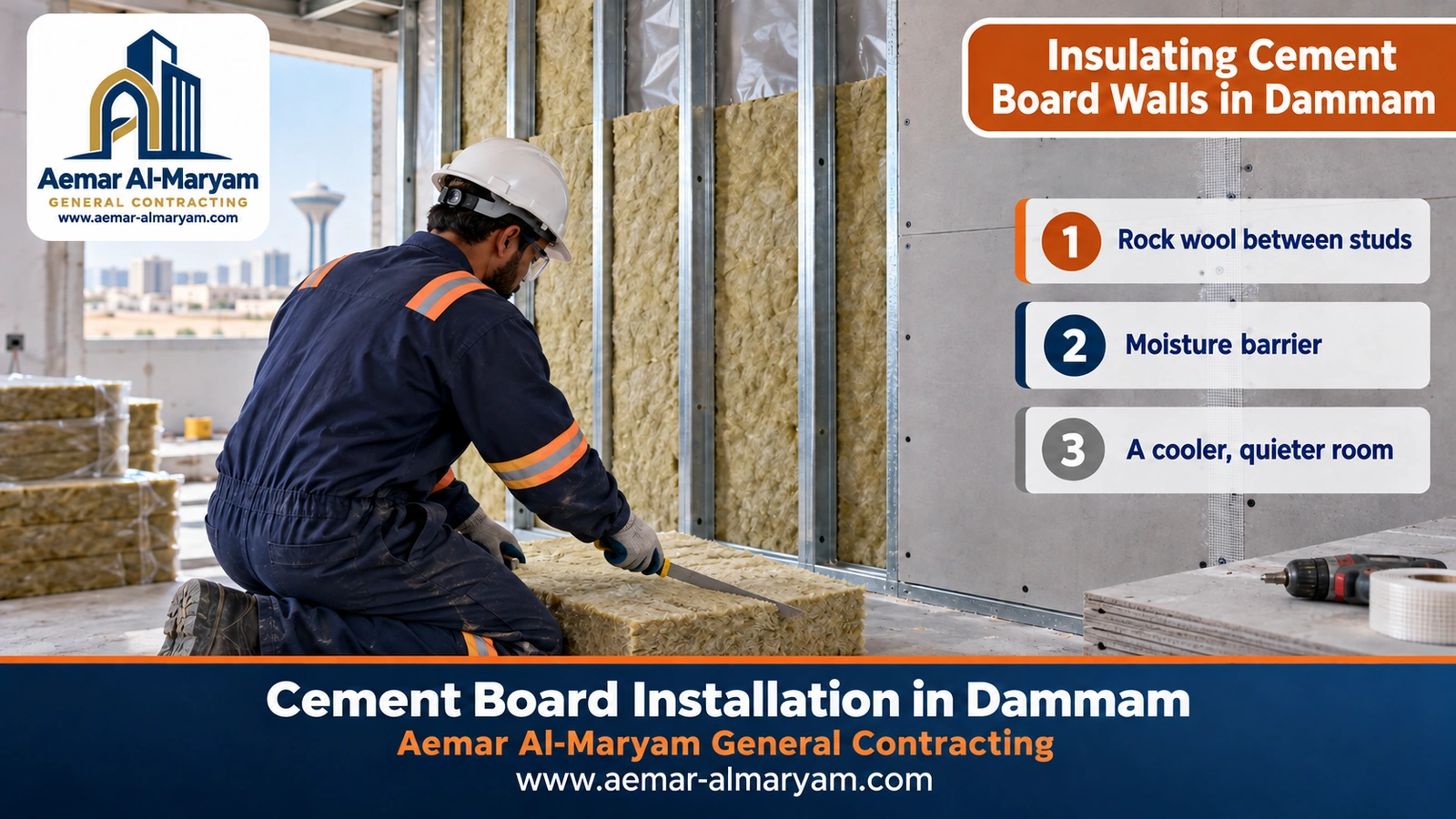
A cement board sheet is not a thermal insulator in itself. In this system, the insulation comes from the layers built with it. In Dammam, where walls and roofs spend long hours in the sun, we rely on four layers: rock wool filling the stud cavity completely, a moisture barrier on the correct side of the wall, a sandwich-panel roof with an insulating core, and a light exterior paint that reflects part of the heat. The result is a room that holds its air-conditioning longer than an uninsulated light room, with less outside noise coming through.
■ Thermal insulation
rock wool with a density and thickness that suit the stud depth, with no gaps at corners or around openings.
■ Sound insulation
rock wool improves it and two boards per face improve it further, but it still falls short of a thick block wall.
■ Moisture and condensation
a correctly placed moisture barrier and treated joints, so humid air does not condense inside the wall.
■ The roof
5 cm sandwich panel laid to a fall for rain, with joints and fixings sealed using the right materials.
If the room sits on an older roof, the roof itself may need waterproofing before the base is fixed, so that no water is trapped under the room and later leaks into the floor below. We decide this at the inspection with our waterproofing and insulation team.
Cement Board, Block or Gypsum Board in Dammam?
The choice between cement board, block and gypsum board in Dammam follows the wall’s location and job. Gypsum board belongs in dry interiors. Cement board suits exterior walls, wet areas and light rooms. Block suits walls that need mass and high sound insulation, provided the foundations can carry the weight. Confusion usually comes with the question of a “gypsum board room on the roof”. The answer is that ordinary gypsum board is an interior lining that must be kept dry, and one maker’s data sheet says it should not be exposed to temperatures above 52 °C for long periods. So it has no place on the outside of a room exposed to a Dammam summer on the roof.
| Criterion | Cement board on galvanised frame | Block and concrete | Gypsum board |
|---|---|---|---|
| Best place | exterior walls, light rooms, wet areas | ground annexes and majlis, load-bearing walls | dry interior walls and ceilings |
| Weight | light | heavy | lightest |
| Water | water-resistant; needs waterproofing in showers | good with plaster and waterproofing | poor, except moisture-resistant types inside bathrooms |
| Speed | days | weeks with pouring and curing | days |
| Sound insulation | medium; better with rock wool and double boards | highest | medium, interior |
| Our starting price | SAR 185/m² insulated wall | see the annex price table | see the gypsum board page |
No board is best everywhere; each location has its material. We often combine them in one room: cement board outside and gypsum board inside.
The best alternative to cement board depends on the goal. For more speed and built-in insulation, sandwich panel works for both walls and roof. For strength and sound insulation, block is the choice if the structure allows it. Exterior gypsum sheathing exists, but it is a layer behind cladding, not a finished surface exposed to the weather.
Advantages and Disadvantages of Cement Board in Dammam’s Climate
The main advantages of cement board are its low weight compared with blockwork, its tolerance of moisture, fast installation and its acceptance of most finishes. Its drawbacks are that it is heavier than gypsum, its joints punish poor workmanship, its sound insulation is lower than block, and cutting it requires dust control. Here are both sides as we explain them at the inspection:
■ Light on roofs
allows rooms and stores on buildings that cannot take blockwork, after an engineer’s check.
■ Tolerates humidity
does not break down in moisture as gypsum does, so it suits facades, bathrooms and outdoor walkways.
■ Fast and clean
no pouring and no curing wait, and site work disturbs the neighbours less.
■ Takes most finishes
paint, textured render, spray, tiles and cladding, and it can be cut into decorative shapes.
■ Heavier than gypsum
needs two people to carry and a stronger frame, and takes longer to cut.
■ Joints are the weak point
any shortcut in joints or fixings shows as fine cracks along the board lines.
■ Limited sound insulation
better with rock wool and double boards, but never equal to a thick block wall.
■ Hanging needs planning
heavy loads hang on backing built into the frame before it is closed.
Can Cement Board Handle Water, Heat and Fire in Dammam?
Yes, within clear limits. Cement board handles humidity and rain when it sits on a sound frame with treated joints and a painted face. It takes the sun’s heat without softening or breaking down as gypsum does, and many fibre-cement boards are classed as non-combustible in their technical data. Each property comes with a condition:
- ●Water: the board is water-resistant, not a waterproof membrane. In showers and wet floors we add a waterproofing layer, and outside we rely on the finish and treated joints.
- ●Heat: the board is stable in heat, but its slight movement is why the joints are left open. A room’s thermal insulation comes from the rock wool and roof, not from the board.
- ●Fire: some boards are classed A1 non-combustible under the European classification in their maker’s data. We check the data sheet of the board supplied rather than assuming it of every board.
- ●Salt and coastal humidity: the greatest risk is to the steel, not the board, which is why the frame is galvanised, the screws are rust-proofed and every cut edge is sealed.
How Long Cement Board Lasts in Dammam, and Its Maintenance
The lifespan of a cement board wall cannot be reduced to a single number. The board itself is a durable cementitious material. What decides how long the wall lasts is whether the frame rusts and the condition of the joints and finish. A wall built on a galvanised frame, with treated joints and a proper exterior paint, lasts for many years with simple maintenance. A wall built on ungalvanised sections or with black screws soon shows rust through the paint. We recommend this easy routine:
- ✓Inspect joints and corners once a year, especially after summer, and repair any hairline crack early.
- ✓Check the sealants around windows, doors and the roof, and renew them when they crack.
- ✓Rinse the facade with low-pressure water to remove dust and salts, never aiming a high-pressure jet at the joints.
- ✓Repaint the exterior when the paint fades or cracks, before water can reach the board.
- ✓Keep the bottom edge of the boards clear of standing water and rain run-off.
When We Do Not Recommend Cement Board
We do not recommend cement board when the job calls for a load-bearing wall, a large majlis that needs high sound insulation, a wall that will carry heavy loads along its whole length, or a room on a roof that no engineer has checked. In those cases block, structural strengthening or another system is the better fit, and we say so at the inspection even if it means losing the job. Nor do we fit cement board as a cosmetic cover over a wall with rising damp or active cracks, because the cladding will hide the problem for a few months and then it will show through.
On the other side, there are jobs where cement board is the obvious choice: a service room on a roof whose columns can carry a light system, an old facade with a sound structure that needs a fresh face, a partition in a damp storeroom, or the soffit of an outdoor walkway exposed to sea air. Our test is simple: the material that does the job with the least weight and the fewest long-term maintenance problems.
Cement Board Installation Prices in Dammam
Our cement board installation prices in Dammam start from SAR 185 per m² for an insulated wall on a galvanised frame, supplied and fixed, from SAR 148 per m² for exterior facade cladding, and from SAR 46 per m² to install materials the client supplies. We set these figures after reviewing the prices contractors publish in Dammam and the Eastern Province. Where no local contractor published a price for an item, we used the nearest city that did.
| Item | Unit | Starts from |
|---|---|---|
| Cement board wall on a galvanised steel frame with rock-wool insulation (exterior cement board + inner lining), supply and fix | m² of wall area | SAR 185 |
| Interior cement board partition, boarded both sides on a galvanised frame, with insulation | m² | SAR 185 |
| Exterior facade cladding, 12 mm boards on a galvanised frame, joints treated with mesh and base coat | m² | SAR 148 |
| Suspended cement board ceiling, 6–8 mm, for canopies, exterior soffits and wet areas | m² | SAR 120 |
| 5 cm sandwich-panel room roof, supply and fix | m² | SAR 125 |
| Labour only, installing boards and sections supplied by the client | m² | SAR 46 |
| Cement board behind bathroom tiles with waterproofing | — | by inspection |
| Final exterior finish (flexible paint, textured render, cladding) | — | by inspection |
All figures are estimates pending inspection and agreement, and they shift with thickness, frame type, insulation, height, finish level and how easy the roof, courtyard or facade is to reach. Items marked by inspection can still be estimated from pictures: share the site photos and sizes over WhatsApp (0547879578).
To compare these with our general price list for other work, see the prices page. Note that most pages that publish a “price per metre” do not say what it covers. A low figure may be labour only, and a higher one may include the frame, insulation and joint treatment. That is why every line in our table states what is included.
Cement Board Price With Installation in Dammam
The price of cement board with installation in Dammam starts from SAR 185 per m² of wall area when it includes the galvanised frame, insulation and both faces, and from SAR 148 for single-faced facade cladding without insulation. Our “with installation” price includes the boards, galvanised sections, corrosion-resistant screws, rock wool in insulated walls, mesh and base coat for the joints, corner beads, labour and removal of offcuts. It does not include the final exterior finish, doors and windows, electrics and plumbing, or flooring, unless we agree to hand the room over complete.
Cement Board Sheet Prices in Dammam
According to published Saudi market figures, a 1.22 × 2.44 m cement board sheet costs roughly SAR 55 to 75 at 9–10 mm, SAR 85 to 110 at 12 mm and SAR 130 to 170 at 15–18 mm, and some building-materials retailers list an 18 mm sheet at about SAR 127 including VAT. These are guide figures that vary with the source and quantity, and as explained above we do not sell loose sheets. We list them because the sheet is only a small part of an installed square metre. One sheet covers about 2.9 m², so a 12 mm board works out at roughly SAR 30 to 38 per m². The rest is frame, screws, insulation, joint treatment and labour.
What Does a 4×4 Cement Board Room Cost in Dammam?
As an illustration with 3 m walls, a 4×4 cement board room in Dammam comes to about SAR 10,880 for its insulated shell. The 16 m perimeter × 3 m gives 48 m² of wall × SAR 185 = SAR 8,880, plus a sandwich-panel roof of 16 m² × SAR 125 = SAR 2,000. That covers the frame, boards, insulation and roof. It does not cover the door, window, electrics, air-conditioning, flooring, paint, or a concrete base if one is needed; these are added to suit your choices after inspection.
Cement Board Room Costs for Other Sizes
| Room (illustrative) | Walls | Roof | Insulated shell, approx. |
|---|---|---|---|
| Storeroom 2×3, 2.5 m high | 25 m² × 185 = 4,625 | 6 m² × 125 = 750 | SAR 5,375 |
| Driver room 3×4 | 42 m² × 185 = 7,770 | 12 m² × 125 = 1,500 | SAR 9,270 |
| Room 4×4 | 48 m² × 185 = 8,880 | 16 m² × 125 = 2,000 | SAR 10,880 |
| Room 4×5 | 54 m² × 185 = 9,990 | 20 m² × 125 = 2,500 | SAR 12,490 |
| Room 5×6 | 66 m² × 185 = 12,210 | 30 m² × 125 = 3,750 | SAR 15,960 |
| Interior partition 4 m × 3 m | 12 m² × 185 | — | SAR 2,220 |
| Facade cladding 60 m² | 60 m² × 148 | — | SAR 8,880 |
Examples are illustrative, calculated from the starting prices above with no deduction for openings, and are reviewed after inspection. Rooms that share a wall cost less, because the shared wall is counted once.
How to Compare Two Cement Board Quotes
When two quotes differ widely per square metre, do not judge on the figure alone. Ask each contractor about the items below and write the answer next to the price. Very often the cheaper quote turns out to have no insulation, thinner sections or joints treated with filler only, and the difference gets paid later in repairs.
| Item | What to ask | Why it matters |
|---|---|---|
| Board thickness | 12 mm outside? What on the inner face? | a thinner board is cheaper but weaker against impact and wind |
| Frame | galvanised sections? What stud spacing? | the frame carries the wall and decides its life |
| Insulation | rock wool? How thick? Is there a moisture barrier? | an uninsulated wall raises the cooling bill |
| Screws | corrosion-resistant and made for cement board? | black screws rust and bleed through the paint |
| Joints | 3–5 mm gap with alkali-resistant mesh and base coat? | this is where cracks start, or never start |
| Finish | ready for paint or painted? Which paint? | the exterior finish is a separate cost item |
| Waste and transport | does the price include removing waste and protecting the site? | a small item that causes big disputes if not written down |
Ask for these items to be written into the agreement. They are what make a price per metre comparable.
What Pushes Cement Board Costs Up or Down?
- ●Thickness: moving from 9 to 12 or 18 mm raises the cost and weight of the boards and needs a stronger frame.
- ●Height and access: tall facades need scaffolding, and work on a roof without a lift means carrying materials by hand.
- ●Frame: stud spacing and section thickness in wind-exposed locations.
- ●Insulation: rock-wool density and thickness, and whether there is a moisture barrier or double boarding.
- ●Openings and details: more windows, corners and cornices mean more cutting and treatment.
- ●Finish: standard paint, flexible paint, textured render or stone cladding.
- ●Area: larger jobs spread set-up and transport over more square metres.
How Long Does Cement Board Installation Take in Dammam?
The frame and boards of a small cement board room take a few days, and a medium facade takes from a few days to a week or more depending on height and scaffolding. Then come joint treatment, base-coat drying and painting, which we never rush, because haste at this stage causes most cracks. If a rooftop room needs a permit amendment or an engineer’s opinion, that time comes before the work starts. After the inspection we give you a written schedule of the stages.
Common Cement Board Installation Mistakes in Dammam
Most of the cement board problems we are called to fix in Dammam are not caused by the board but by shortcuts in installation. These are the most frequent:
- ●Boards butted with no gaps: straight cracks appear along the board lines with the first change in temperature.
- ●Gypsum filler on an exterior surface: it absorbs moisture, swells and falls away with the paint.
- ●Black screws or ungalvanised sections: they rust, brown stains show through the paint, and the board’s grip weakens.
- ●Wide stud spacing: the board waves or flexes, especially on wind-exposed facades.
- ●A joint running from a window corner: it cracks from the corner; the board should be cut around the corner instead.
- ●Board edges touching the ground: they soak up washing water and rain; the board should be raised and its edge sealed.
- ●Ordinary gypsum board used as an exterior wall: the biggest mistake in so-called gypsum board rooftop rooms.
- ●Painting before the base coat has dried: trapped moisture causes peeling and stains.
Checklist Before Painting and Handover
- ✓Joints between boards are present and even, and four board corners never meet at one point.
- ✓Screw heads sit just below the surface, at regular distances from the edges.
- ✓Mesh shows under the base coat on every joint and corner and around every opening.
- ✓The surface is flat under a long straightedge, with no bulges at the joints.
- ✓The bottom edge of the boards is raised and sealed, and the roof sheds water towards the gutter.
- ✓Backing is in place for the AC, TV and cabinets as agreed.
Cement Board Installation in Al Khobar, Dhahran, Qatif and Other Eastern Province Cities
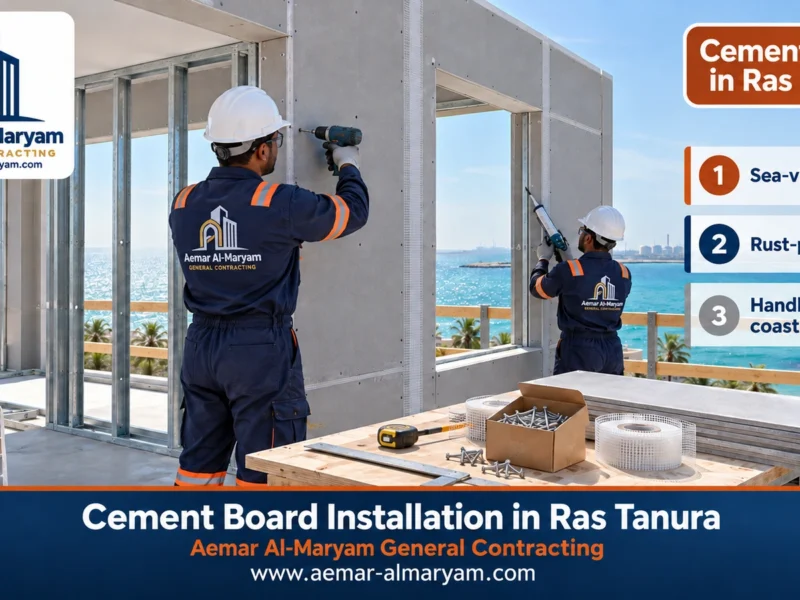
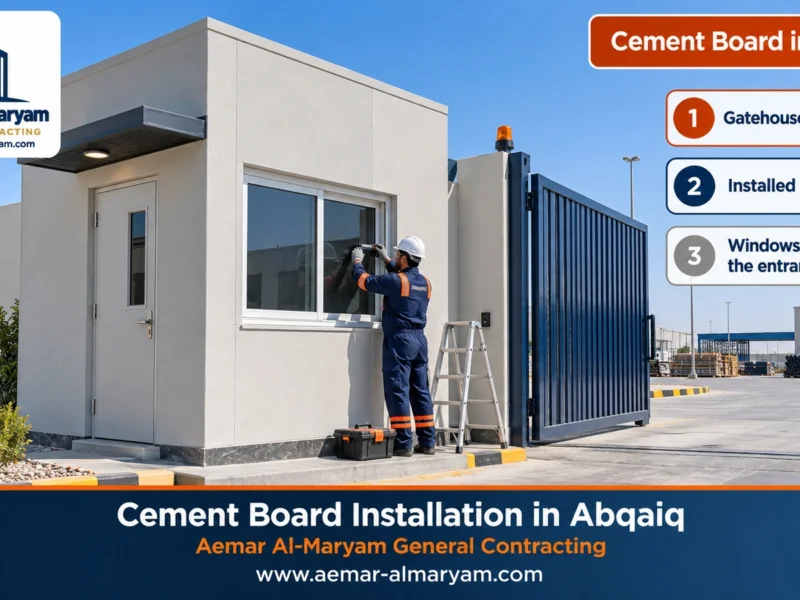
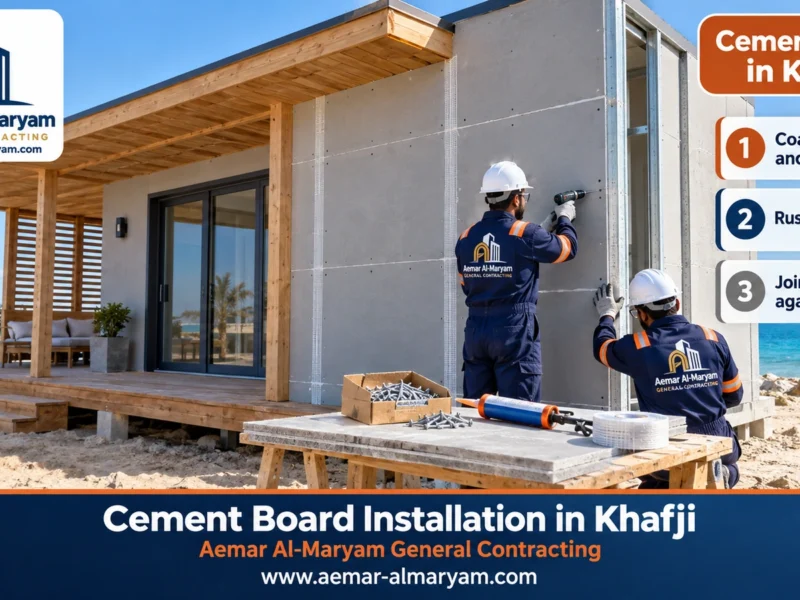
We install cement board outside Dammam with the same system and the same starting prices, adding travel for distant cities after inspection. In coastal cities such as Al Khobar, Qatif, Saihat and Ras Tanura we take extra care to protect the frame and screws from salt. Each city has a service page, and anyone planning a full annex will find a separate annex guide for that city:
| City | City page | Annex building guide |
|---|---|---|
| Dammam | Dammam | Annex builder in Dammam |
| Al Khobar | Al Khobar | Annex builder in Al Khobar |
| Dhahran | Dhahran | Annex builder in Dhahran |
| Qatif | Qatif | Annex builder in Qatif |
| Saihat | Saihat | Annex builder in Saihat |
| Jubail | Jubail | Annex builder in Jubail |
| Al-Ahsa | Al-Ahsa | Annex builder in Al-Ahsa |
| Ras Tanura | Ras Tanura | Annex builder in Ras Tanura |
| Abqaiq | Abqaiq | Annex builder in Abqaiq |
| Khafji | Khafji | Annex builder in Khafji |
| Hafr Al-Batin | Hafr Al-Batin | Annex builder in Hafr Al-Batin |
Dammam Districts Where We Install Cement Board
Our crews cover all of Dammam from the company office in Al-Rawdah. These are some of the districts where we work often:
How to Order Cement Board Installation in Dammam
To order cement board installation in Dammam, send a WhatsApp message to 0547879578 with photos of the space, its measurements and what it is for. We will reply with the system we suggest and an estimate, then book an inspection. A detailed first message brings the estimate much nearer to the final figure:
- ✓Where: your district or a shared map location, plus whether the job is on the roof, in the courtyard, on the facade or indoors.
- ✓Photos: the space from several angles, the roof columns for a rooftop room, and the existing wall for cladding.
- ✓Measurements: approximate length, width and height, or the facade area.
- ✓Use: bedroom, driver room, storeroom, partition, facade cladding or bathroom.
- ✓Finish: wall ready for paint, painted, or a complete room with electrics and flooring.
- ✓Materials: whether you have bought boards or sections yourself, with a photo of their label.
- ✓Timing: when you want to start, and any restrictions on working hours in the building or district.
Why Aemar Al-Maryam for Cement Board in Dammam?
■ We state what the price covers
every line in the table says what it includes, so you can compare quotes item by item.
■ Joints and fixings to spec
proper gaps, alkali-resistant mesh and corrosion-resistant screws, never interior filler outside.
■ No rooftop room before a check
the base sits over the columns after the engineer’s opinion, and the permit comes before the build.
■ Insulation, services and finish
one team for the frame, insulation, electrics and paint, so responsibility is not split.
■ A clean, safe site
cutting with extraction, waste collected and removed, and existing floors protected.
■ See it before you decide
examples of completed company work are shown in the projects gallery.
Start Your Cement Board Project in Dammam
Photograph the space and send the pictures with the measurements and intended use. We will reply with the right thickness and system and an estimate, then arrange a site visit on a day you choose.
Further reading and services
Tags