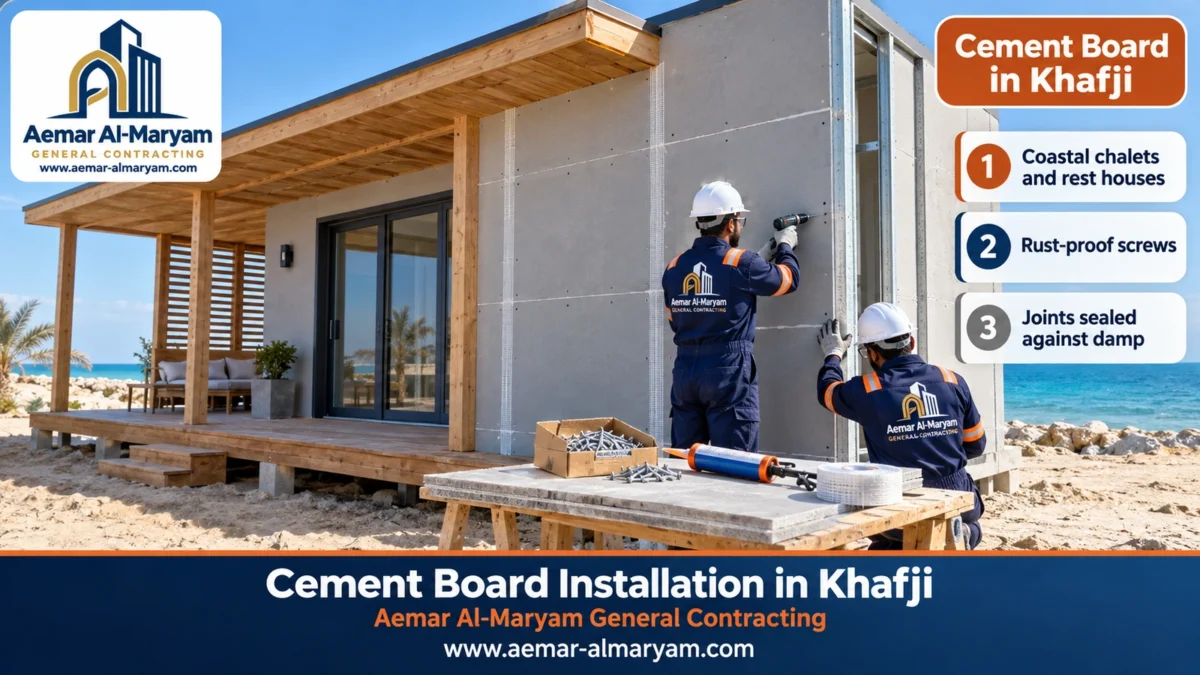
If you are building a chalet near the sea or an annex at your villa, the question that matters is not only whether cement board installation in Khafji is a good idea, but how the boards should go up so they neither rust nor crack in salty, humid air. The answer lies in small details: stainless-steel screws instead of black ones, a flexible sealant around every opening and edge, a water-resistant elastomeric coating over mesh-treated joints, and a tiled skirting that protects the foot of the wall from sand and spray. This is the standard Aemar Al-Maryam General Contracting follows on every Khafji job, and our insulated wall is priced from SAR 185 per square metre with materials and fixing, an initial estimate that becomes firm after inspection. Call or WhatsApp 0547879578.
The road distance between Dammam, where we are based, and Khafji is about 298 km, making it the furthest point we serve up the coast. So everything is planned before the crew sets off: we estimate from photos, inspect in a single visit, then ship the boards, studs, screws and insulation as one full load and protect them on site until the day they are fixed. This guide is ordered the way a chalet owner needs it: rust-proof fixing first, then the coating and skirting, then delivery and storage, then prices and worked examples.
What you need to know about cement board in Khafji
- Uses: small single-storey chalets, villa annexes, courtyard and driver rooms, and recladding existing walls.
- Fixing: stainless-steel screws or screws with a corrosion-resistant coating, and flexible sealant around windows, doors and pipes.
- Water protection: alkali-resistant mesh and base coat over the joints, an elastomeric coating, and a tiled skirting at the base.
- Boards on site: unloaded onto raised timber bearers and kept under a tight tarpaulin until fixing.
- Prices: SAR 185 per m² of insulated wall, 148 for recladding an existing facade, and 46 for labour without materials.
Cement Board Chalets Near the Khafji Shore
The small single-storey chalet is what gets built most often in cement board in Khafji: a wide sitting room, one or two bedrooms, a small kitchen and bathroom, and a front porch facing the sea. The light steel frame stands on a concrete slab, so it does not need the deep footings of a concrete building, and the boards go up quickly enough for the chalet to be ready before the holiday season. The sea changes the rules, though. Salt-laden air attacks any exposed metal, humidity condenses on the walls at night, and the wind drives sand and spray into every joint. So we design the chalet from day one as a coastal building, not as an ordinary room that happens to stand near the sea.
Stainless-Steel Screws: Why We Refuse Ordinary Ones
An ordinary black screw is cheap, but in Khafji’s air it starts rusting within a short time, a brown stain bleeds through the paint above every screw, and then the screw itself weakens and the board works loose. That is why we fix the outer boards of chalets near the sea with stainless-steel screws, or with self-drilling screws carrying a corrosion-resistant coating specified by the board maker, at 20–30 cm centres and far enough from the edge not to break it. We cover the heads with base coat before the coating goes on. The studs themselves are galvanised steel, and every piece we cut has its exposed edge touched up with zinc-rich paint so rust cannot start at the cut.
Sealant Around Openings and Edges
Water does not enter a wall through the middle of a board but around it: around a window frame, under a door sill, through the hole for the AC pipe, and where the wall meets the porch roof. So around every opening we fit a flashing tape or a liquid-applied seal before the frame goes in, then fill the gap between frame and board with a flexible, UV-resistant sealant rather than the cheap silicone that cracks in the sun. Window sills are formed with a fall to the outside so water never sits on them.
The Porch, Its Ceiling and Where It Meets the Wall
The front porch is part of the joy of a chalet, but it is also a common leak point if the line where it meets the wall is neglected. Where the porch roof ties into the cement board wall we fit a corrosion-resistant metal flashing over the junction to cover the gap and throw water away, and seal underneath it with flexible sealant, so rain finds no route between roof and board. If you want a suspended ceiling under the porch, we use thin 6–8 mm boards on closely spaced framing and leave small vents at the edges so sea humidity is not trapped in the void above and does not condense at night. The timber decking of the porch is coordinated with the carpenter so it stays clear of the foot of the wall, leaving room for air and cleaning.
The Chalet Base: Boards Never Touch the Sand
We lift the chalet slab above the surrounding sand, put a damp-proof course beneath the frame’s base track, and start the boards a little above slab level, a gap later covered by the skirting. That way the board does not soak up water from wet sand, and its bottom edge is not the first thing hit by spray when you wash the porch or the wind picks up. We also slope the porch floor away from the wall so washing water does not collect at its base.
Cement Board in Khafji: The Material and Its Thicknesses
Cement board in Khafji is the same board used across the Kingdom: a flat sheet of cement and silica reinforced with fibres, which tolerates damp without breaking down like gypsum and is screwed to a light steel frame. What differs in Khafji is the choice of thickness, fixing and finish to suit the sea air. Sheets usually come 1.22 m wide and 2.44 m long.
| Use in Khafji | Usual thickness | What we watch for |
|---|---|---|
| Exterior walls of chalets and annexes | 12 mm | Closer studs on the wind-exposed sea facade |
| Internal partitions and bathrooms | 9–10 mm | Waterproofing over the board in the shower zone |
| Porch and shade ceilings | 6–8 mm | Ventilating the void above so moisture does not condense |
| Impact-prone spots or heavy cladding | 15–18 mm | As per the manufacturer’s data |
Our supplier must show that the sheets meet the GSO specification for flat fibre-cement boards.
Cement Board Installation in Khafji: Jobs We Take On
In practice, cement board installation in Khafji with us covers the frame, boards, insulation, joints and finish, and we can start from the concrete slab if it is not ready yet. The main jobs are:
■ Single-storey chalet
Insulated exterior walls, internal partitions and a sandwich-panel roof, with the kitchen and bathroom prepared.
■ Villa annex
A guest room or small majlis beside the villa, with an elastomeric coating and tiled skirting.
■ Driver and courtyard rooms
A room with a bathroom in a corner of the courtyard, built without long disruption to the household.
■ Recladding an old wall
12 mm boards over a wall flaking from salt, once the cause has been treated.
■ Porch and shade ceilings
Thin suspended boards under the porch roof with ventilation openings.
■ Bathroom partitions
Cement backer behind tiles with waterproofing, instead of gypsum that breaks down.
We Install; We Do Not Sell Loose Sheets
We do not sell boards by the sheet; we supply them within an installation job we carry out ourselves. If you have bought boards and studs from another supplier, we check them before the appointment and make sure the screws are suitable for the coast, then charge only for fixing, from SAR 46 per square metre.
Exterior Cement Board in Khafji: Flexible Water-Resistant Coatings and Skirting
Exterior cement board in Khafji needs a finish that copes with two things at once: the wall moving with the swing in temperature between day and night, and water arriving as humidity, spray and rain. Ordinary rigid paint cracks over the joints as the wall moves and lets water in, whereas an elastomeric coating stretches with the wall and stays a continuous skin over it.
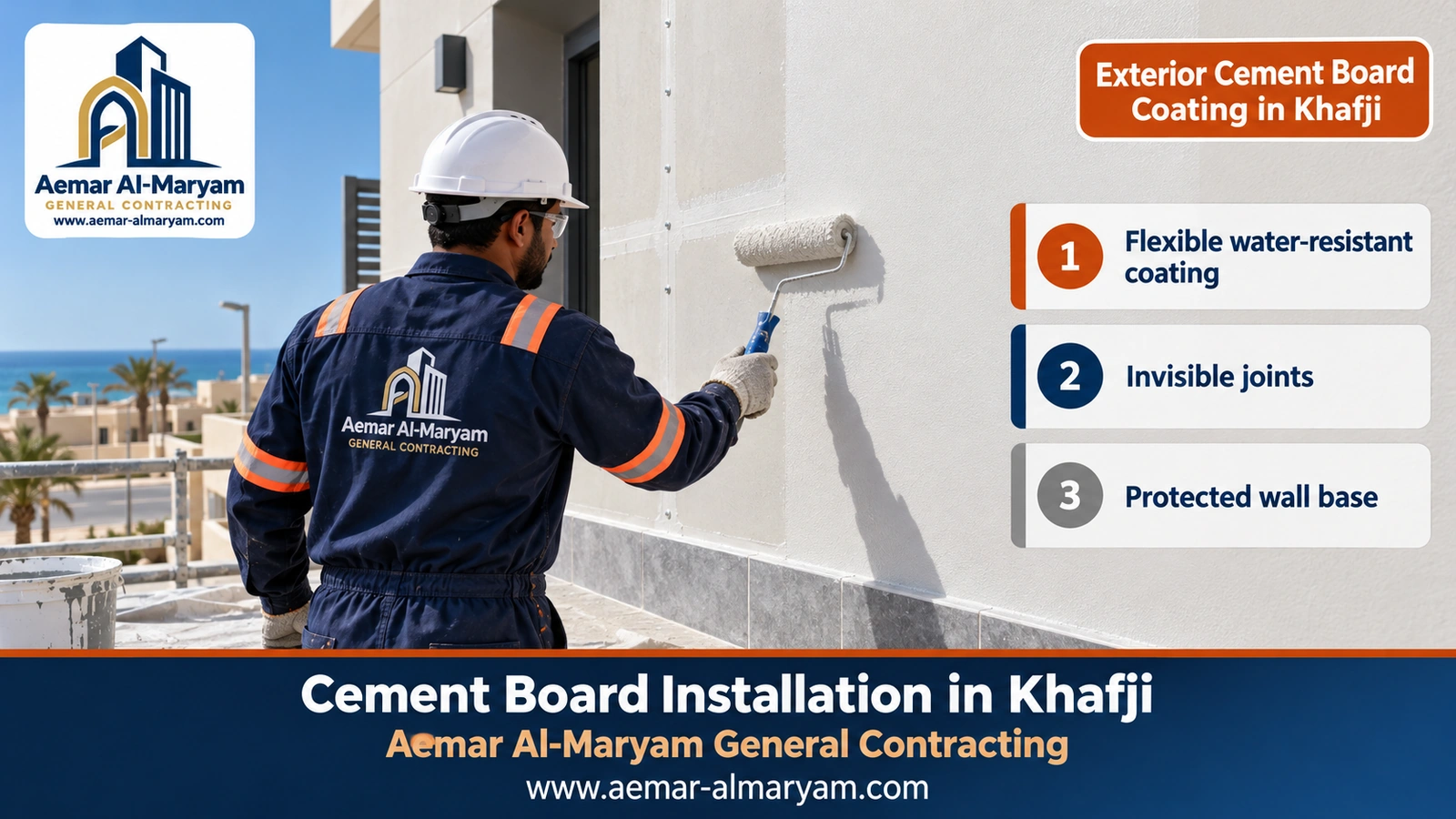
Treating the Joints Before Coating
- 1A small gap between boards: 3–5 mm lets each board expand without pushing its neighbour.
- 2Alkali-resistant mesh tape: bedded in base coat over every joint and corner, wider on external corners.
- 3A full base coat: over the whole face of walls looking onto the sea, with mesh covering the surface.
- 4Full curing: no coating goes on before the base coat is dry, and high humidity lengthens that wait, so we give it the time it needs.
- 5Two coats of elastomeric finish: by roller or spray, at an even thickness that hides the joints.
Tiled Skirting at the Foot of the Wall
The foot of the wall works hardest on a chalet: wind-blown sand scours it, water from washing the porch and cars splashes it, and chairs and trolleys knock into it. So we clad the lower part with a tile or stone skirting at a suitable height, fixed with exterior adhesive over the treated board, and seal its top edge so water cannot get behind it. The skirting also gives the facade a clean line separating ground from wall. We keep the coating colour light, such as stone white or sand, because it reflects the sun and lowers the wall’s temperature. Our other finishing work is on the finishing page.
Delivering and Storing Cement Boards on a Khafji Site
Because Khafji is far away, we deliver the boards for the whole project at once, and storage on site becomes part of the quality of the work. A board left overnight on wet sand or in the rain absorbs moisture, and it may crack or bow if fixed before it dries; its edges break if it is laid on uneven ground. So on every site we follow these rules:
- ●Off the ground: pallets are craned onto closely spaced timber bearers so no board touches the sand or sags between supports.
- ●Under cover: boards stay in their plastic wrap, with a tarpaulin pulled tight over them against rain, spray and dust, leaving some ventilation so condensation does not form underneath.
- ●On level ground: we prepare the storage spot before the truck arrives, close to where we will build so boards are not carried far.
- ●Carried on edge: at around 45 kilos per 12 mm sheet, boards move upright on their long edge between two installers, never flat, so they cannot snap across the middle.
- ●Screws and small items: kept in closed boxes on site, because salt reaches exposed screws even before they are used.
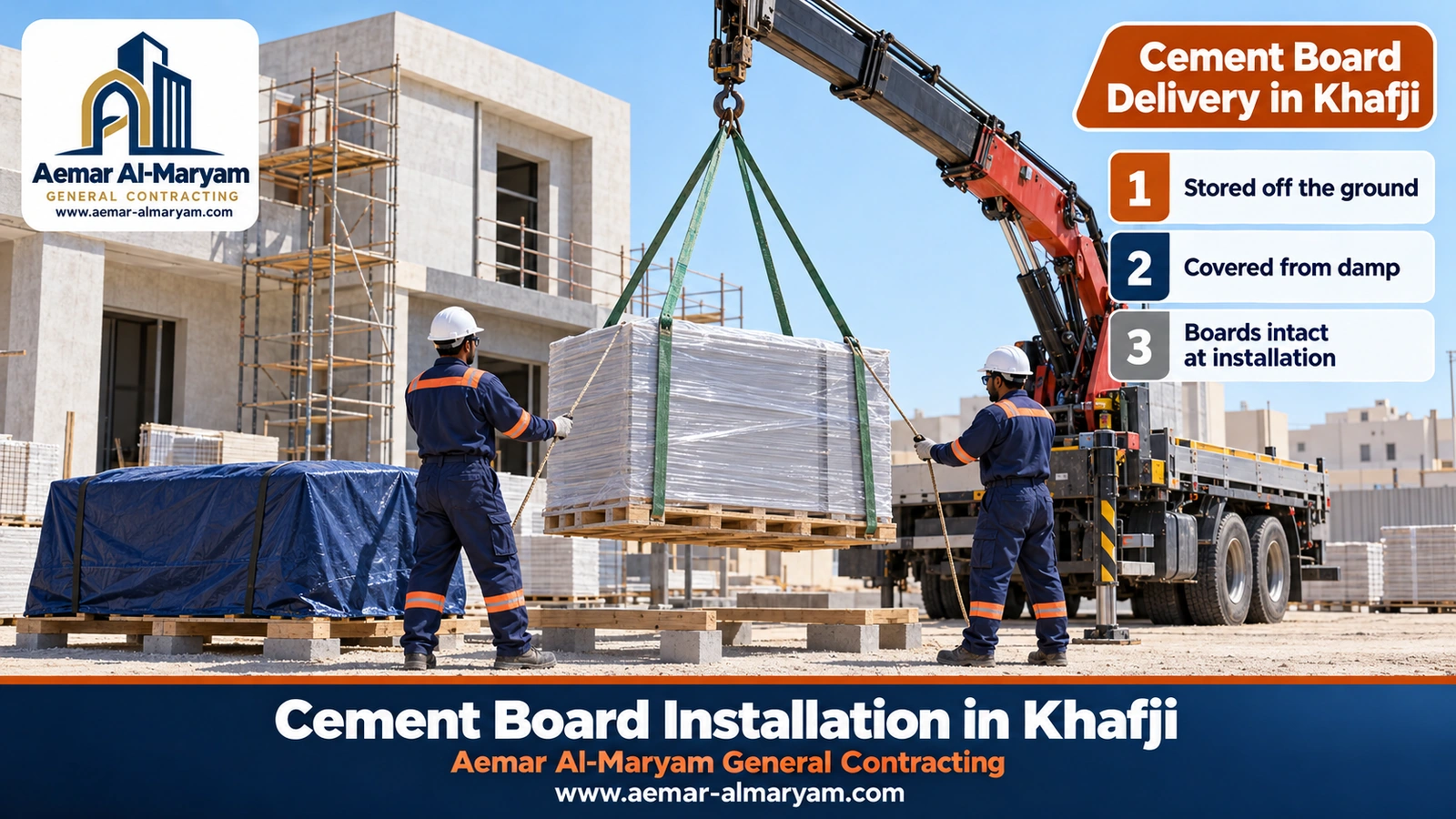
When the load arrives we check it before the truck leaves: we count the boards, match their thickness to the order, set aside any board with a broken edge or a crack, and confirm the screws are the corrosion-resistant type the coast requires. A shortfall found on delivery day is solved before fixing starts; one found halfway through means the crew standing idle in a distant city waiting for a new shipment.
Prepare the site before delivery day
Send us a photo of the plot entrance and the street width, and pick a level storage spot near the build. A crane truck that can pull up beside the site saves hours of carrying by hand and protects the boards from breakage.
Cement Board in the Khafji Coastal Climate
Khafji’s weather combines summer heat, high humidity off the sea, salt carried on the wind and sand lifted by it. Each of these needs a specific answer on site:
■ Salt
Stainless or coated screws, treated cut edges on the galvanised studs, and a continuous coating over the whole board.
■ Humidity
A water and air barrier behind the board, a vapour barrier on the warm side, and ventilated porch ceilings.
■ Spray and rain
Sealant around openings, sills sloping outwards, and a tiled skirting at the foot of the wall.
■ Sand and wind
Closer studs on the exposed facade, sealed joints, and no opening in the wall left unsealed.
This is exactly why gypsum board will not do as an exterior wall in Khafji: its makers require it to stay dry, it suffers under long periods of high heat, and sea humidity ruins it quickly. Its place is ceilings and dry interior walls only.
The Sea-Facing Facade Is Not the Same as the Back Wall
On a single chalet, the walls face very different conditions. The facade looking at the sea takes the salt-laden wind and spray head on, so we place its studs closer, cover its whole face with mesh and base coat rather than the joints alone, and take extra care sealing its large windows. The back wall, sheltered by the building itself, is well served by the usual treatment of joints and corners. This is not cutting corners on one side; it means spending effort and materials where the wall truly needs them, keeping the price reasonable without weakening the most exposed face. We also allow for the sun: the west facade heats up more in the afternoon, so it benefits from a light colour and a shading porch.
Insulating Cement Board Chalets and Rooms in Khafji
Insulation in a coastal chalet has two jobs: slowing the summer heat and stopping moisture condensing inside the wall. We fill the cavity between studs with rock wool, because it is not affected by damp the way some materials are and does not burn easily, and add a vapour barrier on the inside where the chalet is air-conditioned most of the time, so humid air never meets a cold surface inside the wall and condenses on it. The roof is an insulated sandwich panel with a fall that sheds rain away from the walls. For insulating the existing concrete roofs of the villa itself, see our waterproofing and insulation service.
Cement Board Rooms in Khafji: What Does a 4×4 Room Cost?
A cement board room in Khafji is usually built in a villa courtyard as a guest or driver room, or forms the core of a small chalet. To see how the cost adds up, take this illustrative example: a room 4 metres long, 4 metres wide and 3 metres high. Its four walls total 48 square metres, and at the starting price of SAR 185 their share is SAR 8,880. Its sandwich-panel roof is 16 square metres at SAR 125, which is SAR 2,000. That brings the insulated envelope to roughly SAR 10,880; the door, window, electrics, floor, final coating and skirting are then priced after inspection.
The courtyard room most requested at Khafji villas is a driver room with a small bathroom, often in a corner of the courtyard against the boundary wall. If that wall is sound and straight we use it as a back wall, building the frame in front of it with a gap that leaves room for insulation, raising the room above the courtyard floor and keeping its door out of the path of car-washing water. We agree the positions of the water tank and heater with the owner before starting, because hanging them on a light wall needs backing inside the frame.
If the room is part of a chalet, the sums change: a 5 × 6 m chalet, for example, has 66 square metres of exterior wall (SAR 12,210) and a 30 square metre roof (SAR 3,750), about SAR 15,960 for the envelope before internal partitions, bathroom and kitchen.
Cement Board Annexes in Khafji
If you want a light annex at your Khafji villa, cement board offers a fast solution with less weight, well suited to one or two rooms with a bathroom. A full guest annex with a pantry kitchen, or a majlis you want permanently in blockwork, has its own page, annex and majlis building in Khafji; it prices a blockwork shell from SAR 830 for each square metre the annex covers, and a standard-finish annex from SAR 1,200, with an explanation of the permit amendment on Balady. Our annexes and majlis page brings all annex types together.
Building by the Sea: Cement Board, Block or Gypsum Board?
| Question | Cement board | Block | Gypsum board |
|---|---|---|---|
| Suitable for a sea-facing facade? | Yes, with an elastomeric coating and rust-proof fixing | Yes, with good render and waterproofing | No |
| Weight on the slab | Light | Heavy; needs footings | Light |
| Build time | Days for frame and boards | Weeks | Quick, interior only |
| Biggest risk in Khafji | Rusting screws and cracked joints if neglected | Salts rising in the wall and flaking render | Breaking down in humidity |
| Best suited to | Chalets, light annexes, courtyard rooms | Large permanent buildings | Dry interior ceilings and partitions |
We often use cement board outside and gypsum board for the ceilings of air-conditioned interior rooms; our guide to gypsum board in Dammam explains its types and uses, as does our gypsum service page.
Cement Board Price With Installation in Khafji
No Khafji contractor publishes installed cement board rates, so our figures here mirror our Dammam list, Dammam being the closest city with published prices. Getting the crew and tools to Khafji is costed on top, after the site visit, in proportion to the work.
| What we build | Unit | From |
|---|---|---|
| Insulated exterior wall: 12 mm board, rock wool and an inner board on galvanised studs, materials and fixing | m² of wall face | SAR 185 |
| Interior partition, two faces with insulation | m² | SAR 185 |
| Recladding an existing facade with 12 mm boards, mesh and base coat, before the elastomeric coating | m² | SAR 148 |
| Suspended porch ceiling in 6–8 mm boards | m² | SAR 120 |
| Room roof in sandwich panels, 5 cm thick | m² | SAR 125 |
| Labour to fix the client’s materials | m² | SAR 46 |
| Final elastomeric coating and tiled skirting | — | At inspection |
| Bathroom with cement backer and waterproofing | — | At inspection |
Estimated figures, confirmed after inspection and agreement. They rise with greater height, denser fixing on the sea facade or a higher finish, and the travel share drops as the job grows. All our prices.
Cement Board Sheet Price
If you are looking for the price of the sheet itself, prices advertised in the Kingdom for a 122 × 244 cm sheet begin at around SAR 55 for a relatively thin 9 mm board and reach about 75 for 10 mm, while a 12 mm board usually falls between SAR 85 and 110, varying with the supplier and order size. We do not sell sheets on their own; we quote these figures to show how little of an installed square metre the board itself represents; the rest covers the frame, rust-resistant screws, insulation, mesh, base coat and labour.
Example: Recladding an Existing Annex in Khafji
Take an old annex in Khafji whose render has flaked from salt, with 40 square metres of exterior wall. Once the cause of the damp has been dealt with, recladding it in boards with mesh and base coat costs about 40 × 148 = SAR 5,920 as an estimate, with the elastomeric coating and skirting added after inspection. How we deal with the salts themselves is set out on our Khafji renovation page.
Working in a Distant City: One Visit, Grouped Jobs
- ●Put everything you need into one request: the chalet, the driver room and the boundary-wall cladding together.
- ●If a neighbour needs similar work, coordinating the date spreads the travel cost over more than one site.
- ●If the slab is not poured yet, our construction team can cast it on the same trip.
- ●Where you can, size rooms in steps of 1.2 m so fewer boards are cut and wasted.
Inside the Chalet: Bathroom, Kitchen and Electrics
Inside a chalet, moisture comes from another direction: showers after swimming, washing up, wet clothes. So we build every bathroom wall in cement board rather than gypsum, lay a waterproof membrane across the floor and carry it well up the walls around the shower, and seal every joint and screw head before the tiler starts. The board does not break down in water, but water passing its joints reaches the steel studs behind, and the waterproofing is what stops that. In the small kitchen we also use cement board behind the sink and hob and tile it for easy cleaning, with backing inside the frame where the wall cupboards will hang.
Electrics in a chalet need planning before the walls are closed: conduit inside the frame rather than loose cables between insulation layers, a dedicated breaker for the chalet in the panel, earth-leakage protection in the bathroom and kitchen, and covered outdoor sockets on the porch. We set the AC position, the route of its drain pipe and its wall opening before boarding, and seal the opening with flexible sealant once the pipes are through. Final electrical work and connection are carried out by a qualified electrician according to the requirements of the relevant authority.
Cement Board Installation Time in Khafji
Framing, boarding and insulating a small chalet or courtyard room is quick work once the slab has cured: a few working days in most cases. Then comes the stage many people rush and regret: joint treatment and base-coat curing, which in Khafji’s humidity takes longer than in a dry city, and we never apply the elastomeric coating before the base coat is fully dry. So we plan the schedule to finish a complete stage each time the crew is on site, and use the curing time for interior work such as the bathroom and partitions. You receive the detailed schedule in writing after inspection.
Cement Board Installation Steps for a Khafji Chalet
- 1Photos and sizes: photos of the plot, the sea and the wind direction, plus the chalet or room dimensions, on WhatsApp.
- 2Inspection: we check the ground level, the distance to the sea, truck access and the storage spot.
- 3Slab and damp-proofing: a slab standing proud of the sand, with a damp-proof course beneath the base track.
- 4Delivery and storage: boards set down on bearers and covered until fixing.
- 5Frame: galvanised studs at closer centres on the sea facade, with every cut edge treated.
- 6Barrier and services: a water and air barrier, and electrical and plumbing conduit before closing.
- 7Boards: stainless screws, staggered joints, and flashing tape around openings.
- 8Insulation and inner face: rock wool, a vapour barrier and the inner board.
- 9Joints and base coat: mesh and base coat, then patience while it cures in the damp air.
- 10Finish and handover: elastomeric coating, tiled skirting and sealant, followed by a joint inspection.
When cutting boards we work in an open spot away from neighbours and downwind, using a saw with extraction or scoring and snapping, and we wear masks because board dust contains silica; offcuts and dust are collected with a vacuum.
Common Cement Board Mistakes on the Khafji Coast
■ Black screws near the sea
Rust within a short time, and brown stains over every screw in the paint.
■ Cheap silicone around windows
It cracks in the sun and water leaks behind the board.
■ Boards stored on sand
They absorb moisture, bow and chip at the edges before fixing.
■ Ordinary rigid paint
It cracks over the joints as the wall moves and opens a path for water.
■ A wall with no skirting
The foot of the wall wears first from sand and water.
■ Untreated cut edges
Rust starts at the cut on the galvanised stud.
Looking After a Cement Board Chalet After Each Season
A chalet used in season and shut the rest of the year needs a quick look twice a year, ideally before summer and after winter:
- ✓Check the sealant around windows and doors and renew any part that has cracked or come away.
- ✓Wash the facade with fresh water to remove the film of salt and sand, without aiming a high-pressure jet straight at the joints.
- ✓Look for brown spots over screws or hairlines over joints and deal with them early.
- ✓Make sure the porch floor still sheds water away from the wall.
- ✓Renew the elastomeric coating when it fades or loses its flexibility, before water reaches the base coat.
How to Order Cement Board Installation in Khafji
- 1Message us on WhatsApp 0547879578: photos of the plot or building, the dimensions, and what you want built.
- 2Show how close the site is to the sea: a photo showing the distance to the beach helps us choose the fixing and finish.
- 3Photograph the truck access and storage spot: so we can plan the delivery before we arrive.
- 4Receive the estimate: an initial estimated cost, then an inspection date.
- 5Agree and build: we confirm price and schedule, and arrive with all the materials.
What Sets Aemar Al-Maryam Apart in Khafji
- ✓We build the chalet as a coastal building: rust-proof fixing, sealant, elastomeric coating and skirting.
- ✓We protect the boards from the moment they arrive until they are fixed.
- ✓Clear starting prices and worked examples before you agree.
- ✓We plan work in a distant city with one inspection visit and a complete delivery.
- ✓We hand over the chalet after a joint inspection, with a seasonal maintenance checklist.
- ✓Browse finished jobs on our projects page.
Where We Work in Khafji
We reach any site in Khafji and along its coastline, chalets, villas and houses alike, and fix the appointment according to your location and the size of the job. For more about our services there, see the Khafji area page. Our crews also fit cement board in Al-Ahsa and in Hafr Al-Batin; for the complete system explained step by step, read our Dammam cement board guide.
A chalet or annex in Khafji?
Send the photos, sizes and how close the site is to the sea, and we will reply with a cost estimate ahead of the site visit.
Related pages
Tags