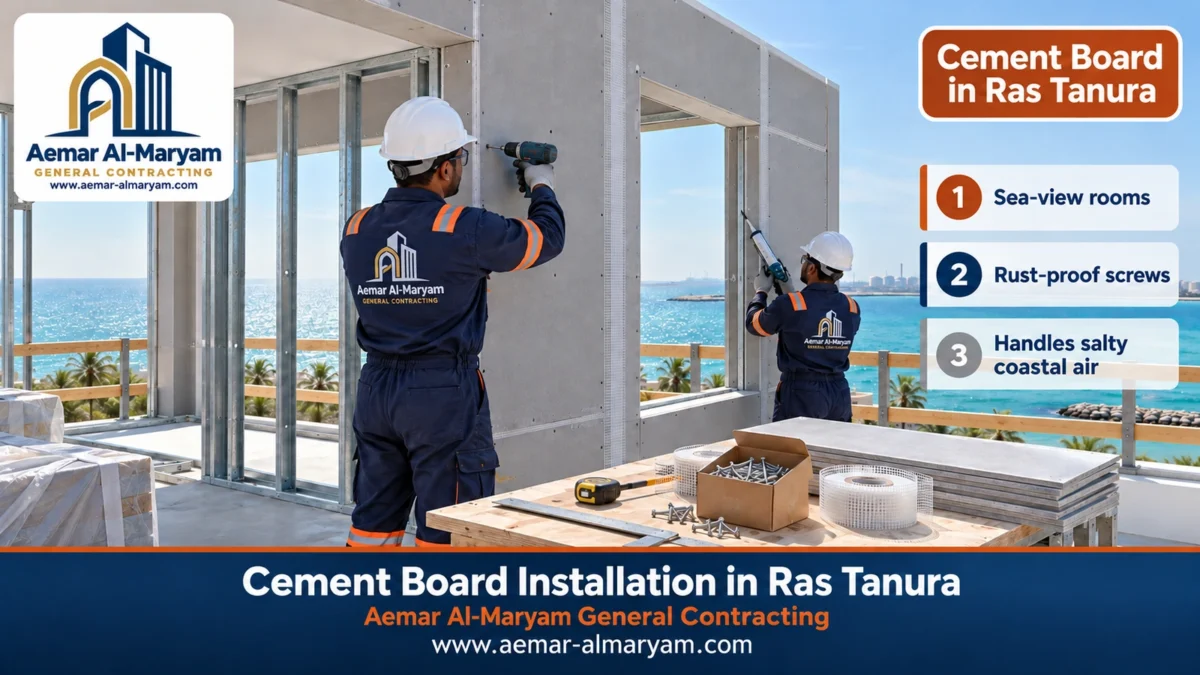
Anyone who builds near the sea in Ras Tanura soon learns that salt goes after the screws long before it goes after the walls. So when we are asked for cement board installation in Ras Tanura, our first question is not “how many square metres?” but “where does the sea air come from?” A wall facing the water needs stainless steel screws, movement joints sealed with a flexible sealant, and a breathable moisture membrane before it needs any attractive paint. We are Aemar Al-Maryam General Contracting, working from Dammam across Ras Tanura and Rahima on scheduled visits. Insulated walls open at 185 riyals per square metre with materials and fitting, a first figure we confirm after seeing the site. Phone or WhatsApp: 0547879578.
What we build most here are sitting rooms on the roofs of seafront villas, with wide windows toward the water, annexes in the gardens of homes near the beach, and new cladding over facades worn down by humidity. The same rule applies to each: the cement board can take the sea, but it is the framing, the fixings and the joint detailing that set how long the wall lasts. This page walks through those details one at a time, then covers prices and how we organise the work.
Cement board in Ras Tanura: what you need to know
- The core idea: the board tolerates salt; the risk lies in fixings, frame and joints, so that is where we focus.
- Marine details: stainless screws, a galvanised frame, movement joints sealed with flexible sealant, a breathable membrane behind the boards, and bottom edges raised and sealed.
- What we build: sea-view roof sitting rooms, garden annexes, facade and fence cladding, and service rooms.
- Opening rates: insulated wall 185 riyals/m², facade cladding 148, thin terrace soffit 120, roof-room panel roof 125; first figures that inspection confirms.
- Scheduling: Dammam-based crew on dates fixed in advance for Ras Tanura and Rahima, each stage arriving with its full materials.
- Send us: photos of the roof or facade, the direction of the sea and rough sizes on WhatsApp 0547879578.
Cement Board in Ras Tanura: Does It Work Near the Sea?
Yes, cement board in Ras Tanura works for homes near the sea, provided it is installed with coastal detailing. The board is made of cement, silica sand and fibres; moisture will not soften it as it softens gypsum, and it cannot rust the way steel does. The problem near the sea is not the board but what holds it: the screw that rusts, the unprotected steel section, and the tight joint that cracks and lets salty water in. That is why an ordinary cement board wall looks fine on handover day, then a few months later shows brown spots at the screws and fine lines along the joints.
The common board size is 1.2 × 2.4 m. Exterior walls usually take 12 mm, inner faces and partitions 9 mm, and suspended ceilings on terraces and covered walkways 6–8 mm. One maker lists a full 12 mm sheet at roughly 45 kg, a number that matters once we start loading a roof with a room.
In other words, the question for a coastal home is less “cement board or not?” and more “cement board installed how?” The rest of this page answers that.
Cement Board in Ras Tanura’s Climate: What Does Salty Air Do?
Ras Tanura’s climate is coastal through and through: high humidity most of the year, a breeze carrying salty spray that settles on every surface, and strong summer sun that heats the walls by day before they cool at night. That daily cycle is what separates a coastal wall that lasts from one that tires quickly, and its effect shows in four places:
■ Fixings
Salt plus humidity speeds up rust on ordinary screws, so spots show through paint and the grip weakens.
■ Steel frame
A section that is not galvanised, or is scratched, rusts inside the wall where nobody sees it.
■ Joints
Daily expansion and contraction of the boards cracks any joint that is pressed tight or filled with something rigid.
■ Board bottom edge
If it touches the ground it soaks up salty water from washing, spray and rain.
So we design a coastal wall to keep water away from the steel, let any moisture that does get in escape, and give the boards room to move without cracking. The next sections show how we achieve those three aims.
Stainless Screws and a Galvanised Frame for Sea-Facing Walls
The screw is the smallest part of the wall and the first to fail near the sea. On sea-facing walls in Ras Tanura we use stainless steel screws made for cement boards, fixed into the studs roughly every 200–300 mm and about 15–20 mm in from the board edge, with the depth set so the head sits flush rather than sinking and breaking the board face. The frame is galvanised steel, and every cut or hole in it is touched up with a zinc-rich coating before closing, because a scratch in the galvanising is where rust begins.
On walls exposed to sea wind we bring the studs closer, to around 400 mm instead of 600, so the boards do not flex in strong gusts and work the screws loose in their holes. We also separate the bottom track from the concrete with an isolating strip, since steel in contact with damp, salty concrete corrodes faster.
On the cost of stainless screws
The price difference for corrosion-resistant screws is small against the installed rate per square metre, yet it makes the biggest difference to a wall’s life near the sea. At inspection we decide which walls need them: sea-facing elevations always, while interior air-conditioned walls may not.
Sealed Movement Joints in Cement Board Walls in Ras Tanura
A movement joint in a cement board wall in Ras Tanura is a deliberate gap between boards, or between a board and another material, filled with a flexible sealant instead of rigid base coat, so the wall can grow and shrink with heat and humidity without cracking. It is not the same as the normal 3–5 mm gap between sheets, which gets alkali-resistant mesh tape pressed into base coat; a movement joint is not meshed over but stays flexible, either visible or hidden under a special profile.
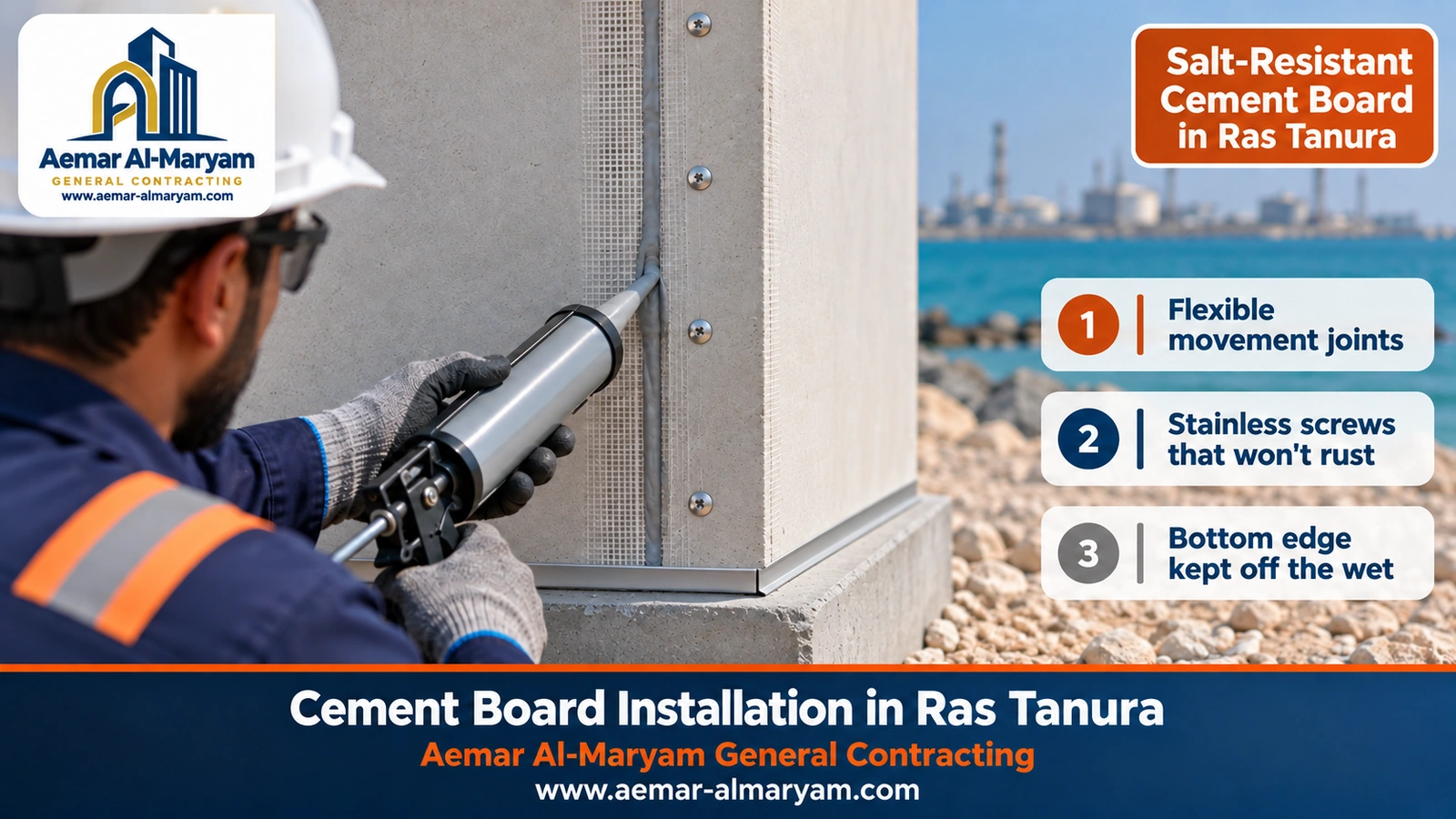
Where do movement joints go? Along long walls at intervals set by the board manufacturer, where a cement board wall meets block or a concrete column, where long walls turn a corner, and around wide window frames. Our rule is never to force two different materials to move as one: concrete, steel and board all expand by different amounts, and a flexible joint absorbs the difference.
- 1Clean the joint: remove dust and salt from the board edges before any material goes in.
- 2Backer rod: a flexible foam rod in the joint sets the sealant depth and stops it bonding to the back.
- 3Primer: a primer on the board edges where the sealant maker requires it.
- 4Sealant: a flexible exterior-grade sealant gunned in and tooled smooth.
- 5Finish: a paint that tolerates movement over the sealant, or the joint left visible in a matching colour.
Breathable Membranes Behind Cement Board in Ras Tanura
The membrane we wrap around the frame of an annex or roof room in Ras Tanura is a water- and air-resistive layer that lets water vapour through. In other words, it stops water coming in from outside from reaching the steel and insulation, while letting moisture that forms inside the wall escape rather than condense and stay. That matters near the sea, because a membrane that does not breathe can trap humidity inside the wall on muggy summer nights, rusting the frame from within.
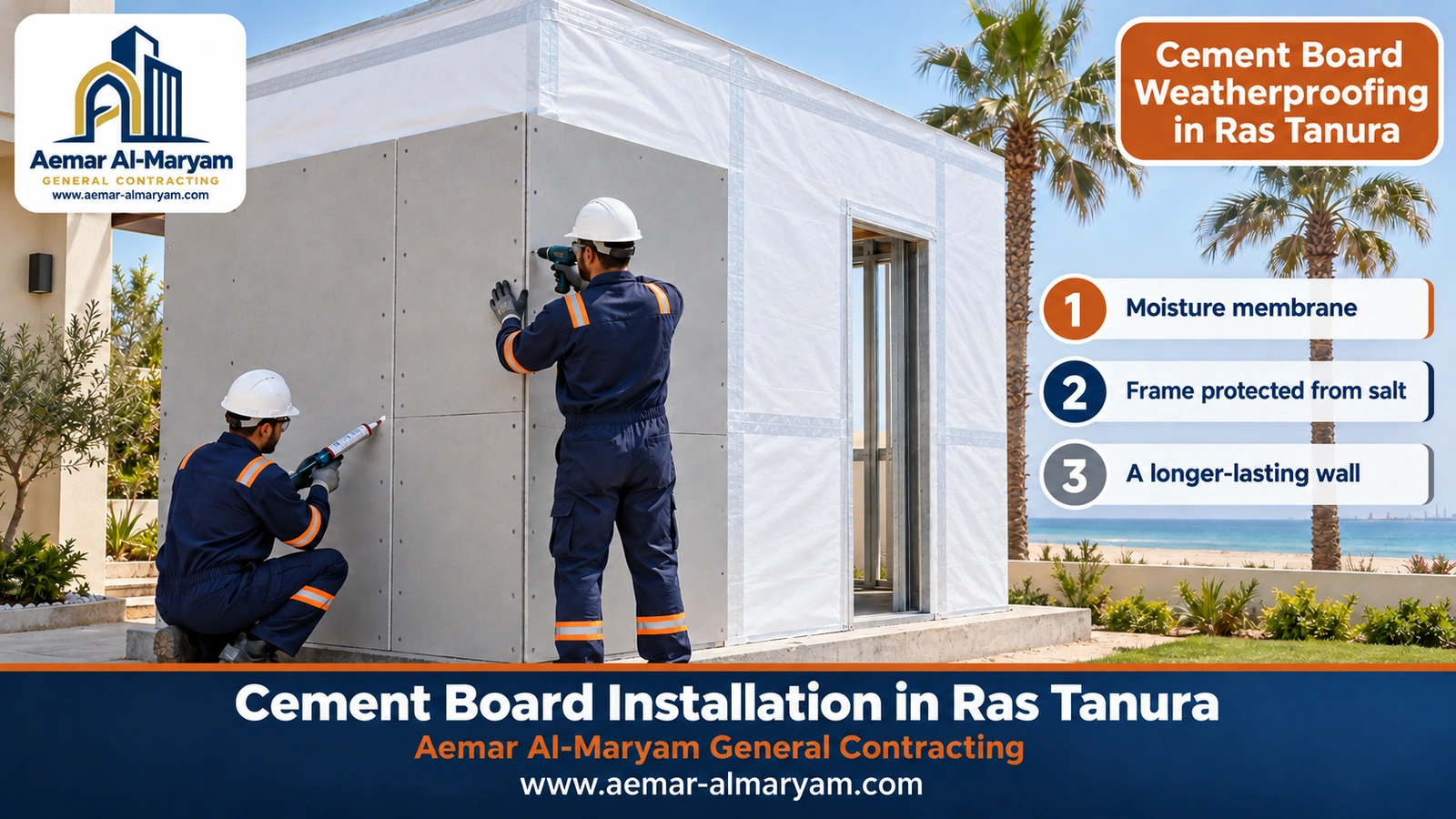
How it is installed decides whether it works. We start at the bottom of the wall and work up, so each run overlaps the one below like roof tiles and water sheds outward, not inward. Laps are taped with a dedicated tape, the membrane is wrapped into window and door openings before frames go in, and the bottom is left with an outlet for any water that reaches it. Boards are then fixed over it without tearing it, and any puncture is taped. Whichever membrane we use follows the board system manufacturer’s specification, as some systems require a particular type behind the board.
Sea-View Sitting Rooms on Villa Roofs in Ras Tanura
A roof sitting room in Ras Tanura is a light cement board room on a galvanised frame, with wide windows facing the sea and an insulated sandwich-panel roof, built on a villa roof once an engineer approves how its loads transfer to the existing columns and beams. It is among the most rewarding things we build here, and also the most exposed to salty air and wind, because it is the highest point of the house and the closest to the sea breeze.
These rooms have their own details. Wide windows mean large openings in the frame, so we surround them with doubled studs and headers, wrap the membrane inside them, and leave a sealed movement joint around each frame. Frames are best in aluminium with a coating suited to coastal conditions, with corrosion-resistant fixings. Fixing to the roof follows a method the engineer sets, resisting wind without piercing the existing roof waterproofing untreated. Shading, a small canopy or a roof overhang above sun-facing windows, reduces heat and protects the sealants.
Owners often ask us about glass and window types. Double glazing cuts the heat of sunlight reflected off the sea and softens wind noise. Wide sliding windows give an open view but need clean drainage tracks, since sand and salt collect in them, while fixed panes need the least maintenance. We often suggest a mix: a large fixed pane toward the sea, with sliding side sections for ventilation on winter evenings. Whatever the choice, frames go in only after the membrane is wrapped into the opening, and their perimeter is sealed with a flexible sealant, never with base coat.
Before choosing where the room goes
Place the room so it does not cut across the roof’s rainwater falls, and leave maintenance space around tanks and AC units. Send us a photo showing the direction of the sea, as we use it to decide which walls get the full marine detailing.
Cement Board Installation in Ras Tanura: What We Build
Cement board installation in Ras Tanura covers the frame, membrane, insulation, boards, ordinary joints and movement joints, then the finish or preparation for it. The dry-board services page brings every type together. What we build most here:
■ Roof sitting rooms
With a sea view, wide windows and details that resist wind and salt.
■ Garden annexes
An annex or guest room near the beach, with a membrane-wrapped frame and exterior boards.
■ Facade and fence cladding
A new board on a light frame over an existing wall worn by humidity, after treating the cause.
■ Terrace and walkway ceilings
Thin cement board ceilings that do not break down in humidity like gypsum.
■ Service and driver rooms
On a raised base with sealed bottom edges, away from wash-down water.
■ Tile backing
In annex bathrooms, with a waterproofing layer over the board.
We do not sell loose cement boards
If you were hoping for a shop, we are not one: our trade is installation, and boards and studs reach you only as part of a finished job. Materials you already bought can be fitted for a labour charge once we have inspected them, and we will tell you plainly if the screws or studs are not suited to sea air.
Exterior Cement Board in Ras Tanura: Layers of a Coastal Wall
Exterior cement board in Ras Tanura is a wall of six layers, each with a job in facing the sea. From outside in:
| Layer | Our choice | Its role near the sea |
|---|---|---|
| Finish | Pale elastic paint, or a textured coat | Protects the board, reflects heat, and washes free of salt |
| Base coat and mesh | Mesh tape on each joint and corner, full mesh over elevations open to the weather | Prevents hairline cracks that let water in |
| Board | 12 mm with 3–5 mm gaps, staggered, cut edges sealed | The solid wall itself |
| Membrane | Water- and air-resistive, vapour-permeable | Protects the steel and lets the wall dry |
| Frame and insulation | Galvanised studs around 400 mm on wind-exposed walls, rock wool | Carries and insulates the wall |
| Fixings | Stainless steel screws | Prevent rust spots and loss of grip |
Inside, we use 9 mm cement board where the room may see moisture, or gypsum board where it will be dry and air-conditioned.
The finish can be a white or light paint in keeping with coastal villas, a textured render that hides minor waviness, or light cladding for a distinctive look. What we care about more than colour is that the materials are exterior-grade and tolerate movement, which we coordinate with our finishing team.
Cement Board Installation Prices in Ras Tanura
In Ras Tanura we price cement board by the square metre. An insulated two-faced wall opens at SAR 185, cladding for a facade or boundary wall at SAR 148, and fitting alone, for owners who already have materials, at SAR 46. The marine details stay a separate line that we assess once we have stood on site and counted the walls that genuinely face the water, because a house in the first row on the beach is not the same as one screened by its neighbours.
| What we build | Measured as | Rates open at |
|---|---|---|
| Room wall faced both sides on galvanised studs with rock wool between, materials and fitting | m² of wall | SAR 185 |
| Internal dividing wall, two boards with insulation | m² | SAR 185 |
| Facade or boundary-wall cladding in 12 mm board with joint mesh and base coat | m² | SAR 148 |
| Terrace or covered-walkway soffit in thin 6–8 mm board | m² | SAR 120 |
| Roof-room roof in 5 cm sandwich panels | m² | SAR 125 |
| Fitting only, with your own materials | m² | SAR 46 |
| Stainless screws, breathable membrane and sealed movement joints | — | Per site |
| Tile backer and waterproofing in an annex bathroom | — | Per site |
| Last coat of paint or render on the facade | — | Per site |
An opening estimate that inspection and agreement confirm; it shifts with board thickness, studs, insulation, height, how close the wall is to the water, the finish chosen and access, and any travel cost from Dammam is stated before you agree.
Cement board price with installation in Ras Tanura
With installation, cement board in Ras Tanura starts at 185 riyals a square metre for a wall insulated and faced on both sides, and at 148 for single-face cladding. Before comparing a rival quote near the sea, put three questions to it: are the screws genuinely stainless or merely plated? Does the membrane behind the boards breathe? Where will the movement joints be, and what fills them? Very often the price gap is simply the gap between those answers. Other services are listed on our prices page.
What one cement board sheet costs
| Sheet thickness (1220 × 2440 mm) | Published Saudi market range |
|---|---|
| 9–10 mm | around 55 – 75 riyals |
| 12 mm | around 85 – 110 riyals |
| 15–18 mm | around 130 – 170 riyals |
Published numbers for comparison only; we do not sell boards, and on a coastal wall the sheet costs less than the frame, membrane, insulation, stainless fixings, joint work and labour put together.
How much does a 4×4 cement board room cost in Ras Tanura?
A 4×4 room in Ras Tanura with walls three metres high needs 48 m² of insulated wall, which is 8,880 riyals at the opening rate, plus 16 m² of panel roof worth 2,000 riyals. In this worked illustration the insulated shell therefore lands close to 10,880 riyals. Doors, glazing, electrics, flooring and paint are added afterwards, together with whatever marine detailing the side facing the sea requires.
Cost examples for coastal rooms in Ras Tanura
| Room or job (illustration) | How we worked it out | Approximately |
|---|---|---|
| 4×6 sitting room on the roof, walls 3 m | 60 m² of wall = 11,100 and 24 m² of roof = 3,000 | SAR 14,100 |
| Garden annex, 4×5 | 54 m² of wall = 9,990 and 20 m² of roof = 2,500 | SAR 12,490 |
| Terrace soffit 3×5 in cement board | 15 m² at 120 | SAR 1,800 |
| Sea-facing facade cladding, 50 m² | 50 m² at 148 | SAR 7,400 |
We applied the opening rates without taking off openings; the figures leave out wide windows and their frames, the marine extras and finishing, all of which we review after inspection.
Cement Board Rooms and Annexes in Ras Tanura
Besides roof sitting rooms, in Ras Tanura we build guest rooms in gardens, driver rooms by the gate and small storerooms, each built the same way: galvanised studs wrapped in membrane, outer boards with the marine detailing, rock wool inside, and a panel roof laid to a slight fall. Rooms at ground level sit on a base lifted above the garden, because groundwater can be close to the surface on coastal sites, and we seal the bottom edge of the boards.
When the project is a complete annex or outdoor majlis, with footings, services and a permit, read the Ras Tanura annex and majlis guide, which also explains how concrete and rebar are protected near the sea. For an older facade damaged by salt that needs treatment before cladding, see renovation contractor in Ras Tanura. Our annex service in general is on the annexes and majlis page.
On the Coast: Cement Board, Block or Gypsum Board?
On the Ras Tanura coast we choose like this: cement board with full marine detailing for light rooms on roofs and for cladding; blockwork for big annexes at ground level and walls that carry load, provided the reinforcement is well protected; gypsum board solely as the inside face of a dry, cooled room. Ordinary gypsum board should never form an outside wall by the sea, since moisture ruins it, a point covered in our gypsum board guide.
| By the sea | Cement board | Block | Gypsum board |
|---|---|---|---|
| On an existing roof | Suitable after an engineer’s check | Heavy; the roof may not carry it | Inner face only |
| Facing the sea | Suitable with stainless fixings and sealed joints | Suitable with protected rebar | Not suitable |
| Weight | Light | Heavy | Lightest |
| Build time | Days | Weeks | Days |
| Our pricing | Opens at 185 riyals/m² insulated | In the Ras Tanura annex guide | In the gypsum guide |
Insulating Cement Board Rooms in Ras Tanura
Insulation in a cement board room in Ras Tanura is three things at once: thermal insulation from rock wool between the studs and the sandwich-panel roof, water resistance from the breathable membrane and sealed joints, and moisture control so humid sea air does not condense inside the wall. Rock wool suits the coast because it does not break down with moisture, resists fire well, and improves sound insulation against wind and waves. Details are on the waterproofing and insulation page.
How Our Dammam Crew Schedules Ras Tanura and Rahima
Our crew travels out of Dammam to Ras Tanura and Rahima on dates fixed with you beforehand, not whenever a gap appears. So we arrange the work in clear stages, each completed within its own visit:
- 1Inspection visit: we measure, photograph, note the direction of the sea and which walls get full marine detailing, and agree the items.
- 2Preparation in Dammam: a complete cutting list, reserved materials, and screws and sealants chosen for sea air.
- 3Frame visit: tracks, studs, membrane wrap, services and rock wool, checked before any board goes on.
- 4Boards visit: boards, movement joints, mesh and base coat.
- 5Finish and handover visit: paint or render, frame sealing, and a final check with you.
This approach cuts wasted days and lowers cost. Grouping more than one job at the same house, such as the roof room together with a terrace ceiling, or more than one house in the area, spreads the travel cost over more square metres.
Cement Board Installation Steps in Ras Tanura, in Brief
- 1Base: a bottom track on a raised base or on tracks over column lines, with a strip separating steel from concrete.
- 2Frame: galvanised studs around 400 mm on wind-exposed walls, doubled around openings.
- 3Membrane and insulation: a breathable membrane lapped bottom to top, and rock wool in the cavity.
- 4Boards: stainless screws at regular spacings, 3–5 mm gaps, cut edges sealed.
- 5Joints: mesh and base coat on ordinary joints, flexible sealant in movement joints.
- 6Finish: exterior materials that tolerate movement, then checking and handover.
Water, Heat and Fire: What Cement Board Tolerates in Ras Tanura
Treated joints and a finished face let cement board live with humidity, salt spray and rain; summer heat will not soften it the way it softens some plastic sheets; and the data sheets of many fibre-cement boards give them a non-combustible rating. Each property has limits, though, and knowing them avoids disappointment after handover:
- ●Water: it resists water without being a waterproof membrane, so bathrooms get a waterproofing coat on top, while outside the finish, the membrane and sealed joints protect it.
- ●Heat: it stays stable yet moves a little, hence the joints and movement joints; comfort inside depends on rock wool and an insulated roof, not on the sheet.
- ●Fire: we check the classification of the supplied board in its data sheet rather than assume every board carries the same one.
- ●Salt: it does not eat the board, but it eats unprotected steel and screws, which is the focus of every marine detail on this page.
When we advise against cement board by the sea
It is the wrong choice for a wall that must carry load, for a big room on a roof that no engineer has assessed, or when the owner wants to drop the marine details to cut the price. In that last case we would rather decline than build a wall we know will tire after two summers. For large ground-floor annexes, well-protected block may be the better option, and we say so plainly at inspection.
How Many Days a Ras Tanura Roof Room Takes
For a medium roof sitting room, the frame, membrane and boards go up within a few working days, after which joints and base coat need time to dry before finishing. Because we work on scheduled visits from Dammam, the project is spread over a series of consecutive visits, as described above, with dates written into the agreement. On very humid days or when the wind carries spray we may hold the sealing or painting stage for a day, because sealants need a dry, clean surface to bond properly.
Common Mistakes With Cement Board on the Coast
- ●Ordinary screws on a sea-facing facade: the first thing to appear after a few months is rust spots spreading around each screw.
- ●A membrane that does not breathe: it traps moisture inside the wall and the frame rusts from within.
- ●No movement joints in a long wall: the wall cracks at random instead of moving at a joint.
- ●Rigid base coat where cement board meets concrete: the junction cracks with the first summer.
- ●Unsealed cut edges: they absorb salty moisture around windows and openings.
- ●Boards touching the garden or roof surface: their bottom edges fail from water.
- ●Wide windows with no extra framing: the corners of the openings crack under wind pressure.
Maintaining a Cement Board Wall Near the Sea
- ✓Give the sea-facing walls a gentle fresh-water wash now and then to clear accumulated salt.
- ✓After each summer, look over the sealant at movement joints and window frames and replace any that has split.
- ✓Watch for any brown spot at a screw and deal with it early.
- ✓Repaint the exterior when it fades or shows hairline cracks.
- ✓Keep roof outlets and the ground round the room clear, so no water sits against the foot of the boards.
Ordering Cement Board Work in Ras Tanura, Step by Step
- 1Photos: pictures of the roof, garden or facade, plus one showing the direction of the sea, on WhatsApp 0547879578.
- 2Sizes and use: approximate length, width and height, and whether it is a sitting room, annex or cladding.
- 3Location: Ras Tanura or Rahima, and any access or working-hour restrictions.
- 4Estimate and date: we send an initial estimate from the photos and book the inspection.
- 5Agreement and schedule: we write down the items, marine details and visit dates.
What sets our coastal work apart
- ✓We design the wall for the sea: stainless fixings, movement joints and a breathable membrane.
- ✓Visits booked from Dammam, in stages that each finish within their visit.
- ✓Published starting prices, with any extra details explained before agreement, not after.
- ✓One crew for frame, boards, insulation and finishing; see our projects.
Areas covered on the coast
The city itself and Rahima, with particular attention to houses and villas near the beach; the Ras Tanura area page lists everything we offer there. For the whole system explained step by step, read the Dammam cement board guide; offices and warehouses are covered on the Jubail page, and gate rooms and roof screens inland on the Abqaiq page.
A roof room with a sea view?
Photograph the roof, mark which way the sea lies and add rough sizes; we come back with a first figure and a date for the Dammam crew.
Useful links for coastal homeowners
Tags