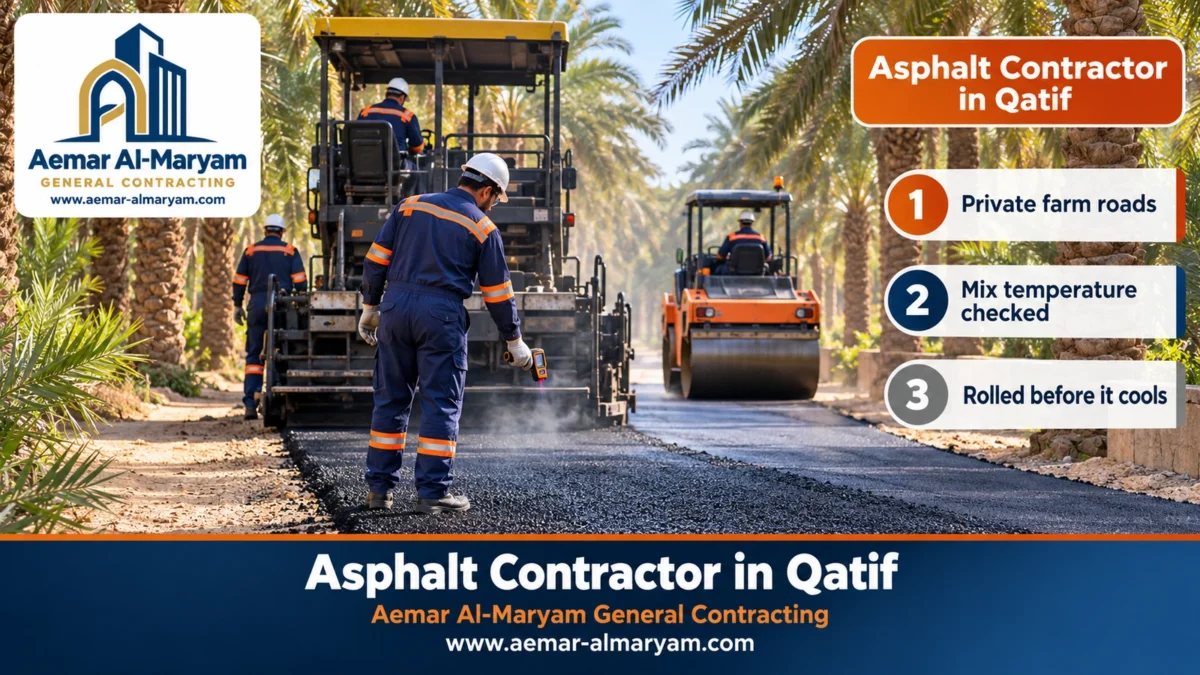
An asphalt contractor in Qatif is most often called for a private road that runs between palm groves inside a farm, for an older house yard whose asphalt is full of cracks, or for the open ground in front of a rest house that turns to mud after rain. At Aemar Al-Maryam General Contracting, our paving teams treat each of these sites for what it is: we dig out weak clay and replace it with compacted crushed stone, lay hot mix and check its temperature, and seal the cracks in old asphalt with hot rubberised sealant. Prices begin at SAR 37 a square metre where a firm base already exists and at SAR 74 when we build the road from the soil, as estimates until inspection and agreement; to reach us, ring or message 0547879578.
Qatif was a palm oasis long before it was a city, and that shows in the paving work here: farm owners who want a road that the family car and the fertiliser truck can use all year, ground that has been irrigated for decades until parts of it have become sticky clay, and houses whose yards were paved once long ago and then left alone. This guide starts with the price, because that is the first question everyone asks, then moves to farm roads, clay soil and the upkeep of older yards.
What this page covers
- Farm roads: shaping the route, a crushed-stone base, hot mix with its temperature checked, and hand laying on the bends between the palms.
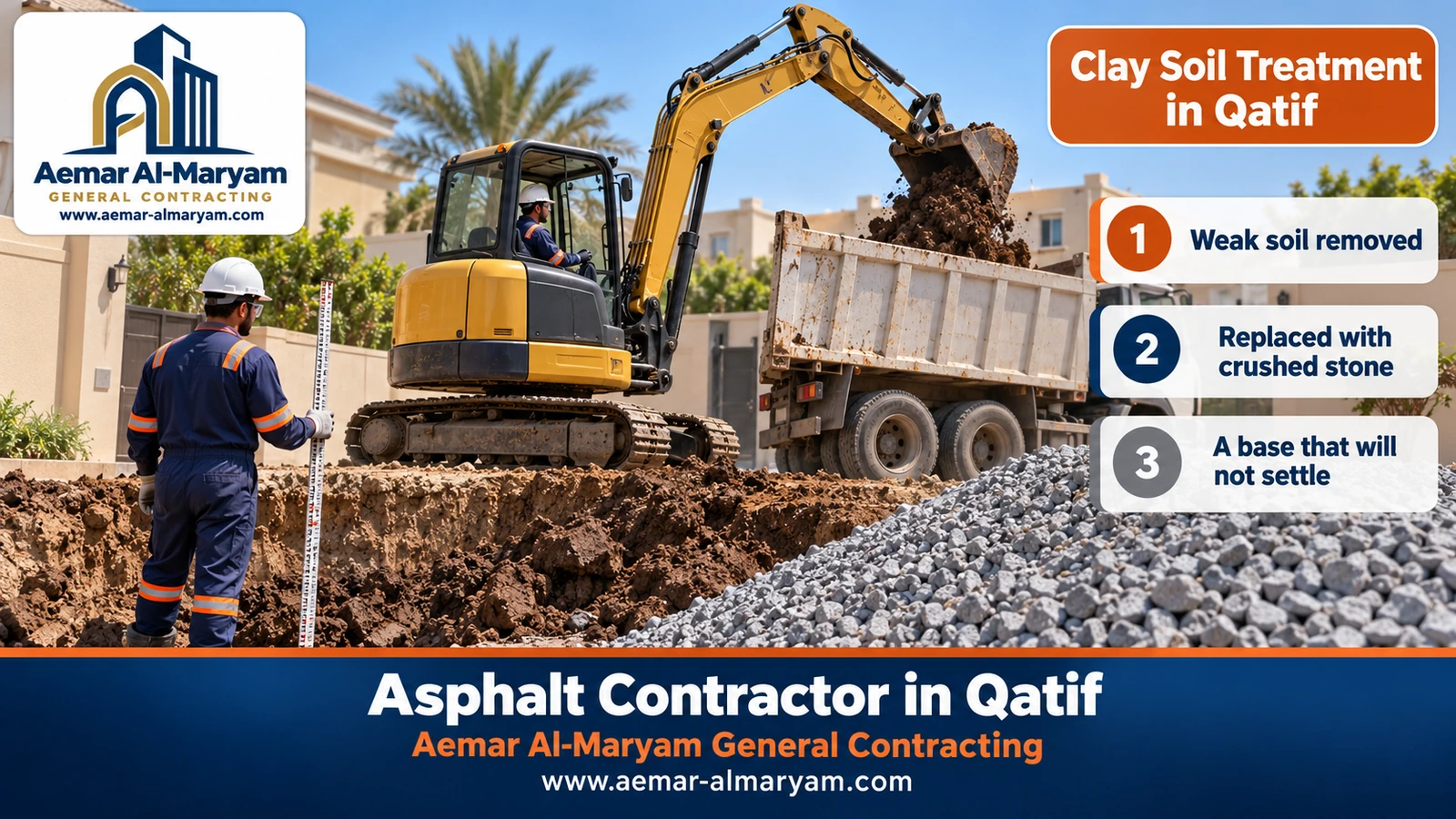
- Clay soil: the sticky layer comes out and is replaced with crushed stone compacted in layers; depth is decided after testing, not before.
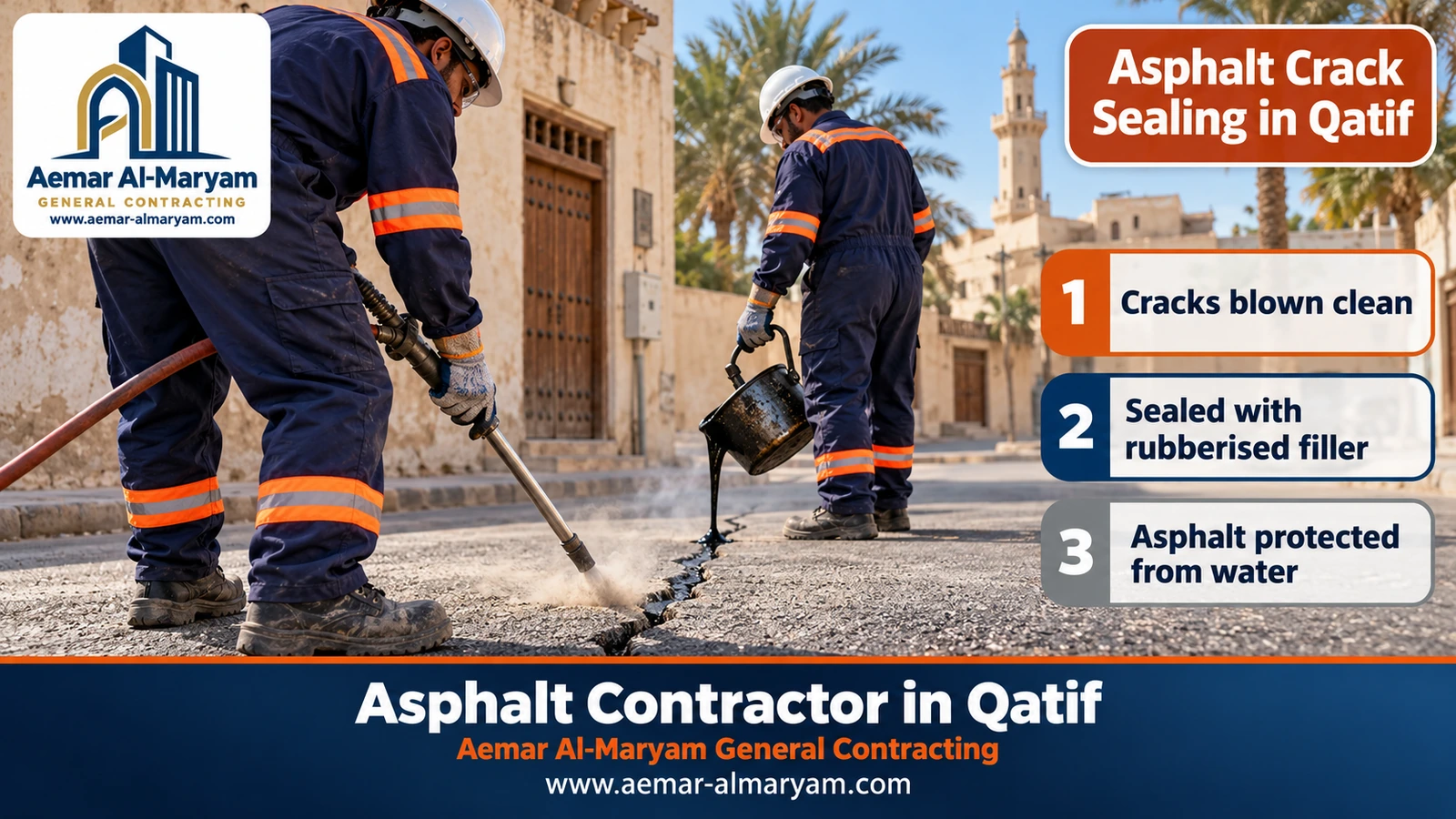
- Older houses: cracks cleared with an air lance and closed with hot rubber-based sealant, or a tired surface planed and re-laid.
- Price per square metre from: SAR 37 on firm ground, 74 when built from the soil, 38 to plane and re-lay, 46 for a stop-gap cold patch; transport set at the visit.
- Areas: Qatif city and its towns from Safwa in the north to Anak in the south, Tarout Island, and Saihat.
- Contact: pictures, dimensions and the soil type on WhatsApp 0547879578.
Asphalt price per square metre in Qatif
The asphalt price per square metre in Qatif uses the Dammam price list as its starting point. The one difference is that Qatif sits beyond our Dammam–Khobar–Dhahran triangle, so moving the equipment and crew gets its own figure once we have seen the site, based on distance and job size; we do not fix a number for it in advance. After that, your own figure depends on whether the soil needs replacing, how long and wide the road is, and whether a paver fits or the mix has to be laid by hand.
| What needs doing | Starting price | Note for Qatif |
|---|---|---|
| 5 cm of hot mix over an existing firm base | SAR 37/m² | Yards and plots that were filled and compacted before |
| 7 cm over an existing base for heavier vehicles | SAR 41/m² | Farm entrances used by lorries |
| Road built from the soil: grading, compaction, stone base, prime, then 5 cm | SAR 74/m² | Earth farm roads and rest-house yards |
| Mix with a polymer-modified binder | SAR 55/m² | Lorry parking and long-stay spots |
| Filling potholes for now with cold mix | SAR 46/m² | A quick fix until the permanent patch |
| Planing 3–5 cm of old asphalt and re-laying | SAR 38/m² | Older house yards with a sound base |
| Removing clay and replacing it with crushed stone | After inspection | Depth set after a trial pit |
| Sealing cracks with hot rubberised sealant | After inspection | Measured by crack length |
| Spreading and rolling millings | After inspection | For back tracks on farms |
| Permanent hot-mix patch after cutting the edges | After inspection | By number and size of patches |
| Moving equipment and crew to Qatif | After inspection | Its share per metre falls as the job grows |
How to bring the price per metre down in Qatif
Put your jobs into one visit: the farm road together with the rest-house yard, or your yard together with a neighbour’s. Taking the paver, the roller and a truck of mix to Qatif costs the same either way, so the more square metres share it, the less each one carries.
What the starting price leaves out
A starting price assumes ground that is ready for work. Anything that comes before that is listed separately, line by line: breaking out old asphalt, tiles or concrete and hauling the debris away, replacing clay, irrigation culverts under the road, kerbs along the edges, raising inspection chamber covers, and marking parking bays. Small areas, such as a yard of a few dozen square metres, cost more per metre than the table, because the paver, roller, truck and crew cost the same however small the job is.
Paving farm roads between the palms in Qatif
A farm road in Qatif is not a wide, straight street. It is a narrow track between rows of palms, with bends around trunks, irrigation channels crossing it, and edges that are watered all the time. The first thing we do at the inspection is walk the whole road and note three things: its narrowest point, which tells us whether a paver can get in or the mix must be laid by hand; the places where irrigation water crosses; and the type of soil under the surface.
Road width, trunks and roots
Where the road is wide enough for a paver we lay in one or two passes, and on the bends around the palms we finish by hand with shovels and lutes before rolling with a small roller. We keep deep digging away from palm trunks, and leave a margin around each trunk protected by a kerb or stones, so the heat of the mix and the weight of the roller do not reach roots close to the surface. Where old roots have pushed the ground up in one spot, we deal with it before the base, not after.
Irrigation channels and water
The worst enemy of farm asphalt is irrigation water seeping in from the sides and into the base. So we set the road slightly above the neighbouring beds, give it a side slope that sheds rain away from it, and where a channel crosses the road we agree with the owner on a culvert or pipe under the base, laid before paving. We never let the asphalt simply stop at the edge of wet soil; the edge is held with a kerb or a compacted shoulder of crushed stone.
Checking the mix temperature on long roads
On a farm road several hundred metres long a truck can wait its turn longer than it would at a house yard, and mix that cools before it is rolled will not bind however many passes the roller makes. One member of the crew therefore carries a handheld thermometer, points it at the mat right behind the paver, and checks every truck as it arrives. The technical reference we follow puts the floor at roughly 139 °C at laying and wants the rollers finished while the mat is still above about 90 °C. A load that arrives cold is sent back, not laid.
Hot mix or millings for a farm road?
Millings are old asphalt that has been planed off and ground up, then spread and rolled again. They cost less than new mix and suit back tracks between beds, equipment yards and overflow parking; they are spread about 8 to 10 cm in two lifts and compacted thoroughly. But the surface is rough and uneven, it can soften in severe heat, and it never looks like new mix. That is why many farm owners combine the two: hot mix from the gate to the house or rest house, and millings on the inner tracks.
| Comparison | New hot mix | Millings |
|---|---|---|
| Where it fits on a farm | Entrance, main road, in front of the house | Back tracks and equipment yards |
| Surface | Smooth, black and continuous | Rough and uneven |
| In summer heat | Stable when the base and rolling are good | May soften and move |
| Usual thickness | 5–6 cm over a compacted base | About 8–10 cm in two lifts |
| Cost | From SAR 37 or 74 per m² | After inspection |
Rest-house yards and guest parking
Many farms in Qatif have a rest house or majlis that welcomes guests at the weekend, with an open yard in front where cars park. That yard is different from the road: cars stand and turn on it, and water collects if it has no clear fall. We give it a slope toward a side that will not harm the palms or the rest-house entrance, lay 5 to 6 cm over a compacted base, and use kerbs to mark the garden and walkway. If the owner wants bays marked with clear lines, we add them once the asphalt has cooled, priced after inspection.
Protecting the palms during the work
- ✓We fix the truck route before the trucks arrive so they do not cross palm beds or channels.
- ✓Crushed stone and dug-out soil are never piled against the trunks, and spoil is hauled away as we go.
- ✓Trunks right next to the road are kept away from the hot mix with a stone edge or a kerb.
- ✓We agree with the farm worker to pause nearby irrigation on prime coat day and paving day.
Clay soil in Qatif: why we dig it out and use crushed stone instead
Not every plot in Qatif is clay, but farms and yards that have been watered for many years often hide a dark, sticky layer under the surface. A published KFUPM study of unsaturated soil problems in the Kingdom recorded expansive clay at a site studied in Qatif, meaning clay that swells when it takes in water and shrinks when it dries. That does not make every site the same, but it does mean we assume nothing and check before we price.
How do you know the soil needs replacing?
- ✓It sticks to shoes and tyres after irrigation or rain, and opens wide cracks when it dries.
- ✓Car wheels sink into it or leave clear ruts after a single pass.
- ✓In a trial pit it is dark and sticky, and stays damp below the surface even when the top is dry.
- ✓Old asphalt over it is wavy or has sunk into small bowls although its thickness is reasonable.
Replacement depth and compaction in layers
We dig one or more trial pits to find where the weak layer ends, then remove it with a small excavator and load it into a tipper truck to leave the site. Clean grey crushed stone then goes in one layer after another, each 15 cm or less once compacted, moistened with water and rolled until it is close to its maximum density before the next one goes on. On top of the replacement we build the usual base course: roughly 15 cm where only cars drive and 23 cm or so under lorries. Where groundwater sits close to the surface we may add a geotextile fabric that keeps the stone and the clay from mixing over time.
⚠ Do not skip the replacement to save money
Asphalt over untreated clay can look perfect on handover day and then crack after the first irrigation season or the first rains. The money saved by leaving the clay in place is paid twice later: once to remove the failed asphalt, and again for the replacement that was needed from the start.
What comes after the replacement?
Once the base is compacted and trimmed to level, we spray it with MC prime coat, somewhere between 0.65 and 1.75 litres a square metre depending on how much the stone absorbs, and wait at least a full day before paving. The prime soaks into the top of the stone, closes it and glues the asphalt to it; without it the black layer separates from what lies beneath at the first heavy load. On farms we also ask the owner to switch off irrigation along the road on prime day and paving day so the base stays dry.
Worked example: a farm road in Qatif
An illustration for a private farm road 120 metres long and 4 metres wide, used by family cars and now and then by a small truck. The area is 120 × 4 = 480 m². We show two cases, because the difference between them is exactly what the site check decides:
| Item | How it is worked out | Approximate result |
|---|---|---|
| If the road already has firm old fill (5 cm layer) | 480 × 37 | SAR 17,760 as a starting figure |
| If it is bare earth needing a full build | 480 × 74 | SAR 35,520 as a starting figure |
| Weight of mix at 5 cm (2.3 t per m³) | 480 × 0.05 × 2.3 | About 55 tonnes |
| Volume of 15 cm base after compaction | 480 × 0.15 | About 72 m³ |
| Clay replacement, if found | By depth after a trial pit | After inspection |
| Moving equipment to Qatif | By distance and job size | After inspection |
One tonne of mix, rolled to 5 cm, spreads over a little under 9 square metres, so if you are quoted far fewer than 55 tonnes for this road, the real thickness will be less than the one you agreed.
Caring for a farm road after paving
A paved farm road lives a harder life than a house yard: irrigation close by, roots looking for moisture, fertiliser or date trucks in season, and dust building up along the edges. A few simple habits make it last longer:
- ✓Keep irrigation off the edges: sprinklers or drippers aimed at the road soak the base slowly from the side and weaken it.
- ✓Clear drains and culverts: a culvert blocked with fronds and mud sends water over the asphalt instead of under it.
- ✓Watch for cracks early: a small crack is sealed in an hour; a neglected one becomes a pothole in a single season.
- ✓Spread heavy loads: do not leave a loaded truck standing on the same edge for days, especially in summer.
- ✓No fires on the asphalt: burning fronds or waste on it melts the surface and breaks it up.
If the road needs patching or crack sealing over time, group it into one visit before the rainy season, because open cracks in winter are what let water into the base.
Asphalt crack sealing for older house yards in Qatif
In Qatif’s older neighbourhoods there are houses whose yards and frontages were paved many years ago and then left to the sun and rain. Old asphalt loses its flexibility with time and cracks, and a crack left open becomes a path for water to reach the base, which weakens and lets the surface sink around it. The good news is that many of these yards do not need to be removed if they are treated in time.
What the cracks tell you
| Crack pattern | Usual cause | Suitable treatment |
|---|---|---|
| A single lengthwise or crosswise crack | Aged asphalt shrinking with temperature | Clean, then seal with hot rubberised sealant |
| Close cracks along the yard edge | An edge with no kerb, or irrigation water from the side | Cut out the weak edge, patch it and restrain it |
| Interconnected crocodile-skin cracking | A weak base, or water has reached it | Remove to sound depth and rebuild |
| A crack around an inspection cover | Backfill around the chamber has settled | Square cut round the cover, recompact and patch |
| A crumbling surface shedding stones | Old mix that has lost its binder | Plane 3–5 cm and re-lay |
How we seal a crack
- 1Clean it out
Weeds and soil are removed from inside the crack, because sealant will not stick to dust. - 2Blow it with compressed air
An air lance runs along the crack until the last of the dust is out and the bottom is dry. - 3Heat the sealant
The rubberised sealant is heated to the pouring temperature its maker sets, without burning it. - 4Pour from the pot
Sealant is poured from a pour pot into the crack and in a narrow, even band over it, closing it while still allowing movement. - 5Dust with sand if needed
Where cars cross soon after, fine sand is sprinkled so the sealant does not pick up on tyres.
When crack sealing is not enough
If the yard has sunk in places where water collects, or the cracking is interconnected over wide areas, sealing will be no more than a temporary cosmetic fix. Then we suggest one of two routes: plane 3 to 5 cm off the surface and re-lay it if the base is sound, from SAR 38 a square metre, or remove the failed asphalt and base in the sunken areas and rebuild them. We decide after opening a small hole and looking at what lies beneath the asphalt.
Asphalt patching and pothole repair in Qatif
A pothole at a house entrance or a farm gate grows quickly if left, because every wheel that drops into it tears at its edges. A patch that stays starts with a straight cut around the hole, out to sound asphalt, then removal of everything inside down to a firm bottom, then a light spray of RC tack coat on the sides and floor of the cut, then hot mix placed in layers and pressed down by a mini roller or vibrating plate, working from the middle out to the edges. If the bottom of the hole is wet clay, it has to be replaced first, or the pothole will be back next season.
Cold mix: the emergency option
If the pothole is stopping cars getting in and there is no time to bring hot mix, we fill it with cold mix as a temporary fix, from SAR 46 a square metre, and come back later for a permanent hot-mix patch on a visit that bundles other work.
Asphalt in front of houses on Qatif’s narrow lanes
Asphalt in front of houses in Qatif varies from one neighbourhood to the next. In newer districts with wide streets we work as we do in Dammam: paver, roller and a truck of mix. In older districts with narrow lanes a truck small enough for the street brings the mix, the crew places it with shovels, a mini roller or vibrating plate firms it, and we agree a time with the owner that does not shut the lane on the neighbours for long.
- ✓Only the owned strip in front of the house; we do not extend asphalt into the public street or change its level.
- ✓A slope that sends water off the doorstep and away from the house wall, out to the street or a drain.
- ✓Inspection chamber covers raised to the new level before paving.
- ✓A clean cut edge where new asphalt meets old asphalt or tiles.
If the house is being renovated or an annex is being built, it is better to pave once that work is finished and the heavy trucks have gone. See our renovation contractor in Qatif and annex and majlis builder in Qatif; and if old tiles or concrete must be broken out of the yard before paving, that is a job for our demolition contractor in Qatif.
Asphalt company in Qatif: the mixes and where each one fits
Whoever searches for an asphalt company in Qatif, or for “zeft Qatif”, ultimately wants to know what will be laid on their ground. Hot mix comes from asphalt plants loaded on trucks, and it is laid and rolled while hot; it is the basis of every permanent job. Cold mix sits in bags or heaps and is used for emergencies. Between the two is polymer-modified mix, a hot mix whose binder resists rutting better under loads that stand still in the heat.
■ Standard hot mix
For farm roads, yards and house fronts; lasts many years when the base and drainage are right.
■ Polymer-modified hot mix
For lorry parking and long-stay spots; from SAR 55 a square metre.
■ Cold mix
To close an urgent pothole until the permanent repair; short-lived.
■ Millings
For farm back tracks; cheaper and rougher, and it needs good compaction.
Where the hot mix comes from
We do not mix asphalt on site. Hot mix is produced at asphalt plants in set proportions of stone, sand and bitumen and carried in covered trucks so it keeps its heat. That is why we time the loading to match the site: the base compacted, the prime coat down for at least a day, and the crew and rollers in place before the first truck arrives. To anyone looking for mix supply only, to lay it themselves, we explain that mix without a paver and rollers ready waiting will cool before it is compacted.
The right thickness for Qatif sites
| Site | Asphalt after rolling | Base beneath |
|---|---|---|
| House yard and frontage | About 5–6 cm | About 15 cm |
| Farm road for family cars | About 5–6 cm | About 15 cm over treated soil |
| Farm entrance used by lorries | About 12–14 cm in two layers | About 23 cm |
| Rest-house yard for guest cars | About 5–6 cm | About 15 cm |
No single layer goes beyond roughly 8 cm after rolling; thicker sections are built in two.
Mistakes that keep coming up in Qatif paving
- ✓Laying mix on wet clay without replacing it, then being surprised when it sinks after the first irrigation season.
- ✓Leaving the road edge with no kerb and no compacted shoulder next to beds that are watered every day.
- ✓Filling cracks with soil or cement, so the cement cracks and pops out at the first movement.
- ✓Patching a pothole with cold mix and then forgetting it until it breaks up and widens.
- ✓Mix that arrived cold after a long wait on a narrow road and was laid anyway.
- ✓A yard falling toward the doorstep of an old house, so water comes in under the door or pools at the wall.
Equipment we bring to Qatif sites
On farms and older yards we size the equipment to the place: a small excavator and tipper truck for soil replacement, a mid-size vibratory roller and a plate for the base, a spray bar for the prime and tack coats, a paver wherever the width allows, shovels and lutes for hand laying, a small roller for lanes and bends, a compressed-air lance and pour pot for crack sealing, a floor saw for straight cuts around potholes, and a handheld thermometer for the mix.
Public roads in Qatif
The public road outside your house or farm is the municipality’s to pave and look after, and any digging in it or change to its level needs coordination with the municipality and its project coordination office. We work inside the property line: the farm road, the yard, the open plot and the owned strip in front of the house. If you see a pothole in a public road, the place to report it is 940 or the Balady app; do not ask anyone to fill it without coordination.
How to order an asphalt contractor in Qatif
- 1Photograph the site
Pictures of the road or yard from several angles, and a close-up of the soil or the cracks. - 2Send sizes and use
Approximate length and width, and who uses the road: cars only, or lorries too. - 3Share the location
A map pin, the town or district name, and the narrowest point on the road. - 4Inspection and trial pit
We visit, measure the levels and dig where we suspect clay. - 5An itemised estimate
Replacement if needed, base, prime, asphalt and transport, each on its own line. - 6Staged work and handover
Replacement and compaction, then prime and a day’s wait, then laying and rolling, then a water and straightedge check.
Why Qatif owners choose us for paving
■ We check the soil before pricing
No farm road is priced before we know what lies under its surface.
■ We measure the heat
Every truck of mix is checked on arrival, and cold loads go back.
■ We know lanes and farms
Hand laying and small rollers where big machines cannot go, with the palms protected.
■ Maintenance, not replacement
We seal cracks and plane surfaces when that is enough, and do not push removal that is not needed.
■ Clear line items
Replacement, transport and base each on their own line, so you see where your money goes.
■ Close to Dammam
Inspections in Qatif, Tarout and Saihat are grouped on set days.
Finished jobs can be browsed in our projects section, and estimated prices for all our services on the prices page, or request an inspection directly.
Where we pave in Qatif Governorate
Our paving teams cover Qatif city, the towns around it, Tarout Island and Saihat:
Tarout’s newer districts are on our list too, among them As-Sawari, Al-Fath, Ar-Rida, As-Sadafah and Ash-Shati. The Qatif page gathers all our services in the governorate. For building car parks and square-cut patching read asphalt contractor in Saihat; for compound streets and factory yards read asphalt contractor in Dhahran; and the full reference guide is asphalt contractor in Dammam. If you are renewing the whole house, our tile installer in Qatif may help with the part of the yard that is tiled.
A farm road or an old yard in Qatif?
Send pictures, the length and width and the soil type if you know it, and we will tell you whether it needs soil replacement, crack sealing or a new layer, with a rough cost and a day for the visit.
You may also need
Tags