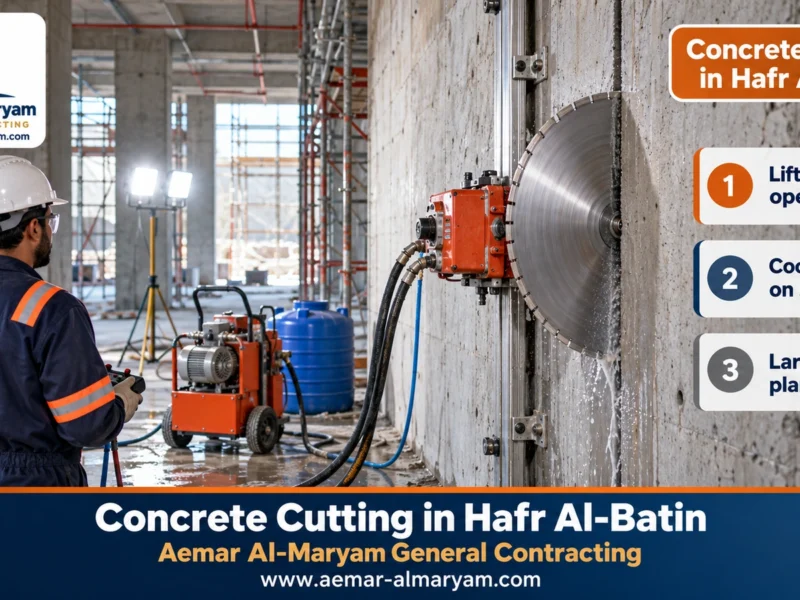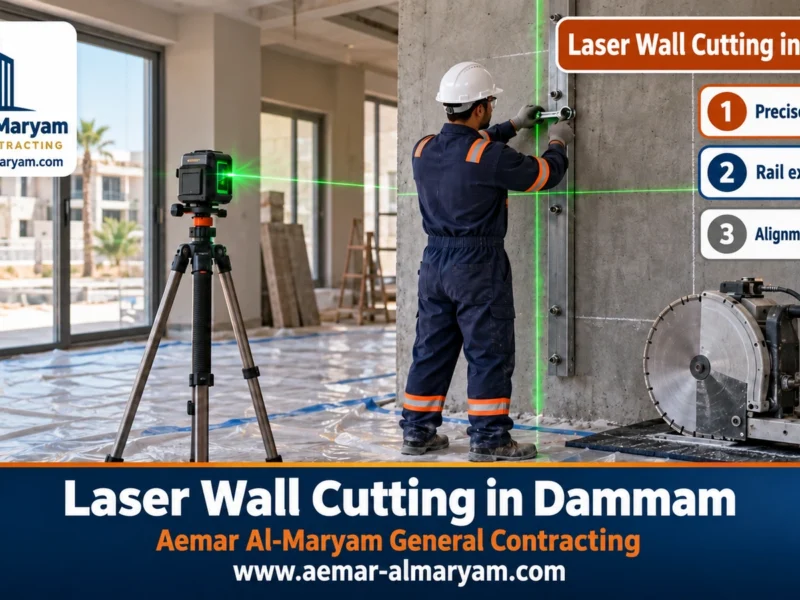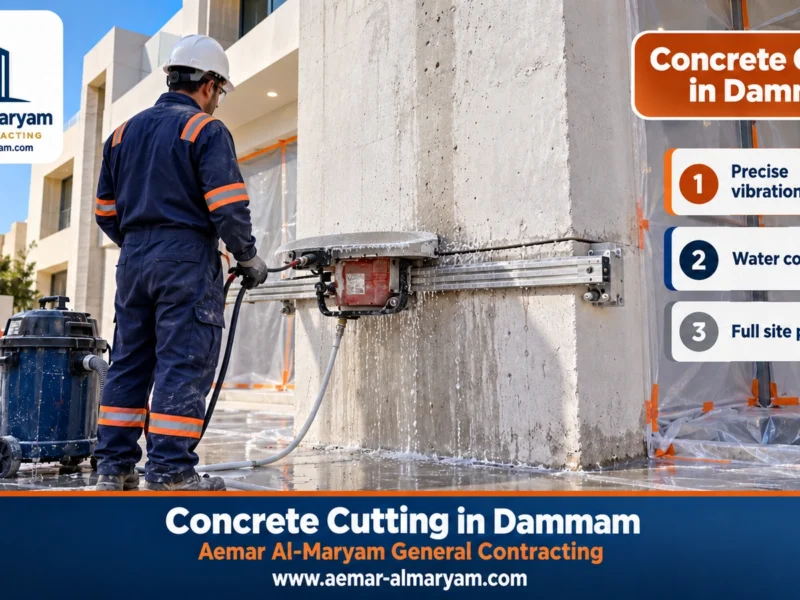

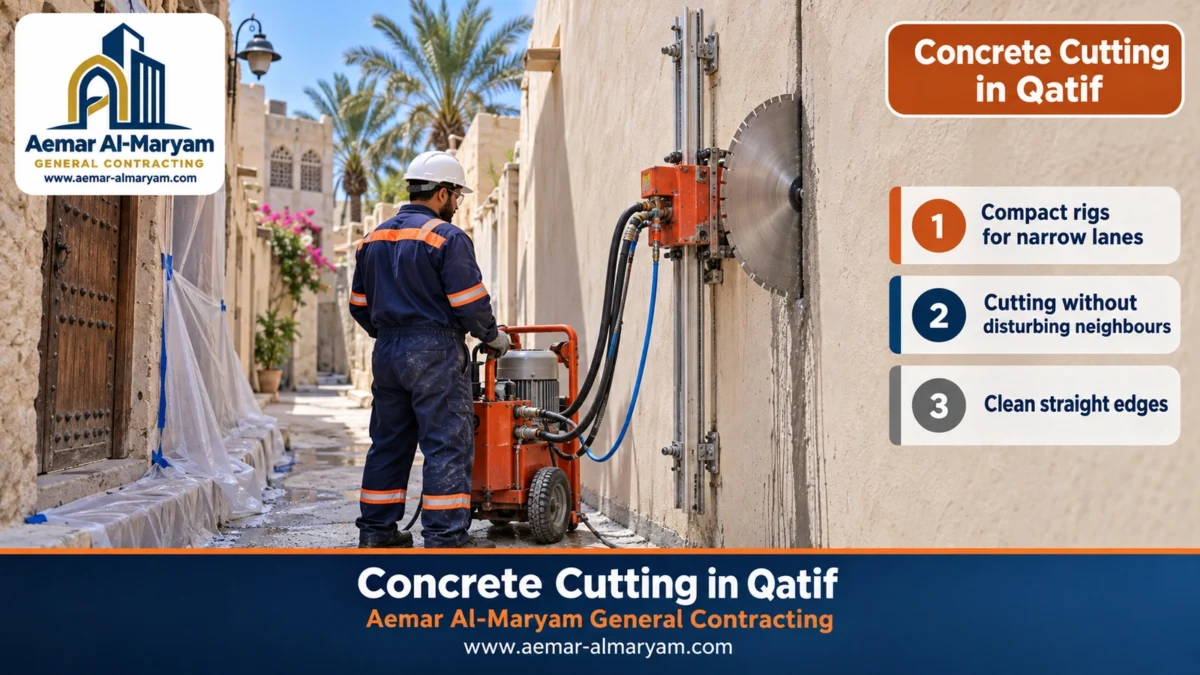
Concrete cutting in Qatif is the controlled opening of a concrete wall, slab or floor in your home or shop with diamond saws and core rigs, so the concrete and its rebar are cut along a clean line instead of being hammered apart. At Aemar Al-Maryam General Contracting we travel from our Dammam base to Qatif, Tarout Island, Safwa, Al-Qudaih and Al-Awamiyah with compact equipment chosen for narrow lanes and houses that share walls with their neighbours. We drill AC and drainage cores, open doors and windows, and cut slabs and floors. Our starting prices are SAR 90 for a simple opening, SAR 75 for each metre of cut line and SAR 140 for doors or windows, all of them estimates until inspection and agreement. Reach us on 0547879578 by phone or WhatsApp.
Qatif has a character of its own when it comes to cutting work. An older house built decades ago can stand a few doors away from a brand-new villa, and getting to the job is not always simple: a lane too narrow for a truck, a slim front door, or an upper floor reached by a tight internal staircase. Before we load anything, we ask about the width of the street, where a vehicle can stop, and roughly how old the building is. Then we choose between a core rig, a track-mounted wall saw and a hand-held cutter based on what the site allows, not on what is quickest for us.
Qatif cutting jobs at a glance
- What we do: Core holes for AC, drainage and extract fans; door and window openings; wall, slab and floor cutting; diamond wire sawing of old tank bases and footings.
- Older houses: We work carefully with aged concrete and rusted reinforcement, and we show you its condition the moment it appears in the cut face.
- Tight sites: Compact core rigs and saws that can be carried by hand, plus hoses and wet vacuums that reach from the parking spot into the house.
- Prices: Simple openings start at SAR 90, 5-inch cores at SAR 140, each metre of cut at SAR 75 and whole wall jobs at SAR 280.
- Coverage: Qatif, Tarout, Az-Zour, Sanabis, Darin, Ar-Rabi’iyah, Safwa, Al-Qudaih, Al-Awamiyah and Saihat.
- How to order: Send photos of the wall, the access route and the sizes on WhatsApp 0547879578 and we reply with the method and an estimate.
Concrete Cutting in Qatif: Older Houses Next to New Districts
The requests we receive from Qatif usually fall into two clear groups, and each one calls for a different way of thinking before the blade ever touches the wall. The first group is older houses whose owners are renovating part of the building or rearranging rooms. The second is modern villas and apartments where the occupant wants a change after handover, such as an extra doorway or an AC hole that was never planned into the design.
Older houses: long-lived concrete and reinforcement that needs attention
Concrete in an older house is often harder and drier, and wall thicknesses can change from one room to the next because the house was built in stages or had an annex added later. When we cut, we frequently find bars that have started to rust, especially near bathrooms and kitchens and at the base of external walls that have taken moisture for many years. That does not stop the job, but it changes how we handle it. We feed the blade more slowly, watch the cut face, and pause to show you the steel if it shows clear corrosion, then agree with you on how it will be treated before finishing.
Older houses also hide services that nobody remembers: old water pipes inside the wall, cables run without a drawing, and sometimes a disused drain under the courtyard floor. That is why every hole we make is preceded by a scan, and why we ask the owner for anything they know about earlier additions or repairs. A two-minute conversation at the door often saves an hour of repairs later.
Modern villas and flats: changes after handover
In newer districts the wall is easier to read and a drawing is usually available. Typical requests are a core for an additional AC unit, a kitchen hood that has been moved, or a doorway between two rooms whose use has changed. Here the priority is cleanliness and protecting fresh finishes: polished tiles, fitted kitchen units and paint that is only a few months old. We cover everything before we start and vacuum the cooling water continuously so slurry never reaches the tiles.
■ Older house
Uneven wall thickness, possibly rusted rebar and services without drawings; slower cutting and closer checks.
■ Modern villa
Drawings available and new finishes; the focus is protecting tiles, cabinets and paintwork.
■ Annex or extension
New concrete against old; we check the junction before opening any doorway between the two.
■ Shop or showroom
Often done outside opening hours, with service cores and AC ducts and no long closure.
Concrete Cutting Company in Qatif: Working in Narrow Lanes and Tight Sites
A concrete cutting company in Qatif first has to work out how to get its equipment to the wall. In older neighbourhoods the lane may be too narrow for a delivery vehicle to stop at the door, and the room you want opened may be reached through a slim corridor or an internal staircase. So we bring equipment that can be broken down, carried by hand and assembled inside the room, and we run hoses and cables from wherever the vehicle can park.
In our experience, what slows a Qatif job down is rarely the cutting itself. It is access and organisation: where the vehicle will stand, where we take water and power from, and how the cut block leaves the house without scratching the corridor floor or a neighbour’s door. When we know this in advance from your photos, the work day is calm and short.
- ✓Core rigs on lightweight stands: Anchored to the wall or floor, they work inside a small room without needing space around them.
- ✓Wall saw with short track sections: The track is bolted to the wall itself, so the saw needs only enough room for the operator to move.
- ✓A small generator where needed: If the house supply is not adequate or not safe for running the machine.
- ✓Wet vacuums and collection trays: They capture water and slurry inside the house, so nothing runs into the lane or across a neighbour’s threshold.
- ✓Small trolleys and rollers: To move cut blocks through narrow passages instead of carrying them or breaking them on the spot.
Core rig or wall saw when space runs short?
When a square opening is needed in a cramped room, there are two main options. The first is the track-mounted wall saw, which is the fastest and cleanest choice if there is room to fix the track and swing the blade. The second is stitch drilling: a chain of overlapping core holes drilled around the outline until the block comes free. It is useful when the saw will not fit, or when the wall meets a low ceiling or a corner the blade cannot reach. The hand-held cutter stays reserved for shallow cuts and trimming edges.
| Method | When we choose it in Qatif | What you should know |
|---|---|---|
| Track-mounted wall saw | A door or window in a concrete wall with enough room to fix the track | The cleanest edge and quickest finish; a heavy saw reaches roughly 73 cm from one face |
| Stitch drilling with cores | A tight room, a corner, or a spot the blade cannot reach | Slower than sawing; the edge needs light dressing after the block is removed |
| Single core hole | Round holes for AC, drainage and extract fans | From about 12 mm up to around half a metre depending on the bit and rig |
| Hand-held cutter (grinder) | Shallow cuts, blockwork, edge trimming | About 12.5 cm depth only, not enough to cut through a full reinforced wall |
Concrete Cutting Qatif: The Services We Carry Out
If you searched for “concrete cutting Qatif” without the “in”, you are looking for the same service: we open, cut and core concrete in houses, residential buildings and shops across Qatif and the towns around it. These are the jobs we are called for most often, and each one is explained in detail in the sections that follow.
■ Core holes
For split AC units, sewer connections, extract fans, chimney flues and electrical runs.
■ Door and window openings
In concrete or block walls, with temporary props and a support lintel where needed.
■ Slab cutting
Openings for duplex stairs, home lifts, service ducts and skylights.
■ Floor cutting
Channels for drainage and plumbing in courtyards and bathrooms during renovation.
■ Thick elements
Old tank bases and footings, cut with the diamond wire saw.
■ Breaking and removal
Sectioning the cut block and taking it away, agreed in advance.
You can also find these services on the concrete cutting and coring service page and on our Qatif area page, which brings together our other contracting services in the city.
Concrete Cutting and Coring in Qatif: When Do You Need Both?
Cutting and coring complement each other. Sawing gives straight lines for a square or rectangular opening, while coring gives a round hole of an exact diameter. In older Qatif houses we combine the two often. We may drill cores at the corners of an opening so the saw blade does not overrun the corner and leave an extra slot in the wall, then saw the sides between them. For a large duct opening in an old slab, we may core first simply to learn the real thickness of the slab and the state of its steel before deciding how to cut the rest.
Why a probe core helps
In an older house where nobody knows the wall thickness, we sometimes drill a small core inside the area that will be removed anyway. It reveals the true thickness, the condition of the reinforcement and the type of concrete, so the final price is more accurate and there are no surprises halfway through the job.
Concrete Coring in Qatif and Core Drilling for Services
Concrete coring in Qatif means drilling a clean round hole with a diamond bit that removes a complete cylinder of concrete, so a pipe or duct can pass through without any breaking around it. The cores we drill most often in Qatif are for AC units, drainage pipes that link a house’s internal plumbing to the outside line, and extract fans in kitchens and bathrooms after renovation.
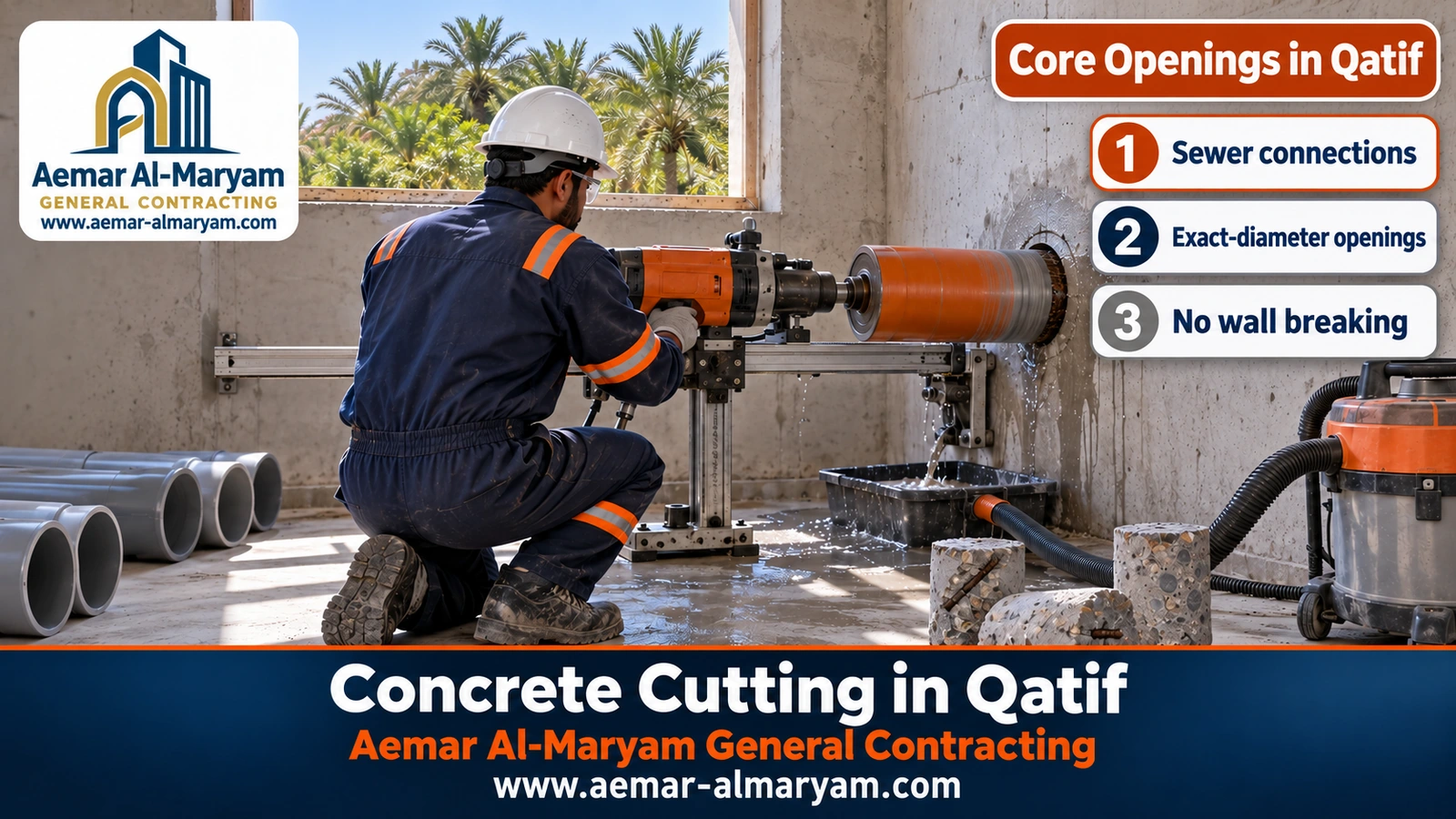
Core drilling in Qatif for sewer connections
A drainage core is one of the more exacting coring jobs, because its position and height decide the fall of the pipe. We take the level from the plumber before drilling, mount the rig horizontally near the base of the wall, and core at a diameter that matches the outside diameter of the pipe plus a little clearance for sealing material. We do not pick the diameter ourselves; it follows the plumbing layout and the pipe the owner or contractor has bought.
Where the hole passes through an external wall below ground level, we discuss sealing with the plumber before we start, because a neat core is only half the job. The annular gap around the pipe has to be closed properly so water and insects cannot use it as a route into the house.
AC core holes in Qatif
A split AC unit is normally fed through a hole near 65 mm across, angled slightly down towards the exterior; that fall lets condensate escape outdoors instead of dripping back indoors, which is what the makers’ fitting guides call for. In an older house we also make sure the hole does not land on a column or a beam hidden under the plaster, so we scan the wall and measure from the corners before fixing the rig.
Extract fans, chimney flues and ducts
Kitchen and bathroom extract fans usually need a core of about 6 inches, while oven flues and ventilation ducts may need 8 inches or more. Before drilling we confirm that the outside face of the hole is open air and does not discharge straight onto a neighbour’s house or into a shared passage, a point that comes up again and again with houses built wall to wall.
| Purpose | Approximate diameter | What we check before drilling |
|---|---|---|
| Split AC unit | About 65 mm | Outward slope and distance from columns and beams |
| Small plumbing and electrical | Up to about 100 mm | Old pipes and cables running inside the wall |
| Sewer connection | To suit the pipe’s outside diameter (around 5 inches or per drawing) | Pipe level and fall, agreed with the plumber |
| Extract fan (kitchen/bath) | Roughly 6 inches | That the outside face does not open onto a neighbour’s house |
| Duct or chimney flue | 8 inches and larger | Rebar scan, and an engineer’s view if the diameter is large |
Coring through slabs in older houses
An old slab needs extra care before coring. We scan for reinforcement to place the hole between the bars, make sure no electrical conduits run inside the slab, and support the core from below so it does not drop when it breaks free. If the slab is post-tensioned, which is less common in older houses but present in some newer buildings, nothing gets drilled until a ground-penetrating radar survey has mapped the tendons. More on coring alone is on the core drilling service page.
Reinforced Concrete Cutting in Qatif: Rusted Rebar and Aged Concrete
Cutting reinforced concrete in Qatif in a house that has stood for decades is not the same as cutting it in a new building. The diamond blade cuts concrete and steel together without difficulty; what needs a decision is what the cut face reveals. Is the steel sound? Is the concrete cover over it adequate? Is there a crack running from the bar to the surface? We answer these questions in front of you, because the new opening exposes part of the structure that nobody has seen in years.
When we find light surface rust on the bars, we finish the cut and leave the exposed ends clean, then recommend coating them with an anti-corrosion primer and covering them with repair mortar before the frame goes in. If instead we find bars that have lost a large part of their section, or concrete crumbling around them, we stop in that area, photograph it for you and advise you to have an engineer look at it before we continue. At that point the issue is no longer the opening; it is the condition of the element itself.
⚠ Signs that call for an engineer before cutting
Concrete flakes falling from the ceiling or the base of a wall, brown rust stains on the plaster, long cracks that follow the line of the reinforcement, or bars visible in the ceiling. If you see any of this near the planned opening, send us a photo on WhatsApp; the element may need repair before cutting or straight after it.
■ Gentle cutting
Slower blade feed in old concrete so the edges do not spall.
■ Photographing the cut face
We show you the steel and concrete inside the opening before anything is covered.
■ Treating exposed ends
Rust removal, anti-corrosion coating and repair mortar before finishing.
■ No column cutting
Columns and beams are touched only to an approved engineering design.
For related restoration and demolition work, see the demolition and breaking service; some older houses need a damaged section removed before a new opening is made.
Wall Cutting in Qatif and Door or Window Openings in Concrete
Wall cutting in Qatif without breaking means marking the opening, sawing its full outline with a diamond blade, then freeing the block and taking it out in pieces, so the wall around it stays intact and does not vibrate. This matters in houses built against each other, because hammering a shared wall with a breaker can pass vibration and cracks straight into the neighbour’s home.
Cutting a new doorway through concrete in Qatif
A new doorway in a concrete wall starts with one question: is the wall load-bearing? In a modern house the drawings answer it. In an older house we read the thickness and the position of beams and columns, but the final answer belongs to an engineer. Then we mark the opening to the size of the door frame you plan to fit, install temporary props and a support lintel if the design calls for one, cut all four sides and free the block.
We always ask for the frame size before we cut rather than after. A doorway cut to a guessed size and then enlarged later costs more than one cut once to the right dimension, and the second cut is never as tidy as the first.
Opening or enlarging a window in an older house
Many older Qatif houses have small windows, and owners renovating them often want larger ones to bring in more daylight. Enlarging a window with a diamond saw leaves a straight edge ready for the new frame. Keep in mind that changing the façade may need a permit, and that widening an opening in a load-bearing wall needs strengthening above it. For more on doors and windows, see door and window openings in walls.
Openings between an old house and its annex
A frequent request is a doorway between an older house and an annex built beside it later. Sometimes there are two walls standing back to back, or an old wall with a new column next to it. We check the junction carefully, cut each wall separately if necessary, and leave straight edges so the threshold and frame are easy to fit.
Slab Cutting in Qatif: Duplex Stairs, Home Lifts and Skylights
Slab cutting in Qatif is usually structural work, because an opening for stairs, a lift or a duct changes the way load is carried across the slab. So we never start cutting a slab until we have a drawing from an engineer showing where the opening goes, its dimensions and the strengthening its edges will need. We then set steel props beneath the section to be cut, divide it into pieces that can be lifted, and saw it from above or below depending on access.
In older houses a slab can turn out thinner or thicker than expected, and it may contain corroded steel from past roof leaks. That is why we start with a probe core inside the opening area and adjust the plan to what we find. No block is ever allowed to drop from a slab; each piece is supported and lowered under control.
- ✓Duplex stair opening: To the approved drawing, with props under the slab and strengthening around the edges.
- ✓Home lift shaft: Exact dimensions from the lift supplier are needed before any cutting.
- ✓Skylight or light well: We coordinate with the waterproofing contractor to restore the roof membrane around the opening.
- ✓Duct opening: Usually started with cores at the corners, then the sides are sawn.
Cost of Cutting a Wall with a Grinder in Qatif, and When It Is Enough
The cost of cutting a wall with a grinder in Qatif follows the same logic as our diamond cutting: per linear metre from SAR 75 for normal thicknesses, or per opening from SAR 90 for a simple one. But the more important question is not the price; it is whether a grinder can do your job at all. A large 14-inch hand-held cutter reaches a depth of only about 12.5 cm, so a typical 20 cm reinforced wall is beyond it when worked from a single face.
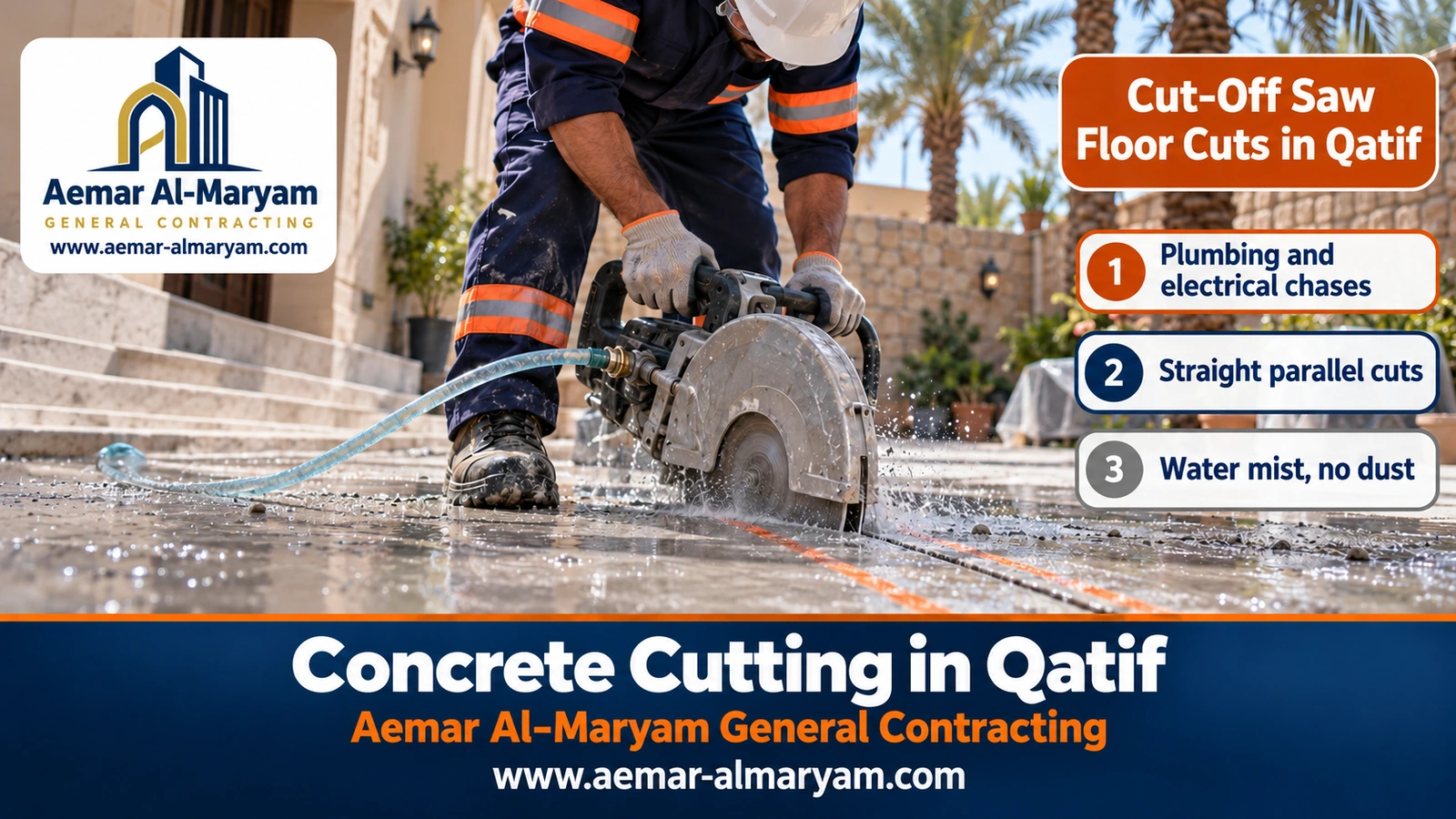
The grinder is excellent for specific tasks: a shallow channel in a courtyard or bathroom floor for a pipe, an opening in an internal block wall, trimming the edges of an opening cut by the wall saw, and cutting off concrete nibs. Used on its own on a thick reinforced wall, however, it cuts part of the depth and the rest gets broken out, so the benefit of clean cutting is lost and vibration and cracking come back.
| Job | Is a grinder enough? | Better alternative |
|---|---|---|
| Plumbing channel in a courtyard floor | Usually yes, with water to limit dust | Floor saw if the run is long |
| Internal block wall | Yes, for ordinary openings | Wall saw for thick walls |
| 20 cm reinforced concrete wall | No, it only cuts part of the depth | Track-mounted wall saw |
| Round AC or drainage hole | No | Core rig |
| Trimming the edges of an existing opening | Yes | — |
Factors that raise the cost of grinder cutting, or of any cutting, include wall thickness, how dense the reinforcement is, how hard the site is to reach, whether breaking and debris removal are included, and how many openings are done in one visit. In many cases the wall saw ends up cheaper than the grinder, because it finishes sooner and leaves no repairs behind.
Floor cutting for bathroom and kitchen renovations
When a bathroom or kitchen is renovated in an older house, the plumber often needs a new route for a drain pipe under the tiles. We cut the route with two parallel lines using the hand-held cutter or the floor saw and remove the concrete between them, leaving the rest of the floor untouched. The same method works for electrical routes in floors, and for cutting asphalt or concrete in driveways before a line is laid beneath them.
Concrete Saws in Qatif: The Equipment We Bring to Site
The right concrete saw in Qatif depends on the element and the space available. Because so many Qatif sites are tight, we make sure our equipment can be dismantled and carried by hand while still being able to cut thick reinforced concrete. This is what we use and the role each machine plays on the jobs we do here:
| Equipment | Role on Qatif sites | Approximate capability |
|---|---|---|
| Track-mounted wall saw | Doors, windows and openings in house walls and slabs | About 73 cm from one face in the heavy class |
| Floor saw | Drainage channels in courtyards, and cutting openings from the top of a roof slab | About 24 cm |
| Diamond wire saw | Old tank bases, footings and large blocks | No blade-size ceiling; the wire wraps the block |
| Core rig | AC, drainage, extract fans and ducts | From 12 mm to around 500 mm |
| 14-inch hand-held cutter | Shallow cuts, blockwork and trimming | About 12.5 cm |
| Detection and laser tools | Locating rebar and services, and setting out the opening | Checks before cutting, not after |
Note: Figures describe typical machine classes; what we reach in your wall depends on the specific saw and how heavily it is reinforced.
Wire sawing old tank bases
When an old house is demolished and its plot is prepared for a new build, an old underground tank or a massive concrete base is sometimes left behind. Breaking it out with a compressor means long hours of noise and vibration that reach the neighbouring houses. This is where the diamond wire saw earns its place: a wire is looped around the block over pulleys and cuts it, relatively quietly, into large pieces that can be lifted and hauled away.
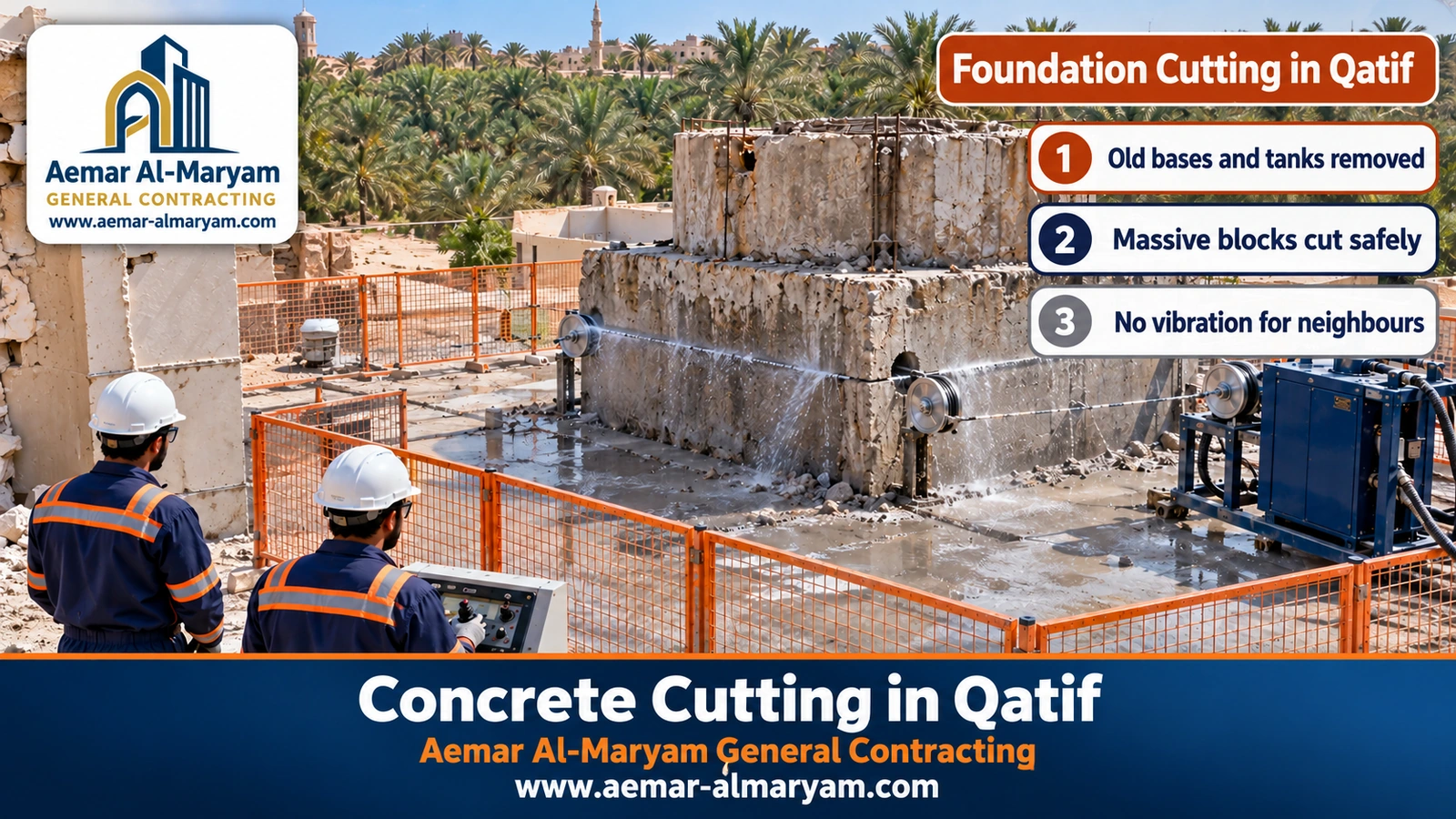
This approach saves days of breaking, spares the neighbours from constant noise, and produces regular pieces that are easy to load. It is priced after an inspection, because it depends on the size and position of the block and on how it will be lifted and transported.
“Laser” Wall Cutting in Qatif: What You Actually Get
“Laser wall cutting” is a common search phrase, but in practice a concrete wall is cut with a diamond saw or a diamond wire saw, while the laser is a measuring tool that sets out the lines, alignment and level of the opening before cutting. High-power lasers have been tested in laboratories to scabble a few millimetres off a concrete surface, and they have not become a way of cutting a reinforced wall in a house.
What people want when they type that phrase is precision and cleanliness, and that is exactly what a wall saw running on a fixed track delivers once the lines have been set with a laser. For a deeper look, we wrote a separate article, laser wall cutting in Dammam, and everything in it applies equally to our work in Qatif.
Concrete Cutting Prices in Qatif
Concrete cutting prices in Qatif match what we charge in Dammam; Qatif is close to our base and we add no separate distance charge for a normal visit. These are the starting points for common jobs:
| Type of request | Examples | Price starts (SAR) |
|---|---|---|
| Small hole or core up to about 100 mm | AC hole and small water or electrical runs | From 90 |
| 5-inch bit | Drainage or ventilation pipe | From 140 |
| 6-inch bit | Kitchen and bathroom extract fans | From 140 |
| 8-inch bit | Ducts and chimney flues | From 230 |
| 10-inch bit and above | Central AC ducts | Set after the visit |
| Linear cut | Per metre in a wall or floor of normal thickness | From 75 |
| Door or window opening | Cutting the sides and removing the block | From 140 |
| Complete wall-cutting job | Depends on area, floor level and access route | From 280 |
| Slab opening or wire sawing | Stairs, lifts, bases and thick blocks | After the visit and drawings |
Prices are estimates until inspection and agreement. They vary with thickness, reinforcement density, the age of the concrete and how difficult the site is to reach.
Qatif-specific factors that can affect the price: access through a narrow lane that requires carrying equipment by hand, hard old concrete that wears the blade faster, and treating exposed reinforcement if you ask us to. On the other side, bundling several openings into a single trip reduces what each one costs. To find out what your job will cost, message the pictures and measurements to 0547879578 and a realistic figure comes back to you; the rest of our prices are in the estimated price guide.
Photograph the wall and the access, then send them
One photo of the wall from each side, one of the street or lane leading to the house, and the opening size. We will reply with the right method, an estimate and an inspection date in Qatif.
Does Cutting a Wall or Slab in Qatif Need an Engineer or a Balady Permit?
In Qatif we separate work into two kinds. Small holes for AC units and plumbing generally stay clear of load-bearing elements, so we check their position and carry them out. A new doorway in a wall that carries the roof, a window opened in a load-bearing wall, a stair or lift opening in a slab, and anything that touches a beam are structural alterations. For these we ask for a report from a licensed engineering office, and a permit through the Balady platform may also be required. An older house needs that report more than most, because its concrete and steel may call for strengthening that a new house would not.
- ✓Building Restoration Permit: Returns a building to good condition without adding new components or altering structural elements, and requires a contract with an engineering office that prepares the drawings.
- ✓Adding and Modifying Building Components: A Balady service for changing the components of a licensed building, which requires an engineering office acting as designer and supervisor.
- ✓Signs of a load-bearing wall: A wall thicker than 20 cm, one sitting on a beam, or one with a column landing on it. These are guides only; the decision belongs to a civil engineer.
- ✓Our clear limits: We do not cut columns, and we core a beam only where a structural engineer has specified the position and diameter in writing.
Protecting Neighbours and the Lane During Cutting in Qatif
In closely built neighbourhoods, the job is not the homeowner’s alone. Water, slurry, noise and a vehicle standing in the lane all affect the neighbours, so we treat them as part of the work rather than a side detail. We agree a suitable time with the owner and give a rough idea of how long the noisy part will last, so they can let the neighbours know if they wish.
■ Cooling water under control
We collect water and slurry in trays and vacuum it, so it never runs into the lane or over a neighbour’s step.
■ Protecting steps and passages
Covers and boards on floors and doors along the route for equipment and cut blocks.
■ Barriers and warnings
Orange barriers at the work point if it is close to the street.
■ Less dust
Wet cutting limits harmful silica dust and keeps the air cleaner for the household and neighbours.
■ Vehicle in the right place
We agree the parking spot in advance so nobody is blocked in.
■ Clean-up before leaving
We remove the pieces and slurry and leave the site clean.
Occupational safety bodies recognise wet cutting as a primary way to control silica dust. Alongside it we use watertight electrical connections and residual-current protection, and we keep the work area separated from children and passers-by.
Tarout Island: How We Organise Work in Tarout, Darin and Sanabis
Tarout Island is part of Qatif Governorate and includes the towns of Tarout, Az-Zour, Sanabis, Darin and Ar-Rabi’iyah, with districts such as Ar-Rida, Ash-Shati’, Al-Fath, As-Sadafah and As-Sawari. The older quarters on the island share what we have described about narrow lanes and attached houses, alongside newer homes and buildings.
When a request comes from Tarout, we ask for photos of the entrance and the route to the house, as we do elsewhere in Qatif, and we try to group more than one job on the island into the same day where possible. That saves the customer money and brings the appointment forward. If you have several openings, say an AC hole, an extract fan and a drainage core, book them as one visit rather than three.
How to Order Concrete Cutting in Qatif in 5 Steps
- 1Send photos on WhatsApp
Photograph both faces of the wall and the way into the house, add the size and floor level, and send them to 0547879578. - 2Receive our recommendation
Wall saw, cores or grinder; whether an engineer is needed; and the approximate cost. - 3A short site inspection
We measure thickness, scan for rebar and services, check access and parking, and confirm the price. - 4Preparation and protection
Covering floors, furniture and thresholds, and installing props where needed. - 5Cutting and handover
Sawing or coring, removing the blocks, cleaning up, and handing over an opening ready for finishing.
What to Send on WhatsApp for a More Accurate Price
The clearer the information we receive, the less our estimate will move when we finally see the site, and the more likely we are to bring the right equipment on the first visit:
- ✓Pictures of the element: Both faces, with a tape measure or ruler next to the opening if possible.
- ✓Opening size: Width and height, or the diameter of the pipe that will pass through.
- ✓Thickness if you know it: Measured at a nearby door or window, or taken from the drawings.
- ✓Approximate age of the house: And whether an annex was added or earlier alterations were made.
- ✓A photo of the route and entrance: Lane width, where a vehicle can stop, and the staircase if the job is upstairs.
- ✓Location: The district or town name, or a map pin.
- ✓Preferred timing: Days and hours when the work will disturb the household and neighbours least.
Why Qatif Homeowners Choose Aemar Al-Maryam
■ Equipment that fits the site
Compact machines that get into lanes and tight houses, plus a wire saw for big blocks.
■ At home with older houses
We handle aged concrete and corroded steel calmly and tell you what we find.
■ Published prices
Starting prices on this page, a quick estimate from your pictures, and a firm figure once we have seen the site.
■ Respect for neighbours
Water and slurry under control, protected thresholds, and a clean-up before we go.
■ Technical honesty
If your request calls for an engineer or a permit you hear it from us first, and columns are never on our cutting list.
■ Close by
From Dammam to Qatif, Tarout and Safwa in a short drive, with jobs grouped into one visit.
Finished jobs are shown on our projects page, and the complete reference is concrete cutting in Dammam.
Qatif Areas We Serve
We cover Qatif Governorate, its towns and districts, including:
For nearby Saihat we have a dedicated article, concrete cutting in Saihat, and we also work in Dammam, Khobar and the other Eastern Province cities. If your town is not listed here, drop us a map pin on WhatsApp and we will fix a visit.
Ready to open that wall in Qatif?
Call us or send the photos now, and we will agree the method, an estimate and the earliest inspection slot in Qatif, Tarout or Safwa.
More from Aemar Al-Maryam
Tags