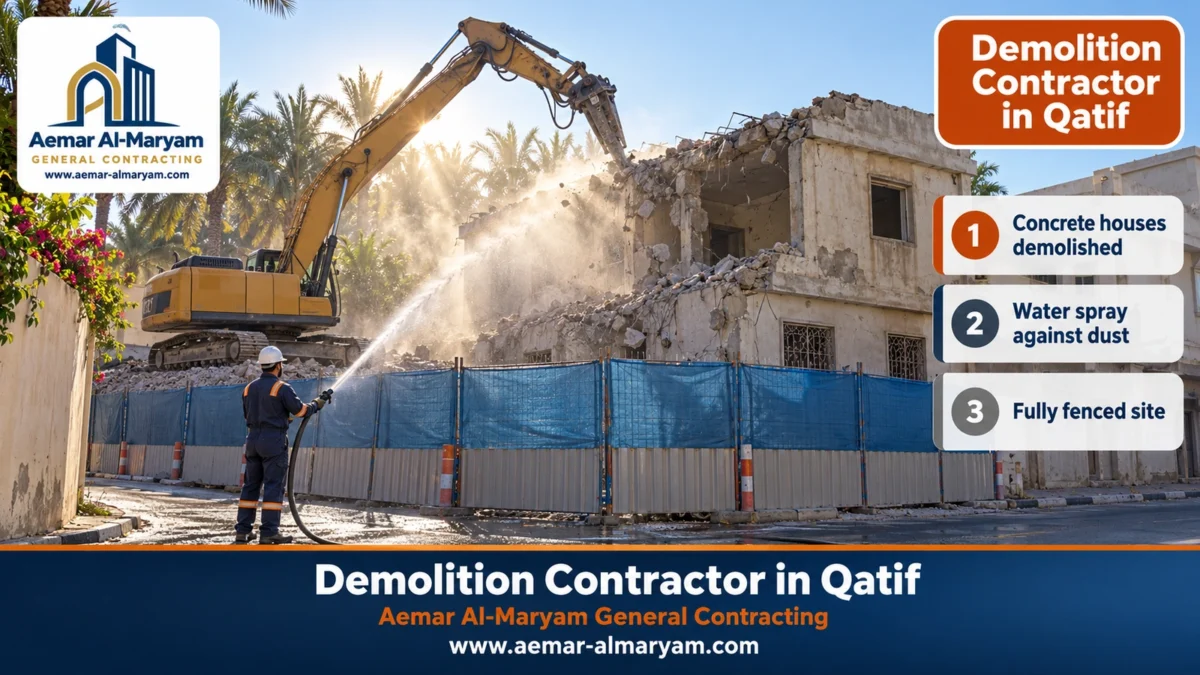
A demolition contractor in Qatif usually works between two walls: the wall of the house coming down, and the neighbour’s wall that must stay exactly as it is. Qatif’s older concrete houses stand shoulder to shoulder or are separated by narrow gaps, many carry raised concrete water tanks on their roofs, and plenty were extended in stages over the years. Our crews at Aemar Al-Maryam General Contracting bring these houses down from the top while protecting the house next door with scaffolding, sheeting and water spray, break rooftop tanks by hand and lower the pieces in bags, and remove interior walls without touching columns or beams. Expect a starting point of SAR 7,400 for a modest one-floor older home, SAR 13,900 for a two-floor house or villa of around 300 m², and SAR 185 for a block partition; the final figure is agreed once we have seen the house. Phone and WhatsApp: 0547879578.
Qatif is part of the Dammam metropolitan area, yet its urban fabric has a character of its own: older quarters with narrow inner streets, concrete houses built decades ago and then given extra rooms and annexes, and towns such as Tarout Island, Safwa, Al Qudaih and Al Awamiyah, each with its own streets and approaches. All of that changes how a house is demolished. A large machine cannot always get in, debris cannot be heaped in the street, and the neighbour is often one metre away. This guide is written for exactly those conditions.
What to know before demolition in Qatif
- We demolish: older one- and two-storey concrete houses, villas, annexes and rooftop rooms, and raised concrete tanks.
- We break: interior partitions, tiles and floors, and surplus concrete, without touching the structure.
- We do not demolish: heritage buildings on Tarout, in Darin or in the old quarters; those need the competent authority.
- Neighbours first: photos of the neighbour’s wall before we start, scaffold wrapped in sheeting, and hand work on the last metre.
- Starting prices: SAR 7,400 (small older home), SAR 13,900 (two floors), SAR 185 (partition), SAR 14 per m² (tiles), SAR 90 per truckload of rubble; all provisional until we have inspected and agreed.
- Permit: removing the whole house needs an electronic Balady demolition permit obtained through an engineering office.
Building demolition in Qatif between joined houses: how we protect the neighbour
We protect the neighbour by starting work on their side before demolition begins. On the first day at any tight Qatif site no excavator arrives. We photograph the neighbour’s wall inside and out, recording any existing crack, with the owner present where possible. Then we put up scaffolding along the separating gap, wrap it in protection sheeting stretched from the ground to the roof, and board the floor of the gap so the neighbour’s paving and drains are not damaged.
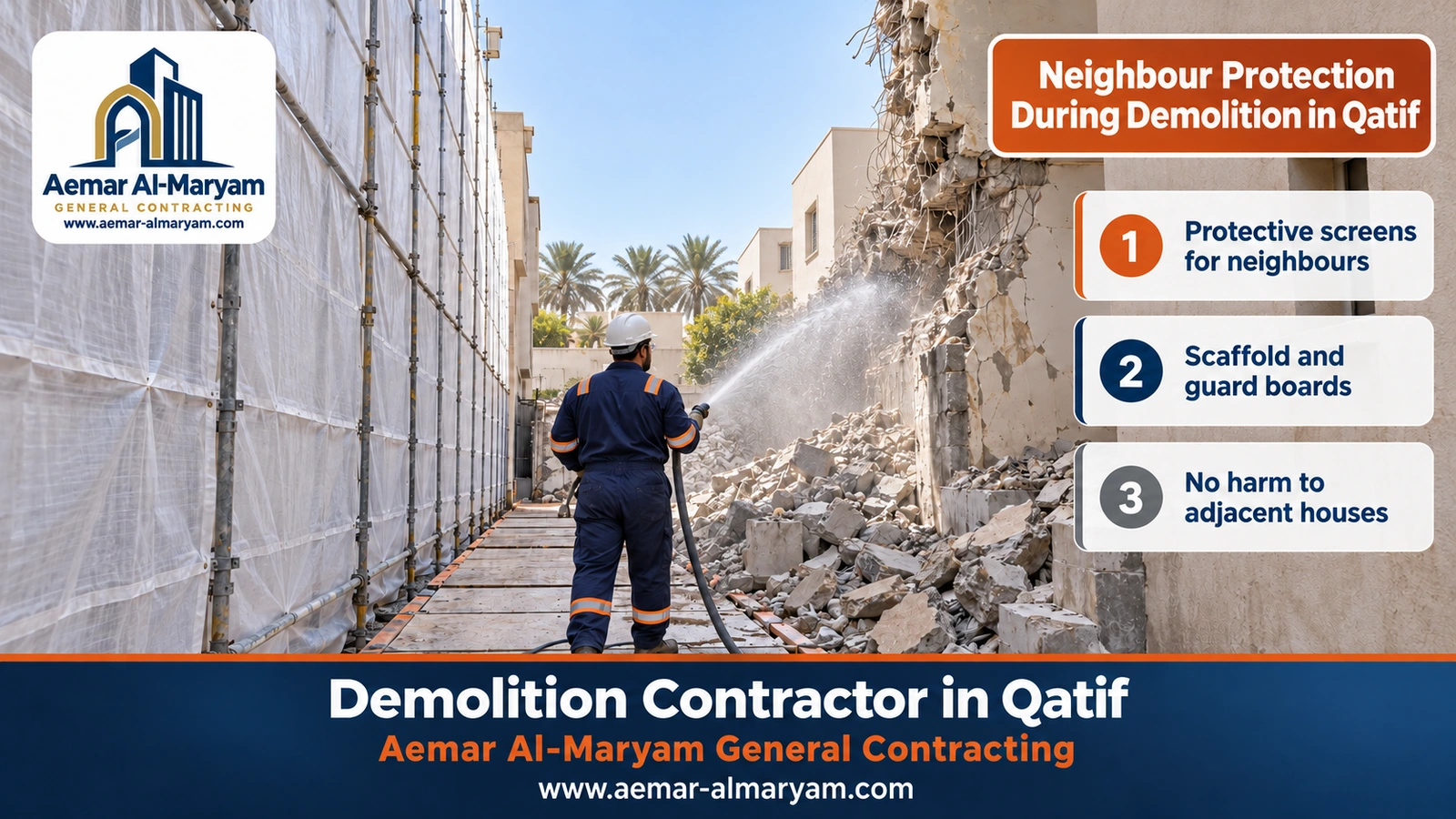
After that, demolition follows an order many people do not expect: the wall next to the neighbour is the last thing to fall, not the first, because it shields their house from dust and debris for the whole job. We take down the roofs and interior walls first and pull everything towards the middle of the plot, then break the shared-side wall by hand from the top with breakers, piece by piece, under constant water spray.
- ✓Party wall or two adjacent walls? We check whether the wall is shared and carries the neighbour’s roof; if it does, we do not demolish it and ask the engineering office how to deal with it.
- ✓Vibration: close to the neighbour we use a crusher jaw that nibbles concrete rather than a hydraulic hammer that pounds it, or we work by hand.
- ✓Dust: continuous water on the rubble, and work paused in strong wind if the dust would blow into neighbours’ windows.
- ✓Hours: we agree working hours that suit the quarter and avoid breaking during rest times.
- ✓The street: no rubble is left in the street; what is broken is loaded the same day wherever possible.
When demolition is complete we return to the neighbour’s wall once more: we strike the scaffold and sheeting, clean the gap, and compare the wall with the photos taken on day one. If a wall that used to be hidden behind the demolished house is now exposed without render or waterproofing, we tell both parties so it can be treated before damp gets in, because a bare wall left open to rain and salt air deteriorates over time.
Talk to your neighbour before we arrive
A word with the neighbour a week before demolition, telling them the start date, the duration and the supervisor’s number, heads off most problems. We give you a short sheet with that information to hand over.
Demolition contractor in Qatif: what we take down and what we leave alone
In Qatif we work on relatively modern concrete and blockwork buildings: family houses, villas, annexes and small shops. These have building permits or survey decisions, and the ordinary Balady demolition permit applies to them.
Heritage buildings on Tarout and in Darin: we do not demolish them
⚠ An old building in traditional materials? We stop before we start
Tarout Island, Darin and Qatif’s old quarters contain heritage buildings or houses built in traditional materials such as sea stone and mud. We do not demolish or break into these, because any work on them needs the approval of the competent heritage authority first. If your property is especially old or you think it may be registered as heritage, check with that authority first; if it permits removal and a permit is issued, we can then discuss the work.
■ Older concrete houses
One or two floors with a column-and-slab frame and block walls.
■ Newer villas and houses
Full demolition to rebuild, or partial demolition to change the layout.
■ Annexes and rooftop rooms
Rooms added on the roof or in the yard, cut free and removed.
■ Raised concrete tanks
Old water tanks standing on piers above the roof.
Demolishing shops and small buildings in Qatif
Older shops on Qatif’s commercial streets are sometimes demolished so they can be rebuilt with newer fronts. Here the challenge is the pavement and passers-by as much as the neighbour: we hoard the whole frontage, work in the quieter hours, and load debris straight into the truck without piling it on the pavement. For a small commercial block the per-metre rate opens at SAR 46 and moves with its height and how tightly it abuts the next shops.
Old house demolition in Qatif, from the roof to the ground
An older concrete house in Qatif comes down in clear stages, and the number of days depends on access. If the street lets a compact or mid-size excavator in, we work from outside with it; if the house sits on a lane no machine can enter, we take the upper floor down by hand until access opens up, or finish entirely by hand.
- 1Strip and empty
We take out steel doors, windows, AC units, water heaters and services, sorting anything with value. - 2Tanks and roof rooms
We start with the rooftop tank and any added room, as they are the highest and heaviest elements. - 3Roof, then walls
We break the roof slab, then the interior walls, pulling the pieces into the plot. - 4The wall next door
It is left to the end and broken by hand from the top. - 5Floor and footings
Lifted or left as agreed and as the engineer directs. - 6Load and clean
We haul the debris, sweep the gaps and the street, and hand over the plot.
Villa demolition in Qatif
Villas in the newer districts usually sit on wider plots with entrances that take machines, so they can come down faster than a smaller old house in a tight quarter, even though they are bigger. The base price is SAR 13,900 or more while the floor area stays near 300 m²; larger villas are priced per metre from SAR 46.
Partial demolition in Qatif: a rooftop room or a yard annex
A room added on the roof or an annex in the yard can be removed while the family stays in the house. That means separating it from the house first with a diamond-saw cut at the joint, breaking it from the top, and protecting the roof slab and its waterproofing beneath the work. The engineering office decides the right permit for this kind of job, and we price it after inspection.
Removing a rooftop concrete tank in Qatif without harming the roof
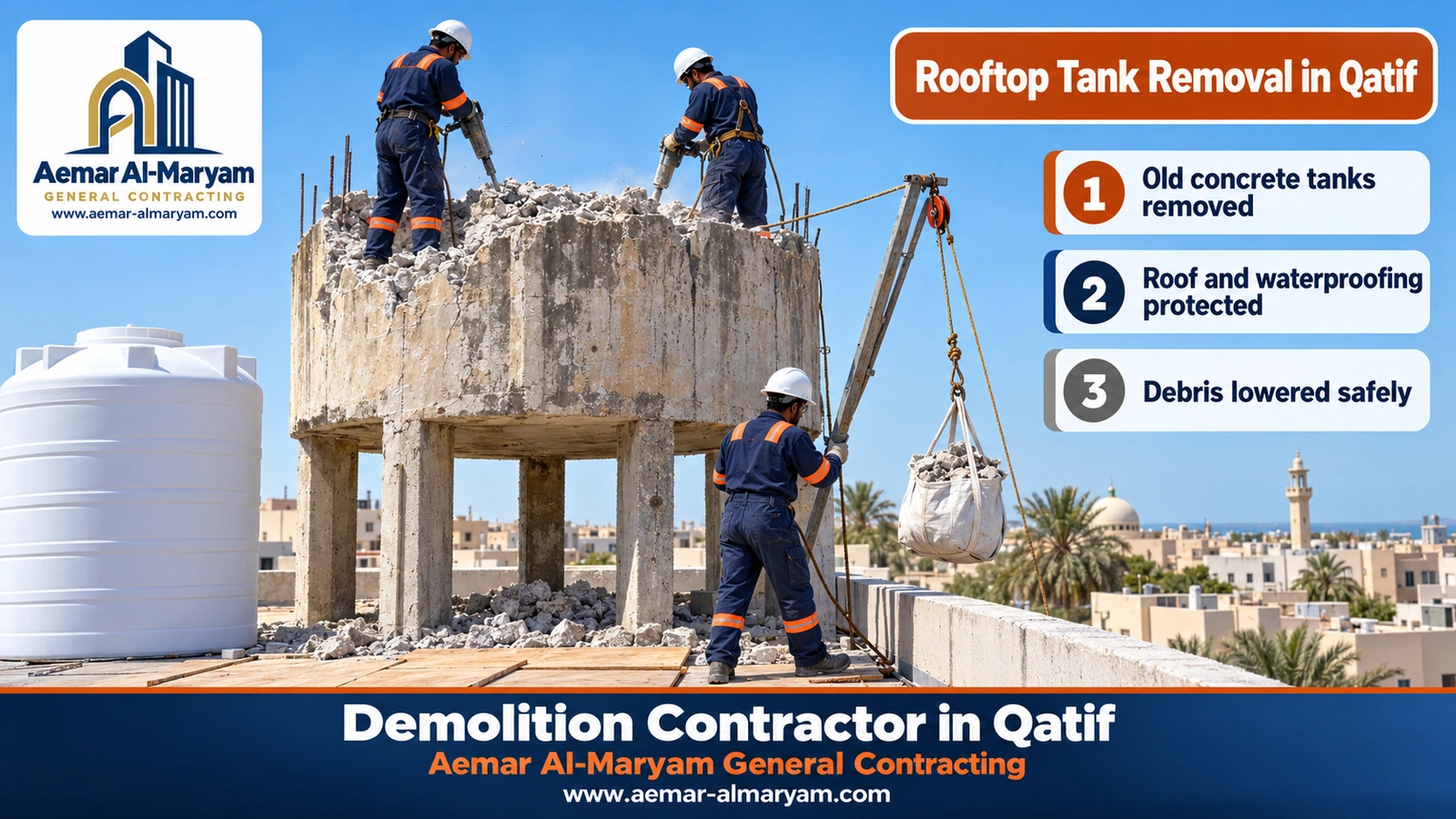
The old concrete tank raised on piers above the roof is one of the jobs we are called for most in Qatif. Some have leaked until the slab beneath is spoiled, some owners want a lighter plastic tank instead, and some tanks come off before the whole house is demolished. The difficulty is that the tank is heavy and high up, and breaking it with a heavy hammer on top of an old roof can crack the slab itself.
- 1Empty and disconnect
We drain the tank completely, disconnect the supply and distribution pipes, and get the replacement ready if one is going in. - 2Protect the roof
Timber boards over the roof slab and the waterproofing around the piers, so pieces never land on them directly. - 3Break by hand from the top
We start with the lid, then the walls downwards, using medium electric breakers that do not shake the roof. - 4Lower by rope and pulley
Pieces are bagged in strong sacks and lowered to the ground by rope, never thrown from the roof. - 5The piers
They are broken out, or kept as a base for the new tank if they are sound and in the right place.
If you are replacing the concrete tank with a plastic one, arrange for the new tank to arrive before removal day so the house is not without water for more than a few hours. We leave the base or build a lighter one depending on what the plumber decides about the connections, and before leaving we check that no wash water is left standing on the roof and that the roof drains are clear of dust and small concrete pieces.
Why we never throw debris off the roof
In a tight quarter a thrown piece can bounce onto the neighbour’s house or a parked car, and every throw sends up more dust. Lowering by rope is a little slower but cleaner and safer, and it keeps you on good terms with the neighbours.
Rooftop tank removal is priced after inspection, because it depends on the tank’s size, the height of its piers and of the house, and the way pieces will be lowered. If the roof beneath has been damaged by leaks, repairing it is renovation work covered in renovation contractor in Qatif.
Removing interior walls without damage in Qatif
Removing an interior wall without damage means three things: the structure is not affected, the services are not harmed, and neighbouring walls and ceilings do not crack. In Qatif’s concrete houses most interior walls are block partitions that can come out, but homes altered over the years can hide a wall that began carrying load once a room was added above it.
Removing the wall between two rooms in Qatif
For an ordinary blockwork partition separating two rooms we charge from SAR 185, which covers breaking it and bagging the waste. We first locate any electricity and water inside it and have them isolated, start from the top just under the beam, and leave the ends at the columns for hand chiselling. Should it prove to carry load, work halts until a structural engineer has reported.
How can you tell a wall is load-bearing before asking to remove it?
- Thickness: a wall clearly thicker than the other interior walls deserves a check.
- What sits above: a beam bearing directly on it, or a room added on the floor above right over it.
- Material: cast concrete instead of the usual blockwork.
- Columns: a column inside the wall itself; the column always stays and is never cut without an engineering design.
Treat these as prompts for a conversation, not a verdict; only a structural engineer can confirm it. For a load-bearing wall the engineer may specify temporary props and a replacement beam before removal, and that work is priced after inspection.
Breaking contractor in Qatif: tiles, concrete and hand-cutter limits
Tile and floor breaking in Qatif
Taking up worn tiling together with its bedding costs from SAR 14 a square metre. In older houses we sometimes find more than one layer of tiles laid over each other, which adds depth, time and debris, and we tell you so after breaking a small test patch. In bathrooms we break carefully around the drains, because old pipes are brittle.
Concrete breaking in Qatif
Yard slabs, old tank and generator bases, concrete steps and benches are broken with heavy hand breakers in tight spaces, or with a breaker on a compact excavator where one can get in. Densely reinforced concrete can be cleaner to saw into blocks than to break.
Wall breaking with a hand cutter in Qatif: what the tool can and cannot do
The handheld circular cutter, often called an angle grinder, is useful for marking the breaking line, cutting blockwork and chasing a small groove, but its blade reaches only about 125 mm and, run dry, it fills the rooms with dust. Thick concrete calls for proper wall sawing or a breaker. In joined houses we prefer wet cutting, since it also keeps dust away from the neighbour.
Breaking and renovation contractor in Qatif: when breaking starts a refurbishment
Not every breaking job leads to demolition. Many Qatif requests are breaking ahead of renovation: stripping old bathroom tiles before new waterproofing and pipes, removing cracked render from a rusty column so the renovation team can treat it, or opening a wall to run new services. Here we break only as much as is needed, leave the surface ready for the next trade, and coordinate with our renovation team so nothing is broken twice. Pricing follows the item: tiles from SAR 14 per square metre, a partition from SAR 185, and the rest after inspection.
Cutting without breaking in Qatif: a clean opening instead of a demolished wall
If you need a door or window opening rather than the whole wall gone, diamond sawing gives straight edges with no vibration reaching the house next door, which matters a great deal in joined houses. Sawn wall work opens at SAR 280, and a doorway or window at SAR 140; details are in concrete cutting in Qatif, round holes for pipes in core drilling in Qatif, while the service itself is outlined here.
Demolition permit in Qatif: what Balady asks for
Removing a whole house in Qatif requires a demolition permit from the Balady platform, an electronic service with no office visit. The owner signs with an engineering office, submits the building permit (or the survey decision where no permit exists), and confirms that the property will be clear of occupants and animals during the work. The office fills in the technical side and plans, the calculator-based fee is settled, and the permit tends to arrive in anything from a day to ten days.
When only part goes, say a tank, a rooftop room or an annex, the engineering office decides which permit applies, while stripping tiles or an interior block partition is usually treated as maintenance. We do not begin a full demolition before seeing the permit.
What if the old house has no building permit?
That is common with older houses. Balady allows the demolition permit to be issued on the basis of the survey decision, and the engineering office will guide you through what is needed.
Before demolition in Qatif: disconnecting services and checking materials
Before the first blow we make sure electricity is disconnected through temporary meter removal by the Saudi Electricity Company, the water connection is closed and the sewer capped, and no gas cylinders remain. Then we walk the house looking for older materials that need special handling.
⚠ Asbestos: we neither break nor cut it
Some older houses have cement sheets on canopies and stores, or old pipes, suspected of containing asbestos. Saudi rules prohibit the material outright and direct that it be replaced in buildings and disposed of safely. Where we suspect it, that area is left untouched until a licensed specialist deals with it; we do not handle it.
Debris removal from Qatif’s narrow quarters
In a tight quarter debris is not heaped in the street and collected days later. Hand-broken rubble is bagged and barrowed out to wherever the truck can stop, and we use a pickup or small tipper that fits the inner streets instead of large trucks. A load starts from SAR 90. Every load leaves with a haulier licensed by the waste authority (the National Center for Waste Management) for an approved site, and the delivery slip it returns is what the engineering office files to close the permit.
Demolition for scrap in Qatif: what it really means
You will see adverts offering to demolish a house free in exchange for the scrap. The truth is that the steel, aluminium and doors in an older family house have value, but rarely enough to cover hand work in a tight quarter, haulage and lawful disposal. What we do instead is sort everything with value, price it, and deduct it from the cost after inspection, so you know exactly what you paid and why.
House demolition cost in Qatif: the price table
These are starting prices in Qatif; the final price is written once we have seen the house, the gap and the neighbours:
| Job | Pricing basis | Starts from |
|---|---|---|
| Modest one-floor older home | fixed price | SAR 7,400 |
| Two-floor house or villa, about 300 m² of floors | fixed price | SAR 13,900 |
| Bigger concrete structure | each built m² | SAR 46 |
| Blockwork partition (not structural) | each wall | SAR 185 |
| Tiles lifted with their bedding | each m² | SAR 14 |
| Rubble run in a small truck | each run | SAR 90 |
| Rooftop concrete tank | — | after inspection |
| Rooftop room or annex (partial demolition) | — | after inspection |
| Structural or concrete wall (engineer to advise first) | — | after inspection |
| Asbestos | — | outside our scope |
Note: these figures are estimates until inspection and agreement; construction type, number of floors, gap width, how close the neighbours are, the share of hand work and the number of loads all affect them. See the prices page for general information.
What an old house demolition costs in Qatif
Reckon on SAR 7,400 upwards for a modest one-floor home that is reasonably easy to reach. On narrow lanes no machine can enter the price rises, because most of the work is by hand and loading is by the bag, and likewise when one of its walls adjoins an occupied home.
Pricing a two-storey house demolition in Qatif
The two-floor base is SAR 13,900 for roughly 300 m² of floors. A worked illustration: 240 m² sits inside that base, whereas 400 m² multiplied by SAR 46 comes to around SAR 18,400 before adding the rooftop tank and any annexes and deducting the scrap.
Villa demolition cost in Qatif
A villa with a wide entrance in a newer district may cost less per metre than a smaller old house in a tight quarter, because machines work freely and loading is direct. Basements, pools and deep footings are added after inspection.
Taking down a wall in Qatif: the cost
Partitions in blockwork begin at SAR 185. Concrete or structural walls wait for the engineer before we quote, and if a neat sawn doorway or window would do instead, that begins at SAR 140.
How to keep costs down in Qatif
Empty the house completely before the date, agree a temporary spot for the truck with the neighbours, start the permit early, and group the tank, rooftop room and walls into one visit.
Demolition methods and machines that suit Qatif’s lanes
Choosing the machine in Qatif starts with the width of the street, not the size of the house. On the visit we measure the narrowest point on the way in and the height of any cables or canopies overhead, then choose. We combine three approaches depending on the case:
| Method | When we use it | What it offers |
|---|---|---|
| Manual demolition | Houses on narrow lanes, the wall next to the neighbour, rooftop tanks | The least vibration and the finest control, though slower |
| Compact excavator with breaker or crusher | Inner streets that let a compact machine through | Speeds up roofs and walls without blocking the street |
| Mid-size excavator | Villas and houses on open streets | The fastest for larger buildings, used away from the neighbour’s wall |
| Diamond sawing | Freeing a room, annex or stair from the house that stays | Stops shocks travelling into the retained part |
Note: we do not use explosives or a wrecking ball on homes, and “laser demolition” is a marketing myth rather than a real contracting method.
Alongside each method we use supporting kit: steel props under ceilings when interior walls come out, hoses to settle the dust, bags and wheelbarrows to move debris, ropes and pulleys to lower it from roofs, and protective gear for the crew, from helmets and gloves to goggles and masks.
Common mistakes when demolishing joined houses in Qatif
- Starting with the shared wall: it exposes the neighbour’s house to dust and debris for the whole job, and can weaken their roof if it bears on that wall.
- Throwing debris off the roof: pieces fly into the gap and onto cars, and dust doubles.
- Leaving rubble in the street for days: it blocks the neighbours’ way and can expose the owner to a violation.
- Ignoring shared services: some older houses carry pipes or cables that serve the house next door; we trace them before cutting.
- Demolishing without prior photos: without before-photos, any dispute over a crack in the neighbour’s house is hard to settle.
Demolish and rebuild in Qatif, or is renovation enough?
Many older concrete houses in Qatif suffer from rusting reinforcement in roofs and columns and spalling concrete caused by damp and salts. If the damage is limited to a few places, renovation is usually far cheaper than demolishing and rebuilding. If it has spread through columns and footings, or the layout will never suit the family however much it is altered, demolition and rebuilding becomes the sensible choice. Ask for a structural engineer’s report first, read renovation contractor in Qatif to compare, and if you decide to build we hand over the plot ready through our construction service.
What to put in the demolition contract
- ✓Scope: what comes down and what stays, including the tank, footings and boundary wall.
- ✓The neighbour: the protection plan and reference photos of their wall before work.
- ✓Permit: its number and the engineering office’s name.
- ✓Debris: the expected number of loads, the haulier and the delivery receipt.
- ✓Scrap: who owns it and how its value is deducted.
- ✓Handover: the state of the plot at the end and when each payment falls due.
Qatif demolition timescales
Expect hours, or at most a day, for an interior wall, and a day or two for a rooftop tank depending on its size. Allow a few days for a small older home with machine access, and longer if the work is by hand on a narrow lane. A large two-storey house can need around ten working days including haulage. Before all that comes the permit, usually between one and ten days.
| Job | Approximate time |
|---|---|
| Interior block wall | hours to one day |
| Rooftop concrete tank | one to two days |
| Rooftop room or annex | about two days |
| Single-storey older house on an open street | a few days |
| Older house on a narrow lane, by hand | longer, set after inspection |
Note: times are estimates and vary with access, number of loads and weather.
Areas of Qatif we work in
From our Dammam base we reach Qatif city and its towns, and we schedule so that jobs in the same town are grouped into one day wherever possible:
For nearby Saihat read demolition contractor in Saihat, for Dhahran villas see demolition contractor in Dhahran, and the broadest guide is demolition contractor in Dammam. Everything else we do locally is listed on the Qatif area page.
How to order demolition or breaking in Qatif
- 1Photograph the house and the gap
The front, the gap between your house and the neighbour’s, the roof and tank, and the street from its start to the house. - 2Send them on WhatsApp
With the location, number of floors, approximate area, and what you want demolished or kept. - 3Site inspection
We measure the lanes, check the neighbour’s wall and the materials, and decide whether a machine can get in. - 4A clear proposal
The method, the neighbour-protection plan, the price and what it covers, and the duration. - 5Work and handover
After the permit and disconnections, then a clean plot and the debris delivery receipt.
Why Aemar Al-Maryam for demolition in Qatif?
- ✓A plan for the neighbour before demolition: photos, scaffold, sheeting and hand work by the shared side.
- ✓Kit that fits the lanes: compact excavators, hand breakers and pickups that enter inner streets.
- ✓Straight talk on heritage: we do not demolish heritage buildings and we say so from the first call.
- ✓Starting prices in the open: the floor price is on this page before anyone visits.
- ✓Lawful debris handling: a licensed haulier and a delivery receipt.
Examples of completed jobs are on our projects page.
Does your Qatif house need demolition or breaking?
Photograph the house, the gap and the neighbour’s house from outside and send them with the location; we reply with a work plan and a preliminary figure before setting the inspection day.
Pages that help in Qatif
Article tags