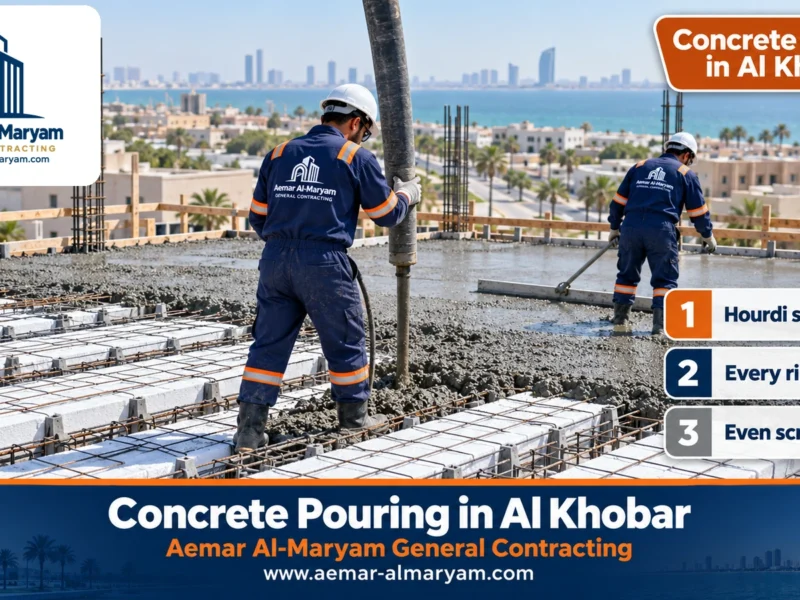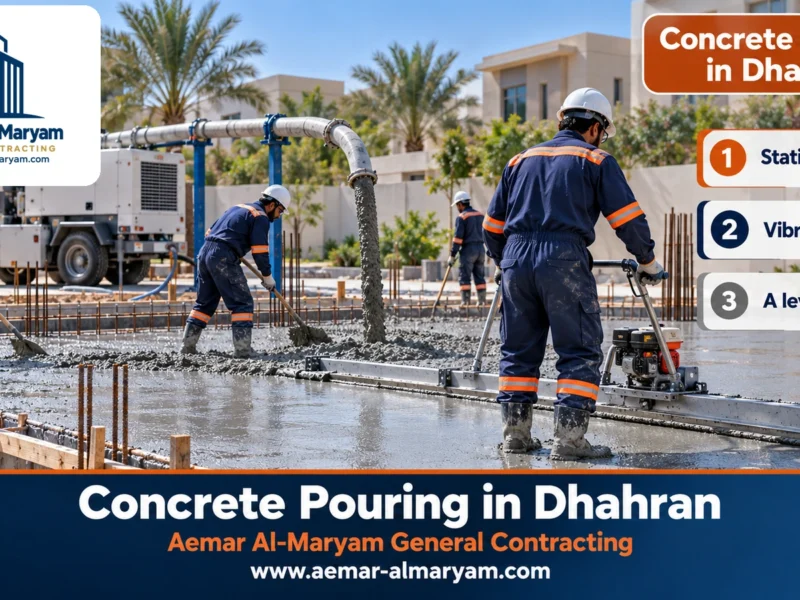
For concrete pouring in Saihat, a villa owner’s first question is usually about timing rather than price: “When will you pour the roof with the temperature above forty?” At Aemar Al-Maryam General Contracting our answer is that the pour time is chosen from the temperature of the concrete leaving the plant and from the sun and wind on the roof. A roof is cast at first light or after mid-afternoon prayer once the sun is low; it does not start until the reinforcement and conduits have passed a full check; and exposed slabs such as yards are cured with a white curing compound or with water. A 10 cm mesh-reinforced yard slab begins at SAR 46 per square metre with materials included, blinding labour at SAR 14, foam roof falls at SAR 17 and stamped concrete at SAR 110; roofs and footings are priced after reading the drawings. Concrete, pump and laboratory are billed on their own invoices, and the crew’s trip to Saihat is costed during the inspection. Nothing is final before we see the site and you approve the scope. Phone or WhatsApp 0547879578.
Saihat belongs to Qatif governorate, roughly 14 kilometres from Dammam, and a national ready-mix producer runs a plant in the city itself, so material is close and the haul is short. Most of what we pour here is villa and annex roofs and yard slabs, so this page opens with the three things that decide their quality: when we pour, what we check before pouring, and how we cure a slab left open to the sun.
Saihat: what matters before the pour
- Pour time in the heat: dawn or late afternoon, and the concrete stays under the 35 °C ceiling when it goes in.
- Before the pour: bar sizes, spacing, laps and cover, conduits between the mats, formwork and props, and the engineer’s sign-off.
- Yards: white curing compound sprayed once the bleed-water sheen has gone, or water curing for 7 days.
- What a square metre starts at: SAR 46 for a yard with materials, 14 for blinding labour, 46 for a machine-trowelled floor, 17 or 23 for foam or mortar roof falls, 110 for stamped paving.
- Supply: from the nearest licensed plant, with one in Saihat itself.
- Travel: assessed at the inspection, and lower per job when you combine several jobs in one visit.
- Contact: 0547879578 with the drawings and photos of the roof and yard.
Roof pours in Saihat in the late afternoon: why and how
Midday sun heats the shuttering, the steel and the concrete itself, and speeds up evaporation from the surface so that it cracks before curing can start. That is why we do not pour Saihat roofs in the middle of a summer day. Two windows remain: first light, or late afternoon once the sun has dropped. Which one we pick depends on how big the pour is and how long it should take, traffic in the street, the wind direction and the concrete temperature the plant can promise at each time.
What changes with a late-afternoon pour?
- ✓Lighting: floodlights go up on the roof before the pour, because final finishing and the last vibration may run past sunset.
- ✓Timing with the plant: we fix the first truck’s arrival and the gap between trucks, and order a retarder, so the pour finishes without a cold joint.
- ✓Surface protection: evening wind dries a slab just as the sun does, so light misting or covers start as soon as the surface firms up.
- ✓Steel and forms: timber shuttering is wetted before the pour, and we do not cast onto forms that have baked in the sun all afternoon without dampening them first.
- ✓The next morning: the first hours of sun hit a slab only one night old, so wetting or covers are ready from dawn.
What the code requires for hot-weather pouring
The Saudi concrete code sets clear limits for hot weather: concrete placed in the forms may not exceed 35 °C, its slump at placing must be 75 mm or more, a truck must be discharged within two hours when the mix contains a retarder, no water may be added on site to make stiffening concrete workable again, and curing must last at least 7 days. It also warns against excessive evaporation during placing, so if wind and heat build up we may need a fog spray over the slab or windbreaks.
| What we watch on pour day | How we handle it in Saihat |
|---|---|
| Temperature of arriving concrete | We ask the plant for concrete no hotter than 35 °C and refuse anything above it |
| Time on the road | The plant is close in Saihat, but we still check the batching time on each delivery ticket |
| Consistency of the mix | A slump test on arrival, and no water added on site |
| Surface evaporation | Light misting or covers from the moment the surface firms up |
| Light for finishing | Floodlights in place before sunset |
Checking the reinforcement and conduits before a pour in Saihat
Any mistake in the steel or conduits is buried under concrete within hours and only shows up later as a crack or a dead circuit. We treat the pre-pour check as part of the job rather than an optional step, and ask the supervising engineering office to inspect and accept the reinforcement before we fix the first truck’s arrival time.
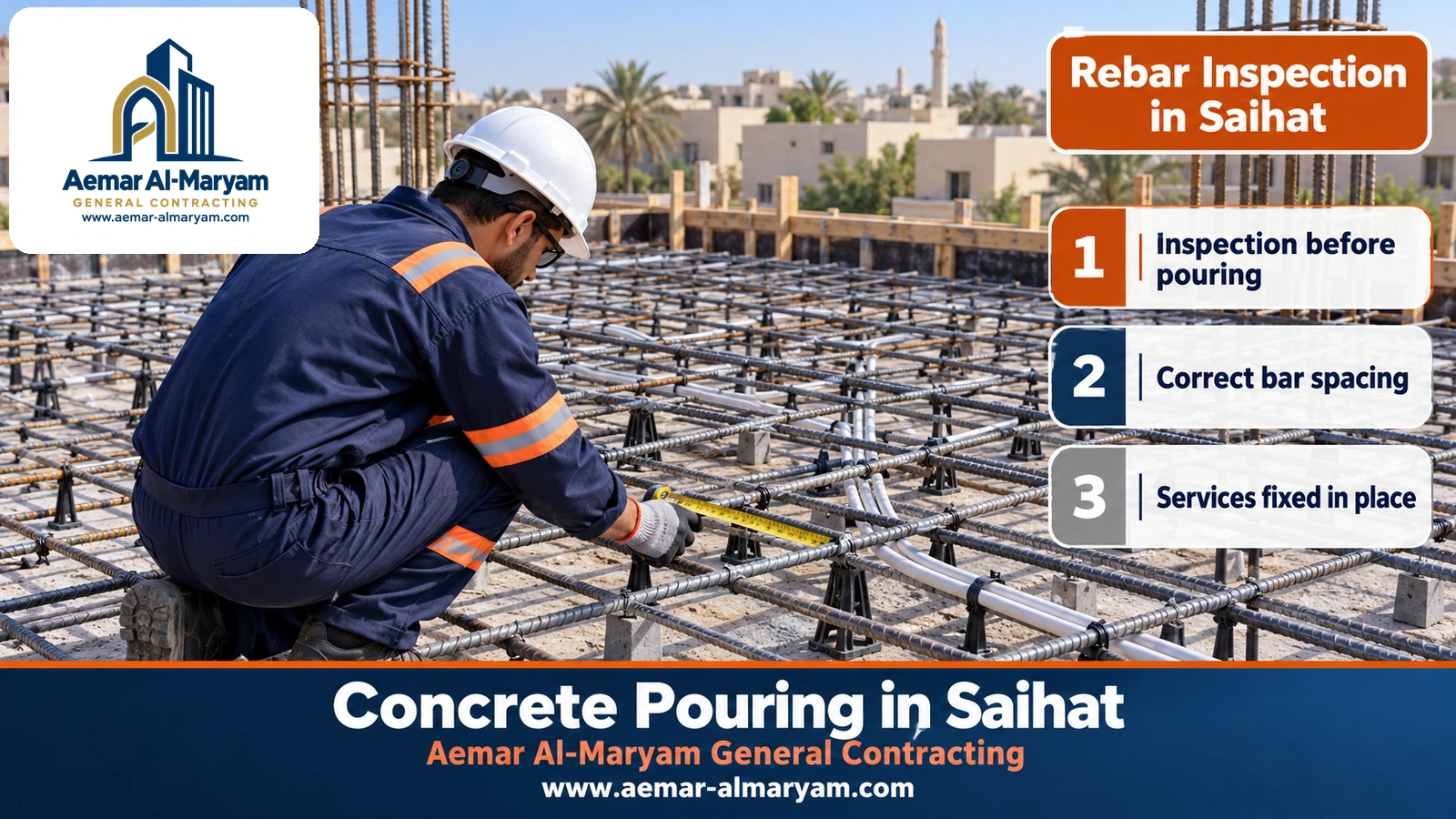
Reinforcement checklist before a roof pour
- 1Bar sizes and spacing
We compare the diameter and spacing of each bar with the drawings in the slab and the beams, measuring with a tape at several points. - 2Bottom and top mats
The bottom mat sits on spacer blocks at the specified cover; the top mat sits on firm chairs that do not collapse under workers’ feet. - 3Laps and extra bars
Lap lengths are where the drawings allow them, and the additional bars over columns and around openings are tied in. - 4Beam steel and links
The number of links and their closer spacing near columns match the drawings, and starter bars for the next floor’s columns are in position. - 5Forms and props
Panels are clean and oiled, joints are sealed, and props stand on firm ground and are braced.
Conduits between the mats
Electrical conduits in a roof run between the bottom and top mats and are tied to the steel at short intervals so they cannot float or shift during the pour. We do not accept a conduit lying directly on the shuttering, because it takes the place of the concrete cover, nor a bundle of conduits side by side in one spot, because it weakens the section. Ceiling boxes must be fixed and sealed so mortar cannot get in. Where drainage or air-conditioning pipes pass through, we check that sleeves are in place before the pour. Coordination with the electrician is covered on electrician in Saihat, and with the plumber on plumber in Saihat.
An opening forgotten before the pour
If, after the pour, a pipe route or opening turns out to be missing, the right fix is a precise round hole by core drilling in Saihat or a controlled cut by concrete cutting in Saihat, once the steel has been located. Breaking through a new slab with a hammer damages the bars and the concrete around them.
The concrete cover we measure
| Steel in | Common minimum cover |
|---|---|
| A footing cast on the soil | 75 mm |
| An outdoor or soil-facing member with bars of 19 mm and above | 50 mm |
| An outdoor or soil-facing member with bars of 16 mm and below | 40 mm |
| An indoor slab | 20 mm |
| An indoor beam or column | 40 mm |
In a coastal city like Saihat, the designer may increase these figures according to the exposure class chosen.
Vibration and finishing on a Saihat roof
Concrete arriving on the roof from the pump carries air between the stones, and if that air stays it leaves voids that weaken the slab and expose the steel to moisture. So the vibrator operator follows the pump hose step by step, pushing the poker in vertically at close, even spacing and holding it a few seconds until the air has stopped coming up and a film of paste shows around it, then lifting it out gradually. Dragging concrete sideways with the poker is something we do not allow, because that separates mortar from stone.
After vibration the straightedge runs on the level rails, followed by a long-handled bull float that closes the surface and removes the screed marks. The timing of the final finish depends on the heat: on a late-afternoon pour the surface can take longer to firm up as the evening cools, so we wait for it and never sprinkle water to make trowelling easier, because water added to the surface weakens the top layer and makes it dust or flake later.
Cold joints and a plan for stopping
On a large roof a pump can break down or a truck can be held up. We plan for that beforehand: the engineer tells us where a stop is acceptable if we are forced to make one, usually in a low-shear zone away from the columns, and we have a timber stop-end ready to close the pour there. If a truck is a little late, we keep working the concrete at the edge so it stays plastic. The essential point is never to stop at random in the middle of a beam or beside a column.
Pouring columns in Saihat
Columns come before the roof. We check that they are plumb both ways, brace their forms with props, and pour in layers with vibration so the base does not honeycomb. On hot days we wrap each column in wet hessian or plastic about a day after striking its sides, because a vertical face dries faster than most people expect.
Curing yard slabs in Saihat with compound
An open yard is one of the surfaces most exposed to sun and wind after a pour, and spraying it with water twice a day is often not enough in summer because it dries out between sprays. That is why we cure many Saihat yards with a white curing compound: a liquid sprayed on the surface that forms a thin membrane holding moisture inside the concrete, while its white colour reflects some of the sun’s heat.
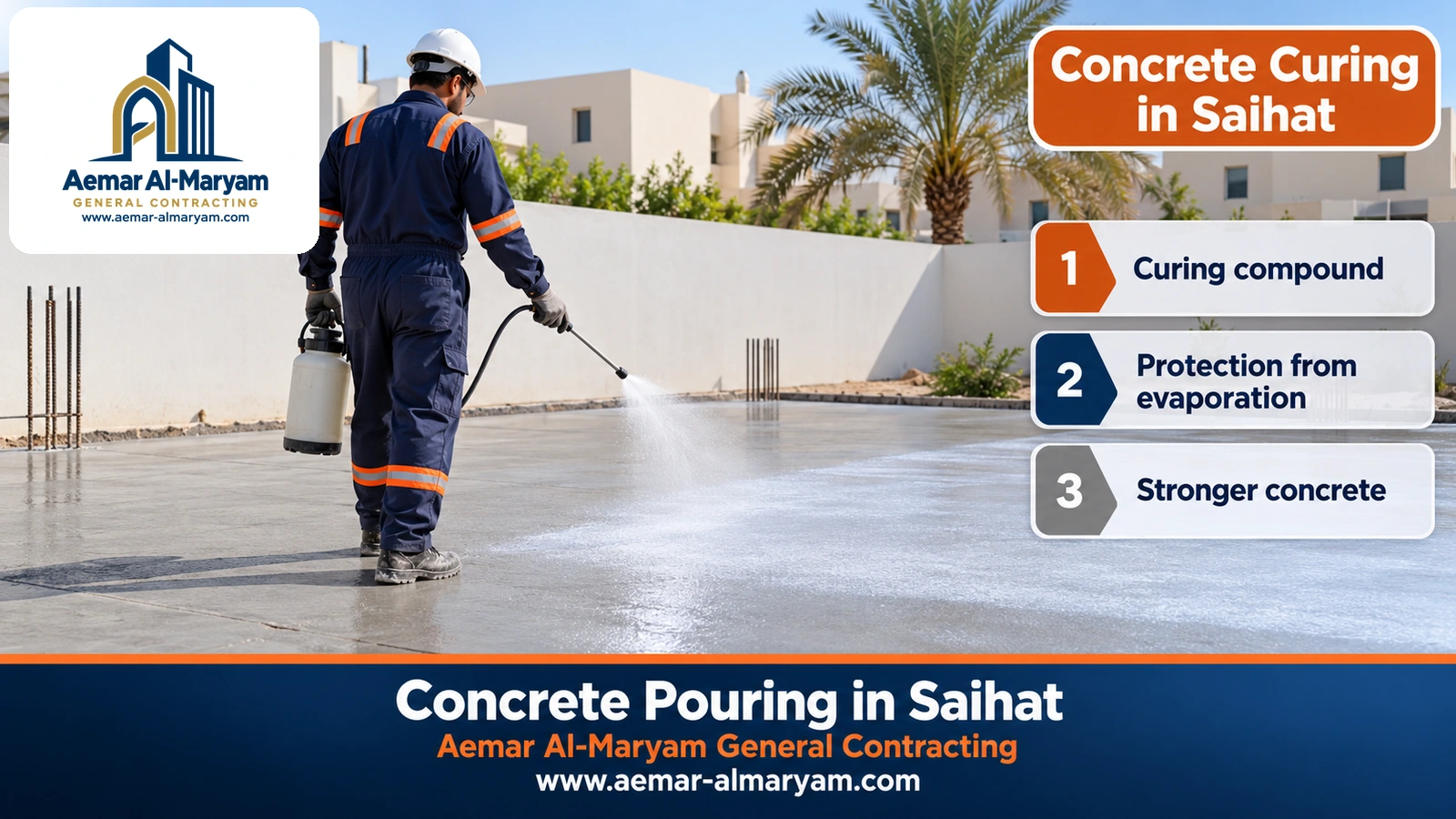
When and how the compound is sprayed
- 1After finishing
We wait until the sheen of bleed water has gone from the surface, since spraying onto visible water dilutes the compound. - 2An even coat
We spray at the coverage rate the manufacturer specifies, as a continuous film, taking in the edges and corners. - 3A second pass where needed
Any patches paler than the rest get another pass, because gaps mean the concrete is drying there. - 4Protect the membrane
Nobody walks on the treated surface on its first day so the film is not torn.
When we choose water instead of compound
If the yard will later be tiled, painted or receive an adhesive-fixed finish, some compounds reduce the bond of whatever goes on top. In that case we cure with water and hessian or plastic sheeting, or choose a compound whose maker states it is compatible with the following finish. Either way, protection starts in the first hours and continues for at least 7 days.
Compound has another advantage in Saihat. On many houses the owners are not on site during construction, so nobody is there to hose the yard at midday. The membrane keeps working all day without anyone opening a tap, provided it was sprayed complete and unbroken from the start. Roofs, on the other hand, we usually cure with water and hessian, because the slope screed and waterproofing will be bonded on top and their adhesion matters more than anything else.
Yard slab layers before curing
- ✓The ground is wetted and compacted until firm.
- ✓Termite treatment is sprayed onto the compacted soil.
- ✓Heavy polythene goes down, lapped at the joints.
- ✓8 mm steel mesh is lifted on chairs so it ends up inside the concrete.
- ✓About 10 cm of concrete is laid with a gentle fall towards the drain.
- ✓Joints are cut at spacings the contractor sets for the area, then the slab is cured.
This slab starts from SAR 46 per square metre with all materials. Stores and big garages can have a helicopter-finished floor, again from SAR 46 a square metre, on areas of 50 m² or so upwards, while decorative stamped paths begin at SAR 110. If you are comparing yard surfaces, see interlock paving in Saihat and asphalt contractor in Saihat.
Concrete pouring in Saihat: what we build
Every concrete element of a Saihat home is within our scope, either as a full package with carpentry and steel or simply the placing if your forms already stand:
■ Below ground
Blinding, footings, necks and ground beams, and bituminous coating of buried concrete before backfill.
■ The frame
Floor columns and beams, solid or hordi slabs and stairs, for villas and small apartment buildings.
■ Annexes
Annex, majlis and rooftop room roofs, once the permit and engineering drawings are in place.
■ Outside
Yards and parking areas, trowelled floors, stamped paths and roof slope screeds.
Concrete contractor in Saihat or a concrete company?
The plant batches and delivers concrete; we prepare the site, pour and cure. We order the concrete in your name at the grade on the drawings, you receive the plant’s invoice as issued, and our labour remains a separate figure. Building the whole house is part of our construction service; the pour on its own has its page at concrete pouring.
Ready-mix concrete in Saihat and the price per cubic metre
Saihat has a ready-mix plant run by a national producer within the city, with further plants in Dammam and Safwa, so we order from the closest one that supplies the grade required. A short haul means the concrete arrives with less time elapsed since batching, which is a real advantage in the heat.
There is no official price published for Saihat. The closest published reference is the Kingdom-wide average from the General Authority for Statistics, which sits around SAR 214 per cubic metre for plain grade 350 and around SAR 224 for the resisting version. Your price on the day moves with admixtures such as a retarder and with the type of pump.
Site-batched or ready-mix?
A small site mixer is only for small, non-structural work. Roofs, footings and big yards get plant concrete instead: its batching is controlled, samples can be taken for the laboratory, and it arrives in a quantity that allows the pour to run without stopping.
Hordi or solid roof slabs in Saihat
Hordi roofs carry hollow blocks between narrow concrete joists, topped with a thin slab, which saves weight and concrete. A solid roof is concrete all the way through, and cutting openings in it later is more straightforward. With hordi the pre-pour check gains a question: are the blocks laid in position and wetted, and are the joist widths and their steel as drawn? Choosing between the two is the designer’s job.
Annex roofs in Saihat
An annex or rooftop room roof goes through the same check and, if it adds to an existing building, needs a permit first, filed by an engineering office on Balady among additions and alterations. Details are in annex and majlis building in Saihat.
Stairs with the slab
Step heights and going are fixed in the shuttering ahead of the pour, and the flight is cast with the slab or afterwards as drawn, because correcting a step later means breaking out concrete or applying a thick render.
Footings, ground beams and blinding in Saihat
Beneath every villa goes a lean blinding layer, typically 5 to 10 cm, placed once the base is compacted and spraying termite treatment; labour for it starts at SAR 14 per square metre. Then come the footings, necks and ground beams, at the grade and cement type the designer sets from the soil report. Groundwater in the Eastern Province is shallow and saline on many plots, and KFUPM research showed that sulphate-resisting cement blocks sulphates but does not on its own protect the steel against chlorides, so every piece of concrete that will be buried gets a bituminous coat before backfilling. For membranes on roofs and foundations, read roof waterproofing and insulation in Saihat.
Slope screeds on Saihat roofs
Once the roof slab has cured and dried, we lay a slope screed on top that sends rainwater to the outlets with a gradient of roughly 1–2 %. Lightweight foam begins at SAR 17/m², while the tougher sand-cement version begins at SAR 23/m². The same hot-weather rule applies: no pouring at midday, keep it damp afterwards so it does not crack, and then the waterproofing goes on top.
When to strip formwork in Saihat
In Saihat we take off column and beam side forms within the first day; props below a slab spanning under 6 m remain for around seven days, and for 10 to 14 days on wider spans; beams keep theirs for about two weeks, or three on long spans. Props come out centre-first, working outwards, and cantilevers are freed at the very end. The engineer has the final word on these periods.
Slump and cube tests in Saihat
A slump test on each truck’s arrival shows the consistency of the mix, while cubes filled at the pour go to the lab for crushing a week later and again at four weeks. The code asks for at least one set every pour day, with a further set roughly every 115 m³ and every 465 m² of slab, and accepts the concrete once three successive results average the required strength. Laboratory fees are passed on at cost.
What you prepare before pour day
The owner is a partner in a good pour, and some of what is needed is in your hands rather than ours:
- ✓Water: a supply close to the roof or yard with enough pressure, because wetting starts within hours and continues for a week.
- ✓Power: a safe socket for floodlights and the vibrator if the pour is in the late afternoon, or we bring a generator and tell you so.
- ✓The street: cars moved from in front of the house when the pump and trucks arrive, and neighbours told the time.
- ✓Access: the gate open and anything in the way of a pipeline cleared if a line pump is used.
- ✓The roof afterwards: other trades kept off it, with no materials stacked on top until we say so.
We send you a reminder of these points the day before, so the pour is not held up an hour by a parked car or a locked gate.
The first 24 hours after a pour in Saihat
The day after a late-afternoon pour decides a lot. Next morning we are on the roof at first light, before the sun gains strength, starting the spray or checking that the wet hessian is in place, and we keep other workers from walking on the slab or stacking materials. We look at the slab edges and overhangs first, because they dry fastest. On a yard cured with compound we check that the membrane is continuous; if feet or wind have scuffed part of it, we spray again or wet it with water.
Concrete pouring prices in Saihat
Rates in Saihat match Dammam’s, plus a travel element worked out when we visit. Labour is kept apart from materials, and the figures are estimates until inspection and agreement:
| Saihat job | Lowest price | Measured by | Remember |
|---|---|---|---|
| Concrete yard: mesh 8 mm, 10 cm thick | SAR 46 | each m², materials in | Tiny yards work out dearer |
| Helicopter-trowelled floor | SAR 46 | each m², materials in | Needs around 50 m² |
| Stamped path or patio | SAR 110 | each m² | Sealer coat included |
| Lean blinding layer | SAR 14 | each m², our labour | Plant invoices its concrete |
| Lightweight foam falls | SAR 17 | each m² | Membrane quoted apart |
| Sand-cement falls | SAR 23 | each m² | Denser, tougher finish |
| Roof of a villa or annex, complete | Priced on site | m² taken off drawings | Pre-pour check included |
| Foundations, tie beams and columns | Priced on site | per m³ or per member | Follows the structural set |
| Staircase | Priced on site | per flight and step count | Steps fixed in the forms first |
| Heavy-load slab | Priced on site | thickness and reinforcement | Calculated by an engineer |
| Bitumen on buried faces | Priced on site | area in the ground | Done ahead of backfilling |
| Plant concrete | As invoiced | each m³ | GASTAT benchmark near 214 (plain 350) |
| Pump hire | As invoiced | hour or pour | Line or boom |
| Laboratory cubes | As invoiced | per set | Tested at 7 and 28 days |
The crew’s trip to Saihat
Because Saihat is beyond the Dammam–Khobar–Dhahran triangle we cover without charge, a trip cost applies, set at the inspection according to the neighbourhood and the number of working days. If you combine the roof and the yard slab, or the footings and blinding, in the same visit, that cost is shared across more than one job.
Worked example: a 12 × 15 m villa roof in Saihat
An illustration for a 16 cm solid slab whose drawings show downstand beams totalling about 6 m³ (an assumed figure for the example), cast in one late-afternoon pour:
| Item | Calculation | Result |
|---|---|---|
| Roof area | 12 × 15 | 180 m² |
| Slab volume | 180 × 0.16 | 28.8 m³ |
| With the beams | 28.8 + 6 | 34.8 m³ |
| Volume with about 5 % waste | 34.8 × 1.05 | about 36.54 m³ |
| Concrete at the national average (plain 350) | 36.54 × 214.10 | about SAR 7,823 |
| Cube sets required | One pour day, under 115 m³ and under 465 m² | at least one set |
Roof labour with shuttering and steel fixing is priced at the inspection, and the pump and laboratory at cost. The aim is to show the size of pour we plan around when we choose the start time, and how many samples that day needs.
Things that shift the cost of a Saihat pour
- ✓Pour size: a large roof needs a boom pump and a steady stream of trucks; a small one may need less.
- ✓Timing: dawn or late-afternoon pours need the plant, pump and lighting booked in advance.
- ✓Mix: resisting cement or mineral additions add to the cubic-metre price.
- ✓Small areas: a little yard still needs the full set-up, so its square metre costs more.
- ✓Travel: assessed at the inspection and reduced by combining jobs.
Does a pour in Saihat need a permit?
New villas go up under a building permit and stamped drawings, which we follow with the supervising engineers. Putting an extra slab, room or column to an existing building needs an application lodged by an engineering office you appoint on Balady. Yard slabs within the plot are normally permit-free; Balady will confirm the position for your house.
Mistakes we see on Saihat pours
- ✓Starting a roof close to midday in summer, so the top layer cracks before it is cured.
- ✓Pouring without the steel being accepted, then finding the spacing wider than drawn when it is too late.
- ✓Electrical conduits lying directly on the forms, taking the place of the concrete cover.
- ✓Spraying curing compound while water still glistens on the surface, or spraying it patchily.
- ✓Using a compound that is not compatible with the tiles that will go on the yard.
- ✓Adding water to the truck to make evening finishing easier.
- ✓Walking on a cured yard on its first day.
If cracks appear after a pour, repair options are on crack repair in Saihat; damaged older concrete is handled by our renovation contractor in Saihat; and removing an old slab before a new pour is covered by demolition contractor in Saihat.
How to book concrete pouring in Saihat
- 1Send the drawings and photos
The structural drawings, photos of the roof or yard, and one shot of the road outside, sent to WhatsApp 0547879578. - 2We propose a time and method
First light or late afternoon, and a boom or line pump, depending on the pour size and the site. - 3Inspection and price
We measure and calculate, writing labour and travel separately from materials. - 4Pre-pour check
We go over the steel, conduits and forms, have them accepted with the engineer, then fix the first truck’s time. - 5Pour and cure
Placing and finishing, a week or more of water or compound curing, then striking in sequence.
Why Saihat owners choose us for their pours
■ A pour time worked out
We pour at the hour that suits the heat, not the hour that suits our diary.
■ A check before every pour
Steel, conduits and forms are reviewed and accepted before the first truck.
■ Curing to suit the surface
White compound for open yards, or water where a bonded finish will follow.
■ Clear costs
Plant and pump invoices as issued, with our labour separate.
Saihat neighbourhoods where we pour
We pour concrete across Saihat’s neighbourhoods, including:
The Saihat area page brings together our services in the city. Close by we also work in Qatif, where bucket-and-crane pours suit narrow streets (concrete pouring in Qatif), and in Dhahran, where line pumps feed villa floors (concrete pouring in Dhahran). Every technical detail sits in the Dammam guide: concrete pouring contractor in Dammam.
A roof or yard to pour in Saihat?
Send the drawings and photos of the roof, yard and street; we will suggest a pour time and method and send a budget figure before the visit.
More on Saihat
Tags