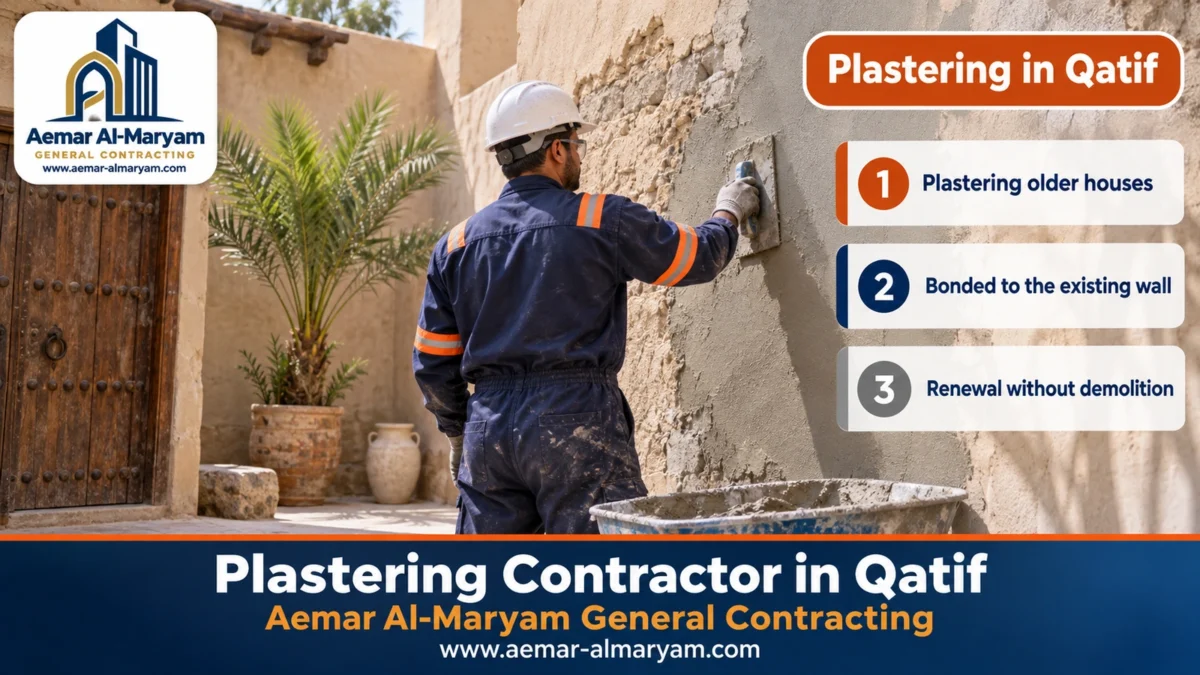
A plastering contractor in Qatif from Aemar Al-Maryam General Contracting who focuses on older houses: we hack off plaster that sounds hollow or crumbles, re-plaster walls on fresh screeds, bridge block-to-column joints with mesh, and check for salts and rising damp at the foot of the walls before any new mortar goes on. Taking an old wall back to block and plastering it again costs from SAR 23 per square metre, stripping alone from SAR 7.5, full-face mesh from SAR 20 and room crack preparation before paint from SAR 140; damp and salt problems are priced on inspection. Nothing is final until the wall has been inspected and the scope signed off. Ring or message 0547879578.
Many homes in Qatif and on Tarout Island were built a long time ago and have changed a great deal since: a bathroom added upstairs, air-conditioners set into the walls, new cables and pipes chased in. Over the years the household learns the signs by heart: plaster that answers a knock with a hollow note, a white band of salt creeping up from the floor, paint that bubbles and flakes in the same corner every year. This page explains how we deal with walls like these step by step, when a partial repair is enough and when the whole wall has to be redone, and what each option costs.
Key points: plastering older houses in Qatif
- We start by: tapping the wall, mapping the hollow areas, and tracing the source of any moisture before anything is hacked off.
- We then: strip failed plaster back to the block, dash, mesh the joints and patches, and apply new plaster on screeds that meets the sound old plaster without a visible edge.
- Rates from: SAR 23/m² re-plastering, SAR 7.5 stripping only, SAR 20 full mesh, SAR 140 per room for surface crack preparation. Damp and salts on inspection.
- What we do not take on: heritage and mud-built buildings; we work on concrete and blockwork houses.
- Where: Qatif city and its districts, Tarout Island, Safwa, Anak, Al Qudaih and Al Awamiyah.
- To order: a full photo of each wall plus close-ups of its lower part, on WhatsApp 0547879578.
Re-plastering old walls in Qatif: when is it really needed?
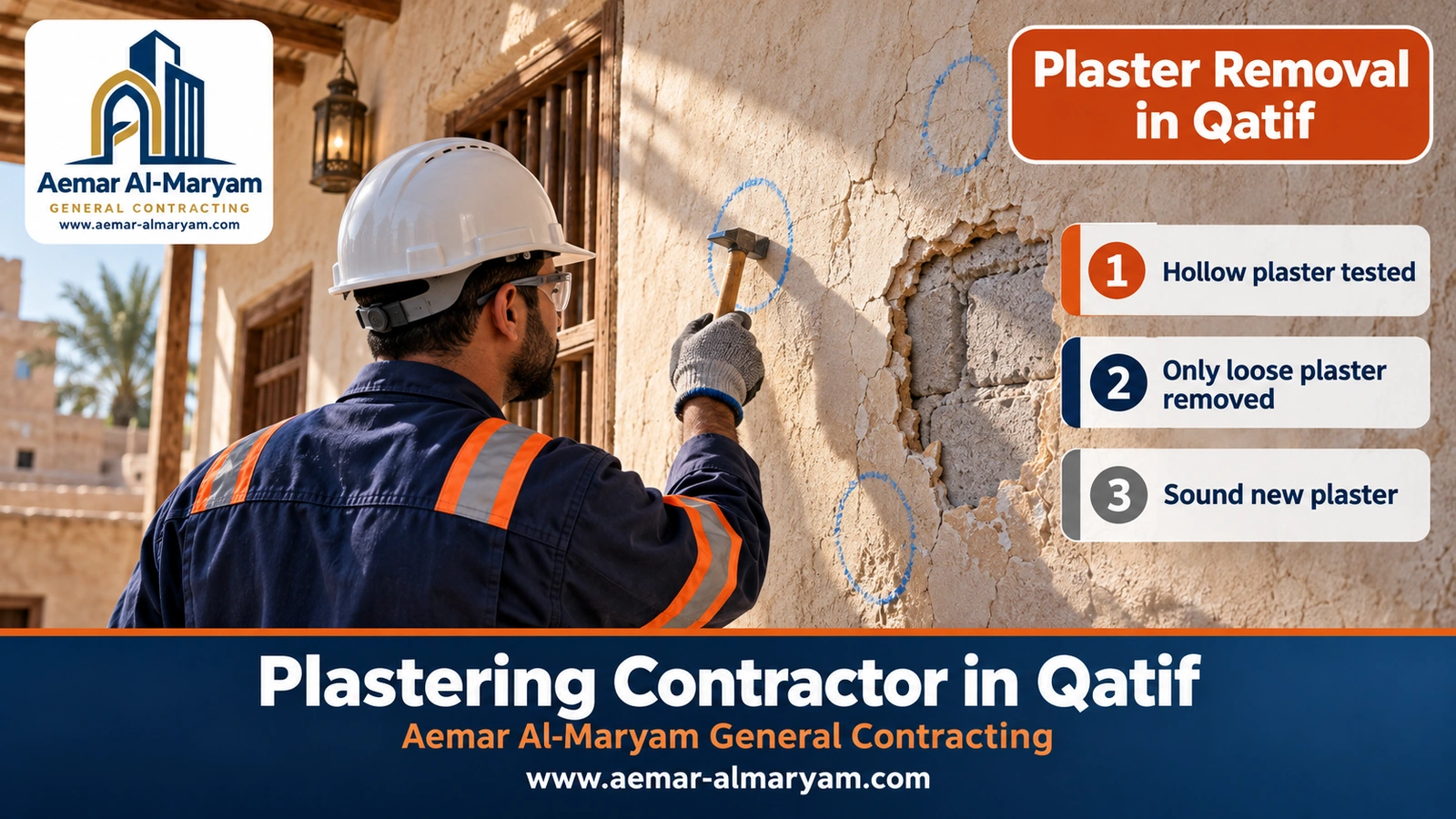
Re-plastering old walls in Qatif is needed when the plaster has come away from the block over a wide area, crumbles when touched, or is so loaded with salts that every coat of paint on it peels. Filler and new paint do nothing for such a wall; give it one season and the same blisters are back. If the plaster is still firmly bonded and only shows hairline cracks, preparing those cracks before painting is enough.
We always begin with a tapping survey. A small hammer handle is run across the wall, and wherever it sounds hollow we draw a chalk ring. A few minutes later we have a map of the wall that shows whether the trouble is in scattered patches that can be repaired or across most of the surface, in which case stripping the whole wall is cheaper and more reliable.
| Condition of the wall | What we suggest | Starts from |
|---|---|---|
| Hairline cracks, plaster still sound | Prepare the cracks, then paint | SAR 140 per room |
| Scattered hollow patches | Cut out to sound edges and patch over mesh | On inspection, by area |
| Most of the wall hollow or crumbling | Strip completely and re-plaster on screeds | SAR 23/m² |
| Salts and damp low down | Deal with the source, then strip and redo the damaged band | On inspection |
Rates are provisional until we see the wall and agree.
With older houses we are open about one thing: if a crack runs through the blocks themselves or through a column or beam, it is not a plaster problem and needs a structural look first. That is covered in crack repair in Qatif, and if the house needs wider refurbishment, start with the renovation contractor in Qatif.
Salt bloom and rising damp low on Qatif walls
White salts and damp at the bottom of walls in Qatif usually come from water rising out of the ground or leaking from a nearby source. The water carries dissolved salts to the wall face, where they crystallise and push plaster and paint outwards. The Eastern Province is known for shallow groundwater that is saline in many places, and moisture can climb a noticeable height up a wall by capillary action. That is why we price this work on inspection rather than at a fixed rate.
The usual mistake is to hack off the damaged band and plaster it again straight away. The salts are back within months because the water is still arriving. Our order of work is different:
- 1Find the source
Is it ground moisture wicking upward, a bathroom, tank or pipe that leaks, or rainwater pooling at the foot of a boundary wall? - 2Stop the water
Repair the leak, improve drainage or waterproof, depending on the cause; priced after inspection. - 3Strip and dry
We hack off the salt-damaged plaster to a margin above the visible damage and let the wall dry out. - 4Clean
Salts are brushed off dry; washing them with water only drives them back into the wall. - 5New plaster
Cement mortar with washed sand and clean water, plus a water-resisting admixture where needed.
⚠ Keep gypsum away from a damp wall base
Gypsum loses strength when wet. Put it at the foot of a wall that ground moisture reaches and it will fail faster than the old plaster did. In that zone we use cement plaster only.
Plaster with mesh in Qatif: why the crack keeps coming back at the column
Plaster with mesh in Qatif is the answer to the crack that reappears in the same place after every repaint, usually a straight line beside a column or under a beam. Block and concrete are different materials that move by different amounts as temperatures swing, and where nothing ties the joint together the plaster splits along it. We cut the plaster open along the joint, bed a band of mesh roughly a hand-span wide (15 cm) across it, and plaster over it.
Older houses have many more places that need mesh: old service chases that were broken out and filled, the edges of patches where old plaster meets new, around AC openings that were enlarged or blocked up, and the corners of windows. If a wall has been patched again and again over the years, we suggest mesh across the entire face, which starts from SAR 20 per square metre.
■ Block-to-column joint
A strip of mesh along the full line before plastering.
■ Old service chase
Mesh over the chase after it has been packed with mortar.
■ Edge of a patch
Mesh lapping across the line between old and new.
■ Blocked AC opening
Blockwork infill and mesh before plaster, so its outline never shows.
Plastering contractor in Qatif or a plasterer? Who answers for the result?
A plastering contractor in Qatif takes the job from diagnosis to handover and answers for the result, while a plasterer sells his hands and skill and leaves the materials, supervision and diagnosis to you. On new work a good plasterer may be enough. In an older house the hard part is rarely the trowel work; it is the diagnosis. Why did the plaster go hollow? Where are the salts coming from? Is the crack in the plaster or in the wall?
Plasterer in Qatif and a plasterer phone number
If you are looking for a plasterer in Qatif, ask before you agree: what will you do about the salts? How far back will you strip? Will you mesh the patches? If the answer is “we’ll plaster over it”, the problem is likely to return. The plasterer number we give is the company line, 0547879578, and the crew that comes works to a method written into the agreement.
Paying a plasterer daily or per square metre in Qatif?
Hiring a plasterer by the day in Qatif makes sense for a small patch or a filled chase, where the area does not justify measuring. Re-plastering a room or a house is better priced by the square metre: you know the cost before stripping starts, and flatness and bond become part of the handover. On repair work in particular the damage can turn out wider once the old coat is off, so we write the rate for any extra square metre into the agreement in advance.
Internal plastering in Qatif: rooms and majlis after stripping
Internal plastering in Qatif after the old coat has been stripped needs more care than plastering new blockwork. Old block is often out of line and carries remnants of mortar, salt and dust. We brush it clean, wet the block because it is very absorbent, dash any concrete, and set new dots and screeds from scratch rather than trusting the line of the old wall.
The second challenge is making new plaster meet sound old plaster without a visible edge. We cut back to a straight, firm boundary, dampen the old edge, carry the new coat up to it at the same level, then float it until the line disappears. Because these edges are among the places most likely to crack, we lay mesh across them too.
Ceilings in older houses
Ceiling plastering in Qatif is from SAR 14 a square metre, but in an older house we check the soffit before quoting. Exposed or rusting reinforcement, or concrete dropping in lumps, is not a plaster job; it is concrete repair that needs assessment. If only the ceiling plaster has come away, we strip it, dash the concrete and apply a thin new coat.
Corners and door reveals
The corners in older houses are usually worn down by years of knocks. When we re-plaster we fix metal corner beads on exposed arrises and around door openings, so the corners come back straight and stay that way.
Working in an occupied house in Qatif
Most of the Qatif homes we re-plaster stay occupied while we work, and that changes how the job runs. We go room by room instead of opening up the whole house, move out what furniture we can or gather it in the middle of the room under plastic sheeting, and close the doorway with a plastic curtain so the dust from stripping does not travel through the house. Stripping starts in the morning, and debris is bagged and carried out as we go so it never piles up in the corridors.
We agree the order of rooms with you, usually starting with the majlis or the least-used room and leaving bedrooms until the previous room has been plastered. A freshly plastered room is then misted for several days, so furniture does not go straight back in and the AC is not pointed at the walls. If there are elderly relatives or small children at home, we keep the noisy stripping to agreed hours.
Plastering bathrooms and kitchens in Qatif before waterproofing and tiles
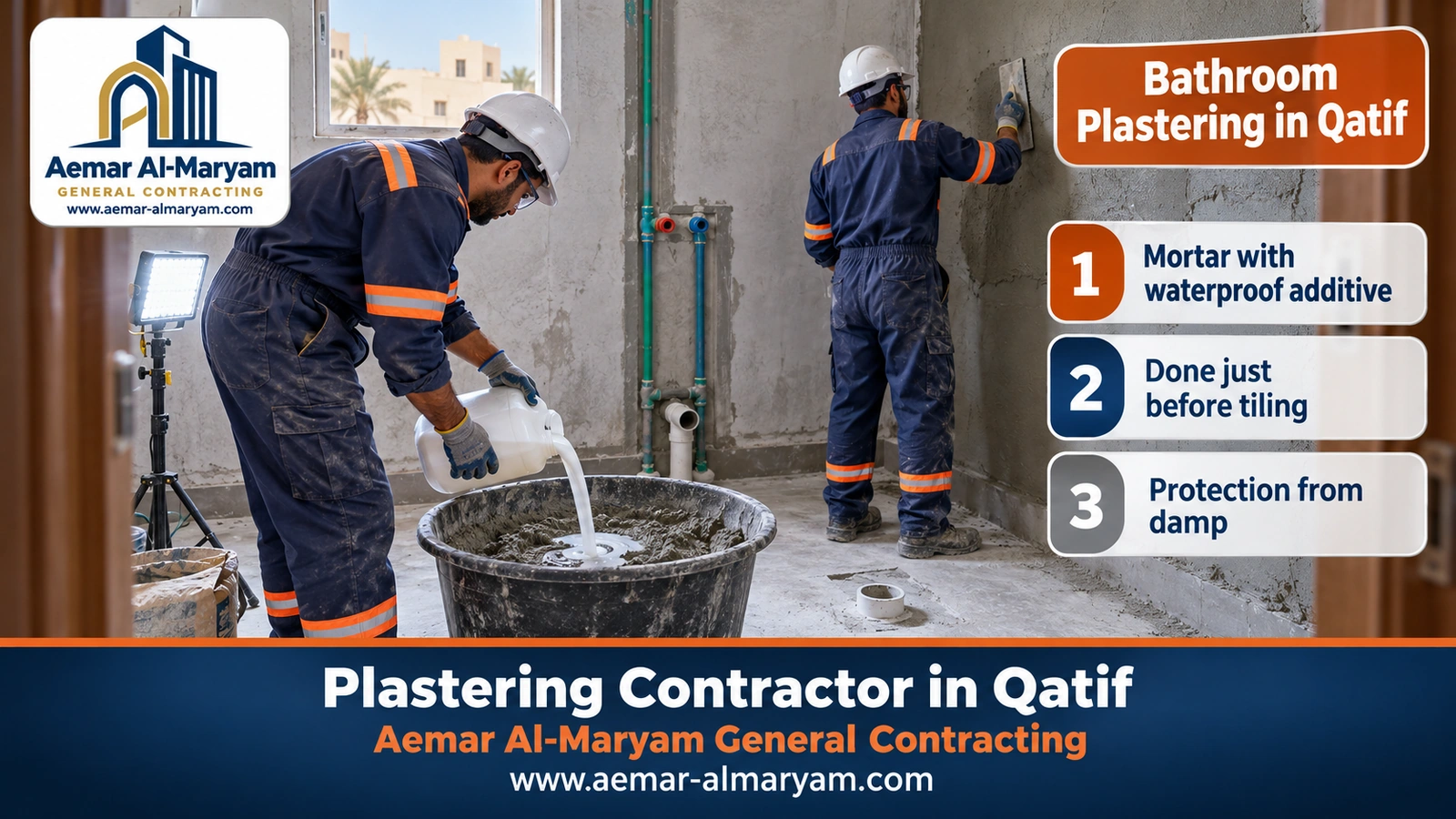
Plastering bathroom and kitchen walls in Qatif is from SAR 18 a square metre, using cement mortar with a water-resisting admixture because these walls see moisture every day. It is one of the most frequent jobs when an older house is refurbished or a new flat is finished: pipes are renewed, the chases are filled, and the wall is plastered before waterproofing and tiling.
Here we pay particular attention to flatness and plumb, because tiles and cabinets expose any lean, to filling pipe and cable chases completely and flush, and to letting the plaster gain strength before the waterproofing goes on. Gypsum plaster is never used in these rooms.
External rendering and facades in Qatif
Rendering external walls in Qatif begins at SAR 14 per m² for the work alone, rising to SAR 18 per m² when we supply cement and sand, applied in two coats with a mortar richer in cement. On older facades we tap first here too, because detached render is a hazard to passers-by if it falls, and every hollow section is cut out before the new render goes on.
Being near the sea, with humid air for much of the year, we add a water-resisting admixture to external mortar, form parapet copings and sills with a fall that sheds water away from the wall, and protect the base of boundary walls from irrigation and rainwater. Scaffolding and height are priced after inspection.
Courtyard walls and their bases in older houses
Courtyard and boundary walls in older Qatif houses are among the most damaged walls of all, because their base sits in courtyard soil and irrigation water while their outer face takes the street and the sun. We often find crumbling plaster from the ground up to a hand-span or two, and vertical cracks at the wall’s columns. We strip the damaged base, lower or redirect drainage away from the wall where we can, re-plaster with water-resistant mortar, and mesh every column joint. If a palm or garden bed is watered right against the wall, we advise moving the water source or putting a barrier between them, otherwise the salts return.
Coloured render in Qatif
Coloured render in Qatif costs from SAR 32 per square metre, pigmented mortar included. It suits boundary walls and facades whose owners are tired of repainting flaking paint, because the colour is part of the mortar itself. It must not go over old render that is salty or hollow, only over a sound base once the lower part of the wall has been dealt with.
Scratch coat, dots and screeds on an old wall
The scratch coat, dots and screeds matter even more on an old wall in Qatif than on a new one. Once the old coat is off, smooth concrete columns and beams appear that plaster will not grip, so we dash them with a rich mix of about one part cement to two of sand and keep it damp for at least a day. Then we re-establish the plane with dots roughly every metre and a half, joined by screeds, because old blockwork is rarely flat.
✦ Why we never plaster straight over the old coat
New plaster laid on weak old plaster is only as strong as the layer beneath it; if the old coat lets go, both come down together. We strip to a firm layer or to the block, and we never put a new coat on a surface that sounds hollow.
Mix ratios and plaster thickness on repair work
Mixes for re-plastering in Qatif are much the same as on new work: by volume, sand at four to six times the cement, with external mortar towards the richer end. The real difference is thickness, because a stripped old wall may need uneven build-up to make good its lack of line.
| Item | Usual figure | In an older house |
|---|---|---|
| Internal thickness | About 12–15 mm | May be more in places, so it is built up in two coats |
| External thickness | About 15–20 mm in two coats | With every hollow area cut out first |
| More than 25 mm | Never in a single coat | We correct the block or build up in layers |
| Time between coats | About two days | The same |
| Sand and water | Washed and clean | Even more important, to avoid bringing in new salts |
We also keep each later coat no stronger than the one under it; a cement-rich coat over a weaker base shrinks onto it and tears it away.
Machine or hand plastering in Qatif?
Machine plastering in Qatif pays off on new houses and large continuous areas, while on repair work hand plastering is nearly always the better fit, because the work is in separate patches, meets old plaster at its edges and often happens in occupied rooms. We price a machine on inspection only where the area is genuinely large, such as a whole facade after stripping.
Gypsum plaster or cement plaster in Qatif?
Gypsum plaster in Qatif suits dry bedrooms and majlis away from any water source, costs from SAR 41 per m² supplied and applied, and takes paint after only a few days. In an older house with rising damp or leaks, though, we prefer cement plaster on all lower walls, bathrooms, kitchens and facades, and limit gypsum to walls that are completely dry, usually on upper floors.
Curing plaster with water in Qatif’s humidity
Curing plaster with water in Qatif is still necessary despite the humid air, because humidity does not stop the sun and wind from drying the surface quickly. We mist cement plaster lightly morning and evening for about seven days, using clean water, never salty well water, so we do not put fresh salts into a wall we have just treated.
- ✓Clean water: nothing salty and nothing of unknown origin.
- ✓A light mist: no water running down to the base of the wall.
- ✓Timing: morning and evening, more often on hot days.
- ✓Before paint: we wait for the wall to dry thoroughly; paint on damp plaster traps water and salts.
Plaster defects in Qatif houses and their causes
| What you see | Likely cause | What we do |
|---|---|---|
| Hollow sound and bulging | Lost bond to the block, or a coat laid over a weak one | Strip to sound edges and re-plaster |
| White band near the floor | Water carrying salts from the ground or a leak | Cut off the water, take the plaster off, brush the salts away, plaster again |
| Crack returning at the column | No mesh across the joint | Open the line, mesh, re-plaster |
| Plaster crumbles to the touch | Salts crystallised inside it, or weak mortar | Strip the crumbling area completely |
| Visible line between old and new | Patch without mesh or floating | Redo the edge with mesh and floating |
| Widespread hairline cracking | Fast drying or a rich finish coat | Prepare the cracks or renew the finish coat |
Structural cracks need assessing before any plaster work.
Plastering price per square metre in Qatif
On repair work in Qatif, our plastering price per square metre begins at SAR 23 to re-plaster an old wall after stripping and at SAR 7.5 for stripping alone; on new walls it begins at SAR 6.5 for labour when the materials are yours. The price moves with the depth of stripping, the state of the blockwork, the presence of salts, working height and access. Every number here firms up only after inspection and a written scope.
| Work in the house | Unit | Starts from | When you need it |
|---|---|---|---|
| Strip old plaster and lay a new screeded coat | m² | SAR 23 | Walls that sound hollow or crumble in older houses |
| Strip back to block, no replastering | m² | SAR 7.5 | When your own plasterer will finish |
| Fibre mesh buried across the full wall face | m² | SAR 20 | Walls patched many times or with mixed materials |
| Hairline cracks in one room made ready for paint | room | SAR 140 | Surface cracks that do not run into the block |
| Labour for an inside wall, you supply materials | m² | SAR 6.5 | A room or simple outbuilding |
| Labour for a true, screeded inside wall with beaded corners | m² | SAR 11 | Rooms and majlis |
| Inside wall, materials on us | m² | SAR 13 | If you would rather buy nothing yourself |
| Room soffits | m² | SAR 14 | After the concrete and its steel have been checked |
| Wet-room and kitchen walls in water-resistant mortar | m² | SAR 18 | Before waterproofing and tiles |
| Fine floated surface to take paint | m² | SAR 17 | Majlis and halls |
| Render labour for the facade and courtyard | m² | SAR 14 | External walls and boundary walls |
| Facade or boundary wall, materials included | m² | SAR 18 | Two coats |
| Coloured render for a boundary wall or facade | m² | SAR 32 | With materials, no paint needed |
| Gypsum skim system for dry rooms | m² | SAR 41 | With materials |
| Damp and salt bloom in the bottom metre of a wall | — | On inspection | Source first, plaster second |
| Hollow or detached plaster | — | On inspection | Mapped by tapping |
| Machine-sprayed plaster | — | On inspection | Rarely worthwhile on repair work |
Provisional figures, fixed by agreement after the visit. To compare with our other trades, see the rates page.
Worked example: a 3.5 × 4 room in an older Qatif house
Consider an older Qatif bedroom, 3.5 m by 4 m, with walls 3 m high. Wall area = (3.5 + 4) × 2 × 3 = 45 m². The door and window are each under 2 m², so by common practice neither is deducted. After tapping, the room could fall into one of two situations:
| Situation | Calculation | Estimated cost |
|---|---|---|
| Plaster hollow over most of the room: full re-plaster | 45 × 23 | About SAR 1,035 |
| Damage limited to a 1.2 m band at the bottom | Perimeter 15 m × 1.2 = 18 m² × 23 = 414 + crack preparation for the rest of the room 140 | About SAR 554 |
| Stripping only, because you have a plasterer | 45 × 7.5 | About SAR 338 |
| Treating the source of damp and salts | — | On inspection |
Illustrative example; the ceiling is not included. The actual figure is fixed after inspection.
The example shows why we tap the wall before pricing: the two situations differ by almost half, and the right decision comes from the chalk map, not from a quick look. If the lower band is salt-laden, we will not plaster it until the water has stopped.
How are square metres counted on repair work?
Each wall is taken as length by height, or only the stripped area is measured where the repair is partial. By custom, small openings are not deducted and large ones over roughly 2 m² are. Because damage in an old house can grow once the old coat is off, we write the rate for any additional square metre into the agreement in advance, so there are no surprises.
Can you paint an old wall without re-plastering?
Not if it is hollow or salt-laden. Paint will not hold on detached plaster or keep salts back, and it will peel in the same place again. If the old plaster is sound and all it has is hairline cracking, it can be prepared and painted directly; details are in painting contractor in Qatif.
Steps for re-plastering a house in Qatif
- 1Tapping and diagnosis
A chalk map of hollow areas, and a check for salts, damp and where they come from. - 2Agreement
Areas, stripping limits, the rate for extra metres, materials and duration. - 3Protection
Floors and remaining furniture covered, and the room screened off from the rest of the house as far as possible. - 4Stripping and cleaning
Failed plaster removed to sound edges, salts brushed off dry. - 5Preparation
Block wetted, concrete dashed, mesh over joints and edges. - 6Plastering
New dots and screeds, fill and rule off, then floating along the edges. - 7Curing
Misting with clean water for about seven days. - 8Handover
A joint check by tapping and straightedge before we leave.
Receiving re-plastered walls: what to check
- ✓Tap again: go over the whole wall; no hollow note should remain.
- ✓Edges: where new meets old, the surface is level and no line shows.
- ✓Straightedge: a two-metre rule on the wall in several directions.
- ✓Wall base: level and clean, with no visible damp once dry.
- ✓Corners: straight and protected with metal beads.
Mistakes we see in plaster repairs in Qatif houses
- Plastering over hollow old plaster: both layers come down together.
- Stripping salts without stopping the water: they return within months.
- Washing salts off with water: it drives them back into the wall.
- Curing with salty water: it adds salts to a freshly treated wall.
- Gypsum in damp areas: it fails faster than the old plaster.
- Patching without mesh: a crack appears round every patch.
- Painting before the wall dries: trapped moisture lifts the paint.
A note on heritage and mud-brick homes
Some houses in the old quarters of Qatif, Tarout and Darin have heritage value or were built with mud and stone. These buildings need specialists and materials other than cement, and may require approval from heritage authorities, so we decline that work and stick to concrete and blockwork houses.
Qatif and Tarout: where we work
We travel from Dammam to Qatif, its towns and Tarout Island, inspecting first and then scheduling the working days. Places we work in include:
■ Qatif city
Districts such as Al Sawari, Al Fath, Al Rida, Al Shati and Al Sadafah.
■ Tarout Island
Darin, Sanabis, Al Zour, Al Rabiyah and Tarout town.
■ Towns of the governorate
Safwa, Anak, Al Qudaih and Al Awamiyah.
■ Saihat
With its own page on new homes and annexes.
All our services in the governorate are on the Qatif page. The detailed explanation of every plaster type is in plastering contractor in Dammam. Close by you will also find the plastering contractor in Saihat page for new builds and facades, and the plastering contractor in Dhahran page for smooth villa finishes. If you are adding a majlis or annex, see annex and majlis builder in Qatif.
How to order a plastering contractor in Qatif
To order a plastering contractor in Qatif, send us the following on WhatsApp 0547879578. We read the situation and come back with a first opinion and a rough cost before visiting:
- ✓A full photo of each wall plus close-ups of its base and of any salts or bulging.
- ✓A short tapping video if you can; the hollow sound helps us estimate the area.
- ✓Sizes room length, width and height.
- ✓What has changed in the house an added bathroom, a past leak, or a tank near the wall.
- ✓Location your district or town, or a map pin.
Why choose Aemar Al-Maryam in Qatif?
■ Diagnosis before stripping
Tapping, a chalk map and a search for the water source.
■ Honest about scope
Block and concrete are our work; mud and heritage buildings belong to specialists.
■ Mesh on every edge
At joints, patches and old service chases.
■ Clean water, washed sand
So we never add new salts.
■ General contractor
Leaks, waterproofing and cracks handled through renovation and crack repair.
■ Extra-metre rate agreed
No surprises if the damage proves wider once stripped.
Give your Qatif walls plaster that stays put
Photograph the wall and send it, or just call; we will tell you whether a partial repair will do or the wall needs re-plastering, then book a visit in whichever town you are in.
Pages that help in Qatif
- ➤ Plastering service
- ➤ Our services in Qatif
- ➤ Plastering contractor in Dammam
- ➤ Renovation contractor in Qatif
- ➤ Crack repair in Qatif
- ➤ Painting contractor in Qatif
- ➤ Annexes and majlis in Qatif
- ➤ Plastering contractor in Saihat
- ➤ Plastering contractor in Dhahran
- ➤ Finishing works
- ➤ Painting
- ➤ Selected projects
- ➤ Ask for an inspection
Article tags