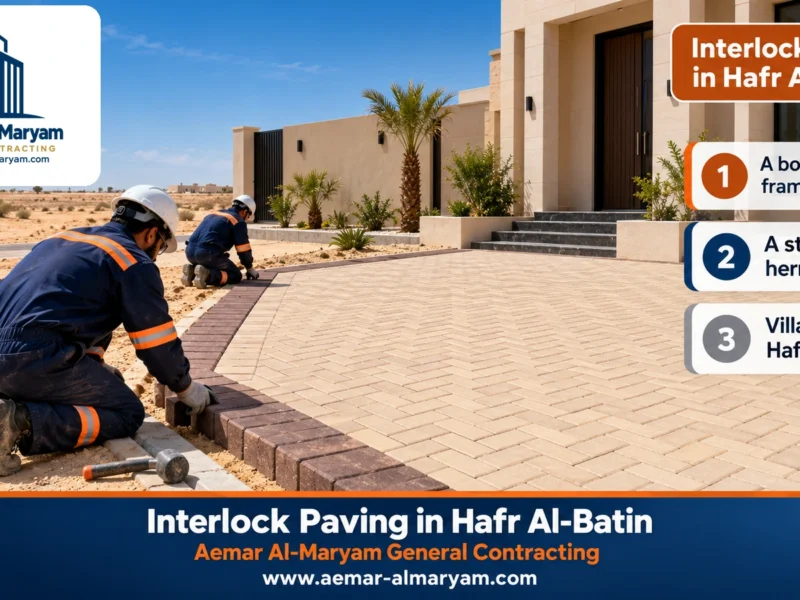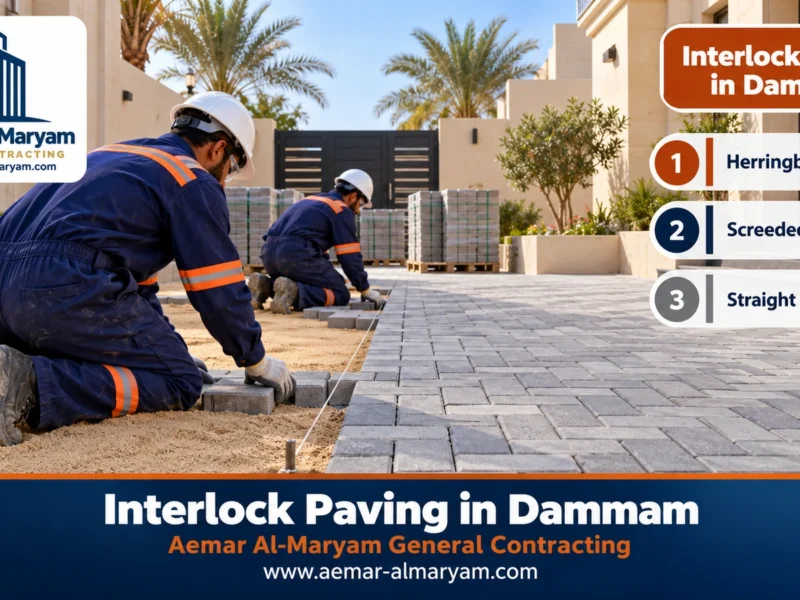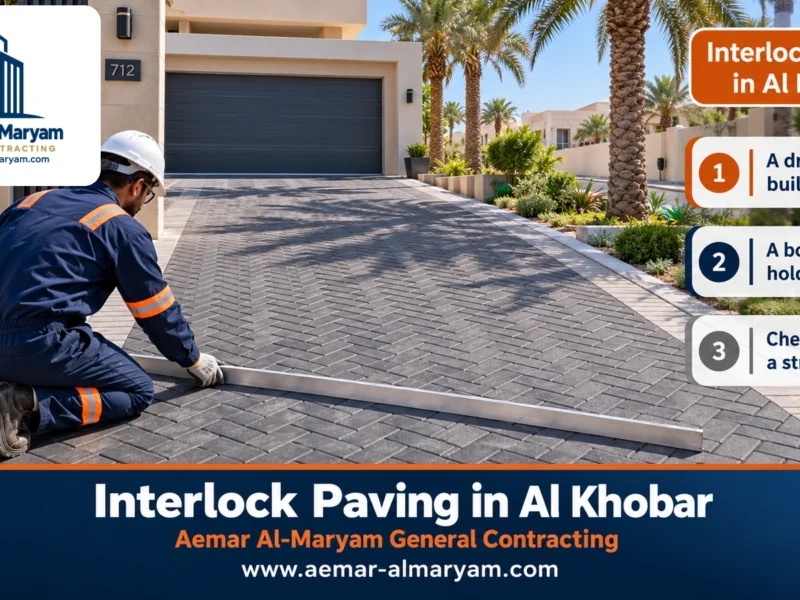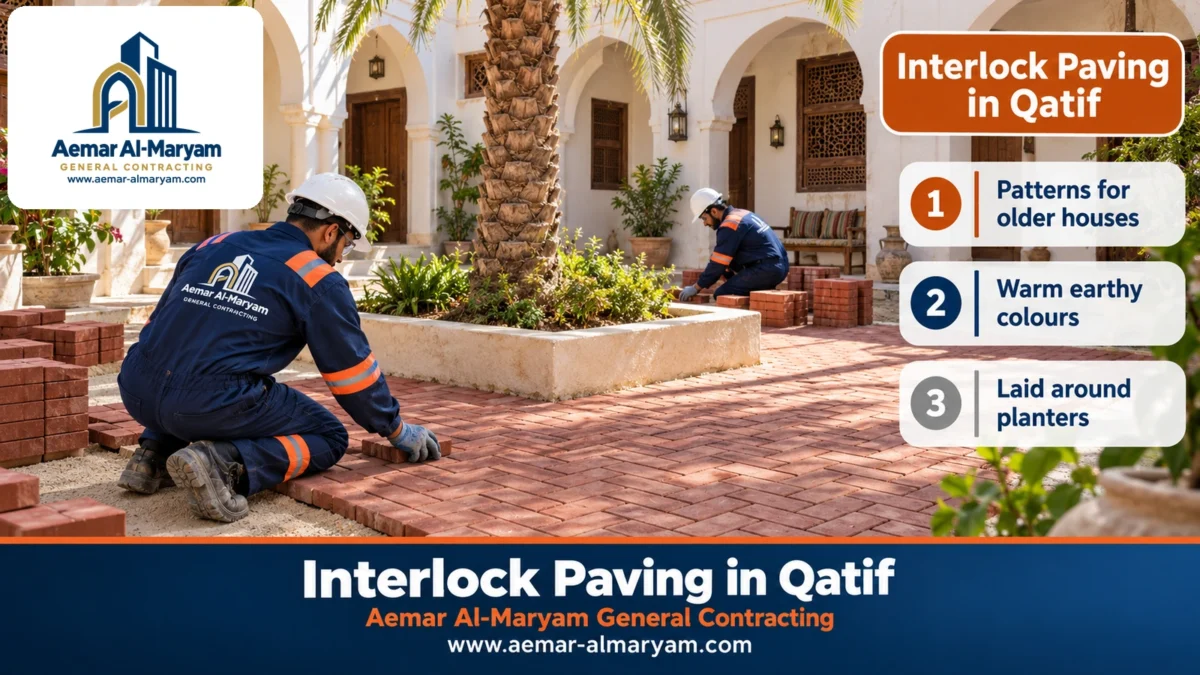
Interlock paving in Qatif starts with the soil, not the pavers. Some sites in Qatif sit on clay that swells with water and shrinks as it dries, so where there is any doubt we dig a small trial pit before deciding how deep the base should be. Then we pave old-house courtyards in earthy tones around their palms, farm paths beside irrigation channels, and house yards and entrances. With Aemar Al-Maryam General Contracting, grey 6 cm costs from SAR 37/m² and coloured units from SAR 46/m², as estimates until inspection. Phone and WhatsApp: 0547879578.
Qatif is not one city with one character. It has restored old houses with arches and inner courtyards, palm farms threaded with irrigation channels, newer districts, and towns such as Tarout, Safwa and Anak. Each of these needs interlock done differently. Below we explain what we do in each case, the figures we work with, and what to ask any contractor before you agree a price.
Before the details
- Ground first: A trial pit where the soil is in doubt, then soil replacement and a base sized to what it shows.
- Heritage courtyards: Terracotta or sand tones in basketweave or stretcher bond, with protected beds around the palms.
- Farms: 6 cm paths between the palms, garden edging, and falls away from the irrigation channel.
- Prices from: Labour 14, grey 37, coloured 46, 8 cm car paving 55, full pedestrian system 64; soil replacement, kerbs and grass pavers at inspection.
- To order: WhatsApp 0547879578 with photos, sizes and the ground type.
Why we dig a trial pit before laying interlock in Qatif
We dig a trial pit before laying interlock in Qatif because the soil decides the base thickness more than anything else. Engineering studies at one site in Qatif recorded highly expansive clay: soil that grows in volume when wet and contracts when dry, carrying whatever sits on top with it. That does not mean every plot in Qatif behaves this way, but it does mean guessing is risky.
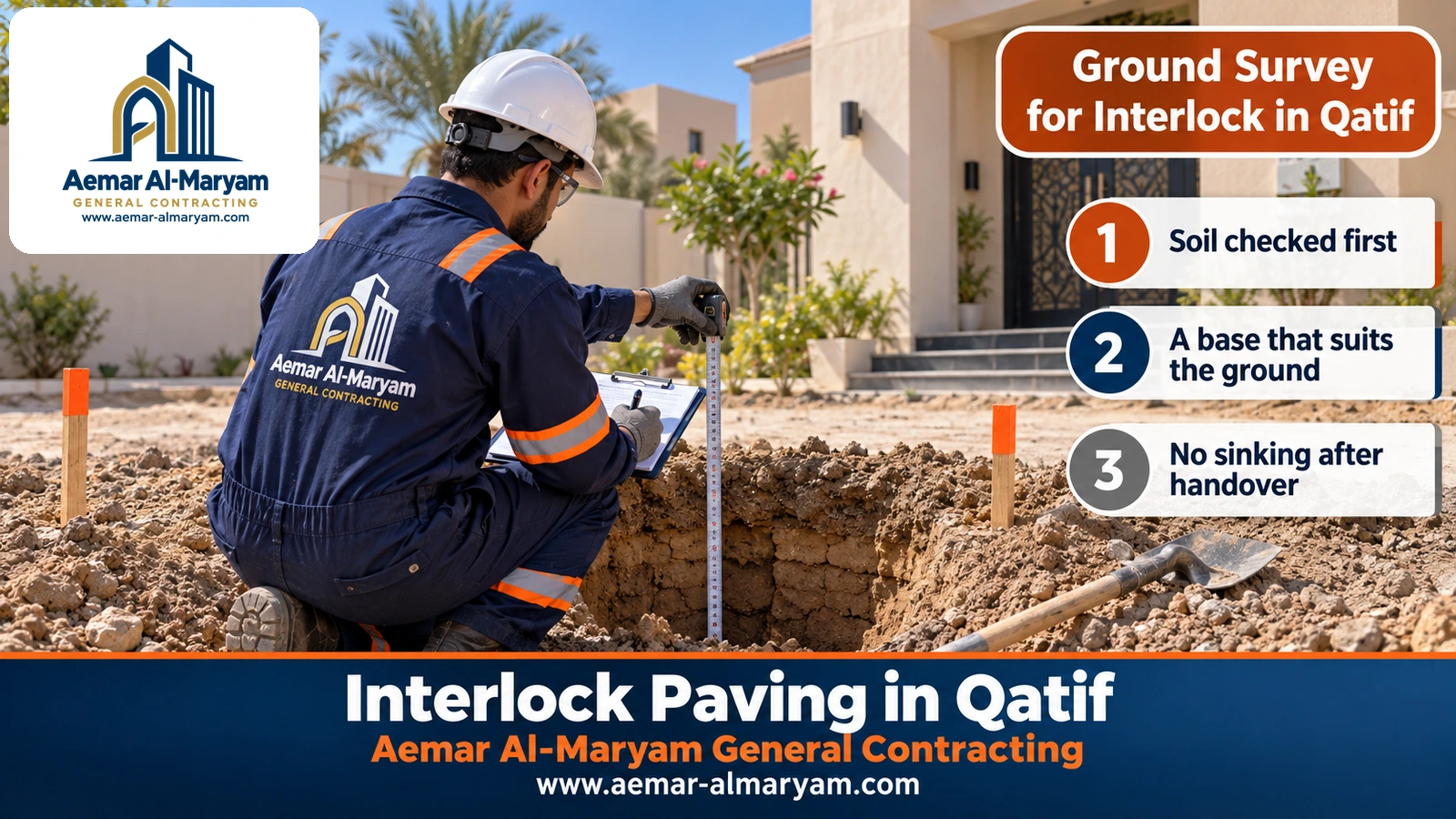
The pit itself is simple: a few tens of centimetres in a spot that represents the yard or path. We measure the depth of the top layer, look at the colour and firmness of the soil, and check for shrinkage cracks, damp, or smells that point to a leak. If the site has more than one kind of ground, such as a former planting area next to a filled area, we dig in each.
| What the pit shows | What it means | Our base decision |
|---|---|---|
| Firm, dry sandy soil | Stable ground | Compact the formation, then a normal base for the use |
| Cracked clay near the surface | Soil that moves with moisture | Dig out part of the clay and replace with compacted granular fill |
| Wet clay or shallow water | A constant moisture source or a leak | Fix the water source first, then replace and add a separator fabric |
| Old fill with rubble | Mixed, uneven ground | Remove the rubble, refill and compact in layers |
| Dense roots | Palms or trees nearby | Keep the edge away from roots, with a root barrier where needed |
Extra sand does not cure clay
Some installers spread a thicker sand bed over clay, thinking it solves the problem. A thick sand bed under interlock increases rippling and does nothing to stop the clay moving below. The cure is replacement, a compacted base and keeping water away.
Water remains the main driver of clay problems: excess irrigation, a pipe weeping under the yard, or a roof downpipe emptying onto one spot. So we ask about every water source around the site, and if the yard shows signs of a leak we suggest checking the pipework with a plumber in Qatif before we pave over it.
The layers under interlock on Qatif ground
The layers under interlock on Qatif ground are the same as anywhere else, but their thickness changes with what the pit reveals. Working upwards: a compacted formation or a replacement layer, then a crushed-stone base course, then the bedding sand, then the units, and finally the fine sand that fills the joints.
- 1Formation or replacement
We compact the formation if it is sound, or excavate soft clay and backfill the hole with granular material, compacted layer by layer. - 2Separator fabric
Where needed, a geotextile goes between the soil and the base so the two do not mix when damp. - 3Crushed-stone base
Between 10 and 15 cm for pedestrian areas, rising to 15–20 cm on a car route, and this is where the fall is shaped. - 4Bedding sand
A loose layer of about 3 cm of clean sand, levelled and left untouched until laying. - 5Units and joint sand
Laid with tight, even joints, then a finer sand swept in and compacted until the joints are full.
Bedding sand and compaction in courtyards and paths
In a small courtyard the tight space tempts some crews to skip the compactor, which is a mistake. We use a small plate compactor with a rubber pad that fits through the door, run it over the units a minimum of three times on either side of sanding the joints, and go gently near the walls so we do not shake old plaster loose.
Heritage courtyard interlock in Qatif
Courtyards in Qatif’s older houses are usually paved in terracotta red or sand-coloured units, laid in basketweave or quiet stretcher courses, so the floor belongs with the plastered arches and wooden windows rather than looking like a modern car park. An inner courtyard has three features we always plan for: narrow access, many thresholds, and often a palm or planter in the middle.
- ✓Access: Where the door is narrow, pallets are broken down and the units carried in by hand, with floors and thresholds protected on the way.
- ✓Thresholds: The paving stays a safe distance below every threshold, and the courtyard falls to its existing drain or a new one.
- ✓The palm: A bed around the trunk edged with a garden kerb, no paving right up to the trunk, and a fall that keeps irrigation water off the joints.
- ✓Walls: We do not butt pavers straight against an old damp wall; we leave a gravel strip or deal with the damp first.
Houses registered as urban heritage
If the house is registered as a heritage building, any change to its floors or courtyard first goes through the competent heritage authority. We carry out the paving after approval; we do not restore heritage buildings themselves. For general house renovation see renovation contractor in Qatif.
In old houses there is often old tiling or cracked concrete under the courtyard. We remove that first, which a demolition contractor in Qatif can also handle, and then check the ground beneath in the same way. The advantage of interlock in these courtyards is that it can be lifted and relaid later if a pipe or cable has to be changed, without any breaking.
One detail many people overlook in old courtyards is the courtyard drain itself: many empty into narrow old pipes that are partly blocked. We pour water into the drain before paving; if it runs slowly we suggest clearing or renewing it first, because a perfectly set fall is useless if it leads water to a drain that does not drain. The drain cover is raised to the new level, the units are cut neatly around it, and the paving finishes just above its rim.
Yard and house-front interlock in newer Qatif homes
Yard interlock in newer Qatif homes is a different job from a heritage courtyard: the area is larger and a car usually comes in. We split the yard into a car lane in 8 cm herringbone and the rest in 6 cm in one or two colours. In front of the house the fall goes towards the street or a drain, and manhole lids are lifted to suit the finished surface. If you are weighing tiles instead of interlock for a covered seating area, read tile installer in Qatif.
Farm path interlock in Qatif
Farm paths in Qatif are usually paved in 6 cm light grey or sand-coloured interlock between the rows of palms, with garden edging on both sides. The real challenge on a farm is not the pavers but the water: the channel beside the path, the soft damp soil beneath it, and irrigation that can flood the edges.
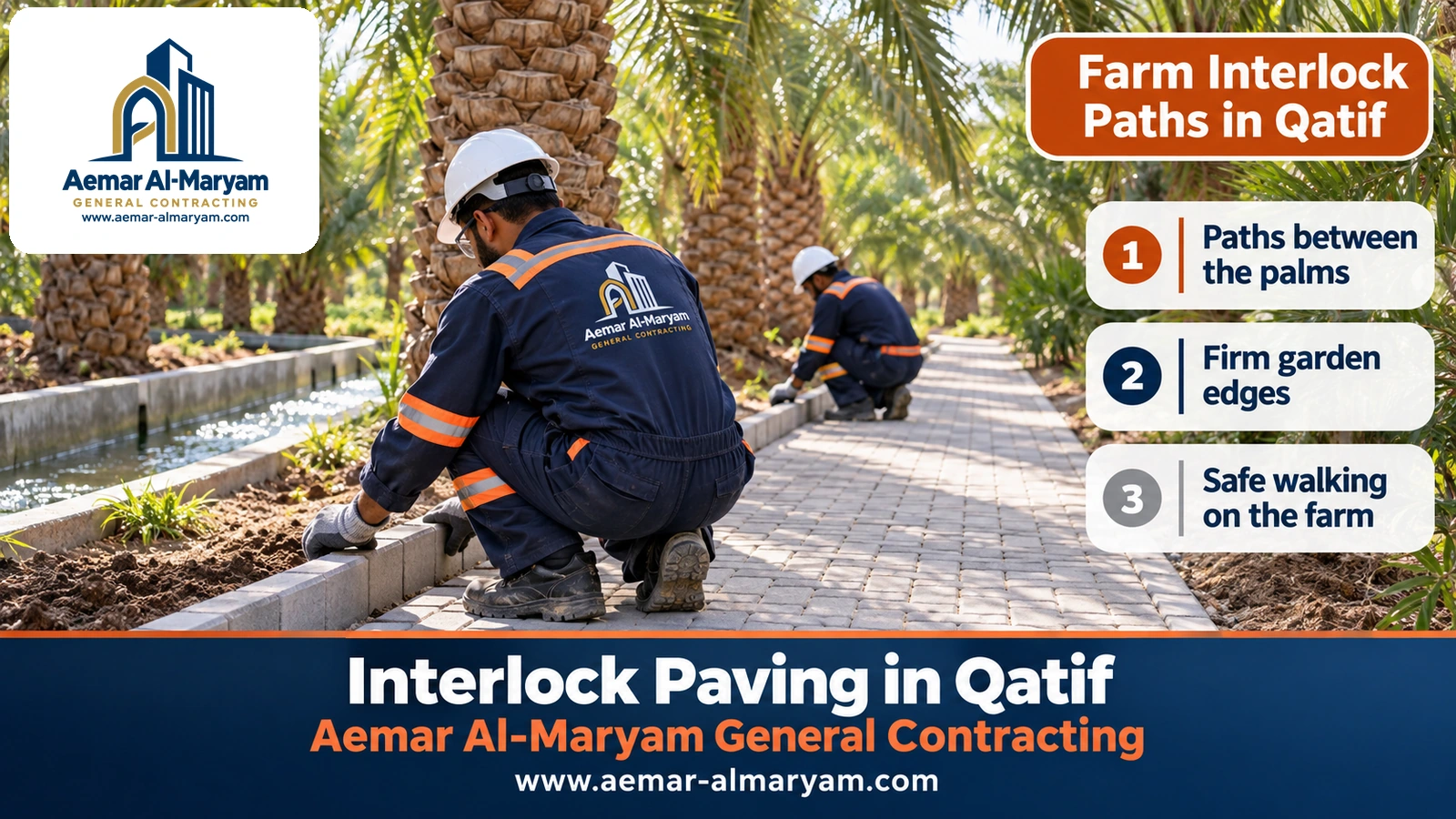
So we raise the path slightly above the channel edge, fall it away from the channel towards the palm beds, and set a kerb on a concrete bed between path and channel to stop water seeping sideways into the base. If the channel walls are cracked and leaking, we suggest repairing them before paving, because constant seepage weakens any base.
- ✓Farm topsoil: Dug out of the path line to a sufficient depth, since it is soft and rich in organic matter, and replaced with compacted fill.
- ✓Width: Around 1.20 m or wider for the main path, and side paths between palms of 60–80 cm depending on row spacing.
- ✓Vehicles: If a pickup or tractor crosses the path, it goes to 8 cm in herringbone over a deeper base.
- ✓Lighting: Any ducts for path lights go in before the base.
Rest house seating areas and outdoor paths
Rest houses on the edges of Qatif usually combine an outdoor seating area, a path from the gate to the majlis and another to the pool or garden. We pave the seating area in two colours or hexagons, make the paths a little wider than house paths because they receive many guests at once, and plan ground lighting and irrigation pipes before the base so the paving is not lifted a few weeks later. If the rest house needs a new majlis or annex, it is better built before the paving; see annex and majlis builder in Qatif.
Grass pavers and rest house parking in Qatif
Grass pavers are open-cell units filled with topsoil and seeded, so the ground stays green yet carries a parked car. They suit visitor parking at farms and rest houses, need regular watering, and are priced after inspection. If the access road into a farm is long and used by many vehicles, asphalt may be better value for it; see asphalt contractor in Qatif.
Garden interlock in Qatif homes
In house gardens we pave seating areas in hexagons or two colours and paths in stretcher courses, keep the edging flush with the grass or a touch higher, and leave space between paths and tree trunks. The aim is for irrigation water to run into the beds, not into the joints.
Kerb installation in Qatif
Kerb installation in Qatif comes before the paving: each kerb sits on a concrete bed of roughly 15 cm or more, is backed with concrete, and is left to harden. On farms we mostly use small garden edging, in yards and car parks the larger kerbs, and at car entrances the chamfered dropped kerb that stands only about 2.5 cm proud.
| Kerb | Approx. size | Height above the paving | Where it suits in Qatif |
|---|---|---|---|
| Small garden edging | 50 × 15–20 × 10 cm | Level, or proud by up to about 8 cm | Farm paths and palm beds |
| Path and seating kerb | 50 × 20 × 12 cm | About 5–10 cm | Courtyards and gardens |
| Medium kerb | 50 × 25 × 15 cm | About 10–15 cm | Yards and car parks |
| Low chamfered kerb | Set by the supplier | From zero to 5 cm | The car opening at the gate |
The dropped kerb at the yard gate
At the gate where the car comes in we lay a chamfered dropped kerb across the width of the opening only, so tyres roll over it smoothly while it still holds the edge courses in place. We never break a full kerb after installation to make an entrance; the opening is fixed on the layout before work begins. If the entrance crosses the municipal pavement, altering it needs the municipality’s approval.
Is a kerb needed on a farm path?
Yes, and on a farm more than anywhere, because the soft soil on either side of the path cannot hold the units, so the edge courses slide towards the beds after the first watering. Owners who prefer no visible edge get a concrete haunch hidden under the paving instead. Separate kerb jobs around existing gardens and beds are also taken on, charged by the running metre once we have seen them.
Car park interlock in Qatif for shops and buildings
Car park interlock in Qatif needs 8 cm in herringbone, which locks every unit on four sides, with bay lines in white units laid into the paving and concrete-bedded kerbs wherever the paving would otherwise end free. Long, slim units are not used in car parks: in a vehicle area a unit’s length should be no more than three times its thickness. Bays for disabled drivers stay almost flat, at roughly 2% or less.
Interlock types and shapes in Qatif
Interlock pavers are pressed concrete units laid dry, without mortar, and locked together by sand and kerbs. The common shapes are rectangular, zig-zag, hexagonal, square and open-cell grass pavers, in colours from grey to terracotta red and sand. Basketweave, where each pair of units runs at right angles to its neighbours, suits courtyards; stretcher courses suit long paths; herringbone is kept for the car lane.
6 cm or 8 cm interlock in Qatif?
6 cm interlock is enough for courtyards, farm paths and gardens that only people walk on; 8 cm is what we lay wherever a car parks or crosses daily; heavier loads such as large delivery trucks have their thickness and base set after inspection. On clay, extra paver thickness does not make up for a weak base: a thick unit on moving clay sinks just like a thin one.
| Site in Qatif | Thickness | Shape and pattern |
|---|---|---|
| Heritage courtyard | 6 cm | Basketweave or stretcher in terracotta |
| Path between palms | 6 cm | Stretcher in a light tone |
| Path crossed by a pickup | 8 cm | Herringbone |
| New house yard with a car | 8 cm lane, 6 cm elsewhere | Herringbone and stretcher |
| Shop or building car park | 8 cm | Herringbone, bays marked in white units |
Falls and drainage for interlock in Qatif
Falls of 2 cm per metre or a little more take water away from walls and thresholds towards a drain, the street or planting beds. In old courtyards the drain is often in the middle near the palm or in a corner, so we design the falls towards it. The fall is formed in the base course, and the pavers finish slightly proud of the drain rim, by a few millimetres, so water drops in.
Interlock prices in Qatif
For grey 6 cm, supplied and laid on ready ground, interlock prices in Qatif start at SAR 37/m², matching our Dammam rates. Each number is provisional until we inspect and agree; the biggest variable in Qatif is the trial pit result: sound ground that only needs compacting, or clay that needs replacing.
| Item | Unit | From (SAR) |
|---|---|---|
| Labour only (pavers and sand already on site, ground prepared) | m² | 14 |
| Grey 6 cm for courtyards and paths, including bedding sand, joint sand and compaction | m² | 37 |
| 6 cm in terracotta, sand tone or a two-colour pattern | m² | 46 |
| Car lane in 8 cm herringbone over an existing base | m² | 55 |
| Pedestrian paving on bare soil: excavation, base, sand and falls, then laying | m² | 64 |
| Car lane built up from soil, base 15 cm plus | — | At inspection |
| Replacing clay or damp soil and adding a separator fabric | — | At inspection |
| Garden or yard kerbs set in concrete | linear m | At inspection |
| Open-cell grass units for parking at the farm | — | At inspection |
| Re-laying sunken interlock and repairing the layer beneath | — | At inspection |
| Removing old courtyard tiles with their mortar | m² | 14 |
| Removing debris by small truck or tipper | load | 90 |
Note that SAR 64 covers foot traffic and light use only. Courtyards under roughly 50 m² cost more per metre, since hauling and machinery cost the same whatever the size. Everything else is listed on our prices page.
Worked example: an old house courtyard around a palm
An illustrative courtyard of 8 × 7 m = 56 m², with a 2 × 2 m palm bed in the middle left unpaved, an old tiled floor to remove, and sound ground beneath it according to the pit:
| Item | Calculation | From (SAR) |
|---|---|---|
| Area to pave | 56 − 4 = 52 m² | — |
| Terracotta 6 cm in basketweave | 52 m² × 46 | 2,392 |
| Removing old tiles with mortar | 52 m² × 14 | 728 |
| Debris removal | One load × 90 | 90 |
| Estimated total | 3,210 | |
| Kerb around the palm bed (about 8 linear m) | Per linear metre | At inspection |
Quantities: with 20 × 10 cm rectangles each square metre takes 50 units, so 52 × 50 = 2,600 units, and with about 5% for cuts around the bed and walls roughly 2,730. The bedding sand is about 52 × 0.03 = 1.56 m³ before waste. If the pit had revealed clay needing replacement, that item would be added after inspection.
What raises the price of interlock in Qatif?
- ✓The pit result: Replacement and a separator fabric add items that sound ground does not need.
- ✓Access: Narrow doors in old houses mean longer hand carrying.
- ✓Cutting: Beds, thresholds and out-of-square walls add cuts.
- ✓Area: Small courtyards cost more per square metre.
- ✓Colour: Coloured units cost more than grey.
- ✓Water: Repairing a leaking channel or pipe before paving.
Interlock company, contractor or installer in Qatif?
An interlock company in Qatif takes responsibility from the trial pit to handover, while an installer or laying crew on their own are skilled at laying but assume the ground is ready. On ground that may be clay, anyone who neither digs nor asks about water is laying over a problem. We bring the inspection, the equipment and the laying crew, and labour-only work is possible when you already hold the materials and the formation is prepared.
Interlock supply and installation in Qatif
When we supply, the whole quantity comes from one production batch, which matters most with terracotta tones where batch differences show clearly. We add an allowance for cuts and keep some spare units for you for future repairs. The area per pallet differs between products, so we work from the manufacturer’s sheet.
Before you agree: what to ask an interlock contractor in Qatif
Before comparing prices, put these questions to every contractor; the answers separate one quotation from another better than the price does:
- ✓Soil: Will you check the ground before setting the base, and what happens if you find clay?
- ✓Base: How thick, compacted with what machine, and in how many layers?
- ✓Sand: How thick is the bedding sand, and is the joint sand different?
- ✓Edges: What will restrain the edges, and on what bed?
- ✓Water: Where will the falls drain, and how will you protect the path from the channel?
- ✓Materials: Is everything from one batch, and is there a test certificate?
Clear answers with figures are the sign of a contractor who knows the work; vague answers deserve a pause, however tempting the price.
Interlock installation steps in Qatif
- 1Inspection and trial pit
We measure, dig in representative spots, and ask about irrigation, leaks and drains. - 2Design
We set thickness, pattern, colour, falls, palm beds and kerb positions. - 3Removal and replacement
Old tiles or farm topsoil come out, and weak clay is replaced as needed. - 4Base and kerbs
The base is spread and compacted, and the kerb beds are cast and left to harden. - 5Laying
The sand is screeded and units laid to a string line, with cuts around beds and thresholds. - 6Compaction and handover
Compaction with joint sand, then a water test and a clean site.
A small courtyard on sound ground takes a few days; replacement adds days; and kerb beds need two or three days before we compact towards them.
Repairing and re-laying sunken interlock in Qatif
Any interlock repair in Qatif begins by asking what made it sink. On clay the cause is often water reaching the soil from irrigation or a leak, so it swelled, then shrank and left a void. It can also be a thin base, a broken kerb or units too thin for a car. We take the paving up, repair the layer and the water source, put the same units back and replace broken ones. For leaks from roofs and walls see roof waterproofing in Qatif.
Looking after interlock on farms and in courtyards
After heavy irrigation or washing, re-sweep the joint sand, pull weeds early and never let water run over a path for hours. If you notice a unit moving or a patch dipping, ask for a check early before it spreads.
Interlock, asphalt or tiles in Qatif?
Interlock earns its place in courtyards and on paths: it lifts and goes back down, comes in tones that match old houses, and stays firm in summer. Asphalt is better value for long farm tracks used by many vehicles. Tiles bedded in mortar suit covered seating areas but cope less well than interlock with moving clay ground. Paving over old tiles is a shortcut we avoid: the tiles come up first and the ground below is checked.
Paver quality and salts in Qatif
Quality is read from a lab certificate, not from how a unit looks: ask for the batch results for compressive strength and water absorption. The common reference is the American interlock standard, which calls for a 55 MPa average strength or better and water absorption capped at 5%. New units, coloured ones in particular, may show a white haze: lime from the cement that moisture carries up, and it weathers away. In damp spots near the coast or on farms, salts rising from the ground can add to it, which is why we care about a granular base and falls that never let water stand.
Common interlock mistakes in Qatif
- ✓Laying without a trial pit: Clay ground moves and the surface ripples.
- ✓Thick sand over clay: It cures nothing and makes sinking worse.
- ✓Farm paths without kerbs: The edges slide towards the beds.
- ✓Falls towards the channel or an old wall: Water gets into the base or the wall.
- ✓Paving up to the palm trunk: The roots lift the units.
- ✓Colours from different batches: A colour change shows across the courtyard.
Receiving interlock in Qatif
- ✓Water: Hose the courtyard or path: water reaches the drain or the beds and never stands at thresholds.
- ✓Edges: Kerbs are firm and the palm bed is clearly defined.
- ✓Surface: No ripples under a straightedge, and no unit moves.
- ✓Joints: Full and even.
- ✓Colour: Consistent across the whole area.
- ✓Cleaning: Surplus sand and debris removed from the courtyard or farm.
Areas of Qatif we serve
Our crews reach Qatif districts such as Al Shati, Al Sawari, Al Rida, Al Sadafah and Al Fath, as well as Awamiyah, Anak and Safwa, and Tarout Island, including Tarout town, Darin, Sanabis, Al Rabiyah and Al Zour. Nearby we also offer interlock paving in Saihat and interlock paving in Dhahran, and the general service guide is in interlock paving in Dammam.
How to order interlock paving in Qatif
- 1Photos
The courtyard, path or yard from several angles, with palms, channels, drains and thresholds. - 2Sizes
Length and width, the size of the palm bed, and the length of the edges. - 3Current ground
Farm soil, old tiles, concrete, or sunken interlock. - 4Use
People only, a car, or a farm pickup. - 5Inspection
We dig the pit and confirm the items and cost.
Why Aemar Al-Maryam for interlock in Qatif?
- ✓We check the ground: A trial pit before setting the base where the soil is in doubt.
- ✓We respect the house: Colours and patterns that suit old courtyards.
- ✓We understand farms: Paths kept clear of channel water and held by kerbs.
- ✓Clear prices: Published “from” figures, with replacement priced at inspection.
- ✓Nearby: Based in Dammam, with Qatif among our neighbouring cities.
An old courtyard, a farm path or a new yard?
Send photos, sizes and the ground type, and we will suggest the layers, colour, kerbs and an estimated cost, then book the trial pit and inspection.
Related pages for Qatif
Tags