Is your Qatif house getting old and its plumbing tired, with leaks that keep coming back, weak pressure and water that runs discoloured first thing in the morning? The Qatif plumbing crew of Aemar Al-Maryam General Contracting, your plumber in Qatif, renews the network in a way that does not tear the house apart: new insulated supply lines run on the surface on evenly spaced clips where that suits, concealed lines where a bathroom or kitchen is being redone, a drainage water test before the screed is poured, and water filters at the house inlet. Bathroom rough-in is from SAR 460, replacing a failed pipe length from SAR 165 and a kitchen from SAR 135, labour figures that firm up after inspection and agreement. We work by appointment; phone and WhatsApp 0547879578.
What we offer in Qatif
- Re-plumbing older houses: surface-run insulated or concealed lines, old pipes disconnected, a valve for every bathroom.
- Testing before anything is covered: a water-column drainage test before screed, supply lines under pressure before plaster and tiles.
- Filters and well water: filters at the inlet or for drinking, and a separate well line that never mixes with drinking water.
- Labour from: bathroom 460, kitchen 135, pipe length 165, heater 140, pump 275, inspection chamber 185. Travel assessed at the inspection.
A plumber in Qatif for older houses: why we start with an inspection
An older house in Qatif cannot be understood from a photo of the fault alone. Many of these homes gained rooms and bathrooms in stages, each stage plumbed by a different person with different materials, so one house may hold old galvanised steel, newer plastic fittings and lines nobody can trace. That is why we begin with an inspection: we follow the line from the tank to the last tap, open the inspection chambers, ask when each extension was built, and then propose a plan that fits the house rather than a ready-made one.
Signs the house network needs renewing
- ✓A run of leaks in several rooms over a short period, rather than one recurring spot.
- ✓Rust-coloured water from a tap that has stood unused overnight, a sign the old steel pipes are corroding inside.
- ✓Poor flow at every outlet while the tank is full and the pump is working.
- ✓Damp patches or flaking paint low on the walls near bathrooms and kitchens.
- ✓A water bill that rises for no reason, and a meter that turns with every tap closed.
If two or more of these appear together, spot repairs postpone the problem rather than solve it. We tell you so plainly after the inspection, and we also suggest what can wait if the budget is limited, such as starting with the worst lines and finishing in a later stage.
Plumbing company in Qatif or an hourly plumber?
An hourly plumber suits a single obvious fault: a dripping mixer, a broken trap, a basin to replace. When the whole house needs looking at, what you need is a plumbing company in Qatif that works like a contractor: it inspects, plans and writes the items, works in stages, tests before closing, and coordinates with whoever breaks out, plasters and tiles. The difference is not the tools but the responsibility. The hourly plumber leaves when the leak stops; the contractor leaves when the whole network has been tested and handed over.
| Situation | An hourly plumber is enough | You need a plumbing contractor |
|---|---|---|
| A leak at one known point | Yes | No |
| Repeated leaks in different places | No, it will keep coming back | Yes, to assess the network |
| A full bathroom or kitchen refit | Partly | Yes, with waterproofing and tiling |
| An old house extended with extra rooms and bathrooms | No | Yes, to trace and unify the lines |
| A filter at the house inlet | Possible | Better as part of renewing the network |
We take small jobs too, but we advise grouping them into one visit, especially since travel to Qatif forms part of the cost: so bundling jobs into one trip cuts what each one carries.
Re-plumbing older houses in Qatif with insulated surface-run lines
In older houses whose tiles and walls are sound, running new supply lines on the surface is cheaper and quicker than breaking walls to dig out the old pipes. We run two parallel lines, red for hot and blue for cold, close to the ceiling in corridors or along back walls, lagged in foam, and drop from them to each bathroom and kitchen by the shortest route. The old buried lines are cut off and disconnected from the tank so they cannot become a hidden source of leaks.
| Item | Insulated surface-run lines | Lines concealed in the wall |
|---|---|---|
| Breaking out | Very little, small openings where lines drop to fixtures | The wall is chased along the route, then plastered and tiled |
| Access for maintenance | Direct, the line is in front of you | The route must be located and the wall opened |
| Appearance | Needs neat runs and regular clips; can be boxed in with gypsum board | Completely hidden |
| Duration | Usually shorter | Longer because plaster and tiles follow |
| Best for | Corridors, roofs, service rooms and occupied homes | A bathroom or kitchen being fully refitted |
Clips, spacing and expansion of the hot line
A good surface run shows in its clips: equal spacing and a straight line that does not sag between supports. We set clips closer on the hot line than on the cold, because PPR softens and expands with heat, and on long runs we leave an offset or a sliding clip so the pipe can move instead of bowing. The foam lagging is not just cosmetic: it keeps heat in the hot line and stops condensation forming on the cold line on humid days.
When we conceal lines instead of running them on the surface
When a bathroom or kitchen will be broken out and retiled anyway, there is no sense keeping an exposed line inside it, so we chase it into the wall and test it before plastering. The same goes for rooms where appearance matters, such as the majlis. In corridors, service rooms and on the roof, a neat surface run is a practical solution that does not spoil the house and can be boxed in later with gypsum board; see gypsum board installation in Qatif.
⚠ Do not just cap the old line
If old pipes stay connected to the tank with only their ends capped, they remain under pressure and can leak inside the wall years later. We disconnect them at the source so they drain completely.
House re-piping in Qatif: one length or the whole network?
Replacing a failed length is from SAR 165 and suits a house whose network is sound apart from one clear spot. If the pipes are old galvanised steel throughout, replacing one length today means another in a few months, and renewing the whole network is cheaper in the long run; we estimate it on site. If the re-pipe sits inside a bigger refurbishment, we line it up with renovation contractor in Qatif, breaking out with demolition contractor in Qatif, and re-plastering with plastering contractor in Qatif.
In an occupied house we organise the work so you are not without water for days: we build the complete new network while it is still disconnected, test it, then switch the house over in a single day and cut off the old one. The interruption lasts hours, not days.
Valves and distribution in an older house
What wears down the families in Qatif’s older houses most is a single stop valve for the whole house: one leak in a bathroom and everyone is without water until the plumber comes. In the new network we place a main valve somewhere known near the tank or pump, a stop valve per wet room, and an angle valve under every fixture. In larger homes we sometimes feed every fixture from a manifold with its own pipe, which leaves fewer joints buried in walls and lets any fixture be shut off by itself.
In houses where bathrooms were added on the roof or upper floor, we often find lines run up from under the tiles by winding routes. We tidy that into a single organised riser to the upper floor that then branches to the bathrooms with their valves. If the upper bathroom’s drainage runs through a heavy, deteriorating floor build-up, we discuss suspended drainage with you, hanging the waste under the slab and hiding it behind a false ceiling in the room below. It lightens the floor and makes later leaks reachable, provided the ceiling height allows it.
How to tell if there is a hidden leak before renewal
Turn off every tap indoors and out, then watch the meter dial for fifteen minutes. If it moves, there is a leak somewhere between the meter and the taps. This simple test helps us tell whether the problem is in the internal network or in the tank line. If damp has already reached a ceiling or wall, leak detection and treatment are covered in roof waterproofing and insulation in Qatif, and the affected walls in crack repair in Qatif.
Drainage water test before the screed in Qatif
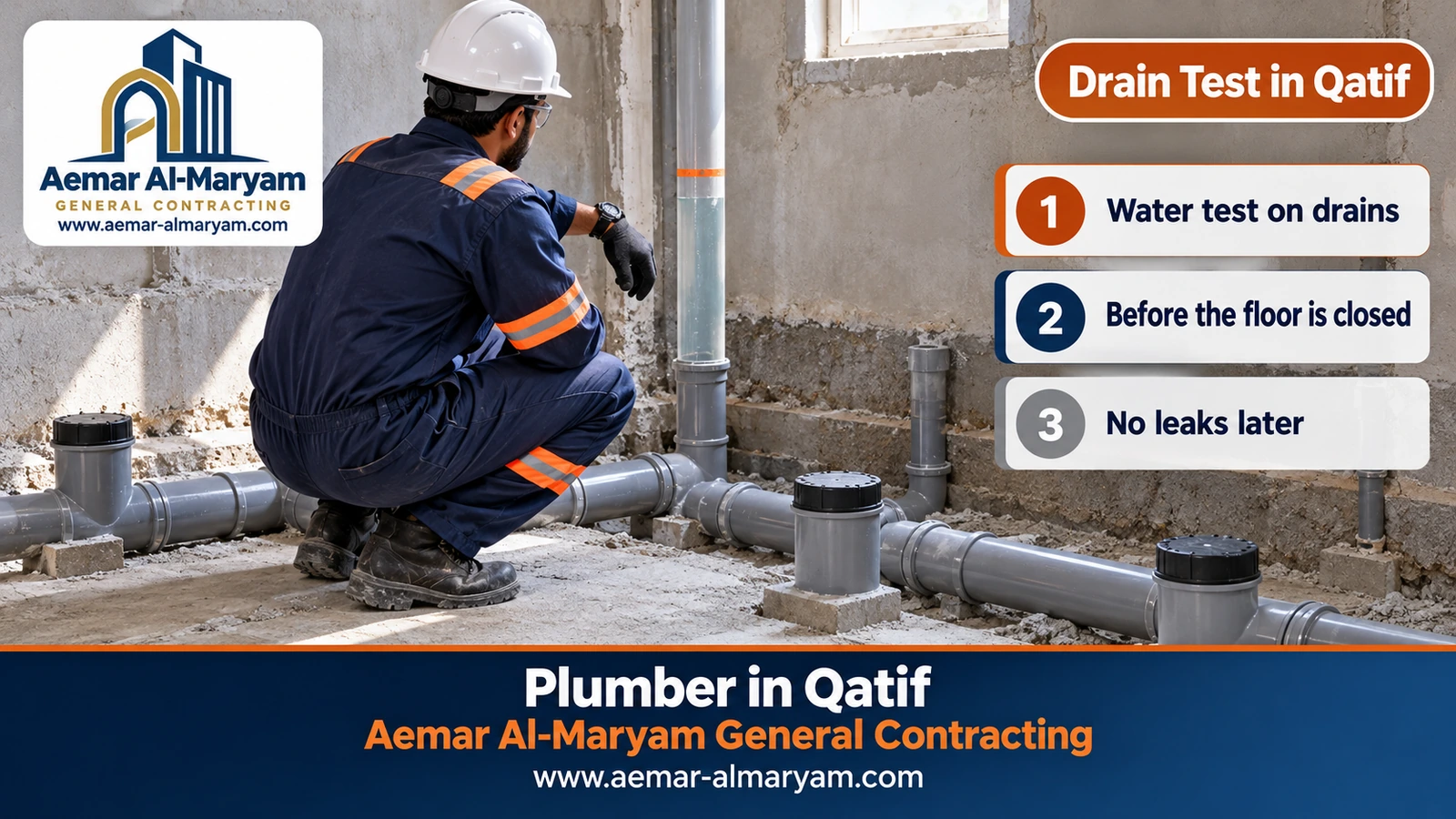
In every bathroom we refit in Qatif, the new drainage is tested before the screed goes over it. We seal the openings with test plugs, fit a temporary vertical pipe and fill it until the water stands at least 3 metres high, mark the level with tape and keep an eye on it for fifteen minutes or longer, which is the Saudi plumbing code minimum. If the level holds, the network is tight; if it drops, we find the joint before it is buried.
Sizes and falls we check during the test
| Fixture | Typical waste size | Minimum fall under the code |
|---|---|---|
| WC | 110 mm | About 1% |
| Shower and floor drain | About 40 mm | 2% |
| Basin | 32 to 40 mm | 2% |
| Kitchen sink and washing machine | 40 mm | 2% |
| House drain out to the first manhole | 110 mm upwards | Close to 1% |
The Saudi plumbing code was built on the International Plumbing Code, and its slope tables call for 2% for pipes no wider than two and a half inches and close to 1% for the 3 to 6 inch range. In older houses we often find a floor drain set higher than the floor around it, or a pipe with no fall that holds water, and we correct these before the test, not after. We also make sure the ground floor drains to the main line on its own connection instead of sharing the upstairs stacks, which the Ministry housing rules insist on, so a blockage cannot push waste back into the ground-floor bathroom.
After the test: waterproofing, then screed
Once the test passes, the bathroom floor is waterproofed, then screeded, then tiled. The wet-area membrane is explained in roof waterproofing and insulation in Qatif, and tiling in tile installer in Qatif.
Plumbing rough-in in Qatif for bathrooms and kitchens
Labour for a standard bathroom in Qatif is from SAR 460: every fixture gets a hot and a cold line, the WC, basin, shower and floor drain are drained, and a valve isolates the room on its own. A kitchen is from SAR 135, cheaper than a bathroom because it has fewer points and no WC waste: hot and cold at the sink, an outlet for a dishwasher or washer, a feed for the filter and a 40 mm waste.
Bathroom rough-in in an older Qatif house
An old bathroom differs from a new one because its floor may have been raised by layers of tiles over tiles, with old pipes whose route is hard to know. We break down to the concrete, remove all the old drainage and re-plumb along a new straight route to the stack or inspection chamber, then test as described. Where the new waste must cross a concrete wall or floor slab, we make a neat opening by diamond coring, described in core drilling in Qatif.
Kitchen plumbing in Qatif
In an older house the kitchen waste is often tied into a narrow line or one without enough fall, so grease builds up and it blocks every so often. When we plumb a kitchen we run a 40 mm waste with a clear fall to the nearest stack or chamber, give the dishwasher its own trap, add a cold point for the filter under the sink, and place the kitchen valve where you can reach it without emptying the cupboards. We agree outlet positions with the carpenter or cabinet fitter before installation, so the back of a cabinet is not cut at random to pass a pipe. For a full kitchen refit with tiles, see renovation contractor in Qatif.
Finishing after the tiles
After tiling we return to fit the WC, basin, mixers and bidet spray, each fixture on its own angle valve. Hanging a new basin and connecting its mixer costs from SAR 90, and swapping a mixer on its own from SAR 75. We open every point and watch the joints before we leave.
Water filters in Qatif: mains water and well water
Desalination plants in the Eastern Province feed Qatif with water that leaves the network clean. In older houses, though, it may pass through tanks that need cleaning and old pipes that carry sediment, so a sediment filter on the line entering the house is useful to protect mixers and the heater. We mount the housings side by side on the wall, with a valve before them, a valve after them and a bypass loop so you can swap cartridges while the house keeps its water.

Houses next to farms, and well water
Some houses in Qatif and its towns sit next to farms with wells for irrigation. Here we hold one rule without exception: well water stays on its own line for irrigation and outdoor washing and is never connected to the house drinking-water line or its tank. The Saudi plumbing code devotes a whole section to protecting drinking water from any mixing, because well water may carry salts or contamination you cannot see, and if it flowed back into the drinking line once it would reach every tap. If you want to use well water indoors, the first step is a laboratory analysis, then a treatment chosen to match the result; a filter that removes sediment does not deal with salinity or bacteria.
Which filter suits your house?
| Need | What we suggest | Where it goes |
|---|---|---|
| Protecting mixers and the heater from sediment | Sediment filter with a replaceable cartridge | On the house inlet after the tank or pump |
| Better-tasting drinking water | Carbon filter or a multi-stage drinking unit | Under the kitchen sink with its own tap |
| Well water for non-drinking use | Sediment filter on the separate well line | On the irrigation or outdoor washing line only |
| Well water for use inside the house | Analyse the water first, then suitable treatment | Decided by the analysis, not the technician |
Filter installation varies with the number of stages and the location, so we price it after a photo of the spot. The best time to fit one is while the network is being renewed, when the main line is already open.
Heaters, tanks and pumps in Qatif homes
When we renew the network we also review what feeds it. An electric cylinder heater, fitted with the T&P valve that releases water when heat or pressure climbs too high, costs SAR 140 upwards to install, and we take the valve’s discharge pipe to the nearest drain instead of letting it drip on the tiles. A pump fitted and plumbed in is from SAR 275, a roof tank set or reconnected from SAR 920, and a call to find and cure weak pressure from SAR 135.
Where should the heater go in an older house?
In older houses we sometimes find the heater above a bathroom door or in a corner nobody can reach, with its relief pipe cut short or missing. When renewing we suggest a spot that is easy to reach for servicing, on masonry strong enough for a full cylinder, and close to the bathrooms it serves so the hot run stays short. If the bathrooms are far apart, two small heaters may serve better than one large distant one. We arrange a dedicated circuit with a suitable breaker with the electrician; see electrician in Qatif.
- ✓The old ground tank: we check its inner and outer waterproofing and its cover; the residential building rules call for tight waterproofing and a metre or more between the tank and the cesspit.
- ✓Capacity: the same rules want the tanks to hold five days’ supply or more for the household, which matters in houses whose occupants increased after extensions.
- ✓The meter: we never put the pump on the meter or bypass it; the National Water Company treats a direct connection after removing the meter as a violation.
- ✓Heater temperature: hold storage at 60 °C or more, and fit a thermostatic mixing valve in the children’s bathroom, because water hotter than 44 °C burns skin.
A ground tank in the Eastern Province sits near groundwater that is close to the surface and salts that attack concrete. If the old tank is cracked, building a new one by excavating, casting and waterproofing is estimated on site and may be cheaper than patching a tank that leaks.
Drainage problems and smells in older Qatif houses
A smell in an older house has specific causes that we check in order: a dry trap in a little-used bathroom, a broken trap under the basin, a failed WC seal, a drain without venting that siphons the traps, an inspection chamber cover that does not seal, or a broken pipe under the floor soaking the soil. Clearing a basin or floor drain is from SAR 90 per visit, and a new or replacement inspection chamber from SAR 185.
When the same line blocks again and again, the problem is usually not how it is used but the line itself: poor fall, a sagging section or roots in an old joint. Clearing is not enough then, and we suggest relaying the failed length between two inspection chambers.
External drainage and old inspection chambers
In many older Qatif houses the inspection chambers have been tiled over in the courtyard or buried under a newer extension, so no one knows where they are until the drains overflow. We find them, bring them back up to ground level with a sealed cover, and add a chamber at each change of direction where one is missing. When we relay an outside line we bed it on clean sand at a laser-set fall, and we waterproof the chambers because the shallow, salty groundwater of the Eastern Province attacks concrete. To open a route through an old concrete floor we use diamond sawing as in concrete cutting in Qatif rather than random breaking.
Common mistakes when re-plumbing older houses
| Mistake | Result | What we do instead |
|---|---|---|
| Patching one length after another in an old steel network | A new leak every few months | Assess the network and propose staged renewal |
| Leaving old pipes connected and capped | A hidden leak inside the wall | Disconnect them at the source and drain them |
| A surface run with widely spaced clips | The hot line sags and bows | Close clips, and sliding clips on long runs |
| Screeding before testing the drains | A leak appears in the ceiling below the bathroom | A 3 m water column for at least 15 minutes |
| Connecting well water to the house line | A risk to drinking water | A separate well line and analysis before any indoor use |
Plumbing prices in Qatif
Qatif pays the Dammam rates, no higher. Getting a crew from Dammam to Qatif and its towns adds a travel element that we judge on site from how big the job is and how many days it takes; bundle several jobs into one trip and each carries less of it.
| Service | Counted by | Labour begins at |
|---|---|---|
| Bathroom renewed in an older house, lines and waste | Each bathroom | SAR 460 |
| Kitchen sink, dishwasher and filter points with waste | Each kitchen | SAR 135 |
| New house or annex plumbed from its plans | Each m² built | SAR 23 |
| A corroded stretch of supply pipe replaced | Each stretch | SAR 165 |
| Network renewed throughout, surface-run or concealed | The house | Estimated on site |
| Cylinder heater with T&P valve and its discharge | Each heater | SAR 140 |
| House-wide heater with a return circuit | The system | Estimated on site |
| Changing a tap | Each tap | SAR 75 |
| New basin with its tap connected | Each basin | SAR 90 |
| Pump lifting from the ground tank, piped in | Each pump | SAR 275 |
| Roof tank put in place or re-piped | Each tank | SAR 920 |
| Replacement underground tank for a cracked one | The tank | Estimated on site |
| Buried manhole uncovered, or a new one built | Each manhole | SAR 185 |
| Pipe for air-conditioner condensate | Each unit | SAR 90 |
| Blocked sink or gully cleared | Each call | SAR 90 |
| Weak flow traced and put right | Each call | SAR 135 |
| Whole bathroom rebuilt with waterproofing and tiles | Each bathroom | SAR 2,300 |
You pick the pipes, fittings and filters, and nothing is final until the visit and our agreement. Anything marked for an on-site estimate can be photographed and sent to WhatsApp 0547879578 for a first figure; the rest of our services are on the prices page.
Worked example: re-plumbing an older two-bathroom house in Qatif
An older house in Qatif with two bathrooms and a kitchen has four failed supply lengths in its corridors, and its roof tank needs a new connection and a replacement pump:
| Item | Calculation | Labour |
|---|---|---|
| Re-plumbing two bathrooms | 2 × 460 | SAR 920 |
| Kitchen rough-in | 1 × 135 | SAR 135 |
| Replacing four supply lengths | 4 × 165 | SAR 660 |
| Roof tank connection | 1 × 920 | SAR 920 |
| New pump | 1 × 275 | SAR 275 |
| Estimated total | SAR 2,910 |
The total excludes pipes, fixtures and the pump itself; breaking out, bathroom floor waterproofing and retiling; travel, which is assessed at the inspection; and any filters you add. It is an illustration, and the price we stand by comes after the visit, once the items are agreed.
What to send on WhatsApp for an accurate estimate
- ✓A wide photo of each bathroom and the kitchen, and a close-up of any leak or damp.
- ✓Photos of corridors and ceilings if you are considering surface-run lines, so we can see the available route.
- ✓Photos of the ground tank, roof tank, pump and meter.
- ✓The approximate age of the house and what was added to it later.
- ✓The current pipe type if any of it shows, steel or plastic.
- ✓Whether there is a well or farm next door and whether it has a line into the house.
- ✓Your town or district and your location pin.
With these photos we can usually give you an initial estimate before the visit, then confirm it at the inspection.
How to book a plumber in Qatif
- 1Photos of the house, not just the fault
Corridors, bathrooms, kitchen, tanks and meter, with the approximate age of the house. - 2A short call
We ask about extensions to the house and what you notice about leaks, pressure and water colour. - 3Inspection and line tracing
We follow the network, open the inspection chambers and decide what is replaced and what stays. - 4A staged plan
Written items with prices, and an order that keeps water available to you during the work. - 5Work and testing
A tested new network, then the house switched over in one day and the old one cut off.
Why Aemar Al-Maryam in Qatif?
■ Experience with older houses
We trace lines before proposing anything, and choose surface-run or concealed to suit the house.
■ Testing before burying
No screed over untested drainage, no plaster over supply lines that have not held pressure.
■ One team for every stage
Breaking out, plumbing, plastering and tiling under one coordination.
■ Straight talk on cost
A starts-from table, written items, and travel assessed openly at the inspection.
Qatif, Tarout and the governorate towns: where we work
From our Dammam base we cover Qatif city, Tarout Island and the governorate towns, grouping inspections in neighbouring towns into one working day. We take requests from these places and others:
■ Inside Qatif city
Al-Sawari, Al-Sadafa and Al-Fath, as well as Al-Shati and Al-Rida.
■ On Tarout Island
Darin and Sanabis, Al-Rabiyah and Al-Zour, and Tarout town itself.
■ In the governorate towns
Al-Awamiyah and Al-Qudaih north of the city, Safwa, and Anak to the south.
■ Saihat
It has its own page: plumber in Saihat.
Where a street in an older district is narrow, we agree with you before the visit where the work vehicle can park. We limit our work to concrete and block houses; heritage buildings of mud brick or stone need specialists and approvals from the competent authorities. The Qatif page gathers our services in the governorate, our full guide is plumber in Dammam, and nearby there is plumber in Dhahran for villa plumbing and central heaters.
Links that help when renewing an older house
Renew your older house’s plumbing without tearing it down
Send photos of the corridors, bathrooms and tanks, and we will reply with an initial plan, an estimated cost and an inspection date in Qatif.
Tags