
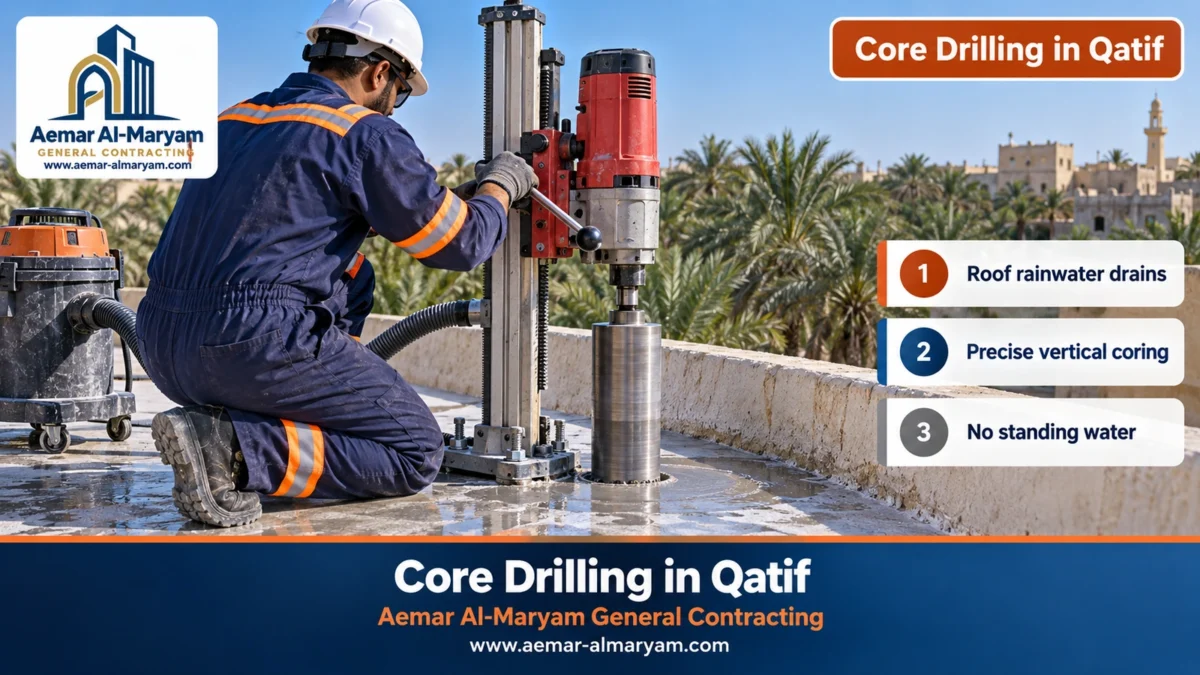
Core drilling in Qatif means cutting clean, round holes through roof slabs, floors and concrete walls with a diamond-tipped core rig, so that rainwater outlets, bathroom drains, power cables and AC lines can pass through without breaking the concrete or shaking the house. Aemar Al-Maryam General Contracting travels from its Dammam base to Qatif, Tarout Island, Safwa and the other towns of the governorate, working in older family houses, newer villas and shops that are being fitted out. Our lowest price is SAR 90 for an AC hole or a small core, rising to SAR 140 once the diameter reaches five or six inches, and every figure is an estimate we fix after seeing the job. Phone and WhatsApp: 0547879578.
Most requests we get from Qatif are not a single AC hole on its own. They usually come with a story. A roof where rainwater pools because the old outlet is blocked or was never in the right place. An upstairs bathroom that is being moved, so its drain needs a new route down through the slab. A shop on a busy street that cannot open until the power cable reaches its board. And many of these houses sit in older quarters with narrow lanes, so the owner’s first question is often “how will you even get the machine in?” rather than “how much will it cost?”. This page answers those three questions in the order a Qatif customer needs them.
Core drilling in Qatif at a glance
- Roofs: rainwater outlet holes through the roof slab, with the waterproofing rebuilt around the new outlet.
- Bathrooms: drain holes drilled from above, with a catch tray on a steel prop in the room below.
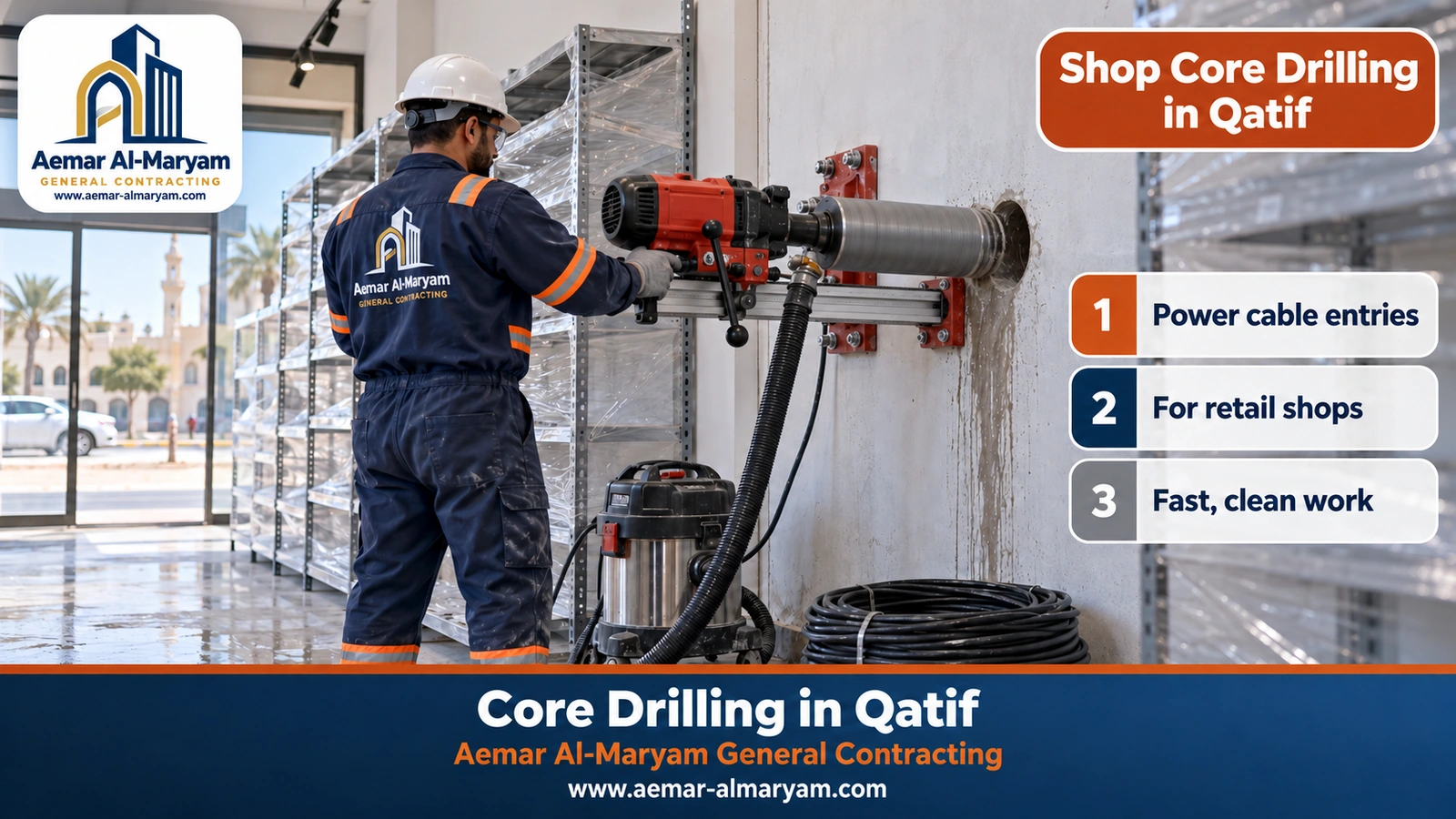
- Shops: cable entry holes for the incoming power supply, plus AC, extractor and drain holes during fit-out.
- Older quarters: rigs that break down into hand-carried parts, a spare water tank and generator when needed, and neighbours told in advance.
- What it costs: small holes SAR 90, then SAR 140 at five to six inches, SAR 230 at eight and SAR 320 at ten to twelve; anything bigger is priced on site.
- Contact: a photo of the roof or wall and the pipe size on WhatsApp 0547879578.
Core drilling in Qatif: what do homeowners and shop owners usually need?
Core drilling jobs in Qatif fall into four main groups: roof drains, bathroom and kitchen drains between floors, shop fit-outs, and the AC holes that turn up in almost every request. What they share is the method. A hollow, tube-shaped bit with diamond segments on its rim spins against the concrete and grinds away a thin ring. When it is through, a solid cylinder of concrete comes out and leaves a smooth, round hole at exactly the diameter you chose.
Because the governorate mixes older family houses in its historic town centres with newer neighbourhoods of modern villas and flats, the slab or wall we drill can change completely from one address to another. It might be a roof slab with layers of insulation and tiles added over the years, a block wall under several coats of plaster from past makeovers, or dense modern concrete with a lot of rebar. Those differences are why we ask about the house before we choose the bit and the method.
■ Roof rainwater outlet
A hole at the lowest point of the roof slab, where the outlet body sits and ties into the waterproofing.
■ New bathroom drain
A hole in the floor of the upstairs bathroom so the drain pipe can drop to the floor below.
■ Shop power cable
A hole in the back wall or ceiling where the incoming supply cable and its sleeve enter.
■ AC units and extractors
Holes for refrigerant lines, condensate drains and fan ducts in outside walls.
Ceiling and roof core drilling in Qatif: rainwater outlets in older roofs
Core drilling through a roof slab in Qatif is the clean way to add a new rainwater outlet or move an old one. The rig cuts one round hole of a set size, and the tiles and layers around it stay intact instead of cracking the way they do when the slab is broken out with a hammer. Many older roofs were never given proper falls, or have had tiles laid over tiles until the levels changed, so water now gathers in a corner far from the original outlet.
Where should the roof outlet hole go?
We start by finding the real low point of the roof, not the one it was supposed to have. We pour a little water or read the stains left by old ponding. Then we pick a spot that keeps a safe distance from beams, columns and the wall that carries the parapet. We also check what lies directly below on the inside. Will the hole come out in a bedroom, a bathroom, or above a kitchen cabinet? The pipe that leaves the ceiling has to find a route outside or into an existing drain stack, so the position is decided with the plumber, not by guesswork.
Roof outlet hole diameter
The diameter follows the outlet body and the pipe the plumber will fit. Residential roofs often use pipes of about 3 to 4 inches, and we cut the hole a little wider than the pipe, leaving a ring of space to pack and seal. That is why we ask you, or your plumber, for the exact part that will be installed, and drill to that part rather than to an estimate.
After drilling: the waterproofing around the outlet matters more than the hole
Any hole in a roof passes through the waterproofing layers. If those layers are not rebuilt tightly around the outlet, the new drain simply becomes a new leak. We drill the hole, clean it and leave it ready for fixing. The outlet is then set in place, the gap around it is packed with non-shrink mortar, and a waterproofing collar is lapped into the existing roof membrane. If the roof needs more than a repair around the outlet, see our waterproofing and insulation service.
⚠ Roof with recent waterproofing?
Tell us before the visit what kind of waterproofing is on the roof (sheet membrane, liquid coating or foam), so we can agree with the waterproofing technician who restores the layer around the hole. The roof should never be left open between the two visits.
Kitchen and bathroom core holes in Qatif
Kitchen and bathroom core holes in Qatif are mostly drain holes through the floor of an upper storey, so the pipe can drop to the floor below, plus extractor holes that run from a wall to the open air. Demand peaks when a bathroom is moved, or added to a room that was never planned for one, and its drain needs a new path through the slab.
Drilling a bathroom drain from above with a catch tray below
When we drill down from an upstairs bathroom floor, the last few centimetres of slab give way suddenly. The heavy concrete core drops, and so does the cooling water. So we prepare the room underneath before we start. A clear plastic sheet is stretched across the ceiling around the breakthrough point, and an adjustable steel prop holds a catch tray directly under it. The core and the water land in the tray, not on the floor or the furniture.
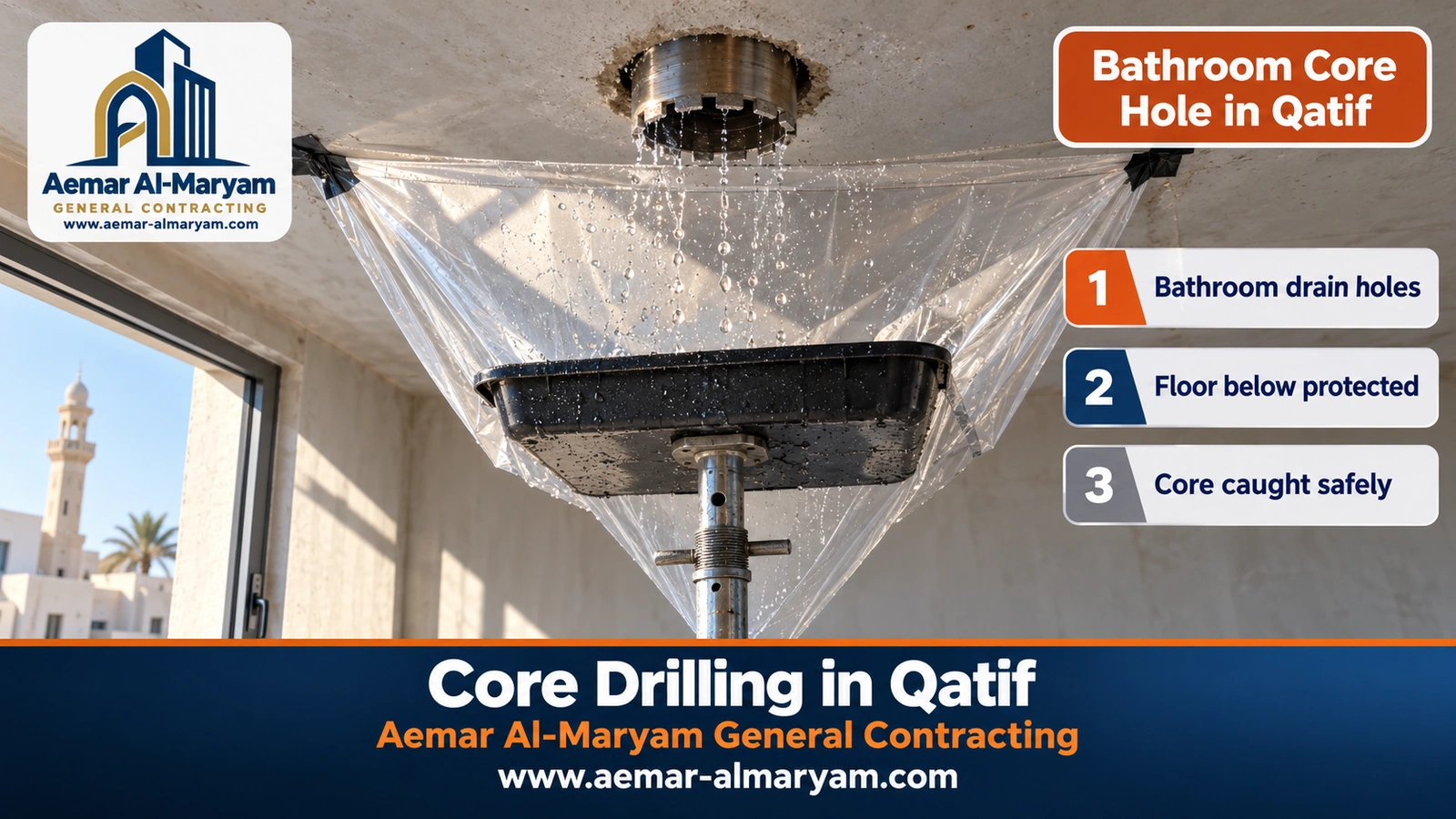
If the room below is lived in or has fixed furniture, we agree the time of the breakthrough with you and keep a technician beside the tray until the drilling is finished. As for the pipe, the usual household soil pipe measures 110 mm outside and is sold as “four-inch”; it will not go through a hole of its own size, so we open roughly five inches to leave space for packing. The fall and the position of the bend are checked with the plumbing works team before we drill.
Kitchen and bathroom extractor holes
Most household bathroom fans are built for a 100 mm duct, which means a hole of roughly four inches; a cooker hood more often comes with 150 mm ducting, so its hole is nearer six. We always prefer to see the fan manual or the duct size first. A hole that is too small has to be enlarged, and one that is far too big is harder to seal neatly from outside.
Bathroom above a bedroom?
Arrange the drilling for a time when nobody is sleeping in the room below, and move the bed and wardrobe at least a metre clear of the hole position. We cover and protect everything anyway, but an empty space makes the job quicker and calmer.
Concrete coring in Qatif, in older and newer homes
Concrete coring in Qatif means drilling the wall or slab with a rotating diamond core rig instead of breaking it, so the edges stay sound and no hammering travels into the next room or into the neighbour’s house that shares your wall. In reinforced concrete we drill wet. Water runs into the centre of the bit, cools the diamond segments, and the dust leaves as grey slurry that the vacuum collects.
| Point | Core rig drilling | Traditional breaking |
|---|---|---|
| Shape of the hole | A circle of a set diameter with smooth sides | An irregular opening that needs patching |
| Vibration | Rotation, no hammering | Repeated blows that travel through the slab and walls |
| Dust | Turned into slurry and vacuumed | Heavy dust in the house and the lane |
| Rebar | Only the bar in the path is cut | More bars exposed than needed |
| Disturbance to neighbours | Limited to a short period | Long, loud work in attached houses |
In older houses we may meet concrete that is harder than usual, or bars with signs of rust, and a ceiling may be thicker in one room than another if the house was extended in stages. None of this stops the drilling, but it does mean we slow the feed and watch what comes out with the core. If corroded steel shows in the side of the hole, we point it out and advise treating it before the hole is closed. Repairs to old concrete and rusted bars are covered on our renovation contractor in Qatif page.
Rebar scanning before core drilling in Qatif
Before every core hole in Qatif we scan the spot with a detector that locates the bars and services inside the concrete, then nudge the position, where necessary, so the bit passes through a gap in the steel. This matters even more in older houses, where drawings are usually lost and electrical and water lines were added over the years with no plan of their route.
- Roof slab: we locate the bars, any hidden beams and the path of old pipes before the stand is fixed.
- Bathroom floor: we check that no supply pipe or old drain runs through the path, and ask where the stack is.
- Shop wall: we look for existing cables, and for fire or AC pipework if there is any.
- Post-tensioned slabs: if a modern ceiling might contain stressed tendons, we stop and ask for an engineer’s view before drilling anything.
When do we say no to a hole?
We never drill a column, and we only core a beam to a structural engineer’s design. There is usually an alternative close by: shifting the outlet or pipe a few centimetres into the plain slab next to the beam.
Drilling holes in walls in Qatif
Drilling holes in walls in Qatif with a core rig works for both concrete and block walls; what changes is the method, not the result. On concrete, the rig runs wet and bolted to its stand. A block wall may be drilled dry with dust extraction, so the block does not soak up water and crumble around the hole, especially in a finished room.
In older houses a wall can carry several coats of plaster and tile from earlier makeovers, so we start slowly to stop the outer layers flaking off around the hole. If the opening you need is bigger than any bit, or rectangular for a duct or a door, coring alone is not enough and a saw comes in, as explained in the section on coring versus cutting below.
A useful habit before any wall hole is to look at both faces. A hole that looks perfect from the inside can come out behind a water heater, on a shared wall or right where the outdoor AC bracket should go. We mark both sides and confirm with you before we start, which takes a minute and saves a second hole.
AC core holes in Qatif
An AC core hole in Qatif is drilled at the diameter the unit’s installation manual asks for, tilted gently downward to the outside so condensate leaves the house instead of dripping indoors. As a reference, the installation manual of many wall-mounted splits specifies 65 mm with that outward slope. Larger units, or routes that carry several pipes together, may need a bigger diameter.
- We agree the height of the hole and the position of the outdoor unit with your AC technician before drilling, not after.
- In attached houses we make sure the hole does not come out on a neighbour’s wall or a shared passage.
- Reusing the opening of an old window unit for a split system seldom works; it is closed up and a new hole of the right size is drilled.
- Central and ducted systems need larger openings, sometimes rectangular, which are made by coring combined with sawing.
Shop core drilling in Qatif: power cable entry during fit-out
Most shop core drilling in Qatif is a hole for the incoming power cable, from the meter room or the back of the building to the shop’s distribution board, followed by holes for AC pipes and, in a restaurant or café, the kitchen extractor. A shop being fitted out runs to a tight schedule. The electrician is waiting for the hole to pull the cable, the carpenter is waiting for the electrician, and the opening date does not move.
Sizing the cable hole
The cable size is decided by the licensed electrician according to the shop’s load. We drill a hole that fits the cable and its sleeve or protective conduit, with enough clearance to pull it through without rubbing on the concrete edge. So we ask for the exact outside diameter of the conduit, or a photo of the cable drum showing its specification.
A shop below apartments: firestopping the penetration
If the shop is on a ground floor under flats, a hole through its ceiling passes through a slab that separates two different uses. In buildings where the consultant specifies a firestop system for penetrations, the gap around the pipe or cable is sealed with products tested for that purpose, following the approved drawings. We drill the hole at the size that system needs, and the firestop is installed to the consultant’s specification.
For a faster fit-out
If the shop needs several holes (power cable, AC, extractor, sink drain), send them all in one message. We drill them in a single visit before the electrician and carpenter start, which lowers the price per hole and keeps the schedule moving.
Narrow lanes in Qatif: how we get the rig to your door
We reach houses in Qatif’s narrow lanes with a core rig that comes apart into pieces: motor, column, base and bits, each one light enough for one technician to carry. We park at the nearest point the road allows, carry the kit to the door by hand and assemble it inside. If the hole is on the roof, we take everything up the internal stairs. Most residential jobs need no crane and no scaffold.
- Water: we bring a small tank with a pump, so we are not relying on a weak tap in the house.
- Power: we use the house supply if the circuit can take it; otherwise a small generator stays outside the door.
- Neighbours: we ask you to tell the attached neighbour when we will drill, especially if the wall is shared.
- The lane: we never block it, and the vehicle is left where it does not stop anyone passing.
That is why, when you book, we ask three questions about access: how wide the road is in front of the house, whether there is somewhere close to park, and how many floors we climb with the equipment. The answers decide how many technicians come and which stand we bring, and they save you a second visit.
Core hole sizes in Qatif by use
A core hole is sized to the outside diameter of whatever passes through it, plus a margin for sealing. This table is a guide to the jobs we see most in Qatif; the final word belongs to the appliance manual, the plumber or the electrician.
| Use | Approximate diameter | Note |
|---|---|---|
| Light telecom or power cable | up to 2 inches | often enough for several cables in one hole |
| Wall-mounted split AC | about 65 mm or per manual | sloping to the outside |
| Shop supply cable in conduit | often 3–4 inches | depends on the conduit’s outside diameter |
| Roof rainwater outlet | often 4–5 inches | depends on the outlet body and pipe |
| 110 mm bathroom drain | 5-inch class | room for sealing material |
| Bathroom extractor | about 4 inches | for a 100 mm duct |
| Kitchen extractor | about 6 inches | for a 150 mm duct |
| Large ventilation duct or flue | 8–12 inches | larger by inspection |
Note: diameters are approximate, for planning; we confirm the size from the actual part before drilling.
Core drilling prices in Qatif
Core drilling prices in Qatif start from SAR 90 for a small hole or an AC hole and rise with the diameter. These are our published starting prices, and they are estimates until inspection and agreement:
| Hole | Starts from | Usually includes |
|---|---|---|
| AC or small hole, roughly four inches and under | SAR 90 | scanning, drilling, water vacuuming, clean-up |
| 5–6 inch hole (drain, kitchen extractor, roof outlet) | SAR 140 | the same, plus protecting the room below for slab holes |
| 8 inch hole | SAR 230 | the same |
| 10–12 inch hole | SAR 320 | the same |
| Over 12 inches, rows of holes or thick slabs | by inspection | photograph the spot, add the size and message 0547879578; we reply with a figure |
Keep in mind: every figure is confirmed only after we inspect and agree. Fitting the outlet, pipe or waterproofing is not included unless agreed.
What raises the price of a hole in Qatif?
- The thickness of the slab plus the tiles and insulation on top; an old roof can be much thicker than a wall.
- Heavy rebar, or particularly hard old concrete.
- Difficult access: a narrow lane, or carrying the kit up several floors.
- Setting up the prop and catch tray in the room below for bathroom floor holes.
- Working outside business hours in a shop that is trading.
The easiest way to bring the cost down is to group your holes into one request: one visit for five holes costs less than five visits. The rest of our price list sits on the prices page.
Core drilling or concrete cutting in Qatif: when do you need a saw?
Coring is enough in Qatif when the hole is round and within the range of our bits. If the opening is rectangular, larger than the biggest bit, or is a door, window or stair opening, it needs a diamond saw. Sometimes we combine the two: the corners of the rectangle are cored first, which stops the saw blade at each corner, and the straight sides are sawn afterwards.
For sawing work in Qatif, from walls and slabs to door openings, see concrete cutting in Qatif and our concrete cutting service.
Core drilling on Tarout Island and in Qatif’s towns
On Tarout Island we reach Darin, Sanabis, Al Rubaiyah, Al Zour and Tarout town itself, and we try to group island requests into a single day. We also cover Safwa, Anak, Al Qudaih, Al Awamiyah, Al Jish, Umm Al Hamam, Al Jarudiyah, Al Tobi, Al Bahari, Umm Al Sahek and the other towns of the governorate.
In the oasis towns a house may be surrounded by farms or reached by a short unpaved track, while in the coastal towns it may sit in a tight old quarter. Either way, we ask about the route before the visit and bring the kit that suits it. We do not drill heritage buildings or houses built with traditional materials, as those need specialist bodies.
Mistakes we see with roof and bathroom holes in Qatif
Most of the repairs we are called to in Qatif trace back to a hole drilled in a hurry, without thinking about what comes before and after it. These are the most common, and all of them are easy to avoid:
- Outlet away from the low point: the drain goes where drilling was easy rather than where water collects, so the pond stays and a leak appears around the hole.
- Hammer instead of core: tiles and waterproofing crack in a ring far wider than the hole, and the patching ends up bigger than the job.
- Hole left unsealed: a pipe passes through a wide hole with nothing around it, letting water and insects in through the gap.
- Nothing under the breakthrough: the concrete core and the water land on a gypsum ceiling or the floor below.
- Drain hole without a planned fall: drilled before the plumber has decided the pipe route and bend, so it needs enlarging or a second hole.
That is why we ask the plumber or electrician to be there, or to send us the size and route, before drilling, and we agree who fits and who seals, so the hole is closed the same day or as soon as possible after.
Core drilling contractor in Qatif: what to ask before you agree
Choose a core drilling contractor in Qatif who explains, before drilling, how they will deal with what is under the hole: where the core will fall, where the water will go and who will rebuild the waterproofing round a roof outlet. These questions show the difference between someone who just makes a hole and someone who makes it as part of the whole job:
- ✓Price: do you charge by diameter for each hole, and is the clean-up, the vacuuming and the room below covered?
- ✓Scanning: do you scan for bars and services, and what is the plan if a beam sits right where the hole should go?
- ✓Access: how will the kit reach my house in this lane, and do you need a generator or water?
- ✓After drilling: will the hole be ready for the outlet or pipe, and who restores the waterproofing?
- ✓Shops: can you drill at a time that fits the electrician’s and fit-out schedule?
How to order core drilling in Qatif
- 1Send photos
the hole position from both sides, the roof and where water collects, or the shop wall inside and out, on WhatsApp 0547879578. - 2Give the use and size
roof outlet, bathroom drain, cable, AC or extractor, with the pipe’s outside diameter or the unit’s model. - 3Describe the access
road width, parking, floor level, and whether the room below is lived in. - 4Get the estimate and a date
we reply with a price based on the table above and the nearest slot in your town. - 5Drilling and handover
we scan, drill and clean; you check the diameter, position and slope before we leave.
Prefer a form? Leave your details on the inspection booking page and our team will phone you.
Why Aemar Al-Maryam for core drilling in Qatif?
■ We think about what is below
a prop and catch tray under slab holes, and protection for furniture and floors.
■ Kit that fits the lanes
rigs that come apart and are carried by hand, with spare water and power when needed.
■ Published prices
a table that starts from SAR 90 by diameter, confirmed after inspection.
■ Working with other trades
we drill to the plumber’s, electrician’s and AC technician’s sizes, not to a guess.
Photos of finished jobs are on our projects page, and every item of the service is described on the core drilling service page.
Qatif areas we serve for core drilling
We cover Qatif city and its districts, including:
More reading for Qatif customers
A roof that needs an outlet, or a bathroom that needs a drain?
Message the photos and the pipe size to 0547879578; you get an estimated price and the first free slot in Qatif, Tarout or your town.
Article tags