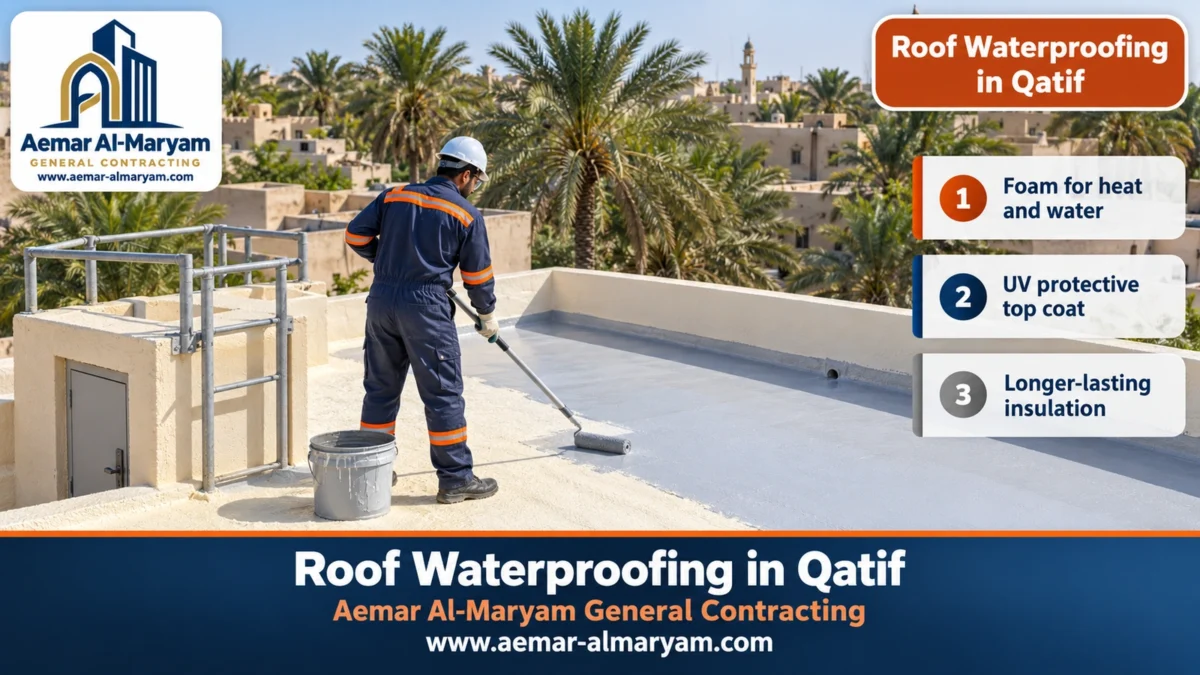
Roof waterproofing in Qatif on older houses is a different job from waterproofing a new villa. Many roofs here were tiled years ago, with an old membrane underneath that the owner knows nothing about, and the bottom of the walls is often damp from ground moisture that has nothing to do with rain. So we start with diagnosis: we waterproof tiled roofs without breaking the tiles when the tiles allow it, and we treat damp from the foundations when its source is the ground. Aemar Al-Maryam General Contracting covers Qatif, Tarout Island and the nearby towns. A clear coat over tiles starts at SAR 10 per square metre, bitumen membrane at SAR 13 and spray foam at SAR 23, estimates that inspection and agreement confirm. Call or WhatsApp 0547879578.
Houses in Qatif are not all one type: old quarters where walls touch, two-storey homes built long ago that owners have added rooms and annexes to over the years, palm groves and farms around some of the towns, and the coast close by. All of this shows up in waterproofing work. An old roof needs someone who knows how to deal with layers built up over time, and a wall flaking from the bottom needs someone who can tell ground damp from a leaking pipe. That is what this page explains, in an order that starts with what we are asked about most in Qatif.
Waterproofing in Qatif, in short
- Old tiled roofs: tap-tested first; sound tiles are sealed with a clear coat without breaking, from SAR 10/m².
- Rising damp: we separate it from leaks and treat it at the base of the wall and the foundations; priced on inspection.
- Roof systems: per m², SAR 13 membrane, SAR 23 foam, SAR 42 foam sealed under a protective coat for water and heat, SAR 46 for the full build-up of waterproof membrane, heat boards and protection tiles.
- Underground tanks: cementitious lining from SAR 14/m² or drinking-water epoxy from SAR 46.
- Where we work: Qatif city, Tarout and the towns of the governorate.
- To book: photos of the roof and lower walls on WhatsApp 0547879578.
Roof Waterproofing in Qatif: Why Older Houses Start With an Inspection
Roof waterproofing in Qatif on older houses starts with an inspection because the roof is usually layers on layers: concrete, a first membrane, tiles, and perhaps a second membrane and new tiles laid over the old ones in an earlier repair. Each layer added weight and changed the falls, and sometimes raised the roof level until water now stands at the stair-room door instead of reaching the drain.
On the visit we go up and check three things before mentioning any material: where water stands after rain or roof washing, how the tiles sound when tapped, and the state of the parapets and their tops. Then we go down to the rooms underneath and read the stains: their shape, where they are, and whether they are dry now or damp. From that picture we know whether a local repair is enough, a coating over the tiles, or stripping and starting again.
■ Sound tiled roof
Seepage through the joints only, so a clear coat that soaks into them is enough.
■ Hollow tiles in places
Lift the hollow areas, waterproof them, relay the tiles and tie them into the rest.
■ Roof that has lost its falls
Strip the tiles and failed layers, lay a new screed to falls, then a full system.
■ Old exposed roof
Clean, repair cracks, then foam or a liquid membrane with a protective coat.
Tiled Roof Waterproofing in Qatif Without Breaking the Tiles
Waterproofing a tiled roof in Qatif without breaking it is possible when the tiles are still bonded to what is underneath and water is getting in through worn joints or fine cracks. We pressure-wash the tiles, clear dust and weeds from the joints, let it dry, then apply a clear penetrating sealer by roller that fills and closes the joints and pores, starting at SAR 10 per square metre. This keeps your tiles and saves the cost of stripping, a new screed and new tiles.
The Tap Test: How We Know the Tiles Can Be Coated
We knock each tile in the suspect areas with the handle of a small tool. A bonded tile gives a dull, solid sound; a loose one sounds hollow, because there is a void underneath where water may be running. We chalk around the hollow areas. If they are few and scattered we lift just those and treat beneath them; if they cover most of the roof, a clear coat will not work and stripping becomes the honest answer.
- ✓Suitable for a clear coat: firm tiles, worn joints, hairline cracks, no standing water after rain.
- ✓Not suitable: hollow tiles over large areas, raised or broken rows, water standing in patches for a day or more.
- ✓In between: limited hollow patches around drains or at the parapet, lifted and treated before the whole roof gets the clear coat.
A clear coat does not fix the falls
If water stands on the tiles, any coating on top will spend most of its life under water and fail sooner. The cure for standing water is correcting the falls, not adding more layers.
For sound tiles that are not used as a sitting area there is another option: an acrylic coat brushed over all the tiles in a light colour, which waterproofs and reflects part of the sun. It changes how the roof looks and needs to be walked on with care, so we offer both options and leave the decision to you.
Old Roof Drains and Rainwater in Qatif
Rain in Qatif comes on few days, but when it comes it is heavy, and in an hour it exposes every fault in a roof’s drainage. On older houses we often find drains too narrow for the roof area, a single outlet in a corner far from the lowest point, or spouts that came out of the wall and then broke so water runs down the facade. As tile layers build up, the drain opening ends up a centimetre or two above the roof around it, so water pools beside it instead of going in.
We therefore treat drainage as part of the waterproofing, not a separate item: we lower the outlet to roof level, fit a flexible sleeve inside it for the membrane to reach, and suggest an extra drain if the roof is large or water collects far from the existing one. We clean the spouts and make sure their water does not land at the foot of a wall, because that feeds the damp at its base, as the next section explains.
Rising Damp and Foundation Waterproofing in Qatif
Rising damp in Qatif is water drawn up from the ground into walls and floors by capillary action, carrying salts that crystallise at the wall surface and break up paint and plaster. It shows clearly in some older houses near the coast or surrounded by farms, where the ground stays damp for much of the year. Its telltale sign is damage along the lower part of the wall at a roughly even height, which changes little between summer and winter.
| Sign | Rising damp from the ground | Leaking pipe or bathroom |
|---|---|---|
| Where the damage is | Along the base of the wall over a long stretch | Concentrated around one spot, widening outwards |
| Salts | A white salt line and crumbling plaster | Usually less, and the stain is darker |
| Change over time | Fairly constant all year | Grows with water use or jumps suddenly |
| Meter and bill | Unaffected | The meter may move with the house closed |
Rising damp is not limited to walls. In some older houses with no membrane under the ground-floor slab, the floor tiles darken at the joints, there is a damp smell under rugs, and the legs of wooden cupboards swell. Treating a floor is harder than treating a wall because it means lifting tiles, so we measure first and set out the options and their cost before touching anything.
Because the two causes can sit in the same wall, we take moisture readings at several heights, run a meter test and check nearby water lines before deciding. Treating rising damp as a leak, or the other way round, means the problem comes back.
How We Treat Rising Damp in an Existing House
- 1Find the upper limit of the damp
We measure at stepped heights and mark the line where the damp stops. - 2Remove the damaged plaster
We strip the salt-laden plaster to some distance above the damp line, because salts left behind keep drawing moisture. - 3Treat the wall
Clean off the salts, then a damp-resistant cementitious coating on the lower wall; depending on the wall we may suggest an injected chemical damp barrier at its base. - 4Deal with the outside
Keep irrigation, AC and washing water away from the base of the wall outside, and correct the slope of the ground around it. - 5Breathable plaster and paint
Finishes that let the wall breathe, not a sealing coat that traps water behind it.
Foundation Waterproofing for New Houses and Annexes in Qatif
If you are building a house or a ground-floor annex in Qatif, the right time to waterproof the foundations is before backfilling: a bitumen coating or membrane on the footings, necks and ground beams, a protection layer over it so it is not torn during backfilling, and a membrane under the ground slab. This work is cheap compared with treating damp years later, and it is priced on inspection by the size of the foundations. For annex projects, read annex and majlis building in Qatif.
Roof Insulation Materials in Qatif: Types and How We Choose
Roof insulation materials in Qatif are chosen by the state of the roof rather than by name: waterproofing to keep water out, heat insulation to cool the ceiling, and some systems that do both. Here is a quick comparison of what we install:
| Material | Type | When we choose it in Qatif | From, per m² |
|---|---|---|---|
| Clear coat over tiles | Water | Old sound tiles leaking through the joints | SAR 10 |
| Bitumen membrane | Water | Roof stripped of tiles and being retiled | SAR 13 |
| Polystyrene boards | Heat | Under tiles within a layered system | SAR 14 |
| Cementitious coating | Water | Under tiles, in tanks and on damp walls | SAR 15 |
| Polyurethane spray foam | Heat, partly water | Exposed roof with many bases and pipes | SAR 23 |
| Acrylic | Reflective water | Room and annex roofs, unused tiled areas | SAR 23 |
| Foam sealed under a protective coat | Both jobs at once | Exposed room roofs on older houses | SAR 42 |
| Full build-up | Both jobs at once | Retiling: waterproof membrane, heat boards, protection tiles | SAR 46 |
| Polyurea | Tough waterproofing | Walkways used every day | SAR 55 |
Figures are starting estimates confirmed after inspection and agreement.
Waterproofing in Qatif
Waterproofing in Qatif is one unbroken layer from edge to edge of the roof, rising up the parapets and turning into the drains. On old roofs that have been stripped we usually use bitumen membrane or a cementitious coating under the new tiles, and on exposed roofs we use liquid systems that have no joints.
Bitumen Membrane in Qatif
Membrane is torched onto dry, primed concrete, each roll lapping its neighbour by what the product sheet requires (some products ask for 75 mm on the sides and 100 mm at the ends), and it turns up the parapets a minimum of 150 mm above the final roof finish. On old roofs we watch for one more thing: any loose old waterproofing left under the new rolls will come away and take them with it, so we remove everything that moves before starting.
Liquid Membranes
Acrylic, polyurethane, polyurea and cementitious systems are brushed or sprayed to cover the roof without seams, which makes them the best fit around crowded bases and pipes and on irregular roofs where membrane rolls would mean endless cutting. We apply at least two coats at the thickness on the product sheet, with fleece reinforcement at corners and cracks.
Heat Insulation and Spray Foam in Qatif: Price per m²
Heat insulation in Qatif tames the ceiling heat that makes upstairs rooms in older houses unbearable at midday. We install it as rigid polystyrene under the tiles or as sprayed foam. Foam on its own is priced from SAR 23 per m²; finished with an elastomeric coat that lets it keep out water as well as heat, from SAR 42. Published specifications for sprayed foam roofs call for a density of around 45 to 48 kg/m³, at least 25 mm thickness, and the coat applied on the same day the foam is sprayed.
Parapet and Corner Waterproofing on Qatif Roofs
Parapets on older Qatif houses are where we most often find waterproofing that simply stops: the membrane rises a few centimetres and ends with its top edge open, so water gets behind it and runs down into the ceiling at the corner. The stain in the room below then sits right against the outside wall, and the owner assumes the wall is the problem.
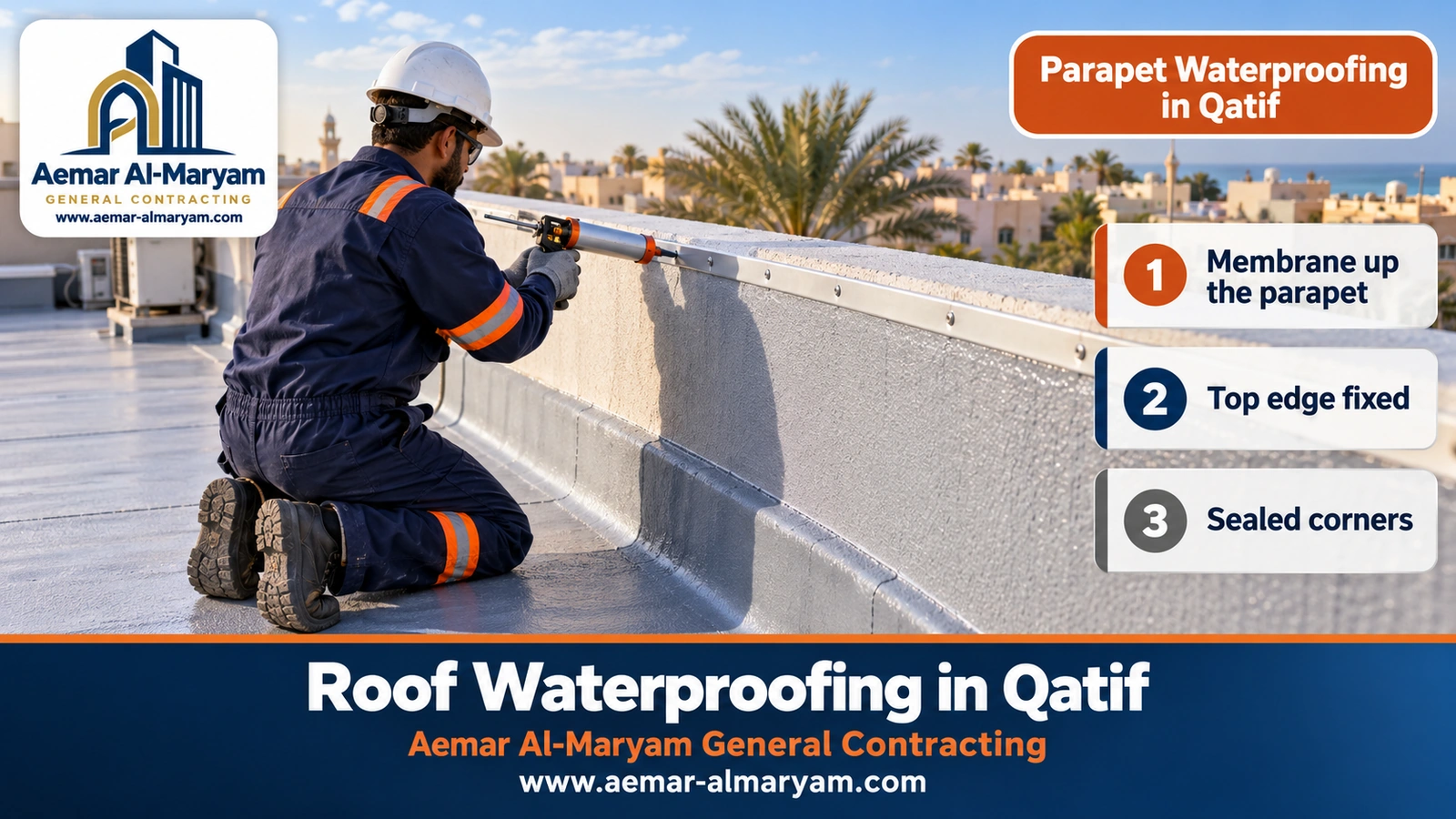
- ✓A chamfered fillet where roof meets parapet: instead of a sharp right angle where the membrane creases and cracks.
- ✓Enough upstand: at least 150 mm over the finished roof surface, and more where water tends to collect.
- ✓A fixed top edge: a metal termination bar screwed along the edge with sealant over it, or the edge tucked into a chase in the wall.
- ✓The parapet top itself: if it is cracked, water gets in from above and behind the membrane, so we repair or cap it.
If the parapet itself is cracked or leaning, waterproofing is not enough and it may need repair first, which renovation contractor in Qatif covers.
Water Tank Waterproofing in Qatif: Underground Tanks in Damp Ground
Water tank waterproofing in Qatif means lining the concrete tank inside, after emptying, cleaning and repairing it, with a material that does not seep and is fit for contact with drinking water. With underground tanks in particular we deal with water moving both ways: tank water leaking out, which is lost and wets the foundations around it, and ground moisture that can press on the wall from outside on damp sites. Cementitious lining starts at SAR 14 per m², drinking-water epoxy at SAR 46, and a tank leak check at SAR 140.
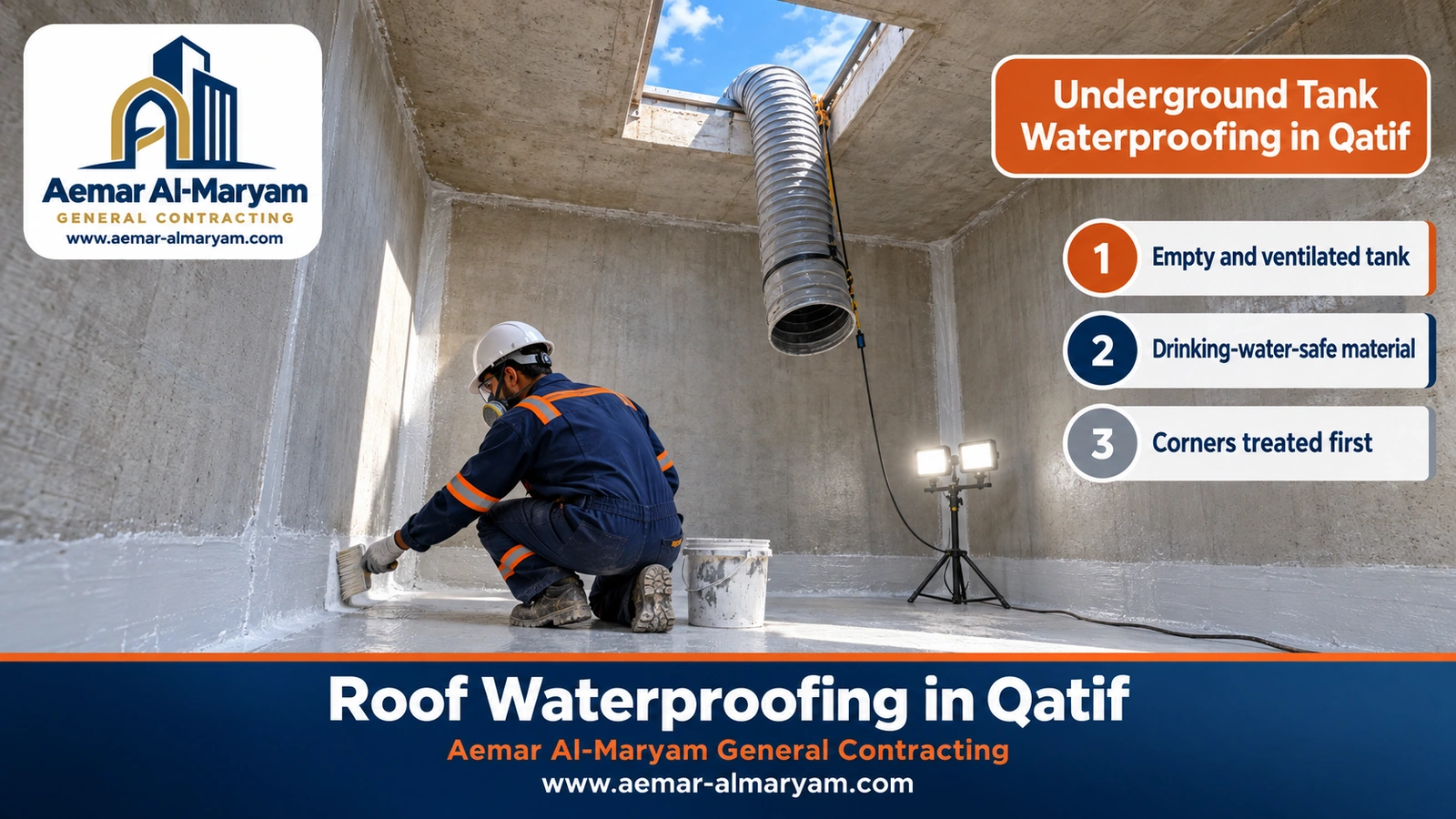
- 1Empty and dry
We drain the tank and let it dry, and watch whether water comes in while it stands empty. - 2Clean and inspect
Remove sediment and loose old coatings, and inspect walls, floor and corners. - 3Repair cracks and corners
Open and fill cracks, and reinforce the floor-to-wall corners where most seepage begins. - 4Lining
Coats of a material carrying a drinking-water certificate such as NSF/ANSI 61, at the thickness the product sheet states. - 5Cure and flush
We wait the period on the product sheet before filling, one of which states 7 days at around 21 °C, then flush the tank.
Working inside a tank is confined-space work
We keep air moving through a duct from the hatch, wear suitable respirators, and never leave one technician alone inside. If the tank concrete is new, we do not line it before it has cured; one product sheet sets this at 28 days.
For new tanks in damp ground we recommend an external bitumen coating on the tank walls before backfilling, in addition to the inner lining, so the tank is protected from both sides.
Best Roof Insulation Type for the Qatif Climate
The best roof insulation for the Qatif climate is one that copes with coastal humidity and heat together, and works with an old roof as it really is, not as it ought to be. We sum up our choices like this:
- ✓Sound tiled roofs: the clear coat first, because it is cheaper and keeps the tiles.
- ✓Roofs being retiled: the layered system, waterproofing and insulating under the new tiles.
- ✓Exposed roofs: foam with a light-coloured elastomeric coat that reflects the sun and seals the roof without seams.
- ✓Walls damp from below: a damp-resistant cementitious coating and breathable plaster, with the cause in the ground dealt with.
High humidity on some days means concrete can look dry when it is not, so we measure it with a meter before priming or spraying foam and, if needed, move the work to drier hours. That small delay beats blisters appearing under the waterproofing a few weeks later.
Roof Waterproofing Company in Qatif: How to Spot a Good One
A good roof waterproofing company in Qatif is one that tells you when you do not need a full system, writes down what it will do layer by layer, and tests it before covering it. We suggest these checks:
- ✓They tap-test the tiles and show you the hollow areas before proposing a coat over them.
- ✓They separate rising damp from a leak before proposing any wall treatment.
- ✓They write down the system, the thickness and how the membrane edge will be fixed on the parapet.
- ✓They run a flood test and go down with you to the rooms below at the end of it.
- ✓They spell out what the price includes and excludes, such as stripping, screed and tiles.
Leak Detection in Qatif
Leak detection in Qatif is a visit in which we locate the source of the water with instruments before breaking anything. Fees begin at SAR 140 for one wet room, SAR 200 for an apartment and SAR 280 for a house or storey, with tanks at SAR 140. We use moisture readings, a thermal camera whose images we confirm by measurement, pressure tests on the supply lines, and a ground microphone under the tiles. Older houses often still have old steel pipework, and if the leak is in it we suggest replacing the line rather than patching one point; see plumbing works.
An Old Ceiling That Is Flaking: When It Is More Than a Leak
When water reaches the reinforcement of an old slab for years, the steel rusts and swells, pushing the concrete cover off in flakes until the bars may show through, brown with rust. Waterproofing alone will not cure that. First the water is cut off at the roof; then, working from underneath, the spalled concrete is broken away, the bars are wire-brushed and given an anti-corrosion primer, and the lost cover is built back up in repair mortar. If the damage is widespread, or the bars have lost much of their section, a structural assessment comes before any work. The repair is explained under crack and concrete repair.
Start with the meter test
Close every outlet and the rooftop tank valve and give the meter thirty minutes. Movement while every outlet is shut points to a leak somewhere on the mains-pressure pipework, and before-and-after photos of it make the visit shorter.
Bathroom Waterproofing in Qatif
Bathroom waterproofing in Qatif starts at SAR 26 per m²: a flexible membrane on the floor rising up the walls, reinforcement at the drain and corners, and a water test before tiling. In older houses we often find bathrooms with no membrane at all, or one that has worn away, and the honest fix is renewing the whole bathroom, from SAR 2,300 per bathroom including stripping, plumbing and tiles; see bathroom and kitchen renovation. In the shower we take the membrane up to 1,800 mm, following an international wet-area reference.
Flood Testing in Qatif
Flood testing in Qatif is a step we never hand over a roof without. Drains are blocked off and the new waterproofing is held under water for at least 24 and at most 72 hours, per ASTM D5957, with 2.5–10 cm standing at the lowest spot; at the end we walk the rooms below. On old roofs we never exceed that depth, because every 10 cm of water adds about 100 kg per square metre to a slab that has already seen many years.
Roof Waterproofing Prices in Qatif
Our roof waterproofing prices in Qatif begin at SAR 10 per m² for a clear coat over sound tiles and rise with the system. Damp, foundation and stripping work is priced on inspection since no two houses need the same amount of it:
| Work | Starting price | When it is needed in Qatif |
|---|---|---|
| Clear coat over sound tiles | SAR 10/m² | Old roofs with firm tiles |
| Bitumen membrane | SAR 13/m² | After old tiles are stripped |
| Polystyrene boards | SAR 14/m² | With the membrane under new tiles |
| Cementitious coating | SAR 15/m² | Under tiles and on damp lower walls |
| Spray foam, standard layer | SAR 23/m² | Exposed roofs |
| Acrylic | SAR 23/m² | Room and annex roofs |
| Foam sealed under a protective coat | SAR 42/m² | Exposed roof with no tiles |
| Full build-up: waterproof membrane, heat boards, protection tiles | SAR 46/m² | A roof being retiled |
| Polyurea | SAR 55/m² | Heavy foot traffic |
| Tank lining: cementitious / drinking-water epoxy | SAR 14 / 46 per m² | Underground tanks |
| Bathroom membrane | SAR 26/m² | Before tiling |
| Complete bathroom renewal | SAR 2,300 | Bathrooms in older houses |
| Leak detection: bathroom or kitchen / flat / house / tank | SAR 140 / 200 / 280 / 140 | Before any breaking |
| Rising damp treatment and foundation waterproofing | On inspection | Houses near the coast and farms |
| Stripping old layers, screed, repairs after detection | On inspection | Roofs with built-up layers |
Estimates pending inspection and agreement; the roof condition, size, number of layers to remove, floor and access all affect them. See also our price list.
Waterproofing a 200 m² Roof in Qatif: An Illustrative Cost
Take an older house with a 200 m² roof, figures for illustration only. If the tiles are sound, the clear coat costs about 10 × 200 = SAR 2,000. If the tiles are hollow and must come up, membrane alone is 13 × 200 = SAR 2,600 and the full build-up 46 × 200 = SAR 9,200, with stripping, screed and tiles added after inspection. If the roof is exposed, foam with its protective coat is 42 × 200 = SAR 8,400. The gap between the cheapest and dearest option is large, which is exactly why we insist on inspecting before pricing.
Roof Waterproofing Steps in Qatif
- 1Photos first
The roof, the tiles, the parapets and the lower walls, on WhatsApp. - 2Inspection
Tap-testing tiles, measuring moisture, tracing the falls and checking ceilings and walls inside. - 3Quote
The right option and an alternative if there is one, with thickness, area, timing and exclusions. - 4Preparation
Washing, removing anything loose, repairing cracks, parapets and drains. - 5Waterproofing
The layers in order, at hours when the concrete is dry. - 6Flood test
24 to 72 hours with the ceilings checked. - 7Finishing
Protection or tiles, clean-up and maintenance advice.
How Long Waterproofing Lasts in Qatif, and Mistakes We See in Older Houses
How long waterproofing lasts in Qatif depends on workmanship and upkeep: foam roofs in published research have outlasted 30 years where owners recoated them about once every fifteen years, and systems under tiles are shielded by the top layer. These mistakes come up again and again:
- ✓Laying new tiles over old hollow ones, trapping water between them and adding weight to the slab.
- ✓Painting a salt-damaged wall with a waterproof paint, so the damp builds up behind it and appears higher up.
- ✓Leaving the membrane edge on the parapet open and unfixed.
- ✓Neglecting roof drains until they block with dust and palm fronds.
- ✓Waterproofing the whole roof to cure a stain caused by a pipe.
Heritage houses in Qatif and Tarout
Listed buildings and old earth-built houses come under the heritage authorities, who must approve and oversee any work. We stick to concrete houses, recent or older, that carry no heritage listing.
Once ceilings and walls have dried we repaint; see how in painting in Qatif.
Pages worth reading for Qatif and nearby
Where We Work in Qatif
We work in Qatif city, its towns and Tarout Island, and schedule neighbouring towns on the same day. Places we reach include:
Our Qatif area page gathers our services in the governorate. In older quarters with narrow streets we tell you in advance what equipment we need and where it will park, so the street is not blocked for the neighbours.
How to Order Roof Waterproofing in Qatif
Send the following on WhatsApp and we will come back with an initial view and then an inspection time:
- ✓Photos of the whole roof from two angles, and a close-up of the tiles and their joints.
- ✓Photos of the parapets from the roof side, their tops and the drains.
- ✓Photos of any damp at the base of walls or on ceilings, and when it gets worse.
- ✓The approximate roof area, and the age of the house if you know it.
- ✓Whether the roof has been waterproofed or tiled more than once.
- ✓The town or district, and the nearest place a work vehicle can stop.
There is also a written request form if you prefer.
An old roof? Do not break it before we check it
Many tiled roofs can be waterproofed without breaking. Photograph yours and send it, and we will tell you whether a light treatment is enough or it needs redoing.
Tags