Crack repair in Qatif, and above all in its older houses, does not start for us with filler or an injection gun. It starts with an engineer reading the crack and naming its cause: plaster shrinkage, rising damp and salt eating away the foot of the wall, or a foundation that has moved. Once the diagnosis is in, Aemar Al-Maryam General Contracting carries out what it calls for: stripping salt-laden plaster and replacing it with salt-resistant render, stitching stepped cracks in blockwork, restoring columns whose steel has rusted, and repairing external stairs, facades and boundary walls. Mesh with local re-plastering is priced from SAR 20 per square metre, a rust-damaged column from SAR 830, and the engineering inspection is quoted on the visit. Every number here is a starting estimate, settled only after a site visit and your go-ahead. Ring or message 0547879578.
Qatif and Tarout mix houses that are several decades old with newer districts, and many sit close to farmland or the coast, where water lies near the surface and the soil is salty. That does not make every old house unsafe. It does mean that a crack in such a house is often the result of something happening below ground or inside the wall rather than in the paint. This page explains how we diagnose cracks in an older home, when an engineer is needed, how rising damp and settlement are dealt with, and what can be repaired without demolition.
Key points: cracks in older Qatif houses
- Starting point: an engineering diagnosis for diagonal and stepped cracks and for column cracks, before any repair; its cost is set on inspection.
- Rising damp: salt-laden plaster removed from the base of the wall, the wall dried, then salt-resistant render with mesh; from SAR 20 per m².
- Settlement: monitor the crack, stop the water under the foundation on the engineer’s instruction, then stitch the stepped cracks with helical bars.
- Columns and ceilings: corroded bars exposed, cleaned, protected and re-covered; a column from SAR 830.
- Stairs, facades, boundary walls: broken step nosings rebuilt; facade cracks treated with render and paint from SAR 41 per m².
- What we will not do: paint over a moving crack, or work on a registered heritage building without the heritage authority.
- To order: crack photos with a ruler, the rough age of the house and the district, on WhatsApp 0547879578.
Crack repair in Qatif: why older houses start with an engineer
Crack repair in Qatif begins with an engineer in older houses because there the crack is a symptom, not the illness. A house that has stood for decades near water and salt has been through things nobody can see: steel rusting inside the concrete, plaster soaking up salts from the ground, a foundation that may have shifted as water levels changed or as an old drain leaked. The crack on the wall is the last link in that chain. Seal it without understanding the earlier links and it comes back, sometimes hiding a problem that is growing behind it.
“Engineer first” does not mean every crack needs a costly report. On the first visit we split the cracks into three groups: finishing cracks with an obvious cause, which we repair straight away; cracks to monitor for some weeks before deciding; and cracks that go to a structural engineer for diagnosis and a repair method. In older houses the third group is bigger than usual, which is exactly why we do not give a final price before inspecting.
■ Finishing crack
Hairlines in interior plaster, or a line where blockwork meets a column. Repaired directly with mesh and flexible filler.
■ Crack to monitor
Diagonal but narrow, or back after an earlier repaint. Marked or gauged, and decided once readings are in.
■ Crack for the engineer
Stepped through the block joints, in a column or beam, with sticking doors and sloping floors, or wider than 5 mm.
Dangerous cracks in Qatif homes: when an engineer is needed
A crack in Qatif is dangerous when it points to movement in the house or weakness in something that holds it up. In older homes we add damp and salt warnings to the usual list, because they often come before the structural crack does:
| What you see | What it usually means | Decision |
|---|---|---|
| Diagonal crack stepping through the block joints | Foundation movement or part of the house settling | Monitor, then engineer |
| Crack wider at the top, or at the bottom | Part of the wall rotating as it settles | Engineer before any repair |
| Vertical crack on a column edge with brown staining | Steel rusting inside the column | Engineer, then expose and treat the steel |
| Flaking paint and a white crust low on the wall | Ground moisture wicking upwards | Cure the damp, then the cracks |
| A door that suddenly sticks or a floor that tilts | Movement in the foundation | Urgent monitoring and an engineer |
| Crack 5 mm or wider, or growing | Damage beyond the finishes | Engineer |
⚠ Cases that cannot wait
Lumps of concrete hanging from a ceiling, a slab that bows, a column that has shed its concrete to bare steel, a crack that widens day by day, or one wider than 25 mm: keep the household out of that room and call an engineer the same day. Safety first, repair afterwards.
Licences and the engineering office
Filling and painting cosmetic cracks is maintenance and normally needs no licence. Repairing structural defects such as columns or foundations is done under a restoration licence through Balady, via a contracted engineering office; altering or adding structural elements needs a separate licence and approved drawings. On anything load-bearing, the engineer’s written findings set our scope.
What causes cracks in Qatif buildings: water, salt and age
In Qatif buildings, several causes usually overlap in one house, which is why one material rarely fixes everything. Near farms and the coast one factor almost never goes away: water close to the surface and the salts it carries. The table gives the general picture; we do not claim water-level figures for any particular district.
| Factor | How it acts | What you see in the house |
|---|---|---|
| Shallow groundwater | The water level rises and falls, changing how the soil under the foundation behaves, and damp climbs into walls | Damp at wall bases; diagonal cracks where foundations have moved |
| Salts in soil and air | Salts crystallise in the plaster pores and break it up; chlorides reach the steel and rust it | White crusts, crumbling plaster, cracks along the bars |
| Age of the house | Thin concrete cover, weaker materials than today, old leaks never fixed | Cracked columns, spalling ceilings, exposed steel |
| Leaks and drains | Waste or supply pipes leaking beneath the floor soak the ground and carry fines away | Local settlement; stepped cracks near bathrooms or the kitchen |
| Later additions | An annex or upper floor added later moves differently from the original house | A straight vertical crack along the junction |
Because these factors combine, our questions on site can seem far from the crack itself. How old is the house? Has the drain ever backed up? Is there a farm or irrigation next door? Was an annex or a floor added later? The answers do half the diagnosis.
Rising damp and cracks at the bottom of walls in Qatif
Rising damp in Qatif is what we meet most in the ground-floor rooms of older houses. Water climbs from the ground through the pores of the wall by capillary action and brings salts with it, which crystallise as the water evaporates near the surface. The result is a band at the foot of the wall where the paint flakes, the plaster crumbles, white crystals appear and the render breaks into short criss-cross cracks. No filler helps here, because the salts push it off from behind.
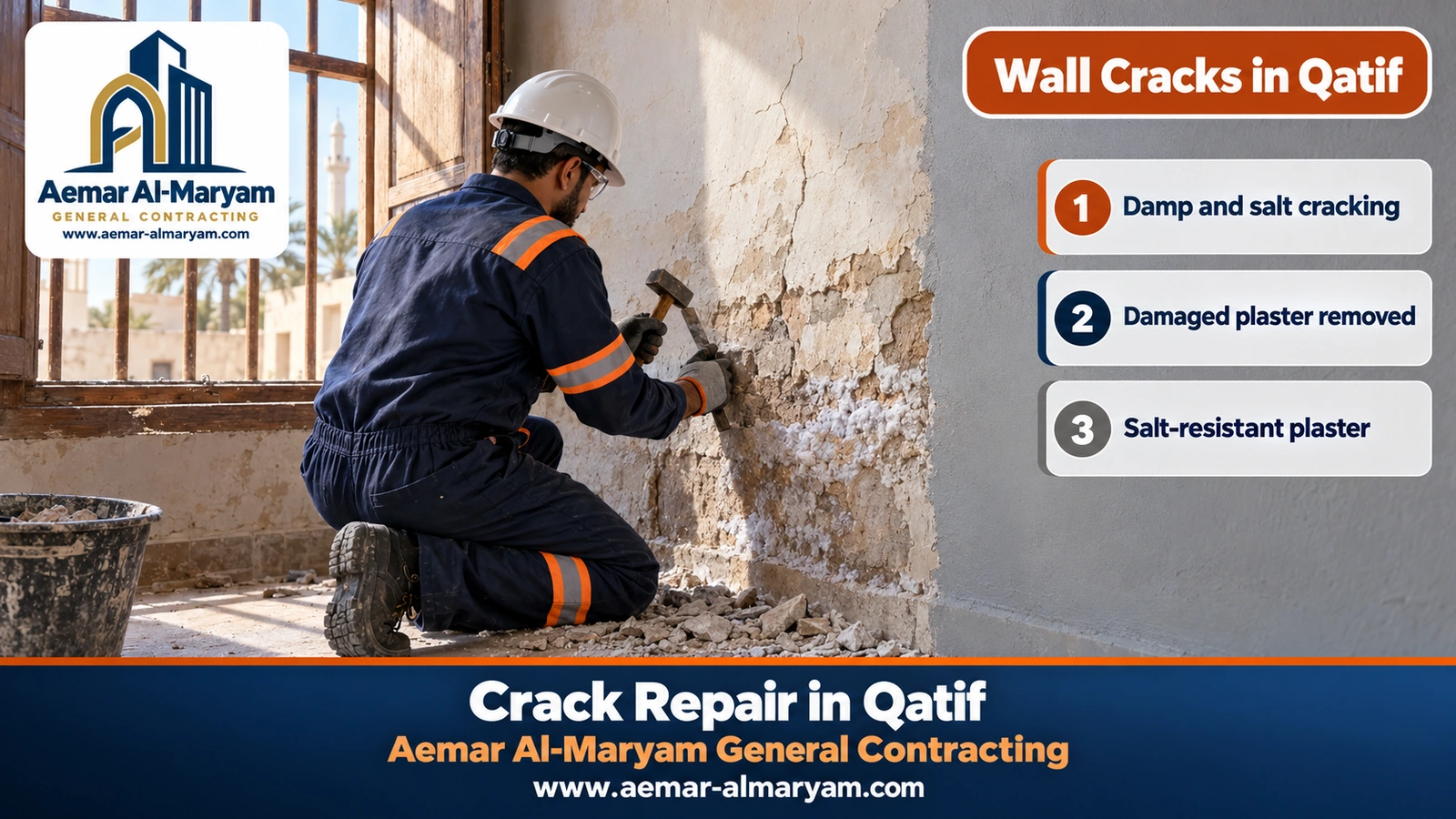
This is how we tackle it:
- 1Find the water source
We separate ground moisture rising through the wall from a pipe weeping inside it, and from irrigation or rain collecting against the wall outside; each has its own cure. - 2Strip the salty plaster
Damaged render comes off to a safe margin above the highest visible salt line, because salts travel further than the eye can see. - 3Clean and dry
Salt is scraped from the blockwork, the surface cleaned, and the wall left to dry with ventilation before anything goes on. - 4Treat the cause
The leak repaired, drainage away from the wall improved, or a damp barrier added where the house calls for one. - 5Salt-resistant render
New render in materials made for damp walls, with mesh over the cracks and over the joint between old and new. - 6Breathable paint
A finish that lets the wall breathe, not a sealing coat that traps the moisture behind it.
Meshing plaster cracks with local re-plastering starts at SAR 20 per square metre. Where damp has risen over large areas or comes from a leak, the work is priced on inspection. For plastering in older homes, see plastering contractor in Qatif.
Don’t seal a damp wall with oil paint
Many owners paint the bottom of the wall with an oil-based or gloss paint to hide the damp. That traps water and salt behind the paint, and the damage simply climbs higher. Cure the cause, then use paint that lets moisture out.
Foundation settlement and building cracks in Qatif
Settlement in older Qatif houses usually shows as stepped cracks running through the mortar joints between blocks like a staircase, often rising from the corner of an opening and gaping more at one end. A door may no longer close easily, floor tiles may lift, or a gap may open between wall and ceiling. Behind it is one section of foundation sinking more than the rest, because the soil beneath has been wetted or washed out by a leak, because the water level under it has changed, or because the footing was weak from the start.
Our order of work for settlement is fixed: first, monitor the crack to learn whether it is still moving; second, a structural engineer’s report on the cause; third, stop any water source; fourth, carry out what the engineer specifies to stabilise the foundation; and fifth, only then, repair the cracks. We put no price on settlement cracks until we have read the engineer’s report, because houses differ enormously here.
Stitching stepped cracks in Qatif blockwork
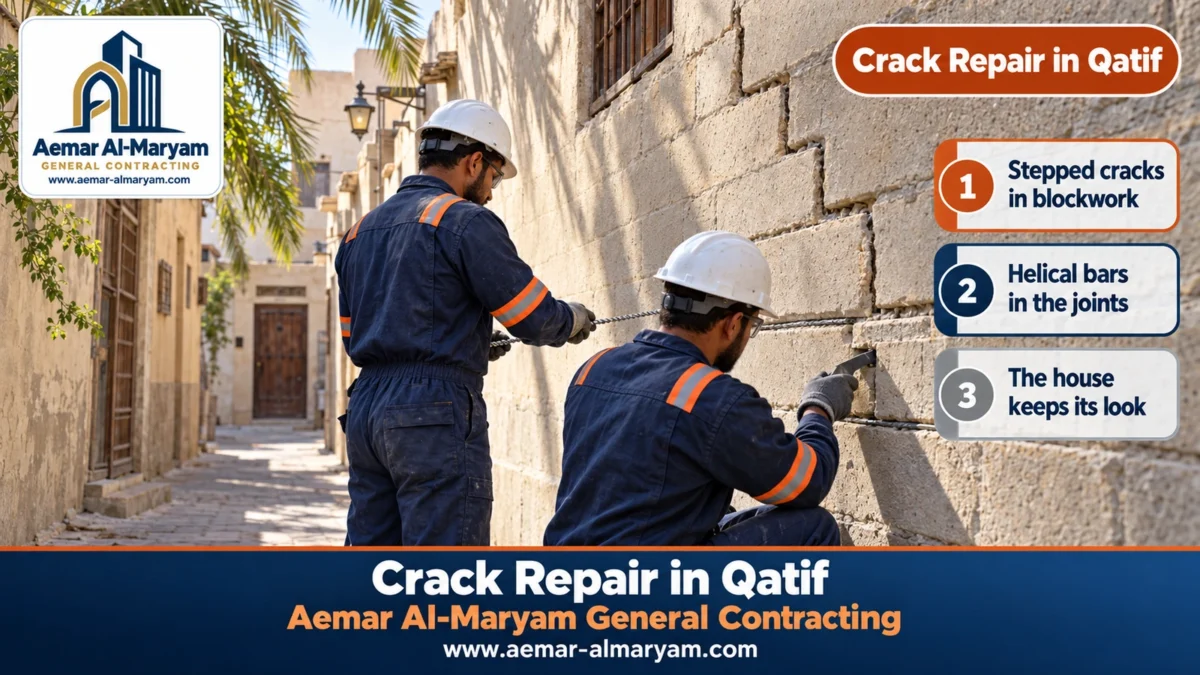
Stitching stepped cracks is the repair we use most in older Qatif block walls once the engineer confirms movement has stopped. We rake out the mortar from selected horizontal joints either side of the crack, feed in thin stainless steel helical bars that typically run about half a metre past the crack on each side, bed them in a special grout, then repoint the joints in a mortar close to the wall’s colour. The bars tie the wall back into one piece without demolition and spread any small future movement over a longer length. The engineer decides how many joints are stitched and how far apart; stitching is priced on inspection.
Crack monitoring in Qatif: has the movement stopped?
Crack monitoring in Qatif is the bridge between diagnosis and repair, and in older houses no decision to stitch or inject is taken without it. A dormant crack can be tied with rigid materials; a live one needs its cause treated first and then a flexible solution. There are two ways to monitor. The homeowner’s version: a dated pencil stroke just beyond each tip, plus a ruler photo taken from one fixed spot at regular intervals over some weeks. Or we fit a gauge made of two transparent plates with a measuring grid, which reads the size and direction of any movement precisely.
Where a house borders farmland, or where water levels change between seasons, we prefer monitoring to cover different times of year if possible, since movement can be seasonal. There is no fixed period for every case: the engineer decides when the readings are enough. Fitting and reading gauges is priced on inspection.
Types of cracks in Qatif by width
Crack types in Qatif are ranked by width, the first thing we measure on a visit. The table follows a well-known British reference classification for crack damage in buildings, with a column on what each band usually means in an older house:
| Band | Width | In an older house it usually means | Action |
|---|---|---|---|
| 0 | Below 0.1 mm | Plaster shrinkage or old paint | Mesh, flexible filler, paint |
| 1 | 0.1 – 1 mm | Tired plaster or thermal movement | Open, fill and mesh |
| 2 | 1 – 5 mm | Possibly the start of movement or rust | Find the cause, then repair |
| 3 | 5 – 15 mm | Clear movement in the wall | Engineer, monitoring, partial repair |
| 4 | 15 – 25 mm | Damage spreading through the wall | Sections taken down and rebuilt on the engineer’s direction |
| 5 | Over 25 mm | Stability at risk | Clear the space; propping as the engineer decides |
Hairline cracks in Qatif
Hairline cracks in Qatif are mostly nothing to worry about: fine lines in plaster or paint from shrinkage or temperature change. In an older house, though, we check where they are before relaxing. A web of hairlines at the foot of a wall with flaking means damp; a straight hairline on a column edge or along a ceiling bar can be the first sign of rust. Anything else is treated with fibre mesh and flexible filler before painting.
Serious structural cracks in Qatif
Serious structural cracks in Qatif run through columns, beams and ceilings, step diagonally and widen, or exceed 5 mm. In older homes we treat any crack with visible rust or spalling concrete just as seriously, and all of them go to the engineer before any work.
Column and beam cracks in Qatif: rusting steel in older houses
Column and beam cracks in older Qatif houses are caused, first and foremost, by rusting steel. Over the years chlorides from salty ground, coastal air and damp reach the bars; the steel rusts and swells to several times its size, splitting the concrete that covers it. The sequence is predictable: a fine vertical line on the column arris, rust bleeding through, the cover loosening, and finally chunks dropping off.
The cure is neither injection nor plaster. The damaged concrete is broken out until the steel is exposed with enough space behind it for mortar to surround it; the bars are cleaned of rust and coated; extra steel is added if the engineer finds the section reduced; and the concrete is rebuilt with repair mortar and a bonding agent. Restoring a rust-cracked column starts at SAR 830, rising with the length of damaged concrete and the extent of bar corrosion.
Ceiling cracks in Qatif
Ceiling cracks in older Qatif houses call for a look at what is above the ceiling before what is below it. A hairline in the ceiling plaster can be ordinary shrinkage, but a straight crack following the bars, especially with a brown stain or flaking, means water has reached the steel, usually from a roof that has lost its waterproofing or a bathroom upstairs. Such a crack is never painted; it gets the same treatment as a rusting column, with the bars uncovered, de-rusted and re-covered, and the leak above stopped. For the roof see roof waterproofing and insulation in Qatif. Restoring a spalling ceiling is priced on inspection.
External staircase cracks in Qatif
Cracks in external stairs are common in Qatif houses with a concrete stair on the side of the building leading to the roof. The stair is exposed to sun, rain and salt on every face; a crack often opens along the line where it meets the house wall, because it is a separate mass that moves differently, and step edges break from wear and rust.
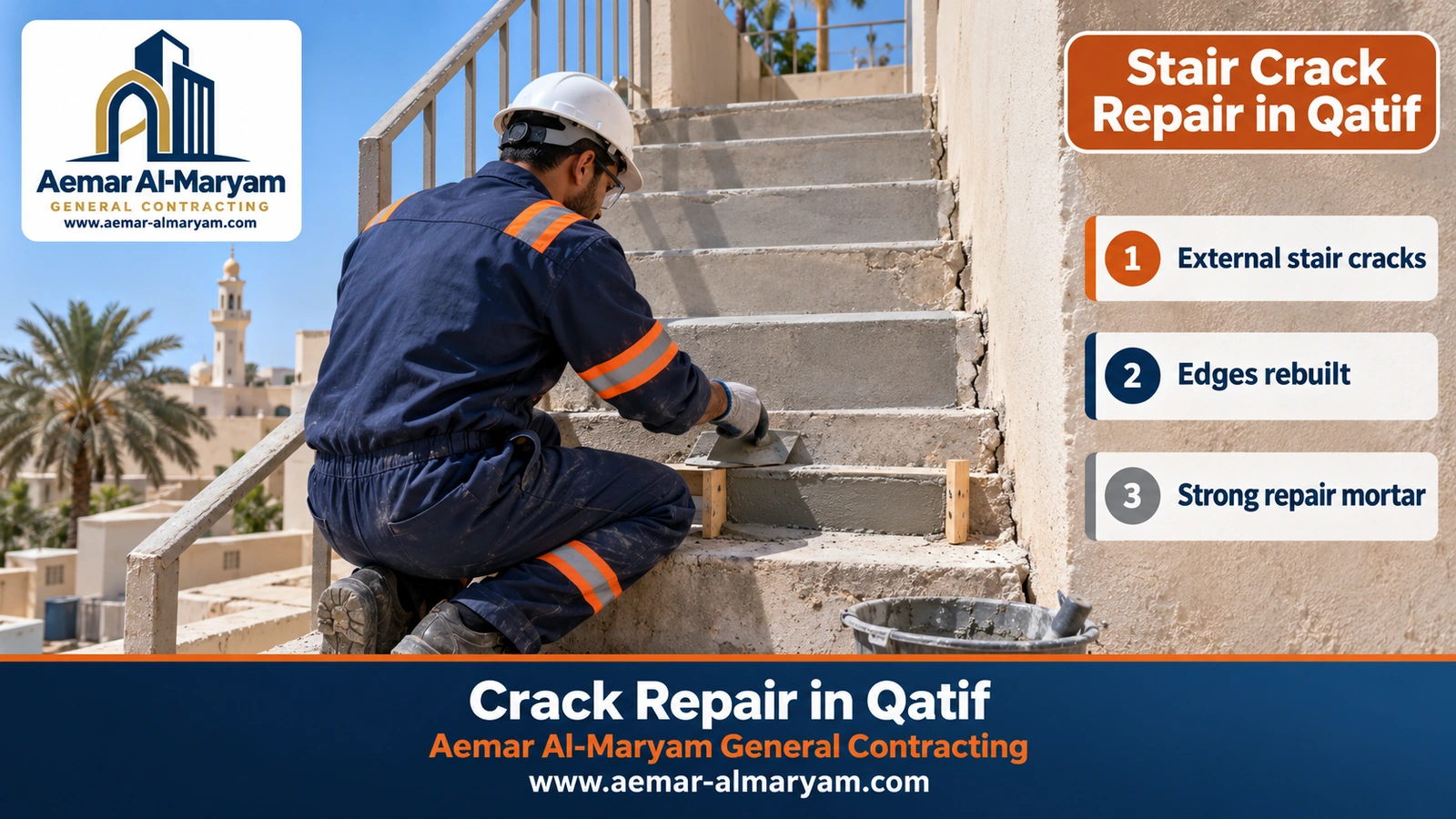
We first examine the crack between stair and wall. If it is narrow and dormant we rout it out and seal it with an elastic sealant so the stair and wall can move independently; if it is widening, or the stair is leaning away from the wall, it goes to the engineer. For broken step edges we cut back to sound concrete, treat any exposed steel, then rebuild the nosing with repair mortar inside a timber form that gives it a straight, sharp arris. Stair repairs are priced on inspection by the number and condition of the steps.
Epoxy crack injection in Qatif: the right and wrong cases
Epoxy crack injection in Qatif works on a dormant crack in sound concrete, such as a slab, beam or concrete wall, from about 0.05 mm wide: the resin fills the crack, hardens and bonds the two faces together. It does not work in three situations we meet often in older houses: a moving crack, because rigid resin cannot follow it; a rust crack, because the problem is in the steel, not the gap; and a stepped crack in blockwork, which needs stitching rather than injection. Where it fits, injection costs from SAR 32 a running metre.
Polyurethane for cracks letting water in
Where water enters through a crack in an underground tank or a wall against the ground, the crack is injected with polyurethane, a flexible resin that reacts with water and foams to close the gap. It stops the leak but restores no strength, and can be followed when needed by a moisture-tolerant epoxy once dry; we price it after seeing the leak.
Facade and exterior wall cracks in Qatif
Facade cracks in Qatif’s older districts combine sun, salt and age: old external render crazed into webs, lines where blockwork meets columns, and flaking around windows where water gets in. We start by sounding the facade to find loose areas, remove them, treat the cracks with alkali-resistant mesh, re-render in exterior-grade materials and paint. Facade cracks treated with render and paint start at SAR 41 per square metre; if all the facade needs afterwards is a protective finish, moisture-resistant masonry paint costs from SAR 18 per m². For facade colours and arches, see painting contractor in Qatif.
Boundary wall cracks in Qatif
Boundary wall cracks in Qatif come in two kinds: a line between blockwork and pier, caused by heat and repaired with mesh and fresh render; and a diagonal crack or leaning wall caused by the footing, which is checked before any render, especially where the wall runs beside a farm, a water channel or irrigation that soaks its base.
Qatif plaster cracks and block-to-column cracks
Plaster cracks and block-to-column cracks are the finishing side of the problem in Qatif, and appear in old and new houses alike. Shrinking mortar leaves a net of fine lines; differing expansion between block and concrete leaves one clean line tracing the edge of a column or beam. We rake the line, pack it with an elastic filler, embed fibre mesh over it in a skim or patch render, and repaint the complete wall. Treating a whole room’s cracks this way before painting starts at SAR 140.
Fixing wall cracks in Qatif according to the cause
Fixing wall cracks in Qatif means choosing the repair by cause; mending the crack itself is the last step, not the first. These are our usual decisions in Qatif homes:
| Cause confirmed by the diagnosis | Matching wall crack repair |
|---|---|
| Plaster shrinkage | Light opening, flexible filler, mesh and paint |
| Thermal movement at a column | Mesh lapping the junction and a local re-plaster |
| Rising damp and salt | Strip salty plaster, treat the water, salt-resistant render |
| Rusting steel | Expose and treat the steel, rebuild the concrete |
| Settlement the engineer says has stopped | Helical bar stitching of stepped cracks, then render |
| Settlement still active | No crack repair until the foundation is stabilised |
| Dormant concrete crack | Epoxy injection |
The best fix for wall cracks in an older house
In an older Qatif house, the best fix for wall cracks is the one that deals with water first. In most houses we inspect, water is part of the story: rising from the ground, coming down from a roof, leaking from a pipe or wetting the soil under the footing. Deal with the water and the crack repair becomes simple and lasting; ignore it and even the most expensive materials will fail.
Restoring cracks in older Qatif and Tarout houses
Crack restoration in Qatif and Tarout’s older houses is usually part of a wider job: plaster, ceilings, columns, waterproofing and paint. We suggest planning the whole job in the right order from the start rather than ordering each item on a separate visit. For the full picture see renovation contractor in Qatif and our renovation service; if the engineer decides a damaged section must be taken down and rebuilt, see our demolition service.
Heritage buildings
We work on relatively modern houses built in concrete and blockwork. Traditional mud buildings, or those registered as heritage, need the heritage authority involved in any restoration, and we do not take them on without it.
Crack repair prices in Qatif
Crack repair prices in Qatif are built on the diagnosis, which is why most work on older houses begins with an inspection. Starting prices for the clear-cut items:
| Item | Unit | From |
|---|---|---|
| Inspection and engineering report | — | On inspection |
| Fibre mesh and local re-plaster over cracks and damp wall bases | m² | SAR 20 |
| A whole room’s cracks before painting | room | SAR 140 |
| Column repair where corroded bars have split the concrete | column | SAR 830 |
| Facade cracks with render and paint | m² | SAR 41 |
| Moisture-resistant masonry paint once repairs are done | m² | SAR 18 |
| Injecting a concrete crack proven dormant | linear metre | SAR 32 |
| Stitching stepped cracks | — | After the engineer’s report |
| Settlement cracks and foundation stabilising | — | After the engineer’s report |
| Crack monitoring with gauges | — | On inspection |
| Polyurethane injection where water enters | — | On inspection |
| Restoring a spalling ceiling | — | On inspection |
Figures are estimates until the inspection and our agreement, and shift with how long, wide and deep the crack runs, where it sits, how hard it is to reach, and the state of the plaster and steel around it. In older houses, removing plaster sometimes reveals more than was visible; if it does, we tell you before we go on. For items marked “on inspection”, send photos to WhatsApp 0547879578 for a first idea. Other services are listed in our price guide.
Worked example: a ground-floor room in an older Qatif house
For illustration: a ground-floor room where rising damp has ruined 12 square metres of plaster along the bottom of its walls, plus a cracked outside facade of 30 square metres. Mesh with local re-plastering inside starts at SAR 240 (12 × 20), and the facade cracks with render and paint from SAR 1,230 (30 × 41), giving a total from about SAR 1,470. To this is added whatever the diagnosis requires for the damp source, and whatever the engineering inspection specifies if stepped cracks are found.
Mistakes that bring cracks back in Qatif homes
- ✓Filler over salt salts crystallise behind it and push it off with the paint within months.
- ✓Sealing paint on a damp wall it traps the water so the damage climbs higher.
- ✓Injecting a stepped block crack injection does not tie a moving block wall; stitching after movement stops does.
- ✓Rendering over rusty steel corrosion carries on under the new render and splits it again.
- ✓Ignoring the drain a leak under the house brings settlement back however well the cracks are repaired.
- ✓Starting before the engineer repairing a structural crack without a diagnosis hides the problem rather than solving it.
Crack repair steps in Qatif: engineer first
- 1Photos
You send crack photos with a ruler and the age of the house, and we triage them. - 2Visit and triage
We measure, check plaster, steel and damp, and group the cracks: finishing, monitor, engineer. - 3Engineering diagnosis
For the third group, a structural engineer sets cause and repair. - 4Deal with the water
Leak, rising damp, roof or drainage, as found. - 5Monitoring
Where we must confirm movement has stopped before tying the wall. - 6Repair
Stitching, concrete repair, injection or salt-resistant render. - 7Finishing
Local re-plastering, mesh and a paint suited to the wall.
Qatif and Tarout: where we repair cracks
We work across Qatif, in older and newer neighbourhoods such as Al Sawari, Al Rida, Al Shati, Al Sadafa and Al Fath, and across Tarout Island at Darin, Sanabis, Al Rabiyah, Al Zour and Tarout town itself. We also cover neighbouring Saihat; for its ceiling and boundary-wall cracks see crack repair in Saihat, for Dhahran villas see crack repair in Dhahran, and for the full guide see crack repair in Dammam.
Why Aemar Al-Maryam in Qatif?
- ✓No price before a diagnosis in an older house we tell you the cause first, then the cost.
- ✓Water before cracks damp and leaks are treated before the damage they caused.
- ✓Methods for older houses salt-resistant render, helical bar stitching and rusted column repair.
- ✓Straight talk on structure we follow the engineer’s report and never decide load-bearing matters alone.
How to order crack repair in Qatif
Send this information on WhatsApp to 0547879578; it shortens the first visit:
- ✓Crack photos close-ups with a ruler and wider shots of each wall.
- ✓Wall bases a photo of any flaking or white salts in ground-floor rooms.
- ✓How old is the house? roughly is fine; mention any annex or floor added later.
- ✓Doors and floors any door that sticks, lifting tiles or a sloping floor.
- ✓Around the house farmland, irrigation or a past drainage problem.
- ✓District in Qatif, Tarout or the nearby towns.
A form works too: request an inspection. Past jobs are under projects.
A crack in an older house? Start with the diagnosis
Send the crack photos and the age of the house, and we will tell you whether to begin with the damp or with an engineering inspection, together with an early idea of cost.
Helpful pages for Qatif
Tags