An asphalt contractor in Al Khobar turns a dusty yard or a broken car park into a firm, drained surface: the ground is treated first, a compacted base course is built on it, the falls are set so water runs away, and only then is the hot mix laid and rolled. At Aemar Al-Maryam General Contracting our Al Khobar work falls into four kinds of private site: new villa yards paved with a paver fed straight from the tipper truck, the owned strip in front of houses inside the property line, commercial car parks that need a new layer over old asphalt, and salty or damp ground near the coast that must be replaced before anything is paved. A square metre of 5 cm hot mix on an existing base starts at SAR 37, and the full system built up from bare soil starts at SAR 74. Both figures are provisional and get fixed once we have walked the site with you. Phone or message 0547879578.
New villas in the south, tired yards in the older districts, worn car parks on the commercial streets, and coastal ground that hides damp and salt until the first winter: that is the Al Khobar picture. This guide walks a property owner through what happens on paving day, how salty ground is handled, when a new layer over old asphalt is enough, what a square metre costs, and how to check the work before you pay.
In short: asphalt work in Al Khobar with Aemar Al-Maryam
- Sites: new villa yards, house fronts inside the property line, commercial and residential building car parks, and private yards.
- Salty ground: weak layer dug out, geotextile laid, crushed stone placed, then a compacted base course; priced after inspection.
- New over old: patching and milling, then a light tack coat (RC) over the old asphalt and kerb faces before the new layer.
- Thickness: five to six centimetres after rolling for family cars and parking bays, more under truck traffic.
- Starting rates (SAR per m²): 5 cm over a standing base 37; 7 cm 41; soil-to-surface system 74; modified binder 55; cold-mix stopgap patch 46; mill-and-relay 38. All provisional pending the site visit.
- Before handover: a long-straightedge check and a hose test on the falls toward the gully.
- Getting a figure: send pictures, rough measurements and the kind of vehicles to 0547879578.
Asphalt contractor in Al Khobar: which sites we work on
As an asphalt contractor in Al Khobar we work on private property only: a yard, a driveway to the garage, the strip you own outside the front wall, the car park of a commercial building, a residential block, a clinic or a private school, and the yard of a company or workshop. The municipality looks after public roads and footpaths, so we never offer anyone to “pave the street”. Settling this before any agreement matters, because it decides where the asphalt stops and where another authority’s responsibility begins.
In Al Khobar the enquiries we get keep falling into four patterns. A villa owner has just finished building and wants the yard ready before moving in. A resident of an older district is tired of dust and mud in front of the house. The management of a commercial building wants tidy parking for customers after the old asphalt has cracked. And a plot near the sea shows dampness and salt. Each of these needs a different way of working, and each has its own section below.
■ New villa yard
A paver fed straight from the tipper truck, a steel-drum roller behind it, and one surface with very few joints.
■ House front inside the line
The strip between the wall and the property line, with straight edges at the wall and gate and a fall that takes water away.
■ Commercial car park
Patching and milling, then a tack coat over the old asphalt, a new layer, and the bay markings.
■ Salty or damp ground
The weak layer replaced with geotextile and crushed stone before the base course.
■ Patching and repairs
Potholes, cracks and local settlement in existing yards and car parks, in hot mix with cut edges.
■ Drainage checks
A long straightedge and a water test in front of you before handover, so nothing ponds by the walls.
Our asphalt service page gives the one-paragraph overview, and the long Dammam guide with its layer and thickness tables is at asphalt contractor in Dammam.
Asphalt company in Al Khobar or a day labourer?
An asphalt company in Al Khobar arrives with a plan before it arrives with machines: levels taken with an instrument, a defined base thickness, a date for spraying the prime coat and a later date for paving once it has cured, a hot-mix order placed with the plant in the right quantity, and a check at the end. A labourer who turns up with a small roller and a single load may quote less, but the difference gets paid later in a dip at the gate or a pond by the majlis wall.
Before talking money, put three questions to whoever quotes: what compacted thickness will I get, what happens if the soil proves wet or salty once you dig, and how will you prove the water reaches the drain? Straight answers there matter more than the figure at the bottom of the quote.
Asphalting in Al Khobar, “zeft” or paving: one job, many names
Asphalting in Al Khobar goes by many names, from blacktop and tarmac to the local Arabic «زفلت» and «سفلتة». Whatever the word, the product is crushed stone bound with bitumen, mixed hot at the plant and compacted on your site, so a search for “driveway tarmac in Khobar” lands on the same service.
Villa yard asphalt in Al Khobar: paving new villas
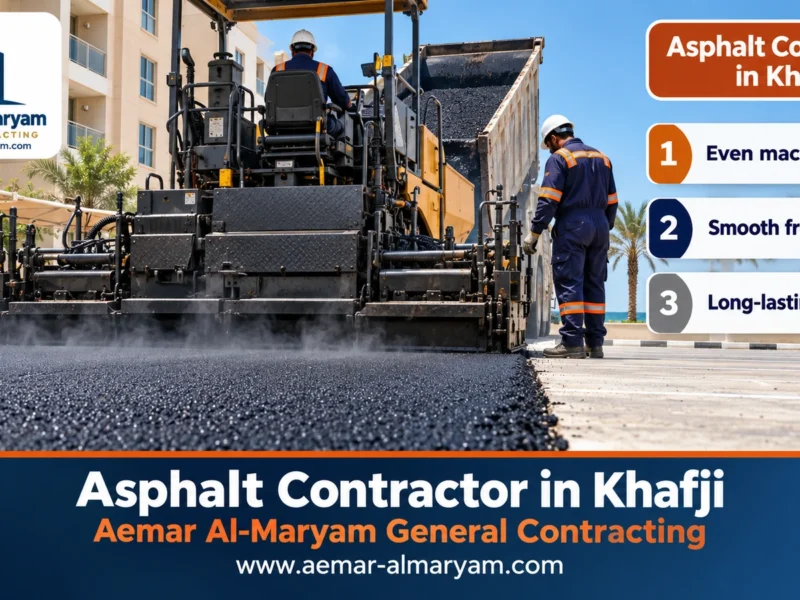
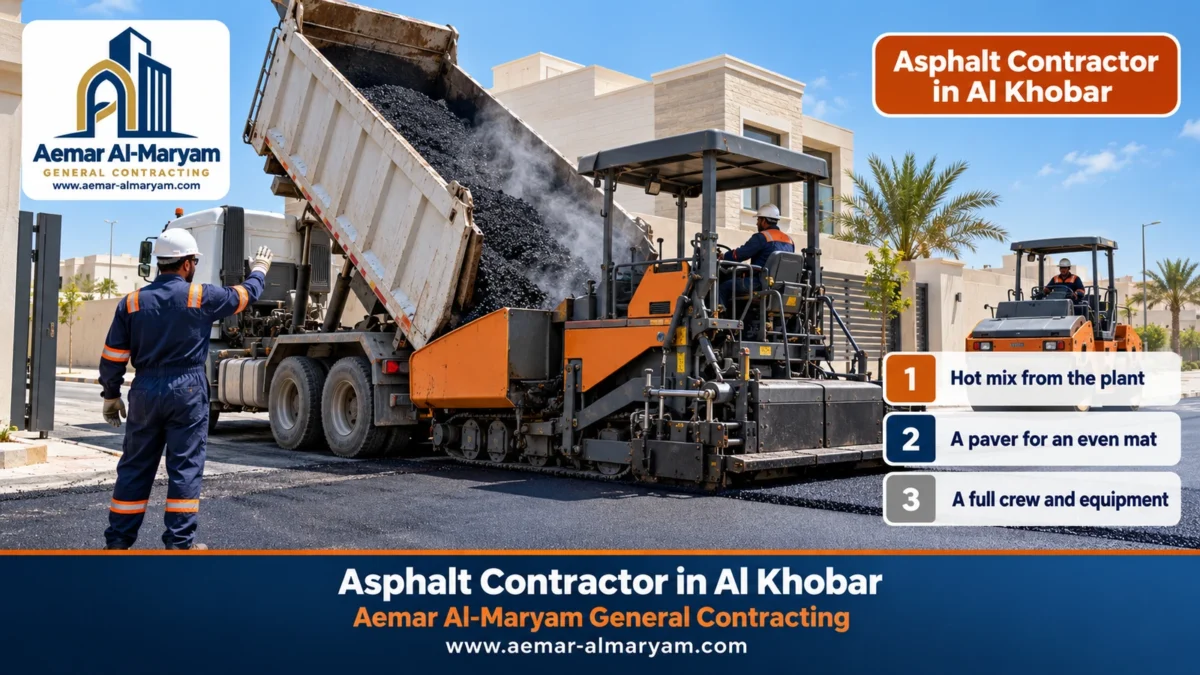
Villa yard asphalt in Al Khobar on new villas is usually laid with a paver. A tipper truck reverses up to it and raises its body to discharge the hot mix into the hopper; the paver spreads a layer of constant width and even thickness, and the steel-drum roller follows before the mix cools. This gives a level surface with very few joints, and it is the right method for a wide yard with an entrance the truck can use.
In the southern parts of the city, where new villas are concentrated, the yard is often bare soil mixed with construction leftovers: broken blocks, concrete offcuts, sacks, and sometimes uncompacted fill that the builder tipped in to raise the yard level. We do not lay asphalt on that. We start by clearing the yard and hauling away the debris, then take the levels of the door thresholds, the gate and the water outlet, and from those decide how much to excavate and how much to fill before the base course.
How the mix gets from the plant to the paver
The plant batches the mix hot, and covered tippers carry it to keep its heat. When a truck arrives we measure the mix temperature before it is tipped. Paving specifications used in the Eastern Province call for a temperature of no less than about 139 °C at laying, and for the rollers to finish their passes before the mat drops to around 90 °C. A load that arrives cold or lumpy is turned away, because no amount of rolling will make it bind.
When the paver cannot get in: hand laying in narrow yards
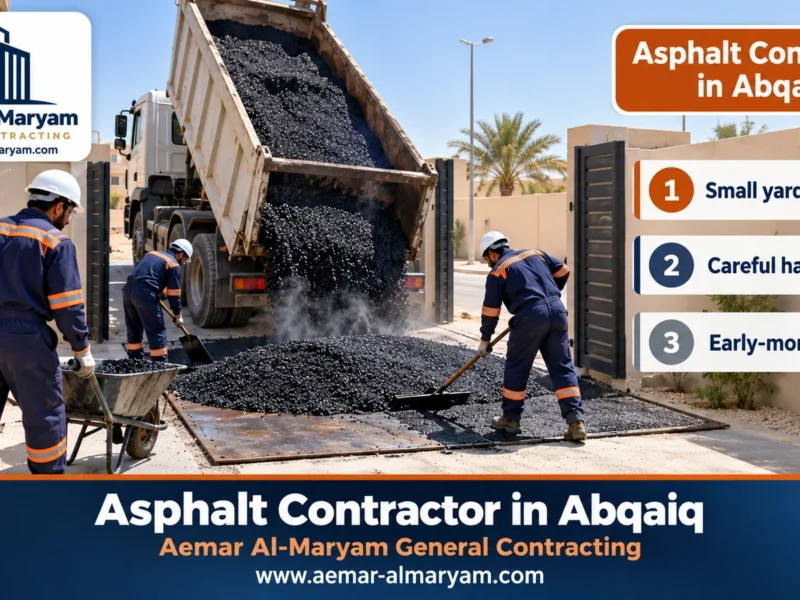
Some yards have a gate too narrow for the paver, or a side passage squeezed between the boundary wall and the villa. There the mix is tipped at the nearest point and the crew spreads it with shovels and a lute, then compacts it with a small double-drum roller or a plate compactor in the corners. Hand laying needs an experienced crew working fast, because a hand-spread layer loses heat quicker than a paver mat, so we split the area into small sections and finish each one before moving on.
Make paving the last job in the yard
Paving should come after the boundary wall and gate, after the drainage, irrigation and lighting lines are in, and after the concrete trucks and the AC cranes have gone. If you are also building an annex or majlis in the yard, finish it before the asphalt.
House front asphalt in Al Khobar, inside the property line
House front asphalt in Al Khobar means paving the strip the owner holds between the boundary wall and the property line, plus the driveway to the garage, at about 5 to 6 cm compacted over a compacted base, with a fall that carries water away from the wall and the gate. We stop at the boundary with a straight edge and do not run the asphalt onto the public pavement or the street.
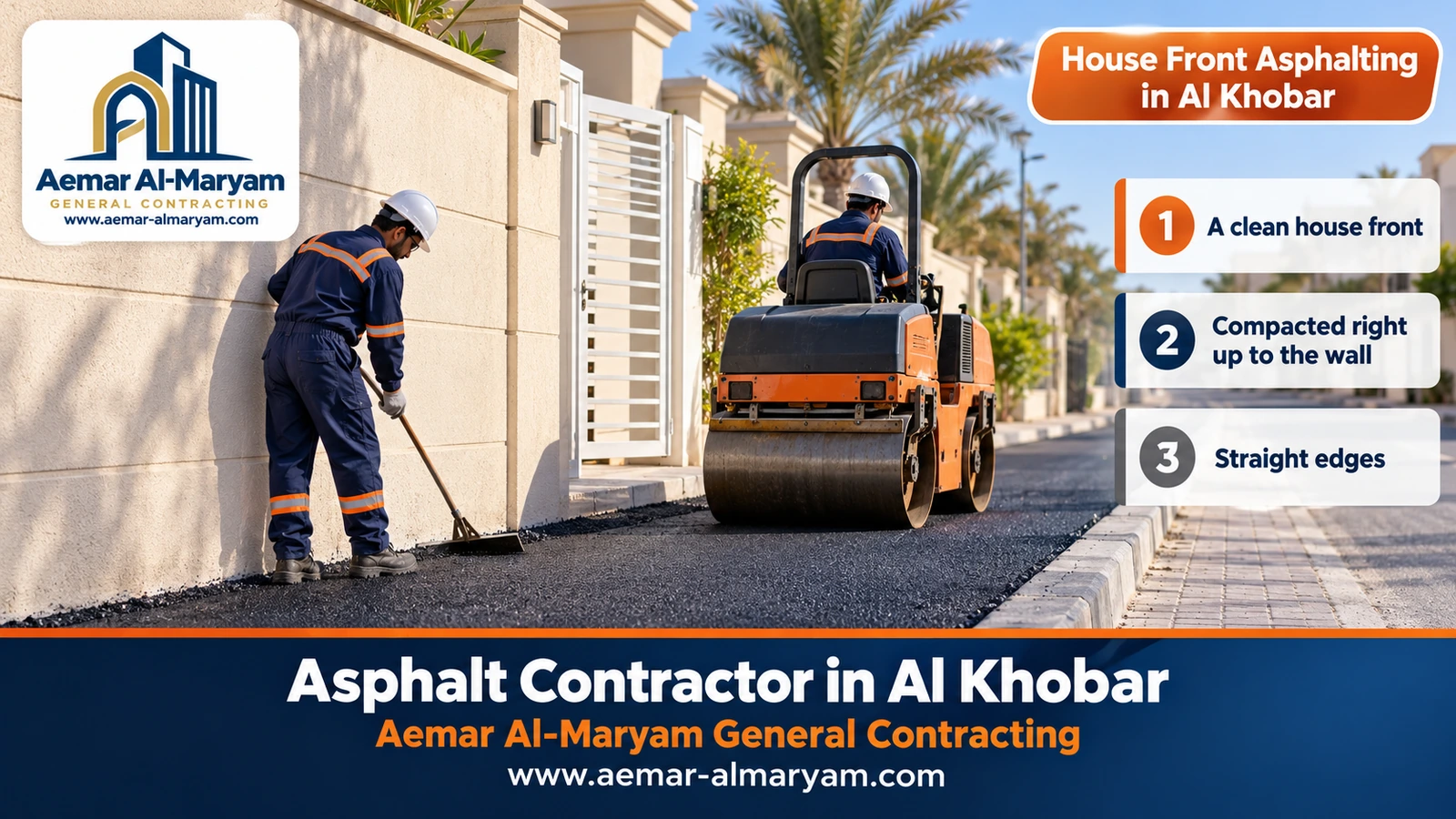
In older districts such as Al Aqrabiyah, Al Hada and Madinat Al Umal, many houses have a cracked concrete apron out front, tiles broken by car wheels, or bare soil that turns to mud after every rain. Laying asphalt over whatever is there does not work. Cracked concrete reflects its cracks up through the asphalt, and broken tiles keep moving underneath it. So we remove the old surface where needed; if it is thick concrete, our demolition team in Al Khobar breaks it out, and then we build the base again.
Where does your plot end and the public street begin?
Before work starts we agree with you on the line between your property and the pavement or street, using the plot plan, the existing kerb or the boundary markers on the ground. Inside that line you need no excavation permit to pave your own land. If the job involves cutting the street to extend a service, or changing the level of the public pavement, that goes through the municipality, while the permit to dig for a new connection is the utility company’s application on Balady, not yours. For a hole in the road outside, call the municipality on 940 or log it in the Balady app.
The wall edge, the gate and the threshold
Three small details ruin more house fronts than anything else. The first is the threshold level: we leave enough clearance under the door and gate thresholds so rainwater does not run in and a sliding gate does not scrape the asphalt. The second is the edge against the wall: it is trimmed by hand and pressed with a small roller or plate so there is no loose margin left to crumble. The third is the direction of fall: toward the outside or a gully, never toward the footing of the wall or the majlis door, because water trapped at the base of a wall rises into it with its salts.
⚠ Do not lift the asphalt above the garage threshold
A new layer over old asphalt or concrete raises the level by several centimetres. If the threshold was already low, water will enter the garage with the first rain. The answer is to mill or remove the old surface at the entrance so the finished level stays right, not to build up on top of it.
Salty ground near the Khobar coast: geotextile and crushed-stone replacement
If a yard or plot is damp and edged with a white salt crust, the answer before paving is to dig out the weak layer, lay geotextile across the bottom with overlaps between the strips, backfill with crushed stone and a compacted base course, and only then lay asphalt. How deep to dig and how much stone to place are decided at the inspection, so this treatment is priced after we have seen the site.
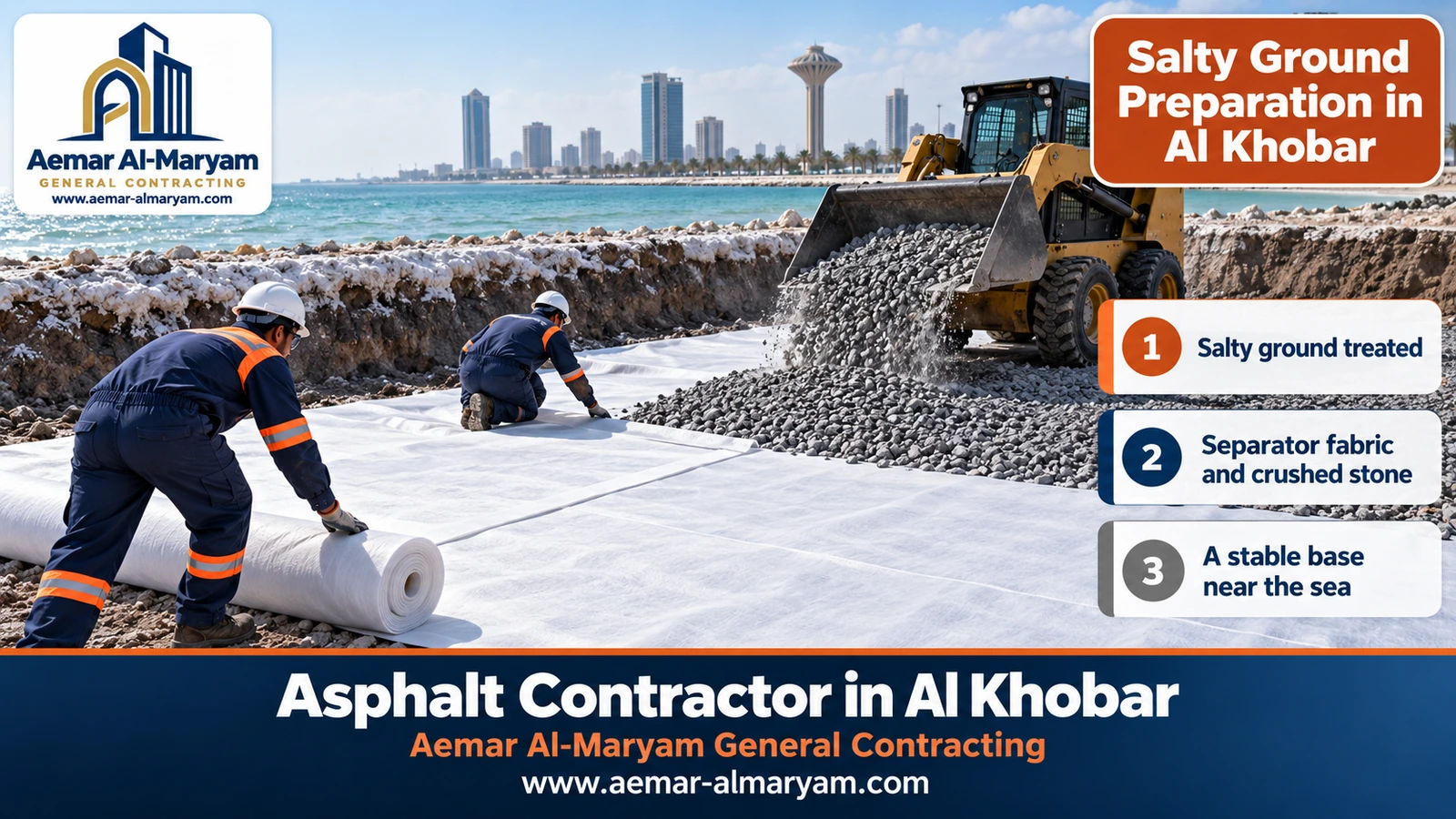
Along the Gulf coast of the Eastern Province, sabkha ground occurs intermittently over long stretches. It is soil that holds together while dry because its salts act as a cement, but loses a large part of its bearing capacity once it is wetted and those salts dissolve. A field plate test reported by KFUPM researchers showed a drop of roughly a third in bearing capacity after leaching in a field plate test. Where saline groundwater lies close to the surface in coastal areas, moisture and salt can also rise by capillary action to just below the asphalt.
We do not claim that any particular Al Khobar district is sabkha; that is decided plot by plot. What we do on every inspection near the coast or on low-lying ground is dig a small test hole, look at the colour and moisture of the soil, note any white crust, and press on the bottom to feel whether it is firm or soft.
Signs that the ground needs replacing before paving
- ✓A white salt crust on the edges of an excavation or on nearby walls close to the ground.
- ✓Dark, damp soil a short way down, even in dry weather.
- ✓A bottom that gives under a boot or under the loader wheel.
- ✓Old asphalt or tiles that have sunk into shallow basins on the same site.
- ✓Water seeping into a test hole a few hours after it is dug.
What geotextile does, and what it does not
Geotextile is a separation layer. It stops the crushed stone and base course from punching down into weak soil, and it stops wet fines from pumping up into the clean layers and contaminating them, so the clean base keeps the thickness it was built to for years. We lay it across the excavation with clear overlaps between strips so no gaps are left. What it cannot do on its own is fix very soft ground; that has to be dug out first, and the fabric and stone then go onto a better bottom.
| Ground condition | What we do before the asphalt | Price |
|---|---|---|
| Dry, firm soil | Level and compact, then about 15 cm of base course | Included in the full system from SAR 74/m² |
| Uncompacted construction fill | Remove debris, compact in layers, then the base | Full system, or after inspection depending on depth |
| Damp soil with a salt crust | Dig out weak soil + geotextile + crushed stone + base | After inspection |
| Soft bottom with water seeping in | Deeper removal, replacement in layers, possibly drainage | After inspection |
Asphalt paving in Al Khobar: the layers from subgrade to surface
Asphalt paving in Al Khobar is a four-layer system, and the asphalt is the last of them: a compacted subgrade, then a base course of graded crushed aggregate, then a prime coat that binds the base to what goes over it, then the hot mix. A shortcut in any one layer shows up in the layer above it.
- 1Subgrade
Compacted to about 95% of maximum dry density at a suitable moisture content, after soft material and debris are removed. - 2Base course
About 15 cm for family cars and car parks and about 23 cm for trucks, built up in compacted lifts of 15 cm at most and brought to roughly 100% density. - 3Prime coat (MC)
Sprayed on the base at roughly 0.65 to 1.75 litres per square metre depending on how porous it is, then left for at least 24 hours. - 4Hot mix
Spread and rolled hot, in lifts of no more than 8 cm; anything thicker goes down in two layers.
These figures come from paving specifications widely used in the Eastern Province and from material data sheets. We use them as a working reference rather than promising a laboratory test on every yard; on large commercial jobs, cores can be taken on request.
Prime coat (MC) and tack coat (RC): which goes where
| Item | Prime coat (MC) | Tack coat (RC) |
|---|---|---|
| Sprayed on | A new granular base course | Old asphalt, between two layers, or on a kerb or concrete face |
| Approximate rate | 0.65–1.75 L/m² | A thin film, up to roughly 0.25 L per square metre |
| Wait before paving | At least 24 hours to soak in | Paved soon after; sprayed again after a 3-day delay |
| Purpose | Closes the pores of the base and ties it to the mix | Stops the new layer slipping on the surface below |
| Trade name in the market | Often “MC1” | Often “RC2” |
On new villa yards we use a prime coat, because there is fresh granular base under the asphalt. On older commercial car parks we use a tack coat, because the new layer goes over existing asphalt. Mixing the two up is one of the most common errors we see in competing quotes.
How thick should asphalt be in Al Khobar?
A family yard or a car park for small cars in Al Khobar needs about five to six centimetres of compacted asphalt over a sound base. Loading yards used by trucks need a total of around twelve to fourteen centimetres, laid in two lifts. The thickness written into the agreement should be the thickness after rolling, because loose mix compacts by about 20 to 25 percent under the roller.
| Site type in Al Khobar | Compacted asphalt | Base course | Lifts |
|---|---|---|---|
| Villa yard and garage driveway | 5 to 6 cm | About 15 cm | One |
| House front strip inside the line | 5 to 6 cm | About 15 cm | One |
| Commercial or residential building car park | 5 to 6 cm (or a new layer over the old) | About 15 cm if new | One or two |
| Truck yard or workshop | About 12 to 14 cm in total | About 23 cm | Two |
The final thickness is set after the inspection, once we know the heaviest vehicle that will use the site. A yard visited by a water tanker every week is a different design from one that only ever sees two small cars.
Car park asphalt in Al Khobar: commercial and residential buildings
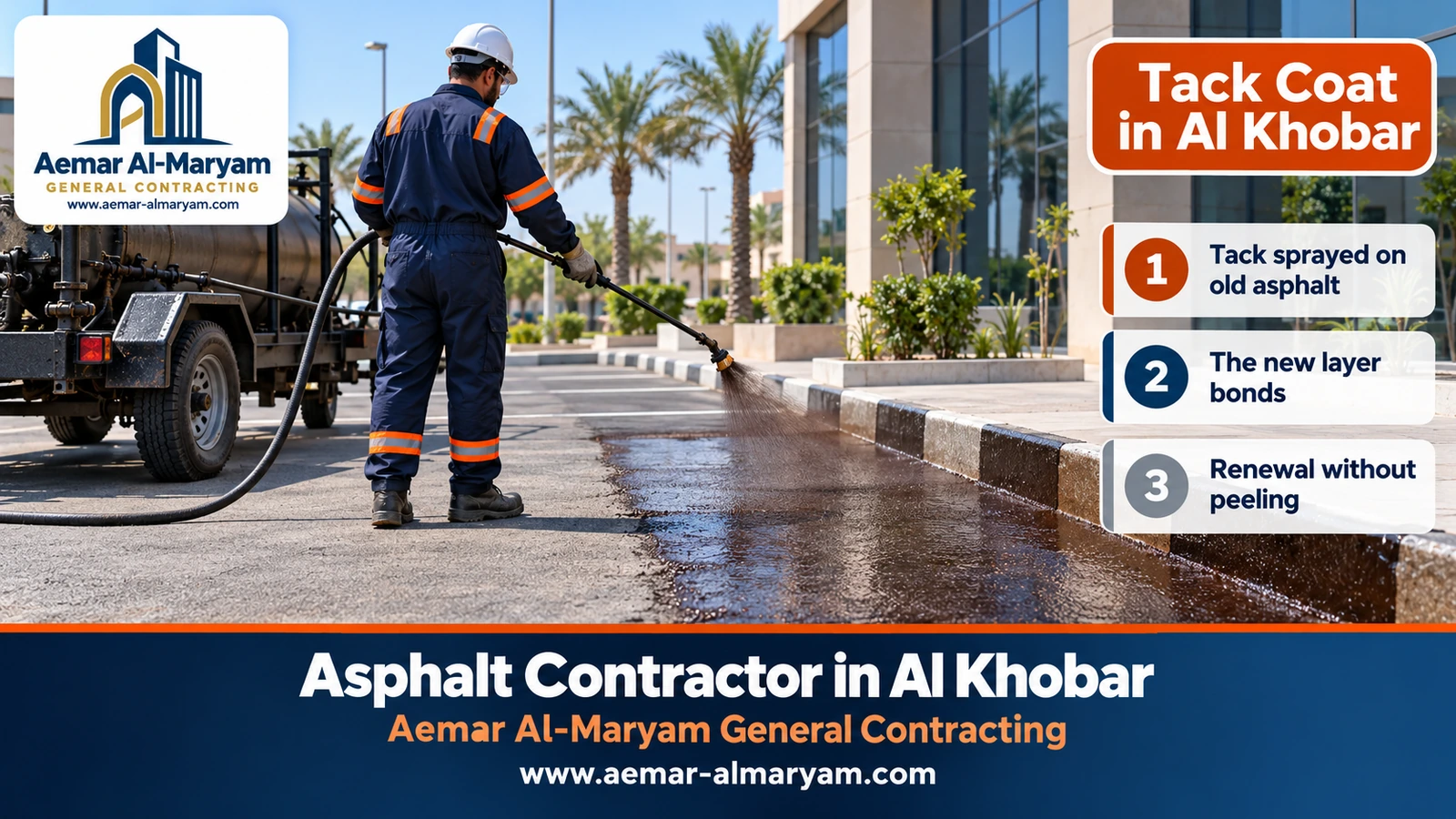
Car park asphalt in Al Khobar on existing commercial buildings usually means a new layer over old asphalt: potholes are filled, raised areas and gully surrounds are milled down, spray a thin tack coat across the whole surface and the adjoining kerb faces, lay about 5 cm of new hot mix and roll it, then mark the bays. Where the old surface has settled because its base has failed, we remove and rebuild those areas.
In districts like Al Thuqbah and Al Olaya, commercial buildings and residential blocks front onto car parks worn down by years of use: branching cracks at the entrances, potholes by the gates, and water standing at the gullies because the asphalt around them has dropped. We do not automatically propose tearing everything out. If the settlement is local and the base is sound across most of the car park, a new layer over the old one saves you the breaking, the debris haulage and days of a closed car park.
Why tack coat is essential over old asphalt
Old asphalt is smooth and dusty, and a new layer will not stick to it on its own. Without tack coat the two layers behave as separate sheets: the top one slides under braking and turning cars and cracks in crescent shapes. So we clean and sweep the surface and spray an even, thin film. Too much is as harmful as too little, because an over-sprayed surface makes the new layer slip. We also coat the faces of the kerbs and concrete gullies that the new asphalt will meet, so the edge bonds to them. If paving is delayed by more than three days, we spray again.
Asphalt milling in Al Khobar before the new layer
Milling is needed when a new layer would push the level above door thresholds, gully covers or the top of the kerb. We mill at the entrances, around the gullies and along the kerbs taking off 3–5 cm or so, so the finished level stays where it was after the new layer goes down. Mill-and-relay is estimated from SAR 38 per square metre. Where we need a straight cut along an asphalt edge for a joint or a new drain, our concrete cutting team in Al Khobar handles the saw work.
Working in a car park that stays open to customers
Most commercial car parks cannot be closed for days. So we split the car park into halves or smaller phases, start with the half farthest from the main entrance, keep a lane open with cones and signs, and finish spraying, paving and rolling in each phase before reopening it. In summer we prefer to start very early, before the heat builds and before the busiest hours, and we agree with the building management on the days when traffic is lightest.
Car park line marking in Al Khobar
Car park line marking in Al Khobar is done after the asphalt has cooled and dried: we mark the rows of bays, the traffic arrows, the pedestrian walkways and the accessible spaces according to the building’s approved layout. Lines are set out with string and tape first, then applied with a line-marking machine so they come out straight and of even width, and arrows and access symbols are painted through stencils.
Accessible spaces go closest to the building entrance. Saudi universal-access guidance asks for the space and the aisle next to it to slope no more than 2 percent in either direction, with the access symbol painted on the surface and a sign mounted at a height of about 2.1 metres or more. Because that slope is flatter than the rest of the car park, we fix the location of these spaces before paving, not after.
The type of paint follows the traffic. Hot-applied thermoplastic lasts longer in busy car parks, while cold paint is quicker and cheaper but needs repainting sooner. Bay dimensions are taken from the building’s approved plan, and we quote after a visit, since line length, symbol count and paint choice drive the cost.
Send the parking layout before the paving
The positions of the gullies and the direction of the falls are designed around the parking layout. If we know it before paving, we can make water run between the rows of bays rather than under the car doors.
Asphalt patching in Al Khobar: potholes and cracks
Asphalt patching in Al Khobar that lasts is done in hot mix: we saw-cut the edges of the pothole in straight lines back to sound asphalt, tack the bottom and sides, then fill and compact from the centre outward with a slight crown. Cold mix is a stopgap for emergencies, estimated from SAR 46 per square metre, and we never pass it off as permanent.
- 1Diagnosis
Is the hole from a worn surface, from a settled base, or from water leaking under a gully or a service line? - 2Drying and cleaning
Water, dust and loose pieces are removed from the hole. - 3Edge cutting
A straight saw cut back to sound asphalt, in a square or rectangle. - 4Spraying
Tack coat on the bottom and the vertical faces. - 5Filling and compaction
Deep holes get hot mix in more than one lift, each pressed down with a plate or small roller. - 6Finishing
A surface slightly proud of its surroundings so it settles flush under traffic, and the area cleaned.
When a pothole keeps returning in the same spot, the cause is almost always below the asphalt: a settled base, a leaking water line, or a gully that no longer drains. In that case we remove the full layer over the damaged area and repair the base; this is called a full-depth repair and is priced after inspection.
Crack sealing
Single longitudinal and transverse cracks are blown clean with compressed air and filled with a hot rubberised sealant that keeps water out of the base. A web of linked cracks, the crocodile-skin pattern, tells you the base has failed, and sealing them alone is not enough. Crack sealing is priced after inspection according to the length involved.
Hot, cold and polymer-modified asphalt in Al Khobar
Hot asphalt is plant mix that is spread and rolled while hot, and it is the choice for paving and for permanent patching. Cold mix is a ready-to-use material for temporary repairs. Polymer-modified asphalt is hot mix with an improved binder that resists rutting under heavy, standing loads in summer heat.
| Mix | Typical Khobar use | Comment | From |
|---|---|---|---|
| Standard hot mix | Villa yards, house fronts, building car parks | Enough for most light use | SAR 37/m² (5 cm) |
| Hot mix at 7 cm | Workshop and truck yards | On an existing base | SAR 41/m² |
| Polymer-modified | Loading bays, bus and truck standing areas | Resists rutting in the heat | SAR 55/m² |
| Cold mix | Temporary emergency patching | Much shorter life | SAR 46/m² |
KFUPM work on the region’s bitumen concluded that polymer modification is needed to meet performance targets in the hot east of the Kingdom, with plain local binder adequate in only a limited part of the Gulf region. Even so, modified mix is not a must for every yard: family cars are well served by standard hot mix, and we suggest the modified option where heavy loads stand still or move slowly.
Hot mix from asphalt plants: do you sell the mix?
People searching for an “asphalt plant in Khobar” or “asphalt supply” usually want hot mix for their own site. We do not sell mix on its own and we do not own a plant; we order it from asphalt plants in the right quantity and grading, receive it, check its temperature, and lay and roll it on your site. Mix without immediate laying and rolling is useless, because it cools within hours.
Falls and drainage: the water test before handover in Al Khobar
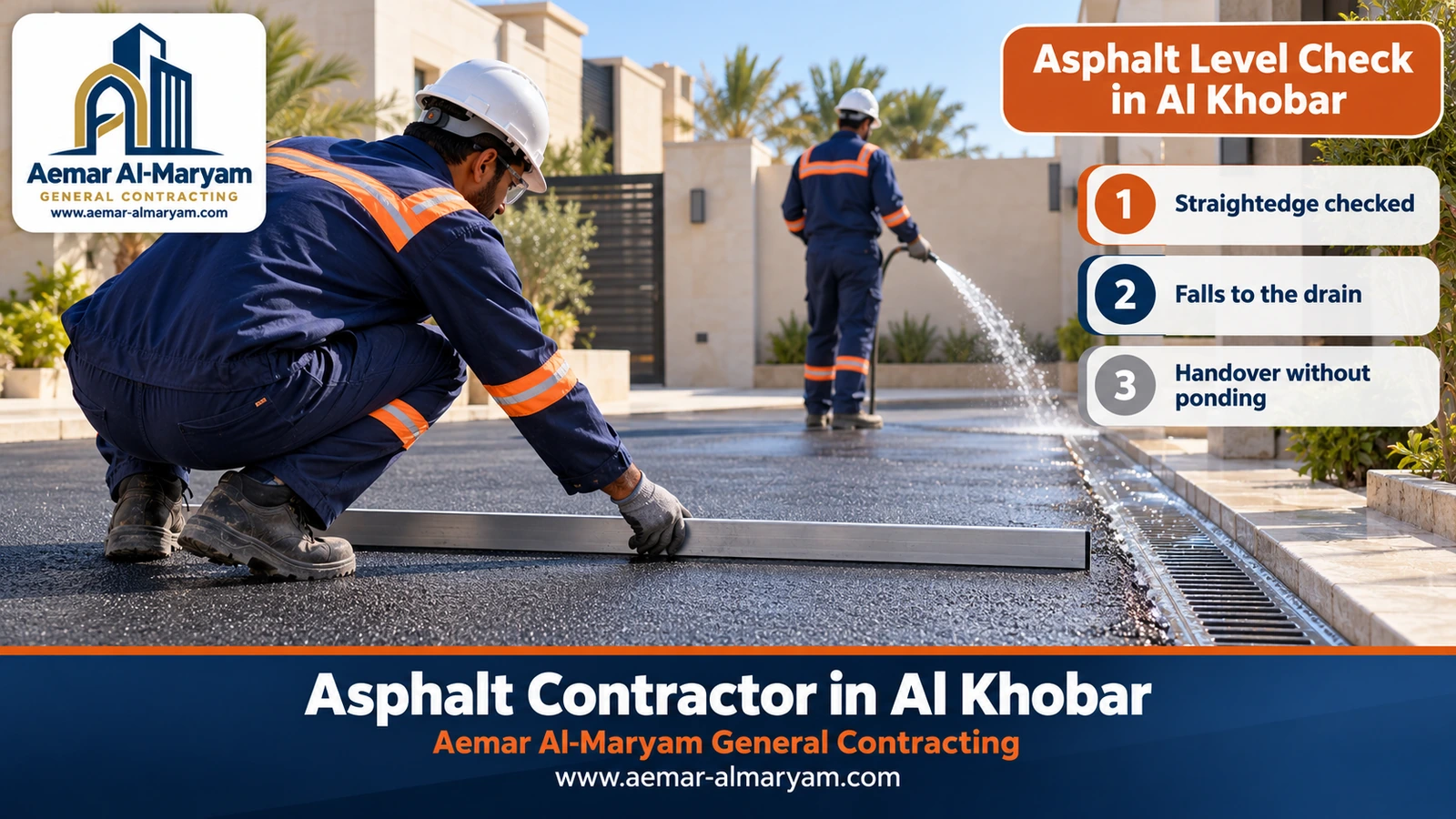
The right fall on asphalt is roughly 1.5 to 3 percent, with car parks at no less than 1.5 percent, running toward a gully, a channel or out of the yard, never toward the walls. We verify it before handover with a long straightedge on the surface and by running water from a hose in front of you, so you can see for yourself where it goes.
In Al Khobar, winter rain is joined by wash water, garden irrigation and AC condensate, and all of it needs somewhere to go. So we take levels with an instrument before the base course and set the falls in the base, because the asphalt follows the shape of what is underneath it. Trying to correct the fall by adding extra mix in the low spots leaves uneven thicknesses and costs more.
The straightedge check: what we look for
We lay a 3 to 4 metre aluminium straightedge in different directions and check for gaps beneath it. A gap of more than a few millimetres means a low spot that will hold water. We pay particular attention to the joints between truck loads and to the edges along the kerbs, which is where defects show up first.
The paving equipment we bring to your site
- ✓Levelling instrument to take levels and set the falls before the base course.
- ✓Loader and tipper to haul debris and spread crushed stone and base material.
- ✓Vibratory roller and plate compactor for the subgrade, the base and the corners.
- ✓Water tanker to bring the base to the right moisture during compaction.
- ✓Towed bitumen tank with a spray lance for prime and tack coats.
- ✓Asphalt paver for yards and car parks it can enter, plus hand tools for narrow ones.
- ✓Steel-drum roller and small double-drum roller for breakdown and finish rolling.
- ✓Milling machine and floor saw for milling and straight edges where needed.
Asphalt or interlock for a Khobar yard?
For the driving line and big open areas, asphalt wins on speed, cost per metre and a joint-free finish. Interlock belongs on walkways, seating areas and garden edges because it offers colours and patterns and can be lifted and relaid for any service work. Combining the two is common in Al Khobar villas.
| Comparison | Asphalt | Interlock | Concrete |
|---|---|---|---|
| Time after preparation | Usually one day for a yard | Days: laid block by block | Pour, then days of curing |
| Look | Seamless black | Colours and patterns | Grey with joints |
| When a pipe must go under it | Cut and patch | Lift blocks and relay | Cut, break and re-pour |
| Surface heat in summer | Gets hotter | Less, depending on colour | Less |
| Needs edging | Preferably | Essential (kerbs) | Usually not |
If you combine them, the sequence matters. The kerbs go in first to set the line between the two areas, then the interlock is laid, then the asphalt is paved with tack coat sprayed on the kerb face. For interlock and kerb details see our interlock and kerbs service, and for tiled seating areas and walkways our tile installer in Al Khobar.
Kerbs around the asphalt
An asphalt edge with nothing to hold it crumbles over time under the wheels, especially where it meets open soil. A kerb or concrete edge restrains the margin and guides water toward the gully. Kerb installation is priced after inspection according to length and type.
Asphalt millings in Al Khobar: when they work and when they do not
Asphalt millings are old asphalt ground up, then spread and compacted. They cost less than new hot mix and suit a farm track, an overflow yard or a temporary parking area, but they look rough, can soften in summer heat and need careful compaction in two lifts, which rules them out for a villa yard or a shopfront in our view. On request we lay them, priced after a visit, but we are not a millings seller.
Asphalt price per square metre in Al Khobar
Asphalt price per square metre in Al Khobar: SAR 37 is the starting rate for 5 cm of hot mix where a base already exists, and SAR 74 is the starting rate where we build everything from the soil up, meaning levelling and compaction, base course, prime coat and then the asphalt. Al Khobar is inside our normal visiting range from Dammam, like Dhahran, so no travel line is added. These starting figures are estimates settled by agreement after the inspection, and they move with the size of the site, the thickness required, the nature of the ground, whether a base already exists, and how easily the machines can get in.
| Item on your site | Unit | Starting price |
|---|---|---|
| Hot mix at 5 cm over an existing base: yard, house front strip, small-car parking | m² | SAR 37 |
| Hot mix at 7 cm over an existing base for truck, workshop and warehouse yards | m² | SAR 41 |
| Soil to surface: levelling and compaction, base course, prime coat, then 5 cm hot mix | m² | SAR 74 |
| Polymer-modified binder for standing loads and heat | m² | SAR 55 |
| Temporary pothole filling with cold mix | m² | SAR 46 |
| Milling 3 to 5 cm of the old surface, then a new layer | m² | SAR 38 |
| Lasting hot-mix patch after cutting edges and tacking | — | After inspection |
| Replacing salty or damp ground with geotextile and crushed stone | — | After inspection |
| Base course on its own, supplied and compacted | — | After inspection |
| Bay lines, traffic arrows and accessible-space symbols | — | After inspection |
| Kerbs along the asphalt edges | — | After inspection |
| Filling cracks with hot rubberised sealant | — | After inspection |
| Millings spread and compacted for farm tracks and overflow yards | — | After inspection |
| Straight saw cuts on asphalt edges at joints and drains | — | After inspection |
Anything shown as “after inspection” waits for our visit before it gets a number; pictures, measurements and vehicle type on WhatsApp 0547879578 normally let us send a rough figure first. Other services and their starting rates are listed on the prices page.
What pushes the price per square metre up or down on your site
- ✓Area: below roughly 100 m² the rate per metre rises, because moving the paver, roller, mix truck and crew is a fixed cost.
- ✓Ground condition: dry soil, construction fill, or salty ground that needs replacing.
- ✓What has to come out: concrete, tiles or old asphalt, and hauling the debris away.
- ✓Thickness and load: family cars, or tankers and trucks.
- ✓Access: whether the paver and tipper can get in, or the job must be hand laid.
- ✓Associated work: kerbs, drainage gullies, line marking and edge cutting.
Worked example: a new villa yard in Al Khobar
Illustrative example: a new villa yard measuring 14 × 9 metres = 126 square metres, with dry bare soil left after the builder has gone. With the full system (levelling and compaction + 15 cm base course + prime coat + 5 cm asphalt): 126 × 74 = SAR 9,324 as a starting estimate. If the builder had left a sound, compacted granular base, paving over it would be: 126 × 37 = SAR 4,662 as a starting estimate.
| Quantity in the example | Calculation | Approximate result |
|---|---|---|
| Hot mix (density about 2.3 t/m³) | 126 × 0.05 × 2.3 | About 14.5 tonnes |
| Compacted base course | 126 × 0.15 | About 18.9 m³ |
| Prime coat at roughly 1 L/m² | 126 × 1 | About 126 litres |
| Cost with the full system | 126 × 74 | SAR 9,324 |
| Cost over an existing base | 126 × 37 | SAR 4,662 |
If the inspection shows that one corner of the yard is damp and salty, replacing that corner with geotextile and crushed stone is added as a separate line after inspection, and the rate for the rest of the yard does not change. The same arithmetic shows why very low quotes deserve suspicion: about 14.5 tonnes of mix for this one yard carry a cost that cannot be skipped, so a price far below it usually means a thinner layer or a base that was never built.
This calculation is for illustration only; the real figure follows the ground condition, the thickness, what has to be removed, the associated work and how easily the machines can reach the site.
Asphalt paving in Al Khobar, step by step
- 1Inspection and measuring
We take dimensions and levels, dig a test hole if needed, and fix the property line and the water outlet. - 2Written agreement
Rolled asphalt thickness, base depth, any soil treatment, inclusions and exclusions, and the start date. - 3Removal and clearing
Debris, old concrete or tiles lifted and hauled away. - 4Subgrade treatment
Subgrade compacted, or weak soil replaced with geotextile and crushed stone. - 5Base course
Spread and compacted in lifts, with the falls set by instrument. - 6Prime or tack
Prime on a new base with at least 24 hours to cure, or a light tack coat on old asphalt. - 7Laying and rolling
Mix received and its temperature checked, laid by paver or by hand, and rolled before it cools. - 8Checks and handover
Long straightedge and a water test in front of you, then the site cleaned and handed over.
Handover checklist: check these before the final payment
- ✓Thickness: measured at the edges, or with a core on larger sites, and matching the agreed compacted figure.
- ✓Water: runs to the gully or out of the yard without collecting in low spots.
- ✓Evenness: no obvious gaps under the long straightedge.
- ✓Edges: straight and well compacted at the wall, the gate and the kerbs.
- ✓Joints: no step up or down between truck loads.
- ✓Surface: no roller marks and no loose stones.
- ✓Gullies and covers: flush with the surface, neither proud nor sunk.
- ✓Cleanliness: no mix or bitumen left on the walls or the gate.
When can you use the yard or car park after paving?
Unlike concrete, hot asphalt needs no water curing: it binds through rolling while hot and can take traffic once it has cooled right through. Rather than quoting one number for every job, we tell you when to reopen based on the day’s heat and the layer depth. Remember too that the prime coat needs its 24 hours before paving, so a full-system yard runs over more than one day. In the first hot days, avoid dry-steering a parked car, do not leave a truck or tanker parked in one spot for long, and do not set crane outriggers or a skip directly on the surface.
Common asphalt mistakes in Al Khobar
- ✓Laying asphalt on soil or construction fill with no compacted base, so it sinks under the wheels within months.
- ✓Ignoring damp and salt on ground near the coast, then seeing basins and cracks after the winter.
- ✓Spraying prime on old asphalt instead of tack coat, or paving over old asphalt with no spray at all.
- ✓Paving before the prime has cured, so the asphalt softens from below and slides.
- ✓A fall toward the wall or the majlis door instead of the gully or the outside.
- ✓Raising the level above the garage threshold with a new layer and no milling.
- ✓Accepting mix that arrived cold because the truck waited too long.
- ✓Paving before drainage, irrigation and power lines are in, then cutting the new asphalt.
- ✓Extending asphalt onto the public pavement without the municipality.
The public street in Al Khobar: what belongs to the municipality
In Al Khobar the municipality owns the job of paving public roads and footpaths; ours stops at your boundary. Under the excavation permits regulation, digging works in streets go through the Balady “Nassiq” coordination service and the projects coordination office of the Amana or local municipality, and excavation permits are issued to utility providers and their approved contractors, not directly to the homeowner.
- ✓Inside your property: the yard, driveway and internal car park need no excavation permit.
- ✓Extending a service from the street: applied for by the utility provider through Balady.
- ✓A hole or sunken patch in a public road: a 940 call or a Balady app report to the municipality.
- ✓Changing the level of the public pavement: only through the municipality.
Asphalt maintenance in Al Khobar and warning signs
Asphalt laid on a good base and kept drained lasts for many years, and how many depends on the base, the drainage and the loads. In Al Khobar it also faces intense summer heat and salty sea air, so a simple check once a year pays off.
■ Single cracks
Sealed early with rubberised sealant before water gets into the base through them.
■ Branching cracks
A sign of a tired base; needs local removal and rebuilding.
■ Rutting at loading points
The mix softened under a standing load in the heat; mill that area and relay in modified mix.
■ Standing water
A low spot or a blocked gully; clean the gully or correct the level.
■ Loose stones
Surface wear over time; a thin new layer after tack coat may be enough.
■ Dip next to a gully
Water leaking under the asphalt; check the gully and its pipework before patching.
If you notice cracks in the house walls or the boundary wall next to the asphalt, that is a different issue that concerns the building itself; read about it under crack repair in Al Khobar, and for renewing the whole house see renovation contractor in Al Khobar.
How to book an asphalt contractor in Al Khobar
Send us on WhatsApp 0547879578 enough to understand your site before the visit, and you get back a rough figure plus a visit time:
- ✓Site photos from several angles, including the gate, thresholds and the pavement edge.
- ✓Dimensions: length and width, or the plot plan.
- ✓Current surface: soil, construction fill, concrete, tiles or old asphalt.
- ✓Vehicles: family cars, customers, or tankers and trucks.
- ✓Water: where it collects and whether there is a gully or channel.
- ✓Damp and salt: a photo of any white crust or wet patch.
- ✓Location pin on the map.
- 1Share the details
Message them on WhatsApp or phone 0547879578. - 2First estimate
We suggest the thickness, the layers and an estimated cost from the starting prices. - 3Inspection
Measurements, levels, a soil check and the property line agreed. - 4Agreement
Written items covering thicknesses, layers and the date. - 5Paving and handover
Preparation, laying and rolling, then a straightedge and water test in front of you, and a clean site.
Why Aemar Al-Maryam for asphalt work in Al Khobar?
■ We start with the ground
Soil, damp and salt are checked before we talk about asphalt.
■ The right spray for each surface
Prime on new base, tack on old asphalt, never confused.
■ Published starting prices
From SAR 37/m², with written items for what the price covers.
■ Checks in front of you
Long straightedge and a water test before handover.
■ Clear boundaries
We work inside your property and tell you what belongs to the municipality.
■ Close by
Al Khobar is inside our normal visiting range from Dammam.
We tie the asphalt into the rest of the yard work when needed: breaking out old concrete, cutting edges and service trenches, and tiling the seating areas and walkways with our tile installer in Al Khobar. Photos of completed work sit on the projects page.
Asphalt work across Al Khobar’s districts and nearby
Our crews reach every part of the city; districts we visit often include:
From Al Khobar we also cover the nearby cities, each with its own page:
| Area | Most requested | Page |
|---|---|---|
| Al Khobar | New villa yards, house fronts, commercial car parks | Al Khobar area |
| Dammam | Yards, car parks and warehouses | Dammam area and the full guide |
| Dhahran | Yards, car parks and private yards | Dhahran area |
| Qatif and Saihat | Yards and house fronts | Qatif area and Saihat |
Pave your Al Khobar yard or car park on a proper base
Send photos, sizes and the vehicle type, and we will suggest the thickness and any ground treatment plus a ballpark cost, and fix a date to see the site.
Pages related to paving your site
Tags