Looking for a tile installer in Al Khobar for a new flat that you want floored in large porcelain, a villa whose roof terrace and courtyard need tiles that can take the sun and the humidity, or a shop you want retiled without shutting the doors during trading hours? Aemar Al-Maryam General Contracting fits ceramic and porcelain in every size up to 120×120, wood-look porcelain in a herringbone pattern, and marble and granite for floors and stairs. We also tile terraces and courtyards to proper falls with movement joints, retile bathrooms together with the waterproofing, and repair hollow-sounding tiles. Our labour rate for ceramic floors begins at SAR 23 per square metre; 60×60 porcelain begins at SAR 32, the longer 60×120 at SAR 37 and marble at SAR 92. Every figure stays an estimate until we have seen the site and settled the scope together. Reach us on 0547879578 by phone or WhatsApp.
Al Khobar is not an inland city when it comes to tiling. Humid Gulf air gets into homes for most of the year, the sun heats villa roofs hard by day before they cool at night, and near the coast the ground often carries salts and moisture close to the surface. None of this shows on handover day. It shows months later: roof tiles lifting into a ridge like a tent, courtyard grout covered in white powder, or a hollow sound under the hall tiles. So in Al Khobar we start by asking where the tile is going, what is underneath it and what it will face, and choose the adhesive, joints and falls on that basis.
At a glance: tiling in Al Khobar with Aemar Al-Maryam
- Modern flats: 60×120 and 120×120 porcelain on a floor checked with a straightedge, wood-look porcelain in herringbone, and skirting cut from the same tile.
- Villas: anti-slip terrace and roof tiles with flexible movement joints, courtyard tiles laid to falls towards the drains, and marble for entrances and stairs.
- Shops: tiling in phases or after closing time by agreement, using a matt porcelain that stands up to foot and trolley traffic.
- Starting rates: ceramic floors at SAR 23 a square metre, walls at 27, 60×60 porcelain at 32, the long 60×120 at 37, the 100×100 and 120×120 sizes at 46, courtyards with their falls at 37, marble and granite at 92, and skirting at SAR 14 a linear metre. All are estimates, fixed after inspection and agreement.
- Maintenance: a limited repair of hollow or broken tiles begins at SAR 92, and polishing marble or tiles at SAR 14 a square metre.
- Contact: 0547879578 by phone or WhatsApp, with pictures, room sizes and the tile you chose.
Tile installer in Al Khobar: flats, villas and shops each need their own method
A tile installer in Al Khobar deals with roughly three kinds of building, and each has different problems. A flat in a modern apartment block calls for precise flatness, because owners usually choose large tiles. A villa calls for care with everything outside the walls: roofs, terraces and courtyards. A shop calls for speed and organisation, because every day closed is money lost for the owner. So we do not offer everyone the same approach. We ask about the building first and then make a proposal.
■ Flats
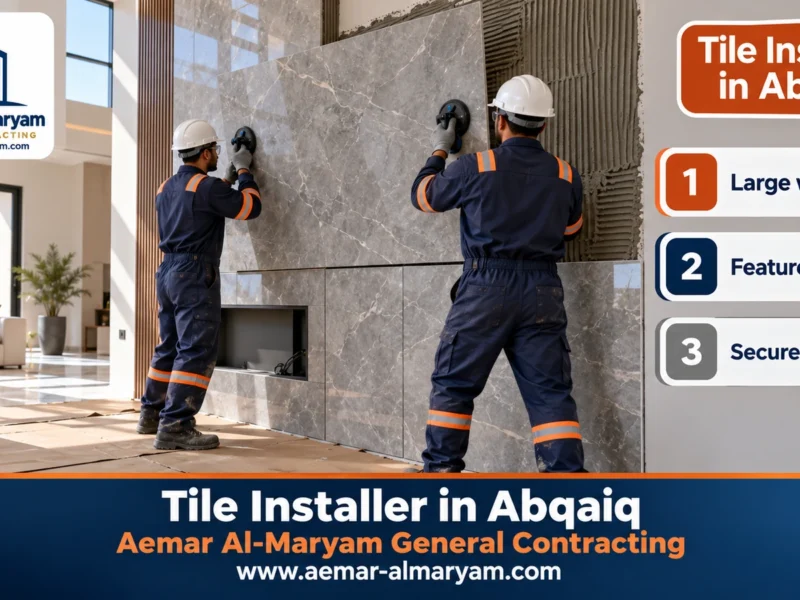
Large porcelain, wood-look patterns, carrying slabs up through the lift and stairwell, and room-by-room work in an occupied flat.
■ Villas
Terraces, roofs and courtyards laid to falls with movement joints, marble for entrances and stairs, and skirting in every room.
■ Shops
Tiling outside opening hours or in phases, matt tiles that take feet and trolleys, and joints near the glass frontage.
■ Repairs
A hollow or cracked tile, failed grout, or a bathroom that needs retiling together with its waterproofing.
Tiler in Al Khobar or a contracting company? What changes for you
A tiler in Al Khobar is a skilled pair of hands that lays tiles; a contracting company carries the job from removing the old floor to handover. The difference shows when trades overlap: a bathroom needs a plumber to reset the drain level before tiling, a roof needs waterproofing tested before tiles cover it, and a shop needs a schedule that fits its trading hours. When the company writes these items down from the start, you do not end up coordinating five people yourself.
If you have already bought the tiles, we simply charge for the fitting, after checking the size, quantity and batches. If we find a shade difference between two batches, we tell you before a single tile is stuck down.
Three questions that reveal a tiler’s experience
What will you use to prove the floor is flat enough for large tiles? Which adhesive will you use on the roof and in the bathroom? Where will you leave the movement joints? A clear answer to those three tells you more about a tiler’s experience than any photos he sends.
Coastal humidity in Al Khobar: what changes in tile installation?
High humidity does not damage the tile itself, because good porcelain absorbs almost no water. What it affects is everything around the tile: the adhesive and how long it takes to cure, the grout, the floor underneath, and the salts that rise from the ground. So in Al Khobar we change some details that others may be relaxed about:
- ✓The right adhesive for the location: in bathrooms, on terraces and in courtyards we specify a C2-class improved cement-based adhesive, and we prefer a deformable S1 adhesive on surfaces exposed to the sun.
- ✓Full coverage behind the tile: we aim for at least 95% contact in wet and outdoor areas, because a void under a tile collects moisture and becomes a weak point.
- ✓Movement joints: on terraces and roofs at intervals of 2.4–3.6 m, plus around each wall and column, because heat expands the tile and moisture expands the bedding.
- ✓Falls: water that sits on tiles in humid air does not evaporate quickly, so it seeps in and leaves its mark. We set falls with a level, not by eye.
- ✓Sand under the tiles: we do not accept salty or clay-laden fill under ground-floor or courtyard tiles.
Salty sand under tiles: why we refuse unwashed fill
The sand laid under ground-floor and courtyard tiles should be clean sand with no clay or salt in it, well compacted and usually 5 to 10 cm deep. In parts of the Eastern Province close to the coast, groundwater is shallow and saline, and moisture can rise by capillary action roughly 75 cm above it, carrying chlorides and sulfates with it. If the sand itself is salty from the outset, you have added a second source to the problem. The familiar result is white patches on the grout, decaying bedding mortar, and tiles that sink in places because the fill was never compacted.
So we ask where the sand comes from, prefer washed sand and compact the fill in layers. If the old floor already shows salts, we treat the moisture source first, because new tiles over a salt-affected floor bring the problem straight back.
Floor levelling before tiling in Al Khobar
Levelling is a step nobody sees once the tiles are down, yet it decides the result of everything above it. We run a 3-metre aluminium straightedge across the floor in several directions and measure the gap beneath it. For tiles with all edges shorter than about 38 cm, a deviation of up to 6 mm in 3 metres is acceptable. Once any edge of the tile is 38 cm or longer, as with 60×60 and 60×120 porcelain, the deviation must not exceed 3 mm in 3 metres. Anything beyond that we correct with a cement levelling screed or a self-levelling compound, depending on the thickness needed. Our levelling rate begins at SAR 14 a square metre; deep fills are assessed on site.
Tile installation in Al Khobar for floors and walls
Tile installation in Al Khobar begins with reference lines that decide where the first tile goes and where the cuts end up. We put the cuts where the eye does not land first when you walk into the room, such as under a sofa or behind a door, and we avoid leaving a thin sliver of tile at the entrance. In halls and majlis rooms we set out the tiles so that their lines meet the main doors squarely, and in long corridors we run the tiles along the corridor so that it looks wider.
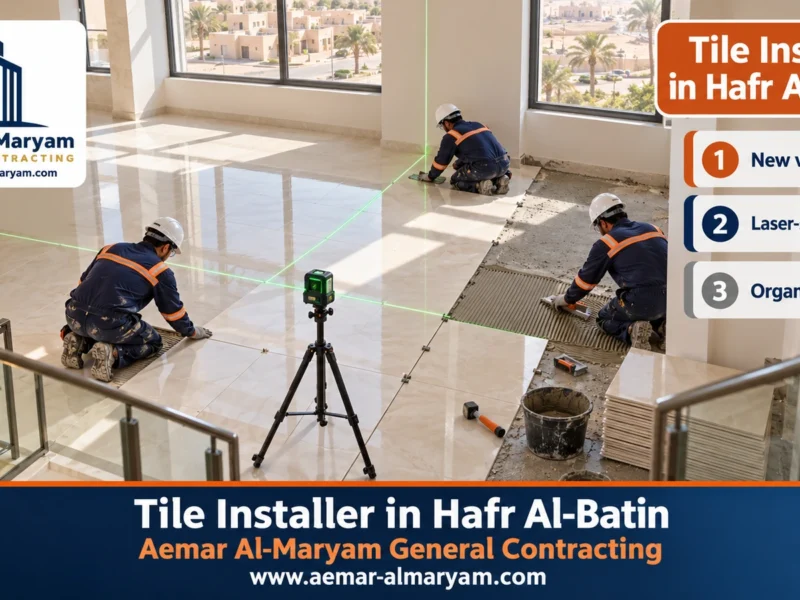
On walls we start from a horizontal laser line, not from the floor, which may fall towards the drain and drag every course with it. Cuts around outlets and sockets are hidden by the cover plates, and the bottom course goes on last so it sits directly on the finished floor.
Ceramic tile installation in Al Khobar for kitchens and walls
Ceramic tile installation in Al Khobar remains the practical choice for walls and kitchens: lighter than porcelain, easier to cut around cabinets and outlets, and fine on dry walls. Behind the hob and sink, which take the most grease and water, we suggest an easy-clean grout. The render must be straight and dry first; correcting an out-of-true wall beats making up the lean with extra adhesive. For anyone renovating a kitchen or needing fresh render, we tie the job in with our plastering team in Al Khobar.
Joints and grout: can tiles be laid with no joints at all?
No. A rectified tile still needs a joint. The technical rule ties the joint to the tiles: it must equal or exceed three times the actual size spread across the delivered batch, which in practice works out at roughly 3 mm on rectified tiles and around 5 mm on standard pressed ones, widened further on long planks by however much the long edge bows. A joint narrower than it should be leaves uneven edges and gives the grout nothing to grip, so it cracks.
Porcelain installation in Al Khobar’s modern flats
Porcelain installation in Al Khobar is the most requested job in new flats and villas, because porcelain absorbs no more than 0.5% water. That lets it cope with bathrooms, kitchens and busy corridors and keep its colour and surface for years. But the same density makes it harder to cut and fix. It does not bond to traditional sand-cement mortar the way ceramic does, so it needs an improved adhesive and a flat substrate.
We lay porcelain on a bed of adhesive combed out with the notched trowel that suits the tile size, and on large formats we also butter the back of the tile itself to achieve full coverage. Then we tap it down with a rubber mallet and use a levelling clip system between slabs, which stops the edges drifting out of line while the adhesive cures.
Large-format porcelain in Al Khobar: 60×120, 100×100 and 120×120
Large-format porcelain in Al Khobar gives a flat a sense of space with very few joints, but it is unforgiving. A large slab needs two people, a suction frame, a floor within 3 mm in 3 metres and adhesive across its whole back. In apartment blocks, ask before buying whether the slab fits the entrance, the lift and the stairwell: a 120×120 slab may not fit a small lift, so the crew carries it up the stairs, adding time and cost. Send us a photo of the lift and its door size first.
Fitting 60×120 begins at SAR 37 a square metre and the 100×100 and 120×120 sizes at SAR 46. Anything with an edge beyond 120 cm we price after a site visit, since it needs a bigger crew and special lifting gear.
Wood-look porcelain in a herringbone pattern in Al Khobar
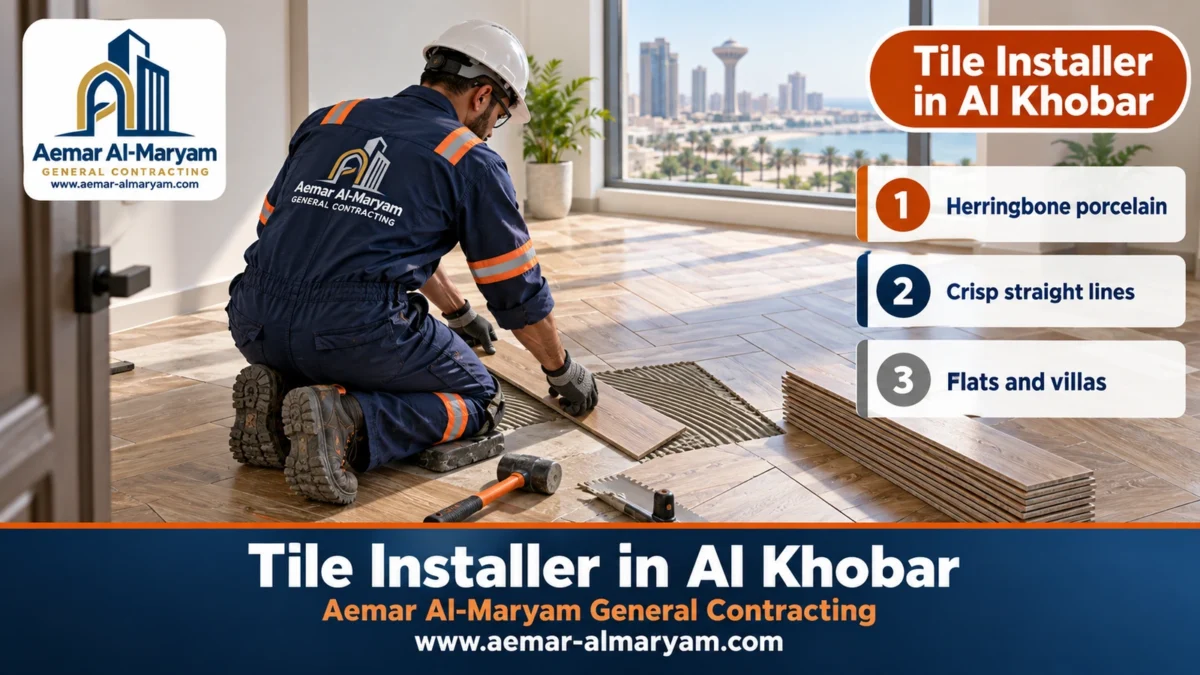
Wood-look porcelain laid in herringbone has become a favourite in the halls of new flats in Al Khobar, because it gives the look of parquet without any worry about water or humidity. The tiles are long and narrow, which makes them prone to a slight bow along their length. Lay them with a half-tile offset, like brickwork, and the edges will not line up. That is why the standards say the offset should not exceed one third of the tile length for tiles with any side longer than about 38 cm, unless the manufacturer specifies otherwise, and that the joint should be widened by the amount of bow along the long edge.
For herringbone we snap a laser centre line down the hall and build the pattern outwards, so the cuts finish symmetrically at both walls. We sort the planks to set aside any with a visible bow and clip every junction. The pattern takes longer and produces more cuts than straight lay, so it is priced after inspection, and we calculate the quantity with waste before you buy.
Never lay big slabs on an unchecked floor
Large porcelain or long wood-look planks laid over a wavy floor give raised edges you trip on and hollow tiles in the middle, and the only fix is to lift the floor and do it again. Checking flatness and levelling before you start costs far less than doing the job twice.
Ceramic vs porcelain vs marble in Al Khobar’s climate
Ceramic is lighter, cheaper and easier to cut, and it is enough for walls and dry rooms. Porcelain is denser and absorbs less water, which suits bathrooms, kitchens, roofs and courtyards. Marble is a handsome natural stone, yet acids attack it and it needs looking after. Granite is a harder stone that copes with entrances and kitchens. This table sums up the choice by location:
| Comparison | Ceramic | Porcelain | Marble | Granite |
|---|---|---|---|---|
| Water absorption | Relatively higher | No more than 0.5% | Porous, needs protection | Low |
| Best place in Al Khobar | Walls and dry rooms | Bathrooms, terraces, courtyards and halls | Halls, indoor entrances and stairs | Entrances, kitchens and outdoor steps |
| With acids and cleaners | Good | Good | Reacts and loses its shine | Good in most cases |
| Suitable adhesive | Standard adhesive or mortar | Improved C2 adhesive | White or rapid-set, depending on the stone | Improved adhesive |
| Fitting rate | SAR 23 a m² and up | SAR 32 a m² and up (60×60) | SAR 92 a m² and up | SAR 92 a m² and up |
Terraces and bathrooms call for a matt or slip-resistant finish. On level indoor floors that get wet, the US standard sets a minimum wet DCOF (dynamic coefficient of friction) of 0.42, so check that value with the seller before buying.
Tile adhesive in a humid climate: what do C2TE and S1 mean?
The letters printed on an adhesive bag are not decoration. C means cementitious. Class 1 is a standard adhesive that must reach 0.5 N/mm² in bond strength; class 2 is the improved grade that must reach 1 N/mm². T means the tile will not slip down a wall by more than 0.5 mm. E stands for an open time stretched to 30 minutes or more, which helps in hot weather when the adhesive surface skins over quickly. S1 means a deformable adhesive that tolerates a little movement, which is exactly what we want on roofs and terraces that expand in the sun.
Coverage behind the tile sometimes matters more than the adhesive type. It should be at least 80% in dry rooms and at least 95% in bathrooms and outdoor areas, with corners and edges fully supported. Spot-bonding with dabs of mortar, a method some still use, leaves voids under the tile that turn over time into a hollow sound and then a crack.
Shop floor tiling in Al Khobar outside trading hours
Shop floor tiling in Al Khobar works differently from homes. The owner does not want to close for a week, the floor will carry heavy foot traffic and stock trolleys, and the glass frontage lets sun onto part of the floor, heating it more than the rest. So we plan the work around the business. Either we tile an empty unit before it opens, which is the easiest case, or we work in phases in a trading shop: we tile one section after closing, let it cure and protect it, then move on to the next.
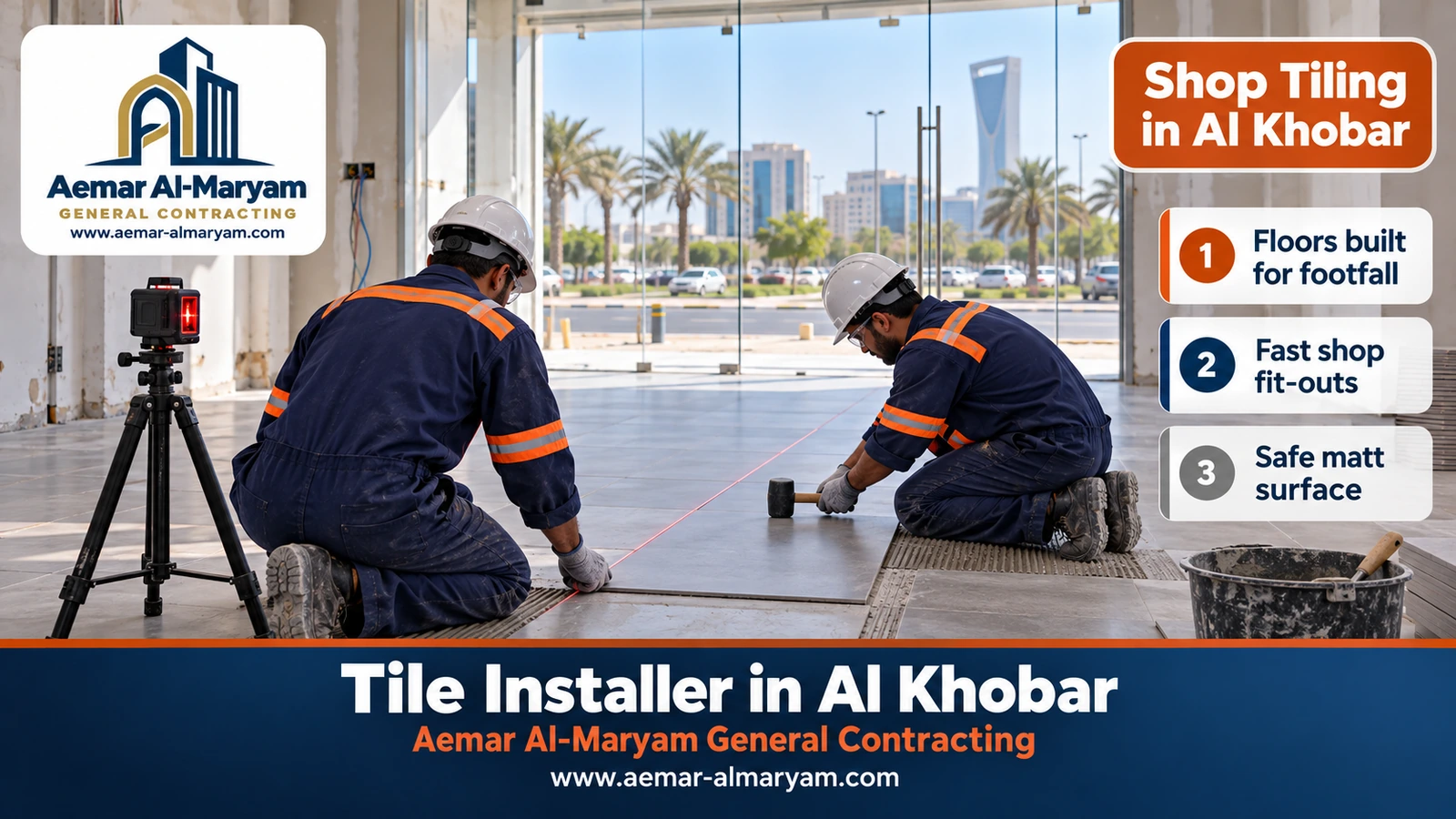
- ✓Out-of-hours work: we agree with the owner on working after closing or on days off, and we respect whatever hours and noise limits the building or shopping centre allows.
- ✓Phasing: we map the customer route and tile the back area first and then the front, or the other way round, depending on where the entrance and stockroom are.
- ✓Tile choice: matt porcelain in 60×60 or 60×120 that handles traffic and does not turn slippery when mopped.
- ✓Movement joints: on large interior floors, a movement joint roughly every 7.6 metres in each direction, closing to about 3.6 metres in the strip that gets direct sun through the glass frontage.
- ✓Protection after tiling: we cover the new tiles and keep trolleys off them until the time stated on the adhesive data sheet has passed.
Replacing a shop floor is maintenance work, but removing walls, opening frontages or changing the layout needs an engineering office and permits; we arrange that with our demolition contractor in Al Khobar or our concrete cutting team in Al Khobar when needed.
Terrace and roof tiling in Al Khobar: sun and movement joints
A villa roof and terrace in Al Khobar face the harshest conditions any tile meets: direct sun all day, humidity at night, rain that is rare but sudden, and AC condensate dripping in the same spots. Outdoor tiles here expand and contract every single day. If they have nowhere to move, they push against their neighbours until a whole row lifts into a tent, or they part from the adhesive and turn hollow.
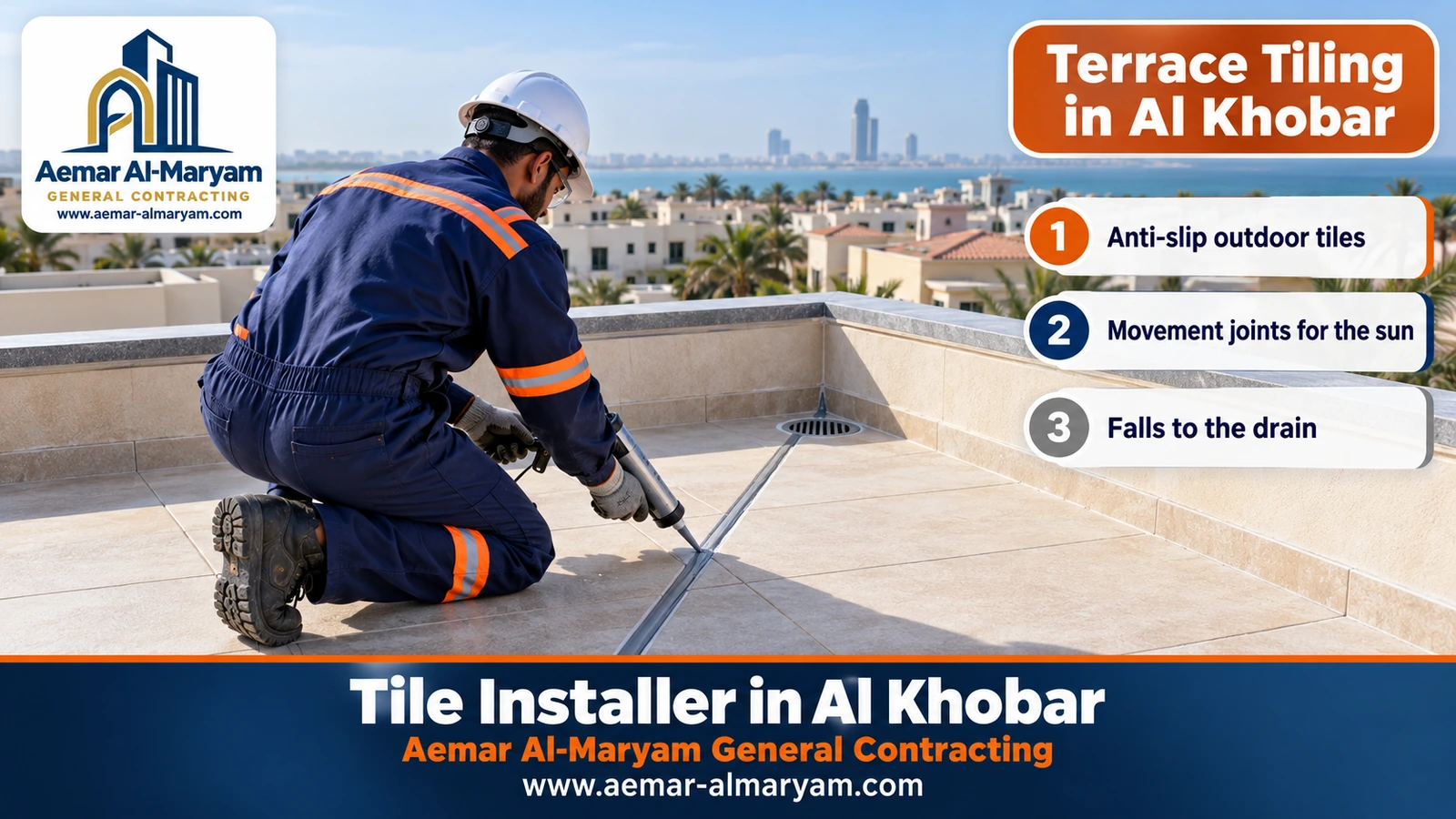
So on terraces and roofs we work to these rules:
- 1Check the waterproofing first
Roof tiles sit on top of the waterproofing layer, and if it has failed the tiles will trap water beneath them. We flood-test the waterproofing for 24 to 48 hours before tiling, and arrange a new membrane with our roof waterproofing team in Al Khobar if needed. - 2The falls screed
Roof falls of 1.5% to 3% towards the drains, which is 1.5 to 3 cm per metre, so water does not sit on the tiles and press on the waterproofing. - 3Movement joints
A joint every 2.4 to 3.6 metres in both directions, plus perimeter joints at every wall, parapet, column and AC plinth, filled with a flexible sealant rather than cement grout. - 4Flexible adhesive and full coverage
An improved deformable adhesive of at least class S1, with back-buttering so coverage exceeds 95%. - 5Matt outdoor tiles
An anti-slip surface in a light colour that absorbs less heat than dark tones.
Anti-slip tiles for terraces and entrances in Al Khobar
Morning humidity in Al Khobar leaves a film of dew on outdoor tiles, turning a glossy tile into a hazard at entrances, on terraces and around pools. Outdoors we suggest a matt or textured tile with slip-resistance data from the supplier, and we avoid polished marble at outside entrances. Pool tiling has its own materials and method, covered on our pools and fountains service page.
Courtyard tiles in Al Khobar
Courtyard tiles in Al Khobar bring everything above together: sun, humidity, ground that may carry salts, daily wash-down water and sometimes a car driving in and out. A good courtyard starts with a sound base: clean compacted fill, then a concrete slab or a level cement screed laid to a 1–2% fall towards the gullies or the street gate, then outdoor tiles in an improved adhesive, with movement joints at 2.4–3.6 m centres and perimeter joints against walls and planters.
For courtyards we choose outdoor porcelain or a natural stone such as granite with a non-glossy surface. If the courtyard doubles as a driveway, ordinary tiles may not hold up, and we suggest interlocking pavers along the car track instead; details are on our interlock and kerbs service page. Courtyard and walkway tiling, falls included, begins at SAR 37 a square metre, while base repairs or salt treatment are priced at inspection.
Replacing and repairing courtyard tiles in Al Khobar
If the courtyard tiles are cracked in a few scattered spots only, replacing the damaged pieces may be enough once the cause is found. Has the fill settled beneath them? Is there a leaking pipe running underneath? Are there tree roots nearby? But if water ponds in the courtyard, if salts show over a wide area, or if the tiles sound hollow everywhere, the answer is usually to lift the tiles and rebuild the base to the right falls. Stripping the old courtyard tiles and mortar costs from SAR 14 a square metre.
Do not tile over visible salts
White patches on courtyard tiles or at the base of walls are a sign of moisture rising from the ground. New tiles laid over them without treating the source bring the problem back within months, and can make it worse because they trap the moisture. Stop the water source, treat the floor, then tile.
Bathroom retiling in Al Khobar
Bathroom retiling in Al Khobar is not simply a matter of pulling tiles off and putting new ones on, because what lies under a bathroom floor is what protects the floor below, or the ground, from water. If the bathroom is old, the waterproofing under it has probably reached the end of its life and the pipes need checking. So we treat a bathroom tile change as a complete job. A small bathroom done completely, with break-out, a new membrane and economy tiles, begins at SAR 2,300; if you only need the floor and walls tiled, the rate begins at SAR 36 a square metre.
- 1Isolate and protect
We shut off the water, remove the sanitary ware and protect the corridor and neighbouring rooms from dust. - 2Strip back to the substrate
We take off the old tiles and mortar until bare concrete or block shows, clearing rubble daily. - 3Inspect the pipework
We check the supply and drain pipes and coordinate with our plumber in Al Khobar to fix any leak or reset the floor drain level before anything is closed up. - 4The falls screed
The shower floor falls 2% towards the drain, which is 2 cm per metre, and the rest of the bathroom a gentle 0.5% to 1%. - 5Waterproofing
A membrane over the whole floor that rises up the walls, and higher still in the shower, followed by a 24 to 48-hour flood test. - 6Tiling and grouting
Improved C2 adhesive with at least 95% coverage, full grout joints, and silicone around fittings and in the corners.
Can bathroom tiles be changed without breaking them out?
Only in limited cases: the old tiles must be fully bonded, the bathroom leak-free, and the floor able to rise a few centimetres without riding above the threshold or reversing the fall to the drain. Where the real reason for the change is a leak or damp in the next wall, tiling over hides the problem instead of solving it. For complete bathroom refurbishment see our bathroom and kitchen renovation service.
Skirting in Al Khobar: a finishing touch that hides an important joint
Skirting is the strip that covers the bottom of the wall above the tiles. Its look matters, but its technical job matters more: it hides the perimeter gap that must be left between the tiles and the wall so the floor can move without pushing against the wall. Tiles butted tight to the wall with no gap are among the first to lift when they expand.
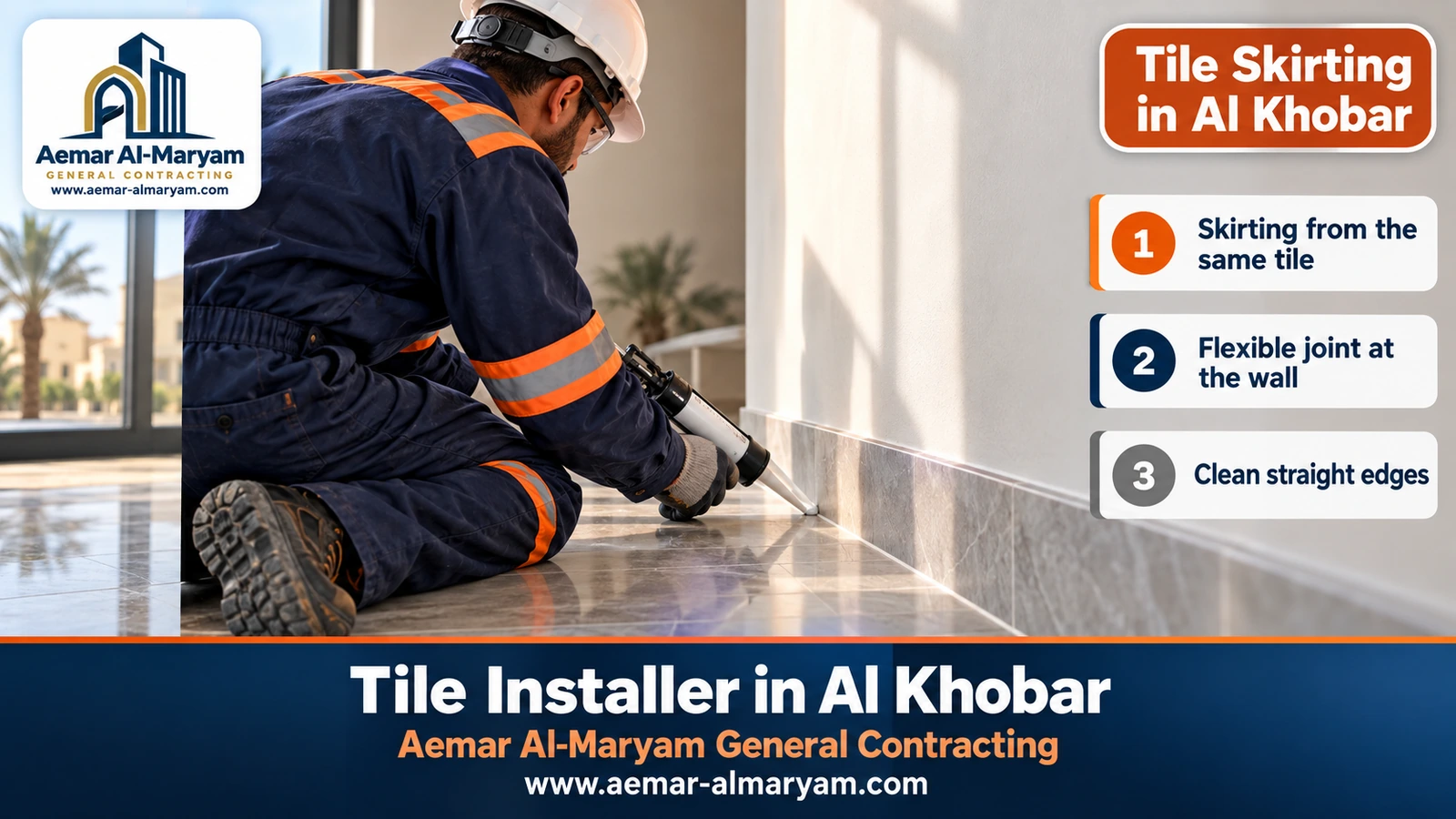
We usually cut the skirting from the same tile so the colour and pattern match, we polish its top edge, fix it with adhesive onto a straight wall, and leave a thin gap between it and the floor that is filled with silicone, not cement. Fitting skirting begins at SAR 14 a linear metre. If you plan gypsum features or light partitions, arrange them before the skirting with our gypsum board team in Al Khobar, and paint comes last with our painting contractor in Al Khobar.
Marble installation in Al Khobar
Marble installation in Al Khobar differs from porcelain in two ways: marble is a natural stone whose thickness and colour vary from slab to slab, and some types are sensitive to water and acids. So before fixing anything we dry-lay the slabs and arrange them by vein and shade, so the darker pieces do not all gather in one corner and the lighter ones in another.
The adhesive follows the stone. Pale and white marble goes down in white adhesive, otherwise grey can ghost through. Certain green and white marbles warp or discolour on contact with water-based setting products, so they need a rapid-setting or reaction-resin adhesive, and we confirm the stone’s sensitivity with the supplier before you buy. Marble or granite floors begin at SAR 92 a square metre for fitting.
Marble in an Al Khobar kitchen or bathroom
Marble reacts with lemon, vinegar and some cleaners, losing its shine where they touch it, and a surface sealer reduces staining but does not stop this etching. So we suggest granite or porcelain for kitchen worktops and bathroom floors, and keep marble for halls, indoor entrances and stairs.
Granite installation in Al Khobar for entrances and outdoor steps
Granite is harder than marble and is not affected by weak acids, so it suits villa entrances, outdoor steps, door thresholds and kitchen worktops. At outdoor entrances in Al Khobar we choose granite with a honed or flamed finish so it does not turn slippery with dew, and we leave movement joints just as with outdoor tiles. Granite kitchen worktops are made to measure and priced at inspection.
Marble stairs in Al Khobar
When we clad an existing concrete stair in marble, we allow for the thickness of the marble and its bedding on both treads and risers, because adding thickness only to the middle steps makes the first or last step taller or shorter than the rest. The rule for residential stairs is a riser no higher than 20 cm, a tread no shallower than 25 cm, and no more than about 9.5 mm variation between steps within a flight. On outdoor stairs we suggest a grooved front edge or an anti-slip strip. Cladding a stair begins at SAR 46 per square metre of step surface; the stone itself is priced by the type you pick.
Stone and marble facade cladding in Al Khobar
A stone facade in a coastal city needs mechanical fixing, not adhesive alone: brackets, angles and anchors in stainless steel, with an air gap behind the stone. Large stones held by mortar alone can fall if the bond weakens with humidity and heat, and they can also stain from moisture in the mortar. Facade cladding is priced at inspection according to the stone, the height of the facade and the fixing method. If the facade needs repair before cladding, we arrange it with our renovation contractor in Al Khobar.
Marble polishing in Al Khobar and tile polishing
Marble polishing in Al Khobar brings back a flat, glossy surface after traffic, cleaners and sand from shoes have dulled it. Real polishing is grinding with diamond pads in stages, not a product wiped over the top: we start coarse, at roughly 50 to 200 grit, to remove lippage between slabs and deep scratches; then medium at 400 to 800; then fine at 1500 to 3000 until the shine appears, with water at every stage. After that, pores and joints get a colour-matched filler and the floor receives a protective finish.
- ✓Acid marks on marble: they do not come off with cleaners; they are polished out in place.
- ✓Marble at entrances: needs polishing more often than elsewhere because of the sand carried in from outside, so put a good mat at the door.
- ✓Tiles and porcelain: can also be machine-cleaned to remove stains and dirty grout, but factory-polished porcelain cannot be re-polished the way marble can.
Polishing marble or tiles costs from SAR 14 a square metre on ordinary areas, falling to SAR 9 for jobs of 200 m² and above, consumables included.
Polishing or crystallisation?
Crystallisation is a final shine treatment applied after polishing, not a substitute for it. If the marble has lippage between slabs or clear scratches, putting crystallisation straight on gives a temporary shine over an uneven surface. The right order is diamond polishing first, then the shine.
Hollow tile repair in Al Khobar
Hollow tile repair in Al Khobar starts with finding the cause before replacing anything. A tile that sounds hollow underfoot is a tile whose back never bonded properly to what is beneath it. The usual causes are adhesive laid in scattered dabs, adhesive left open until a skin formed before the tile was placed, dusty tile backs or floors, sand fill that was never compacted and has settled, or missing movement joints so the tiles pushed against each other.
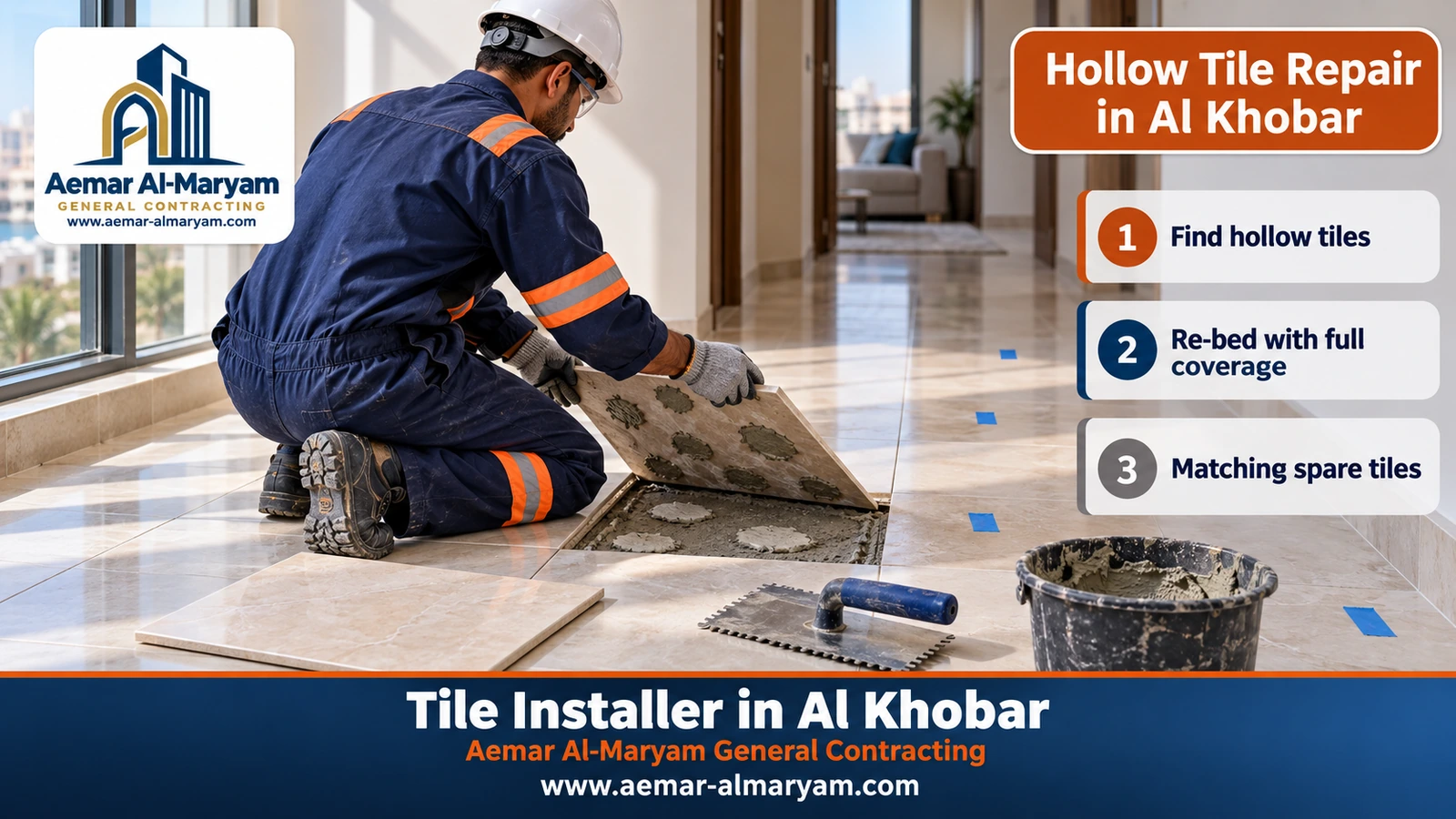
We tap-test the whole floor and mark the hollow tiles. If only a few pieces are affected, we cut out the grout around them and lift them without breaking their neighbours, clean the old adhesive off the floor and the tile back, then re-bed them in fresh adhesive with full coverage. That is why we always recommend keeping a spare box of the same tile after installation, because finding the same shade and batch years later is hard. A small repair to broken or hollow tiles begins at SAR 92. If most of the floor sounds hollow, relaying it fully is better value than patching.
Tiling over old tiles in Al Khobar
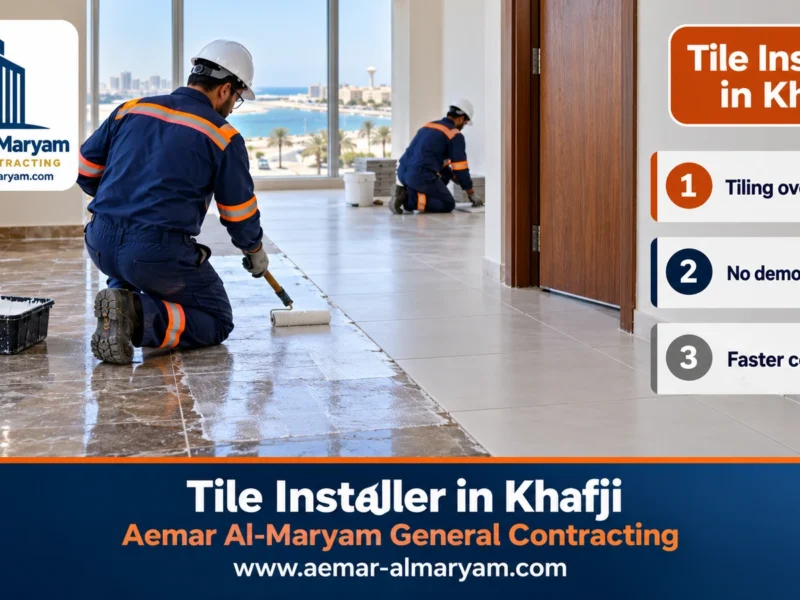
Tiling over old tiles in Al Khobar is possible in dry rooms if the old tiles are fully bonded, clean and abraded or primed, with a suitable improved adhesive. But the floor rises, so doors need trimming and thresholds show a step, and any problem under the old tiles is covered up. We do not recommend it over damp or salts.
Common tiling defects in Al Khobar homes and their causes
Most tiling defects have a known cause that can be avoided from the start. This table gathers what we see when inspecting flats and villas:
| Defect | Likely cause | Fix |
|---|---|---|
| Hollow sound | Spot-bonding or skinned adhesive, dust, uncompacted fill | Lift, clean and re-bed with full coverage |
| Tiles lifting into a tent | No movement joints, combined with heat from the sun | Open up movement joints and re-bed the raised tiles |
| Lippage (uneven edges) | Floor out of flat, bowed long tiles, joints too tight | Level to 3 mm in 3 m and size joints to the tile |
| Cracked tiles | Void under the tile, fill settlement, a crack in the slab | Replace the piece and treat what is beneath it |
| Ponding water | Wrong falls or a drain set too high | Rebuild the falls screed at 1% to 2% |
| White salts on grout | Ground moisture carrying salts upwards | Stop the water source, then clean |
| Grey patches in white marble | Grey or water-based adhesive on sensitive marble | White, rapid-set or resin adhesive |
If a crack runs in a single line across several tiles, the problem is usually in the concrete beneath rather than in the tiles, and the crack must be treated first through our crack repair service in Al Khobar.
Tile installation prices in Al Khobar
We charge Al Khobar the same rates as Dammam and Dhahran, since the city sits inside our daily working area. Treat the table as estimates until inspection and agreement: tile size and type, the state of the floor, the size of the job, the storey and site access all move the figure. The last column spells out what each rate covers:
| Work in Al Khobar | Starting rate | Charged per | What the rate covers |
|---|---|---|---|
| Ceramic on floors | SAR 23 | square metre | Fitting only |
| Ceramic on walls | SAR 27 | square metre | Fitting only |
| Porcelain 60×60 and smaller | SAR 32 | square metre | Fitting only |
| Long porcelain 60×120 | SAR 37 | square metre | Fitting only |
| Porcelain 100×100 and 120×120 | SAR 46 | square metre | Fitting; edges over 120 cm after a visit |
| Tiling a bathroom (floor plus walls) | SAR 36 | square metre | Fitting only |
| Economy tiles supplied, fixed and fitted | SAR 37 | square metre | Economy tiles and adhesive included |
| Courtyards and outside paths with falls | SAR 37 | square metre | Fitting only |
| Marble or granite floors | SAR 92 | square metre | Fitting only |
| Stairs in tile or marble | SAR 46 | square metre of step surface | Fitting; stair stone as you choose |
| Skirting | SAR 14 | linear metre | Fitting only |
| Screed to level the floor | SAR 14 | square metre | Thick build-ups priced on site |
| Stripping old tiles and bedding | SAR 14 | square metre | Long-distance debris haulage extra |
| Fixing hollow or cracked tiles | SAR 92 | small job | Priced by how many tiles |
| Polishing marble or tiles | SAR 14 | square metre | Consumables included |
| Polishing large areas of 200 m² and up | SAR 9 | square metre | Consumables included |
| Complete small bathroom with break-out and membrane | SAR 2,300 | bathroom | Economy tiles included |
| Stone or marble facades | After a site visit | — | Stone type and fixing method |
| Granite kitchen worktops | After a site visit | — | Size and stone type |
| Herringbone, diagonal and other complex layouts are priced after a site visit. Where a line shows no figure, WhatsApp 0547879578 with photos, dimensions and your chosen tile and we will reply with an estimate. | |||
You will find the prices of our other services on our prices page.
What is a tiler’s rate per square metre in Al Khobar?
Tilers in Al Khobar charge by the square metre. Our lowest rate is SAR 23 for ceramic floors, while walls come in at SAR 27 and porcelain of 60×60 or smaller at SAR 32. The rate climbs with large formats, which need two people, a flatter floor and a levelling system; with complex patterns such as herringbone, because cutting and waste increase; with small, cut-heavy areas such as bathrooms; and on upper floors where large slabs will not fit in the lift.
Are the tiles included in the tiler’s rate?
Mostly no. A quoted rate per metre normally pays for the fitter’s work, while tiles, adhesive, grout, screeding and stripping the old floor are separate items. Our table therefore says what each rate covers, and we have an all-in line with economy materials and adhesive from SAR 37 per metre for anyone who wants the complete job without shopping for materials. Buying your own? We tell you the quantity, waste included, before you visit the showroom.
How is the tiled area measured?
Floors are calculated as length times width for each room. Walls are the room perimeter times the tiling height, less doors and large windows. Skirting is measured in linear metres around the room perimeter, less door openings. Stairs are measured by the surface area of the steps. When buying, we add a waste allowance that is higher for small rooms and diagonal patterns.
Worked example: a 6 × 9 m villa roof terrace in Al Khobar
This is an illustrative example of the labour for a villa roof terrace whose cracked old tiles are lifted and replaced with anti-slip outdoor tiles laid to falls:
- ✓Terrace area: 6 × 9 = 54 m².
- ✓Removing old tiles with bedding: 54 m² × SAR 14 = SAR 756.
- ✓Outdoor tiling with falls: 54 m² × SAR 37 = SAR 1,998.
- ✓Skirting along the walls: perimeter (6 + 9) × 2 = 30 m, less the 1 m stair door = 29 m × SAR 14 = SAR 406.
- ✓Estimated labour total: 756 + 1,998 + 406 = SAR 3,160.
The example excludes the tiles and materials, any new waterproofing if the flood test shows the old membrane has failed, and salt treatment. The final figure is fixed after inspection.
Tiling in Al Khobar step by step: your first message through to handover
This is how a job usually runs with us in Al Khobar, whether it is one room or a whole villa:
- 1Pictures and sizes
WhatsApp us pictures of the area with its dimensions and your chosen tile, and we reply with a first estimate. - 2Inspection
We visit, check flatness with a straightedge, tap the existing tiles, measure the falls and ask about damp, salts and waterproofing. - 3Written agreement
We list in writing what the rate includes, who supplies tiles and materials, the number of days, and the order of work with the plumber, electrician and waterproofing crew. - 4Preparation
Break-out if needed, then levelling and falls, then waterproofing and its water test in bathrooms and on roofs. - 5Installation
Laser reference lines, the right adhesive with full coverage, levelling clips and movement joints in their places. - 6Grouting and cleaning
After the time stated on the adhesive data sheet, followed by silicone around fittings and in the flexible joints. - 7Handover
We check the tiles with you item by item and hand over the spare tiles.
Tile handover: a simple checklist
Before you sign off the work, check for yourself:
- ✓Run a straightedge or long rule across the floor in more than one direction and feel the edges with your hand: no tile should stand clearly above its neighbour.
- ✓Tap the tiles lightly with a screwdriver handle and listen for any spot where the sound turns hollow.
- ✓Pour water in the bathroom, on the terrace and in the courtyard and watch it run to the drain without sitting in a corner.
- ✓Make sure the joints are straight and even and the grout is full and clean.
- ✓Check there is a flexible joint at the walls under the skirting and around fittings.
- ✓On light marble, look for any grey patches.
- ✓Take a stock of spare tiles from the same batch and keep it.
Tiling time in Al Khobar and when the floor can take foot traffic
An average room usually takes a day to lay, a large hall two or three days, and a full bathroom longer because the waterproofing is tested first. When you can walk on the tiles or grout them depends on the adhesive, normal-set or rapid-set, and we follow its data sheet rather than guessing. You get the full schedule before we start.
Tiling within renovation and finishing in Al Khobar
Many tiling requests in Al Khobar are part of a bigger project, such as refreshing a flat or renovating an older villa. Tiling is then the last heavy job and the first finishing trade, so we organise what comes before and after it:
- ✓Before tiling: break-out with our demolition contractor in Al Khobar, services with our electrician in Al Khobar and the plumber, rendering, and waterproofing of roofs and bathrooms.
- ✓Alongside tiling: cement board in Al Khobar behind tiles on some light wet-area walls, and gypsum board for ceilings.
- ✓After tiling: skirting, then painting, then fittings and accessories.
- ✓For complete projects: our renovation contractor in Al Khobar or annex and majlis building in Al Khobar; see also our finishing service and completed projects.
Al Khobar districts where we carry out tiling work
Our tiling crews work all over Al Khobar: Al Thuqbah and Al Aqrabiyah, Madinat Al Ummal and Al Khobar Al Janubiyah, Al Olaya, the Green Belt and Al Hada. Flats in modern blocks tend to ask for large porcelain and wood-look patterns, villas for terraces, courtyards and marble, and older buildings for hollow tile repair and bathroom retiling. Al Khobar sits inside the area we cover daily, together with Dammam and Dhahran, so we arrange inspections soon.
We also work in Dammam, where we are based, in Dhahran and in the other Eastern Province cities. Our Al Khobar area page lists everything we offer locally, and for Dammam there is a complete guide on our tile installer in Dammam page. For the service in brief, see marble and tiles.
Booking a tile installer in Al Khobar: what to send
The number for a tile installer in Al Khobar at Aemar Al-Maryam is 0547879578, by phone and WhatsApp. For a quick estimate, send in one message:
- ✓Clear photos of the floor or wall, plus a close-up of any hollow or broken tiles or salts.
- ✓Room measurements or the approximate area in square metres.
- ✓Which tile you picked and its size, and whether you already have it or want us to source it.
- ✓The floor level, whether the building has a lift, and the lift door size if the tiles are large.
- ✓Your district in Al Khobar, a convenient time, and for a shop, its opening hours.
Prefer a form? Use our inspection request form and we will call you back.
Why Aemar Al-Maryam for tiling in Al Khobar?
Because we are a general contracting company that takes care of what is under the tiles as well as what is on top, not a lone tiling crew. We check the floor before we promise anything, we write down what the price covers, and we know what Al Khobar’s humidity, sun and salty ground do to tiles, so we put the right movement joints, falls and adhesive in every location. We work room by room in occupied flats and outside trading hours in shops, and we hand over the tiles after checking them with you.
Need a tile installer in Al Khobar? Send your photos now
Photograph the space, note the area, tile type and size and your district, and WhatsApp it to 0547879578, or phone us to fix an inspection date.
Useful links before you tile in Al Khobar
Article tags