
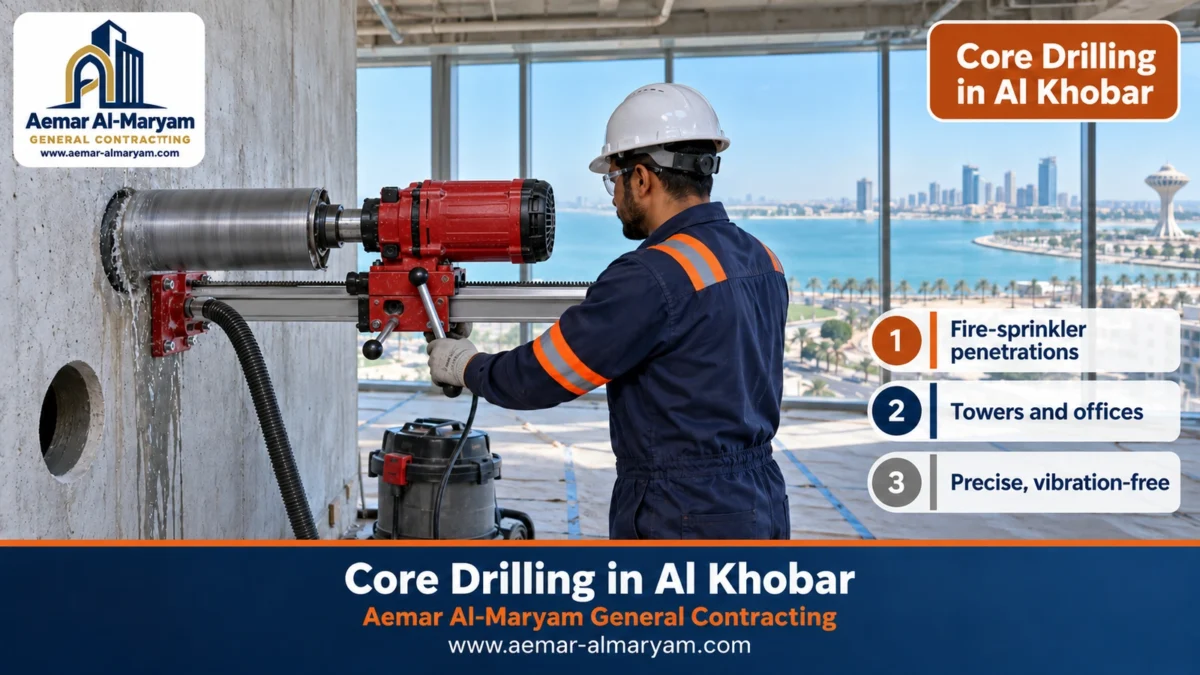
Core drilling in Al Khobar is how we take fire-sprinkler mains, cable bundles, AC lines and drain pipes through concrete walls and slabs: a diamond bit on a fixed rig cuts a clean round hole without breaking out the surrounding concrete and without the hammering that disturbs everyone else in the building. Most of our Khobar work comes from office and retail floors being fitted out, and from high-floor flats where the owner needs a neat AC hole in a building full of residents. On cost: AC holes and other small holes start at 90 SAR, the 5–6 inch class at 140 SAR, 8 inch at 230 SAR and 10–12 inch at 320 SAR. Treat these as starting estimates that we firm up once we have seen the site and agreed the scope. Phone or WhatsApp 0547879578.
Drilling inside a tower is a different job from drilling in a villa. A facilities manager wants a work permit before any machine comes up in the lift, a fit-out contractor is waiting on the holes to keep his programme moving, and an approved fire protection layout dictates where pipes can pass and how every opening must be sealed afterwards. On high floors there is another question people rarely think about until it matters: when the bit breaks through an external wall, where does the concrete core go? This page is written for exactly these situations, with sizes, prices and a clear way to order.
Core drilling in Al Khobar at a glance
- Typical work: fire-sprinkler and firefighting pipe penetrations, cable tray and electrical room openings, chilled water and condensate lines, split-AC holes in flats, and drain holes between floors.
- Buildings: office towers, showrooms and shops being fitted out, residential blocks and high-floor apartments, and villas.
- After drilling: the gap around pipes and cables is sealed with the product the consultant specifies, including fire-rated sealants in rated walls and slabs.
- Prices start from: AC and small holes at 90 SAR, then 140, 230 and 320 SAR for the 5–6, 8 and 10–12 inch classes; anything bigger is priced on site. All are estimates, fixed after inspection.
- Coordination: we work with building management on permits, the service lift and drilling hours, and we protect corridors and floors.
- To order: send 0547879578 a picture of where the hole goes, its size and the floor number, by WhatsApp or a call.
Core drilling in Al Khobar: why towers and offices are different
Core drilling in Al Khobar is different because a large share of it happens inside multi-storey commercial and residential buildings rather than in standalone homes. In a house the owner decides alone. In a tower there are several parties: the building owner or owners’ association, facilities management, the consultant, the fit-out contractor, and the firefighting and electrical subcontractors. Each of them wants something specific from a hole: a position that matches the approved drawing, work that does not stop the other tenants, and a seal that keeps the wall’s fire rating intact.
That is why we do not start drilling the moment we arrive. We check the approved layout and the setting-out marks on the wall with the site representative, confirm the hole is not on a structural element that needs an engineer’s decision, then scan for rebar and existing services. This order saves the owner the most expensive mistake in fit-out work: a hole in the wrong place. Closing it means extra work, and it leaves a patch in a wall that is supposed to stay fire resistant.
■ An office floor under fit-out
Rows of holes for firefighting pipes, cable trays and chilled water lines, often many of them in a single visit.
■ A showroom or shop in a block
Holes for AC lines, drains and a kitchen extract, with care for the neighbour above or below.
■ A flat on a high floor
A split-AC hole in the external wall or a drain hole through the slab, in a fully occupied building.
■ An electrical or comms room
A row of holes for cable bundles, sealed with a fire-rated product once the cables are pulled.
Concrete coring in Al Khobar for office and retail fit-outs
Concrete coring in Al Khobar fit-out projects means cutting precise round holes through shear walls, concrete partitions and slabs so new services can pass, in a structure that may have stood for years or may be brand new but was never designed for this tenant’s layout. The original architectural drawings do not know where the tenant will put the server room, the pantry or the boardroom, so holes appear that were never cast in during construction.
We mostly work with a stand-mounted core rig, because it keeps the hole straight and leaves a smooth bore that makes it easy to fit a sleeve and seal the gap later. Water cooling keeps dust down so it does not reach the smoke detectors on the floor, and a wet vacuum picks up the slurry as we go, which stops it running down to the floor below through existing openings.
Fire-sprinkler and firefighting pipe penetrations in Al Khobar
Sprinkler penetrations are among the most common holes we drill on office floors: the main crosses a shear wall from the corridor into the leased space, and branches drop or rise through the slab. The firefighting contractor sets the pipe size; we choose the core diameter that leaves enough annular space for the sleeve and the sealing product the approved system calls for. We do not drill at the pipe’s exact diameter, and we do not oversize a hole and weaken the wall for no reason.
Because these networks follow the building’s approved fire protection drawings, we ask for every hole to be marked by the firefighting contractor or the consultant before we drill. If a mark falls on a main bar or close to the end of a shear wall, we stop and put an alternative to the engineer rather than guessing.
Cable tray, electrical room and data penetrations
A cable tray usually needs a rectangular opening wider than any single bit, so we drill a row of overlapping cores or combine coring with saw cutting. Single cables and fibre bundles only need small and medium round holes, which we space evenly so they are easy to dress and seal later. We always suggest leaving one or two spare holes where expansion is likely, because drilling them now is far easier than coming back to a sealed and painted wall.
Chilled water, ducts and condensate drains
In offices and showrooms, chilled water pipes, condensate drains and air ducts cross walls and slabs. A condensate line needs a steady fall so water does not run back, so we drill its hole at the level the HVAC technician sets, not at whatever level is easiest for us. Large ducts often need a rectangular cut opening instead of a core, and we say so at inspection so the contractor is not surprised to find that coring alone will not do it.
Sealing core holes in Al Khobar: firestopping after drilling
Sealing core holes in Al Khobar matters as much as drilling them, especially in towers and commercial buildings. A fire-rated wall or slab stops holding back fire and smoke if an open gap is left around a pipe or cable. These openings are therefore closed with sealing products tested as part of an approved system, such as an intumescent sealant that expands with heat, an acrylic firestop sealant or a fire-rated foam, depending on the pipe or cable type and the size of the gap.
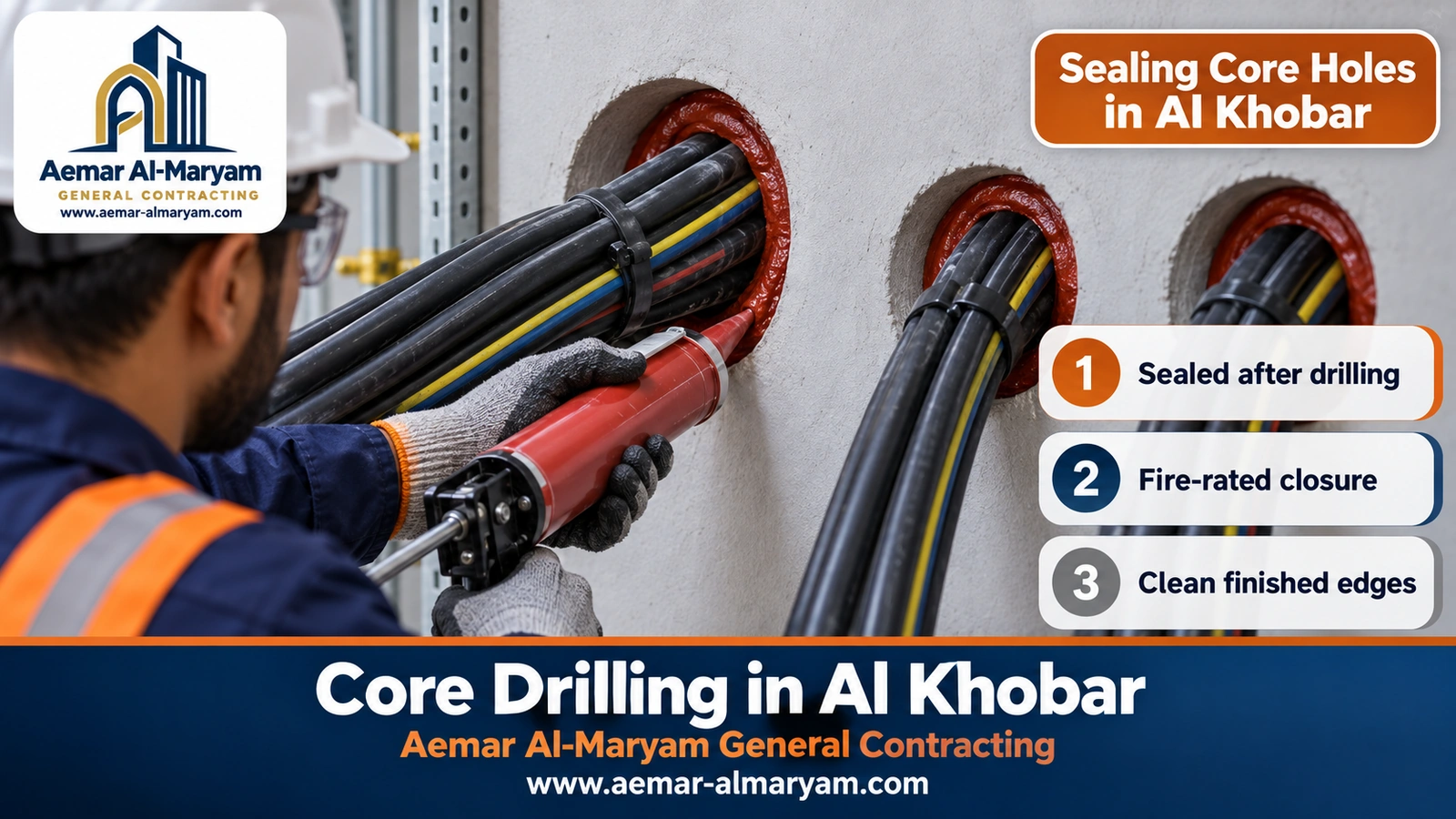
Who chooses the product? The consultant or fire engineer on the project, because every tested firestop system covers a particular combination of wall, pipe and gap. Our role is to drill the hole at a diameter that lets that system be installed, and to hand it over clean, dry and free of slurry and dust so the product bonds properly. If the sealing is in our scope, we apply the approved product the way its system describes and photograph each hole after sealing for the handover file.
- Fire-rated walls and slabs: a fire-rated sealant from a tested system, at the depth and method required.
- Ordinary walls inside flats: non-shrink grout or mortar, then a flexible sealant around the pipe.
- Roofs and external walls: sealing plus a waterproofing layer or collar around the pipe, which is where our waterproofing and insulation service comes in.
- Abandoned holes: filled completely and finished flush, never left hidden above a false ceiling.
⚠ An open hole above the ceiling is not a small problem
Many office holes disappear above the suspended ceiling and get forgotten. An unsealed hole in a wall between two units can carry smoke from one office to the next. Ask for a photo of every hole after sealing, before the ceiling goes up.
Slab and ceiling coring in Al Khobar: tower slabs and post-tensioned slabs
Slab coring in Al Khobar is possible in most slabs once we know what is inside them, but slabs in modern commercial buildings may be post-tensioned, and severing one of those tendons puts both the slab and anyone beneath it at risk. We do not drill a tower slab until we know its type from the drawings or from building management, and we then scan it with ground-penetrating radar to locate rebar, tendons and conduits before fixing the hole position.
There is a practical detail many people overlook. When the bit breaks through a slab, the concrete core and the cooling water drop to the floor below. So we coordinate with whoever occupies that floor, set up a barrier and protection under the hole, and either retain the core or catch it from below. Over occupied spaces we prefer to drill outside office hours, by agreement with management.
When does a slab hole need an engineer?
A large hole, a cluster of holes close together, or any hole near a column or beam or inside a post-tensioned slab. We core a beam only to a structural engineer’s design, and we never core a column.
Rebar scanning before core drilling in Al Khobar
Rebar scanning before core drilling in Al Khobar tells us where a hole can go without cutting a main bar, a buried power cable or an existing pipe. We use a radar scanner that shows bar positions, concrete cover and any tendons, then mark the hole on the surface between the lines. In most cases moving the mark a few centimetres is enough for the bit to pass between the bars.
Commercial walls often contain old cables and pipes that are not on any drawing, because a previous tenant added them and covered them up. That is another reason scanning is a fixed step before every hole rather than an optional extra. If a bar in a structural element cannot be avoided, the engineer decides whether it is cut or the hole moves.
AC core holes in Al Khobar high-floor apartments
An AC core hole in a high-floor Al Khobar flat is usually drilled from inside, because putting scaffolding on the face of a residential tower is not a realistic option. We fix the rig to the wall near the ceiling where the indoor unit will hang and angle the bit slightly downwards to the outside so condensate runs away from the room, not into it. Some split-AC makers specify roughly a 65 mm hole with that outward slope in their installation manuals, yet your unit’s own manual and its installer have the last word.
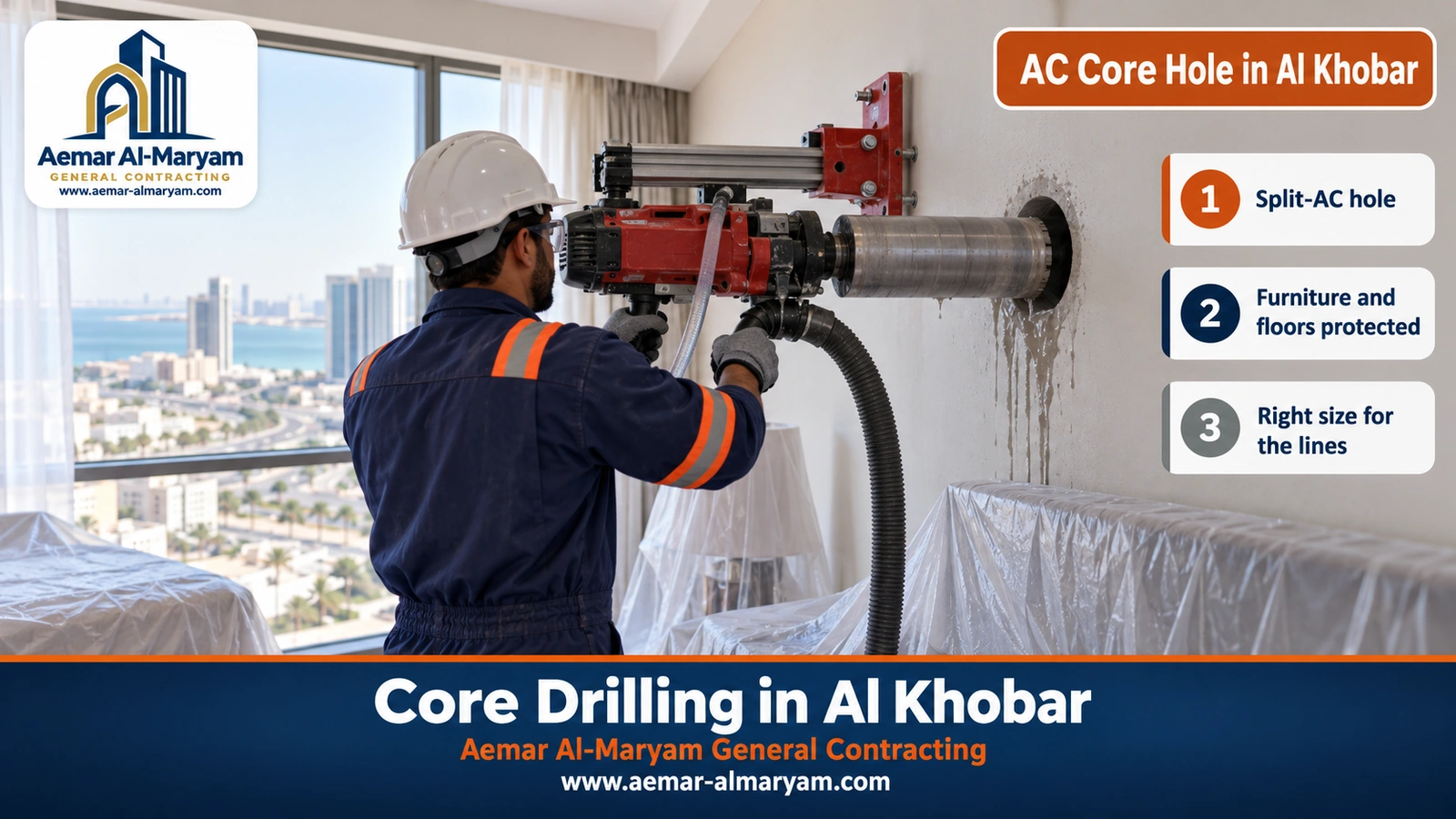
Where does the concrete core go on a high floor?
This is the key question for high-floor holes. If the bit punches through the external wall in one go, the core can fall to the street or onto a neighbour’s balcony. So we drill to near the end of the wall thickness, then finish carefully while holding the core and pulling it back inside, and we ask building management to close off the area below the facade when needed. Where the facade is clad in panels or glass, we first confirm the hole’s path behind the cladding so we do not damage a panel that is hard to replace.
Building management approval for a hole in the facade
In many blocks and towers the external wall is a shared element, and changing the look of the facade may need approval from the owners’ association or management. Ask before you order: is there a set position for outdoor units? Are there pre-formed sleeves hidden behind the plasterboard that can be used? In some buildings the hole was provided during construction, and opening it up is all that is needed instead of drilling a new one.
Working inside an occupied tower in Al Khobar: building management rules
Working inside an occupied tower in Al Khobar means following management’s rules before following the drawing. Most of those rules are sensible: protect the lift and corridors, work within set hours, do not disturb neighbouring offices during meetings, and do not set off smoke detectors with dust. We arrange all of this with you and with management before the day, so we are not turned away at the door.
- ✓Work permit: we provide team and equipment details and a short method description if management asks for them.
- ✓Lift: we book the service lift, line its walls and floor, and move equipment at quiet times.
- ✓Smoke detectors: we coordinate with the fire alarm technician if a zone needs isolating temporarily; wet drilling already keeps dust very low.
- ✓Slurry: collected at the bit by a ring and vacuum the whole time, and the floor beneath inspected after each slab hole.
- ✓Noise: we group the noisy holes into one agreed slot instead of spreading them across the day.
- ✓Cleaning: we leave the corridor and space as we found them, and take the cores and debris away with us.
Ask management these three questions first
What hours are we allowed to drill? Does the building need a permit-to-work form, and how long does approval take? Is the service lift available on our day? Knowing the answers before booking avoids a wasted visit for everyone.
Drilling holes in walls in Al Khobar: concrete, block or plasterboard?
Drilling holes in walls in Al Khobar starts with knowing the wall type, because the method and the price change with it. On office floors many partitions are plasterboard and do not need a core rig at all, while shear walls and stair and lift cores are thick reinforced concrete, and facade walls can be block or concrete. In flats, internal walls are usually block, while load-bearing walls and facades are concrete in some buildings.
| Wall type | What we use | Note |
|---|---|---|
| Reinforced concrete shear wall | Wet rig coring after scanning | Engineer’s decision if the hole is large or near the end of the wall |
| Stair or lift core wall | Wet coring, outside peak hours | Usually a shared element needing management approval |
| Block wall | Dry or wet coring depending on location | We drill through the middle of a block rather than a joint where possible |
| Plasterboard partition | No core needed | A drywall saw from the fit-out team is enough |
If the opening is beyond what coring can do, such as a large rectangular duct opening, we move to diamond sawing. Details are on our concrete cutting in Al Khobar page.
Kitchen and bathroom core holes in Khobar flats and offices
Kitchen and bathroom core holes in Al Khobar serve extract fans, drains and ventilation in flats, and the small pantries inside offices. A bathroom fan usually runs on a 100 mm duct, so it needs a 4 inch class hole, while apartment cooker hoods tend to use a 150 mm duct and therefore a 6 inch class hole. We always ask for the outlet size from the appliance manual before drilling, because a hood or fan bought later may not match the hole.
A 110 mm drain pipe, the one known as a 4 inch pipe, needs a hole slightly larger than the pipe so it can be sealed tightly, usually a 5 inch class core. We agree the level and fall with the plumber before drilling, and our plumbing works team can run the pipe straight after the hole is done.
Core hole sizes in Al Khobar by use
In Al Khobar, a core hole’s size follows the outer diameter of whatever runs through it, plus room for sealing, not by a fixed number. The table below shows the common classes in offices and flats; the final decision rests with the specialist trade.
| Use | Common hole class | Note |
|---|---|---|
| Single cable or small bundle | Up to about 2 inch | Leave spares where expansion is expected |
| Split AC | About 65 mm or per the unit manual | Fall towards the outside |
| Bathroom fan / 110 mm drain | 4–5 inch class | Annular gap for sealing |
| Kitchen hood / 150 mm duct | 6 inch class | Per the hood outlet |
| Firefighting main | Per pipe size and sealing system | Set by the firefighting contractor |
| Insulated chilled water pipes or a group of pipes | 8 inch and above | Insulation increases the outside diameter |
| Cable tray or rectangular duct | Overlapping cores or sawing | Priced at inspection |
Note: sizes are for guidance only. Ask the AC technician, plumber or firefighting contractor for the real outside diameter including insulation.
Core drilling prices in Al Khobar
Core drilling prices in Al Khobar start from 90 SAR for a small or AC hole and rise with diameter and the thickness of the wall or slab. We do not charge Khobar differently from Dammam, but some conditions in commercial buildings affect the final cost, and we explain them before you agree.
| Hole | Starts from | Typical use |
|---|---|---|
| Small hole / AC hole up to about 100 mm | 90 SAR | Split AC, cables, bathroom fan |
| 5–6 inch hole | 140 SAR | 110 mm drain, kitchen hood |
| 8 inch hole | 230 SAR | Insulated pipes, pipe groups |
| 10–12 inch hole | 320 SAR | Ventilation ducts, service risers |
| Over 12 inch, rows of holes or cable tray openings | Priced at inspection | Message the drawing and photos to 0547879578 and we will come back with a figure |
Before you budget: these are starting estimates we confirm after a site visit and your agreement; the hole size, the depth of concrete, how much steel it holds, the floor, the way in and the hole count all move the final figure.
What changes the cost in Khobar commercial buildings?
- Out-of-hours work: if management requires drilling at night or at the weekend.
- Fire-rated sealing: priced by the approved product and number of holes, and sometimes done by a specialist.
- Radar scanning: essential in post-tensioned slabs and buildings without drawings.
- Height and access: holes near a high ceiling need a mobile scaffold.
- Number of holes: booking a whole floor’s holes for one visit brings the price of each hole down.
For fit-out contractors
Send us the services drawing with the holes numbered, and we will price each hole and suggest an order by floor and zone, so every trade knows when its holes will be ready. Examples of past work are on our projects page and item details on the prices page.
Core drilling and concrete cutting in Al Khobar: when do you need a saw?
Core drilling and concrete cutting in Al Khobar go hand in hand. Coring is enough for round holes, however many there are, but a rectangular opening for a wide cable tray, a large duct or a door between two offices needs a diamond saw. Sometimes we core the corners first and join them with saw cuts so the corners come out clean. If your project needs both, book them together in one visit. Read more on concrete cutting in Al Khobar and our concrete cutting service.
When the holes sit inside a bigger office or flat refurbishment, such as crack repair, waterproofing or finishing after the new services, our renovation contractor in Al Khobar page explains how we stage that work in an occupied building.
Core drilling contractor in Al Khobar: what will your project manager ask for?
A core drilling contractor in Al Khobar working on commercial projects reports to a project manager or consultant, and they ask for specific things before allowing drilling. If you own the project, use this list to compare contractors:
■ A written method
A short description of the equipment, cooling, slurry collection and site protection, provided on request.
■ Scanning before every hole
Does the contractor own a scanner, or will he drill and hope he misses everything?
■ Coordination with fire and electrical trades
Who marks the hole, and who pays to move it if it turns out to be in the wrong place?
■ Documented handover
Photos of every hole before and after sealing, numbered to the drawing.
At Aemar Al-Maryam General Contracting we work in exactly this order, whether the job is three holes in a flat or fifty on an office floor. The general service is described on our core drilling page, and the full reference for every type of hole is our core drilling in Dammam guide.
Common core drilling mistakes in Khobar fit-outs
- Drilling before the services are coordinated: the firefighting and electrical routes clash, and one hole ends up abandoned.
- Leaving no gap for sealing: a hole drilled at the pipe’s exact size cannot take the approved firestop product.
- Ignoring the floor below: a core and slurry dropping into an occupied office cause damage and complaints.
- Skipping the scan on a post-tensioned slab: the most serious risk in tower slab coring.
- Forgetting condensate fall: an AC hole drilled flat or sloping inwards sends water back into the room.
How to order core drilling in Al Khobar
- 1Send photos and the drawing
A photo of each hole position, from both sides if possible, and the drawing if you have one, on WhatsApp 0547879578. - 2Give the diameter or purpose
The pipe, cable or appliance size, or tell us what the hole is for and we will suggest the diameter. - 3Tell us the building and floor
District, building type, floor level and whether there is a service lift. - 4Share management’s rules
Permitted hours, work permit requirements and any fire-rated sealing conditions. - 5Get the estimate and a date
We send the estimated cost, then fix the date after inspection and agreement. - 6Drilling and handover
Scan, drill, clean, then handover photos and sealing if it is part of the agreement.
What Aemar Al-Maryam brings to core drilling jobs in Al Khobar
- We know commercial buildings: work permits, service lifts, quiet hours and fire-rated sealing.
- Clean wet drilling: continuous slurry collection and protection of the floor below for slab holes.
- Scanning before drilling: we do not drill a slab or shear wall until we know what is inside.
- Published starting prices from 90 SAR: and a clear estimate for every hole before we begin.
- A team close by: we set out from Dammam and schedule Khobar visits around the fit-out contractor’s programme.
Al Khobar districts we serve for core drilling
We reach every part of Al Khobar, including:
Our crews also cover Dhahran, Dammam and other Eastern Province cities. In Dhahran most of our requests come from villas, covered on our core drilling in Dhahran page. The full city page is our services in Al Khobar.
Pages you may find useful
Holes needed on an office floor or in a flat in Al Khobar?
Send the photos and the drawing on WhatsApp, or call us on 0547879578 to fix a date and arrange things with building management.
Tags