Looking for a plastering contractor in Al Khobar who understands what sea air does to a wall? At Aemar Al-Maryam General Contracting we render villa and apartment-building facades with a richer external mix, joint mesh and fresh-water curing; we plaster flats, villas and shops inside over properly set dots and screeds; and we re-plaster older buildings where the plaster has blown or salts have come through. Internal labour starts from SAR 6.5/m², external work from SAR 14 a square metre for labour or 18 all-in, while stripping and redoing an old wall starts from SAR 23/m²; every figure is an estimate that inspection and agreement confirm. Phone or WhatsApp: 0547879578.
Being a Gulf-front city, Al Khobar plays by different plastering rules than many owners realise. High humidity for much of the year, salt carried in the air and deposited on facades, and fierce daytime heat followed by damp nights test the outer skin of every building, every day. Plaster laid with a weak mix, unwashed sand, no mesh at the columns or no curing shows it quickly: first hairline cracks, then white salt patches, then hollow sections that sound like a drum when you tap them and eventually fall away. A facade plastered the right way, on the other hand, stays sound and holds its paint for years. Below you will find how we handle each building type in the city, the key numbers, and a way to estimate your own room or facade.
Plastering in Al Khobar at a glance
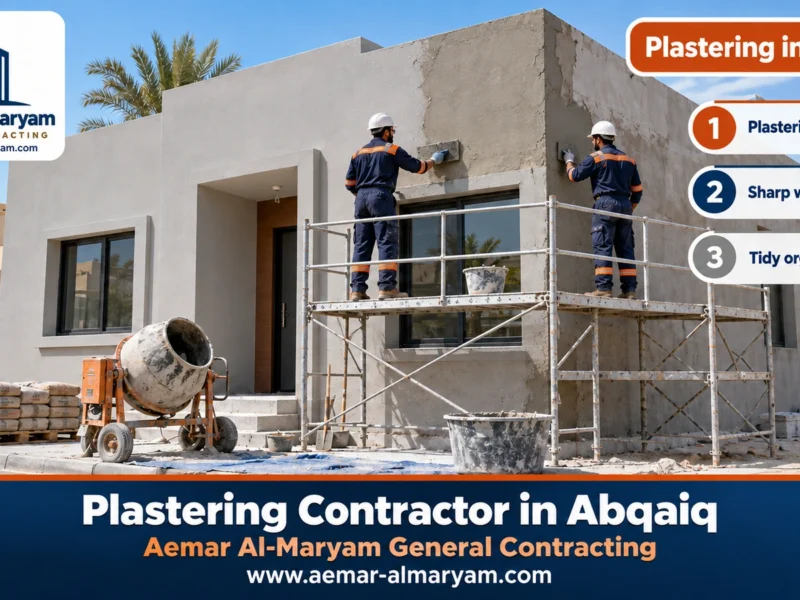
- Coastal facades: scratch coat on concrete, then two-coat external render in a richer mix, mesh over every block-to-column joint, washed sand and fresh water, and several days of wet curing afterwards.
- Villas and apartment buildings: facade rendering from fixed scaffolding or a suspended platform, and coloured render for boundary walls and facades that should not need painting.
- Flats and shops: internal plaster on walls and ceilings over laser-set screeds, with straight arrises around doors and windows.
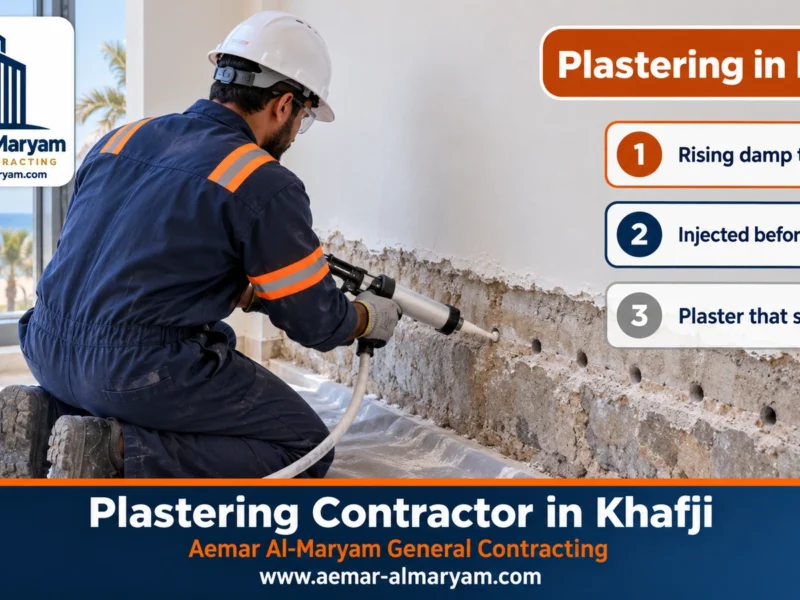
- Older buildings: hollow and salt-laden plaster stripped back to sound material, then new plaster once the source of damp is dealt with.
- Minimum costs: internal SAR 6.5/m² labour, 11 on screeds, 13 with materials; ceilings 14; external with materials 18; coloured render 32. Final figures follow inspection.
- Getting a price: WhatsApp 0547879578 a photo of the wall or facade, your district and approximate dimensions.
Plastering contractor in Al Khobar: which buildings we work on and what we take over
A plastering contractor in Al Khobar takes bare or damaged walls and hands them back as straight, well-bonded surfaces ready for skim and paint or for cladding. At Aemar Al-Maryam we run the job from the start: inspecting and tap-testing the walls, measuring the area, choosing the right method for each part, supplying materials or working with yours, carrying out the work, then curing, checking and handing over. What sets the Al Khobar market apart is how varied the buildings are, and each type needs a different way of thinking:
■ New villas under finishing
Internal plaster for halls, bedrooms and majlis rooms, then the facades and boundary walls before paint or stone.
■ Apartment buildings
Multi-storey facade rendering, plus stairwells, corridors and flats floor by floor.
■ Occupied flats
Re-plastering a wall or a room, filling service chases, and working while the family is at home.
■ Shops and showrooms
Concrete ceilings and tall walls behind glass frontages, ready for the fit-out contractor.
■ Older buildings
Stripping blown and salt-damaged plaster and redoing it after the damp is treated, especially at wall bases.
■ Annexes and majlis rooms
Plastering a new annex or outdoor majlis to match the main house.
Being a general contractor, not just a plastering gang, we can bundle what comes before and after plaster into one agreement if you need it: crack repair, altering openings or services, then plaster, then paint. A brief overview sits on our plastering service page, and finished jobs are in the projects gallery.
External rendering in Al Khobar: facades that face the sea air
External rendering in Al Khobar goes on as two coats totalling roughly 18 to 20 mm, over a scratch coat wherever there is concrete, in a cement-richer mix than indoor work, with mesh bridging each block-to-frame junction and several days of fresh-water curing after. That is the minimum we consider right for a coastal city, and we add a damp-proofing admixture to the mix where the specification calls for it or the wall is particularly exposed.
Why do facades in Al Khobar wear out faster?
Three forces act together on a seafront facade in the Eastern Province. The first is humidity: air loaded with moisture keeps the wall surface damp for long hours, so water slowly finds its way into the pores. The second is salt: chlorides carried on the sea breeze settle on the surface, and with every wet-dry cycle they move into the render and crystallise just behind its face, pushing it outwards. The third is heat: strong sun heats the facade by day and it cools at night, so the coat is constantly expanding and contracting. Studies of buildings in the region link their early deterioration to this saline environment and to groundwater that sits close to the surface in many locations, and the plaster is the first layer those forces reach.
On inspections around the city the pattern repeats: white bloom on facades and boundary-wall bases, paint flaking off salt-laden render, drummy patches under sills and at balcony edges, and straight cracks at every unmeshed column. None of it needs costly products to prevent, only the known steps done properly.
What we do differently on a coastal facade
- ✓Washed sand and fresh water: no clay-laden or salty sand and no brackish water for mixing or curing, otherwise we are adding salt to the wall ourselves.
- ✓Washing the surface first: existing walls get a fresh-water rinse to lift salt deposits and dust ahead of the scratch coat.
- ✓Scratch coat on all concrete: columns, beams and slab edges are smooth, and render will not hold on them without a rough key.
- ✓Mesh on the joints: a strip about 150 mm wide over every block-to-concrete line, embedded in the render.
- ✓Falls that shed water: a slight slope on wall copings, window sills and balcony edges so water does not stand on them.
- ✓Keeping render off wet ground: we do not run the external coat down into damp soil or irrigation water without treating the wall base.
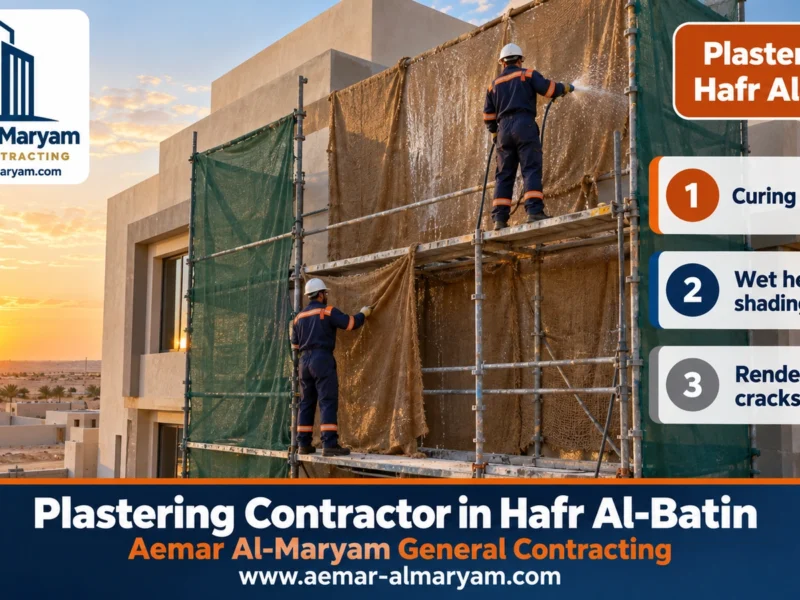
- ✓Longer curing: regular spraying morning and evening for around seven days, and no rush to paint.
Villa facade rendering in Al Khobar
Rendering a villa in Al Khobar covers the front, side and rear elevations plus the boundary walls, and sometimes the annex and outdoor majlis, each exposed to sun and wind to a different degree. We start by inspecting to mark the concrete that needs a scratch coat, the joints that need mesh, and architectural details such as projections, cornices and window surrounds that need moulds or special screeds. Then we put up fixed scaffolding and work from the top down, breaking long runs with planned joints so that random cracks do not appear.
If stone or cladding follows, we leave a flat, keyed surface for the adhesive; if paint goes straight on, the final coat must be fine and even, because low morning and evening sun shows every ripple.
Rendering an apartment-building facade in Al Khobar
Rendering an apartment-building facade in Al Khobar is governed by access before area. How many storeys? Does the facade face a main road or a narrow lane? Is there an adjoining neighbour? Is there room in front for fixed scaffolding, or do we need a suspended platform from the roof? Access, not area, is what drives time and cost here. We sequence the work so each section of the facade gets both coats before we move down, while protecting pedestrians, cars and windows.
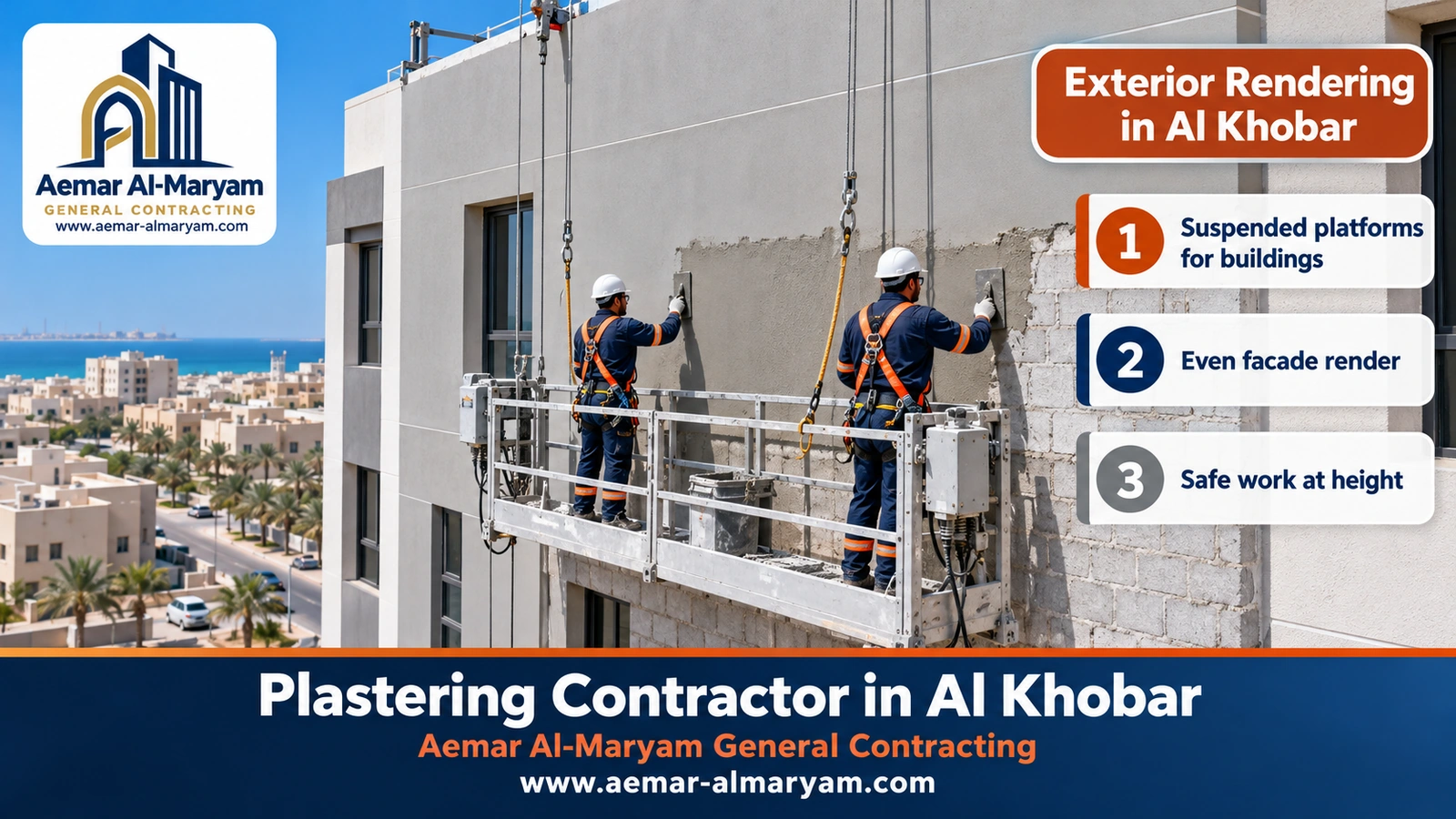
On occupied blocks we agree times with the owner or owners’ association, sheet windows and balconies, warn residents and sweep entrances daily. Exposed steel or wide facade cracks are handled first as renovation work in Al Khobar.
Coloured render in Al Khobar: does it suit the coast?
Coloured render in Al Khobar is a pigmented cement finish, so the wall is done once it cures, with no paint on top; it is popular on boundary walls and on some villa and annex facades. Its advantage in a coastal city is that there is no paint film to blister and peel in the humidity, because the colour is part of the render itself. It does need attention to three things: consistent colour from one batch to the next, which is why we order material for the whole area from one source; the difficulty of patching later in a matching shade; and a sound, salt-free coat underneath, otherwise white bloom shows straight through the colour.
Our coloured render starts from SAR 32/m² including materials, with the final price set once the colour, texture, facade area and height are known. If you are torn between it and exterior paint, ask us for photos of earlier work and read about exterior paint systems on our painting contractor in Al Khobar page.
Stone-effect and textured facade render
Some owners ask for render that imitates stone: a cement or ready-mixed final coat tooled or moulded into joints, grain or lines, sometimes pigmented. It depends on a sound coat beneath, and its rough face traps more dust and salt than a smooth one by the sea, so we price it on inspection according to the pattern.
Re-plastering old walls in Al Khobar: when plaster blows and salts appear
Re-plastering old walls in Al Khobar means removing the plaster that has lost its bond or is saturated with salt until we reach a sound layer or the blockwork itself, then laying new plaster with every proper step, not spreading a thin coat over the old one. New plaster can never be stronger than what holds it up, and if the old coat is detached, both fall together.
In older Al Khobar buildings the damage clusters in the lowest metre of walls, around drain and AC pipes, below windows and on the dampest elevations. Water is nearly always the culprit: old plumbing leaks, garden irrigation, or rising damp where groundwater is shallow and salty, as documented in parts of the Eastern Province. Re-plaster without stopping it and the bloom and drumminess come straight back.
- 1Tap-test and mark
We sound the wall with a small hammer and chalk the edges of hollow and salt-affected areas. - 2Find the water
We ask about leaks, irrigation and the age of the plumbing, and decide whether the source needs treating before plaster. - 3Strip to a sound edge
We remove the damaged plaster, cut its edges straight and clear the debris. - 4Clean and wash
We brush dust and salt off the exposed block with fresh water and let it dry as needed. - 5Scratch coat and mesh
Scratch coat on concrete, and mesh on joints and along the boundary between old and new on large patches. - 6New plaster on screeds
One or two coats depending on depth, ruled flush with the surrounding wall. - 7Cure and monitor
Several days of curing, then a check before painting that the salts have not come back.
For old walls, strip-and-redo starts at SAR 23/m², and stripping on its own at SAR 7.5/m². Treating scattered hollow plaster and salts at the base of walls is priced after inspection, because its extent and cause vary from building to building. If the building needs more than plaster, read about renovation in Al Khobar and crack repair in Al Khobar.
Patch or redo the whole wall?
If the hollow area is small and contained, and the surrounding plaster sounds solid when tapped, a patch with mesh along its edges is enough. If hollow spots are scattered across the wall, or salts are showing on several walls, re-plastering the whole wall costs less than a patch that has to be redone every humid season.
Plasterer in Al Khobar: what to check before hiring one
A plasterer in Al Khobar is the tradesman who lays the plaster by hand, and the quality of his work shows neither in his speed nor in his price, but in how he explains the job before he starts. A plasterer who knows coastal work will bring up, unprompted, dampening the blockwork, the scratch coat on concrete, mesh at the columns, the type of sand and curing afterwards. One who tells you he works “by eye” and will finish two rooms in a day without having seen the walls is giving you a reason to pause.
These simple questions separate a capable plasterer from the rest, whether you hire us or someone else:
- How will you keep the wall straight? Right answer: dots and screeds set with a level or laser, then a long straightedge.
- What will you do at columns and beams? Right answer: scratch coat, then mesh over the joint.
- What thickness do you expect, and what if one area needs more? Right answer: two coats, never one heavy coat.
- Where does the sand come from, and is the water fresh? Right answer: washed sand and water fit for mixing.
- Who wets the wall afterwards, and for how many days? Right answer: about seven days, agreed before work starts.
- Can I see a wall you finished under side light? A photo taken from a distance hides waviness.
Plasterer phone number in Al Khobar
To book a plasterer or a plastering crew in Al Khobar from Aemar Al-Maryam, use our only number, 0547879578, for calls or WhatsApp. We do not work through other numbers or middlemen, and the person who answers can ask about your wall, request photos and give you a technical view, not just an appointment. Share one wide shot plus detail shots of any defect, name the district, and we come back with an initial cost.
Plasterer in Al Khobar by the day or by the metre?
A plasterer in Al Khobar is usually hired in one of two ways: by the day, where you pay for each working day whatever gets done, or by the square metre, where you pay for the area completed however long it takes. A day rate suits small jobs that are hard to measure, such as patching after the plumber and electrician, repairing a window reveal or closing an old AC opening. Whole rooms, flats and facades are better priced by area: the total is fixed up front and slow days are not your problem.
| Situation | Best basis | Why |
|---|---|---|
| Patching after services or closing small openings | Day rate or a fixed price | Small, scattered areas that are hard to measure |
| A whole room or flat | Per square metre | Cost known in advance and tied to progress |
| Villa or apartment-building facade | Per square metre plus an access item | Large area, and access drives cost |
| Re-plastering old walls | Per square metre once the stripping area is set | Stripping and removal are part of the job |
Either way, remember that a plasterer sells his labour and skill, and that materials, curing and supervision usually stay with you unless agreed otherwise. When you hire a plastering contractor you are buying a result: an area, a written method, materials, a timeline and a handover with a clear check.
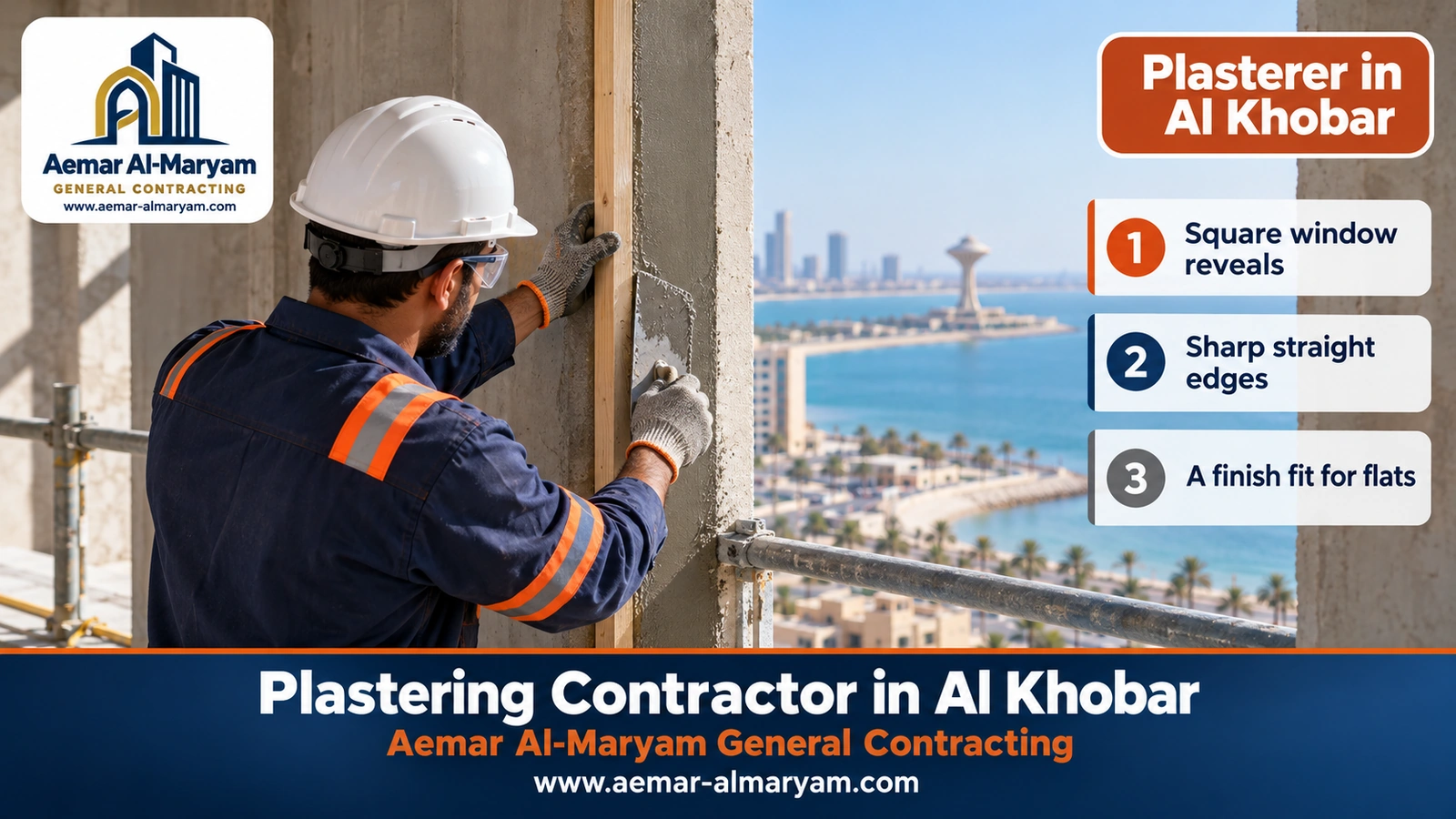
Window and door reveals: where a plasterer’s skill shows
What reveals a plasterer’s level is not the middle of the wall but the sides of the openings: the jambs, head and sill of a window, and the edges of door openings. Here the arris must come out sharp, straight and square to the wall, and the reveal depth must be the same from top to bottom so the frame or aluminium window fits without gaps. That is why we fix a straight batten or a metal bead on the edge as a guide, and give external sills a slight fall outwards so that humidity and rain do not collect on them.
The tools you should expect to see on site
■ Aluminium straightedge
Two metres or longer, drawn along the screeds to level the coat.
■ Laser level and spirit level
To set the dots plumb and level before the plaster goes on.
■ Trowels and floats
To throw the mortar on, then rub and close the surface after ruling.
■ Metal corner beads
Fixed on arrises and openings as straight guides that protect them from knocks.
■ Joint mesh
Metal or fibre, embedded in the plaster over the junction lines.
■ Mixer and spray kit
A mortar mixer, plus hose and sprayer for wetting the wall before and curing it after.
Internal plastering in Al Khobar for flats, villas and shops
Internal plastering in Al Khobar normally means one cement coat of around 12–15 mm on decent blockwork, filled between screeds, ruled flat and floated smooth for the painter. Where a wall is out of true or needs more thickness, we split it into two coats, because one heavy coat tends to sag and later lose its bond.
New villas mean long continuous walls in halls and majlis rooms where lighting exposes any ripple; occupied flats mean working room by room with floors and furniture covered and debris out daily; shops mean tall walls and wide concrete ceilings timed around the fit-out and opening date.
Ceiling plastering in Al Khobar
Ceiling plastering in Al Khobar is harder than walls for two reasons: concrete soffits are smooth and absorb little, so mortar does not grip easily, and working overhead means a heavy coat wants to fall. Our answer is a scratch coat left to harden, followed by a relatively thin coat ruled on ceiling screeds. We work from a mobile scaffold with fixed guard rails, never from ladders or drums, for safety and for a flat result.
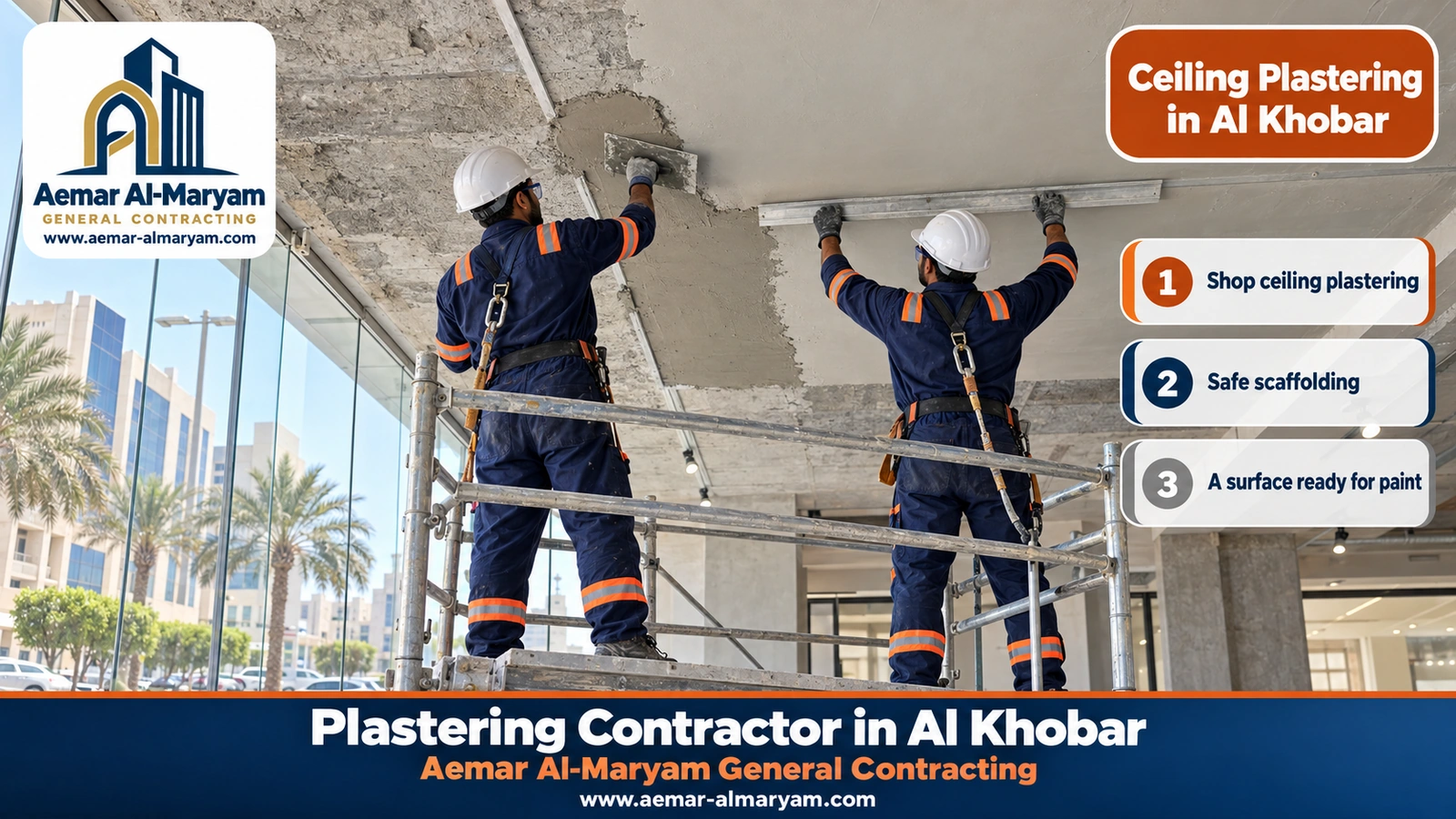
Ceiling plaster starts from SAR 14/m². If the ceiling will later be hidden behind a gypsum-board false ceiling, you may not need to plaster all of it; we point that out on site, so you are not paying for plaster nobody will see.
Bathrooms and kitchens
Bathrooms and kitchens are wet rooms, so we always plaster them in cement, never gypsum. Where tiles will go, we leave a keyed surface for the adhesive, while exposed areas are finished smooth for moisture-resistant paint. Plastering kitchen and bathroom walls starts from SAR 18/m², because the areas are small and full of corners and openings.
Stairwells and building corridors
Stairwell walls run unbroken between floors and change angle with the flight, so we set screeds to the rake of the stairs and bead every external corner against daily knocks.
Corner beads and floor screeds
On every external corner we fix a perforated metal bead, plumbed with a level, before plastering, so the arris becomes a straight edge that does not chip easily. So-called “floor plastering” is in fact a sand-cement levelling bed for levels and falls ahead of tiling or waterproofing, with its own mix and depth; we include it in finishing work where needed. See our finishing service for the full sequence.
Scratch coat, dots and screeds in Al Khobar: how we build a straight wall
Everything that makes a wall straight happens before the main coat goes on. The scratch coat gives smooth concrete a rough key for the plaster to hold, the dots are reference points of mortar that fix the plane of the finished surface, and the screeds are vertical strips joining the dots for the straightedge to run on. Without them, a wall is only as straight as the plasterer’s eye at the end of a long day.
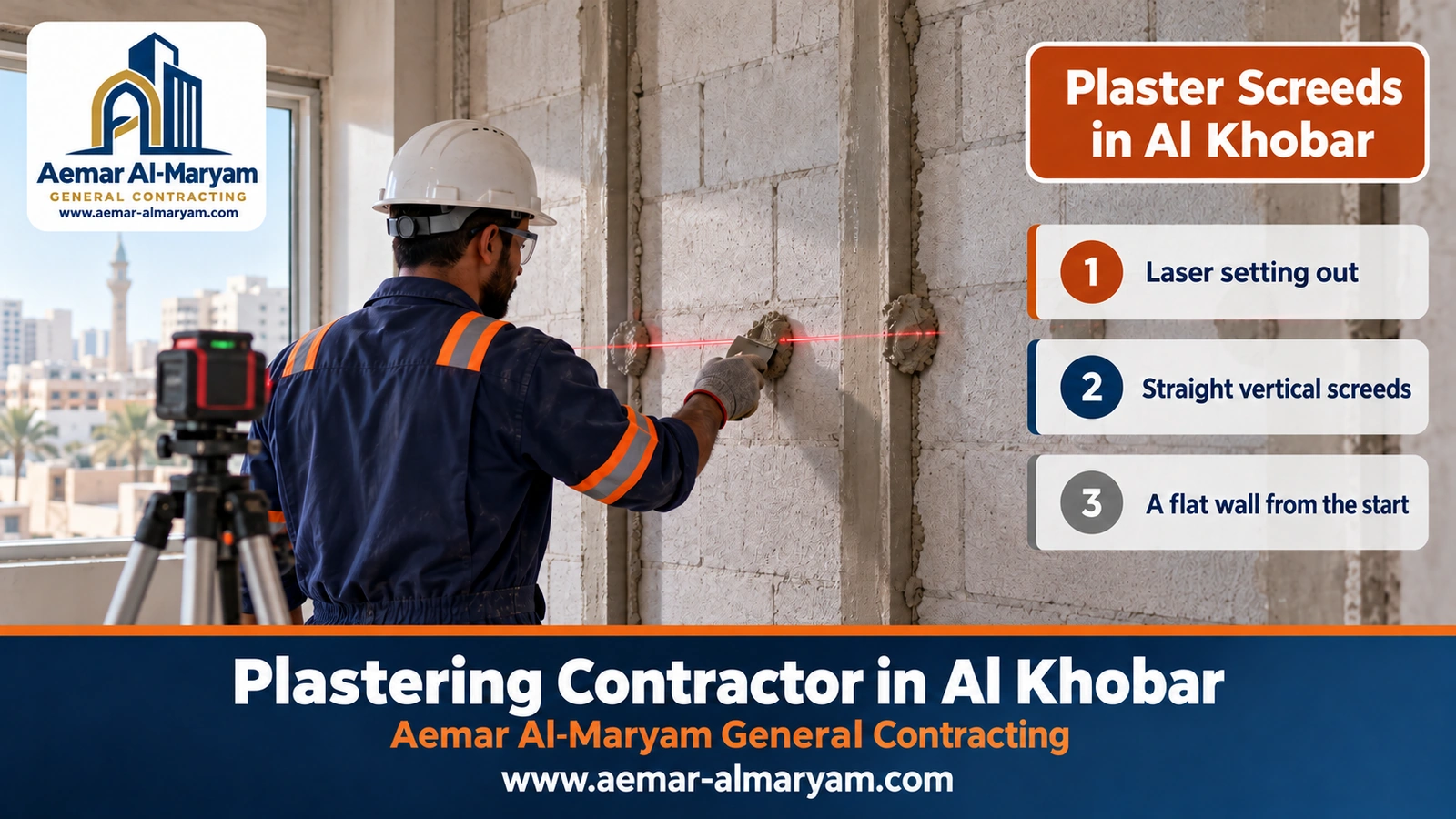
We set dots to a laser line on most Khobar jobs, then confirm with string and level. Opposite walls end up parallel and corners square, which makes wardrobes, kitchens and door frames far easier to fit later.
| Stage | What happens | What to check |
|---|---|---|
| Dampening | Absorbent blockwork is wetted before work, without soaking dense concrete | The wall is neither dry and dusty nor running with water |
| Scratch coat | Cement-rich mortar, roughly 1:2, flung hard at the concrete | It stays rough, not smoothed, and is kept damp for at least a day |
| Dots | Mortar dots at about 1.5 m centres set to the laser or string line | All on one plane and covering the whole wall |
| Screeds | Straight vertical strips between the dots | Firm before the plaster goes on between them |
| Laying and ruling | Filling between screeds, ruling off with the straightedge, then floating | No gap under the straightedge when laid in different directions |
Why “by eye” and “on screeds” are priced differently
Plaster laid by eye without screeds is quicker and cheaper, but it leaves waviness that the painter later has to hide with extra skim and time. That is why our table separates basic labour from SAR 6.5/m² and labour with dots, screeds and beads from SAR 11/m², so you choose knowing the difference.
Plaster mix ratios and thickness for Al Khobar
Sand-cement plaster is typically batched between 1:4 and 1:6 by volume; render outside leans to the richer 1:4, and the scratch coat goes richer still at around 1:2. More important than any ratio: never put a stronger coat over a weaker one, since the stronger layer shrinks harder, drags on its backing and either crazes or lets go.
| What | Guide figure | Khobar note |
|---|---|---|
| Scratch coat | ≈ 1:2 | Any concrete, above all on facades |
| Indoor coat | 1:4–1:5, 12–15 mm | One coat on true blockwork |
| Outdoor render | ≈ 1:4, 18–20 mm over two coats | Damp-proofer added on exposed elevations if specified |
| Backing coat | 15–20 mm | Ruled on the screeds |
| Soffits | Lighter than walls | Scratch-coated concrete first |
| Wait between coats | ≈ 2 days | First coat must be firm |
| Cement | ≈ 1 × 50 kg bag covers 10 m² | At ~2 cm and close to 1:4 |
Figures are indicative, from everyday cement-plaster practice; an approved specification always overrides them.
By the sea, materials count as much as proportions. Washed sand limits shrinkage and brings no salt; clayey sand invites crazing. Mixing water must be fresh, and cement bags must be dry and lump-free, which takes care in Khobar’s humid air. Near the ground or constant damp, sulphate-resisting cement or admixtures may be specified.
Mesh-reinforced plastering in Al Khobar: where it goes and when it covers the whole wall
Mesh-reinforced plastering in Al Khobar means fixing a strip of metal lath or fibre mesh where the plaster is likely to crack, then embedding it within the coat. The most important places are the lines where blockwork meets concrete columns and beams, because the two materials expand and contract by different amounts with heat and moisture, and a straight crack appears along that line if it is left unreinforced. The strip is about 150 mm wide and centred on the joint.
- On every block-to-concrete junction, inside and out.
- Over electrical and plumbing chases once they have been filled.
- Around door and window corners in large walls, where diagonal cracks tend to start.
- Along the edges of large patches where old and new plaster meet.
- Over the whole wall where it is subject to more movement or the specification calls for it, a separate item from SAR 20/m².
Metal mesh in humid air must be galvanised and fully buried; mesh near the surface rusts, swells and pops the plaster. Where it suits better we use alkali-resistant fibre mesh instead.
⚠ Mesh does not fix a structural crack
Mesh prevents plaster cracks caused by dissimilar materials and shrinkage. If the crack cuts through the blockwork as well, runs diagonally from a door corner or widens over the months is a sign of movement in the building and needs assessing before any plaster. Read crack repair in Al Khobar to tell the difference.
Machine-sprayed or hand plaster in Al Khobar?
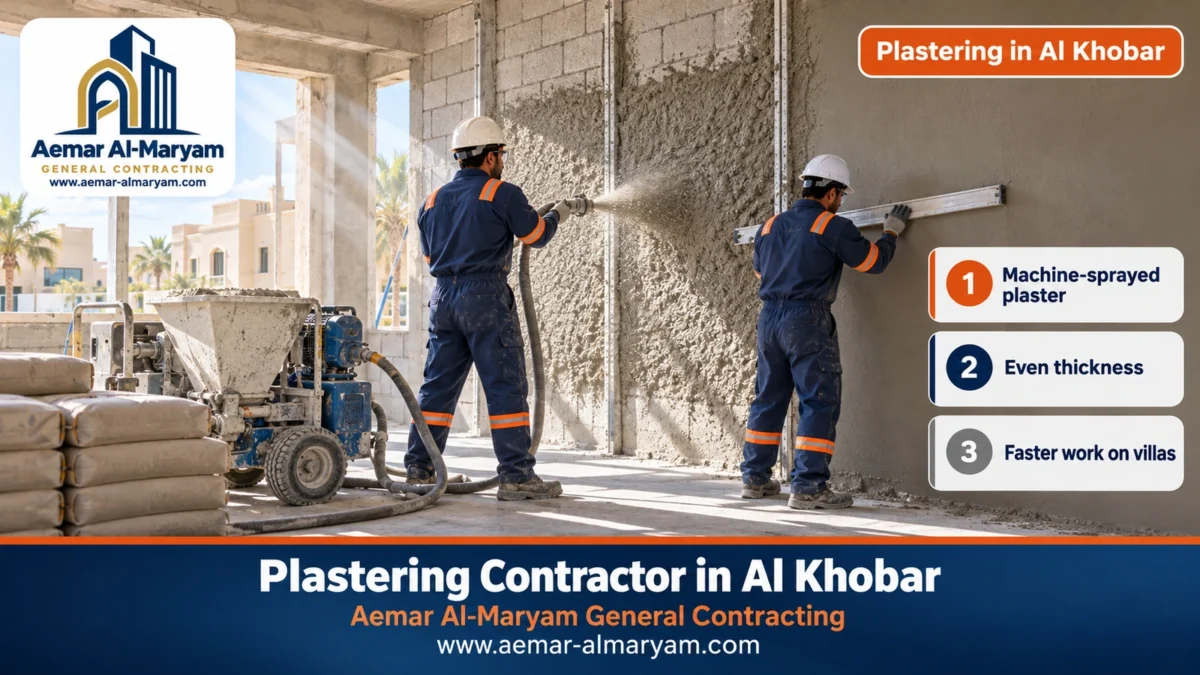
Machine plastering in Al Khobar means pumping a ready-mixed, sprayable mortar through a hose onto the wall in an even fan, then ruling it off on screeds exactly as with hand plaster. It suits new villas and apartment buildings with large continuous areas that can be worked without stopping, because machine mixing gives a consistent mortar, output is higher and waste is lower. Set-up and wash-out are daily chores, and any long stop lets mortar harden in the line.
| Comparison | Machine plaster | Hand plaster |
|---|---|---|
| Best suited to | Villas and buildings under finishing with continuous areas | Occupied flats, single rooms, patching, small shops |
| Material | Ready-mixed pumpable mortar | Cement and washed sand mixed on site |
| Speed | High on large areas | Slower, flexible in tight spaces |
| Straightness | From screeds and the straightedge, not the machine | From screeds and the straightedge |
| Noise and mess | Equipment, hoses and noise | Less, suits occupied homes |
| Cost | Quoted on site from area and product | Labour from SAR 6.5/m² |
The machine lays mortar faster; it does not make walls straight. That still comes from dots, screeds and the straightedge, so we propose spraying only where volume justifies the set-up.
Gypsum plaster or cement plaster in Al Khobar?
Gypsum plaster in Al Khobar comes as a bagged powder you add water to, for dry indoor walls and ceilings. It hardens in roughly 30 minutes, skips water curing, takes paint after about 3–4 days and barely shrinks. In a humid city like Al Khobar, though, its limits are clear: it is not for external walls, bathrooms or kitchens, or damp wall bases, since wet gypsum loses strength.
| Gypsum | Sand-cement | |
|---|---|---|
| Use it in | Dry, air-conditioned rooms | Anywhere, wet rooms and facades included |
| Hardening | ~30 min; dry within days | Weeks to dry out |
| Curing | None | Around a week of spraying |
| Paint | After ~3–4 days | When dry; full strength may take 28 days |
| Starting rate | SAR 41/m² all-in | SAR 13/m² indoor all-in |
We suggest gypsum when a dry interior must be painted within days, or a wall is already true and needs only a thin smooth coat. Lightweight perlite mortars, marketed as lighter and more insulating, are priced once we know the product and area. Gypsum plaster is also not gypsum board, which is dry sheets screwed to a frame.
Curing plaster with water in Al Khobar’s humid climate
Curing plaster in Al Khobar means keeping cement plaster damp for about seven days with a light spray morning and evening, because cement needs water to finish hardening. Some people assume Al Khobar’s high humidity makes spraying unnecessary. It does not: strong sun and wind dry a facade surface quickly during the day even when the air is humid, and a coat that loses its water early shrinks, crazes and bonds less well.
- We spray with clean fresh water, never brackish water or well water of unknown salinity, so we do not add salt to the wall.
- We avoid laying external render in direct midday sun in summer and start as early as possible.
- Facades in sun for most of the day dry faster, so we spray them more often.
- On dusty, windy days we hold back the facade’s final coat, because dust sticks to it and wind dries it out.
- Closed, air-conditioned rooms dry differently, so we spray more lightly with moderate ventilation.
- We do not paint cement plaster until it is properly dry; see the order and timing of painting after plaster on our painting contractor in Al Khobar page.
Who sprays is written into the agreement: on full projects it is our job; in occupied homes the owner may take it on after we explain how. Curing missed in the first days cannot be recovered.
Plaster defects in Al Khobar: cracks, hollowness and salt bloom
Plaster defects in Al Khobar mostly have known causes, and the commonest in a coastal city are salt bloom and hollow plaster. Knowing the cause decides the fix: sometimes a surface repair is enough, sometimes the coat must come off, and sometimes the problem lies in the wall itself rather than the plaster.
| Problem | Signs | Usual reason | Our fix |
|---|---|---|---|
| Salt bloom | White powder low on walls or across facades | Moisture carrying salts out; poor sand or water; rising damp | Cut off the moisture, dry and brush, or replace the soaked coat |
| Drummy, detached plaster | Hollow ring, bulges, pieces dropping | Concrete never keyed, dusty or dry base, too thick, salt behind | Cut back to firm plaster, key it, rebuild in layers |
| Map cracking | Web of fine lines | Quick drying, cement-heavy mix, dirty sand, overworking | Fill, or renew the finish coat if extensive |
| Line beside a column | Crack tracing the concrete edge | Junction left without mesh | Cut out, mesh, make good |
| Crack in the masonry | Slanting from an opening, growing | Structural movement | Engineer’s look first |
| Rust lines and spalling | Brown streaks over columns | Rebar corroding in damp, salty air | Repair the steel, then plaster |
| Ripples | Uneven sheen in raking light | No screeds or hurried work | Skim flat or renew |
Hairlines narrower than about 0.2 mm are normal in cement plaster, harmless, and normally hidden by skim. One that keeps returning in the same place or keeps widening, or spalling over columns and beams with rust lines, points to something deeper than plaster; you will find the crack types and how we deal with them on our crack repair service page.
Plastering price per square metre in Al Khobar: our “starts from” table
The plastering price per square metre in Al Khobar with us: indoor labour on your materials from SAR 6.5, rising to SAR 11 with dots, screeds and beads, or SAR 13 if cement and sand come from us; facades from SAR 14 labour-only and SAR 18 with materials. We pitched these under the rates other Eastern Province plasterers publish, yet they remain starting points; the real figure is written after we see the wall.
| Work | Scope | From (SAR) |
|---|---|---|
| Facade, labour only | Scratch coat plus two render coats; owner buys materials | 14 per m² |
| Facade, all-in | Labour with cement and washed sand | 18 per m² |
| Fibre mesh, full surface | Mesh over the entire wall within the render | 20 per m² |
| Coloured render | Pigmented finish coat with materials, no paint | 32 per m² |
| Indoor, plain labour | Laying and ruling; owner buys materials | 6.5 per m² |
| Indoor, precision labour | With dots, screeds and metal beads | 11 per m² |
| Indoor, all-in | Labour with cement and washed sand | 13 per m² |
| Concrete soffit | Scratch coat and thin coat on screeds | 14 per m² |
| Paint-ready smooth face | Fine final coat that cuts down on skim | 17 per m² |
| Kitchen or bathroom | Sand-cement on wet-room walls | 18 per m² |
| Strip only | Removing failed plaster | 7.5 per m² |
| Strip and redo | Removal followed by complete new plaster | 23 per m² |
| Gypsum plaster | Bagged gypsum, materials included, dry interiors | 41 per m² |
| Room cracks before paint | Treating the walls of one room | 140 per room |
| Machine spraying | Large continuous areas | On inspection |
| Scattered drummy plaster | Located by tapping, then repaired | On inspection |
| Rising damp and salts | Source first, then the wall base | On inspection |
Every figure above is an estimate pending inspection and agreement; wall condition, coat thickness, height, access and area all move it. Lines marked “on inspection” get a number once photos and sizes reach us on WhatsApp 0547879578.
What pushes plastering prices up or down in Al Khobar?
■ Pushes it up
An out-of-true wall needing two coats, a tall facade needing scaffolding or a suspended platform, stripping old plaster and removing debris, salts needing washing and treatment, scattered work across several floors.
■ Keeps it low
One big uninterrupted area, true blockwork, easy access, your own materials, and several jobs done in a single visit.
Worked example: plastering a 5 × 6 m room in Al Khobar
This example is illustrative and shows the method, not a final price. Picture a majlis in an Al Khobar villa of 6 m by 5 m, 3 m floor to ceiling, one door of roughly 0.9 × 2.1 m and one 2 × 1.5 m window:
- Perimeter: (5 + 6) × 2 = 22 m, so the wall area is 22 × 3 = 66 m².
- The door is about 1.9 m², under 2 m², so it is not deducted; the window is 3 m², so it is. Net wall area: 66 − 3 = 63 m².
- Ceiling: 5 × 6 = 30 m², for a total of 63 + 30 = 93 m².
- Basic labour on the walls with your materials: 63 × 6.5 = SAR 409.5, plus the ceiling at 30 × 14 = SAR 420, about SAR 829.5 in all.
- Labour with screeds and beads: walls 63 × 11 = SAR 693, plus the ceiling SAR 420, about SAR 1,113 in all.
- Walls including materials: 63 × 13 = SAR 819, plus the ceiling SAR 420, about SAR 1,239 in all.
- Approximate cement for the whole area: 9 to 10 bags of 50 kg at roughly 2 cm thickness.
If the same kind of wall were in an old house and needed stripping and redoing, 40 m² of it would start from 40 × 23 = SAR 920. For a villa facade with a net area of 320 m², labour starts from 320 × 14 = SAR 4,480, from 320 × 18 = SAR 5,760 with materials, and from 320 × 20 = SAR 6,400 if full-surface fibre mesh is wanted, plus scaffolding and height as assessed on site.
How is plaster measured?
Length times height for each wall, plus the ceiling when included. By custom, openings over roughly 2 m² come off the total and smaller ones stay in, to pay for their reveals. Not every contractor follows that, so we state the rule in writing and re-measure alongside you at handover.
A cheap plasterer in Al Khobar: when does cheap get expensive?
A price well under the norm usually hides a missing step: no screeds, no key on concrete, no column mesh, dirty sand, one thick facade coat or no curing. It looks fine on handover day and fails months later as cracks, salt and peeling paint, when stripping and redoing costs far more. Ask what is included before comparing figures.
Timelines for a room or a villa in Al Khobar
A room with services finished is normally plastered in a day or two, then cured before skim. Villas and buildings run to area, crews and scaffolding, and the programme goes into the contract. Cutting curing days or the gap between coats is a false saving the owner pays for later.
Painting without plaster: does it work in Al Khobar?
Skipping plaster can work indoors on unusually true blockwork or fair-faced concrete with a skim, and in stores or plant rooms. It does not suit facades in a coastal city, walls exposed to damp, or uneven blockwork, because bare block soaks up water and salt and its joints show through the paint. We give our view once we see the wall, and we do not recommend it outside.
How plastering is carried out in Al Khobar, from first message to handover
Whatever the size of the project in Al Khobar, we follow the same order, because skipping any stage shows up later in the wall:
- 1Photos and details
You send photos of the walls or facade, sizes and district on WhatsApp, and we give an initial view and cost. - 2Inspection
We tap-test and measure, look for salts, damp and cracks, and mark where scratch coat, mesh and beads go. - 3Agreement
Items, areas, measuring method, materials, price, timeline and who does the curing, written before work starts. - 4Site preparation
Confirming services are finished, covering floors and windows, erecting scaffolding or platforms. - 5Surface preparation
Washing off salt and dust, dampening blockwork, scratch-coating concrete and fixing mesh. - 6Setting out
Laser-set dots, then screeds, and metal beads on every arris and opening. - 7Laying the plaster
One coat inside or two outside, ruled off with the straightedge and floated. - 8Water curing
Regular fresh-water spraying for about seven days. - 9Checking and handover
Straightedge, tap test and side light, any snags fixed, and the site cleaned.
Accepting finished plaster: checks you can do yourself
- ✓Straightedge: lay a straightedge of at least 2 m on the wall horizontally, vertically and diagonally, and look at the gap beneath it.
- ✓Level: check the wall and the edges of doors and windows for plumb.
- ✓Tapping: tap the wall with a screwdriver handle at random spots; a hollow sound means debonding.
- ✓Side light: a torch or phone light held parallel to the wall shows waviness before paint does.
- ✓Corners and openings: straight, sharp arrises and reveals of even depth.
- ✓Cleanliness: clean edges around sockets and frames, and floors free of mortar.
- ✓Facade: slight falls on sills and wall tops, and no salt patches after the curing days.
Plastering errors we keep finding in Al Khobar
Each of these saved somebody a few hours on site and later cost the owner far more, usually within a humid season or two:
■ Salty water in the mix or curing
Adds salts that show as white patches and weaken paint. Fix: fresh water only.
■ Plastering over old salt
New coat parts company and the bloom returns. Fix: wash and remove the saturated coat first.
■ Skipping the key on concrete
Smooth concrete lets plaster slide off and drum. Fix: a scratch coat kept wet a full day.
■ One thick external coat
It sags and cracks. Fix: two coats with a proper interval.
■ Exposed or ungalvanised mesh
It rusts and pushes the plaster off. Fix: suitable mesh, fully embedded.
■ Sills with no fall
Water stands and the plaster under windows fails. Fix: a slight outward fall.
■ Painting too early
Trapped moisture under paint causes peeling. Fix: wait until properly dry.
■ Plastering before services
The wall gets broken open again. Fix: finish electrics, plumbing and AC first.
Plastering within renovation and finishing in Al Khobar
Plaster is one link in a chain, and putting it in the right order saves you redoing work. In a new building it comes after the structure and services and before tiling and paint; in an old building it comes after cracks, damp and corroded steel are treated, not before. Since we handle general contracting, the preceding and following trades can sit in the same contract:
- Before plaster in older buildings: renovation contractor in Al Khobar, crack repair in Al Khobar and our renovation service.
- For new annexes and majlis rooms: annex and majlis builder in Al Khobar and our construction service.
- After plaster: painting contractor in Al Khobar, our painting service and finishing service.
- For a comparison with Dammam and more on plastering methods: plastering contractor in Dammam.
Al Khobar districts where we carry out plastering
Our crews work in Madinat Al Ummal and the Green Belt, in Al Olaya, Al Hada and Al Thuqbah, and in Al Khobar Al Janubiyah and Al Aqrabiyah. Each has its own character: districts with apartment buildings and rented flats that need re-plastering and refreshing, districts with new villas under finishing, and commercial streets lined with shops and showrooms. Not on the list? We may well still cover it; share a pin and we will say.
Next door, we serve Dhahran and Dammam, and further afield the wider Eastern Province, with travel costed at inspection. Our other local services are listed on the Al Khobar area page, and indicative rates for all services are on the prices page.
Booking a plastering contractor in Al Khobar
To book a plastering contractor in Al Khobar, WhatsApp 0547879578 with the points below and some photos; you get a technical opinion and a first estimate, then we fix a site visit:
- ✓Photos: each wall or elevation in full, and close shots of salt, drumminess, cracks or rust.
- ✓Dimensions: for rooms, L × W × H; for facades, the run and the storey count.
- ✓Building type: villa, apartment building, flat or shop, and whether it is new, occupied or old.
- ✓Type of work: internal, external, re-plastering or coloured render.
- ✓Supply: your own cement and sand, or an all-in price.
- ✓Access: whether the facade faces a wide road or a narrow lane, and whether there is an adjoining neighbour.
- ✓Location and timing: the district or a map pin, when you want to start, and whether services are finished.
If forms suit you better, the site-visit request page works too, or just ring us.
Reasons to plaster with us in Al Khobar
■ Built for the coast
Washed sand, fresh water, scratch coat, mesh and curing, because humidity and salt punish shortcuts.
■ Open pricing
Each starting rate is on this page; the binding figure follows the site visit.
■ Your supply or ours
Both rates sit side by side so you can compare.
■ Laser accuracy
Dots and screeds set by laser so walls and corners line up.
■ Before and after plaster
Crack and damp treatment before, painting after, under one agreement if you wish.
■ A tidy site
Floors, windows and passers-by protected, and cleaning after every stage.
Get your Al Khobar walls plastered properly
Send a photo with the district and sizes, or phone; we recommend a method for each wall, give a first estimate and arrange the visit.
Related reading
Article tags