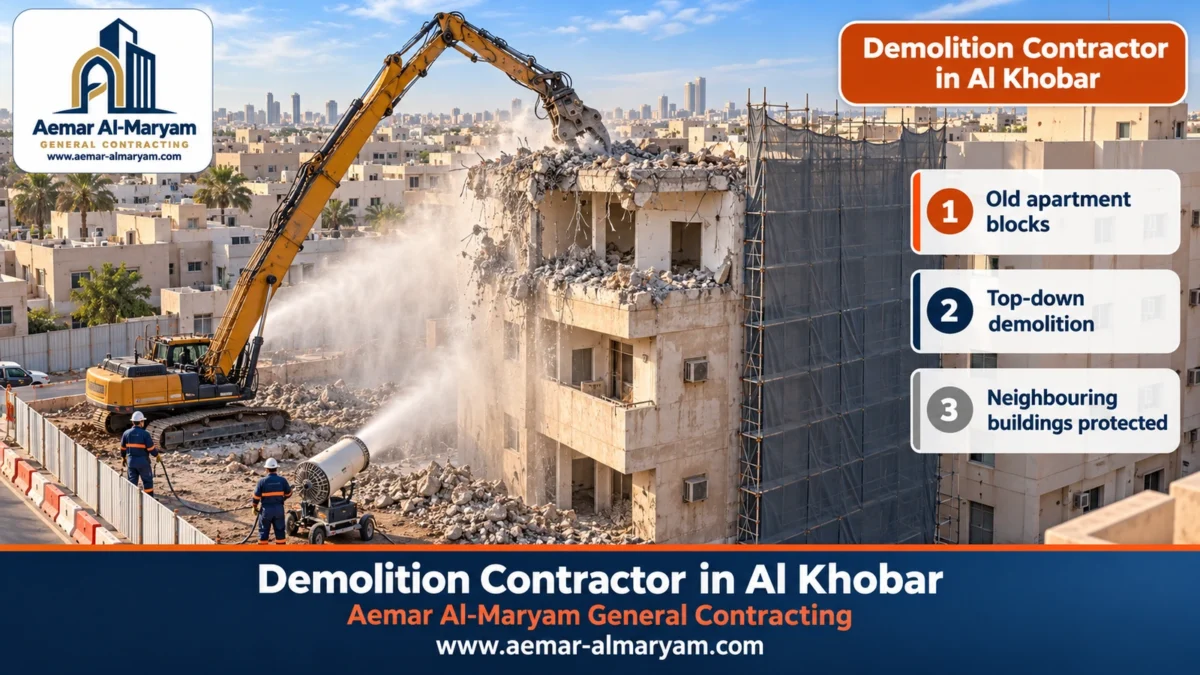
In Al Khobar, the building you want taken down rarely stands on its own. An old apartment block in Al Aqrabiyah or Al Thuqbah shares a wall with the block next door, a shop on a commercial street has people and cars passing its front all day, and the flat an owner wants stripped sits on the fourth floor above neighbours who live there. So a demolition contractor in Al Khobar is judged on one thing above all: removing what has to go without harming what stays. In practice: photograph the neighbours first, cut off the utilities, shield the pavement, work top-down, finish the strip beside the neighbour by hand, and send the rubble out with a licensed carrier. This is the work Aemar Al-Maryam General Contracting carries out in Al Khobar: demolishing old apartment blocks, houses, villas and shops; stripping flats and offices back to the frame; removing shop mezzanines, boundary walls and guard rooms; and breaking walls, floors and concrete. Taking out a block partition costs from SAR 185 and clearing a small traditional house from SAR 7,400, and every figure is an estimate until inspection and agreement. Phone or WhatsApp: 0547879578.
Most Khobar enquiries come from four kinds of client: a block owner who is tired of patching balconies and columns and wants to rebuild; heirs clearing an old family house before a sale; a new shop tenant inheriting someone else’s mezzanine and partitions; and a flat owner who needs ceilings, tiles and an old kitchen out without upsetting the whole building. The sections below follow those jobs, with the local factors that shape them: the adjoining neighbour, the narrow street, the occupied block and the effect of the sea air on old concrete.
Demolition and breaking in Al Khobar at a glance
- Demolition work: old apartment blocks, traditional houses, villas, shops and commercial buildings, boundary walls and guard rooms, annexes and rooftop rooms.
- Work inside buildings: stripping flats and offices back to the structure, removing shop mezzanines, and breaking block walls, tiles, floors and concrete.
- What makes Khobar different: adjoining buildings that need hand demolition beside the neighbour, narrow streets that need covered pedestrian walkways, and occupied blocks that need debris chutes and coordination with building management.
- Starting prices: SAR 185 per block wall, SAR 14 per m² of old tiles lifted, SAR 7,400 for a small traditional house, two-storey villas from SAR 13,900, larger buildings from SAR 46 per m² of total floor area, and a debris load from SAR 90. All are estimates until inspection and agreement.
- Permit: full demolition calls for Balady’s online permit, filed through an engineering office; Balady lists one to ten days for it.
- Contact: send the district name and photos of the building, the neighbours and the street on WhatsApp 0547879578.
Demolition contractor in Al Khobar: why demolition is different in a city of adjoining buildings
The basic difference is that demolition in Al Khobar usually happens a few centimetres from another building or from a pavement people walk on, so the priority shifts from speed to control. On a wide empty plot, a large excavator and a few days are enough. In an older, tightly packed district the plan starts with a different question: what must not be affected? The neighbour’s wall, the water tank on their roof, the cars parked in the street, the shop next door that is still trading, and the residents walking in and out. The answers decide which machine we bring, the order of work and the working hours.
■ The adjoining neighbour
A shared wall, or two walls touching with no gap. The part closest to the neighbour is taken down by hand, piece by piece, and their wall is braced when needed.
■ The narrow street
There is no room for two trucks at once. We schedule machines in and loads out at quieter times and protect the pavement with a covered walkway.
■ The occupied building
Stripping a flat or office among residents. Waste travels down a closed chute into a skip, and work runs to hours agreed with building management.
■ The shop on a busy street
A glass frontage protected from the inside, neighbours who are trading, and a mezzanine removed with a compact machine the operator controls remotely.
Hence no firm figure before a site visit: a corner block an excavator can reach from two sides and a mid-terrace block reachable only from the front may have identical floor areas and very different costs.
Demolition contractor in Khobar: what we take care of from the first visit to the clean plot
A demolition contractor in Khobar handles all the site work and coordinates with the engineering office on the permit and drawings. Put simply, you decide what is removed, we plan how it is removed, carry it out, haul the waste and hand back the site in the condition agreed. These are the stages every full demolition with us in Al Khobar goes through:
- 1Visit and inspection
We look at the building inside and out, photograph the neighbours and the street, and estimate the structure type, number of floors and amount of rubble. - 2Scope in writing
What comes down and what stays: the boundary wall, the underground tank, the ground slab, the foundations, the trees. - 3Permit coordination
The owner applies through Balady and chooses an engineering office; we give the office the information it needs about the method of work. - 4Utility disconnection
Temporary meter removal through the Saudi Electricity Company, and the water and sewer connections capped. - 5Site preparation
Fencing and mesh, protection of the neighbour’s wall, a pedestrian walkway if needed, warning signs and water sprays for dust. - 6Soft strip, then structure
Doors, aluminium, AC units and cables out first, then the structure from the roof down, with the part against the neighbour done by hand. - 7Haulage and handover
Rubble taken by a licensed carrier to approved sites, the ground levelled and the street cleaned, with handover photos.
More on each stage sits on the demolition service page, and examples of the company’s work are on the projects page. If you want to compare our approach in Al Khobar with how we work on more open plots, the guide for a demolition contractor in Dammam covers demolition in less crowded districts.
Demolition company in Khobar: what to ask before you hand over the keys
Before talking price, a demolition company in Khobar should answer five things plainly: how your neighbour is protected, where the machine stands, who hauls the rubble and to where, what remains afterwards, and who handles the permit and utilities. A vague “leave it to us” just moves the risk onto you. Here is how an organised company compares with day labour:
| Item | Organised demolition company | Day labour |
|---|---|---|
| Liability for damage | Set out in the contract | Usually unclear |
| Protecting neighbours and passers-by | A written plan: bracing, covered walkway, hand work beside the neighbour | Left to the worker’s judgement |
| Rubble | Licensed carrier and proof of disposal | May be dumped on vacant land, and the violation comes back to the owner |
| Equipment | Matched to the site: hand tools, mini excavator, remote-controlled machine | Limited to whatever is available |
| Price | All-in, with a written scope and stated exclusions | Per day, with no fixed end |
| Permit and coordination | Coordination with the engineering office and building management | Left entirely to the owner |
Before you sign
Ask for the contract to name the party that will carry the rubble and to commit to handing you proof that it was disposed of at an approved site. That document protects you if waste ever turns up dumped where it should not be.
Building demolition in Al Khobar: old apartment blocks, houses, villas and shops
Building demolition in Al Khobar is shaped more by building type than by size: a tall block needs long reach, an old house needs a mini excavator and hand crews, a villa needs early decisions on basement, pool and boundary wall, and a shop follows the rhythm of its street.
Demolishing an old apartment block in Khobar
An old concrete apartment block of three or more floors comes down from the top, one floor at a time, and no tall wall is ever left standing without support. The right machine is usually a hydraulic excavator with a long-reach arm and a crusher jaw that bites slabs and walls from their edges, so nobody has to climb onto a tired roof. Before we reach the structure we strip the building: doors, windows, aluminium, AC units, tanks and copper cables. Left in the concrete they would only add to haulage, so they are sold or sorted first, and mist cannons keep the dust away from the windows next door.
Where flats in the block have different owners, we need clear joint authorisation before anything starts. Where it is let, vacating it is the owner’s job, and we wait until it is empty, since the permit application itself declares the building free of people and animals.
Demolishing an old house in Khobar
Demolishing an old house in Khobar usually begins with hand stripping and continues with a mini excavator, because older houses in the inner districts sit on small plots along narrow streets. Many grew room by room over the years in mixed materials, so they do not behave as a single structure. Before starting we check any old roof sheets or canopies that could be asbestos cement, and we stop at them if there is any doubt. An old house very often belongs to several heirs, so we ask for the go-ahead to come from whoever holds the decision, so the job does not stall halfway through.
Villa demolition in Khobar
Villa demolition in Khobar needs an early decision on three points that change both price and duration. Is there a basement or a pool to be broken out or backfilled? Does the outer boundary wall stay or go? Are the foundations and ground slab to be pulled out, or is demolishing to ground level enough because the new build will excavate again anyway? A two-storey villa is normally taken down with a mid-sized excavator after the soft strip, while the part touching the neighbour’s villa is left until last and dismantled by hand.
Demolishing shops and commercial buildings in Khobar
A shop or commercial building is demolished by the rules of the street it stands on: peak hours, customer parking, and the shops next door that stay open. On commercial streets we prefer to schedule the noisiest work and the truck loads early in the morning or at times when traffic is lighter, and to keep the pavement open to the public through a protected walkway. Returning a shop to its shell is a different job, covered further down.
Demolition next to neighbours in Al Khobar: party walls and hand work
When the building being demolished directly abuts the neighbour’s wall, the excavator stops a safe distance short of the shared wall and technicians with hand-held electric breakers finish the job, from the top down, one small piece after another. The reason is simple: an excavator jaw is powerful but cannot tell your wall from your neighbour’s if the two are tied together with steel or mortar, and any sideways pull can crack the neighbour’s wall or knock tiles off their roof. Slower and slightly dearer, yes, but it ends without a quarrel next door.
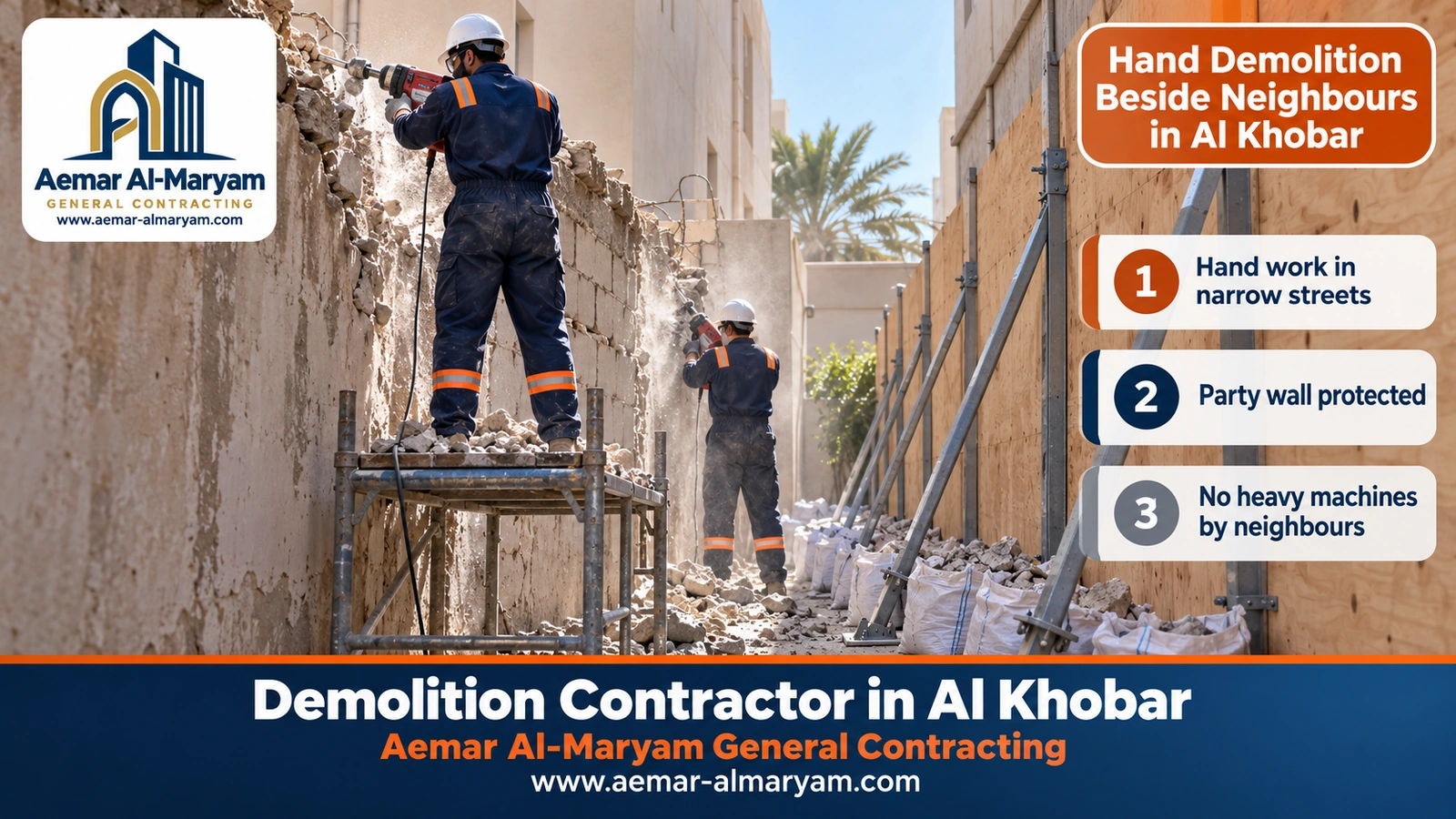
Before we touch the wall: recording the neighbours’ condition
The first thing we do on a site with adjoining buildings is photograph the neighbours’ walls, ceilings and existing cracks, inside if they allow it and always from outside, with a clear date. Many older buildings in Al Khobar already have cracks caused by humidity and salts, and if they are not recorded before demolition, every crack will be blamed on the demolition. Dated photos settle such arguments quickly.
Protecting the neighbour’s wall during and after demolition
- Protection boards: we cover the exposed part of the neighbour’s wall with timber boards or mesh to stop fragments.
- Raking props: if the neighbour’s wall relied on the demolished building for stability, or is tall and thin, we brace it with raking steel props until an engineer decides what is needed.
- Leaving the party wall: if the wall is jointly owned it is not demolished without agreement, and the solution is often to keep it and clean its face.
- Sealing the exposed face: removal can expose a face of the neighbour’s wall that has never seen sun or rain. We agree with the owner in advance who treats and waterproofs it, because leaving it open causes disputes later.
- Constant spraying: water sprays or mist at the breaking point to keep dust out of the neighbours’ windows and AC units.
⚠ When we stop and call in an engineer
If it turns out that a column or beam of the neighbour’s building bears on the wall of the building being demolished, or the foundations are shared, or a new crack starts to appear next door during the work. In those cases we halt that part until a structural engineer sets out a solution. We do not improvise.
Narrow streets and protecting passers-by during demolition in Khobar
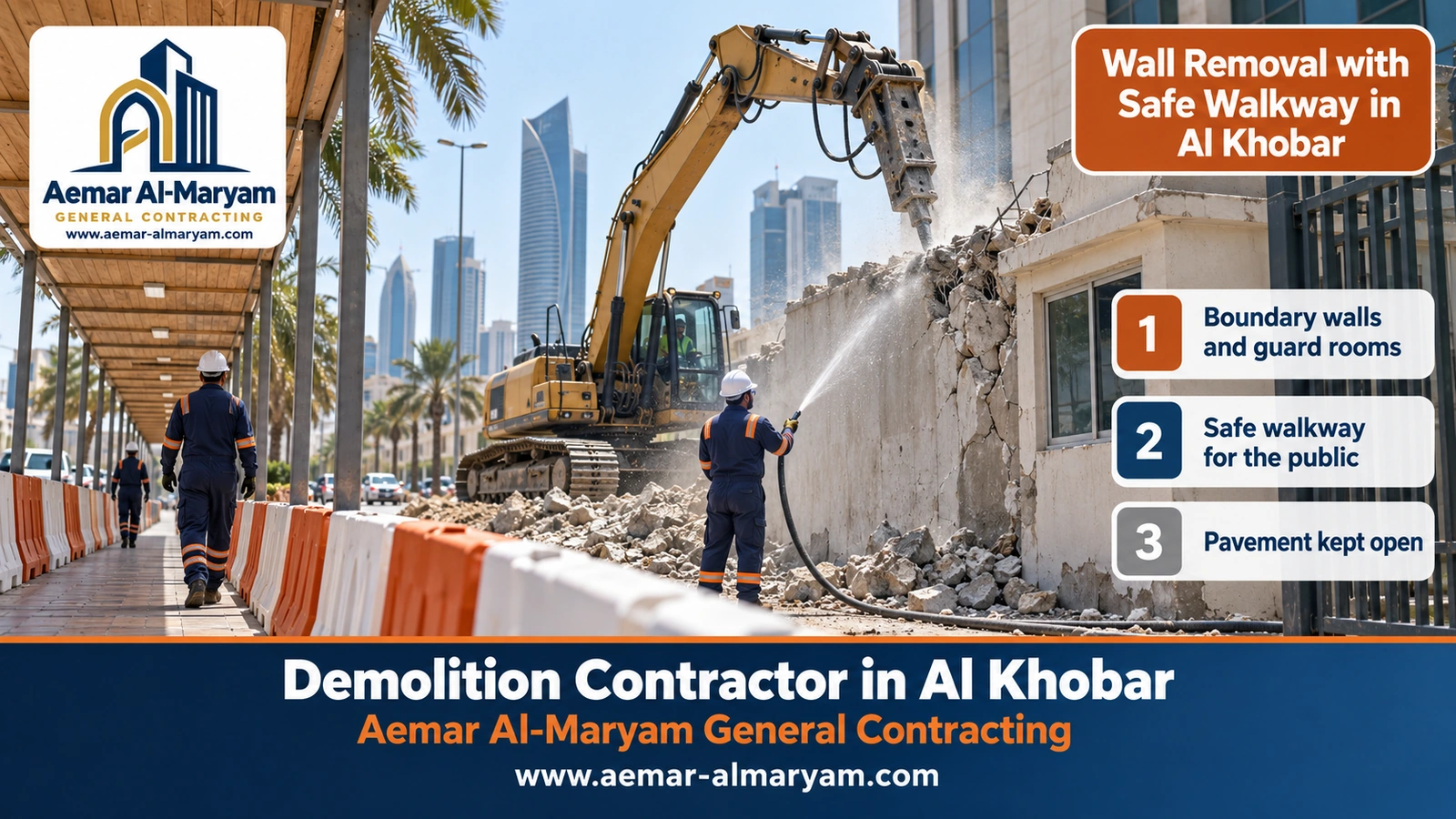
On a narrow street the people walking past need protecting as much as the site. Before machines arrive we fix where pedestrians walk, where the truck stands and when it moves. If the pavement runs right along the building, we put up a covered pedestrian walkway with a timber roof and clear barriers so that no fragment or stone can fall on anyone. If the street is too narrow for a truck to stop without blocking it, we schedule loads at quieter times, post a banksman to guide vehicles while the truck manoeuvres, and clean the dust off the street at the end of every day.
- ✓Covered pedestrian walkway: a timber roof with white and orange barriers along the site frontage when the pavement is right beside the building.
- ✓Cones and signs: to mark the truck and machine area and keep cars outside the reach of the excavator arm.
- ✓Load timing: rubble loaded at the least busy times possible, especially on commercial streets.
- ✓Covered loads: rubble trucks leave sheeted so nothing blows off on the road.
Removing an old boundary wall or guard room in Khobar
Removing an old concrete boundary wall and the guard room at a gate looks like a small job, but it is the work closest to the street and to pedestrians. We break the wall from the top down with a mini excavator fitted with a breaker, or by hand if it is low or close to lamp posts or cables, and before starting we set up a safe route along the pavement. If all you need is a gate opening in a concrete wall while keeping the rest, a saw cut is cleaner than breaking and is ordered through our concrete cutting service.
Stripping flats and offices in Khobar, with debris chutes
Stripping a flat or office means removing everything that was added to the structure: gypsum false ceilings, lightweight partitions, doors, the kitchen, tiles and ceramics with their mortar bed, and sanitary fittings, while keeping the columns, beams, slabs and facade walls. The real challenge is not the breaking; it is getting the waste down from the fourth or fifth floor without carrying it through the lift and the shared staircase.
Our answer is a closed debris chute: interlocking plastic tubes hung down the facade from the flat’s window to a mesh-covered skip at the kerb. Waste goes in at the hopper and lands in the skip, keeping dust out of the stairwell and weight out of the lift. We cone off the bottom of the chute so nobody stands next to the skip while it is being filled.
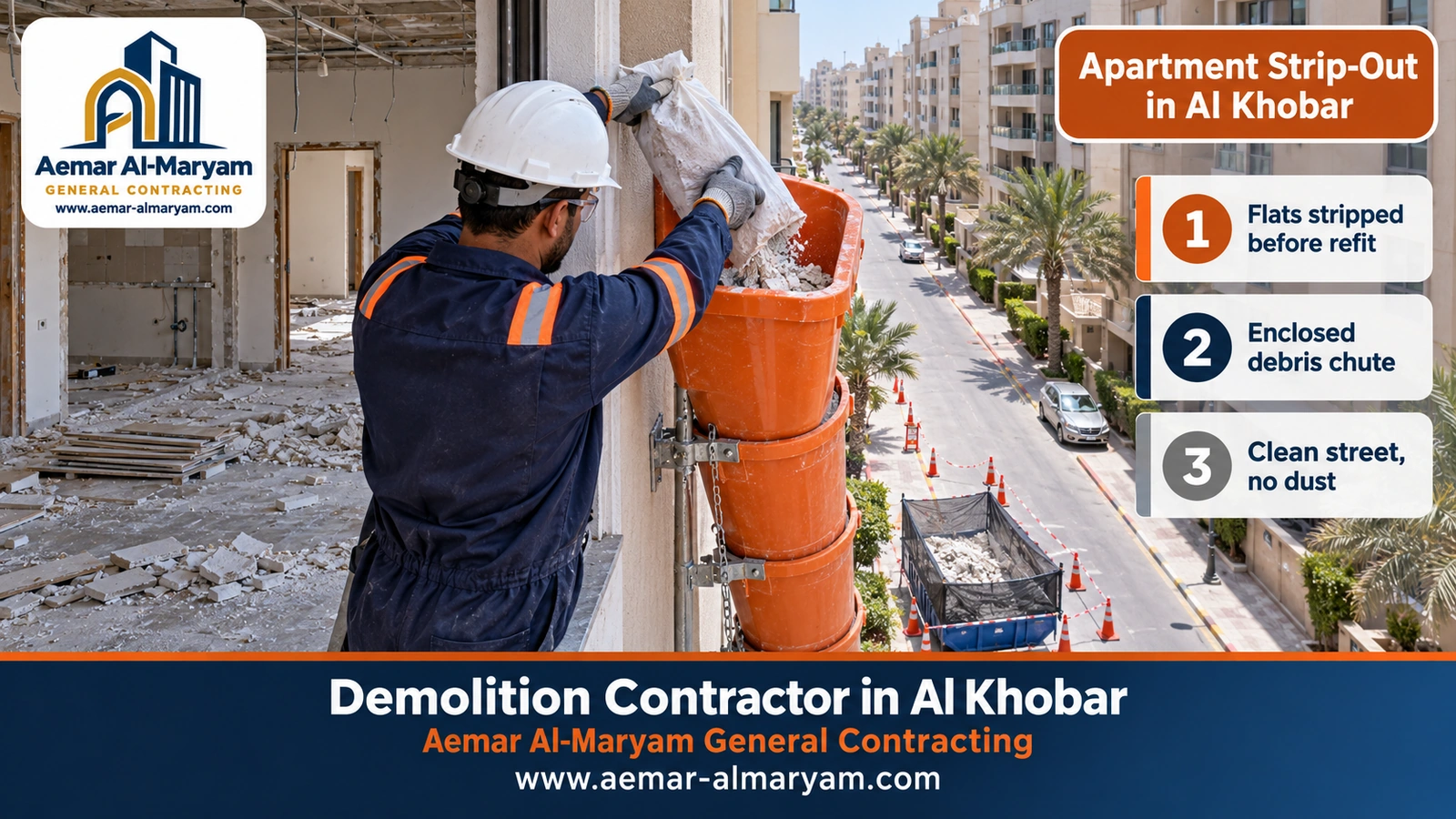
Working in an occupied building: building management and the owners’ association
In an occupied block we agree three things before starting with the owner and the building management, or with the owners’ association where there is one: the hours when breaking is allowed, where the chute and skip will go, and how shared areas such as the entrance, corridors and lift will be protected. In blocks sold as separate units, the owners’ association is set up under Saudi strata rules and looks after the shared areas, so its consent to hang a chute on the facade or park a skip outside the entrance heads off a great many complaints.
- We seal the flat door with a dust screen and lay protection boards along the corridor to the lift if we need to use it for tools.
- We isolate electricity only on the circuits we are working on, and make sure the shared rising water pipes are not touched.
- We never break a floor slab or concrete wall inside a flat without knowing what is under it and inside it, because the pipes of the flat below may run through it.
If the strip-out is the first step of a full refurbishment, the stage after the shell, waterproofing and finishing, is carried out by our renovation contractor in Khobar team within the same company, so you do not have to switch contractors.
Removing shop mezzanines in Khobar with remote-controlled demolition machines
An old concrete mezzanine inside a shop is removed with a compact tracked demolition machine that the operator controls remotely, with temporary steel props under the section not yet broken. The machine is small enough to come in through the shop door and strong enough to break a slab and concrete beams, and, most importantly, the operator stands well back outside the drop zone instead of under the slab being broken. That is the essential difference between this method and hand breaking in an enclosed space.
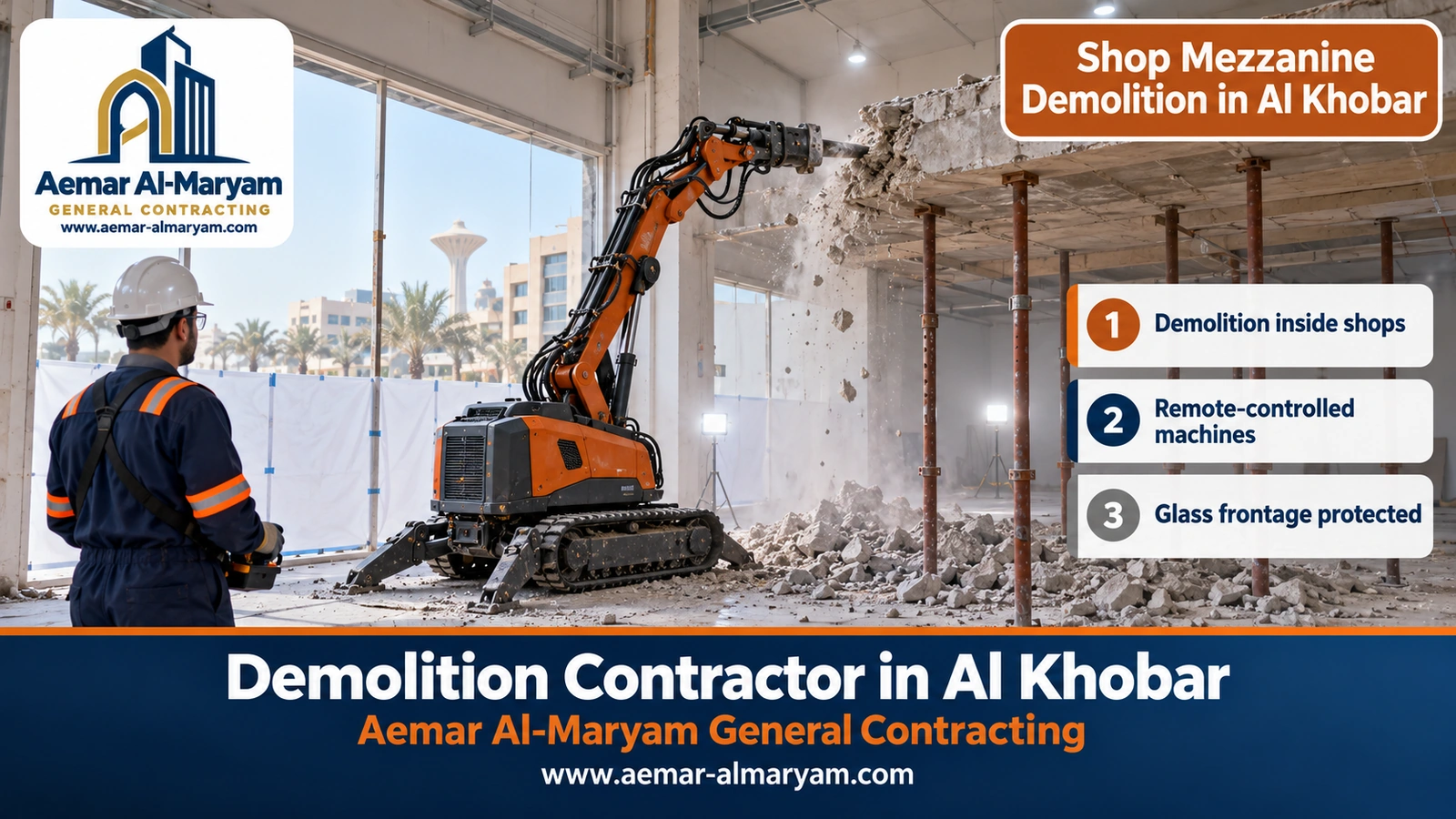
Before removing a mezzanine we check one important point: does it stand on its own columns, or is it tied into the building’s columns and beams? In the first case removal is simpler; in the second, the engineer decides where to cut the steel and how to treat the connection points on the original columns once the mezzanine is gone. In every case we protect the glass frontage from the inside with boards, because a single fragment is enough to crack a large pane.
■ Steel mezzanine
Dismantled by cutting the connections and sectioning it; the steel usually sells, which lowers the cost of removal.
■ Free-standing concrete mezzanine
Remote-controlled machine with temporary props, then rubble hauled when the street is quiet.
■ Mezzanine tied into the structure
Not started until an engineer has set the cut points and the treatment of the original columns.
■ The previous tenant’s walls
Block or gypsum partitions removed by hand, with anything that needs a clean edge cut rather than broken.
Full demolition, partial demolition, breaking or cutting? A table for what you need in Khobar
Most Khobar jobs remove part of a building that stays in use. Which of these four you need sets the method, permit and price:
| Type | When to choose it | Method | Usual permit |
|---|---|---|---|
| Full demolition | To rebuild the plot or sell it clear | Soft strip, then top-down with an excavator; hand work next to the neighbour | Demolition permit from Balady |
| Partial demolition | Removing an annex, rooftop room, mezzanine or boundary wall | By hand or with a small machine, with the remaining part supported | Set by the engineering office according to the element |
| Interior breaking | Flat strip-out, tiles, non-load-bearing partitions | Electric breakers and a debris chute | Usually none if the structure is not touched |
| Cutting without breaking | A neat doorway or window cut into concrete | Wall saw or wire saw | Engineer’s opinion if the element is structural |
Note: for partial work, the engineering office decides which permit applies once it knows the element being removed.
Partial demolition in Khobar: an annex, rooftop room or external staircase
Partial demolition in Khobar means removing one element while the rest of the building stays occupied, such as an old rooftop room, an annex in the yard, a corroded external staircase or a concrete canopy. We start by separating the element from the building that stays: the steel is cut at the junction after propping whatever needs it, and then the element is broken from the top. We never put a large excavator on the roof of an occupied building; this work is done by hand or with small machines. After removal we seal the junction so it does not become a way in for water.
Cutting without breaking in Khobar: when it is the better option
For a neat opening in concrete, or a slab lifted out in pieces instead of hammered over people’s heads, a diamond saw is quieter, gentler and cleaner. In adjoining buildings cutting is sometimes the demolition method itself: we section the slab against the neighbour into blocks and lift them out instead of hammering them. Details and prices are on the concrete cutting in Khobar page, and pipe and AC openings on core drilling in Khobar.
Breaking contractor in Khobar for walls, floors and concrete
Our Khobar breaking crews handle the jobs between maintenance and demolition, such as opening up a living room, lifting old tiles or breaking out a base for a new drain, usually in a home that is still lived in, so dust control comes first.
Wall breaking in Khobar
Before breaking any wall in Khobar we establish whether it carries load or merely divides rooms. In most blocks and villas with a concrete frame, internal block walls are partitions that carry no load, but that is never assumed without checking. Signs of a load-bearing wall include a thickness above roughly twenty centimetres, a beam sitting directly on it, a column above it, or the wall being concrete rather than block. A civil engineer has the last say, and if the wall does carry load, the ceiling is propped temporarily and whatever replacement beam the engineer designs is installed before removal.
Removing a wall between two rooms in Khobar
Removing a wall between two rooms in Khobar is usually a one-day job if the wall is a block partition. We isolate the switches and sockets in it, check whether water or AC pipes run through it, then break it from the top down and bag the rubble. Afterwards the floor strip under the old wall usually needs levelling and matching, and the ceiling and side walls need making good. If there is a column in the wall, the column stays and only the wall around it is broken.
Tile and floor breaking in Khobar
Tile and floor breaking in Khobar covers lifting ceramic, marble or porcelain together with the mortar bed beneath, down to a clean surface that can be built on again. We use medium electric breakers that do not shake the concrete slab, damp the floor to keep dust down, and leave the pipes exposed and intact until the plumber decides. Lifting old tiles with their mortar starts from SAR 14 per m², an estimate until inspection.
Concrete breaking in Khobar
Concrete breaking in Khobar covers old foundations, floor slabs, plinths, bases for AC units and generators, and corroded roof edges. Reinforced concrete needs a hydraulic breaker on a mini excavator, or a remote-controlled machine in enclosed spaces, followed by cutting the steel. On sites next to neighbours we sometimes prefer to saw the concrete into blocks and lift them out, because continuous hammering transmits vibration into the adjoining buildings. Reinforced concrete breaking is priced at inspection because thickness and steel density vary so widely.
Using an angle grinder (“rocket”) on walls in Khobar: real limits
The handheld disc cutter that people in Saudi Arabia call the “rocket” (الصاروخ) is a useful tool, but it does not break a wall on its own. What it does is score cut lines into the wall to a limited depth, so the breaking that follows drops the marked section with cleaner edges. The maximum depth of handheld cutters is about 125 mm, which is enough for a thin block wall or a skin of plaster but not for slicing through a thick concrete wall from one face.
- Good for: marking the edges of a small opening in a block wall, cutting plaster or tiles before removal, and cutting exposed steel.
- Not good for: thick concrete walls, load-bearing walls, or long precise cuts inside an occupied flat because of the heavy dust.
- The cleaner alternative: a track-mounted wall saw, which is the subject of the concrete cutting in Khobar page.
- Dust: a dry cutter fills a flat with fine dust, so indoors we use it with water or with extraction.
Old concrete and the coastal climate in Khobar: when is demolition better value than renovation?
Demolition is better value than renovation when the damage has spread widely through the load-bearing elements, not when the problem is in the finishes. Al Khobar is a coastal city, and field studies of concrete buildings in eastern Saudi Arabia recorded marked deterioration within a relatively short span of years. Reinforcement corrosion was the most widespread form, followed by sulfate attack and environmental cracking. On top of that, the region’s shallow water table carries salts that rise by capillary action into foundations and ground-floor columns. As a result, many older blocks look sound from outside while the steel inside the ground-floor columns is swelling and bursting the concrete around it.
Khobar Municipality has previously cleared dozens of dilapidated houses at risk of collapse after warning their owners, many of whom then took their buildings down themselves. Inheritance disputes and missing records for old buildings were among the hold-ups reported, so they are worth settling early.
Signs that make demolition a serious option
- ✓Rust in more than one column: concrete flaking off columns on the ground floor or in the parking level, with corroded steel showing.
- ✓Sagging ceilings: a visible dip in a slab, or repeated falls of plaster and concrete from bathroom and balcony ceilings.
- ✓Wide, growing cracks: diagonal cracks running from the corners of openings, or cracks in beams that widen over time.
- ✓An engineering report: if the engineer describes the damage as extensive in the structural elements, the real comparison is between the cost of strengthening and the cost of demolishing and rebuilding.
If the damage is in the facade, the render and the balconies, and the columns are sound or need only limited repair, renovation is usually far cheaper. We will set out both options honestly, and the renovation contractor in Khobar page explains what can be repaired and where prices start.
Demolish and rebuild in Khobar
If you decide to demolish in order to rebuild, we recommend that the engineering office designing the new building sees the site before demolition, to decide whether the old foundations should come out or will be excavated anyway, and whether the boundary wall should stay to secure the site during construction. After demolition the company can carry out the build itself through our construction service, so one stage hands over to the next with no gap.
Demolition permit in Khobar: obtaining it through Balady step by step
To pull down an entire building in Khobar you need Balady’s online demolition permit, applied for with an engineering office that fills in the technical data and plans. Balady asks for three things: the office contract, the fee, and either the building’s permit or its survey decision. Expect one to ten days. The steps run like this:
- 1Sign in to Balady
Through the national single sign-on, then choose the “Issuing a Building Demolition Permit” service under new applications. - 2Owner and building details
Specify the owner type and the applicant, then select the building permit or survey decision for the property. - 3Pick the engineering office
It adds the technical details and plans the demolition requires. - 4Declare the building empty
A declaration that the building will be free of people and animals during demolition, which is why it must be vacated before applying. - 5Pay and print
When the office finishes, Balady raises the fee invoice; once it is paid, the permit is ready to print.
Cases that come up often in Khobar: heirs, old buildings and subdivided blocks
- An old building with no building permit on file: Balady accepts the plot’s survey decision in place of a missing building permit.
- A house owned by heirs: it pays to settle the authorisation among the heirs before applying, because a dispute halfway through stops the work and multiplies the cost.
- A block divided into separately owned flats: the decision to demolish belongs to the owners together, and we ask for proof of their agreement before starting.
- A rented building: get the tenants out first, since the application includes the empty-building declaration.
Does breaking a wall or stripping a flat in Khobar need a permit?
Non-structural interior work such as removing tiles, false ceilings or a block partition counts as maintenance, so no demolition permit is usually needed. Removing a load-bearing wall, a column, part of a slab or a mezzanine tied into the structure is a structural alteration, for which the engineering office picks the right permit, possibly the service for adding and modifying building components. In an occupied block you also need the agreement of the building management or owners’ association for anything affecting the common parts.
How much is the demolition permit fee in Khobar?
Balady does not publish one flat fee; its online calculator works it out from the building’s data, and the engineering office charges separately. So our price table contains no figure for the permit, and we always keep the cost of the demolition we provide separate from the cost of the permit, which belongs to the owner and their office.
Utility disconnection and site safety before demolition in Khobar
No demolition starts in Al Khobar until electricity, water and sewer are disconnected outside the building line. The owner books a temporary meter removal with the Saudi Electricity Company, which offers it to customers rebuilding or renovating; ask early. Water and sewer connections are capped at the plot boundary and the drain is sealed so rubble cannot get into it. In commercial buildings we also make sure any gas lines are isolated and cylinders emptied and removed, and that telecom cables and illuminated signs are disconnected.
■ Pre-demolition survey
We identify the adjoining walls, any failing elements that could come down early, and the glass that must be removed before it can shatter.
■ Top down
External walls and slabs come down from the roof downwards, and no tall wall is left unsupported at the end of a day.
■ No loading of slabs
Rubble is never heaped on a slab or against a wall, because its weight can bring it down before its time.
■ Water against dust
Constant spraying or mist cannons, which are essential in Al Khobar where windows and AC units are so close.
Asbestos in older buildings: the stop rule
⚠ We do not break anything we suspect
Some older buildings may contain asbestos-cement roof sheets, canopies, pipes or tanks. Asbestos is banned in Saudi Arabia by Cabinet decision, which also calls for its replacement in existing buildings and its safe disposal, with a standing national committee overseeing the ban. Where we suspect it, that area is left untouched, with no hammering or cutting, until a licensed specialist chosen by the owner has dealt with it. We are not an asbestos removal contractor.
Debris removal in Khobar: a licensed carrier and proof of disposal
Demolition rubble in Al Khobar belongs at the sites designated by the Amana or the municipality, carried by a hauler whose licence comes from the National Center for Waste Management, never dumped on the nearest vacant plot. The Ministry of Municipalities’ requirements for disposing of construction and demolition waste oblige the permit holder to contract a licensed carrier; the supervising engineering office checks the carrier’s licence and the use of the waste-receipt form, and a final waste-receipt certificate is submitted with the end-of-works report. Dumping waste elsewhere exposes the offender to fines.
In Al Khobar specifically, narrow streets decide the size of the vehicle. In the inner districts we rely on small trucks and tippers that can get in and out quickly, while large skips are used where the pavement or the plot has room. We sort the rubble as we demolish: steel, aluminium and doors to one side, concrete and block to another, timber and gypsum to a third, because sorting cuts the volume hauled and raises the value of what can be sold. Each small-truck or tipper load costs from SAR 90; we count the loads at inspection.
Scrap buying in Khobar and demolition for scrap: what is the truth?
Demolition for scrap means the value of saleable materials is deducted from the cost of demolition. In some buildings it can cover a large part of that cost, but in most cases it does not make demolition free. You will see adverts for “free demolition” and “scrap buying in Khobar”, and the truth is that the scrap with real value is reinforcing steel, steel structures, aluminium, copper, doors and working AC units. An old concrete block is mostly concrete and block, materials that cost money to haul and cannot be sold, so its steel usually does not cover the machines, labour, haulage and protection needed in a tightly packed district.
| What is in the building | Scrap value | Effect on price |
|---|---|---|
| Reinforcing steel | Has value once extracted from the concrete | Deducted according to the expected quantity |
| Steel frames, mezzanines and canopies | Good value, because they come apart clean | Can lower the price noticeably |
| Aluminium, windows and doors | Moderate value | Deducted, or kept by the owner |
| Copper cables and AC units | Value if in good condition | Agreed before work starts |
| Concrete, block and tiles | Next to none | Full haulage cost |
The fair approach is to agree ownership of the scrap before starting: either the owner keeps what they want and pays the full price, or an estimated value for what we take is deducted from the price. It goes into the contract so nobody is surprised to find the doors or AC units went out with the rubble.
House demolition cost in Khobar: starting prices
Khobar starting points: SAR 7,400 for a one-storey traditional house, SAR 13,900 for a two-storey villa of roughly 300 m² floor area, and anything larger is priced from SAR 46 for each square metre of total floor area. These are starting points, with the firm price agreed after a site visit:
| Job | Unit | Starts from |
|---|---|---|
| Concrete block or building: full removal, breaking and collection | per m² of total floor area | SAR 46 |
| Villa or two-storey house, around 300 m² of floor area | lump sum | SAR 13,900 |
| Small old or traditional single-storey house | lump sum | SAR 7,400 |
| Block partition between two rooms, standard size | per wall | SAR 185 |
| Lifting old tiles or ceramics with their mortar | per m² | SAR 14 |
| Rubble load inside Khobar (small truck or tipper) | per load | SAR 90 |
| Flat or office strip-out with a debris chute | — | at inspection |
| Shop mezzanine, concrete boundary wall or guard room removal | — | at inspection |
| Annex, rooftop room, stair or canopy (partial) | — | at inspection |
| Reinforced concrete or load-bearing wall breaking (after an engineer’s report) | — | at inspection |
| Asbestos removal | — | not offered (specialist only) |
Please note: figures are estimates until inspection and agreement; they change with the structure type, number of floors, floor area, how many walls adjoin neighbours, street width and the amount of rubble. Photograph the building and its surroundings and send them to 0547879578 for an estimate.
Demolition price per square metre in Khobar
In Khobar a square metre of demolition starts from SAR 46 and is counted on the total floor area, meaning all floors added together, not the plot area. A three-storey block with 250 m² per floor has 750 m² of floor area and so starts at roughly SAR 34,500 before anything specific to its location is added. That is an illustrative example; in Al Khobar the usual additions are hand work beside the neighbour and pedestrian walkways.
Cost of demolishing an old house in Khobar
Demolishing a small old house in Khobar, if it is a single storey, starts from SAR 7,400. The price rises if the house adjoins neighbours on more than one side, if the street only takes small trucks, or if suspect materials turn up that need a specialist. It falls if there is steel, doors or aluminium whose value can be deducted.
Two-storey house demolition cost in Khobar
A two-storey house in Khobar of about 300 m² floor area starts at SAR 13,900; extra area is added at roughly the per-metre rate, so 400 m² comes to around SAR 18,400 as a starting estimate. Basements, water features and heavy foundations are quoted on top after inspection.
Villa demolition cost in Khobar
Khobar villa demolition also begins at SAR 13,900 for two storeys and roughly 300 m². What changes the figure for villas: are the boundary wall and annex being removed? Is there a pool or basement? Are the ground slab and foundations coming out? How close is the nearest neighbour? We list each item separately in the estimate so every riyal is visible.
Cost of demolishing a wall in Khobar
A standard block partition between two rooms in Khobar comes out from SAR 185. Concrete or structural walls are quoted on site once an engineer has looked, since they need propping and maybe a new beam. Finishing after removal, such as plaster, paint and floor patching, is priced separately if you want it.
What raises demolition costs in Khobar specifically?
■ Neighbours on more than one side
Every adjoining wall means extra hours of hand work, protection boards and props.
■ A narrow street
Smaller trucks and more loads, a covered walkway, and sometimes work restricted to set hours.
■ An occupied building
A debris chute and skip, protection of common areas and shorter working hours.
■ What lowers the cost
An open corner site, steel scrap, and grouping several jobs into one visit.
How long does demolition take in Khobar?
Floor area matters, but neighbours and street width matter more, since hand work and load timing add days. Approximate figures, confirmed at inspection:
| Job | Approximate time on site |
|---|---|
| Removing a partition between two rooms | Hours, usually one day including clean-up |
| Lifting the tiles in a flat or bathroom | One to several days depending on area |
| Complete flat strip-out | A few days to a week, depending on permitted working hours |
| Removing a shop mezzanine | Usually a few days, longer if it is tied into the structure |
| Small traditional house | A few days, haulage included |
| Demolishing a villa or an adjoining block | Longer; the schedule is set after inspection |
| Demolition permit from Balady | One to ten days, as Balady states |
Demolition methods and equipment we use in Khobar
Most Khobar projects mix methods: soft strip first, machines where there is room, hand work beside neighbours and indoors.
| Method | Equipment | Where we use it in Khobar |
|---|---|---|
| Selective demolition (soft strip) | Hand tools, cutters, small lifting gear | Removing doors, aluminium, AC units, cables and saleable steel before the structure |
| Mechanical demolition | Long-reach excavator with crusher jaw, mini excavator with breaker, loader and tippers | Apartment blocks, villas and houses where there is safe room for the machine |
| Remote-controlled demolition | Compact tracked demolition machine | Inside shops, warehouses and upper floors, including mezzanine removal |
| Hand demolition | Electric breakers, rebar cutters, steel props | The last wall beside the neighbour, occupied flats and rooftops |
| Cutting | Wall saw, wire saw, core drill | Clean openings and slabs sectioned into blocks for lifting out |
Blasting and wrecking balls have no place on our Khobar sites. Explosives need special authorisation and open sites that residential districts do not offer, and the ball is an old method that throws fragments and whose fall cannot be controlled. As for “laser demolition”, it does not exist on contracting sites; what is advertised under that name is actually diamond-saw cutting.
Your demolition contract in Khobar: clauses not to leave as a handshake
With no official standard demolition contract that we know of, use this practical checklist (not a legal template):
- ✓Scope: exactly what comes down and what stays: the boundary wall, the tank, the ground slab, the foundations, the party wall.
- ✓Protecting neighbours and passers-by: the advance record, hand work beside the neighbour, the walkway if needed, and who bears any damage.
- ✓Rubble: the estimated number of loads, the price of each extra load, the licensed carrier and proof of disposal.
- ✓Scrap: what the owner keeps, what the contractor takes, and the value deducted.
- ✓Utilities and permit: who requests the meter removal and who follows up with the engineering office.
- ✓Price and payments: lump sum, per metre or per load, the exclusions, and payments tied to completed stages.
- ✓Handover condition: a level, clean plot, with before and after photos.
How to hire a demolition contractor in Khobar
You hire a demolition contractor in Khobar with us by sending the property location and photos on WhatsApp 0547879578; we then agree an inspection time and send you the estimate and scope in writing. To save time, include in your first message:
- District and location: the name of the Khobar district and a map pin.
- Photos of the building: every facade, the roof, and the inside if possible.
- Photos of the neighbours and street: the adjoining walls, the street width, the pavement and the shops next door.
- Floors and rough area: plus how it is built, if known: concrete frame with block, or an older house.
- What goes and what stays: full demolition, a flat, a mezzanine, a boundary wall or a single wall.
- Legal status: the building permit or survey decision if you have one, and whether the building is occupied, rented or divided into owned flats.
Have a building, flat or shop in Al Khobar that needs to come out?
Send us the photos and the district, and we will suggest the method and a cost estimate.
Why choose Aemar Al-Maryam in Al Khobar?
■ A method built for adjoining sites
Hand demolition beside the neighbour and an advance record of the adjoining buildings.
■ Equipment to suit the space
Long-reach excavators for blocks, remote-controlled machines inside shops, and chutes for flats.
■ Prices that start from a clear figure
A published table and a written estimate that itemises each part and what is excluded.
■ Compliant rubble disposal
A licensed carrier, proof of disposal, and scrap sorted and deducted from the price.
■ One contractor for every stage
Demolition, then cutting, renovation or construction from the same company.
■ Honest about limits
We stop where asbestos or a structural element is in doubt and bring in the specialist.
Al Khobar districts we work in and nearby cities
We work across all of Al Khobar, from the older, more tightly packed districts to the newer commercial and residential ones. Districts we serve include:
We also serve Dammam, Dhahran and the rest of the Eastern Province, and the Al Khobar area page brings together all our services there. For all prices see the prices page, and to book an inspection use the request form.
Related pages for Al Khobar
Demolition contractor in Al Khobar: inspection and written estimate
Call or send your photos to 0547879578; all prices are estimates until inspection and agreement.
Tags