An electrician in Al Khobar from Aemar Al-Maryam General Contracting means an electrical crew that works on villas and flats across the city by agreed appointment: laying conduits in villa roof slabs before the concrete is poured, wiring the walls after blockwork, setting socket and switch heights with a laser level, installing distribution boards with residual-current protection and earthing, fitting garden and boundary-wall lighting with sealed fittings that stand up to coastal humidity, building data and satellite low-current boxes, and wiring bathrooms with the water-heater switch outside the door. Labour for rough-in starts at SAR 28 per square metre of built-up area or SAR 37 per point inside a project, and a connected distribution board starts at SAR 370; every figure here is an estimate that is confirmed once we have inspected the site and agreed the scope. Send your drawing or site photos on WhatsApp to 0547879578 and we will book the visit with you.
Anyone building a villa in Al Hizam Al Akhdar or refitting a flat in Al Hada soon finds that the electrical decisions arrive earlier than expected. The roof slab is poured in a single day, and anything not laid inside it before the pour can only get there later by core drilling the concrete or by hiding it under a gypsum ceiling nobody planned. Then the plasterer closes the walls over whatever is in them, and then the tiler sets the finished floor level from which every socket height is measured. Al Khobar is also a humid coastal city for most of the year, so whatever is fitted outdoors or in bathrooms needs tighter, better-sealed equipment than a house in an inland city. This page is written for the Al Khobar homeowner: the work done at every stage, the technical numbers behind it, the cost of each item, and the details to send so your estimate comes back clear.
At a glance: home electrics in Al Khobar with Aemar Al-Maryam
- Type of work: Scheduled projects for villas, flats and annexes: rough-in before the slab pour and after blockwork, boards and protection, sockets and switches, indoor and outdoor lighting, low-current systems, rewiring, and additions in occupied homes.
- What we don’t offer: We are not a night-time call-out or a 24-hour emergency service; we work by appointment after an inspection or a review of your photos.
- Prices start from: SAR 28 per m² of built-up area for rough-in, SAR 37 per point within a project, SAR 75 for a point added to an occupied home, SAR 120 for an AC line, SAR 370 for a distribution board, SAR 275 for an earthing system, SAR 90 for a data or satellite outlet, SAR 75 for an outdoor light, SAR 18 for a socket or switch at finishing and SAR 9 for a spotlight. All labour estimates, with materials chosen by you.
- Reference standards: We follow the Saudi Electrical Code SBC 401, which is built on IEC 60364, fit the Saudi three-pin 230 V socket, and protect socket, bathroom and outdoor circuits with a residual-current device rated at 30 mA.
- What is specific to Al Khobar: Sealed outdoor fittings that resist humidity and salt, wet-area boxes and covers, and a clear separation between power conduits and low-current conduits.
- Contact: Phone and WhatsApp 0547879578 with your drawing or site photos.
Electrician in Al Khobar: who we work for and how each electrical project starts
An electrician in Al Khobar from Aemar Al-Maryam starts every job with one question: what stage is your house at right now? If the roof slab has not been poured yet, the first visit is for planning conduit routes and ceiling light boxes on top of the rebar. If the walls are up in blockwork and waiting for plaster, the job is wall rough-in, points and the board. If the house is occupied and finished, the job is additions, rewiring or a new board, done with the least breaking possible. The stage changes the tools, the crew and the cost, which is why we ask for photos or a drawing before giving any price.
In Al Khobar we work on a scheduled-project basis rather than a fast call-out basis, and that is a deliberate choice. Good electrical work needs the drawing read, the loads calculated, the circuits laid out and the installation tested before it is closed up, and none of that happens in a rushed visit.
■ Villas under construction
Roof-slab conduits before the pour, then wall rough-in, the main and sub-boards, and the garden and boundary-wall electrics.
■ New or refurbished flats
Points at consistent heights, the flat’s own board, a low-current box in the corridor, and dedicated circuits for the kitchen and the air conditioners.
■ Occupied homes
Extra points, AC and water-heater lines, board replacement, and staged replacement of old wiring.
■ Annexes and majlis rooms
Feeding the annex from the main board, or preparing it for an additional meter when the permit allows.
Electrical technician in Al Khobar: who comes to your site, and when?
An electrical technician in Al Khobar from our team arrives on the day we agreed after reviewing your request, equipped for that specific job. For rough-in, a lead electrician who reads drawings and decides routes comes with technicians who fix boxes and pull cables. For additions and alterations, one or two technicians come with wall-chasing tools and test instruments. On full villa projects, a supervisor from the company coordinates with the plumber, the gypsum contractor and the tiler, because a late electrician holds up every other trade, and an electrician who runs ahead without coordination spoils their work.
Home electrician in Al Khobar: how does a villa differ from a flat?
A home electrician in Al Khobar mostly deals with two kinds of property, and each has its own logic. A villa in districts such as Al Hizam Al Akhdar, Al Aqrabiyah or Al Khobar Al Janubiyah usually means two or more floors, concrete slabs poured in stages, a garden, a boundary wall and a gate, and often an annex or an outdoor majlis. The electrical work starts early and runs alongside construction, and it needs a main board plus sub-boards for the floors. A flat in Al Hada, Al Olaya or Al Thuqbah has a fixed footprint and sometimes shares walls with neighbours; its board is usually inside the flat, and the challenge is fitting the points to the furniture in a smaller space and bringing low-current cabling from the building’s riser into the rooms without a tangle.
That is why we never give one price for a villa and a flat of the same size. The villa has external runs, garden lighting, pump circuits and several floors; the flat has a higher density of points per square metre.
Electrical rough-in in Al Khobar before the slab is poured: slab conduits and ceiling boxes
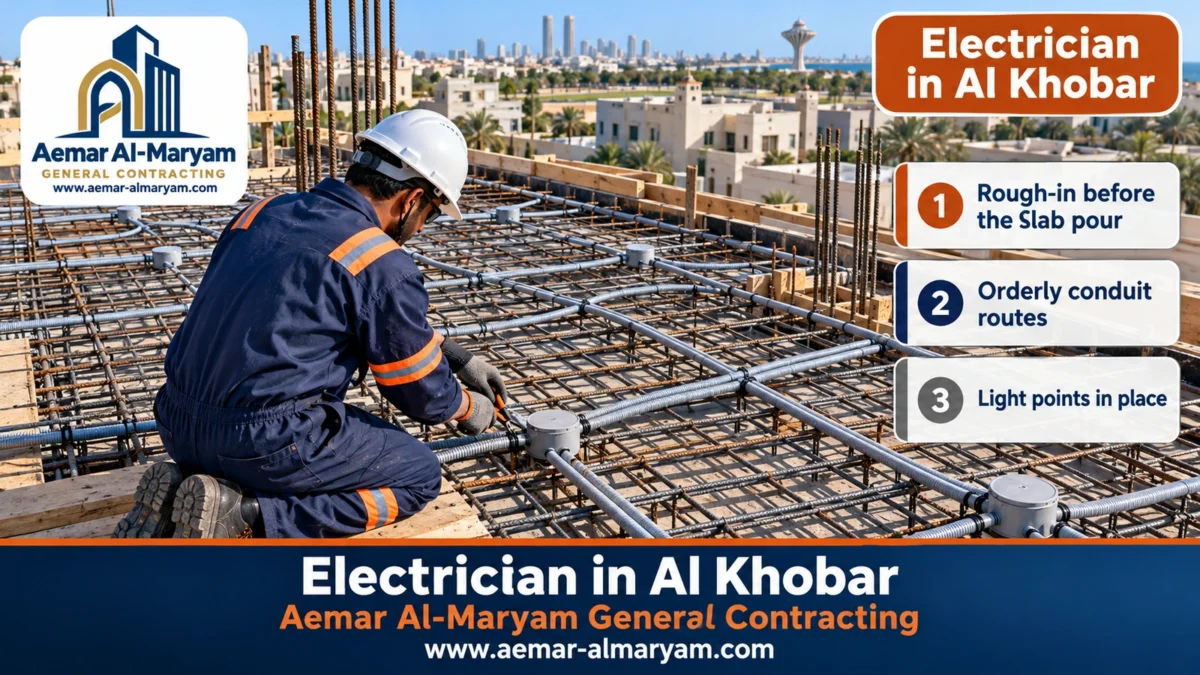
Electrical rough-in in Al Khobar for a new villa begins on top of the roof-slab rebar before the concrete arrives. We lay flexible electrical conduits along orderly routes to the round ceiling boxes that will carry the lights, chandeliers, fans and surface-mounted spotlights, and we tie both boxes and conduits to the steel so they do not shift while the concrete is placed and vibrated. This is the one electrical step that cannot be postponed: any point forgotten in the slab only comes back by drilling through concrete or by hiding it beneath a gypsum ceiling that was never part of the design.
What goes into the concrete roof slab before the pour?
– Ceiling light boxes:: At chandelier positions, room centres and fixed lighting positions, following the electrical drawing or the furniture layout, and allowing for any planned gypsum ceilings.
– Drops to the walls:: Conduits that come down from the slab to switch positions on the same floor, or rise to the floor above for its sockets and switches along agreed routes.
– Sub-board feeders:: The main runs between the main board and each floor’s board, sized for the cables specified on the drawing.
– Low-current conduits:: A separate route for the data, satellite, intercom and camera box that never shares conduits with power.
– Roof points:: Conduits for roof lighting, outdoor sockets and rooftop AC units where they sit on the roof, with their ends sealed before the waterproofing goes on.
How do we make sure the conduits are not blocked during the pour?
Concrete is heavy, workers walk across the rebar, and the vibrator moves everything. So we leave a draw wire inside long conduits, cap the box openings so concrete cannot get in, lay walk boards over the busiest routes, and, where possible, have one of our technicians present during the pour to spot any crushed conduit or tipped box. Once the formwork is struck we test-pull cables through the main routes early, because a blocked conduit found before plastering is solved with a small change, while one found afterwards means breaking out.
⚠ Never cut beams or columns to pass electrics
If a conduit or cable route needs to cross a beam or a column after the pour, that is a structural decision the electrician should not take alone. We stop and refer it to the engineer, and the approved opening is made by diamond core drilling, as explained on the core drilling in Al Khobar page, or the route changes. Random breaking into structural members opens the door to cracks that have nothing to do with the electrics; they are covered on the crack repair in Al Khobar page.
After blockwork and before plaster: wiring the walls
Once the blockwork is up, the second stage starts: cutting wall chases with proper tools instead of random hammering, fixing socket and switch boxes at the agreed heights, joining the wall conduits to the slab routes, and setting the board enclosure in place. This stage runs alongside the plumbing rough-in, so we agree with the plumber in Al Khobar on where the water heaters, pumps and washing machine will sit, so that each power point ends up beside its appliance rather than behind a door. After cables are pulled and tested, the walls are closed by the plastering contractor in Al Khobar, followed by gypsum board installation in Al Khobar, painting and tiling, and we return at the finishing stage to fit the sockets, lights and breakers.
Electrical point prices in Al Khobar: how are points counted?
The price of an electrical point in Al Khobar begins at SAR 37 of labour for a standard light or socket outlet that forms part of a complete rough-in, and at SAR 75 for an outlet added later to a lived-in, fully finished home, since the technician has to cut a channel into plastered wall and then make it good. The difference between the two figures is not in the cable itself but in the work around it. During rough-in the walls are open and the conduits already run; in an occupied home we protect the furniture, cut, and then make good the small patch of plaster.
To an electrician, a point is any outlet that has a box and a cable end: a socket box, a switch box or a ceiling light box. Not all points are equal. Outlets for an air conditioner or a water heater call for a thicker conductor and a breaker of their own, so they are charged as dedicated lines rather than ordinary points. A data or satellite point has its own conduits and its own box, so it is priced as a separate item as well.
| Type of point | How we count it | Starts from (SAR) |
|---|---|---|
| Light or socket inside a rough-in project | Point | 37 |
| New point in a finished house | Point, including cutting and filling the chase | 75 |
| Split AC line with its breaker | Line | 120 |
| Water-heater or extract-fan connection | Point | 65 |
| Data or satellite point | Point | 90 |
| Outdoor light or floodlight | Point | 75 |
A quick way to estimate how many points your home needs
Take the furniture layout and mark every place you will want a socket, a switch or a light: both sides of the bed, the TV wall, the desk, the kitchen worktop, the washing machine, and the entrance of every room. A mid-sized bedroom usually comes to 8 to 12 points between lights, sockets and switches, and a kitchen to more. Send us the drawing with your marks and we will check the count and suggest what is missing.
Villa and flat electrical rough-in in Al Khobar: circuits and cable sizes
Circuits are how the load is shared out across the board, and getting them right is the difference between a house that runs quietly and one whose breaker trips every evening. The rule we work to is this: lighting is kept on circuits separate from the sockets, sockets are split over several circuits by room, and every air conditioner, water heater, oven and washing machine gets its own circuit and its own breaker. Cable size is a design decision calculated from the load, the run length, the installation method and the breaker rating, not a habit passed down. The Saudi code requires conductor cross-sections to be chosen for both normal and fault conditions.
| Circuit | Common practice for cable size | Note |
|---|---|---|
| Lighting | 1.5 to 2.5 mm² | Kept apart from sockets so the house does not go dark when one socket faults |
| General sockets | 2.5 to 4 mm² | Spread over several circuits and protected by a 30 mA RCD |
| Split air conditioner | 4 to 6 mm² | One circuit and breaker per unit, sized to its rating |
| Water heater | Usually 4 mm² | Own breaker and a double-pole switch outside the bathroom |
| Oven and washing machine | 4 to 6 mm² | A dedicated circuit for each heavy appliance |
| Sub-board feeder | By load and distance | Calculated from the load schedule, not guessed |
These figures are common market practice rather than the text of the code, and where an engineering office has produced a drawing we follow it. The Ministry of Municipalities and Housing, in its rules for residential buildings, calls for electrical drawings and material specifications approved by an engineering office, and for cables and equipment that conform to Saudi standards. In a villa we usually recommend a sub-board per floor; in a flat, a single board with enough spare ways for an air conditioner or appliance added later.
Apartment electrical rough-in in Al Khobar
In a flat every centimetre counts. We start from the furniture layout rather than the bare walls: where the bed will stand, where the TV goes, whether the kitchen opens onto the living room, where the washing machine, the vacuum cleaner and the phone charger beside the sofa will be. Then we lay out the circuits so that the kitchen and AC loads do not pile onto one breaker, and we place the low-current box in the corridor close to where the building’s cables come in.
What a villa adds to the picture
A villa brings items a flat never has: a pump for the water tank, a gate motor, lighting along the boundary wall, an outdoor majlis, sometimes a rooftop room. Each of these is a circuit, and each runs a long way from the main board. We plan them at rough-in so that the feeders are in place before the yard is paved, rather than digging up finished paving later to run a cable to a gate.
Sockets and switches in Al Khobar set out by laser: heights measured from the finished floor
Socket and switch installation in Al Khobar starts for us with a horizontal laser line on the wall, not with a ruler and a pencil. Standing the laser at the centre of the room, we throw a single level line around all four walls, take every height from the floor level the tiles will finish at rather than from the raw slab, and fix the boxes to that line. The result is that every switch beside every door sits at one height and every socket in the room sits on one line, so no socket ends up two centimetres higher than its neighbour once the paint is on.
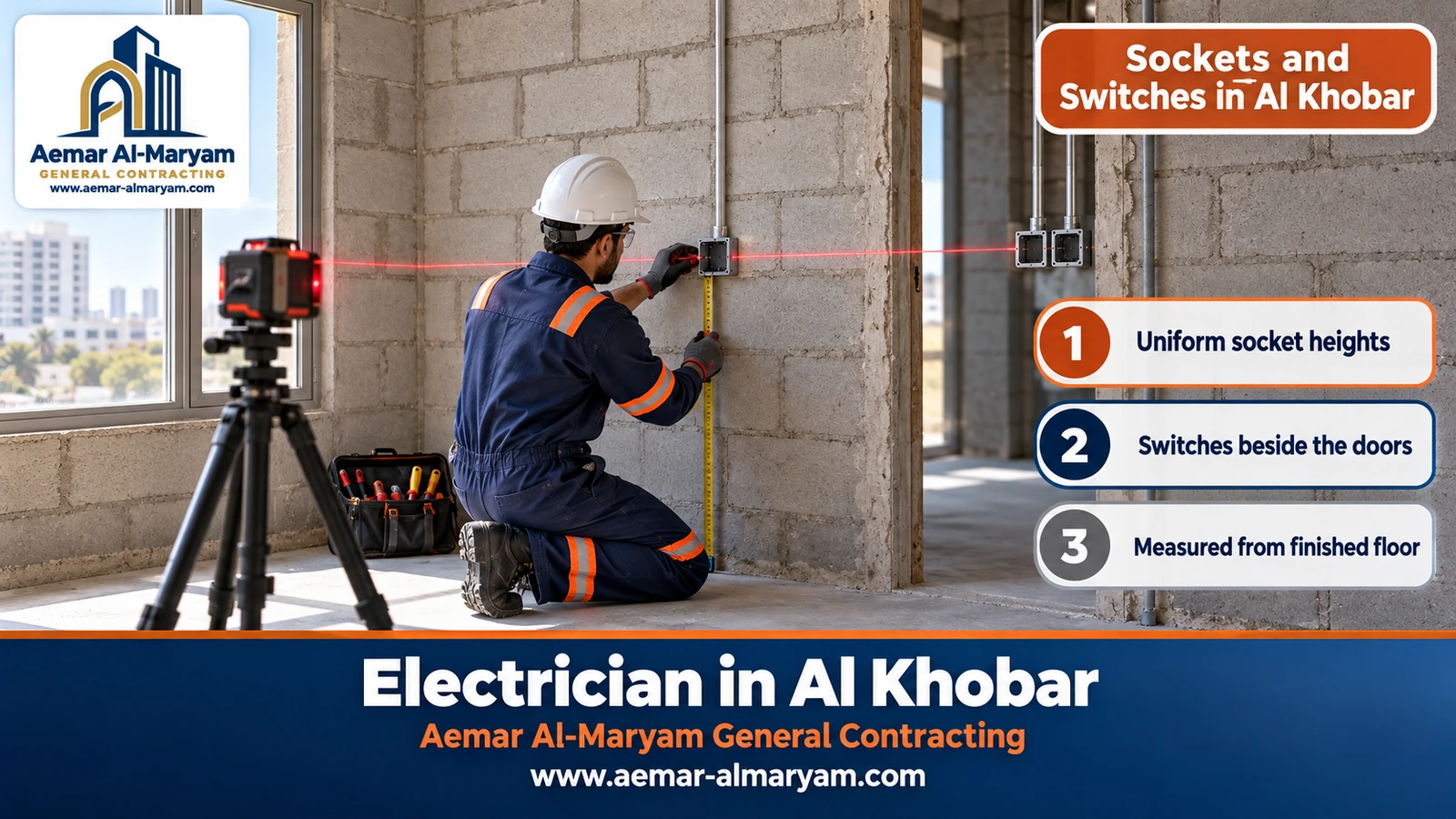
The reason for measuring from the finished level is simple. The difference between the slab and the finished tile, including the mortar bed, can be several centimetres, and anyone who measures from the concrete finds his sockets closer to the floor than he planned. So before rough-in we ask about the floor finish and its thickness, and we agree the finished level with the tile installer in Al Khobar.
| Position | Common height above finished floor | Note |
|---|---|---|
| Light switches beside doors | About 120 cm | On the opening side of the door, not behind it |
| General room sockets | 30 to 40 cm | Unless the furniture layout says otherwise |
| Bedside sockets | 70 to 80 cm | Above bedside-table level |
| Kitchen worktop sockets | About 15 to 20 cm above the worktop | Once the counter and sink heights are known |
| Washing machine and oven | 60 to 70 cm, or to the appliance | Dedicated circuit |
| TV and data outlets | To the screen or unit height | Grouped with the satellite and network points |
These are practice figures, not laws
The heights above are common market practice, and the right answer always comes from your own furniture. If you have an interior design, we work to its heights; if not, we sit down with you over the drawing before the laser goes up.
The socket used in the Kingdom today runs at 230 V with three pins, and its Saudi specification derives from the British one; every socket we install has its own earth conductor.
Distribution board installation in Al Khobar: the board, breakers and protection
Distribution board installation in Al Khobar starts from SAR 370 for the board with its connection, a new breaker in an existing board from SAR 90, and board maintenance with load rebalancing from SAR 185. The board is the heart of the installation: it holds the main breaker, the residual-current devices, a breaker for each circuit and spare space for what will be added later. We place it somewhere dry and easy to reach, never inside a closed wardrobe, in a bathroom or under a water source.
- ✓Number of ways: Calculated from the actual circuits plus spare ways, because a house designed without spare capacity ends up with a second board.
- ✓Main breaker: Its rating follows the meter subscription with the Saudi Electricity Company; residential meter breakers range from 20 A to 200 A at 400/230 V.
- ✓Residual-current devices: 30 mA for socket, bathroom, kitchen and outdoor circuits.
- ✓Labelling: Every breaker carries the name of its circuit, and you receive a printed circuit schedule.
- ✓Sub-boards: In villas, one per floor or for the AC units, so a fault cuts off one part rather than the whole house.
When does your Al Khobar home need a new board?
You need a new board if it has no residual-current device, if its breakers are old and run warm or fail to trip under test, if it is full with no room for a new AC line, if it shows scorch marks or rust, or if it belongs to the old 110 V system and the house is moving to 230 V. In homes close to the sea we sometimes find rust at the terminals of boards installed in spots exposed to humidity; there we suggest moving the board to a dry indoor position where that is possible.
Earthing and the 30 mA residual-current device
The Saudi Electricity Company lists earthing among the things it requires before it energises a residential building, and a house earthing system with us begins at SAR 275. The idea is that any leakage to the metal body of an appliance finds a safe path to ground instead of through a person. The 30 mA residual-current device is the second layer of protection: it cuts the supply on a small leakage that an ordinary breaker would never notice. The IEC rules behind the Saudi code call for this extra protection on socket circuits rated to 32 A and on all bathroom circuits, and summaries of the Saudi specifications extend it to kitchens, wet areas and outdoor sockets. We never use water pipes as an earth, and we never bond neutral to earth downstream of the board.
Bathroom electrics in Al Khobar: the heater switch outside the door and sealed fittings
Bathroom electrics in Al Khobar need extra care because steam and condensation combine with the humidity of a coastal climate. Our first rule is that the water heater’s double-pole switch, with its indicator lamp, goes outside the bathroom door, so it isolates both conductors at once and everyone at home can see whether the heater is on. Our second rule is that bathroom lighting is a closed, sealed, vapour-proof type. The standards divide a bathroom into zones around the shower and the basin, require at least IPX4 in the two zones nearest the water, and require a 30 mA RCD on every bathroom circuit.
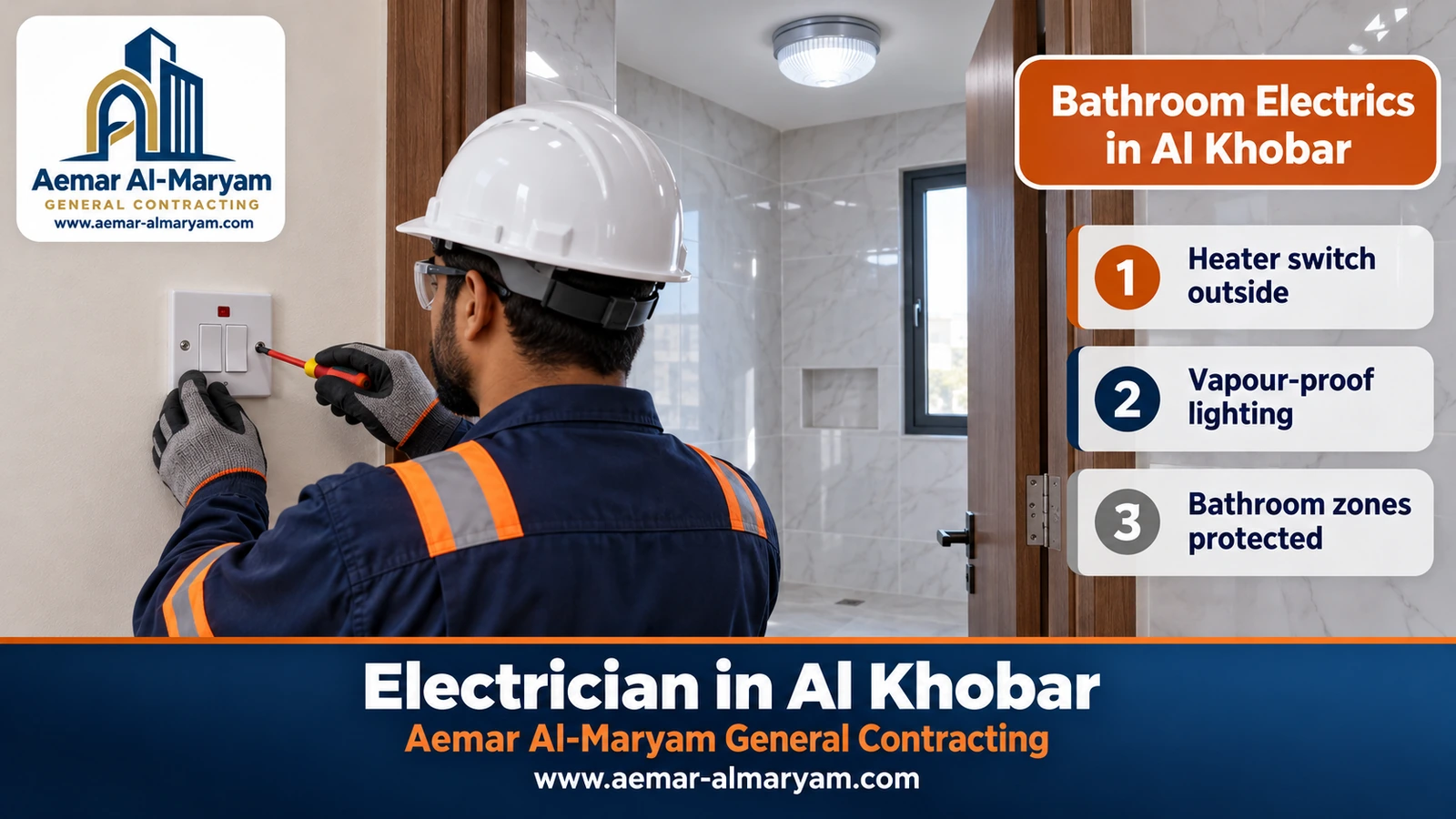
- Heater switch: Double-pole with an indicator lamp, outside the bathroom, on its own circuit and breaker.
- Lighting: Closed and sealed against steam, positioned away from direct shower spray.
- Extract fan: Its own point, linked to the light switch or on a separate switch as you prefer.
- Sockets: None inside the shower zones; any shaver or hair-dryer outlet sits outside the zone nearest the water and behind the RCD.
- Boxes: Corrosion-resistant boxes and outlets in wet areas, because rust shows up faster on ordinary metal boxes in humid air.
Timing matters too. Bathroom conduits are laid before plaster alongside the plumbing, and the lights and switches are fitted after tiling and before the sanitaryware, so that we do not scratch the tiles or work around basins. A water-heater or extract-fan connection starts from SAR 65; installing the heater itself with its safety valve is the plumber’s job.
Kitchen electrics in Al Khobar flats and villas
The kitchen is where loads gather most: an oven, a microwave, a kettle, a fridge, a dishwasher and sometimes an electric hob. We plan the worktop sockets once the cabinet and counter design is known, put the heavy appliances on dedicated circuits, protect the worktop sockets with the RCD, and leave a point for the cooker hood above the hob and a point for under-cabinet lighting if it is in the design.
Outdoor lighting in Al Khobar and garden electrics in a coastal climate
Outdoor lighting in Al Khobar lives in tougher conditions than any point inside the house: high humidity in summer, dew on surfaces on many nights, air carrying salt from the sea, and irrigation sprinklers that soak short bollards every day. An outdoor light point starts from SAR 75 with us, and we choose sealed fittings with an ingress-protection rating to suit their position: IP65 for fittings exposed to spray and dust, and higher ratings such as IP67 for in-ground uplights buried in the soil, plus sealed weatherproof covers for the outdoor sockets in the boundary wall.
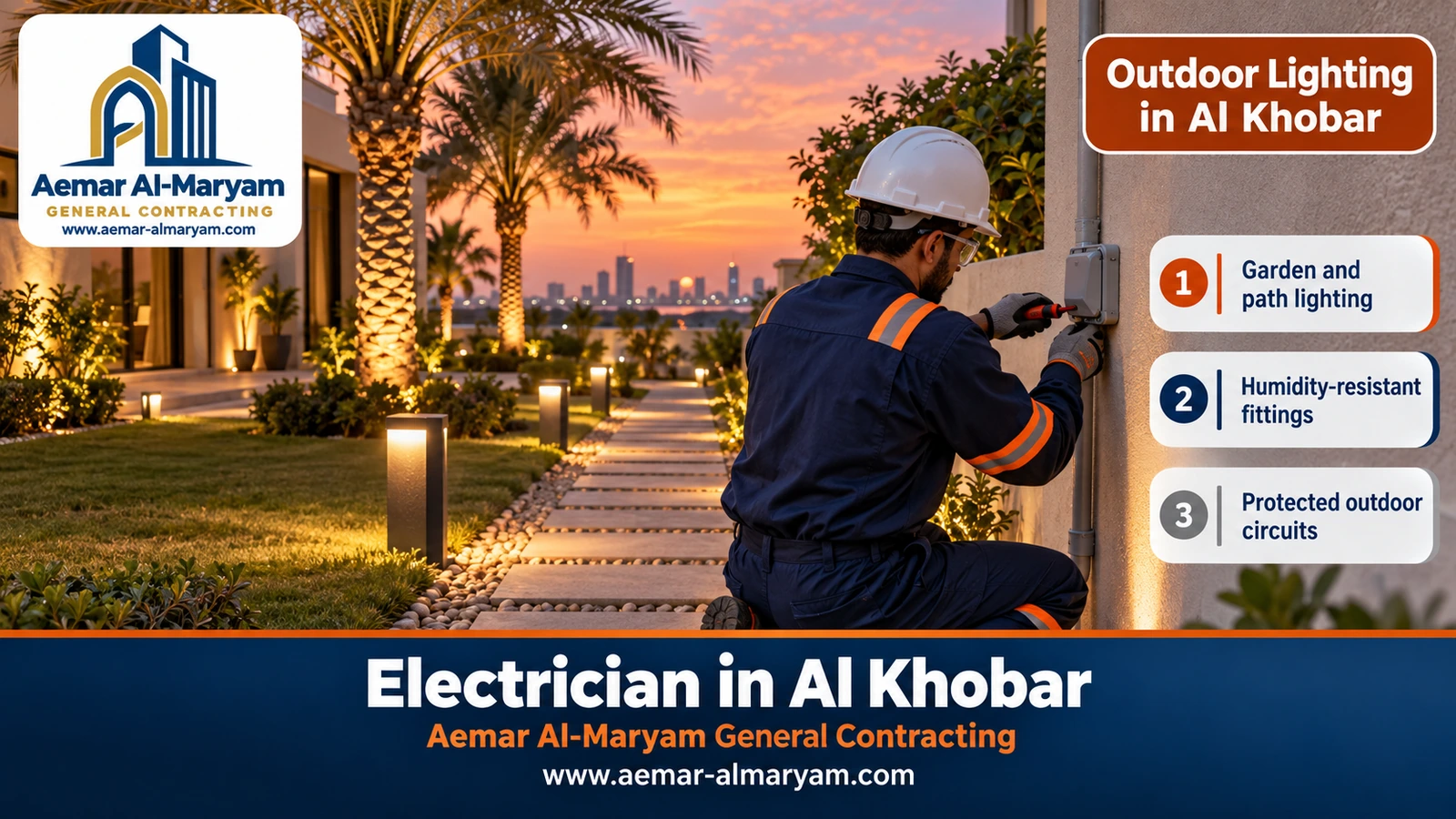
■ Path lights and bollards
Mark the way from the gate to the entrance, fed by buried cable in conduit.
■ In-ground uplights for palms and trees
Sealed buried fittings positioned away from where irrigation water collects.
■ Boundary-wall and gate floodlights
On a switch, a timer or a photocell, with their own RCD-protected circuit.
■ Garden sockets
For garden tools and small pumps, with sealed covers that only open in use.
How do we lay buried cables in a garden?
Buried cable goes inside conduit at a suitable depth; common practice is about 60 cm on a sand bed with a warning tape above it, so that nobody planting a tree a year later cuts through it. We keep cable routes as straight as possible, mark them on the garden plan, and hand you a photo of it. Every outdoor circuit sits behind a 30 mA RCD, because moisture in outdoor joints is one of the most common reasons RCDs trip in coastal homes.
Advice for Al Khobar homes close to the sea
In houses exposed to sea air, choose outdoor fittings made of corrosion-resistant materials, avoid ordinary steel screws on covers, and ask for the cable to enter each box from below so water cannot run down into the joint.
Data and satellite wiring in Al Khobar: the low-current system
Data and satellite wiring in Al Khobar starts from SAR 90 per point, and we treat it as a system of its own rather than an add-on to the power wiring. We set a low-current distribution box in the corridor or near the entrance, and separate conduits run from it to the rooms: a network cable to every room that needs a wired connection, a satellite cable to every screen, an intercom point at the door, and routes for cameras around the house. Standard practice keeps low-current conduits about 30 cm away from power conduits so interference does not spoil the picture or the connection.
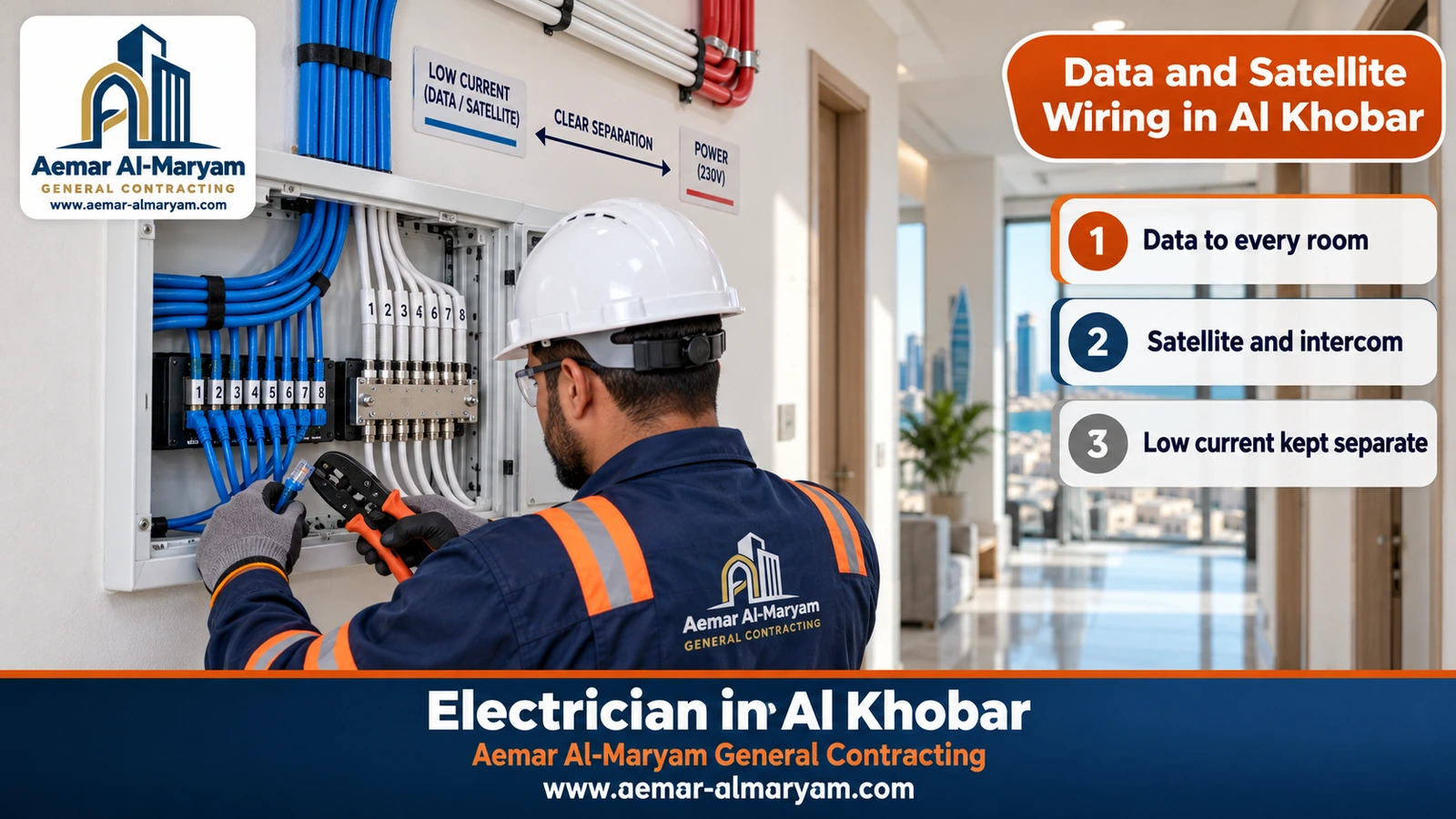
- 1One collection box
Every cable in the house ends in one accessible place, instead of being joined in scattered boxes above the gypsum. - 2Every cable numbered
A label with the room number at both ends, so the internet technician knows later which cable serves which room. - 3Spare conduits
An empty conduit with a draw wire to the living room and the master bedroom for whatever gets added years from now. - 4A power socket beside the box
For the router and switch, so no lead has to trail in from another room. - 5Every point tested
We check the continuity of each cable before the walls close and hand you a schedule of points.
Video intercoms, cameras and electric-vehicle chargers are priced at inspection because their scope varies widely from house to house, but we lay their conduits during rough-in even if you decide to fit the equipment later.
Spotlight installation in Al Khobar, chandeliers and hidden lighting
Spotlight installation in Al Khobar begins at SAR 9 a spotlight, cut-out included, when the ceiling is new gypsum; hanging a chandelier begins at SAR 55, and concealed LED strip at SAR 45 a running metre. A single spotlight or two in a home that is already lived in is charged as a visit, since travel and set-up outweigh the fitting time.
Lighting in modern ceilings depends on coordination with the gypsum contractor. We agree spotlight positions with him before the ceiling is closed, run cables above the gypsum in flexible conduit rather than loose, and leave an access hatch near the drivers of the hidden lighting. A heavy chandelier needs a fixing point anchored in the concrete, not in the gypsum, so we ask for its weight before fitting it. The gypsum work itself is covered on the gypsum board installation in Al Khobar page.
- Spotlights: Split over more than one switch or circuit so you can light the living room in stages.
- Hidden lighting: Drivers placed where they can be reached, never buried above a completely closed ceiling.
- Chandeliers: A concrete fixing point, a ceiling box of the right size, and an earth connection for metal fittings.
- Smart control: If you are considering smart switches later, we run a neutral to every switch box from the start.
AC lines, water heaters and additions in occupied Al Khobar homes
AC lines are what Al Khobar residents ask for most after rough-in, because the long humid summer means every room needs its own unit. A split AC line with its breaker starts from SAR 120. We run it from the board to the indoor unit position with a cable sized to the unit’s rating, and coordinate the route with the condensate drain and the copper pipe so they do not crowd each other inside the wall. Wiring a whole room, as rough-in or as a rewire, starts from SAR 460.
In an occupied home we work with as little disruption as we can: we cover floors and furniture, cut chases with tools that keep the dust down, fill the chase after testing, and leave the small patches ready for paint, which you can arrange with the painting contractor in Al Khobar. Where an addition has to pass through a concrete wall or slab, we use drilling instead of breaking, as on the concrete cutting in Al Khobar page.
House rewiring in Al Khobar and 110 V to 220 V conversion
House rewiring in Al Khobar only gets a price after we have seen the property, because the scope swings widely. A small house with sound conduits can have new cable pulled in within a few days, while a house with blocked conduits, or none at all, needs new routes. Swapping out a damaged length of cable on one circuit begins at SAR 165. In older Al Khobar homes in Al Thuqbah, Al Khobar Al Janubiyah and Madinat Al Ummal we sometimes find installations decades old, some still on the old 127/220 V system and some with no earth conductor at all.
Signs that your house needs rewiring
- ✓A breaker that keeps tripping: With no obvious cause, or one that is warm to the touch.
- ✓Warm or discoloured sockets: Heat marks around a socket or a smell of hot plastic.
- ✓No earth: Two-pin sockets, or boxes with no earth conductor.
- ✓Brittle cable: Insulation that cracks when bent inside the boxes.
- ✓A 110 V system: Old sockets and appliances that need transformers.
- ✓A major renovation coming: If the walls are being opened anyway, that is the best time; coordination is explained on the renovation contractor in Al Khobar page.
Is rewiring possible without opening up the walls?
Quite often it is, provided the existing conduits run unbroken from box to box. The new cable is tied to the end of the old one and drawn through the same route, and the wall is only opened at the boxes. Where a conduit turns out to be blocked or crushed, or the old cable was plastered straight into the wall with no conduit, we either chase a fresh route or run discreet surface trunking where nobody will see it. We decide which applies during the inspection by test-pulling a sample of circuits.
Converting from 110 V to 220 V in Al Khobar
Since the Council of Ministers decided to change the supply voltage, new homes in the Kingdom have been built on 230/400 V, but some older houses are still on 127/220 V. Conversion is not just a change of sockets. It means coordinating the supply side with the Saudi Electricity Company, then a new board, checking every circuit, replacing the sockets with the three-pin type, and checking the appliances that used to run on 110 V. We price it at inspection; our part is the internal work, while the owner applies to the company for the supply change.
Electrical fault finding in Al Khobar by appointment
A testing and fault-diagnosis visit begins at SAR 90; during it we measure insulation and leakage and track down the circuit that keeps knocking the breaker off. What we find most often in Al Khobar homes: moisture in an outdoor socket or garden light tripping the RCD, a water heater or air conditioner wired onto a lighting circuit, a loose connection in a box, and a small breaker carrying a large load. The fix is never to fit a bigger breaker; it is to find the cause and put it right.
⚠ If you see sparks or smoke, or smell burning
Turn off the main breaker only if it is safe to get to, leave the area, and report it to Civil Defence or to the Saudi Electricity Company’s emergency service. As a contractor working to appointments we are not an emergency service; when the danger has passed, we come and inspect the installation and fix whatever caused it.
Electrical testing before plastering and before handover
Under the Saudi Electrical Code an installation must be tested and inspected before it goes live and again after any major change, so we test in two rounds. While the walls are still open, we check that every conductor and earth wire is continuous and read the insulation resistance on a megger, where the IEC minimum is 1 MΩ at a 500 V DC test for circuits rated up to 500 V. After energising, we check polarity at every socket, press the test button on every RCD to confirm it trips, and run each circuit under load.
- 1Photos before closing
We photograph the conduit routes in walls and slabs before plastering and hand you the photos. - 2Continuity and insulation
For every circuit, and any low reading is fixed before the wall is closed. - 3Polarity and earth
After the sockets are fitted. - 4RCD test
A real trip test on every device. - 5Circuit schedule
Printed and fixed inside the board door.
Electricity meters and annexes: what we prepare and what the owner applies for
Among the Saudi Electricity Company’s conditions for connecting a residential building are a meter position prepared to its requirements, completed earthing and completed thermal insulation, which is covered on the roof waterproofing and insulation in Al Khobar page. The same housing rules put meters inside the plot, on the line of the boundary wall. We get the house ready for that inspection, with internal cabling, board, earth and meter recess complete, while the application itself remains the owner’s.
An independent annex that needs an additional meter requires a permit showing it as a separate unit, and the company inspects the site before fitting it. If the annex is not independent, we feed it from the main board with a dedicated line and a sub-board. Building and permitting the annex itself is covered on the annex and majlis builder in Al Khobar page.
Electrical prices in Al Khobar: starting rates by stage
Electrical prices in Al Khobar match our Dammam list, since our crews cross into Al Khobar every working day and we add no travel charge inside the city. Every figure is a labour estimate; you choose the cables, breakers and fittings, and the price is fixed once we have inspected or read the drawing and counted the points, the loads, the run lengths, the floors and how finished the walls are.
| Stage | Item | Unit | Starts from (SAR) |
|---|---|---|---|
| Rough-in | Labour for villa, building or annex rough-in | Per m² of built-up area | 28 |
| Rough-in | Light or socket outlet within the rough-in | Per point | 37 |
| Rough-in | Network or satellite outlet | Per point | 90 |
| Rough-in | Earthing system for the house | Per complete system | 275 |
| Board | New or replacement board, connected | Per board | 370 |
| Board | Extra breaker in an existing board | Per breaker | 90 |
| Board | Board servicing and load balancing | Per board | 185 |
| Additions | Split AC line complete with breaker | Per line | 120 |
| Additions | Supply to a water heater or extract fan | Per point | 65 |
| Additions | Outlet added in an occupied, finished home | Per point | 75 |
| Additions | Complete room rewired or newly wired | Per room | 460 |
| Additions | Damaged length of cable replaced | Per length or circuit | 165 |
| Finishing | Socket or switch fitted at finishing | Each | 18 |
| Finishing | Spotlight including gypsum cut-out | Each | 9 |
| Finishing | Chandelier or pendant hung | Each | 55 |
| Finishing | Concealed LED strip lighting | Per running metre | 45 |
| Outdoors | Garden light or boundary-wall/yard floodlight | Per point | 75 |
| Testing | Testing and fault-diagnosis visit | Per visit | 90 |
| After inspection | Whole-house rewire or conversion to 220 V | — | At inspection |
| After inspection | Intercom, cameras and EV chargers | — | At inspection |
For large projects we do not quote a figure over the phone. Send the drawing and photos on WhatsApp to 0547879578 and we will send you a preliminary estimate, with the price confirmed after inspection and agreement. Prices for the company’s other services are on the prices page.
Factors that move the cost in Al Khobar homes
- ✓Construction stage: Rough-in with open walls costs far less than additions in a finished home.
- ✓Outdoor lighting: Every metre of buried cable and every sealed fitting adds to the cost, but saves repeated repairs.
- ✓Number of floors: A multi-storey villa needs sub-boards and longer feeders.
- ✓Condition of the old conduits: Sound conduits mean a quick pull; blocked ones mean new routes.
- ✓Grouping the work: Combining several items in one visit lowers the cost of each.
Worked example: a two-storey villa in Al Hizam Al Akhdar
This illustration counts labour alone and leaves materials aside: a villa under construction in Al Hizam Al Akhdar with 380 m² of built-up area. Electrical rough-in at 380 × 28 = SAR 10,640, plus 6 AC lines × 120 = SAR 720, 10 outdoor light points for the garden and boundary wall × 75 = SAR 750, 8 data and satellite points × 90 = SAR 720, and 2 water-heater connections × 65 = SAR 130. The total is 10,640 + 720 + 750 + 720 + 130 = SAR 12,960 in estimated labour, before cables, breakers and fittings, and before fitting the sockets and spotlights at the finishing stage. The figures illustrate how the calculation works; actual pricing follows the drawing and the inspection.
Building a villa or refitting a flat in Al Khobar?
Send the drawing or site photos and tell us the stage you have reached, and we will reply with a rough-in plan, a preliminary estimate and a visit date.
Common mistakes in Al Khobar home electrics
- ✓Forgetting slab points before the pour: Leading to a gypsum ceiling or core drilling nobody planned.
- ✓Measuring from concrete instead of the finished tile: So sockets end up lower than intended.
- ✓Indoor fittings used outdoors: Garden lights or wall sockets with no proper sealing, so the RCD trips at the first irrigation cycle or heavy dew.
- ✓The heater switch inside the bathroom: In the steam zone, and single-pole.
- ✓Low-current and power in the same conduit: Producing interference.
- ✓A board with no spare ways: So the house needs a second board for its first new air conditioner.
- ✓Closing walls without testing: Then hunting for faults by breaking plaster.
How to choose an electrical technician or electrical contractor in Al Khobar
The difference between a technician who works without a plan and an organised electrical contractor shows up years later, not on handover day. Ask whoever you are considering: do you work from a drawing? Do you measure from the finished floor? Do you keep low-current apart from power? Do you fit an RCD on sockets, bathrooms and outdoor circuits? Do you test insulation before plastering? Will you hand over a circuit schedule and photos of the routes? A quote worth trusting lists items by unit and quantity, separates labour from materials, and states what the price does not cover, such as plastering and painting after chasing.
If your home is going through other works as well, we coordinate them as one contracting company: electrics alongside plumbing, tiling, gypsum and painting. Finished jobs are shown on our projects page.
Ordering electrical work in Al Khobar: the sequence
- 1Send your request
On WhatsApp to 0547879578 with the drawing or photos and the current stage of construction. - 2First review
We ask about the furniture, appliances, air conditioners and outdoor lighting, and send a preliminary estimate. - 3Inspection
A site visit to confirm the routes, the board and the finished floor level. - 4Agreement
An itemised quote with a schedule, and agreement on who supplies the materials. - 5Execution
Following the construction stages, or on consecutive days in an occupied home. - 6Testing and handover
Measurements before closing and after energising, with a circuit schedule and route photos.
If you prefer, send the details through our quote request page instead.
Why Aemar Al-Maryam for electrical work in Al Khobar?
■ A contracting company, not a lone technician
Electrics are coordinated with the rest of the house under one supervision.
■ Rough-in from before the pour
We are on the slab rebar, not called in when it is too late.
■ Precise finishing
Heights set by laser from the finished floor level.
■ Fittings suited to the coast
Outdoor lighting and bathrooms with sealed equipment.
■ Published prices
An itemised “starts from” table, and a detailed written estimate before work begins.
■ Honest about timing
We do not promise arrival within minutes, and we keep the appointment we agree.
Al Khobar districts we cover and nearby cities
Our crews move across Al Khobar from north to south, and these are districts where we are often on site:
We also cover neighbouring Dhahran, Dammam where we are based (see our electrician in Dammam page), and towns further out across the Eastern Province. The area pages are our services in Al Khobar and our services in Dhahran, and the service page is electrical works.
What to send on WhatsApp to get electrical work priced in Al Khobar
- Stage: Is the roof slab still unpoured, are the walls in blockwork, or is the house finished and occupied?
- Drawing: An architectural or electrical drawing, or even a hand sketch with dimensions.
- Rooms, bathrooms and air conditioners: With the type of each AC unit and where it goes.
- Outdoor lighting: Whether there is a garden or boundary wall that needs lighting, with a photo.
- Photos of the board and meter: For existing homes.
- Location: The district in Al Khobar, and the floor number in apartment buildings.
Useful links in Al Khobar
An electrician in Al Khobar with a clear appointment and an itemised price
Call or send photos of your site on WhatsApp to 0547879578, and we will arrange the visit and a preliminary estimate with you.
Tags