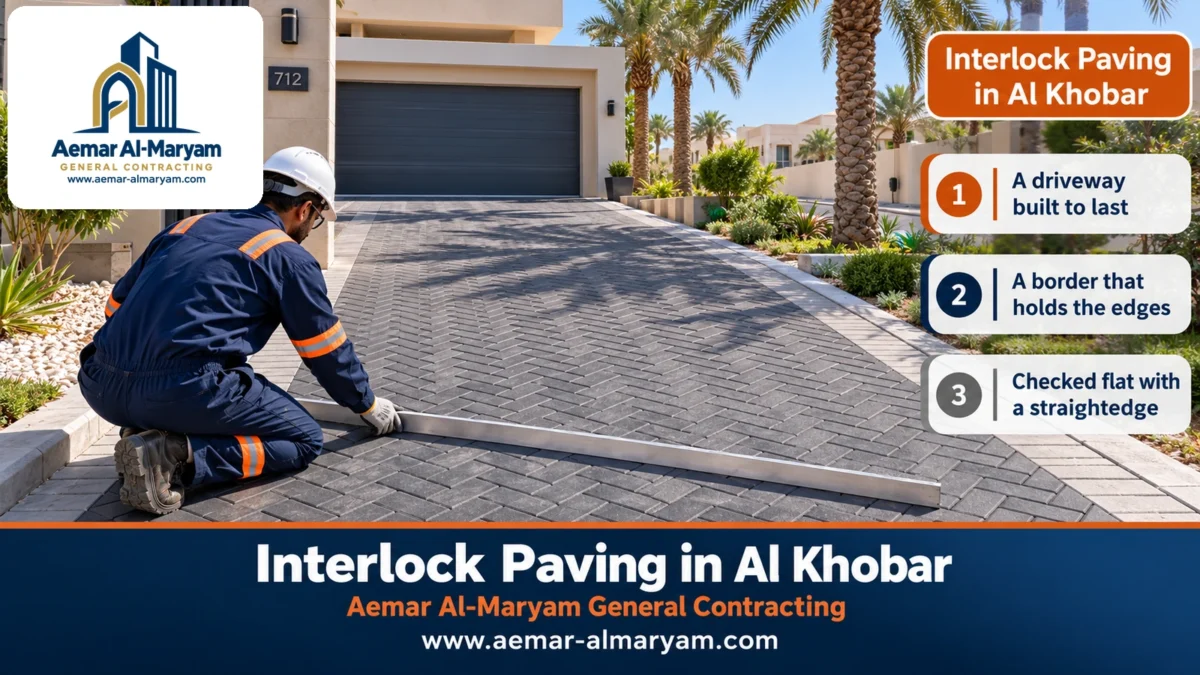
Interlock paving in Al Khobar starts well before the first paver goes down. Coastal ground may carry moisture or salts, a villa yard has to shed water away from the walls, and an apartment car park usually has manhole covers in the middle that need clean cuts around them. Aemar Al-Maryam General Contracting handles interlock supply and laying across Al Khobar for villa driveways and yards, car parks at apartment and commercial buildings, pool decks and garden paths. We also install kerbs and re-lay sunken interlock. Grey 6 cm pavers on prepared ground begin at SAR 37 a square metre with materials and laying, and 8 cm driveway units begin at SAR 55; treat every number here as an estimate until we have inspected and agreed the scope. Phone or WhatsApp 0547879578.
Anyone who lives in Al Khobar knows that paving problems rarely show on handover day. They turn up months later: a corner that has dropped at the garage entrance, a wet patch by the majlis door that never dries, a white line widening between joints, or a cut piece next to a drain cover that snapped under a tyre. That is why this page is written for Al Khobar specifically. It covers how we deal with damp ground and salty sand, where 6 cm goes and where 8 cm goes, how we blend pallet colours so no patches show, and how we pave around pools and manholes. Then come the prices, a worked example for a Khobar villa and a short list of things to check on the finished surface.
In short: interlock in Al Khobar with Aemar Al-Maryam
- Where we work: villa driveways and yards, the owned strip in front of houses, car parks at apartment and commercial buildings, pool decks, seating areas and garden paths, all inside private property.
- Thickness: 6 cm for paths, seating and pool decks; 8 cm in herringbone wherever a car parks or drives daily; heavier loads are decided at inspection.
- Coastal ground: we check the subgrade when we dig, and if damp or salts show up we decide on soil replacement, geotextile or a thicker base before laying.
- Colours: units are drawn from several pallets in turn so shades blend, and unit thickness is checked on delivery.
- Prices from: labour alone SAR 14/m²; grey 6 cm SAR 37; coloured SAR 46; 8 cm car-grade SAR 55; a complete pedestrian build on bare soil SAR 64. Kerbs and re-laying are quoted after a visit, and all of these are estimates pending a site visit and agreement.
- To order: photos and sizes of the area, and whether cars will use it, on WhatsApp or by phone on 0547879578.
Interlock paving in Al Khobar: from villa driveways to building car parks
We lay interlock in Al Khobar on any private area an owner wants paved to last. That covers the driveway from the gate to the garage, the front and back yards, the bit of frontage you own outside the gate, the car park of an apartment block or commercial building, and the paths around a pool, an outdoor seating area or a garden. Every job starts with one question: what will travel over this surface, feet or cars, and once a day or dozens of times? The answer sets the unit thickness, the depth of the base and the laying pattern.
In Al Khobar two kinds of request come up more than any other. The first is villas in districts such as Al-Hada, Al-Aqrabiyah and Al-Hizam Al-Akhdar (the Green Belt), where owners want a smart entrance framed in a contrasting colour, a deck around the pool and paths through the garden. The second is apartment and commercial buildings in districts such as Al-Thuqbah and Al-Olaya, where owners need a car park that copes with residents and visitors coming and going every day, often with inspection chambers and drain covers spread across it. Each has its own details, explained in the sections below.
■ Villa driveways
8 cm herringbone from the gate to the garage, with a contrasting border and a dropped kerb at the gate.
■ Yards and seating
6 cm interlock for yards cars never enter, with falls that take water away from walls and the majlis door.
■ Building car parks
A deeper base, kerbed edges, careful cutting around manholes and bay lines in white units.
■ Pool decks
Light colours, a restraint along the pool edge and a fall that keeps splash water out of the pool.
■ Kerbs
Garden and pavement kerbs on a concrete bed, or a hidden concrete edge where you do not want a visible one.
■ Re-laying
Lifting sunken interlock, fixing the cause and relaying the same units.
For a one-screen overview and the headline rates, open our interlock and kerbs service, and the full guide to layers and sizes is in our article on interlock paving and kerbs in Dammam. This page focuses on Al Khobar and the kinds of sites we see there.
Interlock company in Al Khobar or day labourers?
An interlock company in Al Khobar means one party is responsible for the whole job: digging out, checking the subgrade, placing and compacting the base, setting falls with a laser, setting kerbs on their concrete beds, then laying, cutting, compacting, joint sanding and cleaning up. Paving crews who turn up on their own are usually good at laying and cutting, but their work tends to begin at the sand layer, on the assumption that whatever lies below has been done properly. That assumption is where most of the sinking we are later called to re-lay begins.
Al Khobar’s coastal ground: why interlock starts with the base and the drainage
Al Khobar is a coastal city. In some of its neighbourhoods the water table lies only a short way down and the soil carries salts. Salty coastal ground (sabkha) is known to be firm when dry and to weaken when wetted and its salts dissolve; Eastern Province field research has measured a clear loss of load-bearing strength once the salts were washed out. That does not mean every yard in Al Khobar is sabkha. It means we assume nothing until we have seen the subgrade.
Interlock itself copes with moisture far better than tiles bedded in mortar. The units are laid dry on sand, and small amounts of water drain through the joints. The trouble lies underneath. If the base sits on soil that softens when wet, or the bedding layer is fine salty site sand that holds moisture, the units shift slowly and dips appear in the wheel tracks first. That is why in Al Khobar we give extra weight to three things: the subgrade check, the base thickness and the falls.
- 1Check the subgrade while digging
With the surface layer stripped, we inspect how dark and how wet the soil is, whether a salt crust is present, and we test how well it takes compaction. Good ground is compacted and trimmed to the required fall. - 2Replace soil where needed
If the soil is clearly damp, soft or salty, we remove part of it and replace it with suitable fill or crushed aggregate compacted in layers. The depth is decided at inspection. - 3Geotextile fabric
Some sites get a geotextile sheet laid over the subgrade before the base goes on. It keeps soil and stone apart and keeps the base at full thickness. It helps, but it does not replace soil replacement where that is needed. - 4A deeper base for cars
Where cars run over doubtful ground, we take the base beyond the minimum and compact it harder. - 5Clean bedding sand
We bed on clean graded sand, never site sand mixed with salt and clay.
Signs in your Khobar yard of damp or salty ground
- A white crust or crystals on the soil a few days after watering or rain.
- Dark soil that stays damp in the morning even on dry days.
- Old interlock that has sunk in several places although its kerbs are intact.
If you see any of these, photograph them and send them with your enquiry, because they change the base design from the start. Peeling paint or plaster at the foot of external walls is a related sign of rising damp and a separate job, covered under waterproofing in Al Khobar or renovation in Al Khobar, but we need to know about it before we pave the yard.
Ground treatment cannot be priced over the phone
Nobody knows how deep the replacement must go until they dig. So we price interlock at its published rates and list damp or salty ground treatment as a separate line marked “at inspection”, which we tell you about before work starts, not after.
Courtyard interlock and villa driveways in Al Khobar
Courtyard interlock in Al Khobar is what we lay most often. A front yard usually combines the car entrance, the path to the front door and the way into the majlis, while a back or side yard holds a seating area, a store or a driver’s room. Our first rule is to divide the yard by use, not by shape. Anything a car drives over gets 8 cm units on a deeper base; anything only people walk on gets 6 cm. That way you are not paying for thickness you don’t need on the paths, and you are not risking thinner units in the wheel tracks.
In Khobar villas we often see a two-tone entrance: a dark colour such as charcoal or deep grey for the main field, framed by a border row of lighter units laid along the kerbs. The border is not only decoration. It gives a straight line at the edges that hides the cut pieces, and it marks the car route visually. We lay the border lengthwise along the kerb first, then lay the main pattern and trim its edges against the border.
The garage entrance: 8 cm and herringbone
The route from the gate to the garage is the hardest-working part of any yard, because tyres turn on it when cars enter, leave and park. We lay it in 8 cm units in a herringbone pattern at 45 or 90 degrees. Herringbone spreads the sideways force of turning wheels across many interlocked units, whereas a straight stretcher bond lets whole rows slide as wheels turn. We also choose units whose length is no more than about three times their thickness, because long thin units crack or tilt under cars.
House front paving in Al Khobar: where does your yard end?
Many requests include the area in front of the gate up to the street edge. We pave what lies inside your property line or what the municipality has allowed. The public pavement belongs to the municipality, and changing it needs their approval. At the gate we keep the paving a sensible step below the door threshold and run the fall towards the street, so washing water and rain do not flow into the yard.
The dropped kerb at the car gate
Where cars cross the kerb line we use a low, chamfered kerb whose top sits roughly 2.5 cm proud of the pavers, instead of a full-height kerb that scrapes the underside of cars and chips at its edges. The dropped kerb still sits on its own concrete bed like every other kerb, because it takes more load than any other point at the entrance.
Plan the services before you pave
If you plan garden lighting, an electric gate, a tap for car washing or an AC condensate drain, have the ducts and pipes laid under the yard before paving. Interlock can be lifted and relaid, but an empty duct laid now costs less than lifting the paving later. For the plumbing itself, see plumbing in Al Khobar.
Car park interlock in Al Khobar: apartment buildings, commercial sites and manholes
Car park interlock in Al Khobar, for apartment blocks and commercial buildings, differs from a villa driveway in three ways. More cars use it, more wheels turn on the spot, and there are usually inspection chamber and service covers set into the surface. So we build car parks on a base of at least 15–20 cm. In the reference specifications for car parks used by cars and light vans, the base is about 15 cm compacted fully, and we go deeper where heavier vehicles enter or the ground is weak. We lay 8 cm herringbone throughout and restrain every open edge with kerbs on concrete beds.
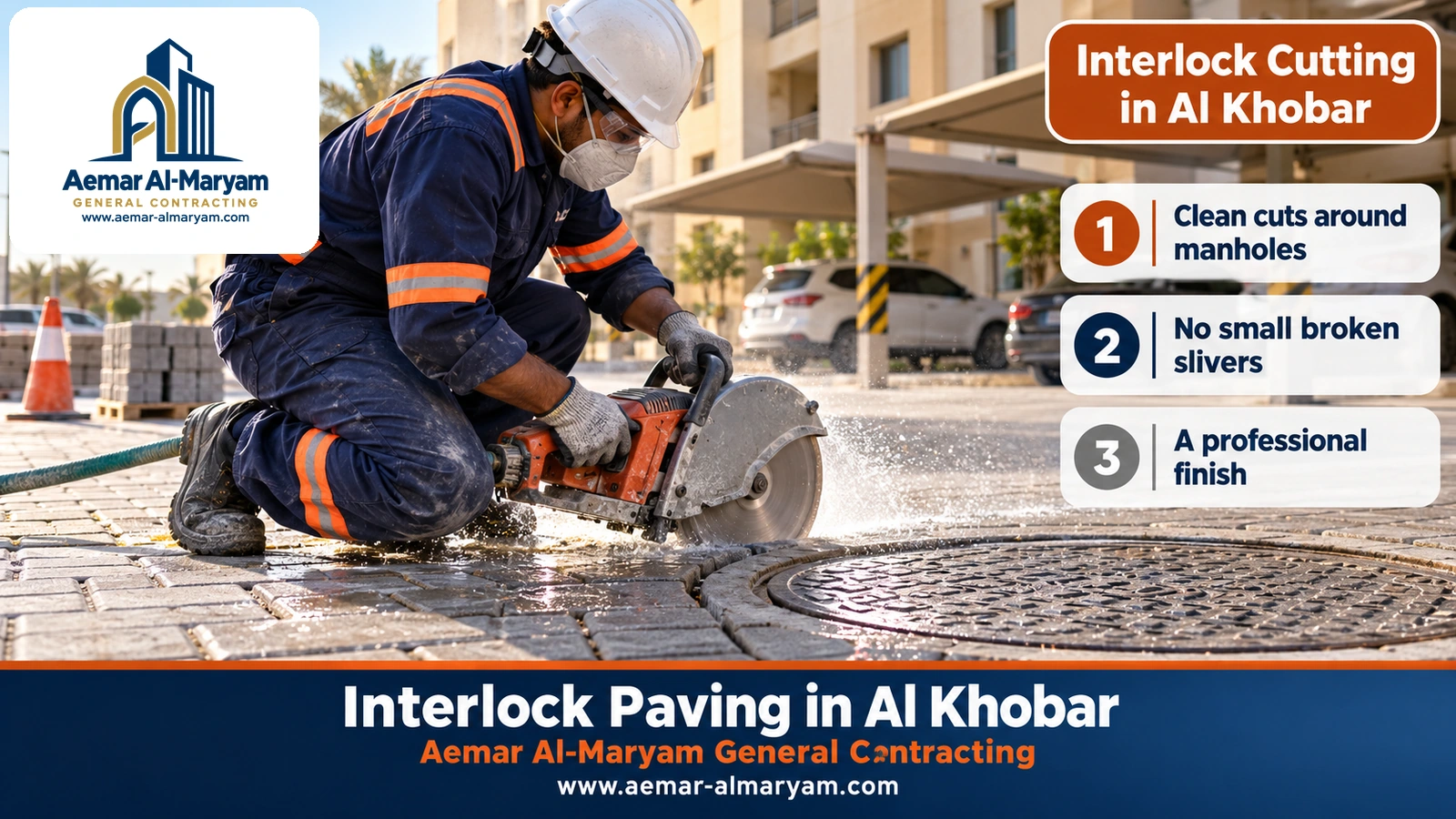
Cutting around manhole covers
A manhole cover in the middle of a car park is where the quality of the paving shows. The units around it are cut to follow its round or square edge, and the usual mistake is to fill the last gap with thin slivers that crack the first time a wheel runs over them. We cut with a diamond-blade saw under a water spray to cut down dust and chipping, and we set out the pattern around the cover so the cut pieces stay large enough to hold. Where needed we cast a small concrete collar around the cover to support the cut units.
The level around the cover matters just as much. We finish the paving about 3–6 mm above drain covers and channels, so water runs into them and no tyre hits a raised cover edge. If the cover itself is tilted or broken we tell you before laying, because raising it or rebuilding its neck is separate work to be agreed.
Bay lines and accessible parking
Instead of paint that fades, parking bays can be marked with white or light units laid within the pattern itself, so the lines last as long as the paving. We place the accessible bay close to the entrance keeping its slope within roughly 2% both along and across the bay, and we lower the kerb where a wheelchair crosses.
Pool-side interlock in Al Khobar
Pool decks and seating areas are among the best uses of interlock in Khobar villas, but they need particular care. The area gets wet almost every day, people walk on it barefoot, and splash water can carry sand and leaves back into the pool. So around pools we usually lay 6 cm interlock, as no cars come here, and choose light colours such as ivory or sand, because they stay cooler to the touch in the midday sun than dark ones.
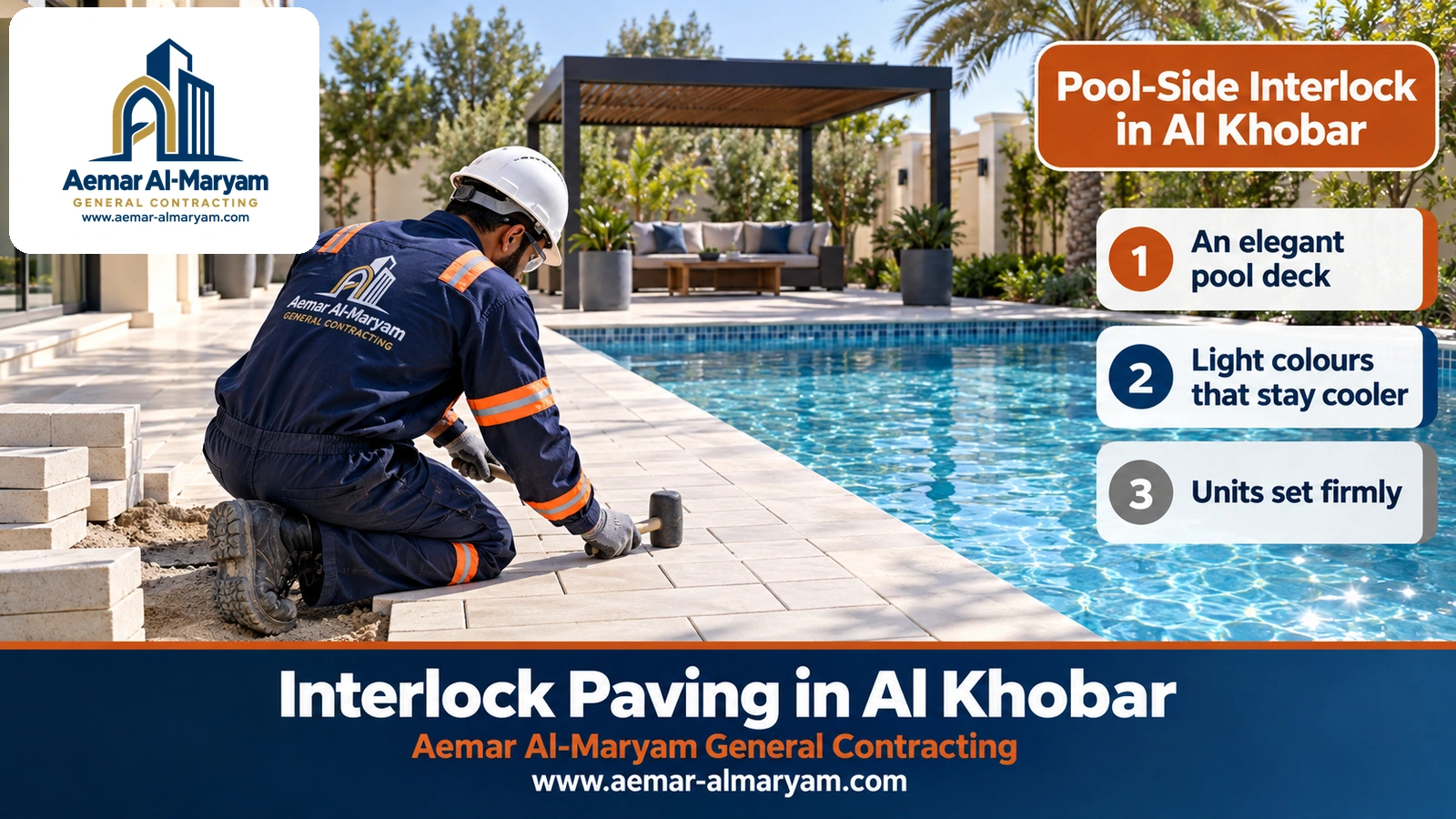
- Fall away from the pool: we slope the deck towards the garden or a drain, so surface water and whatever it carries does not run back into the pool.
- Restraint at the pool edge: the pool coping itself or a hidden concrete strip holds the units; we never leave a loose paving edge beside the water.
- A calm pattern: straight stretcher bond or basket weave suits the narrow paths around a pool; we keep herringbone for the car route.
- Joint sand: frequent washing draws joint sand out over time, so we advise topping it up whenever gaps appear between units.
Work on the pool itself, from the shell and waterproofing to lighting and equipment, is a separate service on the pools and fountains page. We agree the deck level with the pool edge before laying, so the paving does not end up awkwardly above or below the coping.
Garden paths and grass pavers in Al Khobar
Garden paths in Al Khobar take 6 cm interlock on a lighter base than the car route, with low garden kerbs that hold the edges and stop soil creeping onto the path. We make the main path to the front door wide enough for two people to pass, keep the side paths between planting beds narrower, and give the path a slight fall towards the planting so it benefits from washing water and nothing ponds on the surface.
Grass pavers are open-cell units with grass grown in their voids. They suit an extra parking spot in a garden or a rest house where the owner wants it to stay green. They need a base suitable for cars under the growing soil and regular watering, and they are priced at inspection because the details vary from site to site.
Interlock supply and installation in Al Khobar: colour blending and unit checks
Supply and installation of interlock in Al Khobar means we work out the quantities, order the pavers, sand, aggregate and kerbs, deliver them to site and build every layer ourselves, so you deal with one party. We also offer labour only if you buy the materials yourself, as long as the ground is ready. Either way, we check the pavers when they arrive, before a single unit is laid.
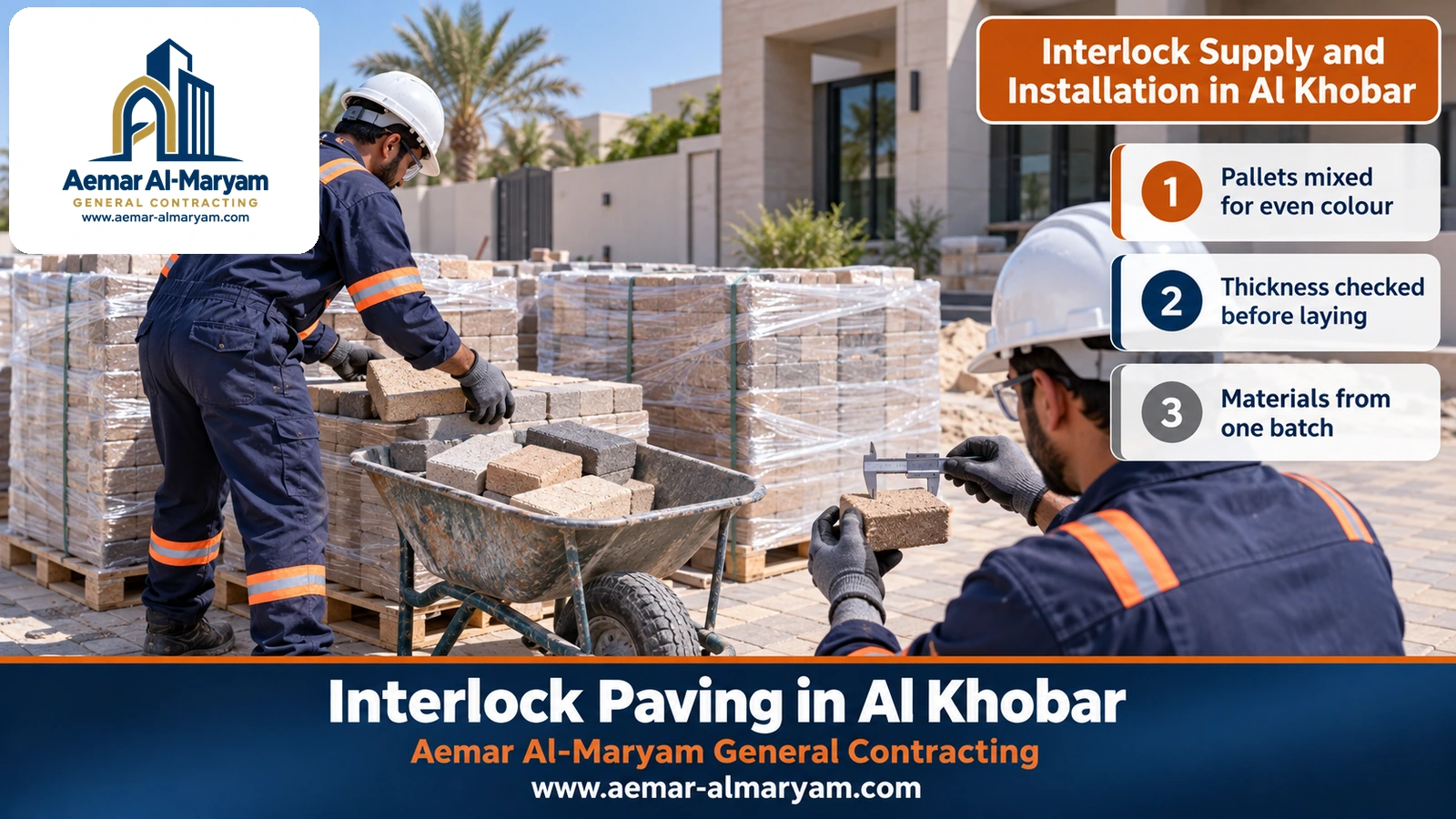
Why we draw units from several pallets at once
Coloured interlock is made in batches, and the shade can differ slightly from one batch to the next, or even between pallets. If each pallet is laid on its own, the yard ends up with a lighter square here and a darker one there, and after compaction the only fix is lifting it. So we open three or more pallets at the same time, and the paver takes units from each in turn as he loads the barrow, which spreads the shades evenly and at random. We order the full quantity from one production run where possible, with about 5% extra for cuts and breakage, so we never have to call off a new batch in a different shade.
Checking thickness and quality on delivery
We measure sample units with callipers to make sure 8 cm really is 8 cm, and match the shape and colour against what was agreed. On a big order you are entitled to a lab report from the factory for that production run, giving crushing strength and how much water the units absorb. The long-standing American standard for interlocking pavers sets an average compressive strength of around 55 MPa and caps average water absorption at 5%. A weak unit soaks up more water, and on salty ground it carries salts to its surface faster.
Interlock pavers in Al Khobar: how many square metres per pallet and units per metre?
How many square metres sit on one pallet varies with the shape, the thickness and the factory, so read it off the supplier’s data sheet. Units per square metre is simple geometry: a 20×10 cm brick shape gives fifty pieces to the square metre, while larger shapes usually come to somewhere between 20 and 30. We work out your quantity in square metres including the cutting allowance, and the kerbs in linear metres.
6 cm or 8 cm interlock in Al Khobar?
The short rule: 6 cm where people walk, 8 cm where cars park or drive every day. Industry application guides put 60 mm units under footpaths and lightly used home driveways and 80 mm units under anything carrying regular vehicle traffic, and recommends herringbone wherever there is continual vehicle traffic. In the Eastern Province market, 8 cm is the most common choice for yards and car parks.
| Area in Al Khobar | Thickness | Suggested pattern | Approximate base |
|---|---|---|---|
| Garden paths and seating | 6 cm | Stretcher, basket weave or hexagonal | 10–15 cm |
| Pool deck | 6 cm | Straight stretcher or basket weave | 10–15 cm |
| Yard with no cars | 6 cm | To taste | 10–15 cm |
| Villa garage entrance | 8 cm | Herringbone at 45° or 90° | 15–20 cm |
| Apartment or commercial car park | 8 cm | Herringbone | 15–20 cm or more |
| Heavier vehicles or weak ground | At inspection | Herringbone | Designed at inspection |
What lies under interlock in Al Khobar: the layers in numbers
Interlock is a system of layers. Each one has a job, and none can stand in for another. Here is the order from the bottom up, as we build it in Al Khobar:
- 1Subgrade (natural ground)
We remove weak soil, roots and debris, compact the subgrade and trim it to the fall, and treat it with replacement or geotextile if damp or salts show up. - 2Base course
Graded crushed stone, laid 10–15 cm deep under walkways and 15–20 cm deep under wheel routes, and compacted lift by lift with no lift thicker than 15 cm. This is the layer that fixes the final fall. - 3Kerbs
Set on a concrete bed before the sand is spread, and left for the concrete to set before we compact the paving next to them. - 4Sand bed
A thin layer of clean sand, roughly 3 cm loose, struck off level along screed rails and kept free of footprints from then on. - 5Pavers
Laid in the chosen pattern with narrow, even joints, with the edges cut against kerbs and covers. - 6Joint sand and compaction
A very fine sand is brushed across the surface and the plate goes over it again and again until it packs between the units and locks them together.
The sand bed: why only about 3 cm?
Some crews spread 5 or 7 cm of sand because it makes it easy to make up for a low base. But thick sand moves under load and traces the wheel tracks over time, and it is one of the best-known causes of sinking. Technical guidance gives a bed of about 2.5–4 cm before compaction. We work to about 3 cm and correct any low spots in the base itself, never with extra sand.
Compaction and joint sand
After laying, we compact the surface with a vibrating plate fitted with a rubber pad so the units are not scuffed, at least three passes, then sweep in the joint sand and compact two or three more times until the joints are full. We do not compact within about a metre of any edge that is not yet restrained, because the units there would be pushed outwards. Joint sand is finer than bedding sand so it can work into joints that are usually only 2–3 mm wide.
Interlock falls and drainage in Al Khobar
In Al Khobar we give interlock a fall of roughly two centimetres in every metre, running from the house walls and the majlis and garage doors out to the gate, the street, a gully or the planting. It is built into the base course with a laser level and staff before the sand goes down, because the sand follows the base and is never used to create the fall.
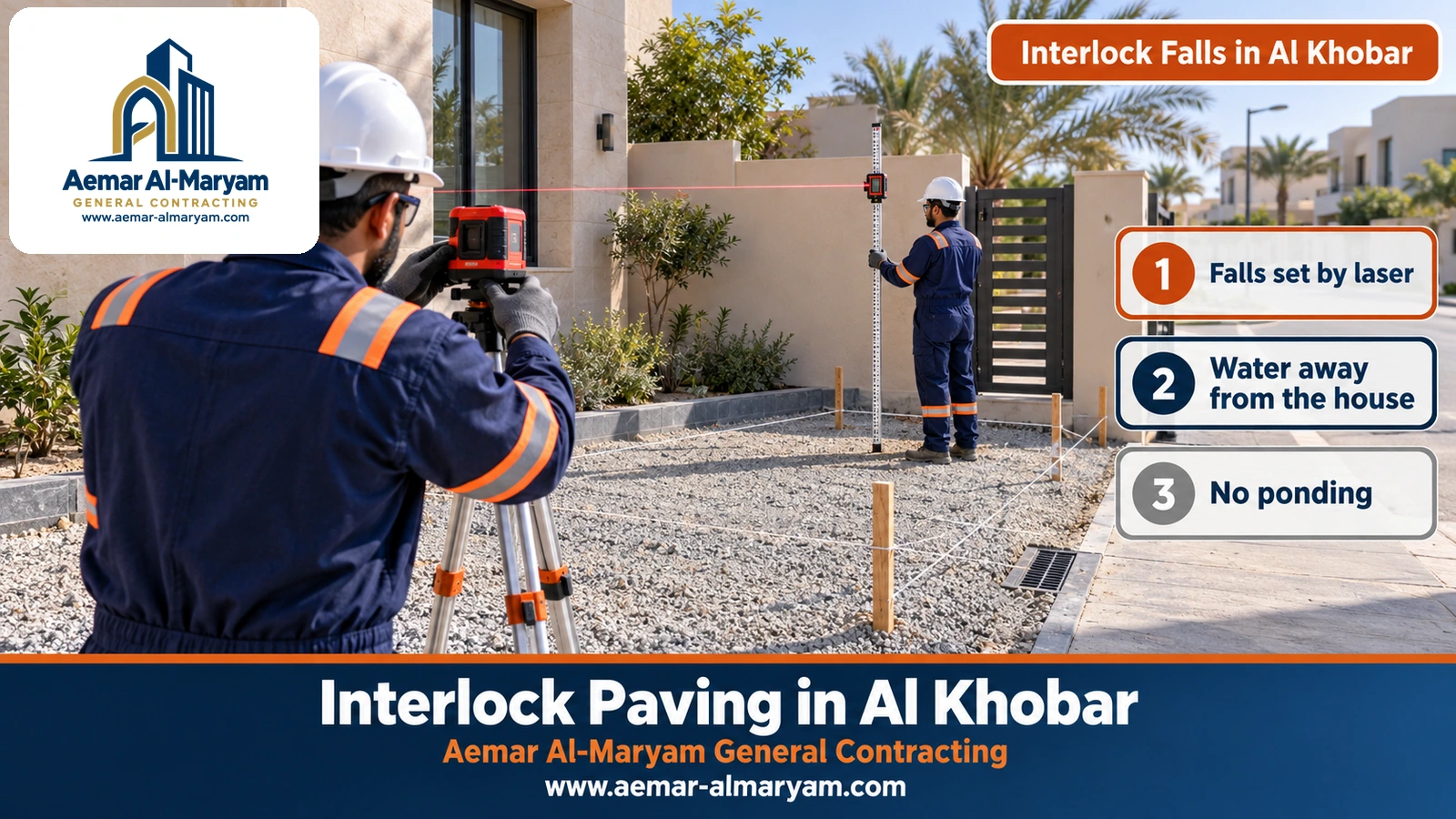
In houses where AC condensate pipes or roof downpipes discharge into the yard, we locate those outlets before designing the falls, and we either direct the water to a drain or run a pipe under the paving to the gate. A constant drip in one place washes out joint sand and softens the base over time. In large yards, or yards enclosed on all sides, we suggest a gully or a grated channel at the gate.
The water test before handover
When the work is finished, ask for the yard to be hosed down and wait a few minutes. The water should run in the agreed direction without standing in patches, and it should not come near the majlis or garage threshold.
Kerb installation in Al Khobar
Kerb installation in Al Khobar means restraining the edges of the interlock with a line of precast concrete units set on a concrete bed and haunched at the back with concrete, so the pavers cannot creep and the shape of the yard and paths is fixed. Locally they are called baldoura, bardoura or bandoura; all mean the same thing. Kerbs are the only part of an interlock system fixed with cement. The pavers themselves sit dry on sand.
| Type | Use | Approximate height above the paving |
|---|---|---|
| Small garden edging | Path edges and planting beds | Flush to a few centimetres |
| Pavement kerb 15×30×50 cm | Car park edges and wide paths | About 10–15 cm |
| Dropped or chamfered kerb | Where cars cross at the gate | About 2.5 cm |
| Hidden concrete restraint | Where no visible edge is wanted (pool decks, seating) | Below the surface |
We set kerbs on a concrete bed about 15 cm thick, haunch the back with concrete in the same operation, and lay them closely butted along one string line. We never compact the paving next to them before their concrete has set, or they would lean outwards. We also install kerbs on their own for owners who already have paving or a garden and want its edges restrained.
Are kerbs necessary with interlock?
Yes, every open edge needs a restraint. Technical specifications require all edges to be restrained, and experience shows that the first thing to drop in a yard without kerbs is the outer row of units, with the joints behind it opening next. The only acceptable alternative is a hidden concrete restraint, which is simply a kerb you cannot see.
Interlock shapes and colours available in Al Khobar
The common shapes in Al Khobar are rectangular (brick), zig-zag (interlocking edges), hexagonal, square in various sizes, and open-cell grass pavers. Each has its patterns: herringbone for cars, straight stretcher bond for paths and pool decks, basket weave (pairs laid at right angles) for seating areas, and hexagonal for gardens. Colours range across grey, charcoal, brick red, sand and ivory, and two or three can be combined.
■ Rectangular
The most flexible shape: herringbone for cars or stretcher bond for paths, and easy to cut at the edges.
■ Zig-zag
Interlocking edges give a strong lock, suited to driveways and car parks.
■ Hexagonal
A calm look for gardens and seating, with more cutting along straight edges.
■ Square
For seating areas and small courts, or a two-colour chequerboard.
■ Border
A row in a contrasting colour along the kerb that hides cuts and marks the route.
■ Grass pavers
Open-cell units planted with grass for green parking in gardens and rest houses.
Interlock price per square metre in Al Khobar: our rates
Our lowest rate for interlock in Al Khobar is SAR 14 per square metre for labour alone. Grey 6 cm pavers with materials and laying start at SAR 37 on ground that has already been compacted and trimmed, coloured units and mixed patterns at SAR 46, 8 cm units for car parks and garage entrances at SAR 55 once the base course is in, and SAR 64 when we start from bare soil and build every layer for footpaths and light use. These are “from” figures and estimates until inspection and agreement: the size of the area, the colour, the thickness, the state of the subgrade, the depth of base, the length of kerbing and how easily machines can get in all move the number. Al Khobar sits inside our core area with Dammam and Dhahran, so no separate travel line is added.
| Item | What it covers | Unit | From (SAR) |
|---|---|---|---|
| Labour only | Laying, cutting and plate compaction; you provide the pavers and sand and the subgrade is already prepared | m² | 14 |
| Grey 6 cm interlock | Materials and laying with bedding sand, jointing sand and compaction on trimmed, compacted ground; for paths, yards and house fronts | m² | 37 |
| Coloured 6 cm interlock | Any colour other than grey, or a pattern mixing several colours | m² | 46 |
| 8 cm interlock for cars | Herringbone for car parks and garage entrances, over a base course already in place | m² | 55 |
| Complete pedestrian system | Dig out, level and compact, then base, sand and 6 cm pavers laid to falls, on bare soil for light use | m² | 64 |
| Complete vehicle system | 8 cm pavers over a base of 15 cm or deeper | — | At inspection |
| Kerbs | Garden edging or pavement kerbs fixed on a concrete bed | lin. m | At inspection |
| Sunken paving repair | Lift, rebuild the base, renew the sand and put the same units back | — | At inspection |
| Damaged units | Swap broken units or recolour part of the surface | — | At inspection |
| Grass pavers | Parking bays with grass grown between the units | — | At inspection |
| Old tile removal | Yard tiles and their mortar taken up before paving | m² | 14 |
| Spoil removal | One trip by small truck or tipper | trip | 90 |
| Damp or sabkha ground | Soil replacement or a geotextile layer | — | At inspection |
How did we arrive at these numbers? We looked and found no service page in Al Khobar or Dammam that states an interlock price, so we turned to the nearest city whose contractors publish rates with a defined scope, and placed ours beneath them. On very small yards, under roughly 50 m², each square metre carries a bigger share of the fixed cost of bringing machines and materials. Any line marked “at inspection” gets its figure once we have seen the site: photograph it and send the sizes and intended use on WhatsApp 0547879578 and expect a figure back. Rates for our other services sit together on one prices page.
Kerb installation prices in Al Khobar
Kerbing is charged by the linear metre, and the rate depends on the type (garden or pavement), the thickness of the concrete bed, the number of curves and corners, and whether old kerbs must be removed first. Because we found no published kerb installation price on any service page we could rely on, we price kerbs after inspection. Send the edge lengths and photos with your interlock enquiry for a complete estimate.
Worked example: a Khobar villa with a driveway and a pool
This is an illustrative example for a villa on level, compacted ground. All figures are “from” prices before inspection:
- Driveway: 6 × 10 m = 60 m² of 8 cm herringbone: 60 × 55 = SAR 3,300.
- Pool deck: a 5 × 10 m pool with a 1.5 m deck on every side gives an outer area of 8 × 13 = 104 m², minus the 50 m² pool = 54 m² of coloured 6 cm: 54 × 46 = SAR 2,484.
- Side path: 1.2 × 15 m = 18 m² of grey 6 cm: 18 × 37 = SAR 666.
- Total: 60 + 54 + 18 = 132 m², costing 3,300 + 2,484 + 666 = about SAR 6,450 for the paving alone.
- Quantities: bedding sand about 132 × 0.03 ≈ 4 m³, or about 4.4 m³ with 10% extra; pavers 132 m² plus about 5% for cuts ≈ 139 m².
- Not included: kerbs around the driveway and path (per linear metre after inspection), and any ground treatment if damp or salts appear.
If the ground were bare soil needing the full system, the pedestrian part (deck and path, 72 m²) would start from 72 × 64 = SAR 4,608 in grey, while the driveway on a 15 cm base is priced at inspection; its base alone is 60 × 0.15 = 9 m³ of compacted aggregate.
Factors that push an Al Khobar interlock quote up or down
- ✓Ground condition: level compacted ground costs less than bare soil, and damp or salty ground adds a treatment line.
- ✓Use: the car route needs 8 cm and a deeper base.
- ✓Colour and pattern: coloured units and two-tone borders cost more than single-colour grey.
- ✓Cutting: many covers, curves and corners add cutting time and waste.
- ✓Area: large areas bring the rate per square metre down; small ones push it up.
- ✓Access: easy access for equipment and materials saves time and cost.
- ✓Removing old surfaces: lifting old tiles or interlock and removing spoil are extra lines.
Interlock installation steps in Al Khobar, from inspection to handover
- 1Inspection and measurement
We measure the area and note the use, levels, doors, drains and chamber covers, and look at the ground. - 2Written agreement
Thickness, pattern, colours, base thickness, kerb type, falls, price and duration. - 3Excavation and removal
We take out old tiles or soil to the required depth and remove the spoil. - 4Subgrade check and treatment
Compacting the subgrade, with replacement or geotextile where needed. - 5Base course and falls
Spreading and compacting the aggregate in layers and setting the fall with a laser. - 6Kerbs
Setting them on a concrete bed and waiting for it to set. - 7Sand bed
About 3 cm screeded with a straightedge and left untouched. - 8Laying and cutting
Laying the pattern with units drawn from several pallets, then cutting edges and around covers. - 9Compaction and joint sand
A first compaction, then sweeping in joint sand and compacting until the joints are full. - 10Water test, clean-up and handover
Hosing the yard, checking with a straightedge and clearing surplus sand and spoil.
How many days does a Khobar yard take?
An average yard on ready ground is done in a few working days. If it needs excavation, a base course and kerbs it takes longer, because kerb concrete needs time to set before compaction next to it. Building car parks are done in stages to suit how the car park is being used. You can walk on and park on each finished section after the final compaction and joint sanding.
Interlock re-laying in Al Khobar and sunken paving repair
Re-laying interlock in Al Khobar means lifting the sunken area, finding and fixing the cause, and putting the same units back if they are sound. One of the strengths of interlock is that its units can be lifted and reused, so you only buy new pavers for broken ones. But re-laying without fixing the cause means the dip will come back.
Why does interlock sink?
Uncompacted base
Laid straight on soil or loose fill, so it sinks under load.
Thick sand
A 5 or 7 cm bed moves under wheels and traces their path.
Unrestrained edge
A missing or broken kerb lets the units creep outwards.
Water underneath
A leaking pipe, an AC drain or a reversed fall softens the base.
Weak ground
Damp or salty soil not treated before laying.
Thin units
6 cm in a daily car route tilts and cracks.
How the repair is done
We lift the units and stack them in order, remove the wet or contaminated sand, repair the base by adding aggregate and compacting it, fix the kerb or the water source, then lay fresh sand, re-lay the units, fill the joints and compact. At the same time we can replace broken units or change the colour of part of the yard, bearing in mind that new pavers may look slightly different from old ones that have weathered in the sun for years.
Routine interlock maintenance
- Top up joint sand whenever gaps appear between units, especially after pressure washing.
- Keep an eye on the kerbs; fix any leaning or broken kerb before the units beside it creep.
Interlock or asphalt for a villa yard in Al Khobar?
Interlock suits you if you want a surface with colours and patterns that changes the look of the house front, comes up and goes back down when services need laying, and looks less black and hot. Asphalt suits large areas used only by cars, because it is quicker to lay and its rate per square metre on a ready base starts at a similar level. We do both, so this comparison is from the interlock side; the asphalt side is covered in our article on the asphalt contractor in Al Khobar.
| What matters to you | Interlock | Asphalt |
|---|---|---|
| Appearance | Colours, patterns and borders | Continuous black surface |
| Local repairs | Lift and relay the same units | Cut-and-patch that stays visible |
| Pool decks and seating | Suitable in light colours | Not suited to walking barefoot |
| Large car areas | Possible, at higher cost and longer time | Usually quicker and cheaper |
| Edges | Kerbs essential | Kerbs preferred |
| Many curves and covers | Careful cutting unit by unit | Laid straight around them |
Interlock or tiles for a yard?
Tiles (porcelain or stone on mortar) give a smooth, continuous surface that is easy to wash, and they suit shaded seating and covered entrances. But they crack when cars drive over them on ground that moves. Interlock is the better choice where a car parks or the ground is doubtful, because it moves slightly with the ground without breaking. For tiling a yard, see our tile installer in Al Khobar article.
Can interlock go over old tiles or concrete?
Paving on top of old tiles is a bad idea, because they trap water under the sand and raise the level at the doors. We remove them with their mortar (from SAR 14/m²) and clear the spoil, then check the ground and build the layers. Large-scale removal or breaking out an old concrete slab is handled under demolition in Al Khobar. A sound concrete slab with the right fall can sometimes be paved over after inspection, with a sand bed and drainage outlets, and if you need a new slab cast for part of the yard, see concrete pouring in Al Khobar.
White staining on interlock in Al Khobar’s climate
The whitish bloom that often shows on new interlock during its first months is lime from the cement inside the unit. Moisture carries them to the surface, where they react with the air and leave a white haze. This is a well-known effect and it usually fades with time, sun and ordinary washing. In a humid coastal city like Al Khobar, or over salty ground, it can be more noticeable or come back, because moisture and salts rise from below.
- Do not wash it with strong acids; they can affect the colour and surface of the units.
- Staining that keeps returning in one spot may point to water collecting beneath; check the fall and any leaks.
Common interlock mistakes in Al Khobar
Laying each pallet on its own
Squares of different shades appear that can only be fixed by lifting.
Thin slivers around covers
They crack under the first tyre and leave a gap.
Fall towards the house
Rainwater runs back to the wall and the majlis door and soaks the base there.
Site sand as bedding
Salty or clayey sand holds water and shifts.
Compacting by a loose edge
Units are pushed out before the kerb is in place.
6 cm in the car route
Units tilt and crack with daily turning.
Ignoring AC drains
A constant drip washes out joints and softens the base.
Paving above the door sill
Washing water runs into the majlis or garage.
Receiving interlock in Al Khobar: what to check before the final payment
- ✓Kerbs: straight and set on a concrete bed, with no leaning or gaps.
- ✓Falls: hosed water runs away from the house without ponding.
- ✓Flatness: run a long straightedge across the surface in different directions and look for any visible hollow.
- ✓Joints: even and full of sand, with no unit rocking underfoot.
- ✓Cutting: tidy edges along kerbs and around every cover, and no narrow slivers anywhere.
- ✓Levels: the paving slightly above drain covers and below door thresholds.
- ✓Colours: evenly mixed with no patches of a different shade, and the pattern as agreed.
- ✓Clean-up: surplus sand, spoil and cutting debris removed.
Pavements on public streets in Al Khobar
Our work is inside private property: yards, private car parks, gardens and frontage within your boundary. Any pavement along a public street belongs to the municipality, and any digging or change to it goes through the municipality and its systems (the Balady platform). Public road paving is not something we offer. If you want the pavement outside your house to match your yard, ask the municipality first what is allowed.
Ordering interlock paving in Al Khobar: the WhatsApp checklist
Message these six things to 0547879578 on WhatsApp. From them we can propose a unit thickness and base depth, give a rough cost, and book a site visit:
- 1Photos of the area
A general shot from the gate, plus the edges, doors, drains and chamber covers. - 2Sizes
Rough length and width of each part, or a simple hand sketch. - 3Use
Will cars use it? How many? Is it a building car park used by residents every day? - 4Ground condition
Soil, old tiles or sunken interlock, and any sign of damp or salts. - 5Your taste
The colours and pattern you prefer, or a photo of an example you liked. - 6District and timing
Your district in Al Khobar and a convenient time for the visit.
Why choose Aemar Al-Maryam to pave in Al Khobar?
Because we agree in writing on the hidden layers before the visible finish: the base thickness, the sand thickness, the direction of fall, the kerb type, and any ground treatment needed. And as a general contractor rather than a paving crew alone, we can remove old tiles, cast kerb beds, adjust drains and take away spoil within the same job, without you coordinating several parties. You can browse finished jobs in our project gallery.
- ✓Open pricing: a published “from” table, and any unpriced item settled with you before work begins.
- ✓Coastal ground checks: we never assume the subgrade is sound before we see it.
- ✓Colour blending: from several pallets so no patches show.
- ✓Clean cutting: around covers and edges, with no thin slivers.
- ✓Close by: Al Khobar is within our core area together with Dammam and Dhahran.
Interlock paving across Al Khobar’s districts and nearby
Our crews pave apartment car parks in Al-Thuqbah, Al-Olaya and Madinat Al-Ummal, villa yards in Al-Hada, Al-Aqrabiyah and Al-Hizam Al-Akhdar, and sites down to South Khobar and the rest of the city. From Al Khobar we also cover nearby Dhahran and Dammam, and reach Qatif and Saihat. Our full list of services in the city is on the Al Khobar area page.
Pave your villa driveway or building car park in Al Khobar
Send photos and sizes of the area and tell us whether cars will use it; we will reply with the thickness, layers and estimated cost, then agree the inspection day.
Useful links in Al Khobar
- ➤ Paving and kerbs: service overview
- ➤ The full Dammam interlock guide
- ➤ Asphalt for Khobar driveways and car parks
- ➤ Tiling yards and floors in Khobar
- ➤ Casting concrete slabs in Khobar
- ➤ Breaking out old yard floors
- ➤ Building a majlis or annex in the yard
- ➤ Sawing openings in concrete
- ➤ Book a site visit
Tags