Interlock paving in Al-Ahsa tends to begin with one question from a rest-house (istiraha) owner: how do I turn the yard around the lawn into a clean, firm surface that the family can walk on barefoot in the evening, and that guests can drive onto from the gate without anything sinking? At Aemar Al-Maryam General Contracting the answer is a set of planned layers under concrete pavers laid dry on a sand bed, held in by kerbs on every side. We pave large rest-house yards, lay border rows around lawns and palm beds, put down grass pavers for farm parking, and set kerbs along farm roads with a concrete haunch behind them. Paving a prepared yard begins at SAR 37 a square metre including the pavers; each figure on this page is one of our estimates until inspection and agreement. Reach us by phone or WhatsApp on 0547879578.
Al-Ahsa lies roughly 160 km from our Dammam yard, which is why a Hofuf, Mubarraz or outlying farm job begins on WhatsApp, not on the road. Your photos and rough dimensions tell us the quantities and the machines to load; the inspection is then booked and paired with other sites close by. The trip cost is fixed during that visit, once the size of the work and the days it needs are clear.
The short version
- What we pave in Al-Ahsa: rest-house yards around lawns, house yards and frontages, farm parking in grass pavers, and kerbs along internal farm roads.
- Thickness: 6 cm for walking and seating areas, 8 cm in herringbone wherever cars park or drive in daily.
- Below the surface: compacted formation, a 10–20 cm crushed-stone base sized to the traffic, then roughly 3 cm of bedding sand.
- Entry prices: laying only from SAR 14/m²; grey 6 cm from 37; coloured units 46; the 8 cm car lane 55; a bare-earth walking yard built from the ground up 64.
- Travel from Dammam: about 160 km, priced at inspection; the larger the area, the smaller its share per square metre.
Interlock paving in Al-Ahsa: what we pave at rest houses, farms and homes
Our Al-Ahsa interlock work stays inside private boundaries: rest houses, farms, house yards, and private parking in front of a shop or warehouse inside the plot boundary. Public pavements belong to the municipality and its contractors. Each kind of site needs its own thickness, base and pattern:
■ Rest-house yards
The wide area between the majlis, the lawn and the pool; mostly for walking and sitting, with a car lane from the gate.
■ Lawn borders
One or two rows of a contrasting colour around the grass and palm beds, marking the edge and stopping the paving from creeping.
■ Farm parking
Grass pavers with open cells that carry a car and stay green, or 8 cm interlock at the store entrance.
■ Farm roads
Kerbs along both sides of the internal road on a concrete bed and haunch, so the edge does not crumble.
■ House yards
Courtyards and driveways of Hofuf and Mubarraz homes, graded so wash water runs off the walls.
■ Repairs
Lifting sunken interlock, fixing what lies beneath and re-laying the same units.
An interlock company in Al-Ahsa or day labourers?
The difference does not show in the first week. It shows after the first rainy season, or after guests have turned their cars on the same spot many times. Day labourers lay pavers quickly on whatever sand is at hand. An interlock company in Al-Ahsa takes responsibility for what is under the pavers: the excavation depth, the base thickness, the number of compaction passes, and setting the kerbs before the laying, not after. Ask whoever quotes you for those four numbers. If the answers come clearly, you are talking to someone who knows the work.
Supply and installation in Al-Ahsa, or labour only?
Either arrangement works. When we buy, we pick a supplier with you who hands over lab results for the run, order roughly 5% over the measured area to cover cuts, and bring pavers and sand to the rest house in one delivery. When the pavers are already yours, our crew lays, cuts and compacts them from SAR 14 per square metre, as long as the ground has been prepared. Buying your own? Take every crate from a single batch, since two runs that look alike in the depot can differ in shade and the gap shows clearly in an open yard under the Al-Ahsa sun.
Rest-house interlock in Al-Ahsa: the yard around the lawn
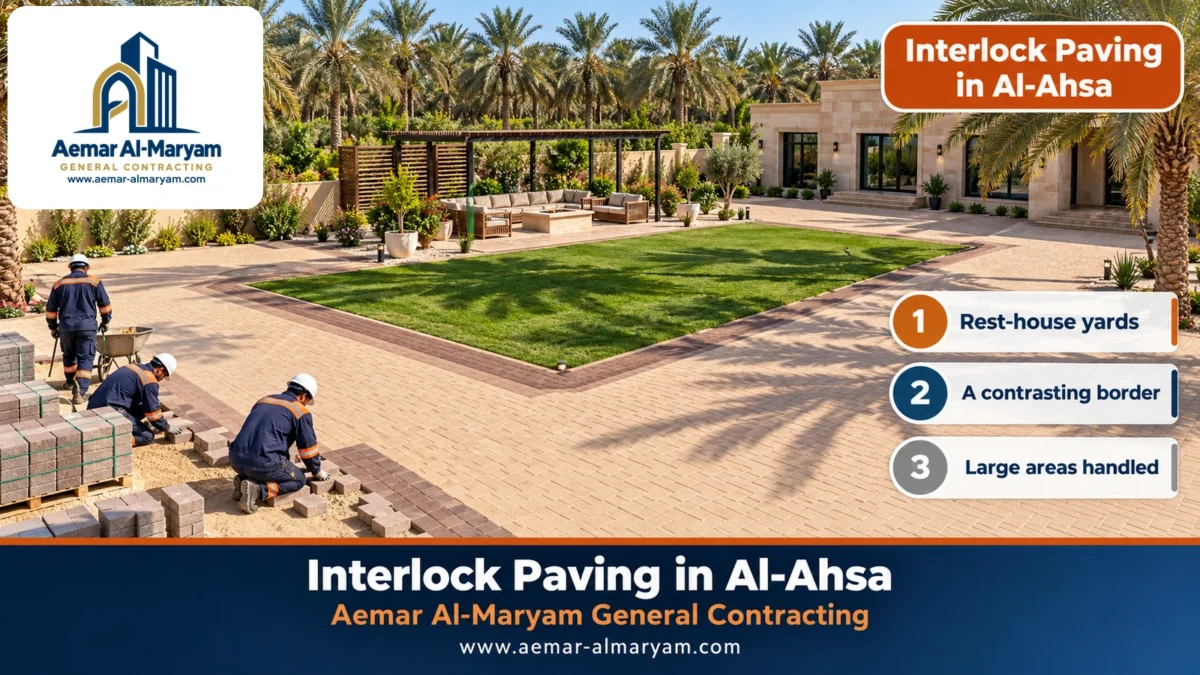
Rest-house interlock in Al-Ahsa is a different job from a house yard, both in scale and in how people use the space. The yard can run to several hundred square metres, with a lawn or palm beds in the middle, outdoor seating around it, perhaps a pool, and a short or long car lane from the gate. So we do not pave the whole yard at one thickness. We split it into zones: walking and seating areas in 6 cm units, and the car lane and parking in 8 cm units laid in herringbone, which resists turning wheels.
We mark the boundaries before any digging: where the grass ends, where the irrigation line runs, and where the water tanker stops to fill the tank. Those details decide where the internal kerbs go and where the base must be stronger. A tanker that comes in every week needs an 8 cm lane on a heavier base, and its thickness is set at inspection according to the load.
Border rows around lawns and palm beds
A border row is a line of interlock units laid lengthwise or crosswise in a contrasting colour, for instance brown around a sand-coloured yard, held behind a low garden kerb or on a hidden concrete restraint. It does more than decorate. The edge next to the lawn gets irrigation water every day, and if it is not held firmly the water gets under it and the units creep towards the soil. So we set the border row on a concrete bed with a haunch that stops movement, and we keep the paving slightly above the planting soil so mud does not wash onto it.
- ✓Around palm trunks: we leave a round or square bed unpaved, because the roots need water and grow over the years, lifting any paving pressed against them.
- ✓Sprinklers: we point them away from the paving or leave a gravel strip between them and the border, since constant water washes out the joint sand.
- ✓Outdoor seating: we suggest a light colour that absorbs less heat, with the fall running towards the lawn or a drain, not towards the majlis.
- ✓The pool: slip-resistant units around it and a fall away from the water; the pool structure itself is outside the interlock work.
House yards and frontages in Al-Ahsa
Plenty of homeowners in Hofuf and Mubarraz want their courtyard paved together with the private strip that runs out to the street kerb. The area is smaller and the access narrower, so we use a small plate compactor and split units by hand at the corners. The fall matters most here: water moves away from the house wall and the door threshold towards the street or a drain, at roughly 2 cm per metre. Remember that the public pavement belongs to the municipality, so we do not change its level or break its kerb without approval.
Grass pavers in Al-Ahsa for farm parking
Grass pavers are concrete units with regular open cells that are filled with planting soil and seeded, so car wheels ride on the concrete ribs while the area stays green. They suit Al-Ahsa farms more than most places: rain and irrigation water soak through instead of running across the surface, the parking blends in with the farm, and dust does not rise under the cars as it does on bare ground.
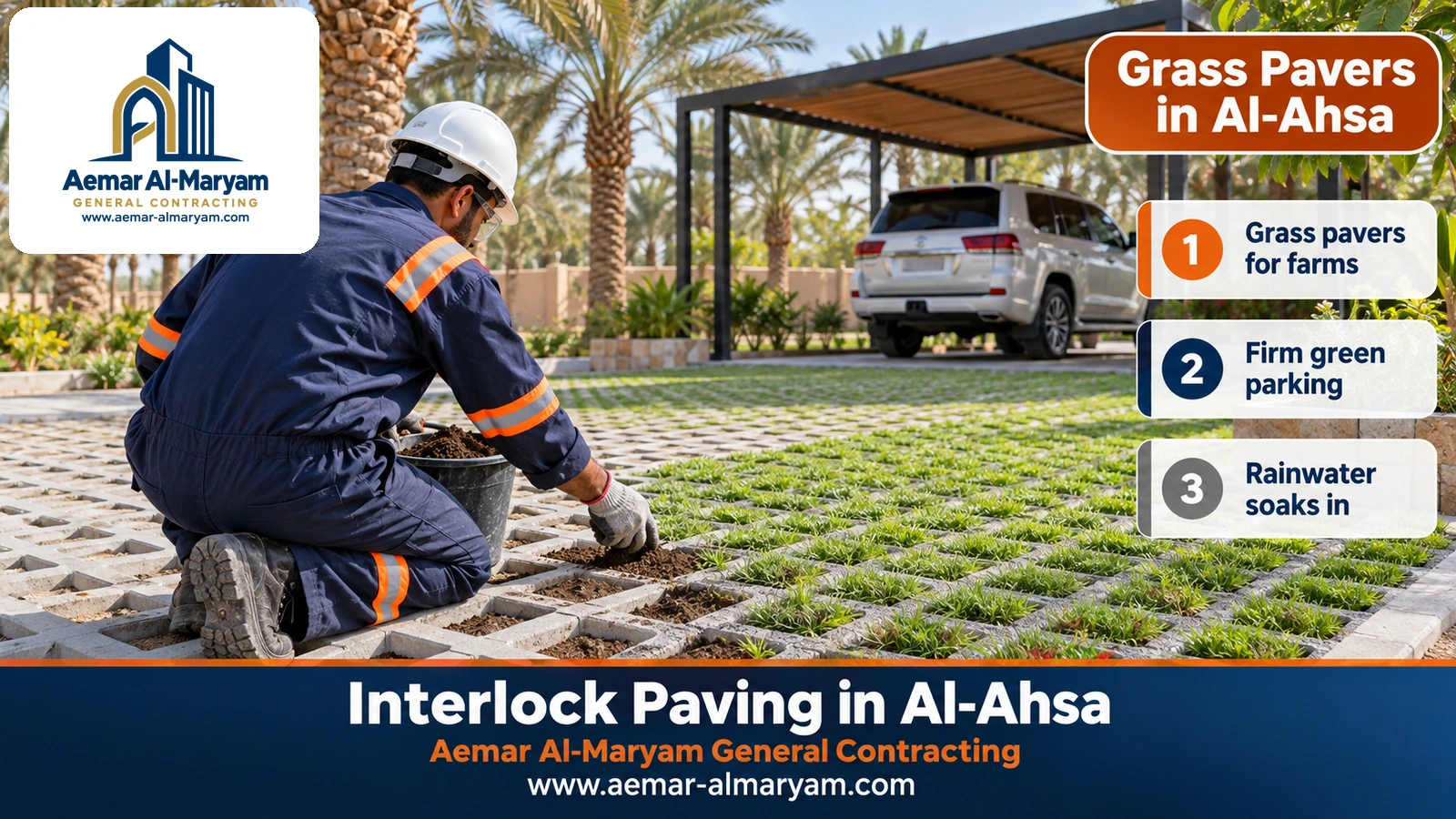
Grass pavers are not laid straight on sand, though. They need a compacted base like any car park, then a thin sand bed, then the units, then planting soil in the cells. The soil is not packed to the brim. It is left slightly below the top of the ribs so the grass is not crushed under the wheels. The grass also needs regular watering in the first months until its roots knit together.
| Question | Grass pavers | Solid 8 cm interlock |
|---|---|---|
| Look | Green, blends with the farm | Even, coloured surface |
| Rain and irrigation water | Soaks through the cells | Runs across the surface to the falls |
| Walking in light shoes | Harder because of the cells | Comfortable |
| Long daily parking | Better for occasional parking | Suits daily parking |
| Care | Watering and mowing | Topping up joint sand when needed |
| Price | At inspection | From SAR 55 on a ready base |
A tip for farm owners
Put grass pavers in the side parking or the guest parking, and solid interlock in the lane where cars turn and machinery passes. Repeated turning on grass pavers tears the grass out of the cells.
Kerb installation in Al-Ahsa on farm roads and entrances
Kerb installation in Al-Ahsa along a farm track or an istiraha gateway deserves to be treated as a job of its own. It keeps the edge of the road from collapsing and stops sand and mud creeping onto the paving. A kerb is never set on bare soil. We dig a trench, place a concrete bed of at least about 15 cm, set the kerb on it to a tight level string, then pour a sloping concrete haunch behind it to support it on the soil side. That haunch is what stops the kerb leaning when a car wheel presses on it or when irrigation water soaks the soil behind it.
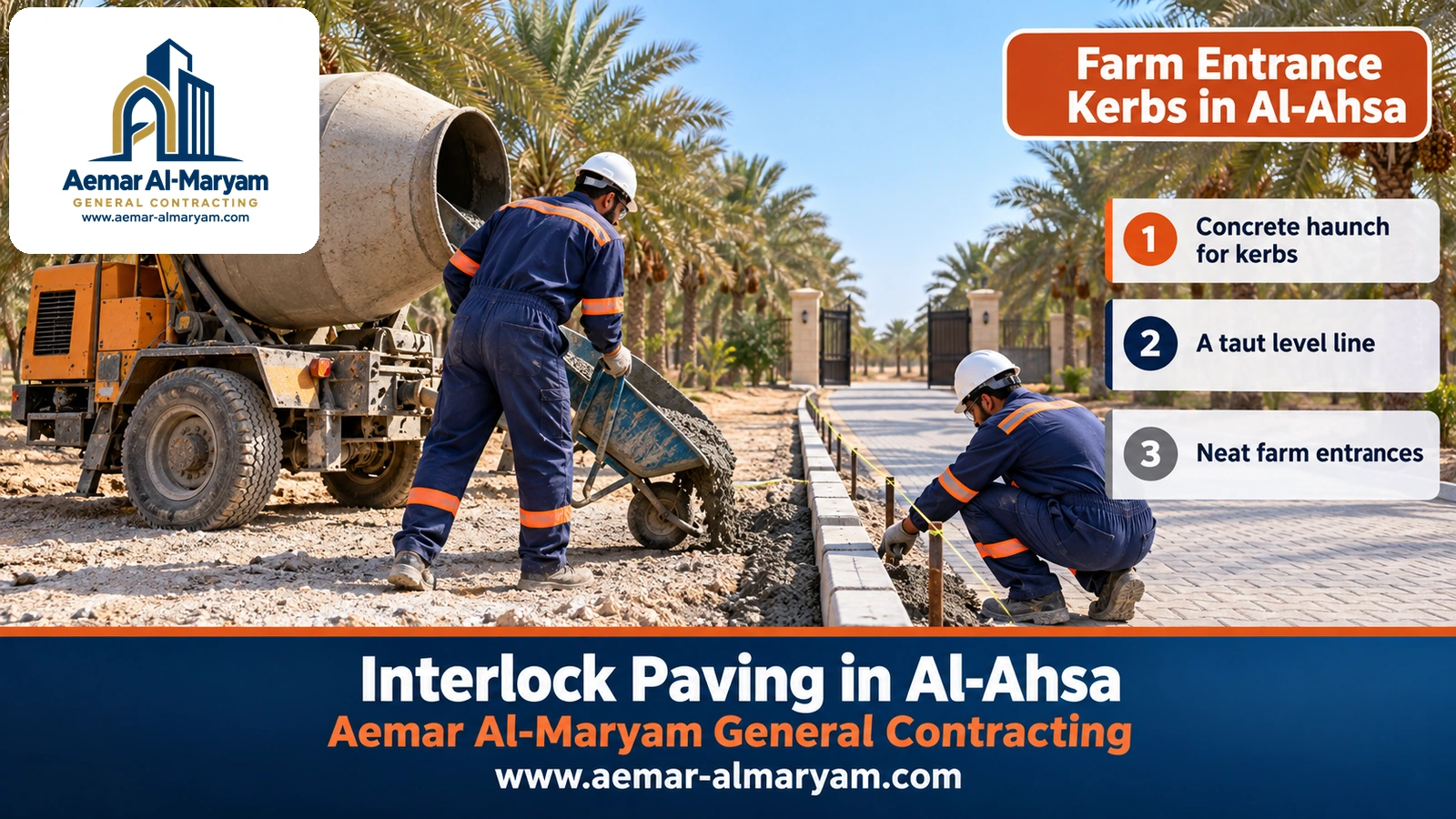
- ✓Pavement kerbs: the common size is 15×30×50 cm, standing about 12 cm above the paving, suited to road and car-park edges.
- ✓Garden kerbs: smaller and lower, suited to lawn edges and palm beds inside the rest house.
- ✓Dropped kerbs: at the car entrance the kerb drops until only about 2.5 cm shows, so wheels roll over without a jolt.
- ✓Joints: kerb ends sit tight together without mortar, and bends are formed from short or trimmed pieces.
Are kerbs really needed with interlock in Al-Ahsa?
Wherever an edge is exposed, yes. Pavers in the middle of a yard grip one another, but the outer row has nothing gripping it from outside except the kerb. Take that away and the row drifts outwards a little at a time, the joints widen, the sand escapes and the edge drops first, then the row behind it. Where you do not want a visible kerb, such as a seating area meeting the lawn, we pour a hidden concrete restraint below the surface that does the same job. The kerbs come first: we wait for their concrete to harden, then screed the sand, lay the pavers and compact towards them. If the project needs larger concrete work than kerb beds, our team for concrete pouring in Al-Ahsa can handle it.
Interlock types, shapes and thickness in Al-Ahsa: 6 cm or 8 cm?
Suppliers offer many shapes. The ones most requested for rest houses are the rectangle, because it accepts several patterns; the zig-zag, because it locks well under cars; the hexagon, for a calm look in seating areas; and large squares for walkways. For colour, sand, brown, grey and charcoal sit best with palms and pale walls. Each shape has its patterns: herringbone for car lanes, and stretcher or basketweave for paths and seating.
| Where in Al-Ahsa | Thickness | Suggested pattern | Base course, roughly |
|---|---|---|---|
| Rest-house paths and seating around the lawn | 6 cm | Stretcher, basketweave or hexagon | 10–15 cm |
| Home courtyard, no vehicles | 6 cm | Owner’s choice | 10–15 cm |
| Driveway and parked cars | 8 cm | Herringbone, 45° or 90° | 15–20 cm |
| Tanker and machinery lane | 8 cm or more | Herringbone | Set at inspection |
| Guest parking on a farm | Grass pavers or 8 cm | Regular | 15 cm or more |
The rule found in paving specifications is that 6 cm suits pedestrians and light home driveways, 8 cm suits areas carrying regular vehicle traffic, and units longer than three times their thickness should not be used where cars drive. At rest houses we lean towards 8 cm for anything cars enter, because guests turn and park in places nobody expects.
The layers under interlock in Al-Ahsa: from farm soil to the surface
Paving lives or dies by the hidden layers. Al-Ahsa gives us two very different starting points: loose dry sand in open yards, and wet, sometimes clay-rich farm soil around the irrigation basins. The farm soil is the one to respect, since ground soaked with water or loaded with salt carries less weight, and across parts of this province brackish water lies shallow and wicks upwards a good way into the soil. Trial holes at several spots during the visit settle the excavation depth.
- 1Remove weak material
We strip planting soil, roots and soft clay down to firm ground, replacing it with suitable compacted fill where needed. - 2Compact the formation
We compact the bottom of the excavation at the right moisture and set the falls from the start. - 3Base course
Crushed stone in a graded mix: 10–15 cm where people walk, 15–20 cm where cars go, each lift no deeper than 15 cm before the plate. - 4Separator where needed
On wet or salty soil we suggest a geotextile between soil and base, or raising the level slightly above the surrounding ground. - 5Sand bed
Clean, well-graded sand roughly 3 cm deep before the plate goes over it, levelled off on rails and never stepped on. - 6Pavers and joint sand
We lay, cut the edges, sweep finer sand into the joints and compact.
Bedding sand and the compactor in Al-Ahsa
Piling on extra sand feels like a safety margin, yet it works the other way: a deep bed squeezes sideways under a tyre and leaves tracks. So our bed stays thin and uniform, and if the stone below has a dip we fix the stone rather than filling the dip with sand. Joint sand is not bedding sand. It is finer, so it can enter joints of about 2–3 mm and fill them. A plate compactor on a protective rubber mat goes over the yard at least three times, then we sweep in sand and repeat until the joints are full. We never compact within about a metre of an edge that is not yet restrained.
Falls and drainage for rest-house interlock in Al-Ahsa
Rain is occasional at a rest house; irrigation runs every day, so the gradient earns its keep daily. We tilt the yard by roughly 2% or more, about two centimetres each metre, so water leaves the majlis and the seating and heads for the grass, a gully or the boundary wall, and we shape that tilt in the compacted stone before any sand goes down. Around each gully the paving finishes a few millimetres, three to six, proud of the grate so the water drops in instead of skirting it. We also suggest running irrigation and lighting lines in ducts laid ahead of the stone base, with a few empty spare ducts crossing under the yard. If you need a plumber for that, our plumber in Al-Ahsa can set out the lines before we start.
⚠ The mistake we see most at rest houses
A sprinkler that sprays the edge of the paving every day, or a small leak from an irrigation line under the yard, is enough to wash the sand from under the units and sink them within months. Fix the water source first, or the sinking will return however many times the area is re-laid.
Interlock in Al-Ahsa: honest pros and cons
■ Lift and re-lay
Units can be lifted, the base repaired and the same units put back, with no breaking and little waste.
■ No softening in heat
Concrete pavers do not soften at midday the way asphalt can under long parking.
■ Colours and patterns
Paths, borders and seating areas can be drawn in different colours in one yard.
■ Spot repairs
One broken paver comes out and a new one goes in; the rest stay put.
There are conditions attached, and we would rather state them now. Interlock only behaves on built-up, compacted ground; every perimeter must be held; once the joints lose their sand, grass and ants move in; and a pale bloom can show for the first few months. Budget pigments also lose their depth under the Al-Ahsa sun, so before buying we want the lab sheet for that particular delivery. The widely cited American paver standard sets the bar at a mean crushing strength near 55 MPa and water uptake capped at 5%.
White patches on new interlock in Al-Ahsa
A few weeks after laying, a chalky film may cover some units. It is lime leaching out of the cement inside the pavers, lifted by moisture and left behind as it dries. Sun and wind wear it away, though it can linger on salty or damp farm ground. Acid washes strip colour, so avoid them; if you cannot wait, trial a dedicated paver cleaner under a seat or in a corner first.
How an Al-Ahsa interlock job runs, step by step
- 1Photos and sizes
You send photos of the yard, its rough area and what will use it. - 2A plan on paper
We propose the zones: 6 cm areas, the 8 cm lane, grass pavers, border rows and kerbs. - 3Inspection in Al-Ahsa
We check the soil, take levels, set the depth and price the travel. - 4Excavation and base
Soft soil out, formation rolled, stone base built up lift by lift to the planned falls. - 5Kerbs first
We set them on a concrete bed and haunch and let them harden. - 6Sand and laying
We screed the sand, lay the agreed pattern and cut the edges. - 7Compaction and joints
We compact, sweep in joint sand and repeat until full. - 8Test and handover
We run water to see where it goes, check flatness with a straightedge and clean the site.
How long does paving a rest-house yard in Al-Ahsa take?
It depends on the area and the ground. A house yard on ready ground is finished in a few days. A large rest-house yard needing excavation, a base and kerbs can take two weeks or more, because the kerb concrete must harden before compacting against it. We give you the schedule after inspection and arrange it so the rest house is not out of use during an occasion.
Interlock prices in Al-Ahsa
Our cheapest Al-Ahsa rate is SAR 37 per square metre, because we run one starting price list for Dammam and Al-Ahsa alike; what differs is the crew trip, which we quote on the inspection day. Read each number below as an estimate, firm only once we have inspected and agreed. Expect it to climb for a small yard, damp farm soil or a tanker lane, and to ease on a large yard that is already prepared:
| Item | Unit | From (SAR) |
|---|---|---|
| Levelled rest-house yard: grey 6 cm pavers with bedding and joint sand | m² | 37 |
| Paths and seating around the lawn in coloured or two-tone pavers | m² | 46 |
| Car lane from the gate, 8 cm, over existing compacted stone | m² | 55 |
| Dirt yard for foot traffic, built from excavation to finished falls | m² | 64 |
| Laying only, with pavers you bought and ground already prepared | m² | 14 |
| Lifting an old house-yard floor of tiles and mortar | m² | 14 |
| Car or tanker lane built from soil on a deeper stone base | — | At inspection |
| Lawn borders, internal kerbs and farm-road kerbs | lin. m | At inspection |
| Grass-paver parking on the farm | — | At inspection |
| Lifting a sunken patch, fixing the cause and re-laying it | — | At inspection |
| Wet or saline farm soil | — | At inspection |
| Crew trip from Dammam and carting away spoil | — | At inspection |
A yard below roughly fifty square metres carries a higher rate per metre, since the compactor, the crew and the drive cost the same whatever the size. For everything else we price, see the full price list.
Worked example: an 18 × 22 m rest-house yard around a lawn
An illustration only: a rest-house yard of 18 × 22 = 396 m² with a 10 × 14 = 140 m² lawn in the middle, leaving 256 m² to pave. Assume the soil there has been levelled and rolled already. Of the paved area, 196 m² goes to paths and seating in sand-coloured 6 cm interlock and 60 m² to the car lane from the gate in 8 cm units:
| Item | Calculation | Result |
|---|---|---|
| Paths and seating, 6 cm coloured | 196 × 46 | SAR 9,016 |
| Gate-to-parking lane in 8 cm units | 60 × 55 | SAR 3,300 |
| Estimated paving total | 9,016 + 3,300 | SAR 12,316 |
| Lawn border | 2 × (10 + 14) | 48 linear metres (at inspection) |
| Bedding sand, about 3 cm | 256 × 0.03 | about 7.7 m³ |
| Pavers incl. 5% for cuts | 256 × 1.05 | about 269 m² |
If the ground is bare soil and needs the full system, the pedestrian part becomes 196 × 64 = SAR 12,544, and the car lane with its heavier base is priced at inspection. Travel from Dammam stays a separate item agreed at inspection, and its share per square metre falls as the yard gets larger or as more jobs share one visit.
Interlock repair and re-laying in Al-Ahsa
Repairing interlock in Al-Ahsa means diagnosing the dip before touching a single paver; lifting and relaying without a diagnosis just recreates it. The causes we see most at rest houses and farms are irrigation water leaking under the yard, a thin or poorly compacted base, a thick sand bed, a broken or missing kerb, or 6 cm units in a lane cars use daily. Our method: lift the units and stack them for reuse, remove wet or contaminated sand, fix the water source, the base and the edge, then screed fresh sand, re-lay and compact. Cracked or faded units are replaced with the closest colour available.
Routine care for rest-house interlock
- ✓Top up the joint sand after every heavy wash or rainy season.
- ✓Pull weeds out of the joints early; their presence means the sand has dropped.
- ✓Watch for any dip near irrigation beds or water lines and fix it while it is small.
- ✓Do not light fires directly on the paving in seating areas; intense heat cracks units and changes their colour.
Interlock, asphalt or tiles for a rest-house yard in Al-Ahsa?
Interlock suits a yard that combines sitting, walking and cars, offers colours and patterns, and can be repaired in parts. Asphalt is faster and cheaper on wide areas used only by cars, such as a long farm road or a big parking yard; see our asphalt contractor in Al-Ahsa page. Tiles bedded in mortar, such as porcelain or stone, suit a shaded seating area or a pool surround where the owner wants a smooth, washable surface, and our tile installer in Al-Ahsa handles that. Many rest houses combine all three: asphalt on the road, interlock in the yard and tiles under the canopy.
Old tiles or an old slab in an Al-Ahsa yard: lay over them or lift them?
Old tiles come up first. Their glazed face lets the bedding sand slide, traps water between the two floors, and the extra height creeps up towards the door sills. Taking them up with their mortar costs from SAR 14 a square metre; if they are bonded to a slab that must be broken, the job goes to our demolition team in Al-Ahsa. A sound slab that already sheds water can sometimes stay and carry the sand and pavers once weep holes are drilled through it; that call is made on site.
Common mistakes in rest-house paving in Al-Ahsa
- ✓Laying pavers straight on site sand with no base course.
- ✓Leaving the lawn edge without a kerb or restraint, so units creep into the soil.
- ✓Paving tight against a palm trunk with no bed around it.
- ✓Using 6 cm units in the tanker or car lane.
- ✓Compacting the paving before the kerb concrete has hardened.
- ✓A fall towards the majlis or seating instead of the lawn or a drain.
- ✓Buying pavers in batches from different runs, so the colours differ.
Receiving interlock in Al-Ahsa: what to check
- ✓Kerbs: straight to the string, the haunch visible behind them, and no movement when pushed.
- ✓Falls: run a hose and watch the water move away from the majlis without ponding.
- ✓Flatness: run an aluminium straightedge along, across and diagonally; any daylight beneath it should be only millimetres.
- ✓Joints: the same width throughout, packed with sand, and no paver tilting when you stand on it.
- ✓Edges and cuts: clean cut units, not thin slivers, especially around covers and beds.
- ✓Colour and pattern: as agreed, with the lawn border continuous and gap-free.
How to order interlock paving in Al-Ahsa
Put these in one WhatsApp message to 0547879578; our reply carries a zoning sketch and a rough cost, after which we fix the visit date together:
- ✓Yard photos one from the gate, one from the majlis, and any spot where irrigation water pools.
- ✓Rough sizes of the yard, the lawn and the road length if there is one.
- ✓Use walking and sitting only, cars, or a tanker and machinery.
- ✓Ground condition sand, farm soil, old tiles or concrete.
- ✓Your taste the colours and pattern you like, or a photo of a yard you admired.
- ✓Location a map pin in Hofuf, Mubarraz or the farm.
Why Aemar Al-Maryam for your rest-house paving in Al-Ahsa?
■ Zoned by use
We never pave a yard at one thickness: 6 cm where you walk, 8 cm where you drive.
■ Restrained edges
Every edge has a kerb or restraint, and every kerb has a bed and haunch.
■ A planned trip
We prepare quantities and equipment from your photos, cutting the days and the travel cost.
■ Related work
We can arrange renovation and annex and majlis building at the same rest house.
Browse completed yards in our projects, read the short interlock and kerbs service summary, or dig into layers and specs in the Dammam interlock guide.
Where we lay interlock in Al-Ahsa
Our crews cover Hofuf, Mubarraz and the istirahas and palm farms on their outskirts, with recent work in these districts:
Coverage details are on the Al-Ahsa page. We also lay interlock in the north of the province; read interlock paving in Khafji and interlock paving in Hafr Al-Batin.
Is your rest-house yard ready for paving?
A handful of photos of the yard and lawn plus rough measurements is all we need to propose zones, thicknesses and a budget, and then to fix a visit to Al-Ahsa.
More for rest-house owners
Tags