Interlock paving in Dhahran depends on what will travel over it. A quiet footpath between villas in a residential compound is well served by 6 cm pavers between two kerbs; a warehouse forecourt used by lorries needs 8 cm or more in herringbone on a deep base; and a villa car entrance needs a dropped kerb that does not jolt the wheels. Aemar Al-Maryam General Contracting handles all three, materials and labour, in Dhahran, from SAR 37/m² for grey 6 cm on prepared ground and from SAR 55/m² for 8 cm, as estimates until inspection. Call or WhatsApp 0547879578.
Dhahran is joined to Dammam and Al Khobar, and two kinds of request come up again and again there. Compounds and villas want neat paths and yards that cope with summer heat and are easy to wash; warehouses and workshops on the industrial edges want a yard that neither cracks nor sinks under load. This page is written around exactly those sites, with figures that help you compare quotations and know what to ask for.
Interlock paving in Dhahran at a glance
- Sites: Compound and villa footpaths, warehouse and factory forecourts, car parks, yards and car entrances.
- Thickness: 6 cm for pedestrians, 8 cm in herringbone for cars, and 10 cm or more for lorries and forklifts, set at inspection.
- Kerbs: On a concrete bed of about 15 cm or more, with a chamfered dropped kerb at every vehicle opening.
- From: SAR 14/m² labour, 37 grey 6 cm, 46 coloured, 55 for 8 cm, 64 full pedestrian system; kerbs and heavy yards priced at inspection.
- Contact: Phone or WhatsApp 0547879578; include pictures, dimensions and the vehicles expected.
Interlock paving in Dhahran: where we work most
Interlock paving in Dhahran covers three main kinds of site for us, and each has its own thickness, base and edge detail. We settle the type of site before any talk of colour or shape, because choosing the wrong thickness is the most common reason interlock fails after a year or two.
■ Compound footpaths
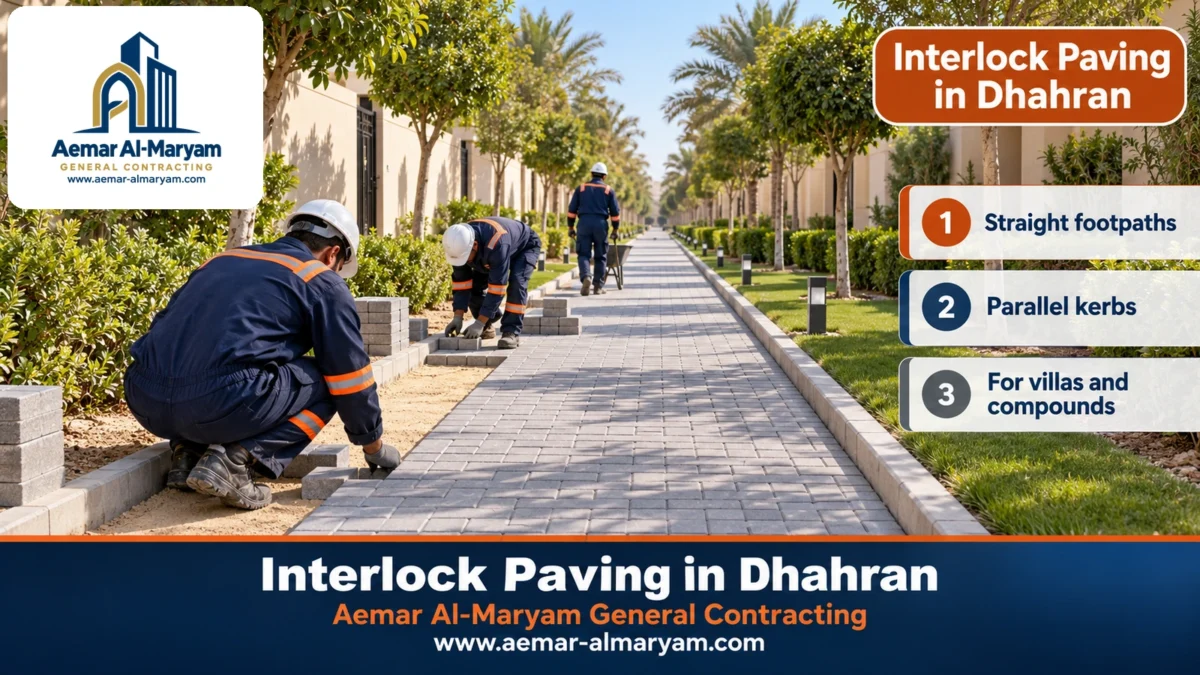
Long paths between villas and around shared gardens, in 6 cm stretcher bond between two parallel kerbs.
■ Warehouse forecourts
Loading yards in front of wide metal doors, in thick diagonal herringbone on a base compacted in lifts.
■ Villa car entrances
The car route from gate to garage, with a dropped kerb at the opening and full kerbs on both sides.
■ Building car parks
Office, shop and apartment car parks, with bay lines laid in white units instead of paint.
■ Yards and seating
House courtyards and the outdoor seating area by the majlis, in one colour or two.
■ Re-laying
Where paving has dropped, we cure the cause underneath and return the original units.
You will find a brief outline of this service on the interlock and kerbs page, and the full general guide is in our article on interlock paving in Dammam. Here we focus on what matters for Dhahran sites.
Compound footpath interlock in Dhahran
Footpaths in Dhahran residential compounds are usually paved in 6 cm interlock in a straight stretcher bond, which is easy on the eye along long runs and leads people in the right direction. Before any paver goes down we set two parallel kerbs on a concrete bed, one each side; they fix the width and the level and hold the edge units in place.
A long path exposes every alignment error: a small drift at the start becomes obvious thirty metres further on. So we stretch a string line along the whole section, lay from one fixed end in a single direction, and check the courses every few metres rather than trying to correct the line with cuts at the end. On curves we adjust the joints gradually instead of forcing a sharp change.
- ✓Width: Main paths between villas about 1.20 m or more; side garden paths usually 60–80 cm.
- ✓Crossfall: About 2% towards the lawn or a drainage channel, so irrigation water does not sit on the path.
- ✓Trees: We keep a gap between the path edge and tree trunks and suggest a root barrier near large trees, since roots lift pavers over time.
- ✓Lighting: If the path has ground lights, the ducts go in before the base, coordinated with an electrician in Dhahran.
Working with the compound management
We agree working hours, the pallet unloading point and the equipment route in advance, split a long path into sections so residents always have an open route, and clean each section before moving to the next.
Compound paths also tend to cross small service covers, irrigation valves and lighting bollards. We lift each cover to the new level and cut the pavers around it with a saw, leaving no thin slivers that would break loose later. Where the path meets an existing tiled patio or a villa threshold we keep the paving safely below the door and run a neat border course along the joint.
Garden interlock and walkways in Dhahran
Garden interlock in Dhahran is often chosen in two colours: one for the path and one for the border, or hexagonal units for seating areas. In a garden we drop the kerb so it sits level with the lawn or just above it, and we fall the path away from planting beds so irrigation water does not wash sand out of the joints.
Grass pavers in Dhahran
Grass pavers are open-cell units with turf growing in the openings. They suit visitor parking at the edge of a compound or garden margins where the owner wants a green area that can still carry a car now and then. They need regular watering and some care, and are priced after inspection.
Warehouse and factory forecourt interlock near Dhahran
Warehouse forecourt interlock near Dhahran needs at least 8 cm in herringbone, and 10 cm or more where lorries turn or forklifts work. With the Second Industrial City on the western side of Dhahran and the Third further south, the area holds many loading yards used by heavy vehicles all day: the hardest environment interlock has to cope with.
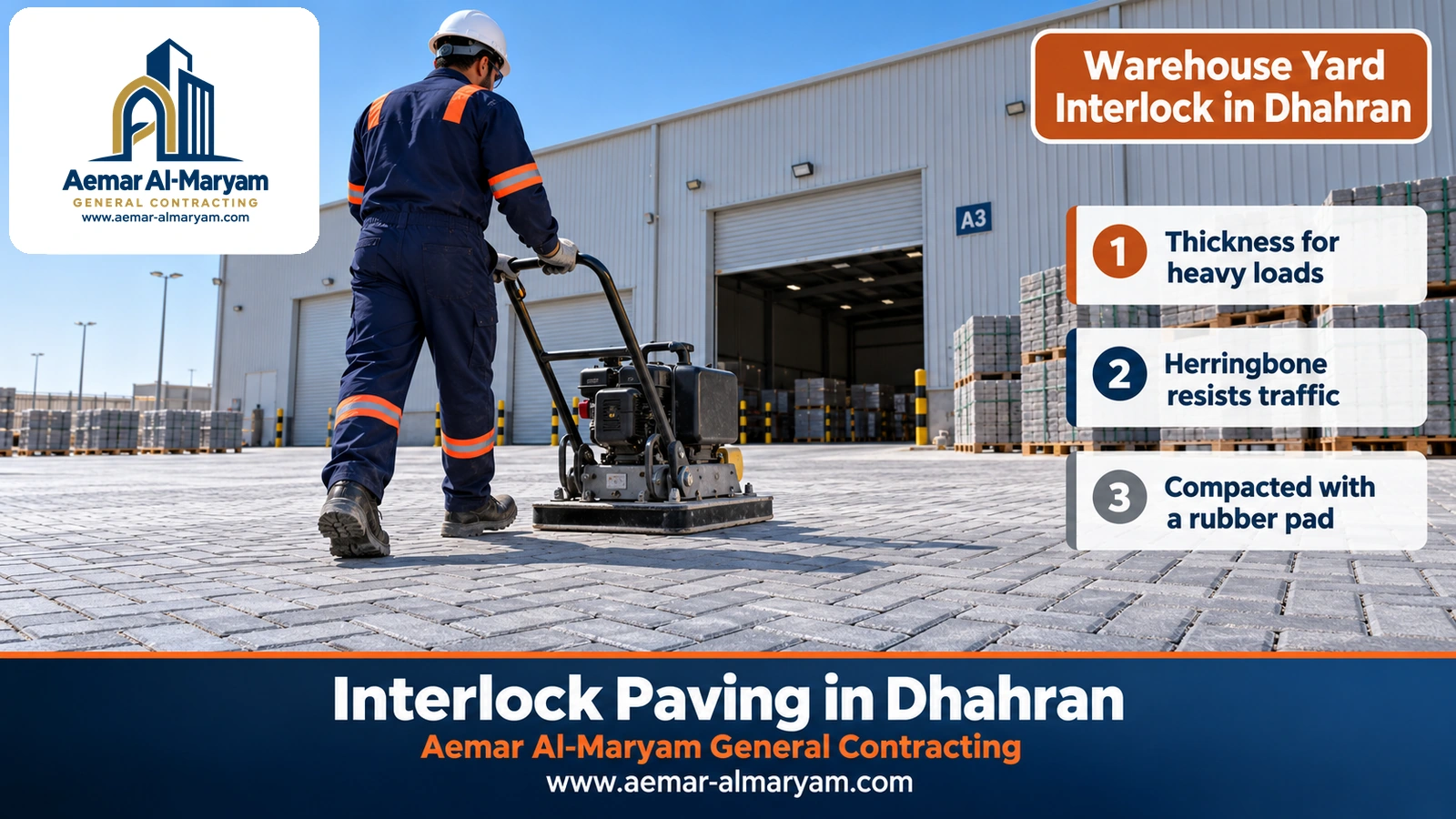
In a heavy yard thick pavers alone are not enough. The load passes from the units to the sand and then to the base course; if that base is thin or poorly compacted, wheel ruts appear within months. The reference specifications used in the region for heavy-traffic parking speak of about 23 cm of compacted base, and we set the final figure after checking the soil and learning which lorries will use the yard.
| Traffic in the yard | Paver thickness | Approx. base | Note |
|---|---|---|---|
| Light cars and visitors | 8 cm | 15–20 cm | Herringbone with kerbs on the edges |
| Small trucks (dyna) | 8 cm | 20 cm or more | Reinforce the edges at the doors |
| Lorries and forklifts | 10 cm or as inspected | About 23 cm or per soil check | Compact in lifts and check levels often |
| Staff walkway by the offices | 6 cm | 10–15 cm | A different colour separates people from lorries |
In yards we use a heavy plate compactor fitted with a rubber pad and make at least three passes before and after the joint sand, and the plate stays roughly a metre clear of any edge until its kerb has set. If an old concrete slab has to be cut to run a drain, that is work for concrete cutting in Dhahran; if you want asphalt for the lorry lane, read asphalt contractor in Dhahran.
Loading-door thresholds and drainage in front of the warehouse
The wide metal loading doors are the point that suffers most: lorries stop and turn there, and water heads straight for them if the fall is wrong. So we build the yard from the door threshold downwards, with the highest level at the warehouse and the lowest at the street or a drainage channel. Along the edge of the internal concrete floor we set a buried restraint or kerb so the first courses do not creep under the wheels.
Where a large yard cannot drain entirely towards the street, we place a linear channel or gullies in the middle and leave the paving a few millimetres above their edges. The channel bed is cast with the kerb concrete, and concrete pouring in Dhahran can cover any part of the yard that is better as a slab.
Car park interlock in Dhahran for offices and shops
Car park interlock in Dhahran is laid at 8 cm in herringbone, and the bay lines are formed in white or light units within the paving itself, so they never need repainting. A full-height kerb separates the bays from the shopfront walkway, and the falls carry water away from the entrances. Accessible bays are kept at no more than about 2% fall in either direction.
Why diagonal herringbone in yards?
Herringbone at 45 or 90 degrees locks every unit on all four sides, leaving no continuous joint along which units could shift as a lorry brakes or swings round. The shape of the unit matters too: in vehicle areas its length should not exceed three times its thickness, while long slim units are kept for footpaths.
Kerb installation in Dhahran
Kerb installation in Dhahran always comes before the paving. We cast a concrete bed of about 15 cm or more under each kerb, back it with the same concrete as a haunch, and let it harden before the sand is screeded, the pavers laid and the compactor run towards it. The kerb holds the interlock, fixes its level and channels the water beside it, which is why we never lay pavers first.
| Type | Common size | Reveal above paving | Where we use it in Dhahran |
|---|---|---|---|
| Garden edging | 50 × 15–20 × 10 cm | Flush up to about 8 cm | Garden paths and planting beds |
| Footway kerb | 50 × 20 × 12 cm | Between 5 and 10 cm | Compound paths and seating areas |
| Pavement kerb | 50 × 30 × 15 cm | Face of about 12.5 cm on internal roads | Car park edges and internal roads |
| Chamfered dropped kerb | Per supplier | About 2.5 cm at a car entrance | Vehicle openings |
The dropped kerb at a Dhahran villa car entrance
The dropped kerb is laid only across the width of the vehicle opening, with a chamfered edge standing about 2.5 cm above the surface, so wheels cross smoothly and the kerb edge does not chip. On each side of the opening the full-height kerbs rise again, with a sloping transition unit between the two.
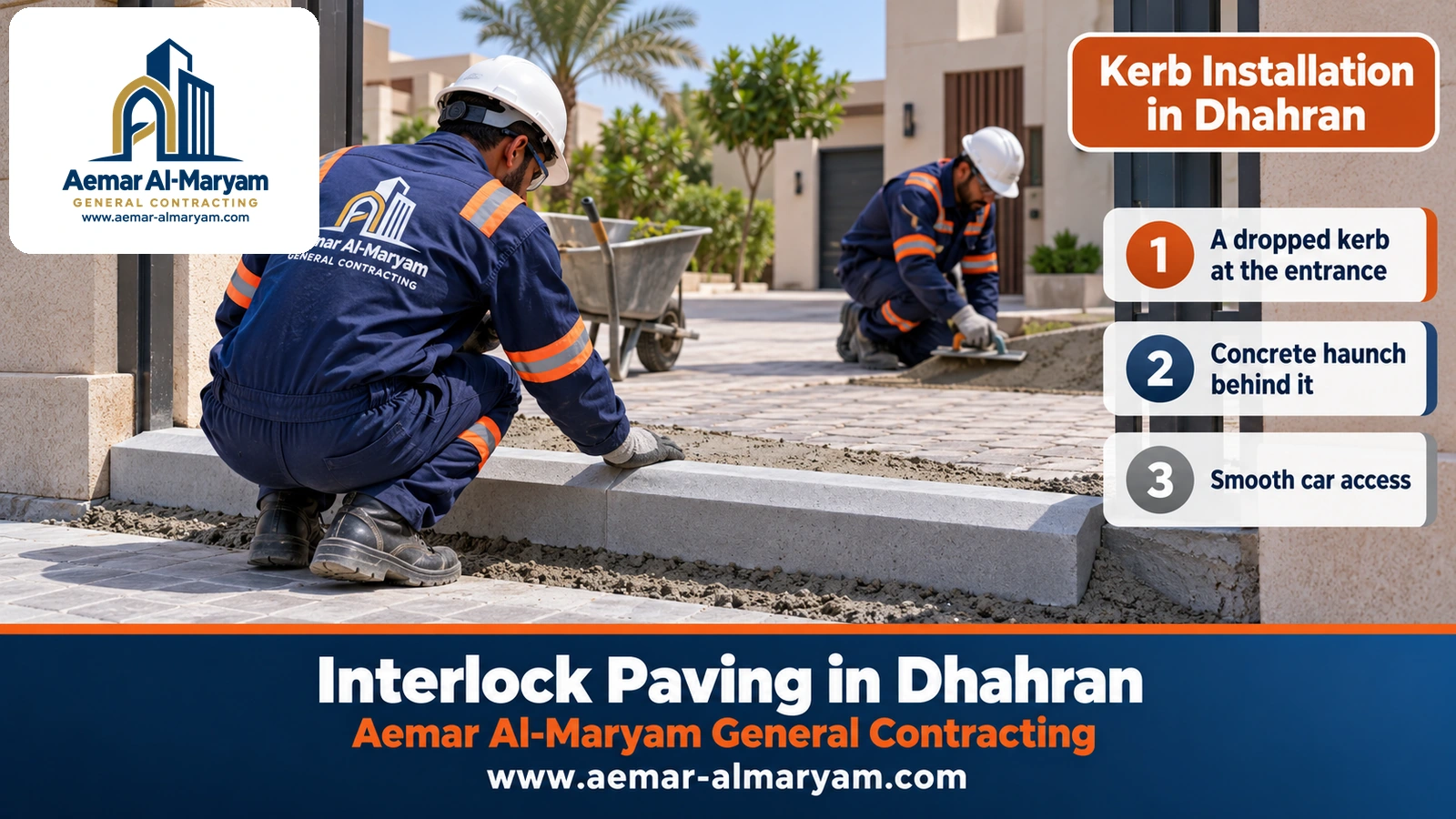
A common mistake is to run full kerbs straight across the entrance and then pour a concrete hump over them, or to break the kerb edge after installation. The right way is to mark the opening on the layout before work starts and order the dropped and transition units from the supplier together with the other kerbs.
The public pavement is not part of your plot
If the car entrance crosses a municipal pavement, lowering or altering it needs municipality approval before any work. We work within the boundaries of the private property only.
Are kerbs really necessary with interlock?
They are needed wherever the paving ends without a wall or slab. Edge units are pushed outwards by every vehicle movement and every pass of the compactor, and without a fixed restraint the joints open and the edge sinks. Where an owner does not want a visible kerb we build a hidden concrete restraint just below the surface.
Kerb installation only in Dhahran
We also install kerbs on their own: around an existing garden, along the edge of an asphalt car park, or to replace broken kerbs. Kerb-only work is charged by the running metre, depending on the kerb type and its bed, so send the length and photos for an estimate.
Interlock for house fronts and yards in Dhahran
House-front interlock in Dhahran usually combines two parts: an 8 cm herringbone strip for the car between gate and garage, and the rest of the yard and paths in 6 cm in a colour or pattern the owner chooses. Splitting it this way saves money without weakening the part the car uses.
In Dhahran yards we watch three points: a slope that sends water off the facade and the majlis entrance towards the gate or a drain; door thresholds, which must stay a safe distance above the paving; and inspection chambers, whose covers we raise to the new level and cut around precisely. If the yard has old tiles, the choice between removing them or retiling is something we discuss with a tile installer in Dhahran.
6 cm or 8 cm interlock in Dhahran?
6 cm interlock is enough for compound paths, gardens and yards without cars; 8 cm is the safe choice wherever a car parks or passes daily; industrial yards have their thickness set at inspection. Well-known paving guides accept 60 mm for residential driveways on a strong base, but we prefer 8 cm on the daily car route.
| Site | Thickness | Suitable pattern |
|---|---|---|
| Compound footpath | 6 cm | Straight stretcher bond |
| Seating area or garden | 6 cm | Hexagonal, basketweave or two colours |
| Villa car lane | 8 cm | Herringbone |
| Office or shop car park | 8 cm | Herringbone with white lines |
| Warehouse yard | 8–10 cm or more | Diagonal herringbone |
Interlock pavers, types and shapes in Dhahran
Interlock pavers are factory-pressed concrete blocks that sit dry on bedding sand and are held together by the sand in their joints and the kerbs around them, which is why they are not set in mortar. The common shapes are rectangular, zig-zag (interlocking edge), hexagonal and square, plus open-cell grass pavers. The rectangle is the most flexible because it goes in stretcher bond on paths and herringbone in car areas; the hexagon gives seating areas a calm look but needs more cutting at the edges.
Colours are a matter of taste, but consistency is not: insist that every unit comes out of a single production run, and keep a few spare units for future repairs. Light greys and sand tones show less dust and stay cooler underfoot in summer than very dark units.
The layers under interlock in Dhahran
There are five layers under interlock in Dhahran: compacted subgrade, a crushed-stone base course, a thin sand bed, the pavers, and fine sand in the joints. The base is what carries the load; the sand is there only to let the pavers bed evenly.
- 1Subgrade
Soft ground, rubble and roots are dug out, then we shape the formation to the required fall and compact it. - 2Base course
Depth grows with load: 10–15 cm under footpaths, 15–20 cm under cars, deeper again in heavy yards, each layer compacted at 15 cm or less. - 3Sand bed
Roughly 3 cm of clean, graded sand (loose), levelled off with a straightedge and kept free of footprints. - 4Pavers
Laid with even 2–3 mm joints and cut at the edges with a saw or block splitter. - 5Joint sand
A finer grade than the bedding layer, brushed in between compactor passes until no joint is left hollow.
Why the bedding layer stays thin
The thin sand bed matters more than many people think. If it is made thicker to hide low spots in the base, it moves under load and ripples appear. Level corrections belong to the base layer, so the sand stays uniform. A different, finer sand goes in the joints, because it has to work its way down and lock the units together.
Falls and drainage for interlock in Dhahran
Interlock needs a fall of at least about 2%, or 2 cm per metre, away from buildings towards the street, the lawn or a drain. We form this slope while building the base rather than by varying the sand, and the finished surface is left a few millimetres above drain edges and channels. In large yards we split the falls into several directions so water never has to travel a long way across the surface.
Interlock prices in Dhahran
In Dhahran, grey 6 cm interlock with materials and laying begins at SAR 37/m² on prepared ground: the same figures we use in Dammam. Treat every number as provisional until we inspect and agree; it depends on the area, thickness, colour, ground condition, required base, kerbs and access for equipment.
| Item | Unit | From (SAR) |
|---|---|---|
| Laying, cutting and compaction only; materials on site and ground ready | m² | 14 |
| Grey 6 cm interlock for compound paths and yards, with sand and compaction | m² | 37 |
| 6 cm units in colour or a two-tone layout | m² | 46 |
| Car lane or car park in 8 cm herringbone, base already built | m² | 55 |
| Footpath built from raw ground: dig, compact, base, sand, 6 cm units, falls | m² | 64 |
| Car-grade full build: 8 cm units over 15 cm+ of base | — | At inspection |
| Warehouse and lorry yards (10 cm and deeper base) | — | At inspection |
| Kerbs of any type (garden, pavement, dropped) bedded in concrete | linear m | At inspection |
| Re-laying sunken interlock with base repair | — | At inspection |
| Grass pavers | — | At inspection |
| Breaking up existing yard tiles and mortar | m² | 14 |
| Debris removal (small truck or tipper) | load | 90 |
| Treatment of damp or saline ground | — | At inspection |
The SAR 64 full system is for pedestrian and light use, so it should not be compared with the full system for cars, which is priced after inspection. Jobs smaller than roughly 50 m² come out dearer per metre, since getting the crew and plant to site costs the same. Our full list sits on the prices page.
Worked example: a warehouse yard with a staff walkway
An illustrative example for a forecourt near Dhahran measuring 18 × 25 m, with its base already in place and compacted, plus a coloured walkway along the 25 m office frontage, 2 m across:
| Item | Calculation | From (SAR) |
|---|---|---|
| Yard, 8 cm herringbone | 450 m² × 55 | 24,750 |
| Office walkway, coloured 6 cm | 50 m² × 46 | 2,300 |
| Total | 500 m² | 27,050 |
| Kerbs between yard and walkway and on the edges | Per linear metre | At inspection |
If the inspection shows that the lorries need 10 cm or that the base is unsuitable, the yard line becomes “at inspection” and its base is calculated by volume: 450 m² at 20 cm means about 90 m³ of compacted crushed stone. The sand bed for the whole area is roughly 500 × 0.03 = 15 m³ before allowing for waste.
What raises or lowers the price in Dhahran?
- ✓Area: The larger the area, the smaller the share of transport and equipment in each square metre.
- ✓Use: Pedestrian paving costs less than car paving, and car paving less than lorry yards.
- ✓Ground: Ready compacted ground is far cheaper than bare or damp soil.
- ✓Edges: The length of kerbs and the number of entrance openings.
- ✓Cutting: Curved paths and many inspection chambers add cutting and waste.
- ✓Access: Whether the truck and equipment can reach the site, and the working hours allowed in the compound.
Interlock company, contractor or installer in Dhahran?
An interlock company in Dhahran takes the job from excavation to handover, whereas an installer or a laying crew working alone usually starts from the sand surface. The difference shows on yards and long paths: who is responsible for levels, alignment and base compaction? We bring a laying crew, a person in charge of levels, and the excavation, compaction and cutting equipment, and we also offer labour only when you have the materials and the ground is ready.
Interlock supply and installation in Dhahran
When we supply, quantities include extra for cut pieces, order the pavers from a single production batch so the colour does not change from one end of a path to the other, and unload pallets where the truck will not drive over prepared areas. Units per square metre depend on the paver size; for instance a 20 × 10 cm block needs 50 pieces per m², and the area per pallet is taken from the supplier sheet for each product.
Interlock installation steps in Dhahran
- 1Inspection
We measure, confirm the use, and check the soil, drains and car entrances. - 2Layout
We mark falls, edges, entrance openings and the pattern, and agree details with the compound management if there is one. - 3Excavation and base
Weak soil out, base course placed and compacted in lifts. - 4Kerbs
Set on a concrete bed and left to harden. - 5Sand and laying
Screeding the sand bed, then laying to a string line from a fixed edge. - 6Cutting and compaction
Edge cuts and cuts around chambers, then compaction with joint sand. - 7Handover
A hose test, an alignment check and a clean site.
How long does it take, and when can a car drive on it?
A villa entrance or medium yard on prepared ground takes a few days; a long compound path is split into sections and takes longer; a yard depends on the excavation and base. Kerb concrete needs two or three days to set before we compact the pavers towards it. After the final compaction with joint sand a car can use the paving the same day, provided the kerb concrete has hardened.
Interlock re-laying and repair in Dhahran
Re-laying interlock in Dhahran starts by finding why it sank, because putting the units back over the same cause means it will sink again. The usual causes are a thin or uncompacted base, a thick sand bed, a broken kerb, water leaking from a pipe or an AC drain, or 6 cm units under daily car traffic. We lift the area, fix the cause, re-lay the same units if they are sound and replace damaged ones with a close colour match. Where a leak is behind it, we coordinate with a plumber in Dhahran.
Routine maintenance for paths and yards
Maintenance is simple but extends the life of the paving: re-sweep joint sand after pressure washing, pull weeds from joints early because they show that sand is missing, and watch for any loose unit or spot where water collects and have it fixed before it spreads. On industrial yards we suggest an inspection walk after the first rainy season.
Interlock, asphalt or tiles in Dhahran?
Interlock or asphalt? Asphalt is faster and cheaper for very large yards and long lorry lanes; interlock wins when you want to repair a patch without a trace, reach services underneath and put the same units back, or mark pedestrian routes in another colour. Many Dhahran yards use both. Interlock or tiles for a house yard? Tiles are pleasant for a covered seating area that is washed often, while parked cars and shifting ground favour interlock. We do not recommend laying interlock over old tiles; remove them first, which a demolition contractor in Dhahran can handle.
Paver quality and ground conditions in Dhahran
Ask the supplier for a test certificate for the batch showing compressive strength and water absorption. The American interlock standard, the usual benchmark, looks for a 55 MPa average strength or better with water uptake capped at 5%. The white bloom that appears in the first months is lime from the cement brought up by moisture, and weather and time clear it, so do not scrub it with strong acids.
Ground in the Eastern Province varies from site to site. Near the coast the soil may be saline or the groundwater shallow, which calls for soil replacement, a thicker base or a separating geotextile. We do not assume this everywhere; we decide after digging and inspecting.
Common interlock mistakes in Dhahran
- ✓Paving before the kerbs are fixed: The edges shift at the first compaction.
- ✓6 cm units in a lorry yard: Wheel ruts appear within months.
- ✓Correcting levels with sand: Ripples show after the first rain.
- ✓Full kerbs across a car entrance: The edge chips and someone pours a concrete hump over it.
- ✓Falls towards the house or warehouse door: Water collects at the entrance.
- ✓Laying a long path without a string line: The line drifts and shows after tens of metres.
Receiving interlock in Dhahran: what to check
- ✓Kerbs: Straight, at level, with the concrete haunch visible behind them.
- ✓Water: Run a hose: water flows to the drain and does not stand.
- ✓Alignment: Courses run straight along the whole path and a straightedge shows no ripples.
- ✓Joints: Even and full of sand, and no unit rocks underfoot.
- ✓Cuts: Neat along borders and chamber surrounds, without tiny offcuts.
- ✓Entrances: The dropped kerb is in place and a car crosses it smoothly.
Dhahran districts we serve
We install interlock and kerbs across Dhahran, including Doha North, Doha South and Al Qusur, in private residential compounds, and around the Second and Third Industrial Cities. Our crews cover Al Khobar and Dammam as well, and you can read about interlock paving in Qatif and interlock paving in Saihat, with the rest of the Eastern Province covered too.
How to order interlock paving in Dhahran
- 1Photos
Pictures of the path, yard or entrance from several angles, including chambers and spots where water collects. - 2Sizes
Length and width, the length of edges needing kerbs, and the width of car openings. - 3Use
People only, private cars, or lorries and forklifts. - 4Ground
Soil, tiles, concrete, or old sunken interlock. - 5Inspection
We visit and confirm the items, cost and schedule before starting.
Why choose Aemar Al-Maryam in Dhahran?
- ✓Thickness matched to load: We never put 6 cm where lorries run, nor charge you for 10 cm on a footpath.
- ✓Base before pavers: We compact in layers and correct levels in the base, not the sand.
- ✓Proper kerbs: A concrete bed and a dropped kerb at every car entrance.
- ✓Published prices: Clear “from” figures, with the rest priced after inspection.
- ✓Close to Dhahran: Our base in Dammam puts Dhahran within our everyday working area.
A compound path, a warehouse yard or a villa entrance?
Send photos, sizes and the vehicles that will use it, and we will come back with the paver thickness, base depth, kerb details and a rough budget.
Useful links for Dhahran
Tags