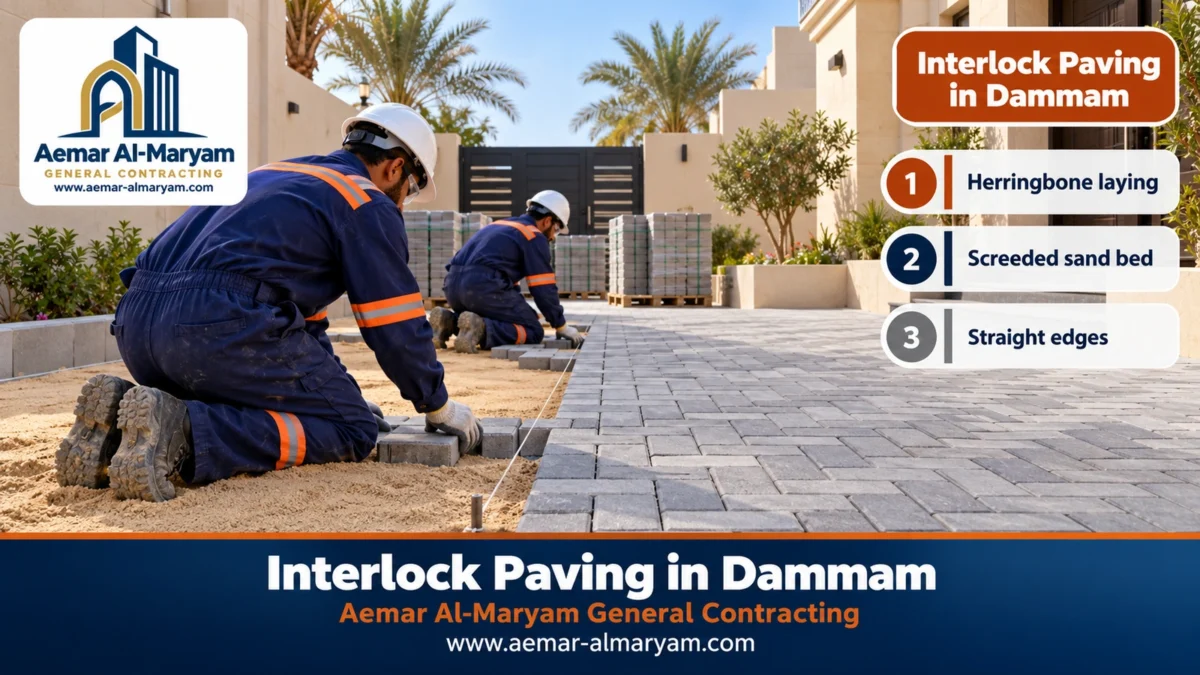
Interlock paving in Dammam means laying factory-made concrete pavers dry on a thin sand bed over a compacted base course, restraining every open edge with kerbs, then sweeping fine sand into the joints and compacting the whole surface until the pavers lock together and carry people or cars as one layer. Aemar Al-Maryam General Contracting lays interlock, materials included, for house yards, house fronts and villa entrances, car parks for apartment buildings and shops, and garden paths; we install kerbs of every common type and we lift and re-lay interlock that has sunk, in Dammam and nearby Eastern Province cities. Grey 6 cm pavers on prepared ground begin at SAR 37/m² supplied and laid, from SAR 55 for 8 cm interlock for cars, and from SAR 14 for labour only. Final figures follow a site visit. Phone or WhatsApp: 0547879578.
Interlock looks like simple work: sand, blocks and a compactor. Yet the gap between a yard that stays flat for years and one whose joints open and corners dip after the first wet winter lies in things you cannot see once the job is handed over: how thick the base course is and how well it was compacted, how deep the sand bed is, which way the falls run, and how firmly the kerbs hold the edges. This guide walks through all of it with numbers. It covers when 6 cm is enough and when you need 8 cm, the layers under the pavers, how kerbs are set, why interlock sinks and how it is repaired, and when asphalt or tiles make more sense. It ends with our price table, a sample calculation and a handover checklist.
In short: interlock paving in Dammam with Aemar Al-Maryam
- Scope: Interlock for yards, house fronts and villa entrances, car parks for buildings and shops, garden paths and seating areas, grass pavers, kerbs, and re-laying of sunken interlock.
- Thickness: 6 cm for paths, gardens and yards with no cars; 8 cm wherever a car parks or drives daily, laid in herringbone. Heavier loads are specified at inspection.
- Layers: Compacted subgrade, then a base course of 10–15 cm for paths and 15–20 cm for car areas, a sand bed of about 3 cm before compaction, the pavers and the joint sand.
- Prices start from: SAR 14/m² labour only, 37 for grey 6 cm, 46 for coloured, 55 for 8 cm for cars, 64 for the full system for pedestrian and light use; kerbs and re-laying priced at inspection. Figures firm up after the site visit.
- Falls: About 2 cm per metre away from the house toward the street or a drain, set in the base course, never in the sand.
- Coverage: All Dammam districts, plus Saihat, Qatif, Al Khobar, Dhahran, Jubail, Al-Ahsa and further cities of the region.
- To order: Call or WhatsApp 0547879578 with photos, rough sizes and whether cars will use the area.
Interlock paving in Dammam: what we install and for whom
We carry out interlock paving in Dammam on any private area its owner wants paved: the house yard, the space in front of the gate, the garage approach, the car park of a building or shop, garden paths, and outdoor seating around a majlis or pool. We do not present ourselves as a contractor for public roads or municipal pavements; those are separate projects with their own authorities, and any change to the public pavement outside your house needs the municipality’s approval first.
Most of the requests that reach us start with a similar sentence: “the yard is bare soil and the dust is wearing us out”, “the old interlock has sunk where the car comes in”, or “we want two-colour paths in the garden”. Each case needs a different approach. A bare-soil yard needs ground preparation and a base course before any paver goes down. Sunken interlock needs the cause of the settlement found before it is re-laid. A garden needs low kerbs and falls that keep the planting from flooding. So we always start with one question: what is going to move across this surface?
■ Yards and house fronts
Paving the yard, the house entrance and the owned frontage outside the gate, with falls that carry water away from walls and doors.
■ Car parks
Parking for apartment buildings, shops, offices and rest houses in 8 cm pavers, herringbone, with bay lines formed in white units.
■ Gardens and paths
Curving paths around planting beds, outdoor seating areas, and grass pavers that let turf grow between the units.
■ Kerbs
Garden, pavement and car-park kerbs set on a concrete bed, plus the dropped kerb at the car entrance.
■ Re-laying and repair
Lifting sunken interlock, fixing what lies underneath and re-laying the same pavers, and replacing broken units.
■ Material supply
Pavers, sand, base material and kerbs delivered in calculated quantities, or installation only if you already have the materials.
A short description of the service and its headline prices sits on the interlock and kerbs service page. This guide goes into the detail a homeowner needs to decide and to order knowing exactly what they will get.
Interlock company in Dammam, contractor or installer: what changes in the result?
An interlock company in Dammam means a team that takes the job from excavation to handover: a small excavator and a vibrating plate compactor, a level, a cutting saw, a laying crew, and someone responsible for the layers and the levels. An individual installer, or a crew of layers who arrive on their own, can be very good at laying and cutting, but they tend to start from the sand surface and assume everything beneath it is ready. That is where most problems begin, because no paver, however good, can rescue ground that was never compacted or a fall that runs the wrong way.
Whatever you call the person doing the work, ask three questions before you discuss price. How thick will the base course be, and with what machine will it be compacted? How thick will the sand bed be? What will hold the edges of the interlock? Answers with clear numbers suggest someone who knows the job. A vague “don’t worry about it” is a reason to pause.
Interlock installers in Dammam: who turns up on site?
On our jobs the laying crew arrives with the person responsible for levels and falls, and the plate compactor, cutting saw and string lines are on site from day one. If the area needs excavation or a base course, that is done first, then laying begins.
What are interlock pavers, and why are they not set in cement in Dammam?
Interlock pavers are pressed concrete units made in moulds at a factory. They are laid dry on a sand bed with no mortar, then fine sand is swept into the joints and the surface is compacted. The sand works its way into the joints and locks each unit to its neighbours. That interlocking is where the name comes from: a paver is not held by cement but by the pavers around it and by the edges that contain the whole area. This is why interlock tolerates small ground movement without cracking, and why it can be lifted and put back when needed.
It also explains why paving with interlock is a different trade from tiling a yard. Tiles and porcelain are bonded with mortar to a rigid concrete slab, whereas interlock relies on compacted granular layers. And it is why pouring mortar under interlock “to make it stronger” is a mistake: the mortar traps water, stops the units from locking and turns any later repair into breaking rather than lifting.
The pavers are dry-laid; the kerbs are set in concrete
Saying that interlock “uses no cement at all” is only true of the pavers. The kerbs around them sit on a concrete bed with concrete haunching behind them. Without that, the edges creep outward and the joints open.
Supply and installation of interlock in Dammam
Supply and installation of interlock in Dammam means we calculate the quantities, bring the pavers, sand, base material and kerbs to site, and build the layers, lay and compact ourselves, so you deal with a single party responsible for both material and workmanship. We also offer labour only if you already have the materials, provided the ground is prepared and compacted and we have checked that the paver thickness suits its use.
On supply we watch three things. The thickness must suit the use rather than simply being the cheapest available. The whole quantity should come from one production batch so that no colour difference shows between one part of the yard and another. And a cutting allowance must be added for corners and around manholes. Pallets are unloaded close to the work area so that the delivery truck never drives over prepared ground.
How many square metres are on a pallet, and how many pavers per square metre?
The area on a pallet depends on the shape and thickness of the paver, so it is best to ask for the supplier’s data sheet for the specific product rather than rely on a general figure. The number of units per square metre follows from the paver size: a 20 × 10 cm rectangle works out at 50 pieces per square metre by simple geometry, and other shapes usually fall between 20 and 30 pieces per square metre depending on their size. We add about 5% for cutting on regular areas, and more on curving paths and circular designs.
Courtyard interlock in Dammam
Courtyard interlock in Dammam is the most common request we receive. The owner wants a clean yard with no dust or mud, somewhere the family can sit, and where the car sometimes comes in. The first decision is not the colour but how the yard is divided. Where will the car drive and where will it park? Where are the seating area and the paths? The part the car uses gets 8 cm units in herringbone on a thicker base, and the rest of the yard is fine with 6 cm. That way you do not pay for heavy-duty paving where it will never be needed.
Yards in Dammam share a set of recurring details: an air-conditioner drain dripping into a corner, a drainage manhole in the middle of the area, an old tree with shallow roots, a majlis door with a low threshold. Each one shapes the design. We point the fall away from thresholds, raise manhole covers to the new level or cut neatly around them, lead AC condensate somewhere that will not wash the joint sand out, and leave space or a root barrier around the tree.
- ✓Services first: Irrigation pipes, ground-light cables and drains are installed before the base course. Lifting interlock later is possible, but it is extra work.
- ✓Threshold levels: We keep a step under door and gate thresholds so rain cannot run inside and the gate swings clear of the paving.
- ✓Walls and boundary walls: Sand is not packed against a wall with no protection at its base, and the fall always runs away from the wall, never toward it.
- ✓Whole-house work: If the yard is part of a wider house renovation in Dammam, we schedule the interlock after the building work so heavy equipment does not break the new edges.
Interlock for house fronts and villa entrances in Dammam
House-front interlock in Dammam is laid inside your property line or on the area you are permitted to finish, and it is designed so water drains toward the street, not toward the gate. It is the first thing a visitor sees, so many owners here pay attention to colour and pattern, a contrasting border along the edges, and how the entrance ties in with the villa steps and planters.
The public pavement in front of the house belongs to the municipality, and any change to it or excavation in it needs the municipality’s approval. Where digging in a public road is unavoidable, the permit goes through the Balady platform and the approved excavation coordination process. Inside your yard or private parking an excavation permit is not normally needed, but we raise the question before we start, not afterwards.
A villa entrance that a car crosses every day is treated like a car park: 8 cm units, a base of 15 cm or more, herringbone, and a dropped kerb at the street edge so the wheels ride up without a jolt. The rest of the frontage can be 6 cm in a different colour, which separates the car lane from the footpath both visually and in use.
Car park interlock in Dammam
Car park interlock in Dammam needs units at least 8 cm thick, a well-compacted base course of no less than 15 cm, and a herringbone pattern that stops the units sliding under turning and braking wheels. That combination is what keeps a car park level despite cars coming and going all day, and what keeps bay lines formed in white pavers straight.
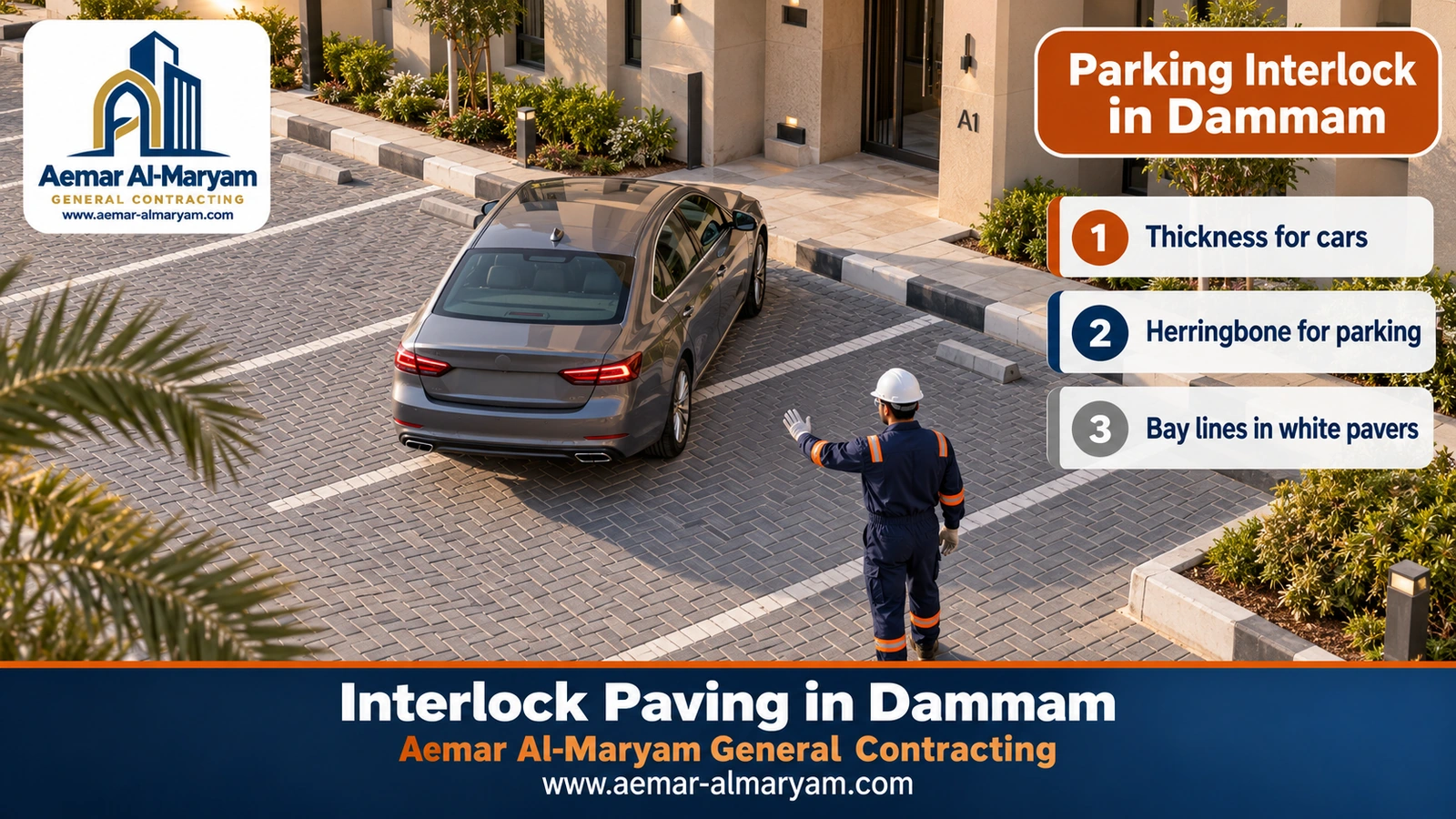
Car parks for buildings and shops differ from a house driveway in two ways: far more arrivals and departures, and far more wheels turning on the spot while drivers park. So we are stricter about the base and the edges, we set kerbs on a concrete bed along every open edge, and we design the falls to send water to gullies or to the street without running across shop entrances.
Why herringbone where cars drive?
Herringbone, laid at 45 or 90 degrees, is the pattern that interlock paving guides recommend for areas under continual vehicle traffic. Each unit is locked on all four sides by units set at right angles to it, so there is no long straight joint line for the pavers to slide along. Stretcher bond, by contrast, is fine for paths, but under a car lane it can creep in the direction of travel over time.
The shape of the unit matters as much as the pattern. Long, thin pavers do not suit vehicles. The rule used in the guides is that, where vehicles run, a paver should be no longer than three times its thickness; units four times as long as they are thick, or longer, are kept for pedestrian areas.
Accessible bays and entrances
If the car park includes a bay for people with disabilities, its surface must stay close to flat, with a fall of no more than about 2% in either direction and a level route to the entrance. We plan for that when we lay out the falls at the start, because correcting it after laying means lifting part of the car park.
Garden interlock and walkways in Dammam
Garden interlock in Dammam is used for paths, seating areas and pool surrounds. It usually needs only 6 cm units and a lighter base than a car park, with low garden kerbs that restrain the edges without interrupting the lawn. A path can curve around planting beds, or a contrasting border can frame a seating area.
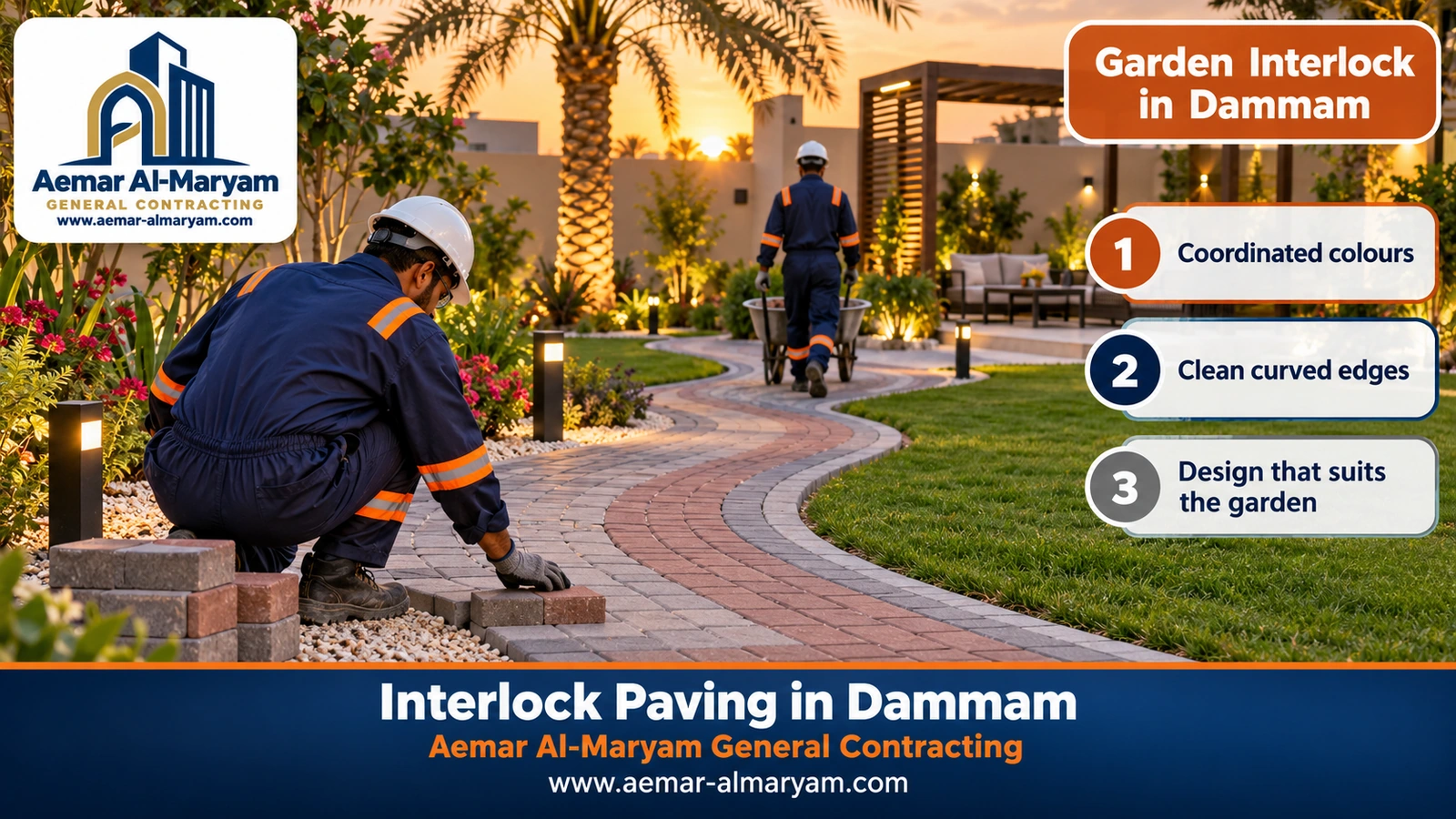
In common practice the main path to the front door is at least about 1.20 m wide so two people or a trolley can pass, and side paths between beds are 60 to 80 cm. In a garden we also care about something that hardly matters in a yard: irrigation water. Sprinklers that keep hitting a path wash out the joint sand and carry mud onto the surface. So we set the fall toward the beds or a small channel, and we recommend turning sprinkler heads away from the paving.
If the garden has a pool or a fountain, the surround needs non-slip units and a fall away from the water so washing water does not run back in; this can be coordinated with our pools and fountains work. Cables for low path lights are run in a duct before the base course goes down.
Grass pavers in Dammam
Grass pavers are open-cell units whose holes are filled with soil and seeded with turf, so the area stays green while still carrying a parked car. They suit rest-house and farm parking and the edges of gardens, and they are usually 8 cm thick. They do need regular watering through the summer, otherwise the cells simply stay as soil. We price them at inspection because soil preparation and planting vary from site to site.
Private pavements
An internal pavement around a house or a private compound is usually laid in 6 cm interlock, with a pavement kerb standing higher than the ground beside it to define the route. The difference from the public pavement on the street is ownership: the first is yours to decide, the second is the municipality’s.
Interlock types and shapes available in Dammam
Interlock types in Dammam vary in shape, thickness and colour, and the shape affects stability, appearance and the amount of cutting, not only looks. These are the shapes most used in homes and car parks:
| Shape | Where it suits | Practical note |
|---|---|---|
| Rectangular | Yards, paths and car parks | The most flexible shape: stretcher bond for paths or herringbone for cars. |
| Zig-zag (interlocking edge) | Car parks and car lanes | The wavy sides increase interlock; usually laid in a single pattern. |
| Hexagonal | Seating areas, paths and yards | A calm look, available in 6 and 8 cm; needs more cutting at the edges. |
| Square | Seating areas and borders | A regular look, often combined with rectangles in designs. |
| Grass paver (open cell) | Rest-house and farm parking | Planted with turf; needs irrigation and upkeep. |
| Border and line units | Seating-area borders and bay lines | A contrasting colour marks routes without paint. |
Grey is the base colour and the least expensive, followed by red, sand yellow, black, and white for lines. Two or three colours can be combined in a pattern, but every extra colour adds to the price per square metre and to the laying time. In Dammam’s heat we suggest lighter colours for areas around a pool where people walk barefoot, and we recommend ordering coloured units from a single production batch.
6 cm or 8 cm interlock in Dammam?
The direct answer: 6 cm for paths, gardens and yards that cars do not enter, and 8 cm wherever a car parks or drives daily, laid in herringbone; heavier loads have their thickness and base specified at inspection. This matches the interlock paving guides, which recommend 60 mm units for pedestrian areas and light residential driveways and 80 mm units for areas under continual vehicle traffic, and it matches what Dammam suppliers advise in the local market.
| Use | Suggested thickness | Base course | Pattern |
|---|---|---|---|
| Garden paths and seating | 6 cm | 10–15 cm | Stretcher, hexagonal or to design |
| Yard with no cars | 6 cm | 10–15 cm | To design |
| Private car entrance | 8 cm (6 cm possible on a strong base) | 15–20 cm | Herringbone |
| Building and shop car parks | 8 cm | 15 cm or more | Herringbone |
| Heavy-load entrances | 10 cm or as inspected | Set at inspection | Herringbone |
Can 6 cm interlock carry cars? The technical guides accept it for residential driveways when the base is right. For a yard where a car is parked every day, though, we recommend 8 cm, because the price difference is small compared with the cost of re-laying later. Remember too that thickness alone will not save a car park without a base: an 8 cm paver on a deep sand bed over uncompacted soil will sink before a 6 cm paver on a properly compacted base.
A quick rule for homeowners
If you are not sure whether a car will ever use a part of the yard, make that part 8 cm now. Changing the thickness after laying means lifting the whole area.
The layers under interlock in Dammam: subgrade, base course and sand bed
Interlock in Dammam is built in five layers from the bottom up: the natural ground, cleaned and compacted; a base course of graded crushed stone; the sand bed; the interlock pavers; and the joint sand. Each layer has a job. The subgrade carries the load, the base spreads it and lets water drain, the sand gives a level bed for the pavers, and the joint sand locks them together.
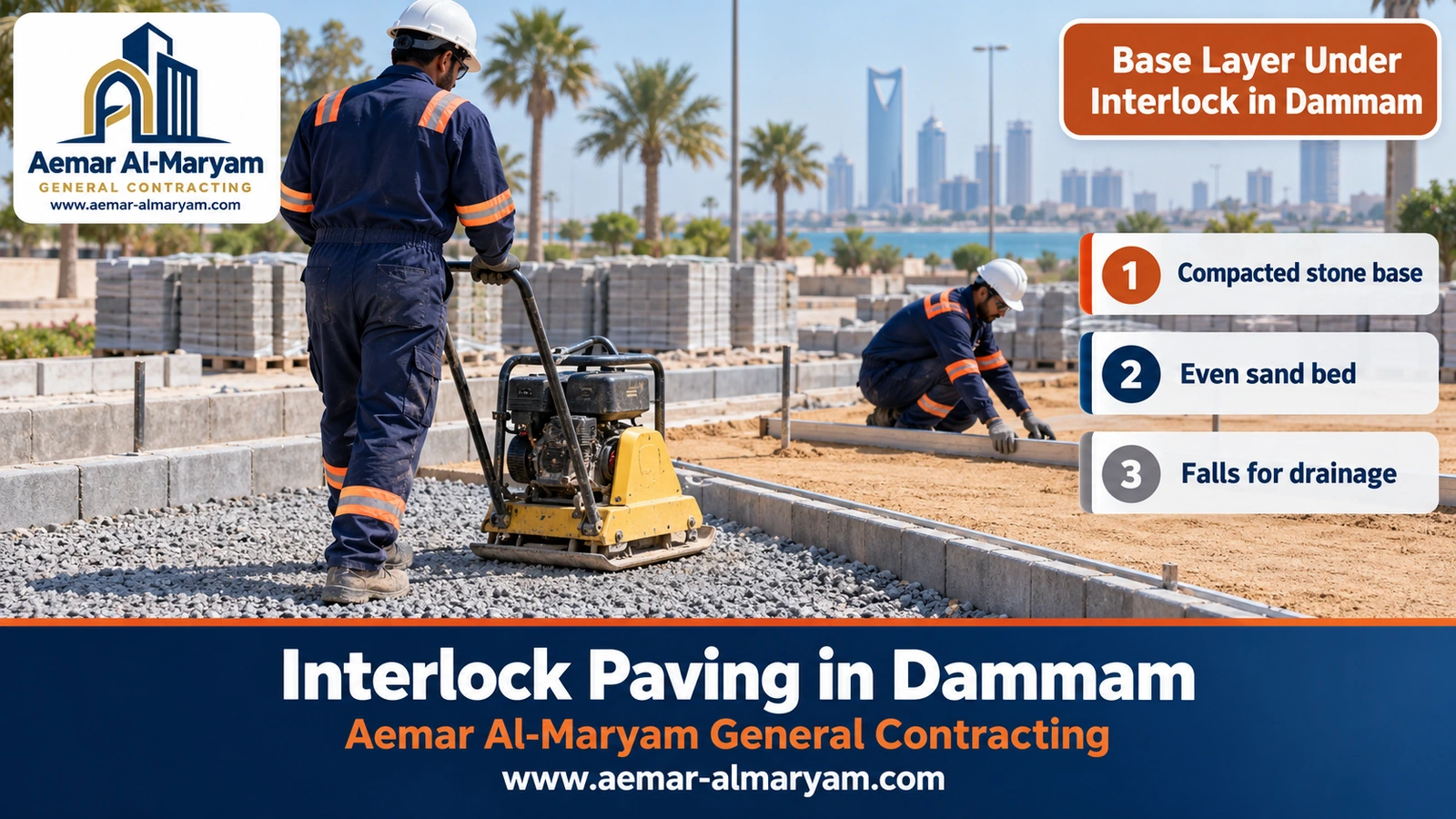
- 1Subgrade
We remove weak soil, debris and roots, add suitable fill where needed, then compact and shape the subgrade to the required fall. In the reference specifications for car parks the subgrade is compacted to about 95% of maximum density. - 2Base course
Graded crushed stone, 10–15 cm thick for paths and 15–20 cm where cars drive, spread and compacted in layers of 15 cm at most. This is where the final fall is set. - 3Sand bed
Clean graded sand about 3 cm thick before compaction, screeded with a straightedge on rails and not walked on once screeded. - 4Pavers
Laid from a fixed edge to string lines, with narrow, even joints of roughly 2 to 3 mm, then cut at the edges. - 5Joint sand and compaction
Sand finer than the bedding sand is swept into the joints, and the plate compactor makes at least three passes until the joints are full.
On large reference projects the excavation sometimes goes about 40 cm below finished level with a 25 cm base. That is reasonable for heavy loads but not necessary for every path. Well-known Saudi specifications for car parks call for a base of about 15 cm for car and light-truck parking and 23 cm for heavy-traffic parking. We decide the depth after seeing the ground: is it firm sand, old fill with debris in it, or damp saline soil near the coast?
If the yard has old concrete or tiles on mortar, those come out first. We handle that as part of the job or with our demolition team in Dammam, including removing the debris, and then the layers start again from the ground.
The sand bed and compaction under interlock in Dammam
The sand bed under interlock should be thin and even: about 2.5 to 4 cm before compaction according to paving guides, and we work at about 3 cm. A deep bed shifts under load, so wheel tracks appear and the busiest spots sink. Many installers in the market spread 5 to 7 cm of red sand. That is thicker than the specifications recommend, and it is one of the causes of the settlement we are later called to repair.
The second rule is that sand is never used to make up low spots in the base. If the base has a 3 cm hollow, the hollow is fixed in the base itself with crushed stone and compaction, not by adding 6 cm of sand at that spot, because that spot will sink on its own a few months later. The third rule is that any sand that has been compacted or walked on before laying is removed and replaced, because its density is no longer even.
Bedding sand and joint sand: why are they different sands?
Bedding sand is clean, well-graded concrete sand, free of clay and salt, that forms a stable bed. Joint sand is much finer, so it can run into narrow joints and fill them to the bottom. Coarse sand in the joints leaves them half empty; very fine sand in the bed turns it into a layer that compresses when wet.
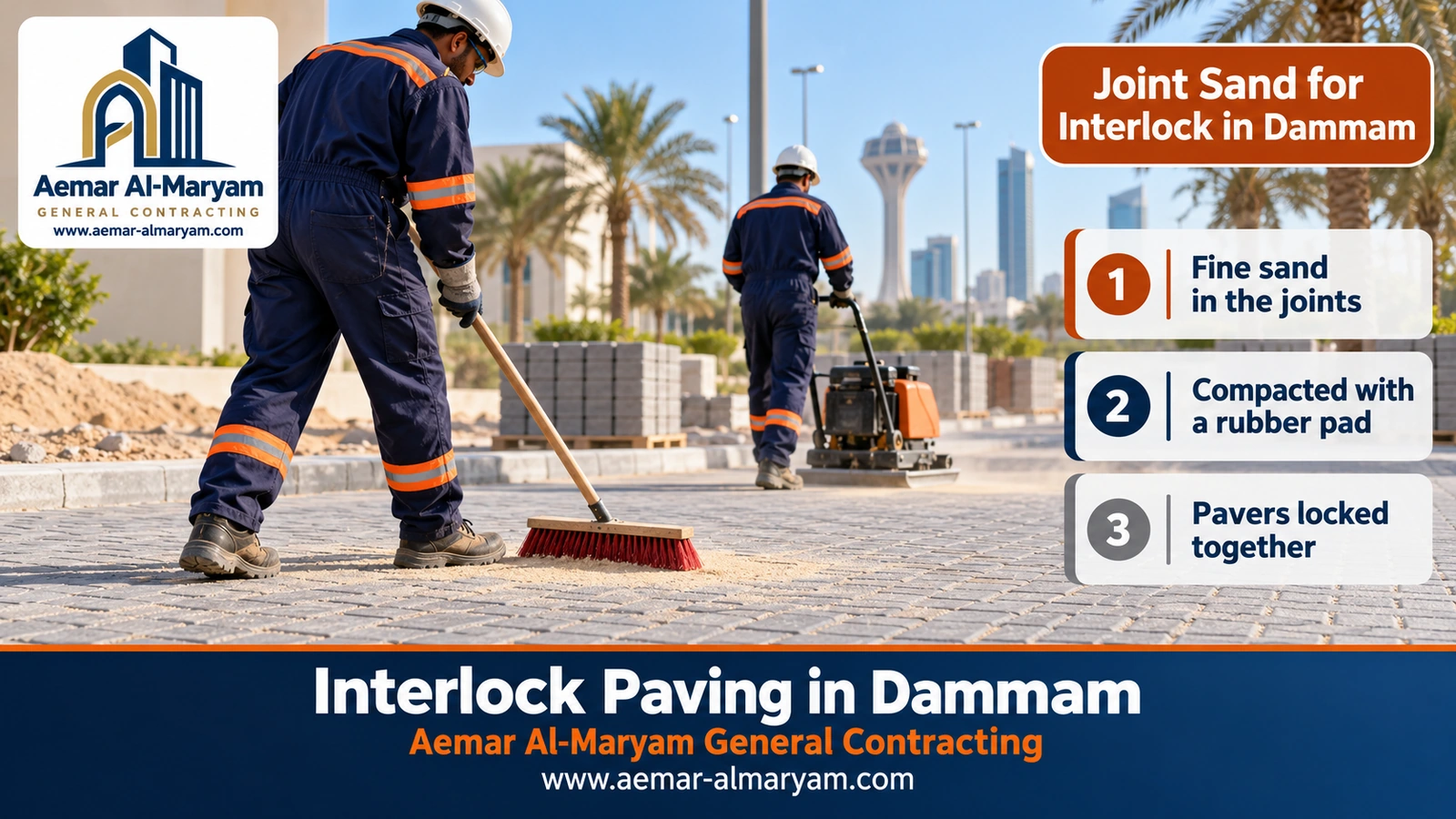
Joint sand is swept in dry on a dry surface, then the compactor passes, then more sand is swept in until the joints are completely full. Empty joints show up later as grass growing between the units or ants nesting in them, and both tell you the joints need topping up.
Compaction: how many passes and with what machine?
Interlock is compacted with a flat vibrating plate, ideally fitted with a rubber or urethane pad so it does not scuff the faces of the units or chip their edges. The rule in the specifications is at least three passes: one after laying to bed the units into the sand, then further passes with the joint sand until the joints fill. Car parks, with their thicker units, need a heavier plate.
No compaction near an unrestrained edge
Pavers are not compacted within about a metre of an edge where the kerb has not yet been fixed, because the vibration pushes the edge units outward. That is why kerbs are set and their concrete has hardened before pavers are laid and compacted against them.
Kerb installation in Dammam
Kerb installation in Dammam means setting precast concrete kerbs on a fresh concrete bed at least 15 cm thick, with concrete haunching behind them, to a straight level line. In Arabic people write it in several ways, «بلدورة», «بردورة», «بندورة» and sometimes «كربستون», but they all mean the same thing: the edge that restrains the interlock, stops it creeping and defines paths, planting beds and pavements.
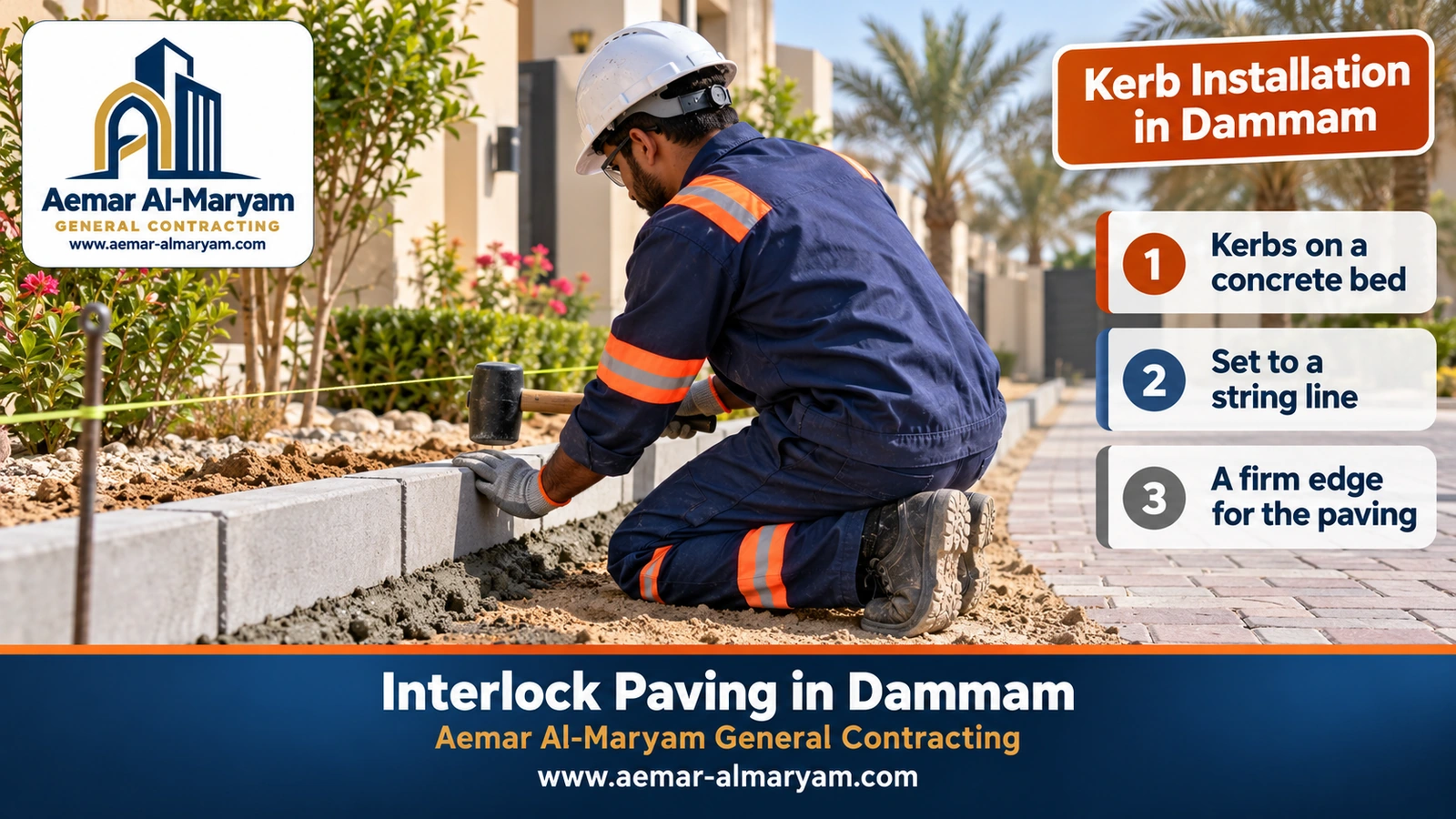
The concrete bed and the backing are placed in a single operation, and the kerbs are butted tightly with narrow dry joints. Paving is not laid or compacted against them until their concrete has hardened, otherwise the vibration from the compactor moves them. Where a project needs more concrete, such as long kerb beds or a slab in part of the yard, we coordinate with our concrete pouring team in Dammam.
Garden kerbs and pavement kerbs: sizes and reveal
The common pavement kerb in the Saudi market is 15 × 30 × 50 cm and shows about 12.5 cm above the surface on pavements and internal roads. Garden kerbs are smaller and less visible, and can be set flush with the ground to hold a path without interrupting the lawn. This table gives approximate sizes for the precast concrete kerbs in common use:
| Type | Approx. size (L × H × W) | Reveal above surface | Use |
|---|---|---|---|
| Garden edging | 50 × 15–20 × 10 cm | 3–8 cm or flush | Paths and planting beds |
| Pedestrian kerb | 50 × 20 × 12 cm | 5–10 cm | Internal pavements and seating areas |
| Medium kerb | 50 × 25 × 15 cm | 10–15 cm | Car parks and yards |
| Large pavement kerb | 50 × 30 × 15 cm | 12–18 cm | Internal roads and compounds |
| Dropped (chamfered) kerb | Per supplier | 0–5 cm | Car entrances and pedestrian crossings |
Are kerbs really necessary with interlock?
Yes, on every open edge. Technical specifications state that all edges of interlock paving must be restrained to secure the perimeter pavers and the sand bed beneath them. Without restraint the edge units creep under load, the joints open, sand escapes and settlement begins at the edges and spreads inward. Where the paving meets an existing wall or boundary wall, the wall itself acts as the restraint.
Hidden concrete edge restraint
If you do not want a visible kerb, for example where the interlock runs straight into the lawn, the answer is a hidden concrete restraint: a strip of concrete below the level of the edge pavers that supports them from the side and is then covered with soil. It gives the same clean look, but it must be built carefully because it cannot be seen afterwards.
The dropped kerb at the car entrance
At the point where a car enters from the street, the kerb is lowered to stand only about 2.5 cm above the surface, or a chamfered unit is used, so the wheels ride up without a jolt and without breaking the edge. At pedestrian crossings it is lower still or flush. We set this drop before laying, because raising or lowering a kerb after compaction means lifting part of the edge.
Kerb installation only
We also install kerbs on their own: to define garden beds, to restrain old interlock that has no edges, or around asphalt in Dammam, which needs an edge to stop it crumbling. Kerbs are priced per linear metre according to type (garden or pavement) and their concrete bed; send us the length and photos of the area and we will work out the cost.
Falls and drainage for interlock in Dammam
The right fall for interlock is about 2 cm per metre (2%) away from the house wall and the majlis door, toward the street, a gully or the planting beds, and it is set in the base course, not in the sand. That is enough for water to run off without anyone noticing the slope underfoot, and it is the minimum given in paving guides. The costliest mistake here is a fall toward the house: water collects at the wall and seeps under the paving toward the foundations.
We leave the finished interlock surface a few millimetres, about 3 to 6 mm, above gully covers and kerb channels, because the units settle slightly in use. If they were laid exactly flush, within months they would sit below the gully and water would pond around it. On large car parks we split the area into zones, each with its own fall direction and outlet.
- ✓A simple test: After handover, run a hose at the highest point and watch: the water should flow to the drain without standing in patches.
- ✓AC condensate: We lead air-conditioner drips to a drain or a planting bed, because a constant drip washes the joint sand out of one spot.
- ✓Roof water: Roof spouts that discharge onto the yard need a splash block or a gully beneath them so they do not dig out the sand.
Interlock installation steps in Dammam
Interlock installation in Dammam starts with the site survey and levels and ends with final compaction and a water test. This is the sequence we follow on yards and car parks:
- 1Survey and levels
We measure the area, record the levels of thresholds, gullies and the street, decide the fall direction and car lane, and check the ground. - 2Excavation and shaping
We dig to the required depth, remove the spoil, and take out weak soil and roots. - 3Services
We confirm irrigation pipes, drains and lighting cables are in place before the base. - 4Subgrade compaction
We compact the ground and shape it to the required fall. - 5Base course
We spread crushed stone in lifts, compact each lift, and set the final fall in this layer. - 6Kerbs
We set the kerbs on their concrete bed to a level line and leave them to harden. - 7Sand bed
We spread about 3 cm of sand and screed it on rails without walking on it. - 8Laying
We lay the units in the agreed pattern from a fixed edge, with string lines every few metres to keep the courses straight. - 9Cutting
We cut units at the edges and around manholes with a saw or block splitter, avoiding very small slivers. - 10First compaction
We run the plate over the pavers to bed them into the sand and level them. - 11Joint sand and final compaction
We sweep in fine sand and make two or more further passes until the joints are full. - 12Testing and clean-up
We test the falls with water, check flatness with a straightedge, clean the site and remove surplus sand.
How long does it take to pave a yard with interlock in Dammam?
A medium-sized house yard on prepared ground is laid in a few working days. Excavation, the base course and kerb beds add more days, because the kerb concrete must harden before compaction against it. You can park on the interlock once the final compaction and joint filling are done, as long as the kerb concrete has set. The exact time is fixed after inspection.
The equipment is simple but essential: a small excavator or skid-steer for yards, a vibrating plate compactor with a rubber pad, a water tanker, a laser or water level and string lines, screed rails and a straightedge, a block splitter and a cut-off saw for edges and manholes, and a small concrete mixer for kerb beds.
Interlock re-laying and repair in Dammam
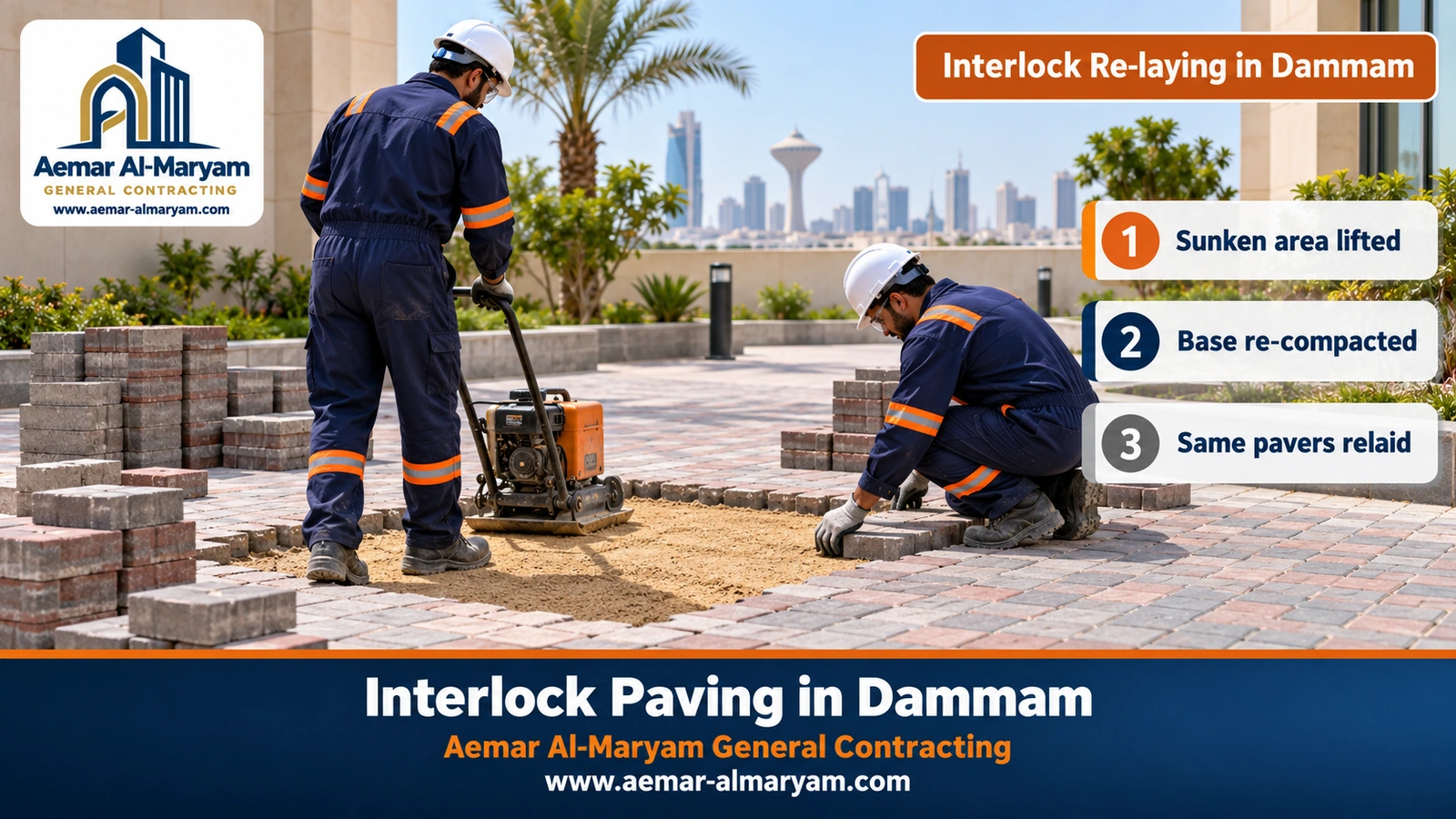
Interlock re-laying in Dammam means lifting the pavers in the sunken area and stacking them aside, removing the wet or contaminated sand, repairing and compacting the base, dealing with the cause, whether a leak or a broken kerb, then spreading fresh sand, putting the same pavers back and compacting them. The advantage of interlock here is that sound units are reused, so you only buy new pavers to replace broken ones.
Why does interlock sink?
Interlock does not sink for no reason, and a repair that ignores the cause brings the dip back in the same place. These are the causes we find most often when we lift a sunken area:
Weak or uncompacted base
Pavers laid straight onto soil or fill that was never compacted settle under load.
Deep or wet sand bed
A 6 or 7 cm bed shifts under wheels and the tracks start to show.
Unrestrained edges
A missing or broken kerb lets the edge units creep.
Water underneath
A leaking pipe, an AC drip or a reversed fall washes out the sand and the base.
Wrong thickness for the use
Thin 6 cm units under a car parked daily, without enough base.
Poor compaction near edges
Edges compacted too little, or compacted before the kerb was fixed.
If the dip is around a pipe, near a water tank or beside a bathroom, the leak should be found and fixed before re-laying. You can call on our leak detection and waterproofing service in Dammam or a plumber in Dammam to repair the pipe, and then we re-lay on dry, compacted ground.
Replacing damaged units and changing a section’s colour
A cracked or oil-stained paver does not mean lifting the whole area. It is removed on its own after loosening its neighbours, a unit of the same type and thickness is fitted, the joint sand is replaced and the area is compacted. The only difficulty is matching the colour, because the old units have faded in the sun; that is why we suggest keeping a few spare units from the original batch at installation. A section of the yard can also be changed in colour, for example to add a border or lines, by lifting and re-laying just that section.
Routine interlock maintenance
Well-built interlock needs little maintenance, but it does need attention. Top up the joint sand after any heavy pressure washing, pull out weeds that grow in the joints by the root, and watch for any spot that starts to dip, because an early repair is easier and cheaper. Clean oil stains promptly with a cleaner made for concrete pavers, testing it first on a hidden corner.
Interlock or asphalt for a yard in Dammam?
Interlock is the better choice if you want colours and patterns, repairs made by lifting single units, a calmer look for the house front, and a surface that does not heat up and soften like black asphalt. Asphalt is better and quicker for large lanes that cars cross all day. A common villa layout mixes both: interlock on the seating area, paths and the front of the house, asphalt for a long driveway or a large rear car park. If asphalt is your choice, the details are with our asphalt contractor in Dammam.
| Point of comparison | Interlock | Asphalt |
|---|---|---|
| Appearance | Colours, patterns and borders | A continuous black surface |
| Repair | Lift and re-lay the same units | Cut out and patch with new mix |
| Access to a pipe underneath | Lifted and replaced with little trace | The patch stays visible |
| Surface in summer | Concrete that does not soften in heat | Absorbs heat and can soften in full sun |
| Speed of work | Laid unit by unit | Faster once the base is ready |
| Large areas | Possible but slower | Cheaper and quicker per m² |
| Edges | Kerbs on every open edge | An edge is preferred to stop crumbling |
On price we do not compare one system with a different one. The SAR 64 full-system figure in our table is 6 cm interlock for pedestrian and light use; it is not the equivalent of a full asphalt system for cars with a 15 cm base. A full interlock system for cars is priced at inspection, because the base depends on the ground.
Interlock or tiles for a yard in Dammam?
Tiles, porcelain or stone bonded on mortar over concrete, give a smooth surface that is easy to wash and suits shaded seating areas and walkways next to the house doors. Interlock is better where a car parks or where the ground may move slightly. Tiles need a rigid concrete slab with falls, and if the ground moves beneath them they crack; interlock adapts to small movements and can be re-laid.
The scope of each price is also different. Yard tiling is usually quoted as labour per square metre, with the tiles, the mortar and the concrete slab beneath them added on top, whereas the interlock prices in our table include the pavers, the sand and the installation. For yard tiling in porcelain or stone, see our tile installer in Dammam. Many homes use both: tiles in the covered seating area, interlock across the rest of the yard and the car lane.
Can interlock be laid over old tiles or concrete in Dammam?
Over old tiles, we do not recommend it. The tiles come out with their mortar, the ground beneath is checked, and the layers are built again. Old tiles form a smooth surface that does not drain, so water gets trapped in the sand above them and washes it out, and the yard level rises for no reason, eating into the step under thresholds. Removing old yard tiles and mortar costs from SAR 14/m², and carting debris away from SAR 90 a load inside Dammam.
Over a sound concrete slab with correct falls, interlock can sometimes be laid on a sand bed with drainage holes cut through the slab to let water out of the sand, after inspection. If the concrete is broken or has no fall, it is better removed; sections can also be cut out for drains or level changes by our concrete cutting team in Dammam.
Interlock paver quality in Dammam: what to ask the supplier for
The quality of interlock pavers is shown by a test certificate for the batch giving compressive strength and water absorption, not by appearance alone. The well-known values in the widely used American standard for these pavers are an average compressive strength of at least 55 MPa with no unit below 50 MPa, and average absorption of no more than 5% with no unit above 7%. Laboratories in the Kingdom test interlock to this standard: dimensions, compressive strength and absorption.
- ✓Thickness: Make sure the stated thickness is the real one: 8 cm should not turn out to be 7 cm.
- ✓Colour: Order the whole quantity from one production run, because batch differences show in sunlight.
- ✓Edges: Chipped edges and cracked units on the pallet point to poor handling or manufacture.
- ✓Absorption: Pavers that soak up a lot of water fade and wear at the surface faster.
- ✓Spare units: Keep a few for future replacements.
White bloom on new interlock (efflorescence)
The white patches that appear on interlock in the first months are called efflorescence. They come from lime in the cement of the units, carried to the surface by moisture, where it reacts with the air and leaves a white haze. It is a normal effect in concrete products and usually fades on its own with time, sun and rain. Do not wash it off with strong acids, which damage the surface and the colours; if cleaning is needed, use a cleaner made for concrete pavers and test it first on a hidden corner. On saline ground, salts rising from below can add to the bloom, which is covered in the next section.
As for Dammam’s heat, concrete units do not soften in high temperatures the way asphalt does, but cheaper pigments can fade in the sun. That is why the test certificate and the quality of the colour matter more than the lowest price per square metre.
Eastern Province ground under interlock in Dammam: sabkha, salts and shallow water
Ground in coastal parts of the Eastern Province can be sabkha: saline soil that seems firm when dry, but whose salts dissolve when it gets wet, cutting its bearing capacity. In one well-known field test on coastal sabkha, bearing capacity fell by about 30% after the salts were leached out with water. In some Eastern Province locations the water table sits shallow, and moisture can rise by capillary action through tens of centimetres of soil.
What does that mean for interlock? On damp or saline ground the base cannot be taken from a table; it is decided after excavation and inspection. We may need to remove a layer and replace it, lay a geotextile to separate the soil from the base, or increase the base thickness. That treatment is priced at inspection. And we never label a particular district as sabkha without checking, because the ground can change from one street to the next.
A sign worth noting
If your existing yard or the foot of your boundary wall shows permanent white salt patches, or soil that stays damp through the summer, mention it and photograph it when you contact us; it changes the base design from the start.
Interlock prices in Dammam
Interlock prices in Dammam start from SAR 37 per square metre, supplied and installed, for grey 6 cm interlock on level, compacted ground; from SAR 46 for coloured units; from SAR 55 for 8 cm car-park interlock on a ready base; from SAR 64 for the full system on bare ground for pedestrian and light use; and from SAR 14 for labour only. They are estimates confirmed at the site visit, and they move with the area, paver thickness and colour, the state of the ground, the base course, the kerbs required and access to the site.
| Service | Unit | From (SAR) |
|---|---|---|
| Interlock laying labour (pavers and sand on site, ground prepared): laying, cutting and compaction | m² | 14 |
| Supply and installation of grey 6 cm interlock for paths, yards and house fronts, including sand bed, joint sand and compaction, on level compacted ground | m² | 37 |
| Supply and installation of coloured or multi-colour patterned 6 cm interlock | m² | 46 |
| Supply and installation of 8 cm interlock for car parks and car entrances in herringbone, on a ready base course | m² | 55 |
| Full system for pedestrian and light use on bare ground: excavation, levelling and compaction + base course + sand bed + 6 cm interlock + falls | m² | 64 |
| Full system for cars, 8 cm with a 15 cm or deeper base | — | At inspection |
| Supply and installation of kerbs (garden or pavement) on a concrete bed | linear m | At inspection |
| Repair of sunken interlock: lifting + base repair + fresh sand + re-laying the same pavers | — | At inspection |
| Replacing damaged units or changing a section’s colour | — | At inspection |
| Grass pavers for planted parking | — | At inspection |
| Lifting old yard tiles with their mortar before interlock | m² | 14 |
| Debris removal (one small truck or tipper load within Dammam) | load | 90 |
| Treatment of sabkha or damp ground (remove and replace, geotextile) | — | At inspection |
Why these figures? No service page in Dammam or Al Khobar publishes an interlock price, so we based our table on the nearest city that publishes prices with a clear scope and set our “from” figures below them. On small areas (under roughly 50 m²) the price per square metre rises, because transport and equipment costs are fixed; it is set after inspection. Unpriced items are quoted after the visit; WhatsApp photos and sizes to 0547879578. Rates for our other trades sit on the prices page.
Kerb installation prices in Dammam
Kerbs are priced per linear metre, and the price depends on the type (smaller garden kerbs or 15 × 30 × 50 cm pavement kerbs), the thickness of the concrete bed, whether the ground is already excavated or needs digging, and how many curves and corners there are. That is why we do not publish a general figure that may not fit your site. Send the approximate length, photos of the area and the type of kerb you want.
Worked example: a 9 × 12 m villa yard
Here is an illustrative example for a villa yard of 9 × 12 = 108 m², where the ground is already level and compacted. We divide it into paths and a seating area of 68 m² in grey 6 cm interlock, and a car lane of 40 m² in 8 cm herringbone:
| Item | Calculation | From (SAR) |
|---|---|---|
| Paths and seating, grey 6 cm | 68 m² × 37 | 2,516 |
| Car lane, 8 cm herringbone | 40 m² × 55 | 2,200 |
| Total paving | 108 m² | 4,716 |
| Kerbs on open edges (e.g. 9 + 12 + 9 = 30 linear m) | Per linear metre | At inspection |
For quantities: the sand bed is about 108 × 0.03 ≈ 3.3 m³, plus roughly 10% for waste. Pavers are 108 m² plus about 5% for cutting ≈ 113 m²; with 20 × 10 cm rectangles that is about 113 × 50 = 5,650 pieces. If instead the yard were bare soil and needed the full system, the 6 cm part would start from 68 × 64 = SAR 4,352, while the 8 cm car part on a 15 cm base would be priced at inspection; its base alone is 40 × 0.15 = 6 m³ of compacted material. The figures illustrate the method; your own site fixes the real cost.
What raises or lowers the price of interlock?
- ✓Ground condition: Ready, compacted ground costs less than bare soil needing excavation and a base, and damp or saline ground needs treatment.
- ✓Thickness: 8 cm costs more than 6 cm in both material and base.
- ✓Colours and pattern: A single grey colour costs less than a three-colour pattern with borders.
- ✓Shape of the area: Regular areas need less cutting than curving paths, many corners and manholes.
- ✓Size: A square metre in a large area costs less than one in a small yard.
- ✓Access: A site a truck can enter differs from one where materials are barrowed in.
- ✓Associated work: Kerbs, lifting old tiles and debris removal are separate items.
Common interlock installation mistakes in Dammam
Most of the interlock problems we see in Dammam come from well-known mistakes that can be avoided from the start:
- ✓Laying on bare soil: No base course, or a base that was never compacted, and the yard sinks within months.
- ✓Deep sand: A 6 or 7 cm bed used to make up low spots in the ground, so wheel tracks appear.
- ✓Fall toward the house: Water gathers at the wall and seeps under the paving.
- ✓No kerbs: Open edges creep and their joints open.
- ✓Compacting before the kerb sets: The vibration shifts kerbs whose concrete is still green.
- ✓Empty joints: Coarse or too little sand fails to fill the joints and weakens the interlock.
- ✓Tiny cut slivers: Thin pieces at the edges break and work loose.
- ✓Wrong thickness: 6 cm in a daily car park without enough base.
- ✓Mixed colour batches: Colour differences that stand out in the sun.
Receiving interlock in Dammam: what to check before you accept
Before you accept the interlock, check the edges, falls, flatness and joints yourself, because these are the things that are hard to correct once the crew has left. Here is a list you can work through in a quarter of an hour:
- ✓Kerbs: Straight, at one level, with no gaps, and their concrete haunch visible behind them.
- ✓Falls: Run a hose: the water should flow away from the house without standing in patches.
- ✓Flatness: Lay a straightedge in several directions; any gap beneath it should be a matter of millimetres.
- ✓Joints: Even, and filled with sand to near the surface.
- ✓Units: No paver rocks underfoot.
- ✓Cuts: Clean at the edges and around manholes, with no small slivers.
- ✓Level at drains: The surface sits a few millimetres above gullies and kerb channels.
- ✓Pattern and colours: As agreed.
- ✓Clean-up: The site is clean and surplus sand removed.
Interlock paving across Dammam’s districts, Al Khobar, Dhahran and the Eastern Province
Our office sits in Al-Rawdah, and our crews cover the whole city. Districts we work in, alphabetically: Al-Anud, Al-Athir, Al-Badiyah, Al-Dabab, Al-Faisaliyah, Al-Firdaws, Al-Fursan, Al-Hamra, Al-Itisalat, Al-Jalawiyah, Al-Jameiyin, Al-Khaleej, Al-Manar, Al-Mazruiyah, Al-Nada, Al-Nour, Al-Qadisiyah, Al-Rayyan, Al-Shati, Al-Shulah, Badr, Ghirnatah, Ibn Khaldun, King Fahd Suburb, Taibah and Uhud, besides Al-Rawdah itself. Our Dammam area page brings together what we offer in the city.
Outside Dammam we lay interlock and set kerbs in Saihat, Qatif, Dhahran, Al Khobar, Ras Tanura, Jubail, Abqaiq, Al-Ahsa, Khafji and Hafr Al-Batin. The farther the city, the more transport and equipment set-up weigh in the estimate; combining jobs in one trip spreads that cost. In Jubail Industrial City, the Royal Commission’s site rules apply. If you are renovating a home in Al Khobar, see also our renovation contractor in Al Khobar.
How to order interlock paving in Dammam: what to send on WhatsApp
Start by sending photos of the area with rough measurements to WhatsApp 0547879578 and saying whether cars will use it. We reply with a suggested thickness, layer build-up and estimated cost before visiting.
- 1Send photos
An overall shot of the yard or car park from two angles, plus the entrance, thresholds, manholes and any spot where water collects. - 2Send measurements
Length and width in metres, and the length of the edges that need kerbs. - 3Say how it will be used
Pedestrians only, a private car, or a building or shop car park. - 4Describe the ground
Soil, old tiles, concrete or sunken interlock, and whether there is damp or salt. - 5Choose shape and colour
Or ask us to suggest one; you can also send a photo of a pattern you like. - 6Inspection and agreement
We visit, take the levels, agree the items and timing, and start.
Why Aemar Al-Maryam for interlock paving in Dammam?
Because we explain what goes under the pavers before what goes on top: base thickness and how it is compacted, sand-bed depth, fall direction and kerb type, and we write them into the agreement as numbers. And because interlock is part of a wider contracting service for us, we can lift old tiles, remove debris, pour kerb beds and adjust drains within the same job, so you do not have to coordinate several parties. Photos of earlier work are on our projects page.
- ✓Published prices: A clear “from” figure for each item, and the rest at inspection.
- ✓Layers in numbers: Base, sand and falls written down before we start.
- ✓Thickness by use: We will not sell you 8 cm where you do not need it, or 6 cm where a car parks.
- ✓Reusing units: On repairs we put your sound pavers back.
- ✓Eastern Province coverage: Dammam, Al Khobar, Dhahran, Qatif and the other cities.
Pave your yard or car park on properly built layers
Photograph and measure the area and tell us if cars will use it; we answer with the thickness, layers and kerbs we propose and their estimated cost, then fix a visit day.
Related pages on interlock and associated work
Tags