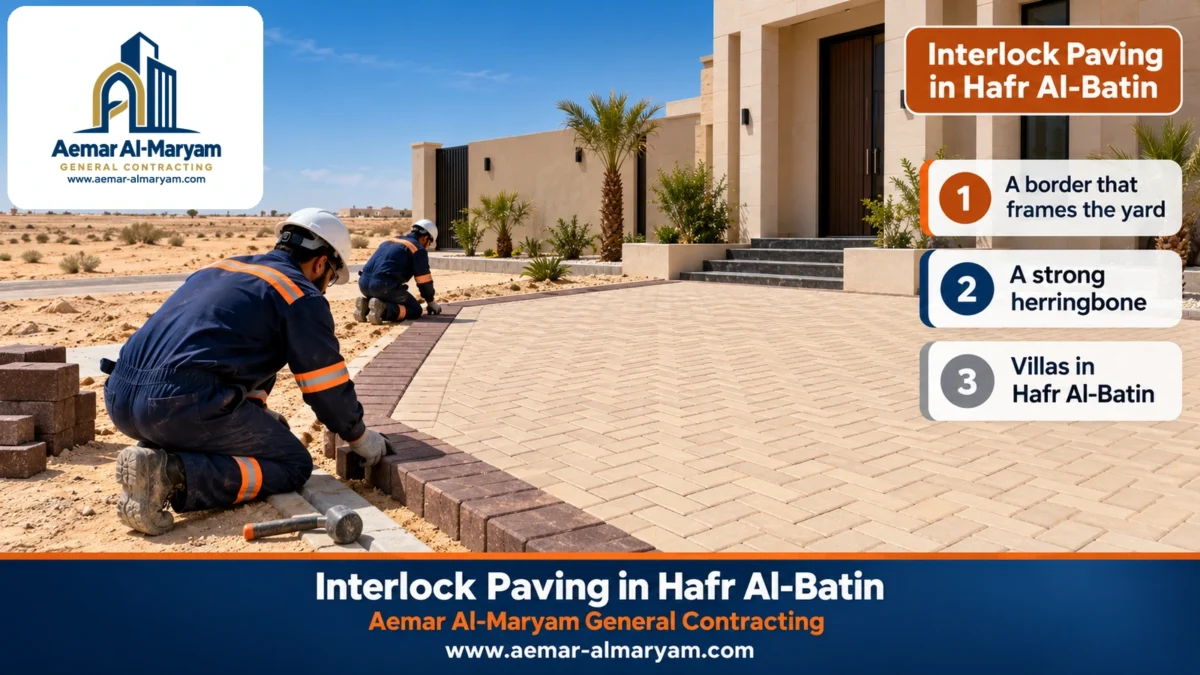
Most new villas in Hafr Al-Batin are received with a forecourt of loose earth littered with site debris, while the owner pictures a smart driveway with crisp, framed edges. Turning the first into the second is the core of our interlock paving in Hafr Al-Batin. The weak soil comes out first, a compacted stone base goes in, the kerbs are set, then a dark border row is laid along them with herringbone pavers filling the field, and every edge unit is cut with a splitter or saw so it meets planters and columns without gaps. At Aemar Al-Maryam General Contracting we also pick colours and layers with the long Hafr Al-Batin summer in mind. Paving on prepared ground starts at SAR 37 per square metre, supplied and laid; treat every price as provisional pending inspection and agreement. Phone or message 0547879578.
Before the crew leaves Dammam for Hafr Al-Batin, your photos and measurements tell us how deep to dig and how much stone and paving to bring, and only then is the inspection booked. The trip itself is costed during that visit according to the scale of the work, and it weighs less per metre on a bigger yard or when several jobs share the journey.
In short: villa interlock in Hafr Al-Batin
- What we do: front yards of new villas with border rows, car entrances, outdoor seating areas, and home gardens and paths.
- Before the pavers: we remove weak topsoil and building debris, then lay a compacted base of 10–20 cm depending on use.
- Thickness: seating and paths in 6 cm units; the whole car area in 8 cm, herringbone bond.
- Where prices start: a bare-earth walking yard built complete from SAR 64/m²; an 8 cm car area on ready stone from 55; a levelled yard in grey from 37 or in colour from 46; labour alone from 14.
- Travel: priced at inspection, with a smaller share per square metre on large areas.
Interlock paving in Hafr Al-Batin for new villas: from bare soil to a finished forecourt
Our Hafr Al-Batin enquiries come mostly from owners whose villa is complete, or nearly so, and who want the dust bowl at the front sealed before the family moves in. Existing homes call us too, to renew a tired yard or pave an outdoor sitting area. We stay inside the plot line; the street pavement is municipal, and changing it needs the municipality’s approval through Balady.
■ Front yards
From the gate to the garage door and entrance, with a border row, kerbs and an 8 cm car lane.
■ Removing weak soil
Digging out loose topsoil and building debris, carting it away and compacting the formation before the base.
■ Edge cutting
Units cut precisely at planters, columns, manhole covers and wall corners.
■ Outdoor seating
Floors under pergolas and around planters in two-colour stretcher patterns.
■ Gardens and paths
Paths between beds at a comfortable width, with low garden kerbs.
■ Repairs
Lifting sunken sections, fixing what lies beneath and re-laying them.
Day-rate crew or an interlock company in Hafr Al-Batin: what is the difference?
A day-rate contractor wants to finish laying. An interlock company in Hafr Al-Batin wants the client not to call back months later about a sunken yard. The whole difference lies in questions answered before the work starts: how deep will we dig to reach firm ground, how thick is the base under the car area, when are the kerbs set, and what compacts the pavers? Ask for those answers in writing. Whoever gives clear numbers is the one to trust.
Interlock supply and installation in Hafr Al-Batin
We buy from a supplier who issues test results with each order, ordering the measured area plus about 5% for cut pieces, a touch more when the yard is full of planters, columns and corners. If the pavers are already yours, you pay for our labour only, from SAR 14 per square metre on prepared ground. Either way we keep crates from different production runs out of the same yard, because a two-shade forecourt is the first thing visitors notice at the gate.
Villa forecourts in Hafr Al-Batin: border rows and the car lane
The front yard is the face of the villa, so we design it before we lay it. We split it into a car lane from the gate to the garage in 8 cm herringbone interlock, and a walking area and path to the entrance in 6 cm units, then frame the whole field with a border row of dark units laid lengthwise along the kerb. The border row gives the yard a clear outline like a picture frame and hides the irregular cuts of the inner field, because cut units meet the straight border instead of meeting the kerb directly.
- ✓Border colour: dark brown or charcoal around a sand or beige field is the most requested, and it suits light stone facades.
- ✓Width: one row in small yards, two rows in large yards or around the seating area.
- ✓Placement: along every edge of the yard, around planters, and sometimes as a line separating the car lane from the walking area.
- ✓Stability: the border is laid first along the kerb on the same sand bed, then the inner field is laid towards it.
Paving the frontage of houses in Hafr Al-Batin
The strip you own in front of your house up to the kerb line is paved at the thickness its use requires. If a car parks on it, we make it 8 cm and drop the kerb at the entry so wheels climb smoothly. What matters is that wash water and rain move away from the door and garage threshold towards the street, and that the interlock meets the pavement level without a sudden step.
Removing weak soil before interlock in Hafr Al-Batin
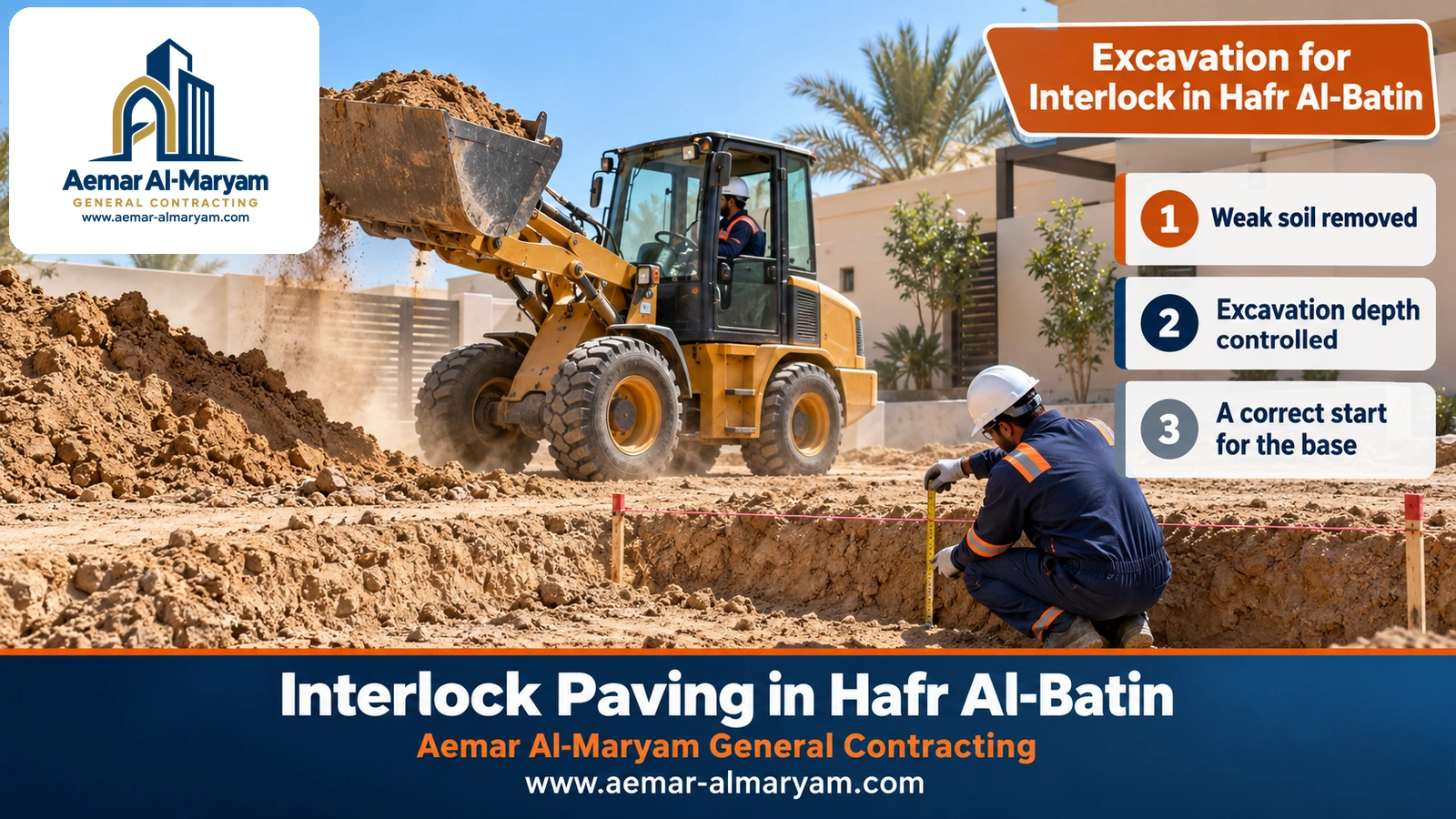
Removing weak soil is the step that decides the life of the whole yard. Around new villas there is usually a layer of loose fill, broken concrete, bricks and bags, with uncompacted topsoil on top, and none of it can carry paving. So we dig down to firm ground, cart the spoil off site, then compact the formation and correct its falls before laying any stone. We measure the excavation depth from a level string tied between two pegs, so the depth is taken from the finished level rather than from the uneven soil surface.
| Use | Pavers | Sand bed before compaction | Base course | Approximate depth below finished level |
|---|---|---|---|---|
| Paths and seating | 6 cm | about 3 cm | 10–15 cm | about 19–24 cm |
| Car lane | 8 cm | about 3 cm | 15–20 cm | about 26–31 cm |
| Ground with loose fill | — | — | Set at inspection | Increased by the layer removed |
The depth in the table is the sum of the layers only. We may dig deeper if we find loose fill, then replace it with suitable material compacted in layers. Before digging we ask about water, power and drainage lines laid around the villa, and ask that yard lighting cables go in before the base, inside protective ducts; you can arrange them with an electrician in Hafr Al-Batin or a plumber in Hafr Al-Batin before we arrive.
The layers under interlock in Hafr Al-Batin
- 1Compacted formation
After the weak soil is removed we compact the bottom and set its fall; the fall starts here. - 2Base course in lifts
Graded crushed stone spread, watered and compacted, with no lift thicker than 15 cm. - 3Kerbs
Set on a concrete bed with a supporting haunch before the sand. - 4Sand bed
About 3 cm of clean graded sand, screeded on rails with a straightedge and never walked on. - 5Laying and cutting
The border first, then the inner field in its pattern, then the edge units. - 6Compaction and joint sand
At least three passes, with finer sand swept into the joints until full.
Bedding sand and plate compaction in Hafr Al-Batin
Bedding sand is a cushion a few centimetres thick, there to seat the pavers, never to fill hollows. Deepen it and it slides under tyres and leaves ruts, so any hollow is corrected in the stone layer itself. The sand brushed into the joints is finer than the bedding so it can run down narrow gaps, and in summer we make sure it is bone dry before brushing, because damp sand bridges at the top of a joint instead of filling it. The plate runs on a rubber mat, and it stays about a metre back from any edge that is not yet restrained.
Cutting edge units in Hafr Al-Batin: splitter or saw?
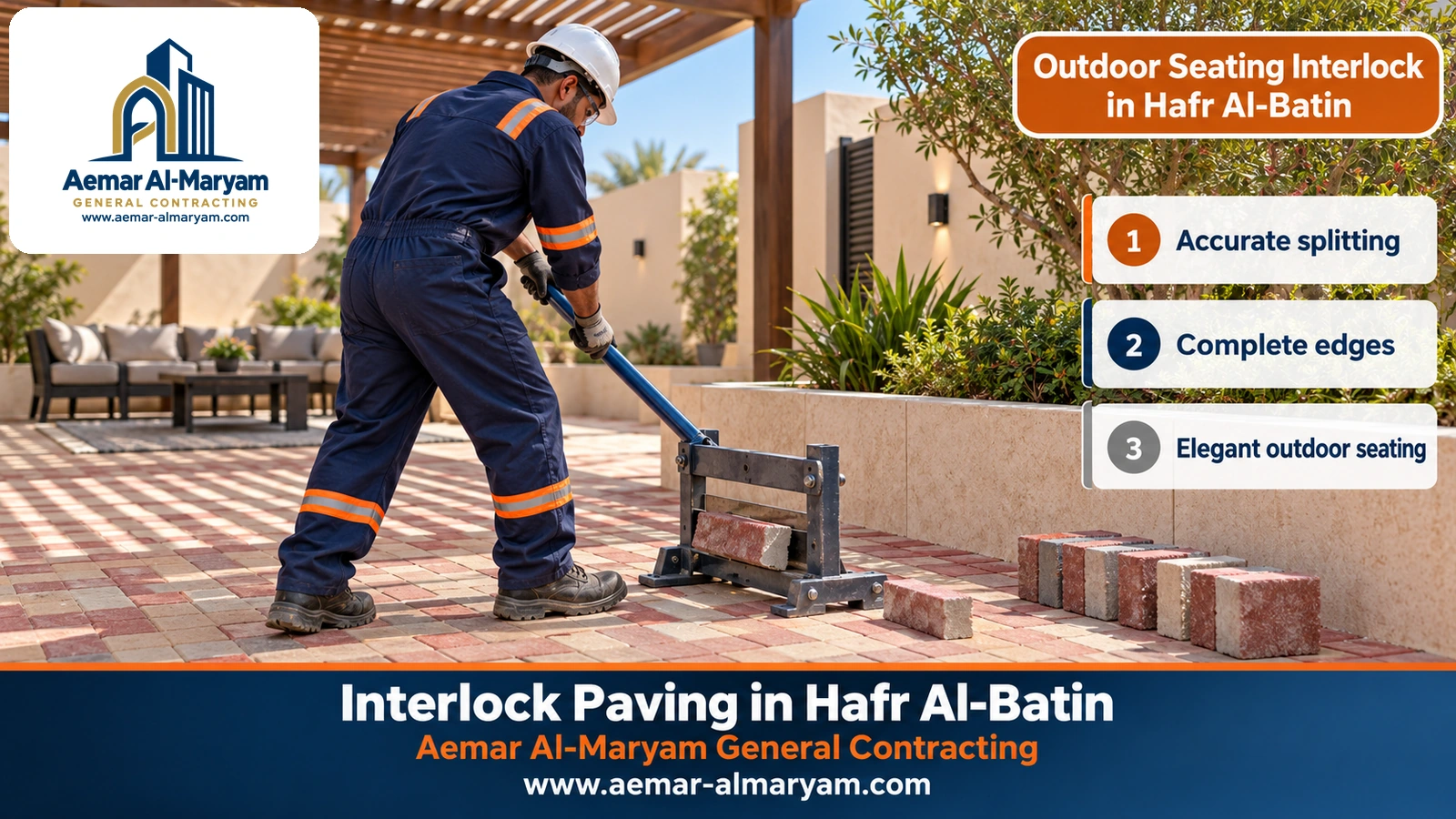
Edge cutting is what separates a yard that looks expertly paved from one that looks patched. Columns, planters, manhole covers and wall corners all need cut units, and we use two tools for them: a long-handled manual block splitter for fast straight cuts in the field, and a cut-off saw for angled corners, curves and covers where a clean line is needed. We avoid thin slivers at the edges because they crack and shift, so we redistribute the rows or use a larger unit cut on both sides instead of a small sliver.
Outdoor seating under the pergola in Hafr Al-Batin
An outdoor seating area under a pergola is where people walk barefoot in the evening, so we lay it in 6 cm units in stretcher bond or basketweave, often in two colours such as red and beige. The pergola columns are fixed on concrete footings before laying, then the paving is cut tightly around them. We fall the surface towards the planters, not the house door, and place a low garden kerb or a hidden concrete restraint between the paving and the planter soil.
Hidden concrete restraint around planters
When a villa owner does not want a visible kerb at the edge of the seating area or a path, we pour a concrete strip below the paving surface that supports the last units from the side. Nobody sees it, but it stops the units creeping towards planter soil that is damp from watering.
Hafr Al-Batin heat and interlock: colours and summer working
Summer in Hafr Al-Batin is long and hot, which raises three questions every villa owner asks. First, does heat affect interlock? Concrete pavers do not soften in the heat the way asphalt can under a parked car, and well-made units do not crack from temperature. Second, which colour? Light colours such as sand and beige stay cooler underfoot in seating areas and paths, while dark colours suit the border and car lane where nobody walks barefoot. Third, do colours fade? Cheap colours can fade in the sun, which is why we ask for a batch test certificate.
- ✓Working hours: in the hot months we lay and compact early in the morning and leave long cutting jobs for shaded hours.
- ✓Kerb concrete: after the pour it is wetted and shaded under sheeting so the sun cannot rob it of strength.
- ✓Joint sand: dry before sweeping, and swept again a few days later as the sand settles into the joints.
- ✓Dust: dust storms leave the surface dusty but do not harm the pavers; sweeping and washing are enough.
Interlock paver quality: what to ask the supplier for
Ask for a batch test certificate showing compressive strength and water absorption. The values commonly quoted from the American standard are an average strength of at least about 55 MPa and absorption of no more than 5%. Check too that all units share one thickness, because a difference of a few millimetres between two units becomes a step underfoot after compaction.
White patches on new interlock in Hafr Al-Batin
During the first months a white dusting may appear that a broom will not shift. It is lime working out of the paver cement with moisture. The Hafr Al-Batin sun clears it gradually, so resist reaching for a strong acid that would bite into the colour; if you want it gone faster, test a concrete-paver cleaner on one hidden unit first.
6 cm or 8 cm interlock in Hafr Al-Batin?
The rule in paving specifications is 6 cm for pedestrians, seating and light home driveways, and 8 cm wherever vehicles pass regularly. At villas we make the whole car area 8 cm, because a car does not always stop in its marked spot, and large family vehicles turn in the front yard more than owners expect. We lay the car lane in herringbone at 45° or 90°, which resists turning, and avoid long slim units whose length is more than three times their thickness.
Car park interlock in Hafr Al-Batin
Parking inside a villa compound, or a private bay outside a shop, takes 8 cm units over 15–20 cm of compacted stone, with pavement kerbs wherever an edge is open. If a pickup or light truck comes in to load, its thickness and base are designed at inspection, and an accessible bay is kept to a gradient of 2% or less in both directions.
Interlock types and shapes available in Hafr Al-Batin
■ Rectangle
The most flexible: herringbone for cars, stretcher or basketweave for seating, and lengthwise as a border row.
■ Zig-zag
An interlocking edge profile that holds under wheels, suited to car lanes.
■ Hexagon
Calm and regular, suited to seating areas and small paths.
■ Large square
For wide paths and pool surrounds with a simple look.
■ Grass pavers
Units with open cells planted with grass for side parking that gets watered.
■ Colours
Sand, beige, dark brown, charcoal and red, often two combined in one pattern.
Kerb installation in Hafr Al-Batin
On Hafr Al-Batin villa yards, kerbs go in before any sand or paver. A shallow trench, a concrete bed at least 15 cm thick, the kerbs lined up on a taut string with their ends butted dry, then a concrete shoulder cast behind them. A typical road-edge kerb measures 15×30×50 cm with roughly 12 cm of face showing; garden kerbs are lighter and lower, made for planter and seating edges. Bigger concrete jobs on the same yard can go to our team for concrete pouring in Hafr Al-Batin.
A lowered kerb where cars come in
At the gate and garage entrance we drop the kerb until only about 2.5 cm shows above the surface, so wheels cross without a jolt and the kerb edge does not chip over time. It is a small detail that is often forgotten, until the owner discovers it with the first low car.
Are kerbs really needed with interlock in Hafr Al-Batin?
Yes, on every open edge. Interlock holds because each unit is locked by its neighbours and the whole field is locked at its perimeter; without that restraint the last units creep, the joints open and sinking begins. We set the kerbs first and wait for their concrete to harden before compacting towards them.
Falls and rain drainage for interlock in Hafr Al-Batin
Hafr Al-Batin can go weeks without rain, yet a single cloudburst shows up any fall that was set wrong. So the yard is graded at 2% or more, carrying water from the villa wall, the front door and the garage sill towards the gate, the planters or a gully, and that grade is built from the first layer up, in the rolled formation and then the stone, never in the sand. At each gully the paving finishes slightly proud of the grate, by 3 to 6 mm. Car-washing water turns up far more often than rain, and it is steered the same way.
Interlock prices in Hafr Al-Batin
This table follows the order of work on a new villa, from digging to laying. The starting rates are our Dammam rates unchanged, the lowest SAR 37 per square metre, and the crew trip is added after inspection. None of it is final before inspection and agreement, and the biggest single variable is how much loose fill has to come out:
| Service | Unit | From (SAR) |
|---|---|---|
| Digging out loose fill and site debris, carting it off and replacing it | — | At inspection |
| Walking yard from bare earth to finished paving: rolled formation, stone, sand, 6 cm units, falls | m² | 64 |
| Car area from bare earth on stone deeper than 15 cm | — | At inspection |
| Car parking in 8 cm herringbone on ready compacted stone | m² | 55 |
| Paths and seating in two tones or a colour other than grey | m² | 46 |
| Border and paths in grey 6 cm on levelled ground | m² | 37 |
| Labour only: laying, trimming and compacting your pavers | m² | 14 |
| Taking up old tiles and mortar before paving | m² | 14 |
| Kerbs for the yard, planters and gateway | lin. m | At inspection |
| Fixing a sunken area or swapping broken units | — | At inspection |
| The trip from Dammam and spoil removal | — | At inspection |
Worked example: a 14 × 16 m villa forecourt
An illustration only: the front yard of a new villa in Hafr Al-Batin measuring 14 × 16 = 224 m². After the weak soil is removed and the base is built (both priced at inspection), we give 120 m² to parking and the driveway in 8 cm interlock and 104 m² to the border, paths and seating in 6 cm grey:
| Item | Calculation | Result |
|---|---|---|
| Car lane and parking, 8 cm | 120 × 55 | SAR 6,600 |
| Border, paths and seating, 6 cm | 104 × 37 | SAR 3,848 |
| Estimated paving total | 6,600 + 3,848 | SAR 10,448 |
| Excavation to remove 20 cm of weak soil | 224 × 0.20 | about 44.8 m³ |
| Base under the car lane, 15 cm | 120 × 0.15 | 18 m³ |
| Base under the walking area, 10 cm | 104 × 0.10 | about 10.4 m³ |
| Border row along three sides | 14 + 16 + 16 | 46 linear metres |
If you have bought the pavers and sand yourself and the ground is ready, labour for the whole area starts from 224 × 14 = SAR 3,136. Kerbs and travel remain items set at inspection.
What raises or lowers interlock prices in Hafr Al-Batin?
- ✓The depth of loose fill to be removed and the volume of spoil carted away.
- ✓The share of car area to walking area, since 8 cm and its base cost more.
- ✓The number of corners, planters and columns, which add cutting and waste.
- ✓Multiple colours and patterns, and the length of border rows.
- ✓Yard size: below about 50 m² the fixed costs push the per-metre rate up.
Interlock repair and re-laying in Hafr Al-Batin
Fixing interlock in Hafr Al-Batin starts by asking what made it drop. In older homes the answer is usually builder’s fill left under the paving, a water or drain pipe leaking beneath the yard, an edge with no kerb, or 6 cm pavers under a parked car. We lift the pavers and stack them, dig out the wet sand, deal with the cause, re-roll the base, then lay fresh bedding, relay and compact. Any broken unit is drawn out with an extractor, so its neighbours keep their arrises, and replaced in the closest shade.
Interlock, asphalt or tiles for a villa yard in Hafr Al-Batin?
For a villa forecourt, interlock gives colour, a hard-wearing car area and repairs one paver at a time, and it stays firm in the heat. For long private roads or yards that only see cars, asphalt is quicker and usually cheaper; our asphalt contractor in Hafr Al-Batin page covers it. Tiles bedded in mortar belong under a roof, in covered seating or porches where a smooth surface is wanted, and our tile installer in Hafr Al-Batin handles those.
Old tiles or an old slab in a Hafr Al-Batin yard: what happens to them?
Old tiles make a poor base for interlock: sand creeps on their glazed face, wash water lingers between the layers, and the yard rises towards the sills. Lifting them along with the mortar costs from SAR 14 a square metre, and anything bonded hard enough to need breakers goes to our demolition team in Hafr Al-Batin. A sound slab with a correct fall can sometimes be kept, drilled to drain and topped with sand and pavers; if it needs trimming or channels cut, our concrete cutting team in Hafr Al-Batin brings the saws.
Does interlock suit villas in Hafr Al-Batin? Pros and cons
| Advantages | Drawbacks and what we do about them |
|---|---|
| Does not soften in heat or stick to tyres | Needs a good base, so we remove weak soil and never skip layers |
| Colours, patterns and border rows that dress the facade | Cheap colours fade, so we ask for a test certificate |
| A damaged unit is replaced on its own | Slight colour differences, so keep spare units |
| Can be lifted and re-laid to run a line beneath | Weeds grow in empty joints, so we refill them with sand |
From bare earth to finished forecourt: our steps in Hafr Al-Batin
- 1Photos and plan
Share pictures of the yard, its size and the villa drawing if you have one. - 2Proposed layout
We suggest the car lane, seating area, border and colours. - 3Inspection
We check the soil and set the excavation depth, levels and travel cost. - 4Excavation and removal
We remove weak material, cart the spoil away and compact the formation to the falls. - 5Base and kerbs
We lay the base in lifts, set the kerbs and wait for them to harden. - 6Sand, border and field
We screed the bed, lay the border, then the inner field in its pattern. - 7Cutting and compaction
We cut edge units with splitter and saw and compact with joint sand. - 8Handover
We test water flow and flatness with you and hand over a clean yard.
How long does paving a villa forecourt in Hafr Al-Batin take?
With the ground ready, a few days is enough. When we start by digging out fill, carting it away, building the stone and setting kerbs, expect more than a week, because the kerb concrete needs several days before the plate can work against it.
Common interlock mistakes at new villas in Hafr Al-Batin
- ✓Laying over loose construction fill without removing it.
- ✓Measuring excavation depth from the soil surface instead of the finished level.
- ✓Leaving the kerbs until after the paving is laid.
- ✓Thin slivers at the edges instead of redistributing the rows.
- ✓A dark colour in a seating area where people walk barefoot in summer.
- ✓Forgetting lighting and irrigation lines, then lifting paving to run them.
- ✓Kerb concrete left in the sun without being kept damp.
Receiving interlock in Hafr Al-Batin: what to check
- ✓Border: straight and continuous on every side, with no gaps between it and the kerb.
- ✓Cuts: clean at planters, columns and covers, with no thin slivers.
- ✓Fall: run water and check it moves away from the villa without ponding.
- ✓Flatness: a long straightedge in several directions; deviations should be millimetres.
- ✓Joints: full of sand, with no unit rocking.
- ✓Entrance: the kerb dropped at the gate and garage, with cars crossing smoothly.
How to order interlock paving in Hafr Al-Batin
A single WhatsApp message to 0547879578 covering the points below lets us sketch the yard layout and estimate the cost, and then we agree the visit date:
- ✓Photos of the yard from the gate, the villa door and the corners.
- ✓Dimensions length and width, and where the planters and columns are.
- ✓Car area how many cars, where they park, and whether a truck comes in.
- ✓Ground condition fresh soil, fill, old tiles or concrete.
- ✓Colours the field colour and the border colour, or a photo of a yard you liked.
- ✓Location a map pin in Hafr Al-Batin.
Why Aemar Al-Maryam for your villa forecourt in Hafr Al-Batin?
■ We start underneath
We remove weak soil before thinking about colour, because a yard lives on what is under it.
■ Precise edges
A straight border row and clean cuts at every planter, column and cover.
■ Heat-aware work
Light colours where people walk, morning work and kerb concrete kept damp.
■ Related work
We can arrange annex and majlis building and renovation at the same villa.
See our work on the projects page, the service description under interlock and kerbs, the full guide in interlock paving in Dammam, and combined prices in the price guide.
Hafr Al-Batin districts where we lay interlock
Coverage details are on the Hafr Al-Batin page. We also pave in Khafji and Al-Ahsa.
Is your new villa yard still bare soil?
Share a few photos of the forecourt, its size and where the cars will stand. We will come back with a layout, colours and a budget figure, then fix the visit to Hafr Al-Batin.
Pages close to your request
Tags