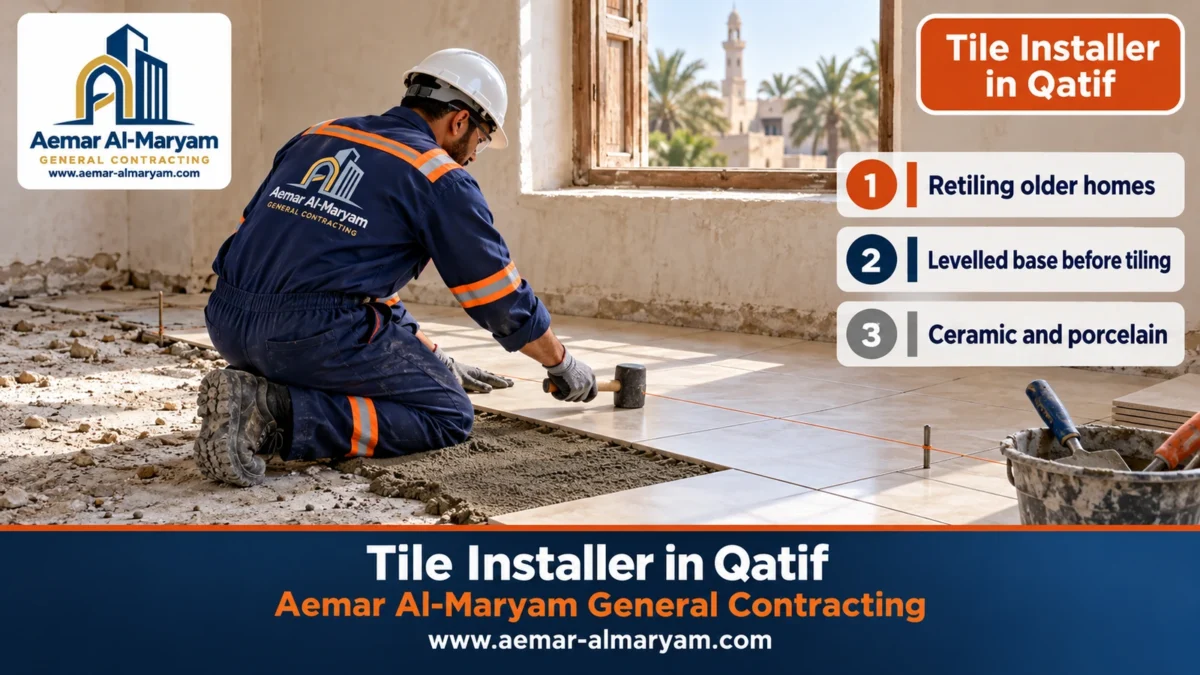
In an older house, a tile installer in Qatif does not start with the new tiles but with what lies under the old ones: crumbling mortar, sand that has settled in a corner of the room, and damp that has climbed the bottom of the walls, leaving white salts and flaking paint. Working as Aemar Al-Maryam General Contracting, we bring back the floors of houses in Qatif, Tarout and the surrounding towns from the base up. We lift the old tiles, deal with the damp before covering it, relay on a properly made sand-cement mortar bed or on adhesive depending on the tile, fix majlis marble with white adhesive, and clad stairs so every riser and tread comes out equal. For Qatif jobs, ceramic floors start at SAR 23 per m², SAR 14 per m² for stripping old tiles, SAR 14 per m² for floor correction, SAR 92 per m² for marble and SAR 46 per m² of stair face. We confirm every figure after visiting the house and add a travel element that we work out at the same time. Contact: 0547879578.
In Qatif, homes built decades ago stand a street away from recent ones, and plenty of them are near palm farms or the shoreline, where the water table is shallow. That setting leaves its mark on floors in particular. The ground floor is the first to suffer from rising damp; old tiles laid in cement using the dab method sound hollow over time; and majlis rooms floored in marble years ago now need polishing or replacing. This article is written for a homeowner in Qatif who wants to renew the floors once and not have to come back to them two years later.
In short: renewing floors in Qatif houses
- Before tiling: we check the wall bases and the floor for damp and salts and stop the source before any new tiles go down.
- Removal and levelling: lifting old tiles with their bedding from SAR 14/m², floor levelling from SAR 14/m², thick build-ups on inspection.
- Fixing method: a sand-cement mortar bed for ordinary ceramic where the floor needs raising or correcting, and an improved adhesive on a flat floor for porcelain and marble.
- Majlis rooms: marble or granite from SAR 92/m² labour, with white adhesive for light marble and every piece back-buttered.
- Stairs: tile or marble stair cladding from SAR 46/m² of stair surface, with the height spread evenly across the steps.
- Where we go: the city itself, Tarout and its villages, Safwa and Anak, with the trip costed during the visit.
- To book: photos of the floor, the wall bases and the stairs on WhatsApp 0547879578.
Tile installer in Qatif for older houses: renewal starts beneath the tiles
A tile installer renewing an older house in Qatif needs to understand why the old floor failed before laying a new one. Tiles rarely break on their own. They break because there is a void under them, they sound hollow because the mortar never bonded to them, and salts appear on them because water is rising from the ground. Lay new tiles over the same causes and the same defects return, however expensive the tiles.
So our first visit in Qatif starts with simple questions that we answer by testing. Do the existing tiles sound hollow when tapped, and in which rooms? Are there damp patches, flaking or white salts at the bottom of the walls, and how high do they reach? Does the floor slope one way or dip in a corner? What is the floor level compared with the courtyard and the street? Is the room on a concrete slab upstairs or on fill at ground level? The answers decide whether we tile straight away, level first, or treat damp before anything else.
■ Hollow tiles in the rooms
Usually dab-fixed mortar that left voids under the tiles, or sand fill that has settled over the years.
■ Salts at the wall bases
Damp rising from the ground and carrying salts; it needs treating before the floor and skirting.
■ A floor dipping in one corner
Fill that was never compacted properly, or a leak from a bathroom or pipe washing the sand away.
■ A dull majlis marble
Scratches and acid etching that polishing removes, unless the marble itself is cracked or hollow.
There is a one-screen summary on the tiles and marble page, and our other Qatif work is listed on the Qatif page.
Damp at the wall bases before retiling in Qatif
Damp at the base of the walls in older Qatif houses must be treated before retiling, because new tiles and skirting cover the place where the damp shows without stopping it. Groundwater under many Eastern Province towns is brackish and only a short way down, and moisture can rise up a wall by capillary action to around 75 cm, carrying chlorides and sulfates with it. When the water evaporates from the wall face, the salts stay behind: they show as white lines, the paint flakes, and the render crumbles at the bottom of the wall.
What we do before tiling depends on where the water comes from. If the source is a leak from a bathroom, a pipe or an underground tank, we find it and repair it first together with our plumber in Qatif. If the source is ground moisture, the cure is a damp barrier at the base of the wall, removal of the salt-laden render and re-rendering once the wall has dried; the details are in renovation contractor in Qatif and plastering contractor in Qatif. Either way we let the floor and the walls dry out before tiling, because tiles on a wet base bring the problem straight back.
⚠ Do not hide damp behind marble skirting
This is what we see most often in older houses: the owner fits taller-than-usual marble or tile skirting to hide the salts at the bottom of the wall. Months later the salts appear above the skirting, the paint above it flakes, and the skirting itself may come away. Skirting goes on after the damp has been treated, not instead of treating it.
A few signs help you tell the two apart. Ground moisture shows at the bottom of both external and internal walls at a fairly even height and gets worse in winter. A pipe leak shows in one specific patch near a bathroom or kitchen and stays the same in every season. If cracks accompany the damp in a wall, see crack repair in Qatif.
Removing old tiles in Qatif
Lifting old tiles in Qatif together with their bedding starts from SAR 14 per square metre, excluding long-distance debris haulage. In many Qatif houses the old tiles sit on a thick layer of mortar, and we remove that too, down to the concrete or the fill, because leaving crumbling old mortar under the new floor means the new tiles bond to a weak layer. If the family is living in, we take one room at a time, sheet over doors and windows, bring equipment in by the shortest route, and clear the debris as we go. For larger work than tile removal, such as taking out walls or concrete floors, see our demolition contractor in Qatif.
Once the tiles are up, the floor tells its real story. Is the concrete sound? Has the fill underneath settled or got wet? Do pipes run beneath it that need replacing? This is the cheapest moment to fix anything under a floor, because everything is exposed.
Tile installation in Qatif on a sand-cement mortar bed
Laying tiles in Qatif on a sand-cement mortar bed is the right method when the old floor is uneven or low and needs building up, and when the tile is an ordinary ceramic of moderate size. Mortar corrects the level and lets us form falls, but it takes skill. It has to be spread as a continuous bed, not scattered heaps; screeded to level lines with a straightedge; and each tile has to be tapped down with a rubber mallet until it beds fully, with a cement slurry or a dusting of cement on the back of the tile so the mortar grips it.
The common mistake in older houses is the dab method: heaps of mortar placed under the corners and centre of the tile, which is then pressed down on top of them. This leaves voids under the tile that sound hollow within months, and the edges snap when weight is put on them. The American installation standard wants four-fifths of every tile back bedded on a dry floor and 95% in a bathroom or courtyard; dabs never get close.
Sand fill under ground-floor tiles in Qatif
The sand under ground-floor tiles in Qatif houses should be coarse washed sand with no clay or salts, usually laid 5–10 cm deep and tamped firm before any mortar. A deep, loose layer sinks year by year and takes the floor down with it, while sand containing clay or salts holds moisture and passes it into the mortar. If we find settled or wet fill after lifting the old tiles, we remove and replace it before any tiling.
When do we use adhesive instead of mortar?
When the floor is flat or has been levelled, and when the tile is porcelain, marble or a large format. Porcelain absorbs very little water, so traditional mortar does not bond to it as it does to ceramic; it calls for a C2-class (improved) cement adhesive. In many Qatif houses we combine the two: a mortar screed to correct the level, then, once it has cured, tiles on adhesive. Correcting a floor costs from SAR 14 a square metre.
Ceramic tile installation in Qatif for rooms, kitchens and bathrooms
We lay ceramics in Qatif from SAR 23 a square metre on floors and SAR 27 on walls. In older houses wall ceramics are in high demand for kitchens and bathrooms, and the walls are often out of plumb or the render is weak. We check the wall with a straightedge, repair what needs repairing, and start from a horizontal line set with a level, because an old wall may lean and the floor may slope; if we started from the floor, every course would run off.
In the rooms we make sure the floor tiling runs between rooms and corridors at one level, without the sudden steps the old house may have had, except where a threshold has to stay, such as the bathroom entrance, which sits slightly lower so water cannot run out.
Bathroom tile replacement in Qatif
For a small Qatif bathroom stripped and rebuilt with a membrane and economy tiles, allow SAR 2,300 or more; where only new tiles are wanted, labour runs from SAR 36 per m². Bathrooms in older houses are often the very source of damp in the neighbouring rooms, so we strip the tiles back to the concrete, check the pipes and the floor drain, re-screed the falls, lay a membrane that climbs the walls, and pond-test it for 24–48 hours before tiling. The shower floor falls at 2% towards the drain and the rest of the bathroom at a gentle 0.5–1%. For waterproofing details see roof waterproofing and insulation in Qatif.
Majlis marble installation in Qatif
Majlis marble installation in Qatif starts from SAR 92 per square metre in labour for marble or granite, and in Qatif homes the majlis is the room the family most wants to look its best. White marble with light grey veining is the most requested, and it is also the most demanding to lay. Grey adhesive can show through it weeks later as dark patches, and some light and green marbles curl or stain with slow-drying water-based materials.
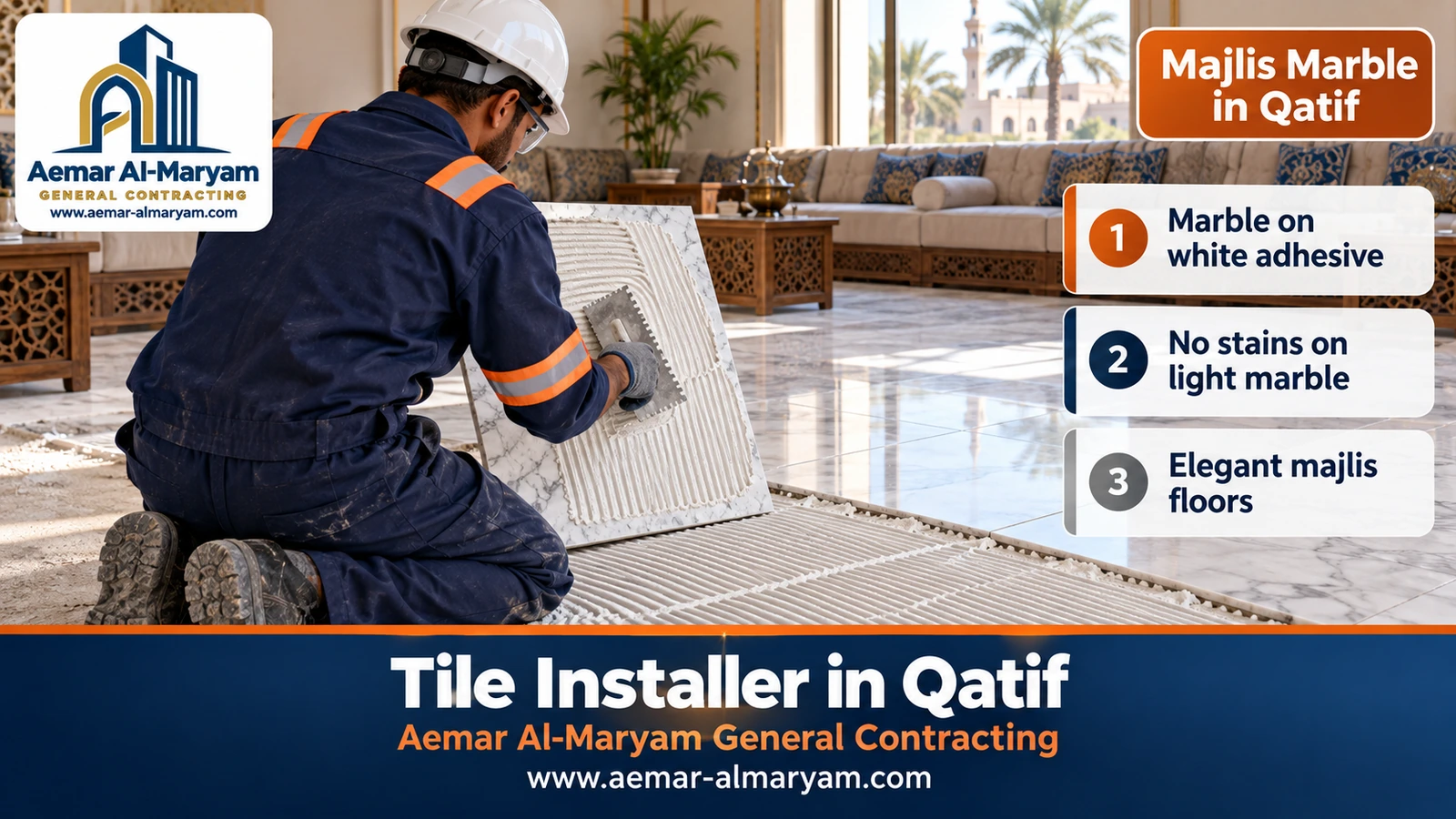
So we fix light majlis marble with white adhesive. We comb the floor with a notched trowel and back-butter every piece with a thin coat of the same adhesive so coverage is complete with no voids. If the marble is a moisture-sensitive type, we use a rapid-setting or resin adhesive and ask the supplier about the stone before fixing. We cut marble on a wet saw with a diamond blade so the edges stay clean, and we lay the pieces out before fixing so the veining is spread evenly across the room.
- ✓Marble and acids: lemon, vinegar and acidic cleaners leave dull etched spots on marble; sealing slows staining yet cannot prevent that etching, so harsh cleaners should never touch the majlis.
- ✓Granite for entrances: where the entrance is washed down or takes foot traffic straight from the street, granite with a non-polished finish suits it better than marble.
- ✓Skirting: in the same marble or a matching tone, fitted after the wall-base damp is treated, from SAR 14 per linear metre.
Marble polishing in Qatif
Majlis polishing in Qatif is priced from SAR 14 per m², reduced to SAR 9 per m² on jobs above 200 m², with abrasives in the price. Many older majlis floors do not need new marble, just polishing. We start with coarse diamond pads to remove lippage and deep scratches, move through finer and finer grits until the shine returns, then apply a protective coat. Dull spots left by acids disappear with polishing; grey stains inside light marble come from the adhesive beneath and polishing will not remove them.
Stair tiling in Qatif
Re-cladding stairs in Qatif, in tile or marble, costs from SAR 46 for every square metre of treads and risers. Stairs in older houses have a particular problem: many were built with uneven steps to begin with, then clad once or twice on top of the old finish, so the first or last step ended up a different height. The code family the Saudi building code is based on limits residential risers to 20 cm, requires treads of at least 25 cm, and allows no more than 9.5 mm of difference between steps in one flight, because your foot gets used to one rise and catches on any step that breaks it.
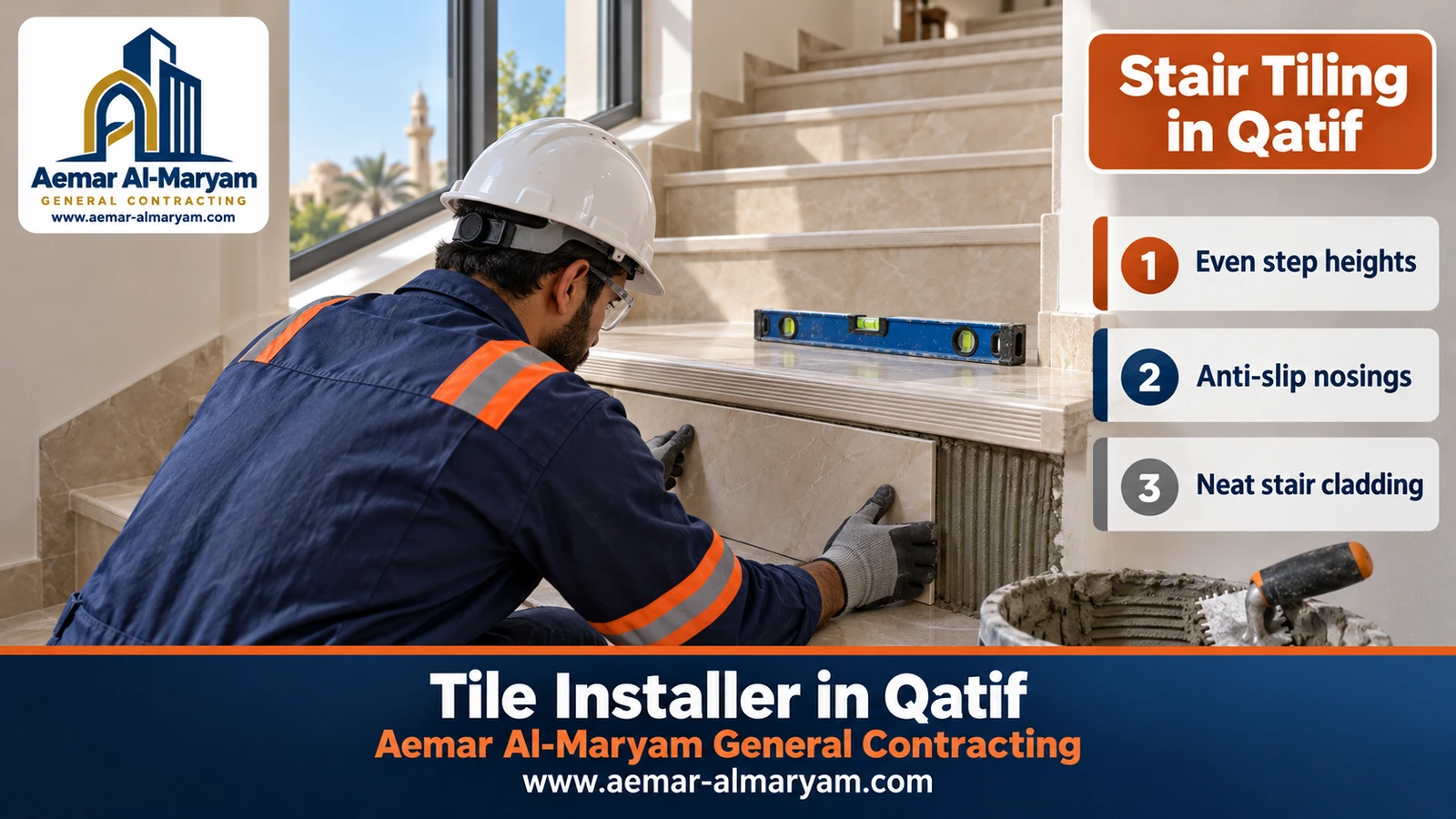
So where the stair carries two or more layers of old cladding, we strip them. We measure the total rise of the stair from floor to finished floor, then share the difference across the steps until they are equal. We set the tread first with a bevelled or grooved anti-slip nosing, then the riser beneath it, and level each tread with a very slight fall forward so cleaning water does not sit on it.
Marble stairs in Qatif
Marble stairs in Qatif are usually laid with treads 2 to 3 cm thick, thicker for heavy use or with a thickened front edge. For internal stairs we choose a marble that is not fully polished, or we add grooves near the nosing, because polished marble on stairs is one of the most common causes of slips at home. The marble itself is priced according to the stone you choose, and fixing labour is as in the table.
Courtyard tiles in Qatif
Courtyard tiling in Qatif starts from SAR 37 per square metre in labour, falls included, and the courtyard of an older house usually needs more than new tiles. We correct the falls to 1–2% towards the drains, cut sealant-filled joints into the yard spaced 2.4 to 3.6 metres apart since it sits in full sun, and choose a matt or textured outdoor tile that does not get slippery. If salts keep appearing on the courtyard tiles and joints, the cause is water rising from the ground or wash water sitting under the tiles, and we deal with it through the base and the falls before the new tiles go down.
Ceramic, porcelain or marble for an older house in Qatif?
| Material | Where it suits an older house | The right fixing method |
|---|---|---|
| Standard ceramic | Rooms, kitchen and bathroom walls | Mortar on a floor that needs correcting, or adhesive on a flat floor |
| Porcelain | Halls, corridors, bathrooms, courtyards | Improved C2 adhesive on a flat floor, since its absorption is no more than 0.5% |
| Natural marble | Majlis rooms, internal entrances, stairs | White adhesive for light stones, every piece back-buttered |
| Granite | The house entrance and outdoor steps | Improved adhesive, with a textured finish outside |
| Matt outdoor tile | Courtyards and paths | On a base laid to falls with movement joints |
What goes wrong with floors in older Qatif houses
| Symptom | Where it comes from | Our remedy |
|---|---|---|
| A tile that drums under a tapping rod | Dab-fixed mortar, or fill that settled under the tiles | Lift and refix with full coverage, and repair the fill if it has dropped |
| White salts on joints and wall bases | Ground moisture rising and carrying salts | Stop the water source, add a damp barrier, then clean |
| Tiles cracked along one line | A crack in the slab beneath, or settlement of the fill | Repair the base or the crack, then replace the tiles |
| Water standing in the bathroom or courtyard | Wrong falls or a drain set above the floor | Re-screed to the right fall and reset the drain level |
| Grey patches in majlis marble | Grey adhesive under light marble | Lift and refix with white adhesive |
| One step higher than the rest | New cladding over old without allowing for height | Strip the old cladding and redistribute the rise |
Repairing broken or hollow tiles in limited areas starts from SAR 92 per job depending on the number of pieces. If most of a room sounds hollow, relaying the room is usually the better value.
Tile handover in your Qatif home
When tiling finishes in an older house, do not judge it by the shine alone; the defects above show up with testing, not looking. This is a short list we go through with you at handover, and you can repeat it yourself a week later:
- ✓Tap test: go over the floor knocking with a coin; a solid note everywhere is what you want, and any drummy tile gets lifted today rather than next year.
- ✓Levels between rooms: walk from room to room and from the corridor into the majlis; you should not feel any step you did not agree to.
- ✓Wall bases: skirting fully bonded, with no damp or salts appearing above it a few days after fixing.
- ✓Bathroom and courtyard: tip a bucket out and follow it; it should find the gully without pooling anywhere.
- ✓Marble: no grey patches and no lipped edges, and the veining balanced across the majlis.
- ✓Stairs: measure each riser; the differences should be tiny and impossible to feel underfoot.
How long does it take? An average room usually needs a day of tiling once its floor is prepared, and a majlis or hall two or three days, but an older house adds days for removal, levelling, mortar curing and damp treatment. That is why your quote comes with a day-by-day plan showing when the floor can be walked on and when the joints are grouted, depending on the materials used.
Tile installation prices in Qatif
Qatif gets our Dammam rates, opening at SAR 23 a square metre for floor ceramics, plus a travel element agreed at the visit. The table follows the order work happens in an older house, from strip-out and levelling through tiling to polishing; treat each number as an opening figure that shifts with the tile and its size, the floor, the quantity and the storey:
| Item | Unit | Starting price | When an older house needs it |
|---|---|---|---|
| Lifting old tiles and thick old bedding | m² | SAR 14 | Every full renewal of a room or majlis |
| Levelling and raising the floor | m² | SAR 14 | Sunken or sloping floors; deep fill after the visit |
| Ceramic floors on mortar or adhesive | m² | SAR 23 | Rooms and bedrooms |
| Wall ceramics | m² | SAR 27 | Older kitchens and bathrooms |
| Porcelain 60×60 or smaller | m² | SAR 32 | Halls and corridors after levelling |
| Porcelain 60×120 | m² | SAR 37 | Halls being modernised |
| Square slabs, 100 or 120 cm | m² | SAR 46 | Rare in older houses; bigger slabs after the visit |
| Majlis marble or granite | m² | SAR 92 | The majlis and entrance; marble bought separately |
| Skirting around the majlis and rooms | linear metre | SAR 14 | Only after the wall-base damp is treated |
| Stair cladding, risers and treads | m² of stair surface | SAR 46 | Uneven stairs or stairs clad twice |
| Tiling a bathroom, floor plus walls | per m² | SAR 36 | Fixing labour alone |
| The whole small bathroom | bathroom | SAR 2,300 | Strip-out, waterproofing, test and economy tiles |
| Courtyard tiles with corrected falls | m² | SAR 37 | Courtyards where water stands |
| Economy materials and adhesive with fixing | m² | SAR 37 | For an all-in job |
| Refixing hollow tiles in limited spots | job | SAR 92 | Depends on how many tiles |
| Majlis marble polishing | m² | SAR 14 | Sound but dull marble; materials included |
| Polishing large areas from 200 m² | m² | SAR 9 | Materials included |
| Cladding a frontage in stone | — | Costed on site | Stone choice and fixing system |
| Granite worktop for the kitchen | — | Costed on site | Worktop size and granite type |
| Travel to Qatif and its towns | visit | On inspection | Lower per item when jobs are grouped in one visit |
Lines costed on site can still be estimated roughly from photos and dimensions sent to 0547879578; for other trades see the prices page.
What does a Qatif tiler charge per square metre?
Per m², we start at SAR 23 for ceramic on the floor, SAR 27 for ceramic on walls and SAR 32 for porcelain of 60×60 or less. In older houses the rate per metre is not enough to know the cost, because removal, levelling and damp treatment can outweigh the tiling itself, which is why we list each item separately after the inspection.
Are the tiles inside the Qatif per-metre rate?
Only on one line. Everything else is hand labour, and tiles, adhesive and grout are bought separately. The exception is our budget package, where we supply economy tiles and the adhesive and fix them for SAR 37 a metre, and if you buy the tiles yourself we work out the quantity for you with a wastage allowance.
Travel cost to Qatif and Tarout
The travel cost to Qatif, Tarout Island and the surrounding towns is set at inspection according to the location and the number of working days. Grouping several jobs into one visit, such as the rooms together with the bathroom and stairs, or tiling together with plastering and painting, lowers the share of travel cost carried by each item.
Worked example: a majlis in an older house
Suppose a majlis in a Qatif house measures 5 × 7 m, has hollow old tiles, and the owner wants white marble with skirting; the wall-base damp has already been treated:
- ✓Area: 5 × 7 = 35 m².
- ✓Removing the old tiles: 35 × 14 = SAR 490.
- ✓Floor levelling: 35 × 14 = SAR 490.
- ✓Marble labour: 35 × 92 = SAR 3,220.
- ✓Skirting: majlis perimeter 24 m less the 1 m door = 23 m, and 23 × 14 = SAR 322.
- ✓Estimated total: 490 + 490 + 3,220 + 322 = SAR 4,522 in labour, before the marble, the white adhesive and the travel cost.
This example is illustrative; the actual figure is fixed once we have seen the floor under the old tiles.
What we do not take on in Qatif
Qatif and Tarout have registered heritage buildings and old mud and stone houses. These have their own competent authorities and restoration methods that preserve the original materials, so we do not work on them. What we do work on is residential houses, old and new, built in concrete and blockwork: renewing their floors, bathrooms, majlis rooms, stairs and courtyards. If you are not sure whether your house is a registered heritage building, ask the municipality before any work.
How to book a tile installer in Qatif
- 1Photograph floors and walls
The current tiles, the bottom of the walls if there are salts or flaking, and the stairs if they are part of the job. - 2Write down the areas
Measurements of each room, the tile you are after, and whether it is already in the house. - 3Say where you are
The Qatif district, the town or Tarout Island, the floor level, and the street width if it is narrow. - 4Site visit
We tap the tiles, measure moisture and levels, and write the items in order: damp, then removal, then levelling, then tiling. - 5Work and handover
One room after another, finishing with a joint inspection: coin taps, the long rule, and water poured in the wet areas.
Send all of that on WhatsApp 0547879578 or fill in the inspection request form; our finished jobs are pictured under projects.
What sets our Qatif tiling apart
■ We start with the cause
Damp and settled fill are treated before tiling, so the defect does not return after the renewal.
■ Two methods, chosen by the floor
A sand-cement mortar bed when the floor needs correcting, improved adhesive when it is flat.
■ Careful marble work
White adhesive, full back-buttering and wet-saw cutting for majlis marble.
■ A general contractor
Plumbing, waterproofing, plastering and renovation alongside the tiling, with one party responsible.
If the renewal includes the old wiring, we coordinate it with our electrician in Qatif before tiling, so the new floor is never broken open to run a cable.
Qatif, Tarout and the towns we cover
Our Qatif jobs run from Al Shati, Al Sawari and Al Sadafa to Al Fath and Al Rida in the city, across the causeway to Darin, Sanabis, Al Zour, Al Rubaiyah and Tarout town itself, and north to Safwa and west to Anak. For the older districts with narrow streets we arrange visits in advance and tell you the size of the equipment and where it will park. For the complete tiling guide read tile installer in Dammam; for neighbouring Saihat flats, roofs and bathrooms see tile installer in Saihat; and villas with stone frontages are covered in tiling in Dhahran.
An older house in Qatif that needs new floors?
Photograph the tiles and the bottom of the walls and send them with the area, and we will tell you whether treatment is needed before tiling and what the estimated cost is.
Also useful for an older Qatif house
Tags