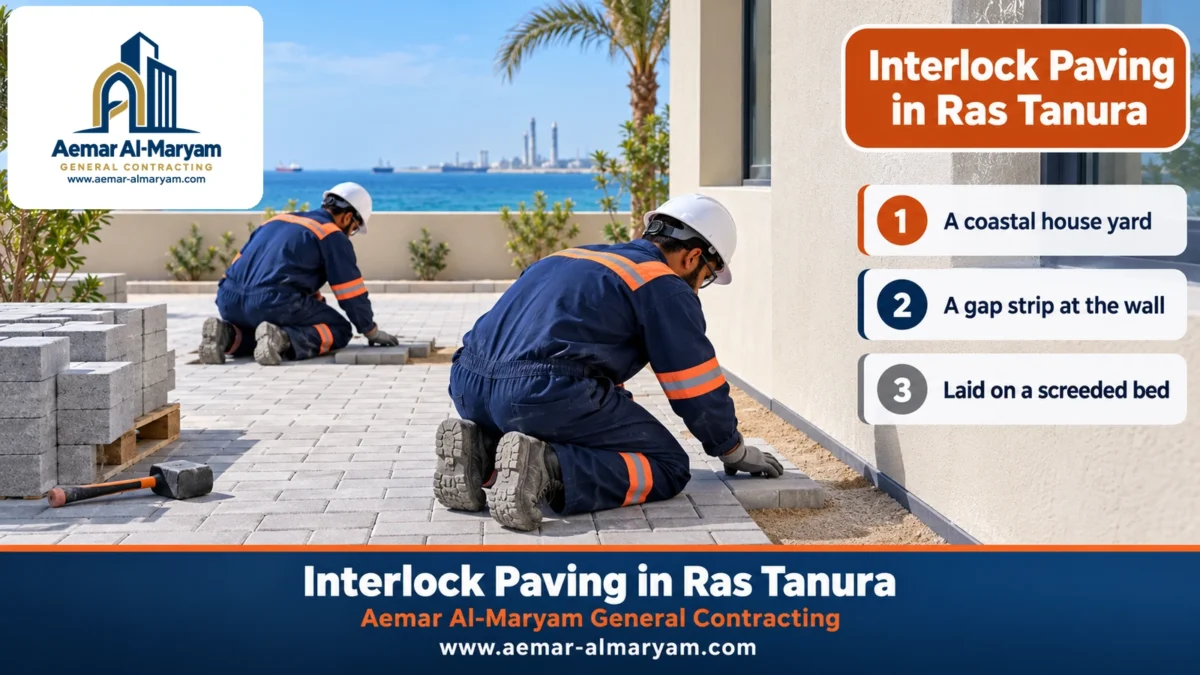
In Ras Tanura the sea comes close to the houses, and with it humid air and ground that can hide water and salt a short way down. That is why interlock paving in Ras Tanura starts, for us, with a small hole in the yard before anyone picks a colour: we read the soil, its colour and how wet it is, then decide whether an ordinary compacted base is enough or whether the yard needs geotextile and partial soil replacement. Aemar Al-Maryam General Contracting paves coastal house yards, paths, parking areas and kerbs, and explains the white-bloom question honestly before you ever see it. A grey 6 cm yard begins at SAR 37 a square metre, with any ground treatment and our travel from Dammam costed once we have dug and looked. Phone or WhatsApp 0547879578.
This page follows the order we work in on site: the ground first, then what goes on it, then the pavers, edges and falls, and finally prices, with a worked example for an 80 m² yard on damp ground.
Quick summary: interlock paving in Ras Tanura
- Ground: A trial hole at inspection; damp or clayey ground gets geotextile and a thicker base, or partial replacement.
- Pavers: 6 cm for seating and paths, 8 cm herringbone for parking, and an expansion strip along the house wall.
- White bloom: Natural white marks may appear in the first months and fade with time; we reduce the causes and don’t promise to eliminate it.
- Prices: Per m²: labour-only 14, grey yard 37, coloured yard 46, 8 cm car space 55, bare-earth yard built up 64; damp-ground work and travel after the visit.
- Coverage: Ras Tanura town and Rahima, with crews coming from Dammam by appointment.
Interlock paving in Ras Tanura starts with the ground, not the pavers
Interlock paving in Ras Tanura differs from an inland city on one important point: groundwater may be close. In the Eastern Province, saline groundwater is known to lie near the surface at many coastal sites, and it can rise through the soil by capillary action for tens of centimetres. Salty sabkha can feel hard when dry, yet weaken markedly once water dissolves the salts holding it together. That does not mean every yard in Ras Tanura is a problem; it means guessing the ground without digging is a risk.
How do we know whether the yard ground is damp or salty?
- ✓Soil colour: Dark, wet soil when digging 20–30 cm on a day the yard was not hosed.
- ✓White crusts: A salty layer on the soil or on the bottom of the wall and old tiles.
- ✓Old surfaces: Tiles or concrete whose edges crumble, or that show salts again after every clean.
- ✓Slow drying: Washing water that sits in low spots for hours.
- ✓Feel: Sticky soil that clings to the tool, or soft clay under a thin layer of surface sand.
At inspection we dig one or two small holes in different spots, photograph them for you, and propose the right treatment before any final price.
And if the ground is dry and firm?
Not every house in Ras Tanura sits on damp ground. If the trial hole shows dry, firm soil, we use an ordinary base with no fabric and no replacement, and we add no treatment you do not need to your bill. That is the reason for digging before pricing: you pay for what the ground actually needs, no more and no less.
Geotextile under interlock in Ras Tanura: when and why
Geotextile is a permeable synthetic fabric laid between the soil and the base course. Its first job is separation: it stops the crushed stone sinking into soft soil under compaction and loads, and stops fine clay particles rising into the base and filling its voids. Without that separation, the base gradually turns into a mix of stone and mud that loses its strength, and the interlock above it sinks.
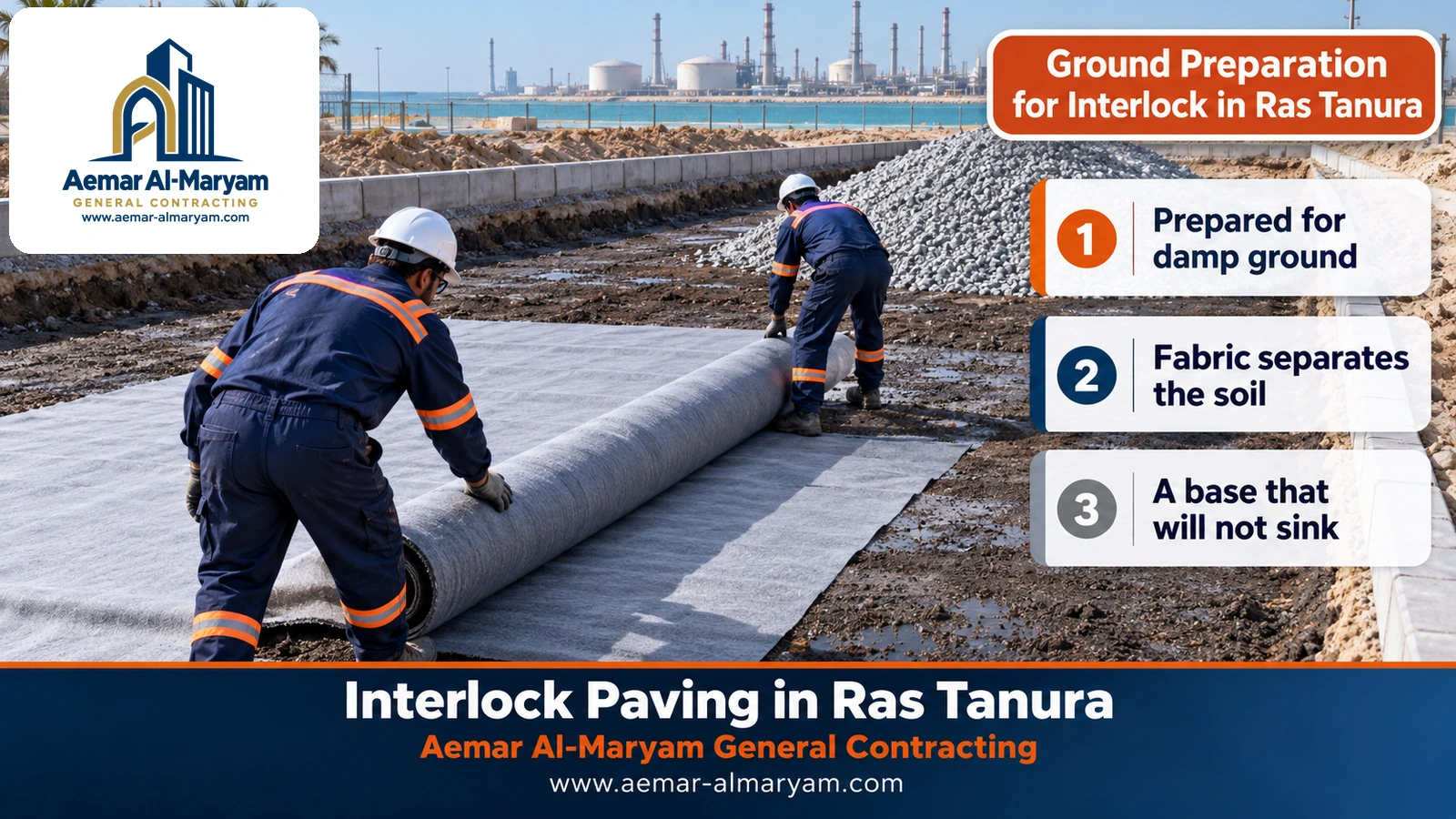
- 1Excavation
We dig to the required level and remove soft clay and organic matter. - 2Compacting the bottom
We compact the formation as far as the soil allows without turning it into paste. - 3Laying the fabric
We spread it over the bottom, turn it slightly up the sides, and overlap each roll on the next so no gap remains. - 4Base course
We place the crushed stone on the fabric carefully so it does not tear, and compact it in lifts. - 5Finishing
Sand bed, pavers, joint sand and compaction, as for any interlock.
Geotextile or soil replacement?
Fabric is usually enough when the soil is damp but not very weak. If it is deep soft clay or sabkha that gives way underfoot, we may remove part of it and replace it with good compacted fill before the fabric and base. That decision is made by digging, not guessing, and is priced at inspection. If the yard is covered with old cracked concrete that has to go first, it comes out first with our demolition contractor in Ras Tanura.
White bloom on interlock in Ras Tanura: an honest explanation
White bloom on interlock (efflorescence) is the question we hear most in coastal towns, and we prefer to explain it before the job rather than after. Concrete units contain lime produced by the cement reaction. When moisture enters them and then evaporates, it carries this lime to the surface, where it reacts with carbon dioxide in the air and leaves a white haze. The effect is natural in all cement products, does not mean the paver is weak, and usually fades with time and weather.
Why does bloom show more near the sea?
Because moisture is the carrier. In Ras Tanura the air is humid, the ground may be damp, and extra salts can rise from salty soil through the joints. So you may notice marks at a house near the sea more than at a similar house inland, and they may appear after very humid spells and then fade.
What we do to reduce it, and what we don’t promise
- ✓Drainage from below: A crushed-stone base that drains, and geotextile on damp ground, so the sand bed does not stay wet.
- ✓Falls from above: A fall of about 2% that sends washing and irrigation water away, so it does not stand on the pavers.
- ✓Low-absorption units: We ask for the batch test certificate; the known value in the American paver standard is absorption of 5% or less.
- ✓One batch: All pavers from one production run, so any bloom is even rather than in scattered patches.
- ✓No false promises: We do not promise the paving will never turn white; we promise to explain why and reduce the causes.
Do not wash bloom off with acid
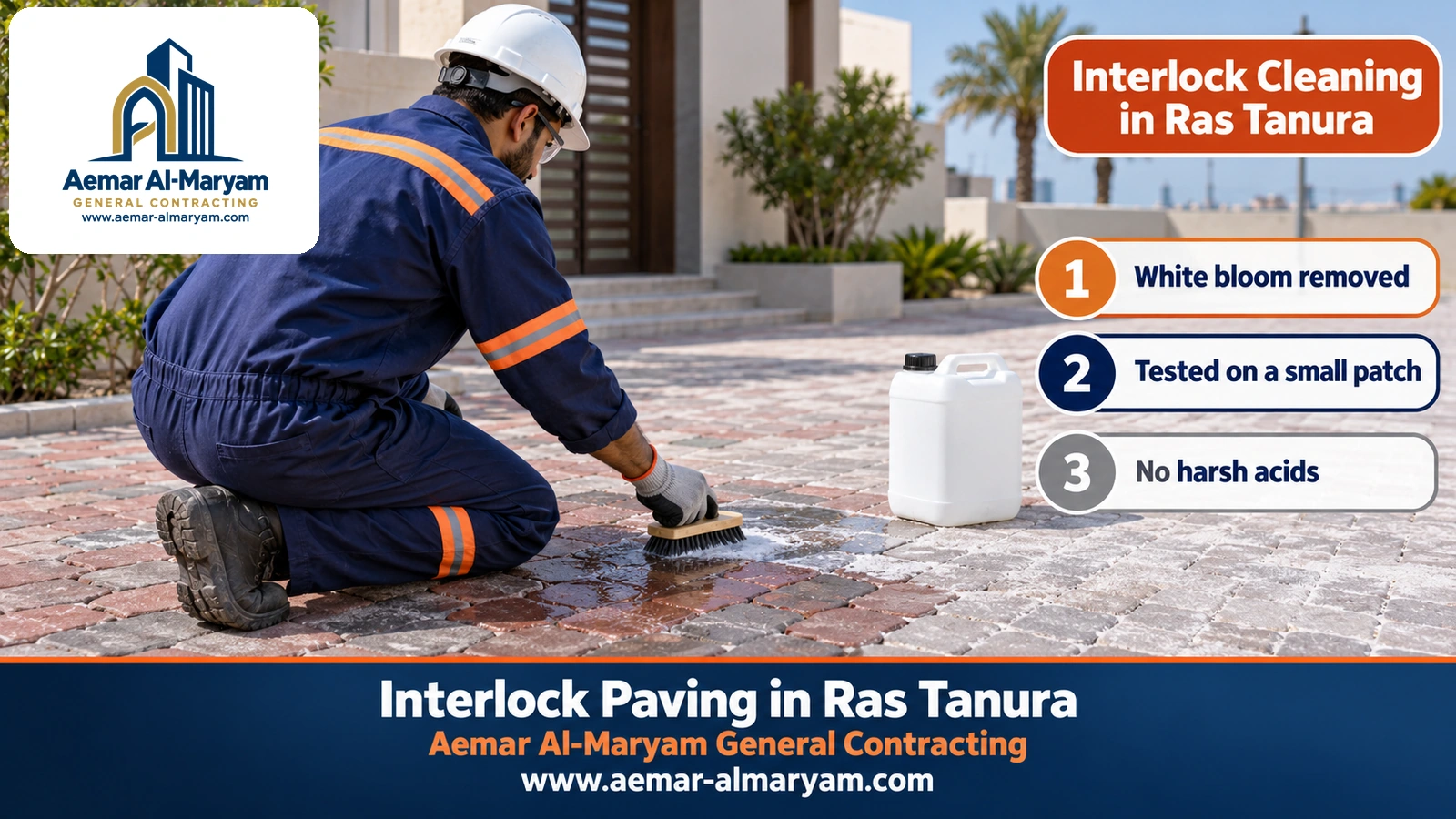
Strong acids dissolve the white layer but eat into the paver surface, expose its aggregate and change its colour, and can make bloom worse later. If you need to clean, use a paver-specific cleaner after testing it on a hidden spot, and rinse well.
Interlock for coastal house yards in Ras Tanura
Interlock for a coastal house yard in Ras Tanura is usually an open seating area, a path around the house and a space for one or two cars. For seating we choose light colours that absorb less heat, and lay rectangles in a simple stretcher bond on paths and seating areas because it is plain and needs little cutting; herringbone is kept for the car space.
The expansion strip along the house wall
Along the house wall, the door threshold or a tank base, we place a thin flexible strip between the interlock and the fixed concrete element. Segmental paving specifications mention expansion strips of this kind next to rigid structures. The benefit is that the pavers do not press directly on the wall, so the units next to it do not chip and the render at the bottom of the wall is not scuffed.
Garden watering next to the wall
Repeated water at the foot of a wall increases salts and damp in both the wall and the interlock. Keep irrigation away from the wall, or add a gravel strip between the planting and the house.
House front interlock in Ras Tanura
House front interlock in Ras Tanura is the inside area between the gate and the front door, where guests and the car often pass together. We divide it by use: the car track in 8 cm herringbone, the rest in 6 cm in the same colour so the surface reads as one. We make sure the paving at the gate sits a little above the street so street water does not run into the yard, and that the door threshold stays high enough above the paving to keep water and sand out of the house.
Beyond the boundary wall the footway is municipal, so dropping its kerb or relaying it is for the municipality to permit. We work only inside the property; if the outside pavement is so high that it blocks the car, we photograph the situation so you can apply to the municipality.
Interlock supply and installation in Ras Tanura
If we supply, the pavers, sand, crushed stone and any fabric travel to Ras Tanura with our team, and the square-metre rate includes them. We reserve a single production run big enough for the yard plus offcuts, and want to see its lab figures for strength under load and water uptake before paying; the usual American yardstick is a mean of 55 MPa or better with uptake capped at 5%. In a coastal town absorption matters most, because a less absorbent unit lets in less water and so carries less salt to its surface.
An interlock company in Ras Tanura or a labour-only installer?
If you have bought the pavers yourself and the ground is ready, we lay them for labour only from SAR 14 per m². On damp ground, though, we prefer to run the job from the excavation, because what lies under the pavers decides whether they succeed, and nobody can stand behind a base someone else laid. An interlock company in Ras Tanura that handles ground, base, kerbs and laying together gives you one party responsible for the whole result.
Interlock types and shapes that suit coastal homes
| Shape | Where we use it in Ras Tanura | Note |
|---|---|---|
| Rectangle in stretcher bond | Seating areas and paths around the house | Simple, little cutting, a calm look |
| Rectangle in herringbone | Car space and gate entrance | Resists rows sliding under braking and turning |
| Zig-zag | Parking in front of shops | More interlock between units |
| Hexagon | Open seating areas | Distinctive, with more cutting at edges |
| Open-cell grass pavers | Extra planted parking | Needs watering; we avoid it next to house walls |
Light colours such as pale grey and sand absorb less heat than dark ones, and they also hide efflorescence better than dark colours, on which white marks stand out clearly. It is a practical point many people miss when choosing a colour for a house near the sea.
Parking and path interlock in Ras Tanura
A car space in the yard, or parking in front of a shop, needs 8 cm herringbone interlock on a base of 15 cm or more, and on damp ground we thicken the base and lay fabric under it. Long paths around the house stay at 6 cm, about 1.20 m wide for the main path and 60–80 cm for side paths. If the car park is large and heavily used, compare it with asphalt on our asphalt contractor in Ras Tanura page.
Interlock thickness and layers in Ras Tanura
| Layer | Thickness | Note for Ras Tanura |
|---|---|---|
| Soil (formation) | Weak layer removed | A trial hole sets the depth of removal |
| Geotextile | Overlapping fabric | On damp or clayey soil |
| Base course | 10–15 cm for pedestrians, 15–20 cm for cars | May be thicker on weak ground, compacted in lifts |
| Sand bed | About 3 cm before compaction | Clean sand, never used to make up levels |
| Interlock | 6 cm or 8 cm | 8 cm herringbone where the car goes |
| Joint sand | Fills the joints | Finer than bedding sand, swept in during compaction |
A thick sand bed is a common mistake: some installers spread 5–7 cm of red sand to cover a poor base, while the known specifications keep it at about 2.5–4 cm before compaction. A thick bed moves under load, and if it gets wet on damp ground it is worse.
Two sands, two jobs
The sand under the pavers is clean, of mixed grain size, struck off level with a straightedge and then left untouched by feet. Joint sand is finer: it is swept dry over the paving after laying so it enters the narrow gaps between units, and with compaction it fills them and locks the units together. Using wet or coarse sand in the joints leaves them half full, one of the fastest ways for units to start moving in a yard. We keep the bedding sand only lightly moist, because saturated sand does not settle evenly.
Kerb installation in Ras Tanura: the edge that holds the yard
Kerb installation in Ras Tanura is needed on every open edge of the interlock, because the pavers hold together by sideways pressure. Each kerb sits on a poured concrete bed no thinner than 15 cm, with concrete packed up its back in the same pour; butt the kerbs closely together, and let them set before the sand goes down. Close to the sea we pay attention to the quality of the bed concrete and to not leaving the edge soaked by irrigation water.
■ Garden kerb
Low, separating the seating area from planting.
■ Pavement kerb 15 × 30 × 50 cm
Around the car space and edges exposed to wheels.
■ Dropped kerb at the entrance
An upstand of about 2.5 cm so wheels cross smoothly.
■ Hidden concrete restraint
Where you want no visible edge, we cast a restraint below paving level.
We price kerbs by the linear metre once we have seen the edge and agreed the unit.
Falls and drainage in Ras Tanura
A coastal yard should slope at no less than about 2%, running water off from the house to the street or a gully, and we form that slope in the crushed stone before any sand goes on. At each gully the paving is set just above the grating so water falls in. In Ras Tanura falls matter twice over: any water standing on the paving keeps it damp for longer, which raises the chance of bloom and of algae in shaded corners. If the yard needs a new drain, we arrange it with a plumber in Ras Tanura before the base.
Interlock installation steps in Ras Tanura
- 1Inspection and trial hole
We measure the area and levels and check the soil. - 2Removal and excavation
We lift old tiles or concrete and weak soil. - 3Kerbs
We cast their beds, set them and let them harden. - 4Fabric and base
Geotextile where needed, then the base in lifts with the falls. - 5Sand and pavers
A bed of about 3 cm, then laying and cutting, with the strip along the wall. - 6Joints and compaction
Fine sand and at least three compactor passes, then more sand until the joints are full. - 7Water test and handover
Hosing to check the falls, and cleaning the site.
Interlock prices in Ras Tanura
Interlock prices in Ras Tanura match our Dammam rates square metre for square metre; what changes is the work below the pavers. Laying your own units starts at SAR 14. A grey 6 cm yard with our materials over ground that is already compacted starts at 37, a coloured yard at 46, and an 8 cm car space over an existing base at 55. A bare-earth yard where we build every layer for walking and sitting starts at 64. Damp-ground treatment and our crew’s travel from Dammam are only priced after the trial hole and the visit, and the more jobs you put into one trip, the thinner the travel cost spreads.
| What we pave in Ras Tanura | Pricing note | Starting at (SAR) |
|---|---|---|
| Labour-only laying, per m² | Your pavers and sand on site, ground prepared | 14 |
| Grey 6 cm yard, per m² | Materials included, over level ground compacted earlier | 37 |
| Coloured 6 cm yard, per m² | Colours, or a pattern in more than one shade | 46 |
| 8 cm car space, per m² | Herringbone over a base already in place | 55 |
| Bare-earth yard built up fully, per m² | Dig, compact, base, sand, 6 cm units and fall, for walking and sitting | 64 |
| Car space on bare earth | 15 cm of base or more, as the trial hole dictates | After the visit |
| Damp or sabkha ground | Geotextile, or part of the soil replaced | After the visit |
| Kerbs, per linear metre | Units with their concrete bed and backing | After the visit |
| Lifting and relaying sunken paving | Water source stopped first, then the base rebuilt | After the visit |
| Taking up old tiles, per m² | Including the mortar underneath | 14 |
| Crew travel from Dammam | Spread across the area built | After the visit |
All of this is indicative until we have inspected and agreed. Under about 50 m² the rate per metre climbs, because getting people and equipment to site costs the same for a small yard as for a big one. For lines marked “after the visit”, photograph the yard, send its dimensions and say whether a car will use it on WhatsApp 0547879578, and you will get a first figure back. Other services we offer are priced on our rate card.
A worked case: 8 × 10 m of yard on damp ground
A house near the sea in Ras Tanura has an 8 × 10 m = 80 m² yard. The ground is soil that showed damp in the trial hole, and the yard is used for sitting and walking with no cars. Illustrative only:
- ✓Full pedestrian system: 80 m² × 64 = SAR 5,120 “from”: excavation, levelling, compaction, base, sand, grey 6 cm interlock and falls.
- ✓If you choose a colour: The difference between grey and coloured pavers is 46 − 37 = SAR 9 per m², about SAR 720 over 80 m².
- ✓Bedding sand: 80 × 0.03 = 2.4 m³, and with about 10% waste roughly 2.6 m³.
- ✓Fabric: Covers the whole bottom, 80 m² plus extra for overlaps and turning up the sides, priced with the treatment at inspection.
- ✓Not included: Kerbs per linear metre, any soil replacement, and the crew’s trip.
What changes the price in Ras Tanura?
- ✓The trial hole result: Dry firm ground means an ordinary base, damp ground means fabric and a thicker base, deep clay means replacement.
- ✓What is on the ground now: Bare soil is easier than old tiles or concrete that must be lifted and carted away.
- ✓The car: A car space needs 8 cm and a thicker base than a seating area.
- ✓The edges: Length of kerbs and the number of drains and columns to cut around.
- ✓The trip: Spread over the area, so the bigger the job or the more you group, the less per square metre.
How long does an interlock yard take in Ras Tanura?
If the ground is ready, a typical yard is done in a handful of days. If it needs digging, soil treatment and kerb beds, we add days, because the kerb concrete has to set before compacting pavers next to it, and a base on damp ground is compacted in lifts without rushing. The agreed timetable goes into the contract after the visit.
Paving over old tiles or a concrete slab in Ras Tanura?
Over old tiles, we do not recommend it: tiles do not drain, so the sand bed on top stays wet, which at a coastal house is a recipe for bloom and sinking. It is better to lift the tiles and see the ground beneath, and that is often where we find the source of the damp. A slab in good order that already falls the right way can carry pavers on sand, as long as we drill outlets so water cannot sit beneath; we judge that on site. Taking up tiles and mortar is from SAR 14 a square metre.
Repairing sunken interlock in Ras Tanura
Interlock that has sunk at a coastal house usually tells you that water reached what lies beneath: a fall that collects water in a corner, a leaking pipe, or damp ground paved without separation. The repair starts by stopping the water, then lifting the sunken area, removing the wet sand and mixed soil, laying fabric if needed, rebuilding and compacting the base, and re-laying the same sound units, replacing only damaged ones. If you suspect a leak, find it first; for damp problems in roofs and walls see roof waterproofing in Ras Tanura.
Looking after interlock in the coastal climate of Ras Tanura
Interlock needs little maintenance, but the coastal climate speeds some things up. These simple habits extend the life of a yard:
- ✓Joint sand: After pressure washing or rain some joint sand washes out; sweep fine dry sand back in, because an empty joint lets units move.
- ✓Weeds and algae: In shaded damp corners green algae or weeds may grow between units; they signal an empty joint or standing water, so fix the cause, not just the look.
- ✓Washing: Wash with ordinary water and a brush, and avoid leaving water standing in the yard for hours.
- ✓Broken units: A unit is lifted and replaced with one from the same batch, so keep a few spares.
- ✓Edges: Check the kerbs after some years; a kerb that moves is worth fixing before the units behind it creep.
Common mistakes with interlock at coastal homes
- ✓Laying straight on damp clay: Without fabric or enough base, so the paving sinks after a few months.
- ✓A thick sand bed: To hide a poor base, so units move and ripple.
- ✓A fall toward the house: Washing water collects at the wall, adding damp and salts to it.
- ✓No expansion strip: Units press on the wall and chip at the edges.
- ✓Washing bloom with acid: Damages the surface and changes the colour.
- ✓Mixing batches: Colour differences show as patches across the yard.
Interlock, asphalt or tiles in Ras Tanura?
In a coastal yard interlock stands out because its joints allow small movements without cracking, and any part that sinks can be lifted and re-laid with the same units. Asphalt is faster and cheaper for large car areas, but it is black, it heats up, and its patches show. Tiles on mortar are smooth and easy to wash for covered seating areas, but they crack if the ground moves beneath them. For seating-area and indoor tiles see our tile installer in Ras Tanura.
Receiving interlock in Ras Tanura: what to check
- ✓Water test: No puddles after hosing, and water heading away from the house.
- ✓Expansion strip: Present along the wall and thresholds, with sound edge units.
- ✓Flatness and stability: No units rock, and a straightedge shows no dips.
- ✓Joints: Filled with sand almost to the top.
- ✓Kerbs: Straight, with their haunching visible behind them.
- ✓Colour: One batch, with no obvious differences between areas.
How to order interlock paving in Ras Tanura
Send on WhatsApp 0547879578 photos of the yard from all four sides, its rough sizes, whether a car will use it, a close-up of any white marks or damp on the existing paving or walls, and your district in Ras Tanura or Rahima. We reply with an initial estimate, then agree an inspection date when we dig the trial hole and take levels, after which we write down the items, duration and price. You can also request an inspection on the site.
Why Aemar Al-Maryam in Ras Tanura?
- ✓We check before we price: A trial hole sets the real base, not a guess.
- ✓Honesty about bloom: We explain the cause and reduce it, and promise nothing no one can deliver.
- ✓A base for damp ground: Geotextile, a thicker base and soil replacement when needed.
- ✓Joined-up work: Removal, kerbs, drainage and laying in one agreement.
See finished jobs in our project gallery, and read about the trade on the interlock service page.
Covering Ras Tanura and Rahima
Our teams come from Dammam by appointment to seafront homes in Ras Tanura and to Rahima; the Ras Tanura area page lists what else we do there. Up the coast, our Jubail page covers Industrial City walkways, Al-Balad carports and clad entrance steps; inland, our Abqaiq page deals with paving in the heat; and the Dammam guide remains the long reference.
Yard near the sea? Start with a photo of the ground
Send pictures of the yard, any white patches or damp, and its size. We suggest a build-up for that ground with a rough cost, then book the dig and site check.
Related pages for Ras Tanura
Tags