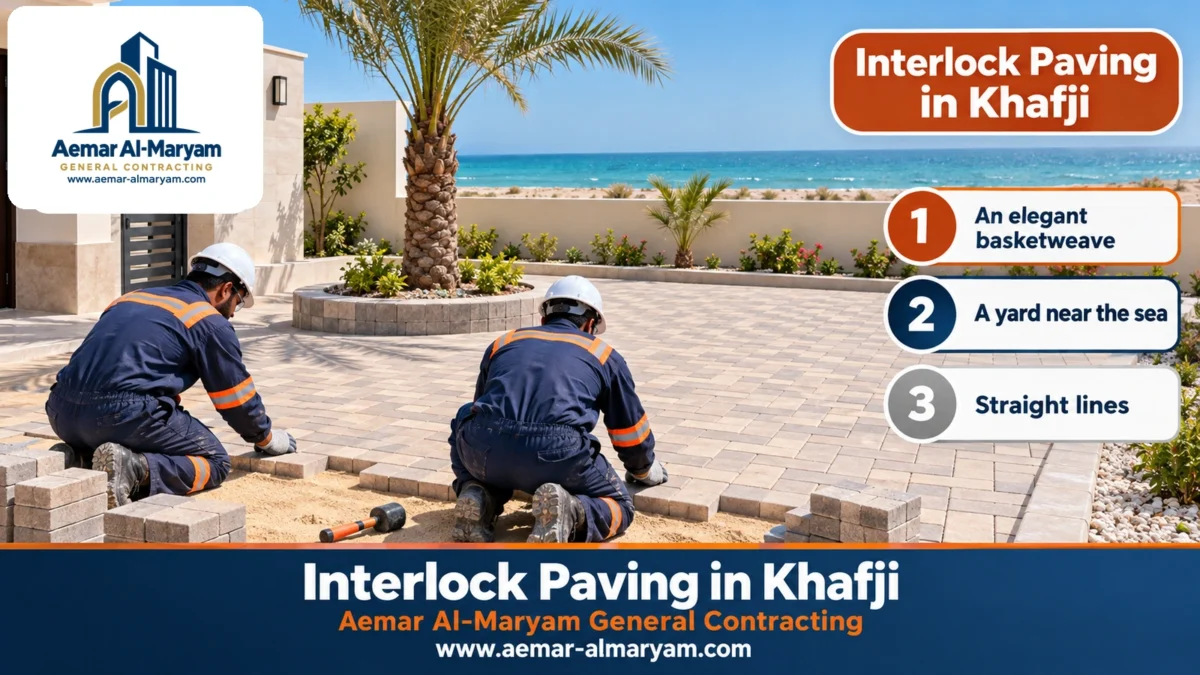
One broken paver in the middle of a courtyard does not justify tearing up the courtyard. A chalet patio you picture as rings around the seating cannot be built in straight rows. And a house a few streets from the sea needs its yard tilted so hose water and salty spray drain off, away from the walls. Those three jobs make up most of our interlock paving in Khafji, and they are exactly what Aemar Al-Maryam General Contracting does there. We supply and lay pavers for homes and villas close to the shore, pull out cracked units one by one with an extractor while the surrounding pavers stay put, set out two-colour circles and fans in chalet courtyards, and frame the lot with kerbs. Paving on a prepared yard starts at SAR 37 per square metre; all prices are estimates until inspection and agreement, and the trip north is worked out when we visit. You can ring or WhatsApp us on 0547879578.
Khafji is about 298 km from Dammam, so every visit is planned with care. We ask for photos and measurements first, prepare replacement units in the right colour before arriving when the job is a repair, and try to group more than one site in the city into the same trip.
What you need to know, briefly
- Most requested in Khafji: house yards near the sea, replacing cracked units and repairing sunken areas, and chalet courtyards in circular patterns.
- Thickness: 6 cm for walking yards and seating, 8 cm wherever a car enters or parks.
- Near the sea: we check the soil at inspection, choose low-absorption pavers and set the fall away from the wall.
- Where prices begin: a car bay in 8 cm units from SAR 55/m²; a grey 6 cm yard from 37, coloured from 46; a sandy yard built from scratch from 64; laying alone from 14. Swapping units and repairs are priced on site.
- Travel: about 298 km from Dammam, priced at inspection and reduced by grouping jobs into one visit.
Interlock paving in Khafji: what we do and where
We work inside private property in Khafji: the house yard, the villa entrance, the chalet courtyard, and the private bays outside a shop or apartment block. Public pavements belong to the municipality, and we change nothing on them without its approval. These are the jobs that come to us most:
■ Yards near the sea
A full yard paved with a planned fall, light colours and slip-resistant units around the washing point.
■ Replacing a cracked unit
Pulling out the damaged unit, fitting one of the same colour, then joint sand and light compaction.
■ Chalet courtyards
Two-colour circular or fan patterns around seating, a fountain or a barbecue.
■ Car entrances
8 cm herringbone interlock with a dropped kerb at the entry.
■ Sunken areas
Lifting the low section, fixing what lies under it and re-laying it.
■ Kerbs
Garden and pavement kerbs around beds and parking on a concrete bed.
An interlock company in Khafji or a paver fixer by the piece?
A skilled hand may be enough to swap two units. Paving a whole yard or a chalet courtyard, though, needs someone who takes responsibility for layers, edges and falls together. An interlock company in Khafji writes down before starting what goes under the pavers: how deep it will dig, how thick the base will be, where the kerbs go and how the water will run. Put the same questions to anyone who quotes you. They separate a yard that lasts from one that sinks after a single winter.
Interlock supply and installation in Khafji
If we buy for you, we choose with you a supplier who can show lab results for the run, then order enough extra to cover offcuts, more than usual for circles and fans because so many units are trimmed. If the pavers are already in your yard, you pay only for our hands, starting at SAR 14 per square metre on prepared ground. One habit we always recommend: put a few leftover pavers from the same run in the store room. Years later, they are the perfect match when one cracks.
Interlock for house yards near the Khafji beach
Interlock in house yards near the Khafji beach faces three things a yard in the open desert does not: higher humidity, spray that carries salt, and wind-blown sand that piles up in the corners. That does not make interlock a poor choice for these homes. It means the pavers, the layers and the falls must be chosen with care. Good, low-absorption concrete pavers cope with these conditions, and a yard that drains quickly does not hold salt for long.
- ✓Colours: beige, light grey and sand tones suit the coast better; they stay cooler underfoot and do not show blown sand the way dark colours do.
- ✓Pattern: basketweave gives a house yard a calm look, and we switch to herringbone in the car lane.
- ✓Washing point: around the yard tap and car-washing spot we use textured, slip-resistant units and send the fall to a nearby drain.
- ✓Palms and beds: we leave an unpaved bed around each palm and restrain the paving there with a small garden kerb.
Interlock in front of houses and villa entrances in Khafji
The strip an owner holds in front of the house up to the kerb line can be paved with interlock to make a clean car entrance. We use 8 cm where the car parks, drop the kerb at the entry point and fall the surface towards the street. Any public pavement beyond your boundary keeps its level unless the municipality approves a change through the Balady platform.
Replacing a cracked interlock unit in Khafji without lifting the yard
Replacing a cracked interlock unit in Khafji is a small job that needs a patient hand. The units sit tight against each other, locked by sand, so they are not knocked out. They are drawn out with a metal extractor that slips into the joints and grips the unit on both sides. The hardest unit is the first one: if it is broken we take out the pieces, and if it is sound but discoloured we remove it whole to reuse in a less visible spot.
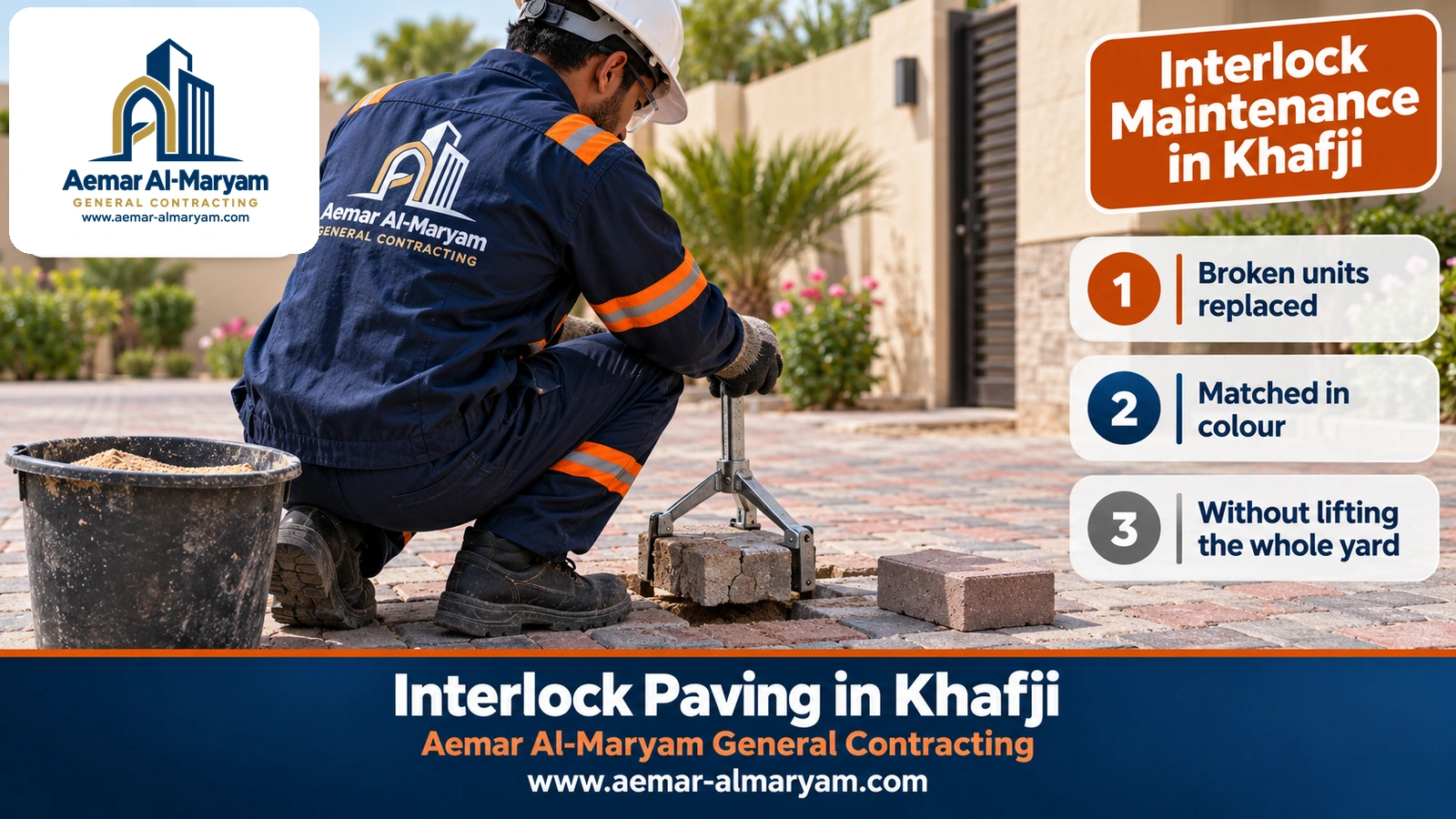
- 1Open the joints
We sweep the sand from around the unit and clear the joints slightly with a thin tool. - 2Draw the unit out
We fit the extractor and lift straight up so the neighbours keep their edges. - 3Correct the bed
We level the sand beneath, add a little if it has dropped, and check the base has not sunk. - 4Set the replacement
We choose the closest colour, set it level with its neighbours and tap it with a rubber mallet. - 5Fill and settle
We sweep in fine joint sand and compact the spot with a small plate or repeated tapping.
Matching the colour
A new unit looks darker or cleaner than its neighbours for the first weeks, then weathers closer to them in the sun. If the exact colour is not available, we move a sound unit from a hidden corner into the visible spot and put the new one in the corner.
Why do interlock units crack?
A single cracked unit usually has a local cause: a heavy point load such as a jack stand or a tank frame, something hard dropped on it, or a 6 cm unit where a car turns. When cracking repeats across an area, the cause lies beneath: a void where sand has washed out, a base that was never compacted, or an edge without a kerb, so the units started moving and grinding against each other. In that case replacement is not enough; the area needs repair.
Repairing and re-laying sunken interlock in Khafji
When part of a yard sinks, we mark its outline and lift the units from it and around it until we reach sound paving, stacking them in order. Then we look for the cause: water from a leaking pipe or air-conditioning drain, a wrong fall that collects water, or a weak base. We fix the cause, and if the leak comes from the roof or walls we point you to waterproofing in Khafji. Then we recompact the base, screed fresh sand, re-lay the same units and compact them. Repair is priced at inspection because it follows the size of the area and the reason it sank.
Chalet interlock in Khafji: circular and fan patterns
A chalet courtyard in Khafji is a place for sitting more than for cars, so owners ask for a pattern that gives the space a centre: a circle widening around seating or a fountain, a fan pattern of overlapping arcs, or rings in two colours alternating grey and beige. These patterns look good but need planning before laying. We fix the centre with a peg, mark the rings with a string tied to it, lay from the inside out, and cut the units where the circle meets the straight lines at the edges.
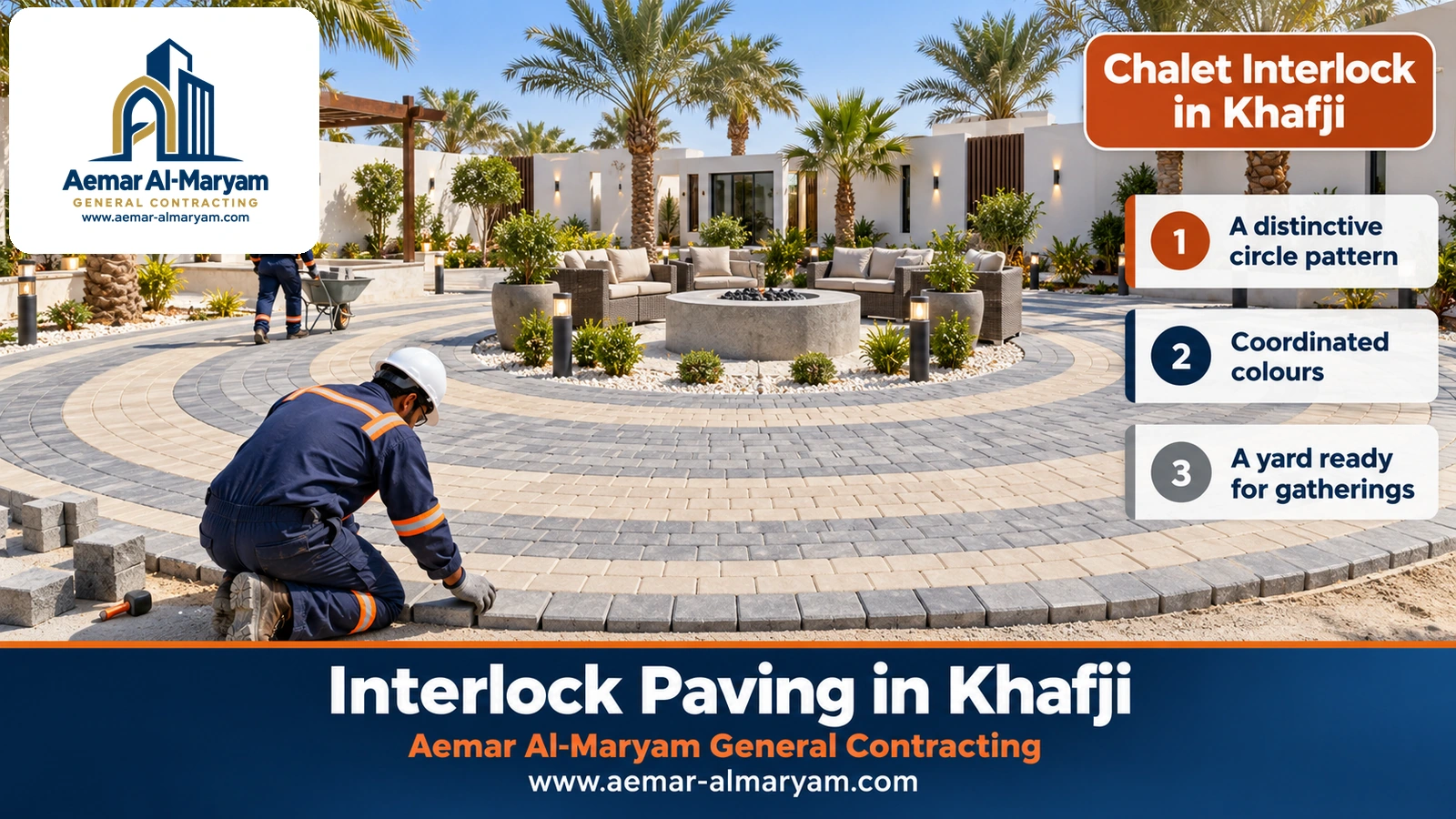
- ✓Units for circles: some suppliers sell dedicated circle kits; otherwise we cut them from rectangles.
- ✓More cutting: waste in a circular pattern is higher than in straight laying, so we allow for it in the quantity.
- ✓The outer edge: we close the circle with a border row and then a garden kerb or hidden restraint so the last rings do not loosen.
- ✓Seating and barbecue: a fixed barbecue sits on a concrete pad or thicker units, kept clear of the coloured rings so the heat does not mark them.
Interlock types and shapes available in Khafji
| Shape or pattern | Where it suits in Khafji | Note |
|---|---|---|
| Rectangle in basketweave | House yards and chalet paths | Calm and easy to replace |
| Rectangle or zig-zag in herringbone | Car lane and parking | Resists turning wheels |
| Circular or fan | Chalet courtyard around seating | More cutting and planning |
| Hexagon | Small seating areas and garden paths | Distinctive and regular |
| Grass pavers | Side parking at a chalet | Drains water and stays green with watering |
Garden paths and walkways at Khafji homes and chalets
The path from the gate to the front door of a house or chalet carries the most foot traffic, so we give it a comfortable width, usually no less than about 1.20 m, while side paths between planting beds need 60 to 80 cm. We outline the path with a border row in a contrasting colour on both sides and hold it with a low garden kerb so its units do not creep towards damp soil. Where the path meets grass, we keep the paving slightly above the soil so mud does not wash over it during watering. A path that winds between palms instead of running straight is possible, but the curves need more cutting, which we include in the quantity. At chalets where floors are washed after every gathering, we choose textured units for the paths, since they are less slippery underfoot when wet, and fall them towards the beds rather than the doors.
6 cm or 8 cm interlock in Khafji?
For a house courtyard, a chalet patio and the paths between them, 6 cm pavers do the job provided no car drives on them. Anywhere a car stops or rolls in every day gets 8 cm, laid in herringbone at 45° or 90°, the bond that resists turning tyres best. Slim units whose length exceeds three times their depth are kept off the driveway, since a wheel tips or snaps them. Heavier vehicles, such as a pickup that comes in to load, get a thickness and base designed at inspection.
Car park interlock in Khafji
Private parking outside a Khafji shop or within a villa compound needs 8 cm units on a compacted base of 15–20 cm, pavement kerbs along its edges and a dropped kerb at the entrance. If one of the bays is for disabled drivers, its slope stays within 2% in both directions. For large car parks used only by cars, asphalt may be cheaper; the comparison is further down.
Coastal ground under interlock in Khafji: sabkha and salts
Sabkha is salt-crusted ground found in patches along the Eastern Province shoreline. Dry, it feels firm underfoot; wet, its salts go into solution and it carries noticeably less. Not every Khafji plot sits on it, but the town lies on the water, so at inspection we open small trial holes at several points in the yard, paying most attention to low corners and to places where wash water lingers. Where the soil proves soft, salty or damp, we dig it out and bring in clean compacted fill, separate it from the base with a geotextile, or lift the finished level a little. That work is priced on site.
Interlock paver quality near the sea
A thirsty paver drinks in salt spray along with the water, so its face blotches and its surface grains loosen earlier than they should. For coastal homes we therefore look at the laboratory results for that exact order before buying. The well-known American paver standard expects a mean compressive strength of roughly 55 MPa as a minimum and caps water uptake at 5%. We also compare samples from different crates for thickness and shade before the first row goes down.
White bloom on interlock in Khafji
That light, chalky film on brand-new pavers comes from lime in their cement, brought to the face by moisture and left there as it dries. Sunlight wears it off over the following weeks. Close to the sea, damp air can also pull a little soil salt up through the joints. Start with patience and plain water; if you need more, a paver cleaner tested on a hidden unit, and never a strong acid.
Layers, sand bed and compaction for interlock in Khafji
| Layer | What we do with it | Approximate thickness |
|---|---|---|
| Soil | Remove weak, salty or wet material and compact the formation to the falls | As found at inspection |
| Base course | Graded crushed stone compacted in lifts | 10–15 cm for walking, 15–20 cm for cars |
| Sand bed | Clean graded sand screeded with a straightedge, never walked on | About 3 cm before compaction |
| Pavers | Laid in the pattern, edges cut | 6 or 8 cm |
| Joint sand | Finer sand swept into the joints during compaction | Fills joints of 2–3 mm |
Our plate compactor runs on a rubber mat that protects the paver faces; it makes three passes or more, then we scatter fine sand, brush it in and run the plate again until every joint is packed. Dips in the stone base are fixed in the stone, never hidden under extra sand, because a deep bed rolls and ruts under load. Any edge still waiting for its kerb is left uncompacted for about a metre. As for the wind-blown sand that drifts into Khafji yards, a broom clears it; it is no substitute for proper joint sand.
Kerb installation in Khafji
On every Khafji yard or courtyard we do, the kerbs go in before the first paver. A trench is cut, concrete at least 15 cm deep is laid in it, the kerb is bedded on that, and a sloping concrete shoulder is cast behind it; the plate keeps away until that concrete has gained strength. The usual pavement kerb is 15×30×50 cm and stands roughly 12 cm proud of the paving, garden kerbs are slimmer and lower for beds and seating edges, and where a car enters we sink the kerb so only around 2.5 cm shows.
Are kerbs really needed with interlock in Khafji?
An unprotected edge always loosens: the outer pavers walk outwards, gaps open, sand washes away and the edge settles before the rest. Chalet owners who prefer no visible kerb get a concrete strip cast below paving level that does the same job unseen. Larger pours are handled by our team for concrete pouring in Khafji.
Falls and drainage for interlock in Khafji
Our Khafji yards fall by about two centimetres in every metre, sometimes more, running away from the house wall and the chalet door towards the road, a gully or a planting bed. The fall is cut into the compacted stone, not shaped in the sand, and next to each gully the paving finishes three to six millimetres higher than the grate so the water drops straight in. Near the sea a good fall pays twice: rain and wash water leave quickly, and salty water never sits long enough to dry on the surface and stain it.
Pros and cons of interlock for a yard near the sea in Khafji
| Advantages | Drawbacks and how we handle them |
|---|---|
| Repairable in parts: a cracked unit is replaced on its own | A new unit may differ slightly in colour, so we keep spares from the same run |
| Can be lifted and re-laid after fixing what is beneath | Needs a good base or it sinks, so we never cut corners on the base |
| Stays firm in summer heat, unlike asphalt | Low-grade pigments fade, which is why we check lab results |
| Patterns and colours that suit chalets | Circular patterns need more cutting and more time |
| Sheds water quickly to the falls | Weeds grow in joints that lose their sand, so we top them up |
Interlock prices in Khafji
Below are our starting rates for Khafji. They are the Dammam figures unchanged, the lowest being SAR 37 per square metre, with the crew trip added after the inspection. Nothing here is final before the site visit, and figures rise for small yards, patterns with heavy cutting and weak coastal soil:
| What you need in Khafji | Unit | From (SAR) |
|---|---|---|
| Swapping one or several cracked units in the nearest shade | — | At inspection |
| Re-levelling a dip: lift, repair beneath, relay | — | At inspection |
| Seaside house yard on prepared ground, beige or grey 6 cm | m² | 37 |
| Two-tone patio or path in basketweave or hexagons | m² | 46 |
| Coloured rings and fans around a chalet seating area | — | At inspection |
| Car entrance or private bay in 8 cm units on existing compacted stone | m² | 55 |
| Sandy yard paved for walking, from excavation to the last fall | m² | 64 |
| Car area built up from sand on a heavier stone base | — | At inspection |
| Crew labour only, using pavers you supply | m² | 14 |
| Taking up an old tiled yard with its mortar | m² | 14 |
| Kerbs for beds, paths and parking | lin. m | At inspection |
| Salty or waterlogged coastal soil under the yard | — | At inspection |
| The trip to Khafji and removal of rubble | — | At inspection |
How to bring the travel cost to Khafji down
The Khafji trip carries the crew, the plate compactor and the cutting kit, sometimes the sand as well, and its cost moves with the number of days and the size of the job, so we do not print a figure in advance. What we can say with confidence is that a visit carrying more work leaves a smaller share on each task. A few cracked units plus a new garden path, or your yard together with a neighbour who needs a repair, belong in one request. That same fixed cost is why a yard under roughly fifty square metres works out dearer per metre.
Worked example: a 7 × 11 m house yard near the sea
An illustration only: a house yard in Khafji of 7 × 11 = 77 m² on sandy ground with nothing built on it, and no car entering. It needs the full pedestrian system: excavation, compaction, a base course, sand and 6 cm interlock with a fall towards the gate:
| Item | Calculation | Approximate result |
|---|---|---|
| Full pedestrian system | 77 × 64 | SAR 4,928 |
| Base course, 12 cm after compaction | 77 × 0.12 | about 9.2 m³ |
| Bedding sand, about 3 cm | 77 × 0.03 | about 2.3 m³ |
| Pavers incl. 5% for cuts | 77 × 1.05 | about 81 m² |
| Spare units kept in store | — | Recommended for future replacements |
| Travel from Dammam | — | Set at inspection |
If the ground were already compacted and level, the figure would drop to 77 × 37 = SAR 2,849 for grey, or 77 × 46 = SAR 3,542 for coloured. If the inspection finds wet or salty soil that needs replacing, its treatment is added as a separate item.
Interlock, asphalt or tiles for a yard in Khafji?
For a yard where the family sits and a car sometimes passes, interlock suits better: its colours are calm, repairs are partial and the surface does not soften in the heat. For a large car park in front of a building or shop, used only by cars, asphalt may be faster and cheaper; see our asphalt contractor in Khafji. Tiles bedded in mortar suit a covered seating area where the owner wants a smooth surface that wipes clean, which is work for our tile installer in Khafji.
Can interlock be laid over old tiles in Khafji?
Paving over old tiles is a short cut that costs more later: sand will not stay put on a glazed face, water gets trapped between the two floors, and the new level crowds the door sills. So the tiles and their mortar come up first, from SAR 14 per square metre, while heavy breaking is handed to our demolition team in Khafji. If a solid concrete slab with a correct fall lies beneath, it may be kept as a platform, drilled with drainage holes and topped with sand and pavers; we judge that on site.
Interlock installation steps in Khafji
- 1Pictures and measurements
Share them on WhatsApp and tell us whether it is new paving, a few replacements or a sunken area. - 2First estimate
We suggest thickness and pattern and work out the estimated cost from our starting prices. - 3Inspection in Khafji
We check the soil, take levels and match the colour if it is a replacement. - 4Excavation and base
We remove weak soil, compact to the falls and lay the base in lifts. - 5Kerbs
On a concrete bed and haunch, left to harden. - 6Bed and pattern
The sand is struck off, then the pattern goes down, circles always from their centre peg. - 7Compaction and joints
At least three passes with joint sand until full. - 8Sign-off
We hose the yard and run a straightedge with you, then leave the site swept.
How long does interlock work in Khafji take?
Replacing a number of units usually takes part of a day, and a house yard on ready ground a few days. A chalet courtyard with a circular pattern and kerbs on ground that needs a base takes longer, because there is more cutting and the kerb concrete must harden. We give you the duration after inspection.
Before you accept interlock work in Khafji
- ✓Water: run a hose and confirm it moves away from the wall without ponding.
- ✓Straightedge: lay it in several directions; deviations should be millimetres.
- ✓Circles: rings of even width and unbroken, with clean cuts at the edges.
- ✓Replacement units: exactly level with their neighbours, neither higher nor lower.
- ✓Kerbs: firm and straight, with their concrete complete.
- ✓Joints: packed with sand, and no paver wobbling when you step on it.
Mistakes we come across in Khafji homes and chalets
- ✓Knocking out a cracked unit so the neighbouring edges chip.
- ✓Replacing units in a sunken area without fixing the base beneath.
- ✓Laying a circular pattern without a fixed centre, so the rings drift.
- ✓Leaving the courtyard edge unrestrained, so the outer rings come loose.
- ✓A fall towards the chalet door or the house wall.
- ✓High-absorption pavers near the sea that stain quickly.
- ✓Throwing away surplus units after laying, then hunting for the colour years later.
How to order interlock paving in Khafji
One WhatsApp message to 0547879578 with the points below lets us suggest a fix and a rough cost before we agree a visit date:
- ✓A wide photo and a close one of the yard or courtyard, and of any cracked units with something to show their size.
- ✓Count or area the number of units to replace, or the dimensions of the new area.
- ✓Use walking and sitting, or a car.
- ✓Pattern and colours a photo of a circular or fan pattern you like if it is a chalet courtyard.
- ✓Spare units? from the same run, they are the best colour match.
- ✓Location a map pin in Khafji.
Why Aemar Al-Maryam for interlock at your Khafji home or chalet?
■ Repair before replace
If only one unit is damaged we replace that unit, and we never suggest lifting the yard without a reason.
■ Planned patterns
Circles and fans start from a fixed centre and tight strings, not guesswork.
■ Coastal care
We check the soil, choose low-absorption pavers and set falls away from the wall.
■ One contractor
If the house also needs renovation or an annex, we can schedule it alongside the paving when needed.
Photos of finished jobs are in our projects, a short summary sits on the interlock and kerbs service page, and the full technical background is in our Dammam interlock guide.
Khafji and its surroundings
We work across Khafji, at these kinds of sites:
More about what we do in the town is on our Khafji area page. Further south we also lay interlock in Hafr Al-Batin and Al-Ahsa.
A cracked unit or a whole yard in Khafji?
Photograph the area and send the sizes or the number of units. We will tell you the solution and an estimated cost and arrange the Khafji visit alongside other nearby jobs.
Related services in Khafji
Tags