


Core drilling in Saihat is how we put round holes through the walls and slabs of apartment blocks and villas for AC lines, drains, extractors and ventilation ducts, in a way that keeps finished floors spotless: a suction ring around the bit and a wet vacuum that pull the grey slurry away the moment it leaves the hole. Saihat is about 14 km from Dammam, where Aemar Al-Maryam General Contracting is based, so our crew reaches it quickly and a same-day or next-day slot is often possible. An AC hole costs from SAR 90 with us, the kitchen and bathroom sizes most people need start at SAR 140, and the final figure is set after we inspect and agree. Phone or WhatsApp 0547879578.
The jobs that come to us from Saihat tend to fall into two clear types. The first is a multi-storey apartment block whose owner wants AC holes for every flat at once, worked from the outside on a scaffold. The second is a finished villa or flat, with polished marble and the furniture in place, where the owner needs one or two holes and does not want to see a single drop of mud on the floor. Between the two sits a third request that keeps coming up: a rectangular ventilation opening in a concrete wall, which we make with a chain of overlapping cores. This page is built around those three jobs.
Core drilling in Saihat: the short version
- Apartment blocks: AC holes for every flat from an external scaffold, at matching heights and falls.
- Finished homes: a rubber suction ring around the bit and a wet vacuum, with furniture and marble covered.
- Ventilation openings: stitch drilling with overlapping cores when a single circle will not do.
- Cost: from SAR 90 for an AC hole, climbing to SAR 140 at five or six inches, SAR 230 at eight and SAR 320 at ten to twelve.
- Districts: Al Deerah, Al Khassab, Al Noor, Qurtubah, Ghirnatah, Al Khaleej, Al Danah, Al Kawthar, Al Nemer and more.
- Contact: a photo of the facade or wall and the number of holes on WhatsApp 0547879578.
Core drilling in Saihat: what we drill and why we use a core rig
Core holes in Saihat are round holes cut by a tubular diamond bit turning on a stand that is fixed to the wall or slab. The bit cuts through the concrete and any bar in its way, lifts out a solid cylinder, and leaves a hole with straight sides and a known diameter. We use it for AC, drain, water, extractor and cable holes, and for large ventilation openings when we join several circles together.
Choosing coring over breaking in Saihat is about more than looks. Many homes here are fully finished, apartment blocks have a family on every floor, and the streets inside the residential districts are quiet. Hammering fills a flat with dust, shakes walls shared between neighbours and cracks the plaster round the hole. A core rig turns without striking, and the water that cools it is drawn away before it reaches the floor.
Administratively Saihat belongs to Qatif governorate; Anak lies just north of it and Dammam just south. Its old lanes around Al Deerah sit alongside newer streets lined with family villas and residential blocks. That mix means a day in Saihat might start with a building facade on a scaffold and end with an extractor hole in a newly finished villa kitchen, and each needs a different set of kit and protection.
■ Apartment block AC
Repeated holes across the facade for each flat, drilled from the scaffold.
■ Finished homes
One hole or several, with no trace on the marble or paintwork.
■ Ventilation and ducts
Rectangular openings made with a chain of overlapping cores in garages and kitchens.
■ Drains and water
Holes between floors in bathrooms, kitchens and on the roof.
AC core holes in Saihat: whole apartment blocks from a scaffold
AC core holes in Saihat’s apartment blocks are usually drilled from outside on a steel scaffold. The rig needs a stand fixed to the wall, and the technician needs to stand steady in front of the hole, not reach out of a window or balance on a ladder. When the order covers ten flats or more, a scaffold is faster and cheaper than going into every flat one by one.
Why a scaffold and not a ladder?
- A core rig with its stand is heavy, and fixing it needs a safe footing and space around the hole.
- Working from outside keeps most of the water and slurry out of the occupied flat.
- One scaffold serves several neighbouring flats on the same floor, so the crew moves along without re-rigging.
- The outdoor unit brackets can be fitted from the same scaffold once the holes are done.
One height and one fall for every flat
In each block we agree with the owner and the AC technician on one height for every flat’s hole, and a fixed distance from the window edge or the room corner, so the facade comes out orderly rather than random. Every hole is drilled with a slight fall to the outside. For reference, many wall-unit installation guides gives 65 mm with the bore dropping towards the outdoor side; if your own unit’s guide differs, its figure wins.
Old window-unit openings on the facade
Many older blocks in Saihat were built with openings for window AC units, and owners now want to switch to split systems. The old opening is far too big for split pipes, so it is filled with block and mortar and rendered on the outside, and we core a new hole of the right diameter next to it. If the owner wants to reuse part of the old opening for the pipe run, we agree it with them and the AC technician so no gaps are left around the pipe for dust and water to get in.
We also ask where the condensate will go. Will it run down the facade in an exposed pipe, or into a nearby drain? The hole position decides the length of that run, and condensate trickling down a wall leaves marks on the paint over time.
Working with the residents
An occupied block needs planning. We ask the owner to tell residents the schedule, we agree which flats we enter from inside to cover furniture near the wall, and we avoid rest hours. If some flats are locked, that is fine: we drill from outside and leave the inside for a later visit when the tenant is home.
Building owner?
Send us a photo of the whole facade, the number of flats and the number of AC units in each. A large number of holes in one visit lowers the price per hole and saves you paying for the scaffold twice.
Concrete coring in a finished Saihat home: the marble never sees the water
Concrete coring inside a finished villa or flat in Saihat relies on a rubber collar sealed to the wall round the bit and hosed to a wet vacuum, which draws the grey slurry away as soon as it leaves the hole, so it never runs down the wall or reaches the floor. Water is essential in wet drilling, because it cools the diamond bit and keeps the dust down. But it comes out loaded with fine cement and sand, and if that mix dries on marble or in its joints it leaves a dull film, while the sand grains scratch the polish when someone walks over them.
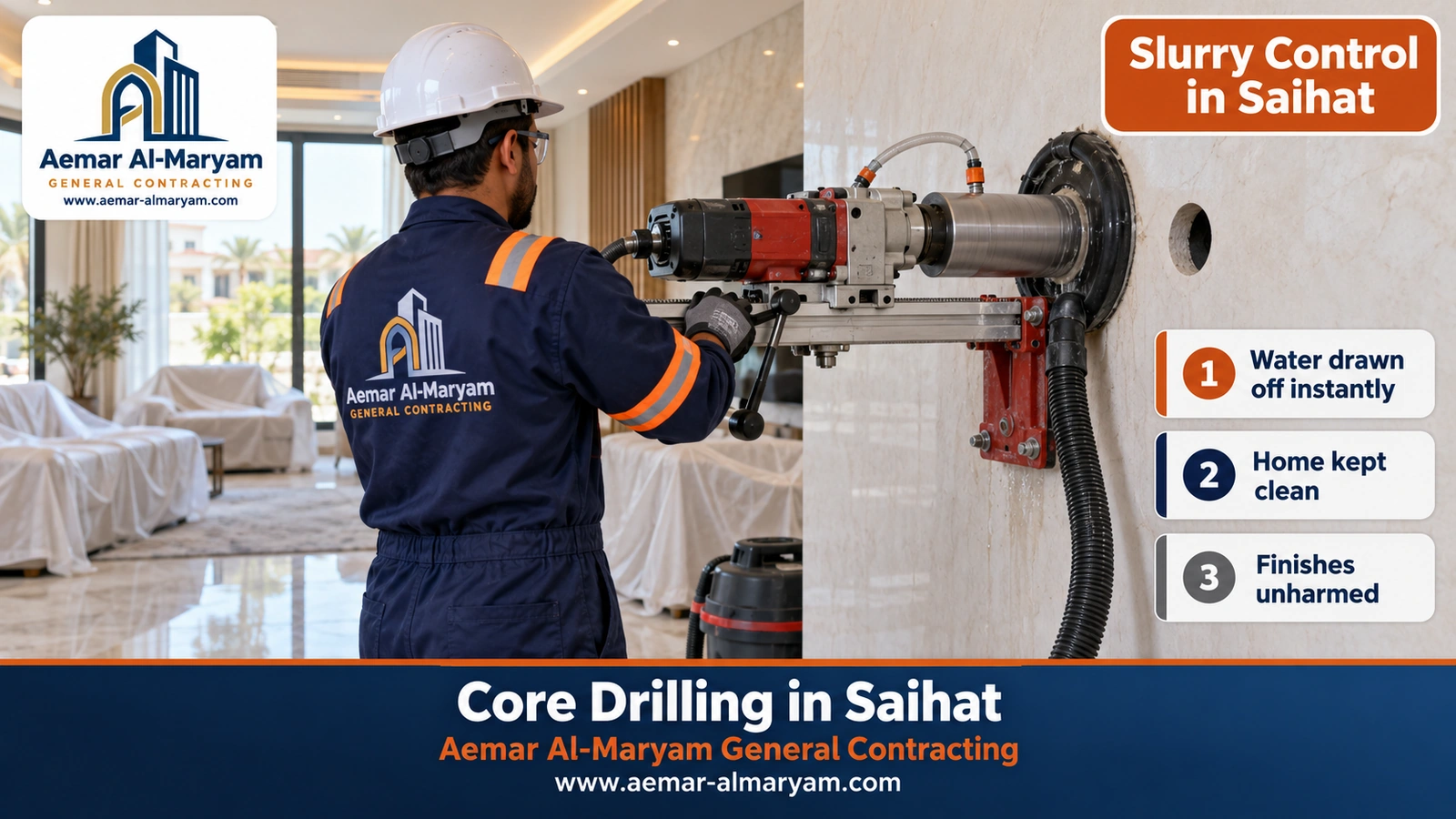
What we do before the bit starts turning
- 1Clear the path
we move furniture away from the wall and cover anything that cannot be moved with clean sheets. - 2Protect the floor
a waterproof cover goes under the hole position and along the route the equipment takes. - 3Fit the suction ring
we set it on the wall around the bit position, connect it to the wet vacuum and test it before drilling. - 4Set the water flow
we give the bit only what it needs to stay cool, because extra water just burdens the vacuum. - 5Prepare the other side
if the hole comes out into a room or an inner corridor, we cover that too, since the last of the water leaves from there.
When water is not an option at all
On an internal block wall, near an electrical board, or above timber and furniture that cannot be moved, we may drill dry with a suitable bit and extract the dust straight from the hole. It does not suit thick reinforced concrete, but on lighter walls it gives a clean result with no water at all.
When we finish, we wipe down the work area, lift the covers ourselves and take the concrete core and the slurry away with us. All you see after we leave is the hole.
Stitch drilling in Saihat: rectangular vent openings from overlapping cores
Stitch drilling means drilling a row of overlapping core holes along the outline of the shape you need, each circle cutting into the one before it, until the chain surrounds the rectangular opening and the block in the middle comes out in one piece. In Saihat we use it for ventilation duct openings in garages, kitchens and service rooms, when the opening is bigger than our largest bit or has to be rectangular to match the duct.
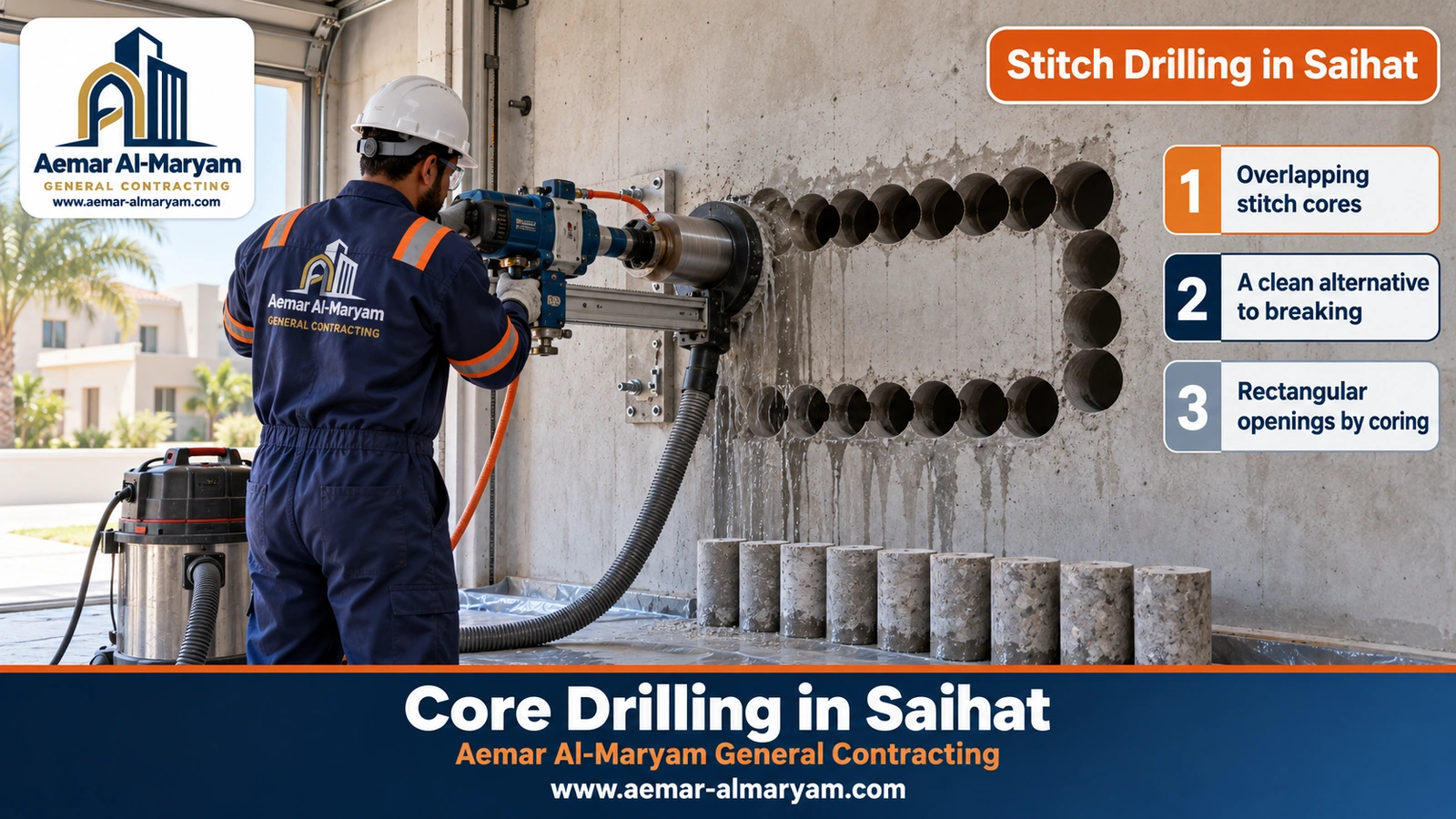
How we carry out stitch drilling, step by step
- 1Mark the rectangle
we draw the opening on the wall to the duct frame size and scan for bars along its whole length. - 2Space the circles
we work out how many cores are needed so each overlaps its neighbour enough to leave a continuous cut with no bridges. - 3Drill in order
corners first, then the sides, pulling each core as soon as it is free and laying it on the floor. - 4Remove the centre block
once the chain is complete the block is loose, so we support it and lift it out whole or in sections. - 5Dress the edges
we take off the ridges between circles so the frame sits flat.
When do we choose stitch drilling over a saw?
- Tight space: a wall saw needs room to fix its track, while a core rig works in a smaller area.
- Inside corners: cores do not run past the corner the way a saw blade can, so no overcuts show outside the opening.
- Thick walls: where the wall is deeper than the available saw blade can reach, a core bit goes further with extensions.
- Awkward positions: when the opening sits so close to a ceiling or floor that a saw track cannot be fixed.
On the other hand, a stitch-drilled edge is slightly scalloped by the circles. If the opening will stay visible we trim it with a saw or plaster, but where a duct frame or vent grille covers it, it disappears completely. Since the cost of stitch drilling depends on how many circles are needed, their diameter and the wall depth, there is no fixed figure before a site visit; photograph the wall, note the duct size and message 0547879578 for a first estimate.
⚠ Before any large rectangular opening
A large opening in a load-bearing wall, or in a slab that is part of the structure, needs a structural engineer’s review before work starts and can require a municipal permit applied for on Balady. Small vent openings in non-load-bearing walls usually do not.
Drilling holes in walls in Saihat
Drilling holes in walls in Saihat starts with two questions: what is the wall made of, and what is on the other side? Concrete gets wet drilling on a bolted stand with the suction running; block may be cut dry. The other side decides the protection: a bedroom, a kitchen full of cabinets, the street, or the neighbour’s flat.
On the outer walls of blocks near the sea we pay attention to the edge of the hole after drilling, because any gap around the pipe lets damp into the wall. So we leave the hole clean and ready for sealing, and the space around the pipe is closed with a sealant suited to outdoor use once the pipe is installed.
Ceiling core drilling in Saihat
Ceiling core drilling in Saihat is needed for drain pipes between floors, for water and power runs from the roof, and for ventilation ducts that exit from the top floor. We fix the rig on the floor above or on the ceiling below depending on the space, and set up something under the breakthrough point to catch the core and the water.
In finished villas there is often a suspended gypsum ceiling under the hole. We first cut a small, precise opening in it to see what lies above and to lead the water into a container, rather than letting the gypsum soak and spoil. If the hole is for an upstairs bathroom drain, we agree its position with the plumber so the pipe drops inside the gypsum or in a corner that is easy to box in.
In modern blocks we ask about the slab type before drilling. If it might be a post-tensioned slab, we do not drill it until it has been scanned with radar and an engineer has approved, because cutting a stressed tendon puts the slab and everyone below it at risk. More on protection before drilling follows in the scanning section.
Kitchen and bathroom core holes in Saihat
Kitchen and bathroom core holes in Saihat are mostly extractor holes to the open air and drain holes between floors for sinks, basins and toilets. In flats, bathroom fans are typically fitted to 100 mm ducting, so their hole is close to four inches, while cooker hoods mostly use 150 mm and get a hole of around six. A 110 mm soil pipe is given a slightly wider bore, roughly five inches.
In a finished kitchen the cabinets are usually already in, so we place the hole to come out between or above the wall units and protect the marble or worktop with thick covers. If the kitchen is new and the cabinets are not yet fitted, that is the best time to drill all its holes. Drain routes are coordinated with our plumbing works team so the fall is right from the start.
Core hole sizes in Saihat: a quick guide for flats and villas
| What passes through | Common diameter | Where we see it in Saihat |
|---|---|---|
| Split AC pipes with condensate | 65 mm or per manual | block facades and villa rooms |
| Cables and internet | 1–2 inches | between rooms and up to the roof |
| Bathroom extractor | about 4 inches | internal bathrooms in flats |
| 110 mm drain | 5-inch class | bathrooms and kitchens between floors |
| Kitchen extractor | about 6 inches | finished kitchens |
| Round ventilation duct | 8–12 inches | garages and service rooms |
| Rectangular vent opening | stitch drilling | garage walls and home storerooms |
To confirm: the final size comes from the appliance manual or the plumber, and we match it to the actual part before drilling.
Rebar scanning before drilling in Saihat
We scan the position of every hole in Saihat with a detector that locates the bars, electrical conduits and pipes inside the wall or slab, and slide the mark where needed so the bit misses the steel. In slabs that may contain stressed tendons, we use radar scanning to find their position and depth, since ground-penetrating radar is the standard non-destructive way to see tendons and bars before any coring.
- ✓Columns: never drilled, however small the hole.
- ✓Beams: drilled only when a structural engineer designs the hole; rerouting through the adjoining slab is normally the better choice.
- ✓Main bar in the path: we stop, show you where it is and agree with you to move the hole a few centimetres.
- ✓Buried power line: we mark its route on the wall before drilling and keep clear of it.
After drilling: sealing core holes in Saihat’s coastal climate
In Saihat, pulling the core out is only half the job on an external wall, because damp sea air and winter rain will exploit the smallest gap round a pipe. We therefore leave the hole clean and free of slurry, and once the pipe is fitted, the gap is packed from inside with non-shrink mortar or a suitable filler and sealed on the outside with a sun-resistant sealant, shaped with a slight fall to shed water away from the hole.
- Roof holes: any hole through the roof slab passes through the waterproofing, so a waterproofing collar is bonded into the existing layer all round it; see waterproofing and insulation.
- Unwanted or misplaced holes: filled with non-shrink mortar in stages until full, then rendered and painted with the wall.
- Cut bar ends: if a bar is cut in an outside wall, we cover its end with mortar so it is not left exposed to damp.
Core drilling prices in Saihat
Core drilling prices in Saihat are the same as ours in Dammam because the distance is short, starting from SAR 90 for a small hole. The figures below are estimates until inspection and agreement:
| Hole type | Price starts from | Notes |
|---|---|---|
| AC hole, or any core to roughly four inches | SAR 90 | each, in an ordinary house wall |
| 5–6 inch hole | SAR 140 | drains, kitchen extractors |
| 8 inch hole | SAR 230 | ducts, small flues |
| 10–12 inch hole | SAR 320 | large ventilation ducts |
| Stitch drilling, or larger than 12 inches | by inspection | priced once we see your photos and sizes on 0547879578 |
Note: prices are estimates until inspection and agreement; scaffolding for apartment blocks is priced by height and number of holes.
What changes the price in Saihat?
- Working on a scaffold or at height, compared with drilling from inside a room.
- Extra protection in fully finished homes, such as continuous suction and covering large floor areas.
- Wall thickness and the amount of rebar.
- The number of holes: the more in one visit, the lower the price per hole.
Further price items appear on the prices page.
Core drilling or concrete cutting in Saihat: where coring stops
Coring stops being the right tool in Saihat when the opening becomes a door, a window or a stair opening, or when a rectangle is so large that the number of circles would cost more than sawing. That is when a diamond wall saw or floor saw takes over, and we may still core the corners first.
Sawing work in Saihat, from new doorways to slab and boundary-wall cutting, is covered in concrete cutting in Saihat and on our concrete cutting service page. If the hole is part of a wider makeover of the house, see renovation contractor in Saihat.
Core drilling contractor in Saihat: what good work looks like
You can recognise good core drilling in Saihat by two things: your floor looks the same after the drilling as it did before, and the holes on the facade sit on one line. Ask the contractor before you agree:
- Do you have a suction ring and a wet vacuum, or will you just put a cloth under the hole?
- How will you work on the building facade, scaffold or ladder, and who erects the scaffold?
- Will you scan for bars and services before drilling?
- Can you make a rectangular opening by stitch drilling if needed?
- Do you price each hole by its diameter, and what is included in that figure?
Does a core hole in Saihat need an engineer or a permit?
Small service holes for AC, extractors and drains do not normally change the structure once their position has been scanned, so in most cases they need neither an engineer nor a permit. A large opening in a load-bearing wall, any hole in a beam, several closely spaced holes in a slab, or coring of any kind through a stressed (post-tensioned) slab counts as a structural change. That needs an engineering office and may require a renovation or modification permit through the Balady platform.
In rented blocks or buildings with several owners, a hole in the facade or in a slab between two flats needs the owner’s or owners’ association’s agreement before work starts. We drill once you have confirmed that, because a dispute after the hole is made has no easy fix.
Common mistakes with AC holes and finished homes in Saihat
- No fall on the hole: drilled dead level or sloping inwards, so condensate or rain runs back into the room.
- Different heights on one facade: each technician drills somewhere else, the facade looks random and brackets are hard to fit.
- Wet drilling with no suction: slurry runs down the painted wall, reaches the marble and dries in the joints.
- Breaking out a rectangle with a hammer: plaster and tiles crack around it, and the repair grows bigger than the opening.
- No outside seal: a gap around the pipe in an outer wall near the sea lets damp into the wall.
All of these are avoided with simple steps before drilling: agree the height and fall, keep the suction running, core instead of breaking, and seal after fitting. If you already have an old hole made with one of these mistakes, it can be closed with non-shrink mortar and a correct new hole drilled beside it.
How to order core drilling in Saihat
- 1Photos of the spot
the full facade for an apartment block, or the wall from inside and outside for a hole in a finished home. - 2Number and purpose
how many holes and what for: AC, extractor, drain or ventilation, with the unit model or pipe diameter. - 3Floor and finishes
is the floor marble or parquet, and is the furniture in place? - 4District and timing
your district in Saihat and the time that suits you and the building’s residents. - 5Handover
you check the diameter, position, fall and cleanliness before we leave.
One WhatsApp message to 0547879578 with these points is enough; if you prefer, use the inspection booking page instead.
Why Aemar Al-Maryam for core drilling in Saihat?
■ Close by
we are based in Dammam, so Saihat visits are quick to arrange.
■ Clean finished homes
suction ring, wet vacuum and covers, and we take the waste with us.
■ Orderly facades
one height and one fall for every AC hole in the block.
■ Answers for non-round openings
stitch drilling for rectangular vent openings.
Finished jobs are pictured on the projects page; the core drilling service page lists everything we do, and core drilling in Dammam goes deeper into diameters and machines.
Where in Saihat we drill
Our crew covers every part of Saihat, old and new. Districts we visit often include:
We also reach nearby Anak and Qatif; see core drilling in Qatif for the rest of the governorate.
A clean hole in your home, or AC holes for a whole block?
Photograph the wall or the facade, count the holes and message 0547879578; we answer with a price estimate and the earliest slot in your part of Saihat.
Article tags