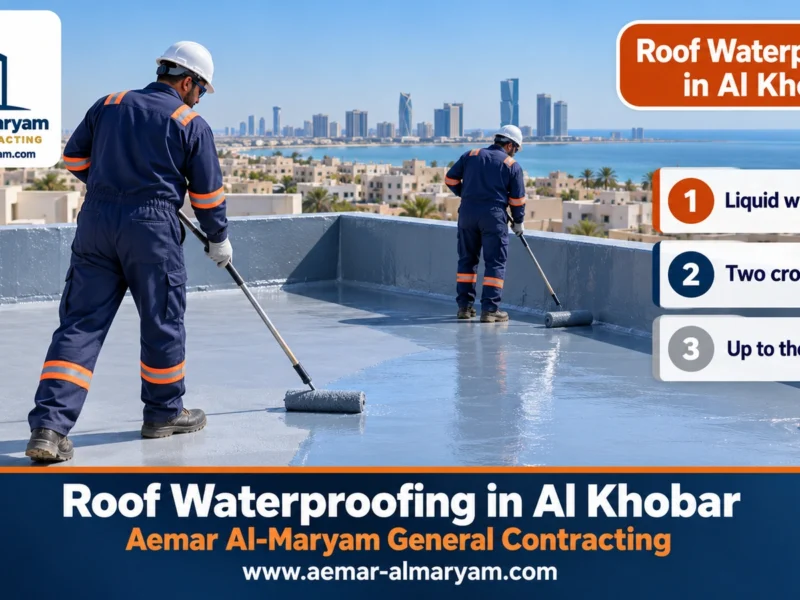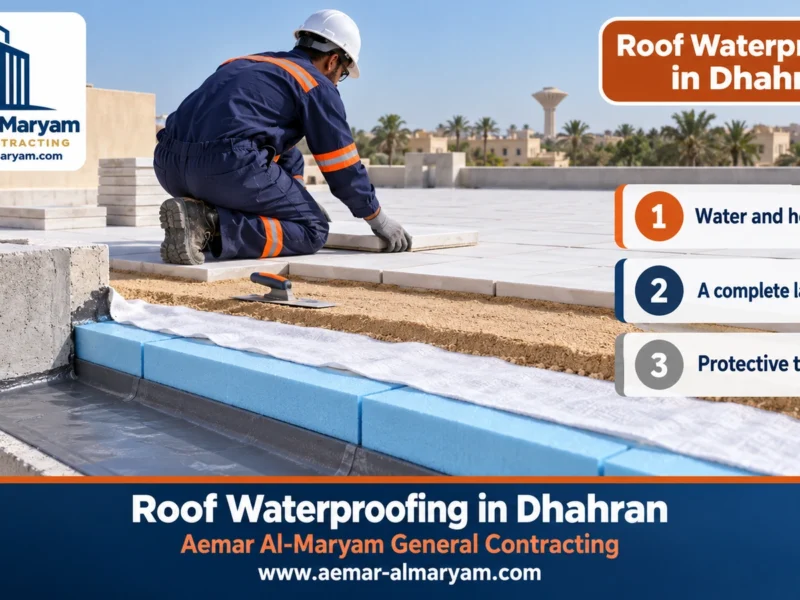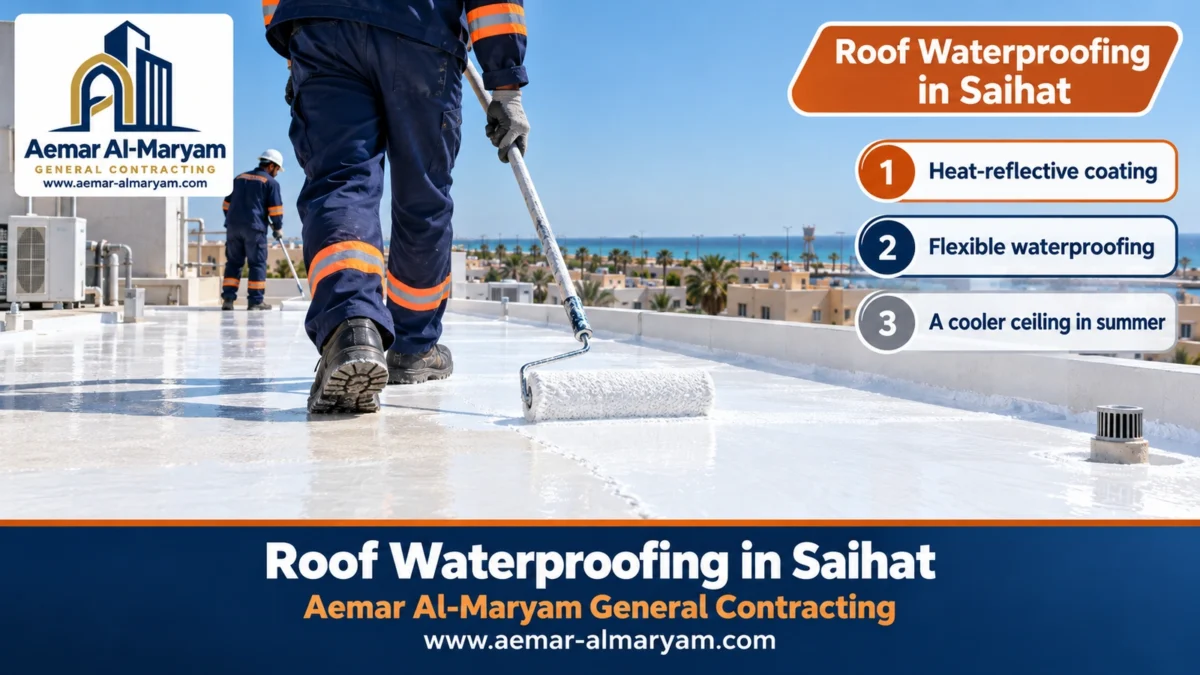
Roof waterproofing in Saihat, in most of the jobs we are called for, means protecting a whole family home from three sources of water: rain and washing on the roof, bathrooms in use all day long, and the rooftop and underground tanks. Saihat is a residential coastal town between Dammam and Qatif, mostly family houses of two or three storeys plus apartment buildings, and the air is humid for much of the year. Aemar Al-Maryam General Contracting waterproofs roofs, bathrooms and tanks here and traces leaks. Bathroom waterproofing before tiling starts at SAR 26 per m², tank lining at SAR 14 and roof membrane at SAR 13, estimates confirmed by inspection and agreement. Phone and WhatsApp: 0547879578.
Because the house is lived in during most of our work here, how we work matters as much as what we use: when the water goes off, which bathroom stays usable, and how dust and smells are kept out of the rooms. So this page starts with what matters in Saihat family homes, bathrooms and tanks, then moves to the roof and the materials that cope with coastal humidity, and ends with prices, testing and how to order.
What we do in Saihat
- Bathrooms: flexible membrane before tiling from SAR 26/m², full renewal from SAR 2,300, one bathroom at a time in an occupied home.
- Tanks: cleaning and lining with drinking-water-safe materials: cementitious from SAR 14/m², epoxy from SAR 46.
- Roofs: SAR 13 membrane, SAR 23 foam or reflective acrylic, SAR 42 spray foam with a protective top layer covering water and heat, SAR 46 for the three-layer system (membrane, insulation boards, protection tiles).
- Tiled roofs and terraces: a clear sealer without breaking, from SAR 10/m², when the tiles are sound.
- Leak detection: from SAR 140 for a bathroom or kitchen.
- To order: photos of the bathroom or roof on WhatsApp 0547879578.
Roof Waterproofing in Saihat: What Coastal Humidity Does to a Roof
Roof waterproofing in Saihat has to reckon with moisture before heat. Air off the sea carries humidity and fine salt, so the roof is wet with dew on winter nights and mornings, and the concrete stays damp inside for hours after its surface looks dry. Prime or spray foam on damp concrete and the moisture is sealed in; the midday sun then expands it and you get blisters and lifting a few weeks later.
So we check the slab with a moisture meter before priming, wait for the morning dew to burn off before starting, and choose materials that tolerate high humidity. We also look at whatever rusts on the roof: steel tank stands, AC frames and the bolts holding them, because rust around them cracks the waterproofing and opens a path for water. On an exposed roof we prefer light, reflective finishes that cut ceiling heat instead of soaking up the sun.
■ Morning dew
No coating or spraying until the roof is dry and its moisture has been measured.
■ Salt in the air
The roof is washed before waterproofing to remove the salt film that weakens adhesion.
■ Steel stands
Rust is treated and the waterproofing reinforced around every leg.
■ Heat
A light reflective top layer, or insulation boards under the tiles.
Laundry, AC Drips and Daily Use: Roofs That Work Hard
A family roof in Saihat is not an empty space: it has washing lines, rugs are sometimes washed up there, and AC condensate drips onto it all summer. That means water reaches the roof even in months with no rain, and the family walks across the waterproofing every day. So at the inspection we ask how the roof is used before choosing a material, because a thin exposed coat will not stand rugs being dragged over it or the metal feet of drying racks.
The fixes are simple if planned from the start: run the AC drains through small pipes to the nearest roof drain instead of letting them drip on one spot, mark out an area for laundry and walking that gets pavers or a tougher coat, and put rubber pads under rack feet so they do not puncture the layer. If laundry is done on the roof a lot, the three-layer system under tiles is the better choice, since it keeps all the waterproofing beneath a surface you can walk on freely.
Apartment Building Roofs in Saihat
In an apartment building the roof is shared, but the person who pays for its failure is usually the top-floor resident alone: stains on the ceiling, hot rooms and paint that peels every summer. We are often asked by a top-floor tenant in Saihat whether they can waterproof just the part above their flat. The honest answer is that partial work is possible if the falls separate that part from the rest of the roof; if water runs from one side to the other, it is better to agree with the other owners to do the whole roof.
We help with a photo report on the whole roof, its area and the cost of each option, for the resident to take to the owners’ association or landlord. On buildings we also plan around the many tanks and their pipes, and make sure people can still reach the tanks after waterproofing without walking on the layer every day, by adding a protected walkway or pavers on top.
Bathroom Waterproofing in Saihat: The Right Way for a Family Home
In Saihat family homes, bathroom waterproofing tops the list of requests, because a bathroom shared by a large household is in use all day and any weakness shows quickly on the ceiling below or the wall next to a bedroom. Done properly, it is one flexible sheet of waterproofing across the floor and turned up the walls before any tile is laid, water-tested before the tiles go down, priced from SAR 26 per m².
Signs That a Bathroom Membrane Has Failed
- ✓A stain on the ceiling under the bathroom: growing after showers or after the floor is washed.
- ✓Grout lines that stay dark: even hours after the bathroom has dried.
- ✓A wooden door frame swelling at the bottom: water travelling under the tiles towards the threshold.
- ✓A damp smell in the adjoining wall: especially behind a wardrobe in the next room.
- ✓Paint flaking in the corridor outside: at the bottom of the wall near the door.
Bathroom Waterproofing Steps Before Tiling
- 1Strip back to the slab
Remove old tiles and the layers beneath down to the floor slab, and check the pipes while they are exposed. - 2Screed to the drain
A levelling bed laid to fall towards the floor drain so water does not sit in the corners. - 3Primer and reinforcement
Flexible tape where floor meets wall, around the drain and at pipe outlets. - 4Flexible membrane
Applied twice across the floor and carried up each wall, reaching 1,800 mm where the shower is and 150 mm above the rim of any bath, following a well-known international wet-area reference. - 5Water test
We plug the drain and leave water on the membrane for at least a full day, watching the ceiling below. - 6Protection then tiles
A protective screed over the membrane, then tiles, with no screws or fixings piercing the waterproofing.
Can a Bathroom Be Waterproofed Over Existing Tiles?
In limited cases. If the tiles are firm and water is getting through worn grout or around the drain and shower mixer, we rake out the old grout and refill with a water-resistant compound, seal around the outlets and roll a clear coat over the floor. If the membrane under the tiles has failed or was never there, a surface coat only delays the problem; the honest fix is to open the bathroom and waterproof it again. What decides between the two is leak detection, not guesswork.
One bathroom at a time
In an occupied house we finish and test one bathroom before starting the next, so the family always has one to use. If there is only one bathroom, we work to a tight schedule and tell you in advance which days it will be out of use.
If the bathroom is old and needs a complete renewal with stripping, plumbing, waterproofing and tiling, it starts at SAR 2,300 per bathroom; details are on bathroom and kitchen renovation.
Ceiling Mould in the Bathroom: Steam, Not a Leak
Not every damp patch in a bathroom is a leak. In Saihat homes with big families a bathroom fills with steam several times a day, and with no working extractor fan or window to open, the steam condenses on the ceiling and upper walls, leaving black mould and paint peeling at the top rather than the bottom. The cure is ventilation, not waterproofing: an extractor sized for the room, running during and after showers, and moisture-resistant paint on the ceiling. We mention this because some callers were about to pay for waterproofing they did not need.
Kitchen and Laundry Area Waterproofing
The kitchen and the washing machine corner need the same treatment to a lighter degree: a membrane on the floor turning a little way up the walls, with extra care at the machine’s outlet and drain, since one slipped hose is enough to flood the floor. In upper apartments in Saihat this protects the neighbour’s ceiling below from a stain they cannot trace.
Water Tank Waterproofing in Saihat: Rooftop and Underground
Water tank waterproofing in Saihat means cleaning, drying and repairing the tank and then lining it inside with a material that stops seepage and is fit for drinking water. Family homes usually have two: an underground tank that receives the supply and a rooftop tank that feeds the house. Cementitious lining for a concrete tank begins at SAR 14 per m² and certified drinking-water epoxy at SAR 46; a tank leak inspection on its own begins at SAR 140.
The Rooftop Tank
A concrete rooftop tank combines two problems: seepage from inside into the ceiling of the room below, and a roof membrane interrupted at its base. We treat it as one unit: an inner lining, then external waterproofing of its base joined into the roof waterproofing around it without a gap. If the tank is plastic on a steel stand, the attention shifts to the stand’s legs, their rust and the waterproofing beneath them.
The Underground Tank
We inspect an underground tank empty and dry, watch whether water enters while it stands empty, and repair its corners and cracks before lining. We work inside with constant ventilation through the hatch and suitable respirators, as it is a confined space. If the concrete is new we wait until it has matured before lining, a period one epoxy maker puts at 28 days.
Looking After the Tank Afterwards
A good lining makes cleaning easier but does not remove the need for it. We advise cleaning the tank regularly with products that will not scratch the lining, checking the lid so dust and insects stay out, and keeping the float valve sound so water does not overflow onto the roof or around the underground hatch. If you notice water going missing that usage does not explain, or damp around the underground tank in the courtyard, that is a sign of a leak worth checking before it reaches the foundations.
Do not fill the tank early
Every lining has a cure time before it may touch water, stated on its data sheet; one drinking-water epoxy specifies 7 days at about 21 °C. Filling early spoils the lining and can leave a taste in the water. We help you arrange another source for those days and flush the tank before use.
Roof Insulation Materials in Saihat: Types and Which Suits Your Roof
Roof insulation materials in Saihat are chosen by what sits on the roof and what will happen to it: will it stay exposed or be tiled? Does it carry many tanks and AC units? Is it used for sitting or for laundry? These are the types we install:
| Material | What it gives | Roof it suits in Saihat | From |
|---|---|---|---|
| Bitumen membrane | Keeps water out | A roof to be covered with protection tiles | SAR 13/m² |
| Polystyrene boards | Cuts heat | Under tiles with the membrane | SAR 14/m² |
| Cementitious coating | Keeps water out | Under tiles, in bathrooms and tanks | SAR 15/m² |
| Reflective acrylic | Water protection and sun reflection | Exposed building or house roof | SAR 23/m² |
| Polyurethane foam | Heat insulation, partial water resistance | Roof crowded with tanks and AC units | SAR 23/m² |
| Spray foam with a protective top layer | Water and heat together | Exposed roof that needs both | SAR 42/m² |
| Three-layer system | Water and heat together | Membrane, then insulation boards, then protection tiles | SAR 46/m² |
| Polyurea | Hard, walkable membrane | Roofs with heavy daily use | SAR 55/m² |
Starting prices are estimates fixed after inspecting the roof and agreeing.
Waterproofing in Saihat
Waterproofing in Saihat is an unbroken layer that stops rain and washing water reaching the roof slab, rises up the parapets and runs into the drains. In a coastal climate we want it flexible, because the roof expands at midday and contracts at night, and a rigid layer cracks with that movement.
Bitumen Membrane in Saihat
Membrane is an economical choice for large, simple roofs that will be tiled, from SAR 13 per m². It is torched onto a completely dry surface, which in Saihat means working after the dew has gone and the moisture has been measured; the rolls overlap by the amount the product sheet sets and turn up the parapet at least 150 mm above the finished face. If it stays exposed it must have a reflective coat on top.
Liquid Coatings and Reflective White Roofs
Reflective white acrylic is rolled onto the roof in two or more coats, sealing it without joints and reflecting a large share of the sun’s rays. It suits exposed apartment roofs in Saihat and starts from SAR 23 per m². Liquid polyurethane is more flexible, polyurea is harder and takes foot traffic, and cementitious coatings go under tiles. We recoat the reflective layer whenever it fades or shows fine crazing, since it is the layer taking the sun and salt.
Heat Insulation and Spray Foam in Saihat: Price per m²
Heat insulation in Saihat eases the heat that makes top-floor rooms the hottest in the house, using polystyrene boards under tiles or sprayed foam. Spray foam in Saihat is priced from SAR 23 per m² for a standard layer; covered with a protective top layer so it resists water too, the starting point is SAR 42. Foam roofing specifications in print want it at roughly 45–48 kilograms per cubic metre and never thinner than 25 mm, with the foam coated on the day it is sprayed. That matters even more in Saihat, where one night of dew and salt on bare foam damages its surface.
Building new?
Heat insulation is required in new buildings, and the Saudi residential building code (SBC 602) sets an upper limit on the heat a roof may pass, which differs by climate zone; the engineer picks the insulation thickness to meet it. If you are building, get insulation into the drawings rather than after handover.
Tiled Roof Waterproofing in Saihat Without Removing the Tiles
Sealing a tiled roof or terrace in Saihat while keeping its tiles works when they are still bonded and the water is finding its way in through the grout lines. We wash the tiles, clear the joints, let them dry, then roll on a clear sealer that soaks into the joints and closes them, from SAR 10 per m². We tap the tiles first; anything that rings hollow cannot be treated this way.
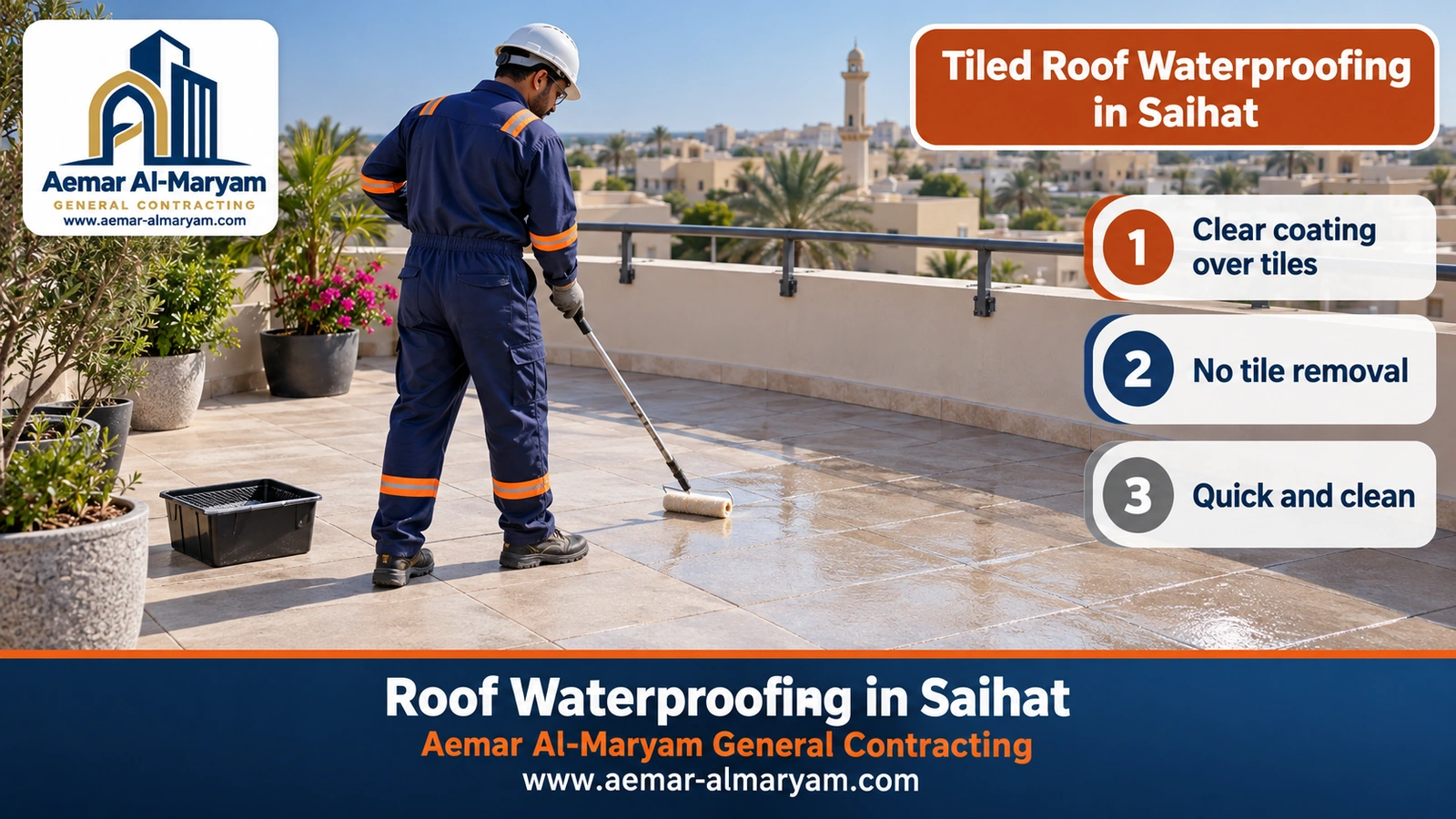
Many terraces in Saihat homes carry plant pots and planters, and these are among the most common causes of damp we see: irrigation water sits under a pot for days, and a planter built against the parapet keeps its base constantly wet. Before waterproofing we move the pots and treat beneath them, and we advise feet that lift pots slightly off the tiles, and a lined planter with its own drain.
Best Roof Insulation Type for the Humid Saihat Climate
The best roof insulation for the Saihat climate is one that handles humidity, salt and thermal movement without lifting, and suits how the roof is used. Since cases differ, here is a summary of our choices:
| Situation | What we suggest | Why |
|---|---|---|
| Exposed apartment building roof | White reflective acrylic, or foam under a protective layer | No joints and it reflects the sun |
| House roof to be tiled | Three-layer system under tiles | Tiles shield the waterproofing from sun and salt |
| Roof crowded with tanks and AC units | Foam with reinforcement around every stand | Wraps around legs without cutting |
| Sound tiled terrace | Clear sealer in the joints | Keeps the tiles |
| Bathroom or kitchen | Flexible membrane under the tiles | Takes constant water and movement |
Remember that damp inside the house is sometimes nothing to do with waterproofing: condensation on the ceiling of a room chilled by its AC under a hot roof, or steam from a bathroom with no fan. We tell these apart from the moisture readings, where the stain is and when it appears, so you do not pay for waterproofing that will not fix a ventilation problem.
Flood Testing in Saihat: Checking Before the Waterproofing Is Covered
Flood testing in Saihat means leaving water on the new waterproofing for a set time and watching the ceiling beneath before protection or tiles go on. On roofs we hold the water between 24 and 72 hours, as the American guide ASTM D5957 sets, at a depth of 2.5 to 10 cm over the lowest part of the roof, and go no deeper, because every 10 cm puts roughly 100 kg on each square metre of slab.
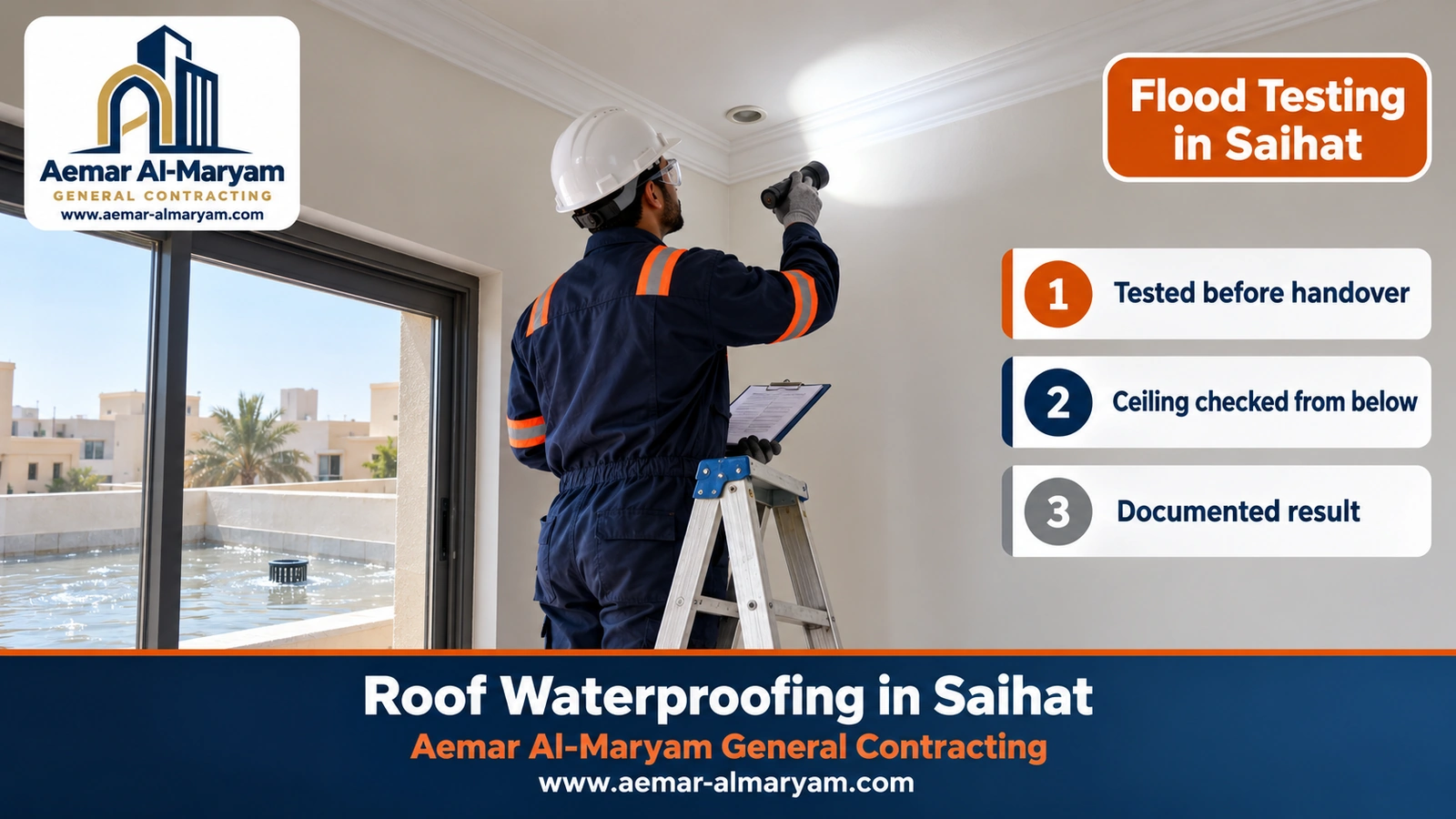
- 1Plug the drains temporarily
With easily removed stoppers, and a water-level mark on the parapet. - 2Flood
Clean water up to the required depth, no more. - 3Watch from inside
We go to the top floor with a lamp and check the corners, around the drains and under the tank. - 4Final reading
If the level drops more than evaporation explains, or damp appears, we find the spot, repair it and test again. - 5Drain and protect
Open the drains gradually, then the protection layer or tiles.
Leak Detection in Saihat
Leak detection in Saihat traces where the water is coming from while the tiles and plaster stay intact. Fees open at SAR 140 for a single wet room, then SAR 200 for an apartment, SAR 280 for a house or a full storey, and SAR 140 for a tank. We take moisture readings at many points, use a thermal camera and confirm what it shows by measurement, pressure-test the hot and cold lines, and run targeted water tests on one drain or one part of the roof. If the source is a pipe, the repair falls under plumbing works, and repairs in general are priced on inspection.
Before calling, try a simple check: close every tap and the rooftop tank’s fill valve, then watch the water meter for thirty minutes. If the dial creeps with every outlet shut, water is escaping from one of the pressurised lines, and a photo of the meter at the start and the end saves us half the testing.
Roof Waterproofing Company in Saihat: What Matters in an Occupied Home
The right roof waterproofing company in Saihat does the waterproofing well and respects the house and the people in it at the same time. Besides a written specification and a water test, ask about these:
- ✓Planning: which bathroom will be out of use and when, when the water will be off, and how many days each part takes.
- ✓Ventilation and smells: some materials smell while being applied; we ventilate, close interior doors, and time the work around children and elderly relatives.
- ✓Protecting the house: covers on floors and stairs, and a fixed route for the crew from the door to the roof.
- ✓Daily clean-up: no debris left on the roof or in the courtyard at the end of the day.
- ✓Clear pricing: what is and is not included, such as tiles, plumbing or removing old waterproofing.
Roof Waterproofing Prices in Saihat
We charge Saihat customers exactly what we charge in Dammam; the town is that close. The table puts bathroom, tank and roof items together, since they are often ordered together for one house:
| Item | From | Typically ordered in Saihat for |
|---|---|---|
| Bathroom membrane: floor and walls before tiling | SAR 26/m² | Family-home bathrooms |
| Complete bathroom renewal | SAR 2,300 per bathroom | Older bathrooms |
| Cementitious tank lining | SAR 14/m² | Underground and rooftop tanks |
| Epoxy lining approved for potable water | SAR 46/m² | A smoother, easier-to-clean finish |
| Clear sealer in tile joints | SAR 10/m² | Tiled terraces and roofs |
| Bitumen membrane | SAR 13/m² | A roof to be tiled |
| Polystyrene boards | SAR 14/m² | Within the three-layer system |
| Cementitious coating | SAR 15/m² | Under tiles |
| White reflective acrylic | SAR 23/m² | Exposed building roofs |
| Foam, standard layer | SAR 23/m² | Crowded roofs |
| Spray foam with a protective top layer covering water and heat | SAR 42/m² | Exposed roof |
| Three-layer system: membrane at the bottom, heat boards above, tiles on top | SAR 46/m² | A roof to be tiled and used |
| Polyurea | SAR 55/m² | Walkways and heavily used roofs |
| Leak tracing: one wet room / apartment / house / tank | 140 · 200 · 280 · 140 (SAR) | Before any repair |
| Old-layer removal and screed, foundations, repairs after detection | On inspection | Case by case |
Figures are estimates until inspection and agreement, set by the condition, area, floor, materials and access. Our full list is on the prices page.
Illustration: a 200 m² Roof and Two Bathrooms in a Saihat House
A family house in Saihat with a 200 m² roof and two bathrooms, each about 20 m² including walls up to the membrane height. Figures for illustration only: waterproofing the roof with reflective acrylic 23 × 200 = SAR 4,600, or foam under a protective layer 42 × 200 = SAR 8,400, or the three-layer system under tiles 46 × 200 = SAR 9,200. Waterproofing both bathrooms 26 × 40 = SAR 1,040 before tiles and plumbing, or 2,300 × 2 = SAR 4,600 as a starting figure if both need full renewal. Removing old waterproofing and a screed to falls are added after inspection where needed.
How the Work Runs in Saihat
- 1Photos and a description
The bathroom, roof or tank, and what you have noticed and when. - 2Inspection visit
Finding the water source, measuring moisture, checking the roof, bathrooms and tanks. - 3Quote and schedule
Materials, thicknesses and areas, with a timetable showing which part of the house is out of use and when. - 4Preparation and protection
Covering floors and stairs, then cleaning, stripping and repairs. - 5Waterproofing
During dry hours, layer by layer. - 6Testing
Roof flooded for 24 to 72 hours; bathroom under water for at least a day. - 7Handover
Tiles or the top coat go on, we tidy up, and you get a short care routine.
How Long Waterproofing Lasts on the Coast, and Mistakes That Shorten It
Waterproofing in Saihat lasts longest with maintenance more than anything else. Published work on sprayed foam roofs reports lives beyond thirty years where the top layer is renewed every fifteen years or so, and in a coastal climate we check the reflective layer every year or two. These mistakes come up often:
- ✓Tiling a bathroom without a water test, so the leak is found on the neighbour’s or the ground-floor ceiling.
- ✓Spraying foam or priming a roof still wet with dew.
- ✓Fixing a new tank stand or AC unit with bolts through the waterproofing without reinforcing it again.
- ✓Filling the tank before the lining has cured.
- ✓Leaving plant pots straight on the tiles for years.
If a leak has marked walls and ceilings, painting follows once they are dry; see painting in Saihat. For wider renewal read renovation contractor in Saihat, and if you are planning a roof room, waterproofing starts with the build, as in annex and majlis building in Saihat.
Helpful links
Saihat Districts We Serve
Being a short drive from Dammam, Saihat costs you nothing extra in travel, and we keep to appointment times. Districts we work in include:
For everything else we do locally, open our Saihat area page.
How to Order Waterproofing in Saihat
Send whatever applies to your job on WhatsApp and we will reply with an initial view and price, then a visit time:
- ✓For a bathroom: a photo of any ceiling stain below it, photos of the floor, grout and drain, the room size, and whether the house has another bathroom.
- ✓For a tank: underground or rooftop, rough dimensions, and whether you notice water going missing or damp around it.
- ✓For a roof: photos of the whole roof with drains, tanks and AC units, its area, and whether it is tiled.
- ✓In general: your district and the times that suit the family.
Or use the price request form on the site.
A leaking bathroom or a seeping roof in Saihat?
Send the photos now; we will book a visit that suits your family’s routine and put the fix and its cost in writing before we start.
Tags