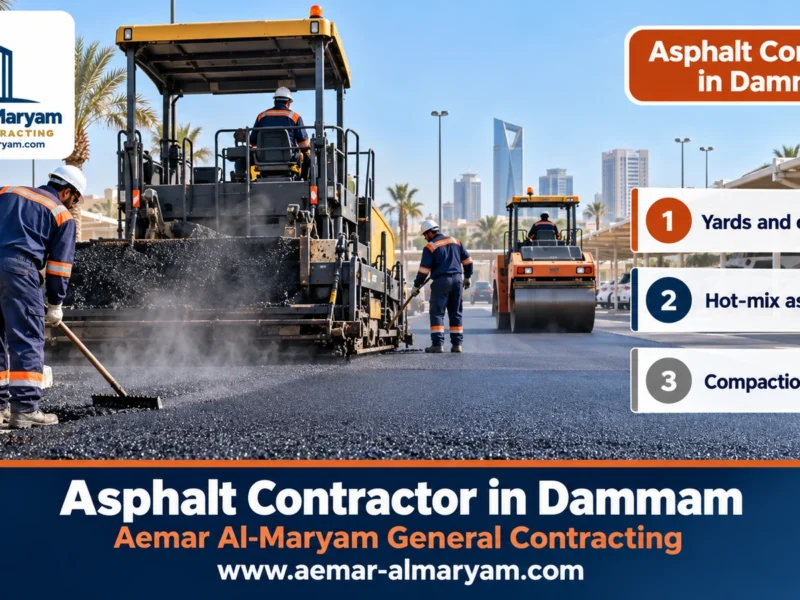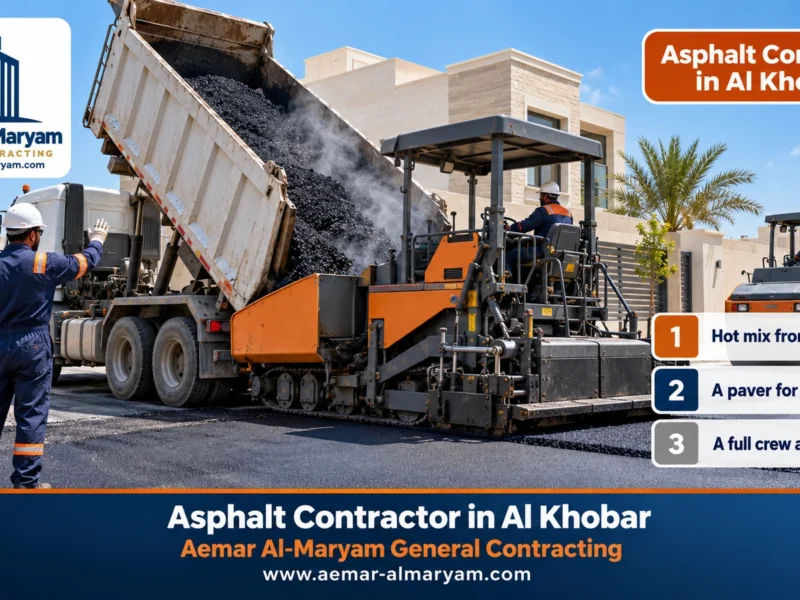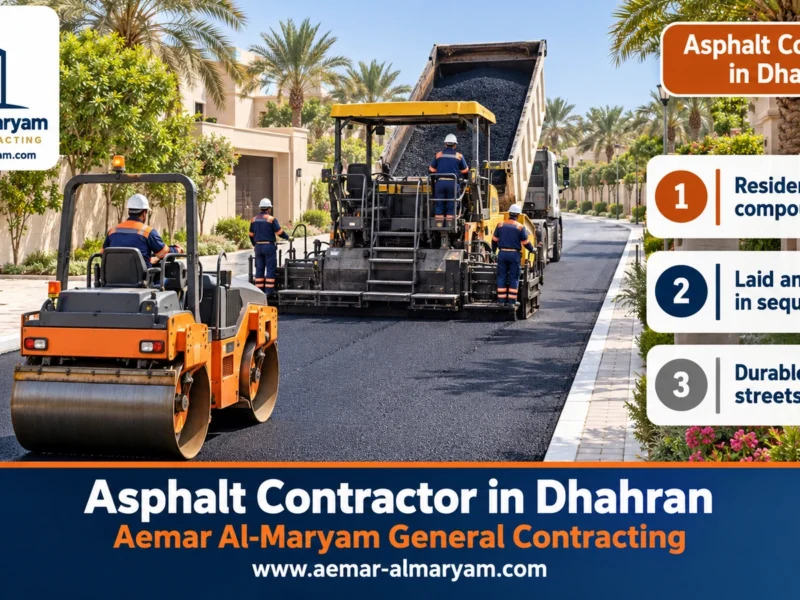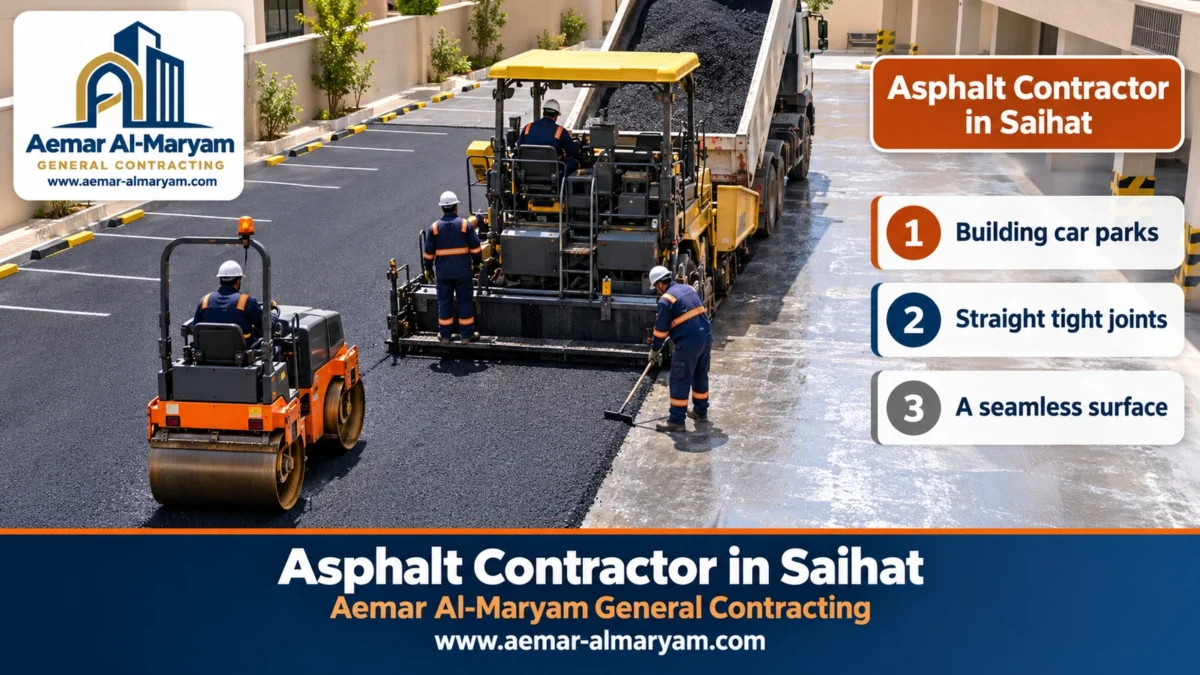
An asphalt contractor in Saihat is usually called for the car park of a new residential building whose tenants are tired of dust, for a villa driveway broken in scattered patches, or for a yard where rainwater stands for days. Car parks are paved by our Aemar Al-Maryam General Contracting crews in two clear stages: prime coat on the base and a day’s wait, then laying in adjacent strips with straight joints. We patch potholes inside a square cut made with a walk-behind floor saw, and we fix the gullies and set the falls before any asphalt goes down. Starting rates run from SAR 37 per m² where a sound base exists to SAR 74 per m² where we begin on raw ground, each one an estimate until inspection and agreement. Ring or message 0547879578.
Saihat is a coastal city in Qatif Governorate, about 14 km from Dammam, where residential buildings and villas in the newer districts grow side by side with older family houses. So paving work here splits between building car parks that need a tidy finish that looks right from the balconies, and house yards that need clean patching and drainage that actually works. This guide starts with the car park, moves on to water, and ends with patching.
What to know before paving in Saihat
- Building car parks: prime coat on the base, at least 24 hours’ wait, then strips laid with straight longitudinal joints, then bay marking.
- Patching: a chalk rectangle around the damage, straight cuts with a water-cooled floor saw, then tack coat, hot mix and rolling.
- Water: a fall of no less than about 1.5 percent on car parks, and gullies fixed at their level before the asphalt.
- Prices: from SAR 37 per m² (sound base) and 74 (full build), with 7 cm at 41, modified mix at 55, a stop-gap cold patch at 46 and planing plus a new surface at 38; transport set at inspection.
- Districts: from old Ad-Deerah to Al-Khaleej, Ad-Danah, Qurtubah, Al-Kawthar and the rest of the city.
- Contact: the car park layout or photos on WhatsApp 0547879578.
Paving building car parks in Saihat: prime first, then strips
Residents see their building’s car park from above every day, so every wandering line and every spot where water stands is obvious. That is why we treat car park paving in Saihat as staged work that cannot be shortened: preparing and compacting the base to level, spraying the prime coat, a day’s wait, laying with the paver in strips, then marking once the asphalt has cooled.
Why we wait a full day after the prime coat
MC prime is a thinned bituminous liquid; the base receives somewhere from 0.65 up to 1.75 L of it on each square metre, the open-textured spots taking more. Its job is to work into the top of the stone, bind and close it, and then become the surface the asphalt grips. That penetration takes time; the technical reference we follow asks for at least 24 hours, and until the base has absorbed the material. In Saihat’s coastal humidity drying can take longer, so we do not pave until we can see the surface has drunk in the prime and no glossy liquid is left on it.
The mistake shows up in two ways: someone sprays a light tack mist instead of a prime because it is quicker, or someone primes in the morning and paves in the afternoon. Either way the asphalt slowly lets go of the base, water gets between them, and cracks start at the edges.
A straight longitudinal joint between strips
A paver lays a mat of a set width, so a car park wider than that is laid in adjacent strips, with a longitudinal joint between each pair. Done carelessly, that joint is the weakest line in the car park: it opens over time, lets water in and ravels. So we handle it carefully:
- ✓We plan the direction of the strips before paving so they run with the traffic as far as possible and joints do not fall in the regular wheel path.
- ✓The first strip is guided by a taut string line so its edge is perfectly straight and becomes the reference for the rest.
- ✓If the edge of the previous strip has cooled, we cut it back vertically to full-thickness asphalt and coat its face with tack.
- ✓The new strip is laid slightly overlapping the old one, the excess is pushed back off the edge, and the joint zone is rolled until both strips sit level.
- ✓After rolling we check the joint with a straightedge so neither side stands above the other.
Transverse joints and the start of each working day
When paving stops at the end of a day or while waiting for a truck, the end of the strip cools and becomes a transverse joint. Next morning we do not pave over the cold tapered end; we cut it off in a straight line square to the paving direction until we reach full thickness, tack its face, and start laying from there. That way the car park does not end up with a little bump wherever the work paused.
Bay marking and accessible parking
Once the asphalt has cooled we mark out bays, arrows and pedestrian walkways according to the building’s approved layout. Accessible bays need their symbol on the surface and a raised sign, and the bay and its access aisle should not slope more than about 2 percent in any direction, which has to be built into the levels before paving, not after. Thermoplastic marking outlasts cold paint in car parks with heavy traffic; marking is priced after inspection.
Car parks for shops and commercial buildings in Saihat
A car park in front of a row of shops or a commercial building differs from a residential one because traffic never really stops: cars in and out all day, small delivery trucks standing at the rear store, and customers walking between parked cars. So we suggest two extra things. First, more thickness along the delivery route and where the trucks stand; a 7 cm layer on a sound base starts at SAR 41 per m², and where trucks stand long in the heat, polymer-modified mix starts at SAR 55. Second, we phase the job into the calmer hours of the day, keeping a section open in front of the shops, with clear barriers around the area being primed or paved.
After that we mark a walkway toward the shop doors, accessible bays as close to the entrance as possible, and arrows for the way in and out, all following the approved layout of the building.
Gullies and falls before paving in Saihat
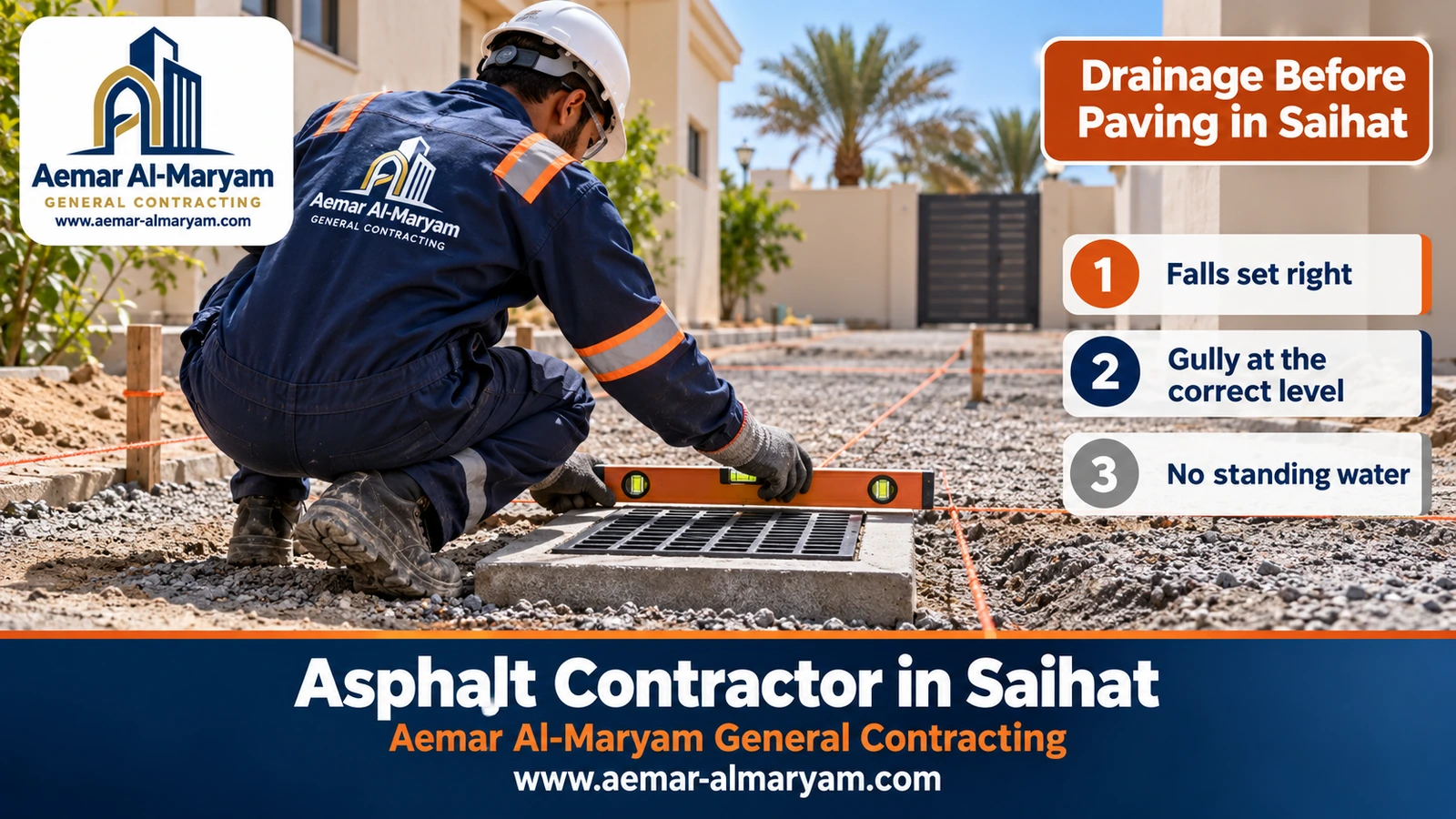
The complaint we hear most in Saihat after rain is water standing in a yard or a corner of the car park for days, or heading toward the building door instead of the street. The cause is usually the same: nobody designed the falls, and the gully went where it was easy to put rather than where the water goes. The cure does not come after paving but before it, in the base course.
How much fall is right?
| Area | Approximate fall | Direction |
|---|---|---|
| Yards and internal roads | Between 1.5 and 3 percent | Toward the street, a channel or a gully |
| Car parks | Not less than about 1.5 percent | Toward spread-out gullies or a drainage edge |
| Accessible bay and its aisle | Not more than about 2 percent | In both directions |
| In front of doorsteps | Always away from the threshold | Never toward the building |
To picture the number: a 1.5 percent fall means the surface drops 1.5 cm for every metre, or 15 cm across a yard 10 metres long. That is why a fall is never set by eye but with string lines stretched between pegs at calculated levels, as in the picture above.
Setting the gully at its level
- 1Find the lowest point
We draw the water direction on the plan and choose a gully position away from doors and walking routes. - 2Connect it to drainage
We check the gully pipe is connected to the drainage network or a permitted outlet, with enough fall of its own. - 3Fix it at level
The gully frame is bedded in concrete at a level slightly below the finished asphalt and checked with a spirit level. - 4Stretch the fall lines
Strings run from the edges of the yard to the gully, and the base course is trimmed to them. - 5Pave around the gully
Mix is placed by hand around the frame and compacted with a plate so no low or high ring is left around it.
A channel at the gate instead of a single gully
In some yards the street sits higher than the yard, or the garage entrance slopes inward, so street water comes in with every rain. One gully in the middle is not enough here; we suggest a linear channel with a grated cover across the full width of the gate, catching the water at the entrance before it reaches the yard and sending it to the network. The channel is set before the base at a level that lets cars cross without a jolt, and the asphalt is laid up to both its edges.
Coastal humidity and salty ground
Saihat is on the coast, and in parts of the Eastern Province saline groundwater sits close to the surface; sabkha soils along the Gulf shore lose a large share of their bearing capacity when they get wet. We do not claim every plot in Saihat is like that, but if the inspection shows damp ground below the surface or a salt crust, we recommend removing the weak layer and replacing it, or a geotextile to separate the base from it, priced after inspection.
Car park layers in Saihat, from soil to surface
Under the black surface of any car park there are four layers, and every pothole or dip we see in Saihat car parks traces back to one of them. The natural ground is cleared of soft and organic material and rolled to about 95 percent of its maximum dry density. On top goes the crushed-stone base, built up lift by lift, each lift 15 cm or thinner after rolling and brought close to its full maximum density. Then the prime coat with its day of waiting, then the hot mix.
| Type of car park | Stone base (approx.) | Asphalt after rolling (approx.) |
|---|---|---|
| Residents’ car park in a building | Around 15 cm | 5–6 cm in one layer |
| Shop car park with heavy daily traffic | Around 15 cm or more | 6–7 cm |
| Delivery truck route and standing area | Around 23 cm | 12–14 cm in two layers |
| Villa yard with garage entrance | Around 15 cm | 5–6 cm |
The mix itself arrives from the asphalt plant in covered trucks and we check its temperature on arrival: a load colder than roughly 139 °C is not laid, and the rollers must finish while the mat is still warmer than roughly 90 °C. Because a single layer is not built thicker than about 8 cm after rolling, anything deeper is laid in two goes, with a tack spray between them if the second is delayed.
Worked example: a residential building car park in Saihat
An illustration for a building car park measuring 30 × 22 metres, handed over by the building contractor with a sound compacted base, where only residents park. Its area: 30 × 22 = 660 m².
| Item | Calculation | Approximate result |
|---|---|---|
| 5 cm layer over the existing base | 660 × 37 | SAR 24,420 as a starting figure |
| Quantity of mix (2.3 t per m³) | 660 × 0.05 × 2.3 | About 76 tonnes |
| Prime coat at about a litre a square metre | 660 × 1 | About 660 litres |
| Number of strips at about 3.7 m wide | 22 ÷ 3.7 | About 6 strips |
| Length of longitudinal joints | 5 joints × 30 m | About 150 linear metres |
| Gullies, marking and equipment transport | By layout and distance | After inspection |
If we arrived at the same car park as bare earth with no base, the full build would be 660 × 74 = SAR 48,840 as a starting figure. The joint length in the table is not there for pricing; it is there so the owner sees why we care about joints: 150 metres of lines either stay straight and closed, or become 150 metres of cracks.
Asphalt patching in Saihat with square cuts
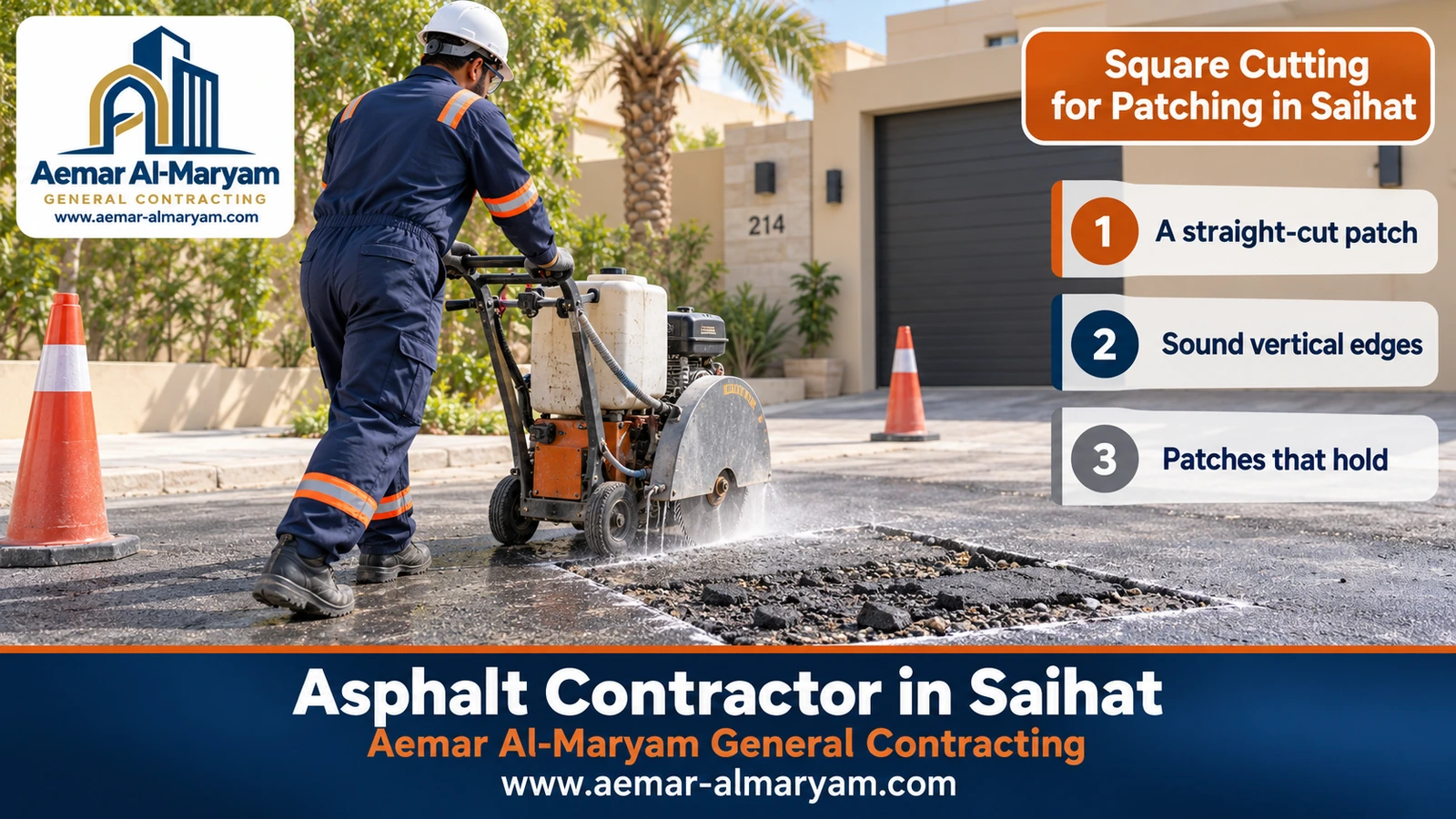
Asphalt patching in Saihat, on villa driveways and building entrances, starts with chalk rather than mix. We draw a rectangle around the broken area that reaches into sound asphalt on every side, with straight sides parallel and square to the traffic, then cut its lines with a walk-behind floor saw pushed by the operator, its blade water-cooled so it cuts cleanly with less dust.
Why square and straight?
A pothole filled as it is keeps broken, sloping edges that the new mix does not bond to, and cracks open between them, let water in and bring the hole back bigger. A straight cut gives vertical walls in full-thickness asphalt that hold the new mix in when it is compacted, and bond to it once tack coat is applied. A square or rectangular shape also looks tidy, and means a car wheel crosses the patch edge across its width rather than running along it.
Steps for a permanent patch
- 1Mark with chalk
A rectangle that surrounds all the cracked or sunken asphalt and reaches into sound material. - 2Cut with the saw
A full-depth cut along all four sides, with the blade cooled by water. - 3Remove to a sound bottom
The asphalt inside the cut comes out; if the base below has sunk or is wet, it is removed and recompacted too. - 4Spray tack coat
A light coat of RC tack on all four walls and the floor. - 5Fill and compact
Hot mix in one or two layers, compacted with a plate or small roller from the centre toward the edges. - 6Close the edges
The joint between patch and old surface is checked with a straightedge, and can be sealed with rubberised sealant if needed.
Cold mix
If the pothole sits at the building entrance and is holding up cars, we close it for now with cold mix (from SAR 46 per m²), then come back to cut it square and patch it in hot mix when other patches are grouped into the same visit.
If the damaged area is large, or needs cutting where new services will run under the car park, the cutting is work for our concrete cutting in Saihat team, whose service is outlined on the concrete cutting page.
Asphalt in front of houses in Saihat
At villas and houses we normally pave the yard, the garage mouth and whatever strip outside the gate belongs to the owner. Around 5 to 6 cm after rolling, over about 15 cm of base, is enough for family cars. What we watch here is that water heads to the street or a gully, not to the doorstep; that inspection chamber covers are raised to the new level; and that the asphalt edge at a garden or tiles is held by a kerb.
In houses where renovation in Saihat or an annex or majlis in Saihat is under way, we advise leaving paving to the end, because concrete and material trucks break new asphalt. Old yard tiles that must be lifted first are handled by our demolition contractor in Saihat.
Asphalt, interlock or tiles for the yard?
Asphalt is finished quickly, is cheaper per square metre, and forms a single surface repaired just where it fails. Interlock offers colours, shapes and blocks that come up and go back, but it needs kerbs to hold it. Tiles suit a walkway better than a car route. Many homes combine asphalt for the car with interlock or tiles for the walkway; interlock details are on the interlock and kerbs page.
Asphalt milling and resurfacing in Saihat
When a whole car park surface is tired, crumbling or covered in patches, but the base beneath is sound, there is no need to remove everything. A milling machine takes the top 3 to 5 cm away and leaves an evenly grooved face; we sweep it, tack it, and replace exactly what was removed, so levels at gates, drain covers and thresholds stay where they were. This starts from SAR 38 per m². Laying a new layer over the old without milling raises the level and can send water back to the entrances, so we only suggest it where the levels allow.
Asphalt price per square metre in Saihat
The asphalt price per square metre in Saihat starts from the same table we apply in Dammam, with equipment transport on top, since Saihat is beyond our Dammam–Khobar–Dhahran triangle; the transport line is set on site and shrinks per metre on larger jobs. All figures remain estimates until inspection and agreement.
| Work | From | Where we see it in Saihat |
|---|---|---|
| 5 cm hot asphalt over an existing compacted base | SAR 37 per m² | Building car parks handed over with a base |
| A 7 cm thickness on an existing base | SAR 41 per m² | Car parks used by heavier service vehicles |
| Built from the soil: grading, base, prime, 5 cm | SAR 74 per m² | Earth yards and new car parks without a base |
| Polymer-modified hot mix | SAR 55 per m² | Long-stay spots and heavy loads |
| Temporary pothole fill with cold mix | SAR 46 per m² | Entrances that need an immediate fix |
| Planing 3–5 cm and laying a new layer | SAR 38 per m² | Tired car parks with a sound base |
| Permanent patch inside a square cut | After inspection | Villa driveways and building entrances |
| Drain gullies and fall corrections | After inspection | Yards where water stands |
| Bay marking and accessible bays | After inspection | Building car parks after paving |
| Treating damp or salty ground | After inspection | Sites close to the coast |
| Kerbs around the asphalt | After inspection | Garden and walkway edges |
| Equipment transport to Saihat | After inspection | Cheaper per metre on bigger jobs |
Questions to put to any asphalt company in Saihat before signing
| Ask | The answer you want |
|---|---|
| What thickness will I get? | A compacted figure written into the agreement, never just “one layer”. |
| Will you prime, and when do you pave after it? | Yes, then at least 24 hours. |
| How will you do the joints between strips? | A straight line, the cold edge cut back, tack on its face. |
| Where does the water go? | A stated direction with a fall percentage, and gullies fixed before paving. |
| How will you patch potholes? | A square saw cut, tack coat and hot mix. |
| What is not included? | A clear list: removing the old surface, gullies, marking, transport. |
Mistakes we see in Saihat car parks and yards
- ✓A wide car park laid in strips without a string line, so the joints wander and open within months.
- ✓A new strip laid over a cold, tapered edge without cutting and tacking it, leaving a weak line that lets water in.
- ✓Prime sprayed in the morning and paved over the same day, so the asphalt lifts at the edges later.
- ✓A gully fitted after paving by breaking the asphalt around it, leaving a ring of patches.
- ✓A pothole patched by filling it as it is, without cutting, so it returns larger the next season.
- ✓Accessible bays marked in a sloping corner far from the entrance.
Does the car park need modified asphalt?
For residents’ parking it usually does not; a standard mix with 60/70 binder handles light cars. But where a delivery truck stands for hours outside the shops’ store, or where heavy vehicles turn slowly in summer, ruts appear with time. KFUPM research on regional mixes called for polymer-modified binder to resist that in the east of the Kingdom, so we suggest it for that patch alone, not for the whole car park.
Equipment we bring to Saihat
For car parks: a grader or loader for the base, a vibratory roller, a water tanker, a prime sprayer, a paver, steel and rubber-tyred rollers, and strings, pegs and a level for the falls. For patching: a walk-behind floor saw with a water-cooled blade, breaking-out tools, a plate compactor and a small roller, and a thermometer. For maintenance: a milling machine, a compressed-air lance, a pour pot for crack sealant and line-marking equipment.
Accepting the building car park after paving
- ✓Water: run a hose over corners and low areas; it should reach the gullies without standing.
- ✓Joints: straight, closed, with neither side higher than the other.
- ✓Surface: lay a 3–4 metre straightedge on it; any gap beneath should be a matter of millimetres.
- ✓Gullies and covers: at the right level, with water entering from every side.
- ✓Marking: straight lines, dimensions matching the layout, accessible bays clearly marked.
- ✓Clean site: no loose stones and no mix left on pavements or walls.
The car park opens to cars once the asphalt has cooled completely, and the building management hears from us when, judged by that day’s temperature and the depth laid. In the first summer days it is better not to turn a car’s wheels while it is standing still.
Looking after the car park after handover
A well-paved car park lasts many years as long as water stays away from its base. These are simple things the building management can keep an eye on:
- ✓Clear sand and leaves from gullies and channels before the rainy season; a blocked gully turns the car park into a pond.
- ✓Seal any crack that appears at joints or around covers in good time, before water reaches the base.
- ✓Stop oil and fuel leaks from cars parked for long periods, because they dissolve the asphalt binder and soften the surface.
- ✓Renew the marking when it fades so the car park stays orderly and accessible bays stay clear.
- ✓Group patching, crack sealing and re-marking into one visit so each item costs less.
The public street outside the building in Saihat
As long as the work stays inside the property itself, its car park, yard and walkways, you need no excavation permit. The public street is another matter; the municipality paves and maintains it, cutting into it is arranged through the municipality’s coordination office, and trenches for new service connections are applied for by the utility on Balady. Our asphalt therefore stops at your boundary, meeting the street neatly at its existing level. Potholes out in the street go to the municipality by calling 940 or through Balady.
How to order an asphalt contractor in Saihat
- 1Send the layout or photos
The car park layout if you have it, photos from several angles, and pictures of potholes or places where water collects. - 2Give the size and use
Length and width, the number of bays needed and the type of vehicles. - 3Say what is under the surface
Earth, a base left by the building contractor, or old asphalt. - 4Levels inspection
We measure levels and decide the water direction, gully positions and strip layout. - 5An itemised estimate
Base, prime, asphalt, gullies, marking and transport, each item separate. - 6Work and handover
Prime and a day’s wait, laying in strips, marking, then a water and straightedge check.
What we offer Saihat property owners
■ Car parks with straight lines
Strips guided by string and joints cut and tacked, so the car park looks orderly from above.
■ Patches that stay put
A square cut with a water-cooled saw, tack coat and compacted hot mix.
■ Water that knows its way
Calculated falls and gullies fixed before paving.
■ Prime given its time
No paving before the base has absorbed the prime, however urgent the job.
■ Close to Dammam
Saihat is about 14 km from Dammam, and we group Saihat and Qatif inspections on set days.
■ Written line items
Everything the price leaves out is stated before work begins.
Our projects page has finished work to look through, and the price guide lists the other starting figures.
Saihat districts where we work
We work in old Saihat and its newer districts, including:
The Saihat area page brings our services there together. For farm roads and clay soil read asphalt contractor in Qatif; for compound streets and factory yards, asphalt contractor in Dhahran; and for the complete reference, asphalt contractor in Dammam. If the building needs work before its car park is paved, our electrician in Saihat can handle car park lighting.
A building car park, a yard or a pothole on a driveway in Saihat?
Send the layout or photos and dimensions, and we will suggest the strip direction, the falls and the gully positions and a ballpark cost, then we agree a day to come and look.
Related pages
Tags