A plastering contractor in Dhahran from Aemar Al-Maryam General Contracting prepares villa and compound walls for a smooth, paint-ready finish: screeded internal plaster, room and hall ceilings, arched openings and crisp corners, and gypsum plaster for dry rooms when the programme is tight. Our rates begin at SAR 11 a square metre for screeded rooms with corner beads, SAR 14 for ceilings, SAR 17 for a floated finish ready for paint, and SAR 6.5 for labour alone where you buy the materials. Treat these as estimates; the firm figure follows a site visit and an agreed scope. Phone or WhatsApp 0547879578.
In a Dhahran villa the walls are seen under wide windows and concealed ceiling lights, and that raking light is unforgiving. A wall that is merely “solid” is not enough; it has to be flat enough that the painter only needs a thin skim, with sharp arrises and arches that curve evenly from one side to the other. This page is written for owners building a villa or refreshing a house in Dhahran who want to understand what actually produces a smooth wall, what each level of finish costs, and what to send us for a quick estimate.
At a glance: plastering villas in Dhahran
- Our focus here: flat internal plaster ready for paint, hall and room ceilings, arches and corners, gypsum plaster for dry rooms, and external render for villa facades and boundary walls.
- What makes a wall smooth: dots and screeds set with a level, a two-metre aluminium rule, a rough dash on any concrete, and a mesh strip wherever blockwork meets a column or beam.
- Prices start from: SAR 11/m² screeded internal, SAR 14 ceilings, SAR 17 paint-ready finish, SAR 41 gypsum plaster with materials. Estimates until inspection and agreement.
- Afterwards: water-cure cement plaster for about 7 days and hold back the paint until it has dried properly.
- Districts: Al Qusur, North and South Al Doha, North and South Al Danah, and the rest of Dhahran.
- To order: photos of the walls, ceiling heights and room sizes on WhatsApp 0547879578.
Plastering contractor in Dhahran for villas: what “paint-ready” really means
For us, a plastering contractor in Dhahran is a crew that takes over the wall at bare block and concrete and hands it back flat, plumb and square, needing nothing more than a light skim before paint. The difference between ordinary plaster and paint-ready plaster does not show on handover day. It shows when the painter rolls the first coat in afternoon sun and sees hollows and humps across the wall, then has to build up thick filler that cracks later or simply costs more.
That is why we split villa work in Dhahran into clear levels, each with its own method and price, and you choose what suits each room:
■ Screeded plaster
The baseline for any room in a villa: dots, screeds, a long straightedge and metal beads on the corners.
■ Paint-ready finish
A final coat floated and closed so the filler needed is minimal, for halls, majlis and long corridors.
■ Room and hall ceilings
Thinner plaster on the concrete soffit, before gypsum board or direct paint.
■ Arches and arrises
Curved templates for arches and metal beads for exposed corners around doors and windows.
■ Gypsum plaster
A white, very smooth surface for dry rooms that can be painted within days.
■ Facades and boundary walls
Two-coat external render, or a through-coloured render that needs no paint.
Before we talk price we ask where the house is in its programme. Are the electrical, air-conditioning and plumbing runs finished? Are door frames fixed? Is a suspended gypsum board ceiling planned? Plastering before services are complete means chasing and patching later, and patches are the first thing raking light reveals. A short summary of the service lives on our plastering service page, and all of our Dhahran work is gathered on the Dhahran area page.
Internal plastering in Dhahran: rooms, majlis and stair cores
We usually apply internal plastering in Dhahran as a single coat about 12 to 15 mm thick on blockwork, a little thicker where the wall is uneven, with flatness controlled by screeds rather than by eye. Villas mix very different spaces: generous bedrooms, a men’s majlis with a higher ceiling, a family hall open to the stair, and long corridors that expose any drift in the wall line.
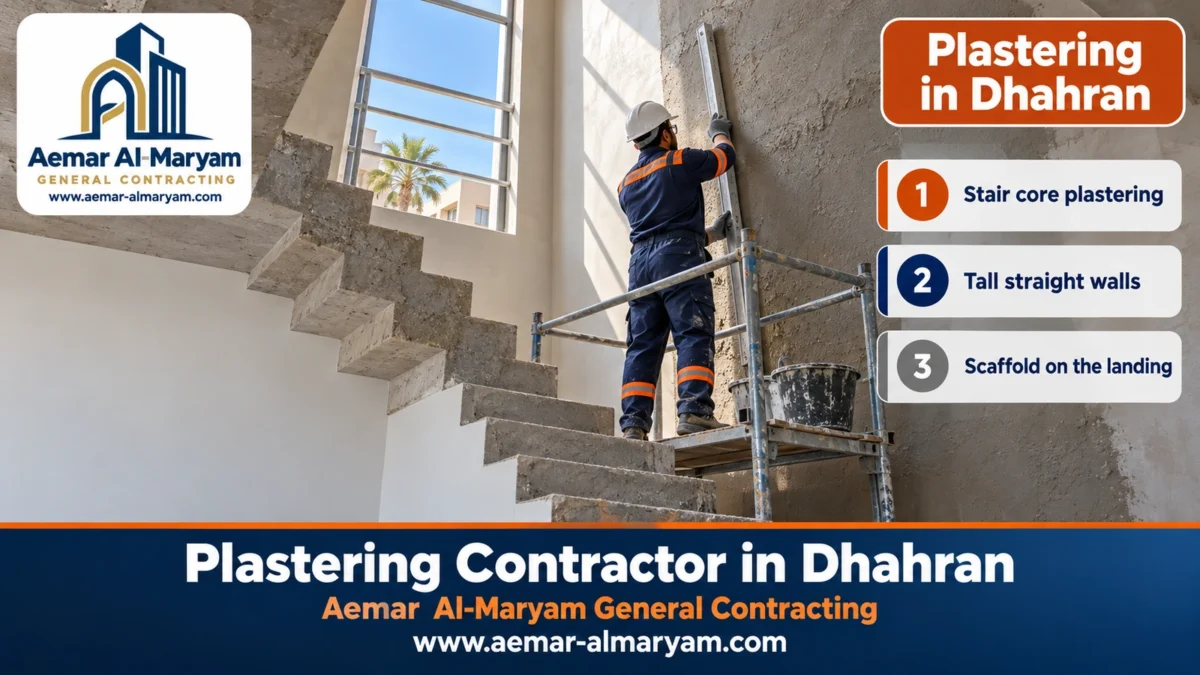
The stair core is the hardest part of a villa to plaster well. Its walls are tall, its angles change at every landing, and it needs a stable scaffold platform rather than a ladder moved from step to step. We set screeds over the full height so there is no visible “kink” halfway up, and plaster from the top down so mortar never drops onto finished work below.
Ceilings and tall halls in Dhahran
Ceiling plastering in Dhahran starts from SAR 14 per square metre and goes on thinner than wall plaster, because heavy mortar overhead is more likely to let go. We roughen or dash the concrete first, then work in short sections. If part of the ceiling is going behind a suspended gypsum board system, we agree whether the whole soffit needs plaster or only the visible margins, which can save you a share of the cost.
Arches and exposed corners
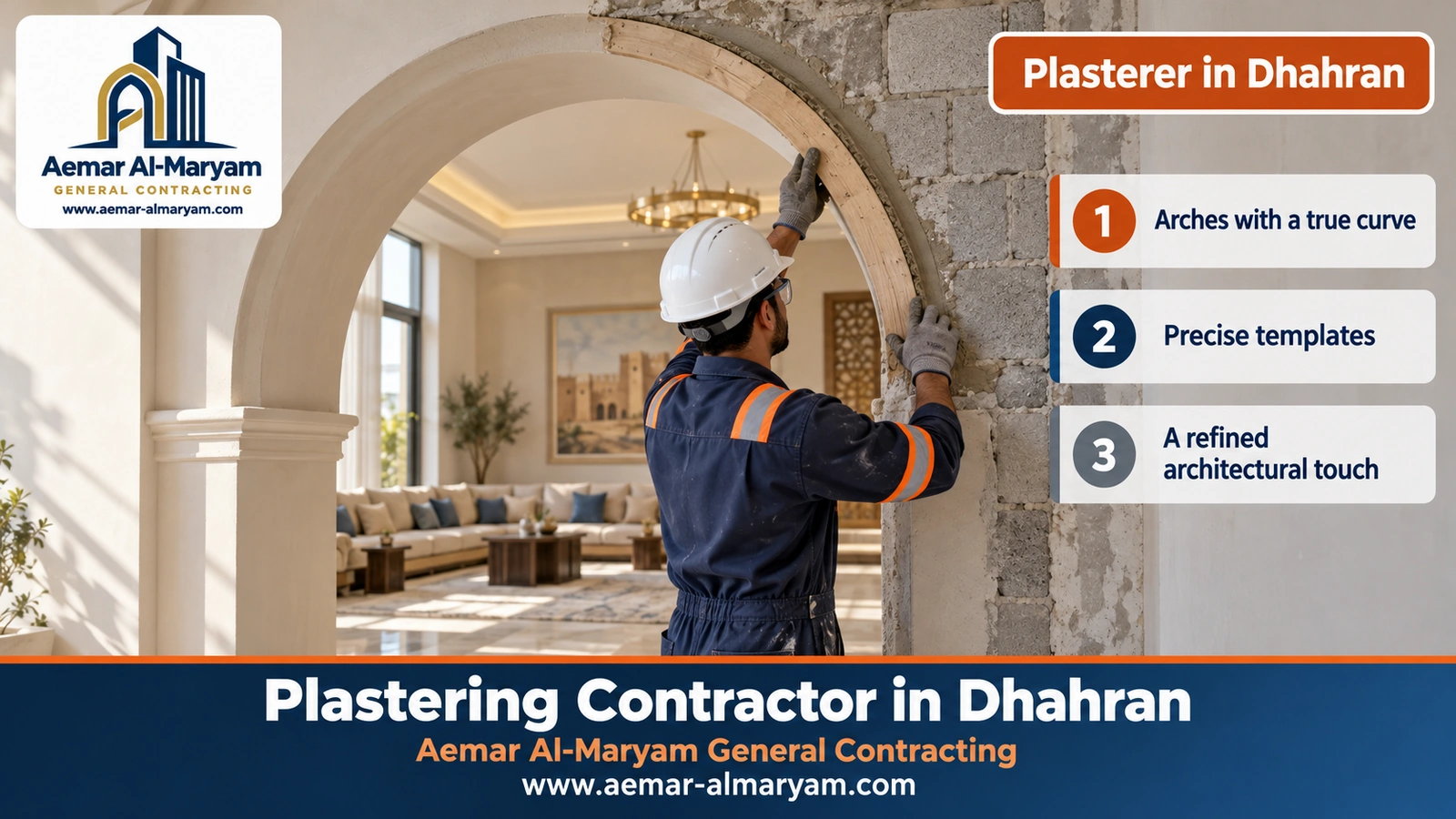
Arched openings between the hall and the majlis are common in Dhahran villas. Plastering them properly needs a curved timber template run along the underside of the arch so the curve comes out identical on both sides. On exposed corners around entrances and windows we fix metal corner beads before plastering, so the arris stays sharp and does not chip the first time furniture brushes past.
Smooth paint-ready plaster in Dhahran: when do you need it?
A smooth, paint-ready plaster finish in Dhahran starts from SAR 17 per square metre. We recommend it for walls that catch side light from large windows, for reception walls and long corridors, and for houses where gloss or semi-gloss paint will show every flaw. Service rooms and stores are well served by standard screeded plaster.
What changes at this level? Once the coat has been ruled off and begins to stiffen, we work it with a sponge or wooden float in circular strokes to close the surface and remove straightedge marks, then check it with the rule in several directions and under a low-angle lamp. The result is an even surface that needs only a thin skim, which shortens the painting stage and avoids heavy filler that tends to crack.
✦ A simple test before painting
Switch the room lights off and hold a strong lamp close to the wall at a shallow angle. Long shadows reveal waves you never see in direct light, and that is exactly how the wall will look after painting under concealed lighting.
Painting comes next; we cover stages, colours and prices in painting contractor in Dhahran, and the wider service sits under painting.
Gypsum plaster or cement plaster in Dhahran?
Gypsum plaster in Dhahran is an option for bedrooms, studies and similar dry rooms, and we charge from SAR 41 a square metre for supplying and applying it. Gypsum sets within about thirty minutes, is simply left to dry rather than wetted for a week, shrinks very little, and is normally ready for paint after three or four days, where cement plaster would keep you waiting for weeks. Owners choose it when a villa has to be handed over quickly or a bedroom is needed soon.
It is not for external walls, bathrooms, kitchens or the bottom of a wall that ground moisture reaches. In those places cement plaster remains the right material. We also never add gypsum to cement mortar to make it set faster, because that mixture is a known cause of plaster coming away later.
| Comparison | Gypsum plaster | Cement plaster |
|---|---|---|
| Where it is used | Dry bedrooms, studies and halls | Everywhere, including facades, bathrooms and kitchens |
| After application | No water curing | Water cured for about 7 days |
| When to paint | After roughly 3–4 days | Once fully dry; full cure can take about 28 days |
| Surface | Bright white and very smooth | Grey, needs a skim for a fully smooth finish |
| Starts from | SAR 41/m² with materials | SAR 11/m² screeded labour, SAR 13 with materials |
Figures are estimates until inspection and agreement.
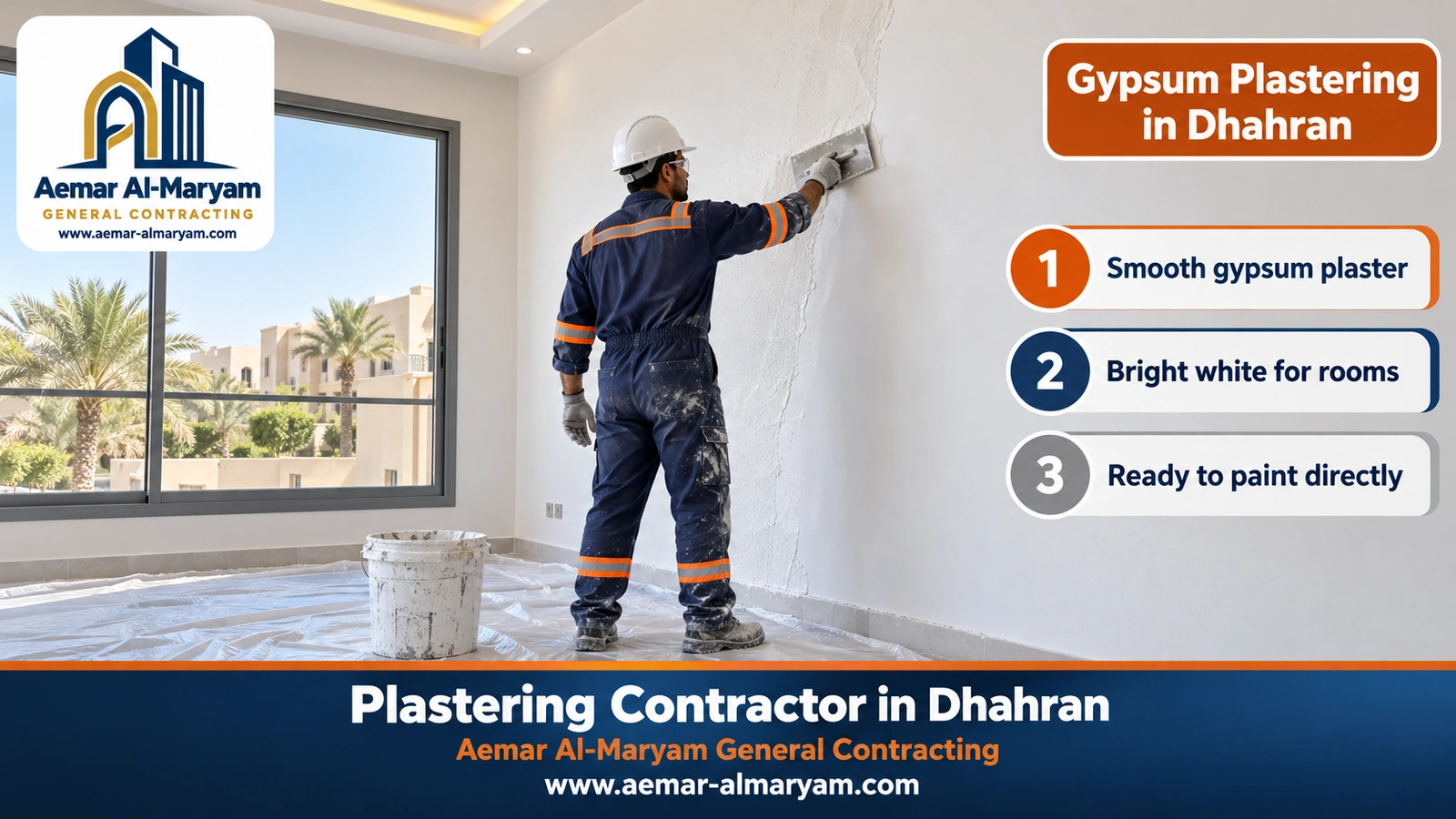
Gypsum plaster and gypsum board are different products. Plaster arrives as powder, is mixed with water and trowelled onto masonry; board comes as factory sheets screwed to a steel frame to form ceilings and partitions.
Scratch coat, dots and screeds in Dhahran: how we set the wall out
The scratch coat, dots and screeds are what make plaster in Dhahran flat by measurement instead of by guesswork. The scratch or dash coat is a cement-rich mix, around one part cement to two of sand, thrown hard onto smooth concrete such as columns, beams and soffits so the plaster has something to grip. We leave its surface coarse and keep it moist for a day or more before anything goes over it.
Dots are small pads of mortar fixed to the wall with a level and string line at roughly 1.5 m centres. Vertical strips called screeds are then run between them; once they firm up they act like rails for the straightedge, and the plaster fills the bays between them to the same plane. On long villa walls we use an aluminium straightedge of at least two metres.
- 1Clean and dampen
Scrape off mortar snots and dust, wet the thirsty blockwork, and only lightly dampen dense concrete. - 2Dash coat on concrete
On columns, beams and soffits, then left to stiffen and kept damp. - 3Dots
Reference pads set to level at the corners and then at regular spacing. - 4Screeds
Vertical strips between the dots that fix the final plane. - 5Fill and rule off
Mortar thrown into the bays and ruled off with the straightedge from the bottom upward. - 6Float
Worked with the float as the coat starts to stiffen, then checked with the rule.
Plaster mix ratios and thickness in Dhahran villas
Common plaster mixes run from one part cement to four of sand up to one to six. Internal plaster is typically 1:4 to 1:5; external is a little richer, around 1:4, with a water-resisting admixture where specified. We keep to the strength order: each coat should be no stronger than the one beneath it, because a rich coat over a weaker one shrinks onto it and pulls, and the two either part company or craze.
| Item | Typical figure | What it means for you |
|---|---|---|
| Internal plaster | About 12–15 mm in one coat | Enough for well-built blockwork |
| External render | About 15–20 mm in two coats | A first coat that firms up, then the finish |
| Ceilings | Thinner than walls | So the plaster does not get heavy and detach |
| Gap between coats | About two days | The finish never goes on a soft first coat |
| How many bags? | One 50 kg bag covers roughly ten square metres at 2 cm | Lets you check material quantities |
Guidance figures from common practice and published specifications; actual thickness depends on the wall.
If a wall needs more than about 25 mm because the blockwork is out of line, we do not fill it in one heavy coat. We build it out in layers or discuss correcting the blockwork, because a thick single coat sags or goes hollow. We use washed sand free of clay and salts, and clean water; these small details protect the plaster from salt bloom later.
Plaster mesh at joints in Dhahran: columns and AC openings
Plaster with mesh in Dhahran means a strip of mesh about 15 cm wide centred on every line where blockwork meets a concrete column or beam, embedded in the plaster. Block and concrete expand and contract differently, so a joint left unbridged usually shows a straight crack beside the column after the first summer.
In villas we also mesh over chased air-conditioning, electrical and plumbing runs, around AC unit openings, and at the corners of large door and window openings. Mesh across an entire wall is a separate item starting from SAR 20 per square metre, which we suggest where a wall has many patches or mixed backgrounds.
⚠ When mesh is the wrong answer
Mesh deals with movement between materials, not with a wall that is moving. If the crack passes through the blocks, widens over the months or steps diagonally away from a window, we stop and get it looked at first. See crack repair in Dhahran to see the difference between a surface crack and one that needs an engineer.
Curing plaster with water in the Dhahran climate
Curing plaster with water in Dhahran means a light mist over cement plaster roughly twice a day, morning and evening, for about seven days, while shielding it from direct sun and wind. In a Dhahran summer the surface can dry before the cement has properly set, and that leaves fine crazing that looks like a spider’s web.
Inside closed villas there is another cause of fast drying that few people notice: air conditioners and fans blowing straight onto fresh walls. We ask that AC air is not directed at the walls in the first days and that windows are shaded where possible. Facade work begins soon after sunrise or once the heat drops later in the day, and is misted at times when the sun is not beating directly on them.
- ✓First days: a fine mist that does not run down the wall, morning and evening.
- ✓Air: no AC or fan aimed at fresh plaster.
- ✓Sun: render facades in the cooler hours and shade new work where you can.
- ✓Gypsum plaster: never wetted; it is left to dry with moderate ventilation.
Plasterer in Dhahran: how to spot a capable one
A plasterer in Dhahran is the tradesman who applies plaster by hand, and a capable one shows himself through the questions he asks before he starts. Will he set dots and screeds or work by eye? What mix will he use? Will there be mesh at the columns? Who wets the plaster afterwards? If none of this comes up, you will probably pay the difference later in filler or patching.
The plasterer phone number we give is our own, 0547879578. We send a crew working under the company’s supervision and responsibility that takes the item from preparation right through to curing.
Plasterer on a day rate or per square metre in Dhahran?
A plasterer on a day rate suits small jobs such as patching service chases or repairing part of a wall, where measuring is awkward. For a villa or a full floor, a rate per square metre is the cleaner deal: the money follows the finished area, not the calendar, and you have the total in hand on day one. We price per metre in most cases and take small jobs as a fixed-price visit after seeing photos.
| Comparison | Day rate | Per square metre |
|---|---|---|
| Suits | Patching, filling chases, limited repairs | Rooms, villas and whole floors |
| Cost certainty | Depends on the worker’s pace | Known before work starts |
| Materials and quantities | Usually yours | By agreement: labour only or supply and fix |
| Responsibility for flatness | Not defined | A clear handover item |
External rendering and villa facades in Dhahran
External plastering in Dhahran costs from SAR 14 a square metre as labour, or from SAR 18 a square metre with our materials. It is built up in two coats to roughly 15–20 mm overall, using a richer mortar with a water-resisting admixture where needed. It covers villa facades, boundary walls, annex walls and parapets.
On facades we pay attention to three things: a dash coat on every concrete surface, mesh wherever block meets columns and beams, and straight movement or panel joints where the background changes or a facade runs long. Scaffolding, height and access are priced after inspection.
Coloured render in Dhahran
Coloured render in Dhahran starts from SAR 32 per square metre including materials. The colour is in the cement mix itself, so no paint is needed afterwards, and the floated finish gives a fine-grained texture that suits boundary walls and some facades. We prepare a flat base just as for ordinary render, then apply the coloured coat and work it with even strokes until the texture is uniform. We trowel a trial patch first and let you judge the shade outdoors before the full wall is done.
Machine plastering or hand plastering in Dhahran?
Machine plastering in Dhahran suits large, continuous areas such as a villa under construction with every wall open, or a compound with repeated units, because the machine mixes evenly and sprays quickly with less waste. It does need a pumpable ready mortar, continuous work so the hoses do not block, and setting up and cleaning time. Occupied rooms, patches and arches are better done by hand.
Either way, the machine does not make the wall flat; dots, screeds and the straightedge do. So we price machine plastering after inspection, once we have seen the area and can tell whether it genuinely saves you money.
Re-plastering old walls in Dhahran
Re-plastering old walls in Dhahran starts from SAR 23 per square metre and covers hacking off failed plaster back to the block, cleaning the background, dash-coating any concrete, and new screeded plaster. Older villas need it when plaster sounds hollow when tapped, crumbles, or bulges at the bottom of a wall. Where your own plasterer will follow us, we can strip the old coat alone from SAR 7.5 a square metre.
Before any re-plastering we look for the cause: a leak from an upstairs bathroom, rising damp, or AC condensate running down the wall. New plaster over an untreated cause fails again. If the house needs wider work, see renovation contractor in Dhahran and our renovation service.
Plaster defects in Dhahran villas and their causes
The most common plaster defects in Dhahran are crazing from fast drying, a straight crack beside columns where no mesh was used, hollowness where plaster has not bonded to concrete, waviness where no screeds were set, and white salts at the bottom of walls. Knowing the cause decides the right repair:
| Defect | Likely cause | Remedy |
|---|---|---|
| Fine map-pattern cracking | Fast drying, or an over-rich finish coat | Proper wetting and curing; fill hairlines; redo the coat if it opens up |
| Straight crack next to a column | No mesh across the block–concrete joint | Open the line, mesh, re-plaster |
| A drum-like note under the knuckle | Plaster laid straight onto slick concrete, dust left on the wall, or too much built up at once | Remove the loose area until firm plaster is reached, dash, then plaster again |
| White salts | Water carrying salts through the wall, or unwashed sand | Stop the water, dry out, then brush off |
| Waviness under side light | Worked by eye without screeds | A correcting coat on screeds, or heavier filler at higher cost |
Structural cracks in the wall itself are outside the scope of plastering and need assessing first.
Preparing surface cracks in one room before painting starts from SAR 140 per room; for deeper cracks see our crack repair service.
Plastering price per square metre in Dhahran by finish level
In Dhahran our lowest rate is SAR 6.5 a square metre when you buy the cement and sand and we provide the hands. It rises to SAR 11 once the walls are ruled between screeds and the arrises are beaded, and to SAR 17 for a floated smooth wall the painter can take over directly. The final figure depends on the condition of the wall, the thickness needed, working height, access and the total area. Each figure is provisional until we have seen the walls and both sides have agreed.
| Work in the villa | Unit | Starts from | Suits |
|---|---|---|---|
| Hand labour only, owner buys cement and sand | m² | SAR 6.5 | Service rooms, stores, walls that will be clad later |
| Labour for villa rooms ruled true between screeds, arrises beaded | m² | SAR 11 | Bedrooms, majlis, corridors |
| Villa rooms with our cement and washed sand | m² | SAR 13 | When you want us to supply everything |
| Concrete soffits | m² | SAR 14 | Room and hall ceilings before gypsum board or paint |
| Floated smooth walls handed straight to the painter | m² | SAR 17 | Reception halls and walls hit by side light |
| White gypsum coat, material included | m² | SAR 41 | Dry bedrooms and studies when time is short |
| Fibre mesh embedded across the whole wall | m² | SAR 20 | Heavily patched walls or mixed backgrounds |
| Kitchen or bathroom walls ahead of tiling | m² | SAR 18 | Water-resistant admixture in the mortar |
| Render labour on the villa outer walls | m² | SAR 14 | Two coats |
| Villa facade with our materials | m² | SAR 18 | Richer external mortar |
| Through-coloured render | m² | SAR 32 | Materials included, no paint afterwards |
| Stripping only, no new coat | m² | SAR 7.5 | If you have your own plasterer to follow |
| Old wall stripped and plastered afresh | m² | SAR 23 | Hollow or crumbling plaster |
| Surface cracks in one room prepared for paint | room | SAR 140 | Hairline and surface cracks only |
| Machine-sprayed plaster | — | On inspection | Large continuous areas |
| Hollow or detached patches | — | On inspection | Depends on extent and cause |
| Salt bloom and moisture low on the wall | — | On inspection | Starts by stopping the water |
Estimates confirmed by agreement after a site visit; compare other trades on our price list.
Worked example: a 4 × 6 master bedroom in Dhahran
Picture a Dhahran master bedroom of 4 × 6 m, ceiling height 3.2 m, with a door opening close to 1.98 m² and a large window of 1.5 × 1.6 = 2.4 m². Wall area = (4 + 6) × 2 × 3.2 = 64 m². Following common practice we deduct the window because it is over 2 m², and leave the door because it is under that size, so the walls come to 61.6 m². The ceiling is 4 × 6 = 24 m².
| Option | Calculation | Estimated cost |
|---|---|---|
| Screeded walls with beads + ceiling | 61.6 × 11 = 677.6 + 24 × 14 = 336 | About SAR 1,014 |
| Paint-ready smooth walls + ceiling | 61.6 × 17 = 1,047.2 + 336 | About SAR 1,383 |
| Gypsum plaster walls (with materials) + cement ceiling | 61.6 × 41 = 2,525.6 + 336 | About SAR 2,862 |
| Basic labour for walls and ceiling, your materials | 85.6 × 6.5 | About SAR 556 |
Illustrative example only; the actual figure is set after inspection. The room needs roughly 9 bags of cement at about 2 cm.
Notice that the step up from screeded to paint-ready walls in this room is about SAR 370, which is usually less than you would spend on extra filler and correcting coats if the plaster came out wavy.
Measuring the plastered area
We take every wall as its length multiplied by its height, total them, and list the ceiling as its own line if it is part of the job. The usual custom is to deduct openings larger than about 2 m² and leave smaller ones, because their reveals take extra work. What matters most is that the measuring method is written into the agreement before work starts.
Can you paint without plaster in Dhahran?
You can skip plaster before paint in practically one case: a surface that came out flat in the first place, such as a concrete wall cast in clean formwork, which then needs only filler and primer. Ordinary blockwork or an external wall should not be painted without plaster, because the block joints telegraph through the paint and the wall copes less well with moisture. In a villa where you want smooth walls under window light, plaster is the step you cannot leave out.
Plastering steps in a Dhahran villa
- 1Visit and measure
We measure rooms and facades, check blockwork, concrete and services, and agree the finish level for each room. - 2Written agreement
Items, areas, measuring method, materials, duration and a price per item. - 3Protection
Floors, windows and frames covered, with the mixing area kept away from entrances. - 4Preparation
Cleaning and wetting, dash coat on concrete, mesh and metal beads fixed. - 5Dots and screeds
The plane set with level and line on every wall and ceiling. - 6Plaster and float
Fill and rule off, then float to the paint-ready level where agreed. - 7Curing
About 7 days of misting for cement plaster; moderate ventilation for gypsum. - 8Handover
A joint check with rule, lamp and tapping, and any snag put right.
Receiving the plaster: what to check yourself
- ✓Straightedge: lay a two-metre rule in different directions; it should not rock or leave obvious gaps.
- ✓Plumb: a level on the wall and the corners to confirm they are vertical.
- ✓Square rooms: measure both diagonals of a rectangular room; equal diagonals mean square corners, which matters when fitting wardrobes and tiles.
- ✓Tapping: tap the wall with a light handle; a hollow sound means debonded plaster.
- ✓Edges: clean lines around sockets, frames and AC openings.
- ✓Cracks: nothing beyond hairline.
- ✓Curing: confirm the curing days actually happened.
Common plastering mistakes in Dhahran villas
- Plastering before services are finished: then chasing for AC and electrics, with patches that show under light.
- Working long walls by eye: saves a day and costs extra coats of filler.
- Running the AC onto fresh plaster: the surface dries too fast and crazes.
- Gypsum plaster in a bathroom or kitchen: it weakens with moisture.
- Adding gypsum to cement mortar: to speed setting, a known cause of debonding.
- Neglecting arches and arrises: leaving lopsided arches and chipped corners.
- Painting too early: on cement plaster that has not dried, so paint peels or blotches.
Where in Dhahran we plaster
Our crews travel to Dhahran from Dammam, booking the inspection first and then consecutive working days so the job is not broken up. Districts we regularly receive requests from include:
■ Al Qusur
Villas and houses needing internal plaster and facades.
■ North Al Doha
Villas, room refreshes and ceilings.
■ South Al Doha
Villas, flats and screeded internal plaster.
■ North and South Al Danah
New houses and annexes.
If your district is not listed, send us your map location. If you are adding an annex or majlis before plastering, read annex and majlis builder in Dhahran; for complete building and finishing see our construction service and finishing service. Our full guide is plastering contractor in Dammam, and nearby we have written about the plastering contractor in Qatif for re-plastering older houses and the plastering contractor in Saihat for new homes and annexes.
How to order a plastering contractor in Dhahran
To order a plastering contractor in Dhahran, put these details in a WhatsApp message to 0547879578; we answer with our first assessment and a ballpark cost ahead of any site visit:
- ✓Room photos: one of each wall, one of the ceiling, and close-ups of arches and corners.
- ✓Sizes: room length, width and ceiling height, plus the height of the stair core and any tall halls.
- ✓Finish level: screeded only, paint-ready smooth, or gypsum plaster.
- ✓Stage: whether services are finished and frames are fixed.
- ✓Materials: whether we supply them or you buy them.
- ✓Location and timing: your district and the week you hope to begin.
Why Dhahran villa owners call Aemar Al-Maryam
■ Clear finish levels
Each room gets a finish level and a published starting price that you choose.
■ Villa-grade detail
Arches on templates, corners on metal beads, screeds on every wall.
■ Gypsum where it belongs
We suggest it for dry rooms only and refuse it in bathrooms and kitchens.
■ General contractor
We deal with cracks, damp and services before the plaster, not after.
■ Tidy site
Floors and windows protected, cleaned after every stage.
■ Work you can see
Finished jobs are posted in our project photos.
Your Dhahran villa walls start here
Photograph the rooms and send them with the sizes, or simply call; we suggest the right level for each wall, send an initial cost, and then fix a date to inspect in Dhahran.
Useful links for your Dhahran project
- ➤ Plastering service
- ➤ Our services in Dhahran
- ➤ Plastering contractor in Dammam: full guide
- ➤ Painting contractor in Dhahran
- ➤ Crack repair in Dhahran
- ➤ Renovation contractor in Dhahran
- ➤ Annex and majlis builder in Dhahran
- ➤ Plastering contractor in Qatif
- ➤ Plastering contractor in Saihat
- ➤ Starting prices for all services
- ➤ Book a site inspection
Article tags