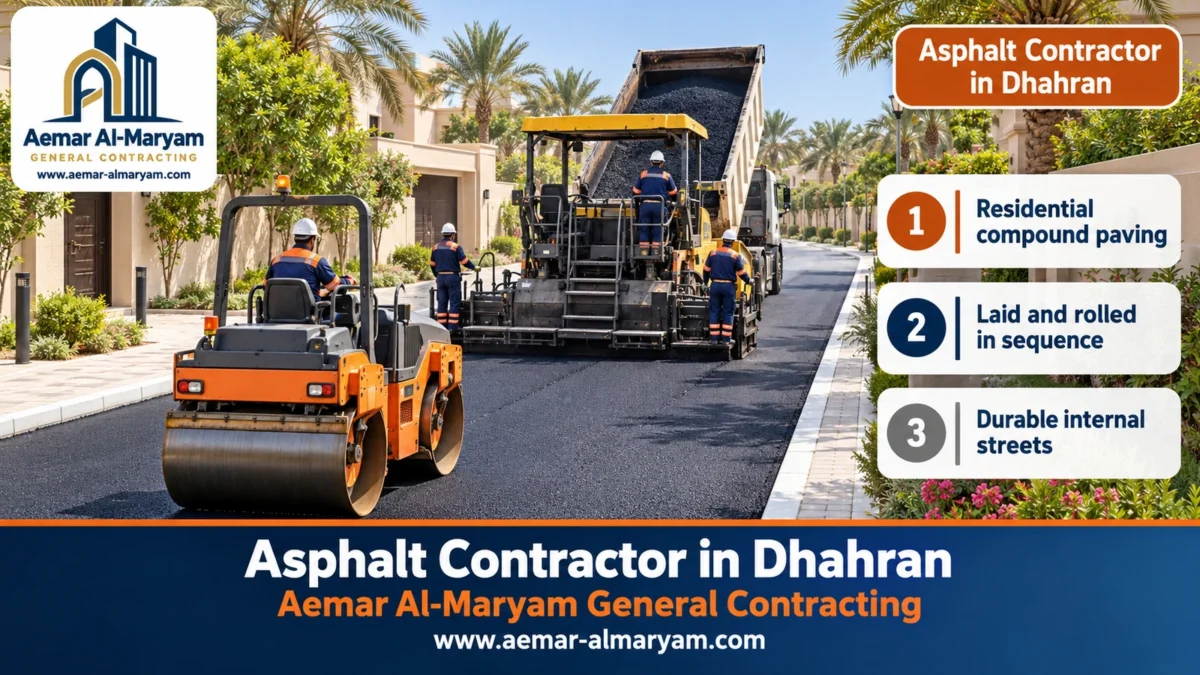
An asphalt contractor in Dhahran is who you call when an internal street in a residential compound is cracking, a factory loading yard is rutting under trucks, or a villa driveway is waiting for its kerbs before it can be paved. The Aemar Al-Maryam General Contracting paving team takes these sites from bare ground to finished surface: a compacted base course, a prime coat, hot mix laid with a paver and compacted with rollers, and precast concrete kerbs that lock the edges. A 5 cm layer over a sound existing base starts at SAR 37 per square metre, and building every layer from the soil up starts at SAR 74; every figure stays an estimate until we inspect and agree. Reach us by phone or WhatsApp on 0547879578.
Dhahran is not a city of public streets for us to pave; those belong to the municipality. It is a city of villas and residential compounds that own their streets and car parks, and on its western and southern edges lie the Second and Third Industrial Cities with their factories and warehouses. So this guide is built around the three sites we work on most here: the internal compound street, the factory yard, and the villa driveway with its concrete edges. For each one we explain what decides how long the asphalt lasts before we reach the price.
In short: asphalt work in Dhahran with Aemar Al-Maryam
- Residential compounds: internal streets, car parks and walkways, coordinated with the compound management and done in stages that keep part of the street open.
- Factory yards: about 12–14 cm of asphalt in two layers over roughly 23 cm of base, compacted with a steel-drum roller and then a pneumatic-tyred roller.
- Kerbs: precast concrete kerbs on a mortar bed, set to a string line and a level, installed before the asphalt and not after it.
- Prices start from: SAR 37/m² when a sound base is already there and we lay 5 cm, 41 for a 7 cm layer, 74 for every layer from the soil, 55 for modified binder, 46 for stop-gap cold patching and 38 for planing and a new layer; estimates until inspection.
- Distance: Dhahran, Dammam and Al Khobar are our near zone, so no special travel arrangement is added to the visit.
- To order: photograph the site and send the pictures, the dimensions and who drives on it to WhatsApp 0547879578.
Asphalt contractor in Dhahran: three sites, three ways of working
Someone searching for an asphalt contractor in Dhahran usually owns, manages or maintains one of three kinds of site, and each needs a different method even though the black mix looks the same. A compound street needs coordination with residents and accurate falls toward drains that were planned long before we arrive. A factory yard needs more thickness, heavier rollers and close attention to where trucks stand. A villa driveway needs straight concrete edges and a level that never sends water back toward the garage door.
■ Private compound streets
New paving or a renewal layer over old asphalt, together with car parks, walkways and planned speed humps.
■ Loading yards and warehouses
Two layers of hot mix, a steel-drum roller followed by a pneumatic-tyred roller, and a polymer-modified option.
■ Villa driveways and garden edges
Precast kerbs first, then base, prime coat and 5–6 cm of asphalt falling away from the building.
■ Patching and maintenance
Pothole and rutting repairs at gates, crack sealing, and milling a tired surface before re-laying it.
A short outline of what the service includes is on the asphalt service page, and the broader reference guide is our asphalt contractor in Dammam article. Here we focus on what comes up again and again in Dhahran.
Asphalt company in Dhahran or a lone paver?
An asphalt company in Dhahran arrives with a full crew: someone to set out levels, someone to compact the base, someone to spray the prime coat, a paver operator and roller drivers. A lone paver who turns up with a truck of mix and a small roller can handle a limited patch, but not a compound street dozens of metres long or a yard that carries trucks. On those sites the life of the asphalt is not decided by the surface you see; it is decided by the base course underneath and by the compaction that happened while the mix was still hot.
People also search for “zeft” or “asphalting” in Dhahran; it is the same job under the everyday word. Asphalt, zeft and paving all describe one mix of stone, sand and bitumen laid hot. What matters is what goes into the agreement: a compacted thickness, a base course with a stated depth, a prime coat before paving, and a clear direction for the water.
Paving internal streets in residential compounds in Dhahran
A private compound street differs from a house yard in two ways: people live around it and need to come and go every day, and rainwater from several villas collects on it. So before any machine moves we agree a simple plan with the compound management: where the equipment will stand, which section closes on which day, and where the water will go.
Coordinating the work inside a compound
Most compounds in Dhahran have a management office, a gate and rules for equipment, workers and working hours. We prepare a list of the machines with their plate numbers and the names of the crew before the date, and ask the management to notify residents of the days each section will close. On streets with no alternative route we pave one half of the width first and then the other, so the exit stays open, and we treat the longitudinal joint between the halves as described below.
- ✓Two days before: residents are asked to move cars out of the closed section and a temporary parking area is agreed.
- ✓Base course day: roller noise and a little dust; we spray water on the layer to keep dust down.
- ✓Prime coat day: the street stays closed for at least 24 hours so the prime soaks in and does not stick to tyres.
- ✓Paving day: each paved section opens once it has fully cooled, and we tell the management the expected time.
Falls and rainwater on compound streets
We give an internal street a sideways slope somewhere between 1.5 and 3 percent, either from the centre toward both sides where there are drains on both edges, or from one side to the other where the drain runs along one edge. We set these levels in the base course with string lines and pegs, not in the asphalt, because filling a low spot with extra mix produces a wavy surface and leaves the water where it was. At villa entrances we check that street water will not head into a garage; if an entrance sits lower than the street, we agree a solution with the owner before paving.
Renewal layer or full rebuild?
Many older compound streets do not need to be removed completely. Where the cracks stay in the top layer and the base below is still firm, we patch the potholes, seal the cracks, and mill the high spots and the edges around gates and manhole covers so the level does not climb there, then spray tack coat (RC) and lay a new layer. If there is settlement along the wheel paths, or interconnected cracking that looks like crocodile skin, water has reached the base or the base was weak from the start, and those areas must be dug out to sound material and rebuilt before any renewal.
A tip for compound managers
Bundle pothole patching, speed hump renewal and car park line marking into one visit. Bringing a paver, rollers and a truck of hot mix is a fixed cost, and spreading it across more work lowers the cost per square metre.
Installing concrete kerbs before paving in Dhahran
The kerb is the precast concrete unit that defines the edge of a street or a driveway. In Dhahran we set them often along villa driveways, around gardens and on compound streets, and they are not decoration. A kerb holds the edge of the asphalt while the roller presses it, so the mix does not spread outward and the edge does not crumble months later, and it is the kerb that draws the path the water follows to the drain.
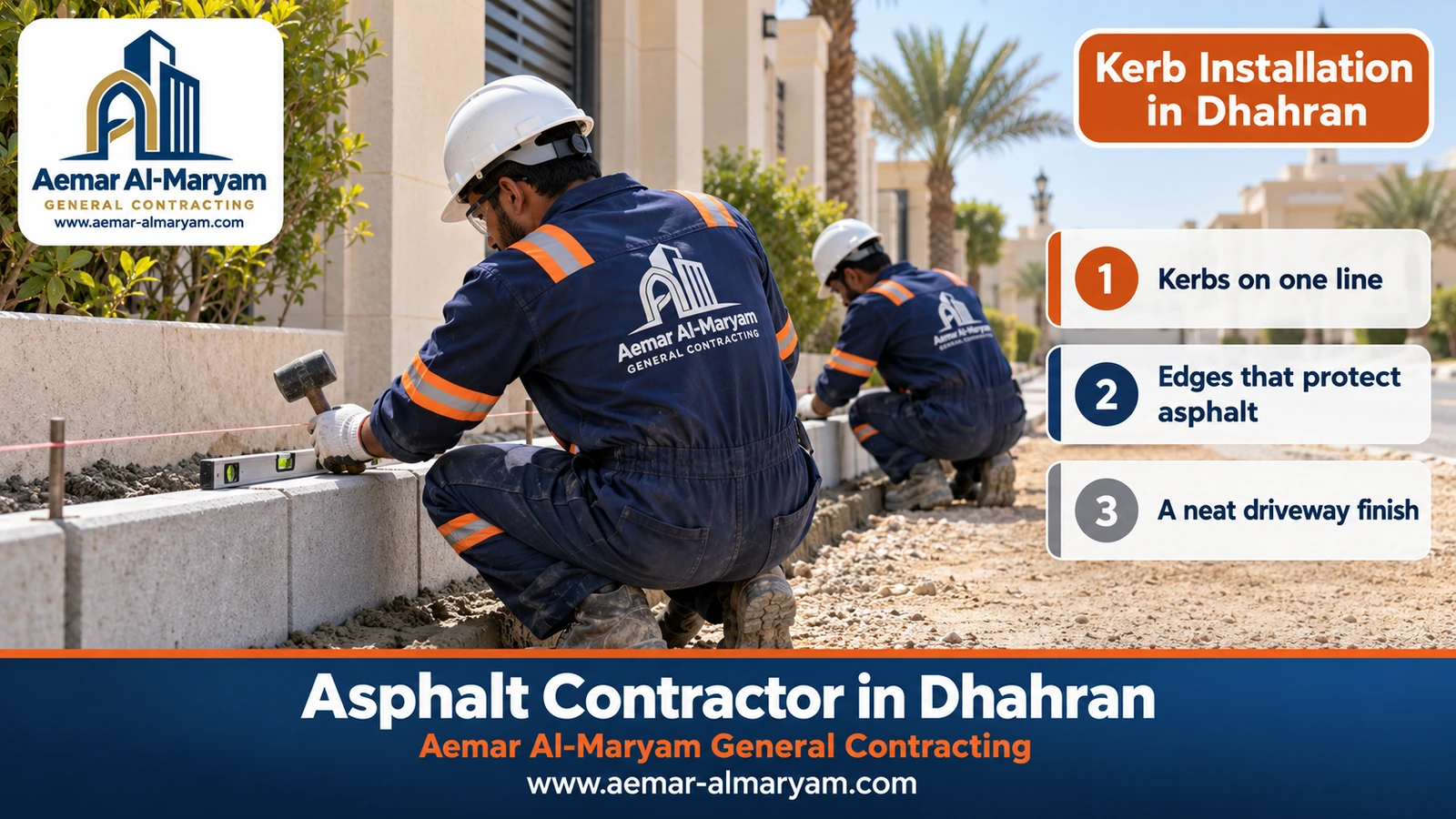
How we set a kerb line
- 1String line and pegs
We fix the kerb line and its level from the levels plan and stretch a string between pegs along the driveway. - 2Preparing the bed
The ground under the kerb line is trimmed and compacted, then a bed of cement mortar or concrete is laid to the required depth. - 3Setting and tapping
Each unit is placed on the bed and tapped with a rubber mallet until it touches the string on top and on the side. - 4Checking with a level
Every unit is checked for line and fall with a spirit level and corrected before the mortar stiffens. - 5Haunching and joints
The back of the kerb is haunched with concrete so it does not lean when the roller comes close, and the joints are filled. - 6Wait, then base
The mortar is left to gain strength before rollers approach the kerb; then the base course and the asphalt follow.
Kerb level against the asphalt surface
Along streets and paths the kerb stands above the finished asphalt so that water runs beside it to the drain; where cars cross, at garage entrances and driveway mouths, a dropped or splayed kerb is used. A common mistake is setting kerbs to the existing ground and discovering after paving that the asphalt sits level with them or above them, so water runs into the garden. We therefore work out the base and asphalt thicknesses first and only then set the kerbs to the right level.
Kerbs around asphalt are priced after inspection, since cost depends on the unit type, the length of the line and the number of curves. If you want interlock next to the asphalt, the details are on the interlock and kerbs service page.
Asphalt for factory yards and warehouses near Dhahran
The Second Industrial City lies west of Dhahran and the Third to its south along the coastal road, and around them are factories and warehouses whose yards see trucks all day. A loading yard is the hardest place there is to pave: heavy wheels standing in front of the loading doors, trucks turning slowly, forklifts spinning on the spot, and a summer sun that heats the surface far above the air temperature. Apart from its colour, such a yard has little in common with a house yard.
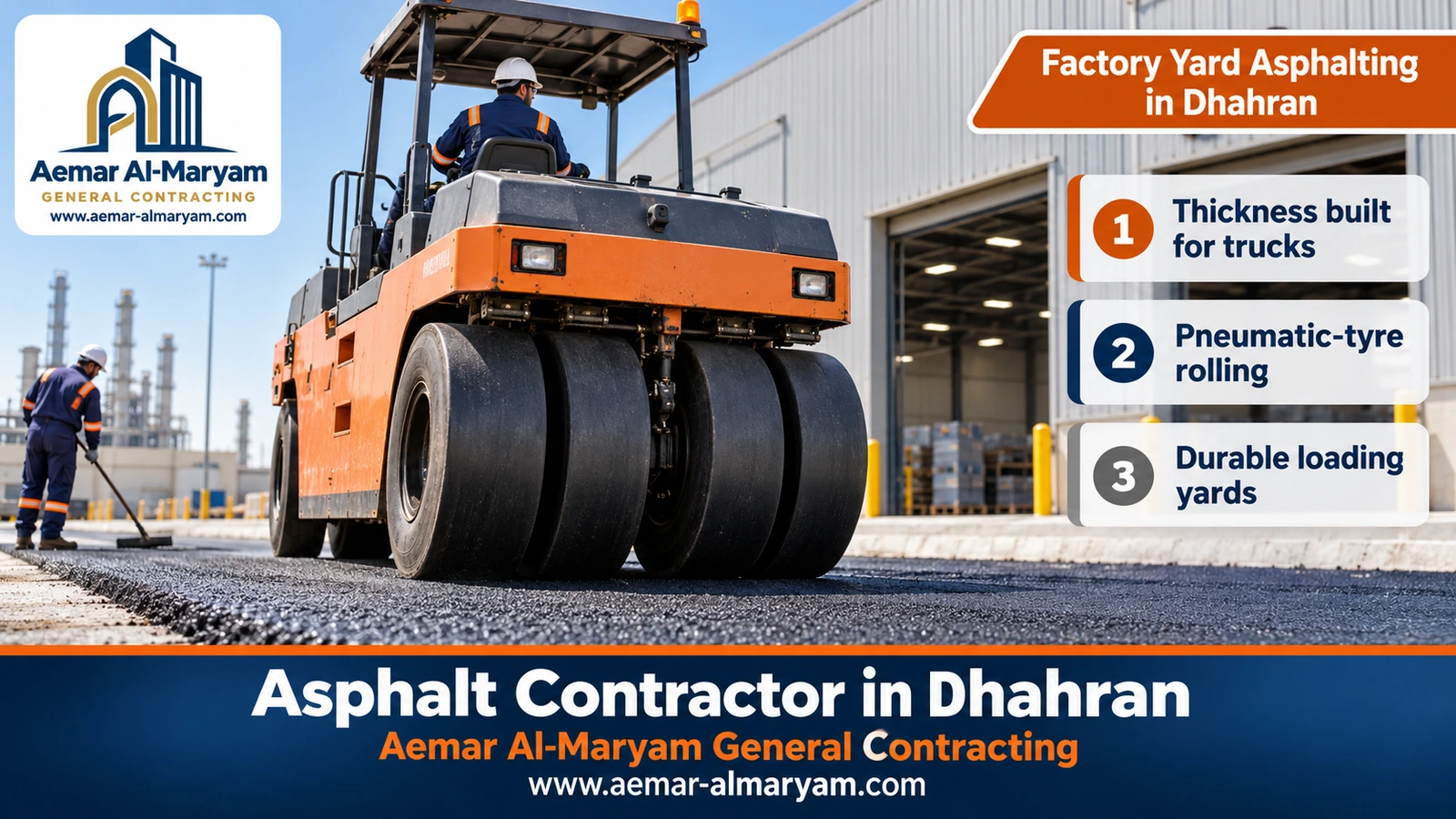
The pneumatic-tyred roller: why we use it on loading yards
Compaction on a thick yard happens in three stages. First a steel-drum roller follows right behind the paver while the mix is at its hottest and gives the layer most of its density. Then comes the pneumatic-tyred roller with two staggered rows of smooth rubber tyres, and its job is different: the tyres knead the surface under an even pressure, pushing the stones to interlock and closing the pores and fine cracks that a steel drum can leave, so the surface lets less water through. Finally a light steel roller runs without vibration to iron out the tyre marks.
All of this must happen while the mix is hot. The reference specification asks for a mix temperature of at least about 139 °C at laying, for the rollers to have finished their work while the mat is still above roughly 90 °C, and for a density of at least 96 percent of the mix’s Marshall reference density. That is why we check the temperature of every truck on arrival and send back any load that arrives cold.
Thickness for truck yards
A single asphalt layer is not laid thicker than about 8 cm compacted, so a yard that needs 12 or 14 cm goes down in two passes; if the second pass waits, or the first collects dust, a thin tack spray goes on before it.
| Type of yard | Asphalt after rolling (approx.) | Base course (approx.) | Note |
|---|---|---|---|
| Staff car lanes | 5–6 cm | About 15 cm | One layer |
| Yard for light delivery vans | 6–7 cm | 15 cm or more | Depends on daily trips |
| Truck loading yard | 12–14 cm | About 23 cm | Two layers, pneumatic-tyred rolling |
| Long-stay truck parking | 12–14 cm | About 23 cm | Consider polymer-modified mix |
| Damp or salty ground | Decided on site | Dig-out and replacement possible | Base designed for the ground |
Polymer-modified asphalt for standing loads in heat
Standard binder (60/70 penetration bitumen) is fine for family cars and light car parks. But studies of regional mixes by KFUPM in Dhahran itself concluded that binders in the Kingdom’s eastern areas need polymer modification to perform as required, because this is where intense heat and heavy axles come together. The place you see the difference is in front of loading doors and in truck parking bays, where tyres stand for hours on a hot surface and leave ruts. We therefore suggest it for those zones specifically, from SAR 55/m², while the rest of the yard can stay in the standard mix if you prefer.
⚠ Before you pave a factory yard
Make sure drainage, power and water services under the yard are finished, and that the route of any future lines is reserved with empty ducts. Cutting new asphalt later to run a cable leaves weak joints. If a cut is unavoidable, it is work for our concrete cutting in Dhahran team.
Asphalt layers in Dhahran: what sits under the black surface
Whether the site is a compound street, a factory yard or a villa driveway, the layers from the bottom up are the same; only their thickness changes. Most of the asphalt failures we are called to repair in Dhahran come back to one of these layers having been cut short.
- 1Natural subgrade
Soft and organic material is removed, then the ground is graded and compacted at suitable moisture to about 95 percent of maximum dry density. - 2Base course
Graded aggregate laid in layers of no more than about 15 cm each and compacted to about 100 percent of maximum dry density; roughly 15 cm under cars and 23 cm under trucks. - 3Prime coat (MC)
Between 0.65 and 1.75 litres goes on each square metre, more on an open base and less on a tight one, and it then needs a full day or longer to soak in. - 4Hot mix
Laid with a paver and compacted with rollers while hot, in one or two layers depending on the required thickness.
| Point | MC prime | RC tack |
|---|---|---|
| Sprayed onto | Fresh crushed-stone base | Existing asphalt, a first asphalt layer, kerb and concrete faces |
| Quantity | 0.65–1.75 L per m² | A quarter of a litre per m² at most |
| Wait | A full day or more | Until the solvent evaporates; spray again if three days pass without paving |
| If it is missing | The asphalt separates from the base and water gets between them | The new layer slides and cracks at the edges |
Tack coat is also brushed or sprayed on the side face of kerbs and any concrete the asphalt touches, so the edge bonds and no gap opens for water to get in.
Asphalt in front of houses and villas in Dhahran
At villas the work usually covers the garage driveway, the owned strip in front of the gate and the edges of the yard. Five to six centimetres compacted on a good base is enough for family cars. Three details matter more than thickness here: the fall must run away from the villa wall and the majlis door; kerbs must separate the asphalt from the garden before paving so irrigation water does not creep under the edge; and inspection chamber covers must be raised to the new level instead of becoming small pits in the driveway.
On narrow paths that a paver cannot enter the crew spreads the mix by hand, levels it with rakes and lutes, then rolls it with a compact roller or a vibrating plate, making sure the mix is still hot when it reaches the last metre. If the villa is being renovated, paving should come at the end, after the renovation work in Dhahran and after the debris has gone, because heavy trucks break fresh asphalt.
Asphalt or interlock for the driveway?
Asphalt goes down in less time, costs less per metre and gives one seamless surface you can patch in place. Interlock brings colour and pattern and its blocks come up and go back, yet it relies on kerbs to hold it and takes more days. Many Dhahran villas combine the two: asphalt for the car lane and interlock for the walkway and garden.
Asphalt patching, crack sealing and milling in Dhahran
Asphalt patching in Dhahran is needed most at compound gates and factory yard entrances, where turning and braking repeat all day. A patch that lasts follows a sequence: we saw-cut around the damaged area in straight lines at right angles until we reach sound asphalt, dig out the inside of the cut to firm material, coat its walls and floor with tack, then place hot mix and roll it working from the middle toward the edges, leaving a slight crown that settles under traffic. Cold mix is for emergencies only, and a stop-gap cold patch is priced from SAR 46/m².
- ✓Crack sealing: clean the crack, blow the dust out with compressed air, then pour hot rubberised sealant into it; priced after inspection.
- ✓Milling and re-laying: plane off 3–5 cm of the tired surface, spray tack coat and lay a new layer; from SAR 38/m².
- ✓Full-depth repair: where a pothole is caused by base settlement, the failed base is removed and recompacted before the asphalt goes back.
Asphalt price per square metre in Dhahran
Dhahran shares one price list with Dammam and Al Khobar because our crews cover the three cities every day. What moves the number for your own site is its size, the thickness, the soil, whether a base worth keeping is already there, and how machines reach it. Every figure below is an estimate until inspection and agreement.
| Item on a Dhahran site | From | Typical use |
|---|---|---|
| Hot asphalt, 5 cm, over a sound existing base | SAR 37 per m² | Villa driveways and compound streets with a good base |
| A 7 cm layer over a sound existing base | SAR 41 per m² | Delivery yards and warehouse aprons |
| Every layer from the soil: grading, crushed-stone base, prime, 5 cm asphalt | SAR 74 per m² | A street or driveway on bare earth |
| Mix with polymer-modified binder | SAR 55 per m² | In front of loading doors and long-stay truck bays |
| Stop-gap pothole filling with cold mix | SAR 46 per m² | Until a permanent patch is booked |
| Planing off 3–5 cm and laying a fresh surface | SAR 38 per m² | Tired compound streets on a firm base |
| Lasting hot-mix patch inside a straight saw cut | On inspection | Gates and yard entrances |
| Precast concrete kerbs along the asphalt | On inspection | Depends on unit type and length |
| Supplying and compacting a stone base on its own | On inspection | When the asphalt follows later |
| Treating damp or salty ground | On inspection | After the soil is checked |
| Bay lines and arrows | On inspection | Depends on line length and count |
| Pouring hot rubber sealant into cracks | On inspection | Depends on crack length |
Worked example: an internal street in a residential compound
This is an illustration for an internal street 85 metres long and 6 metres wide, on bare ground that needs levelling and a base course, used only by residents’ cars. The area is 85 × 6 = 510 m².
| Item | Calculation | Approximate result |
|---|---|---|
| Cost with the full system | 510 × 74 | SAR 37,740 (starting figure) |
| Tonnes of mix for a 5 cm mat (taking 2.3 t per m³) | 510 × 0.05 × 2.3 | About 59 tonnes |
| Base course at 15 cm after compaction | 510 × 0.15 | About 76.5 m³ |
| MC prime at roughly a litre a square metre | 510 × 1 | Around 510 litres |
| Kerbs on both sides | 85 × 2 | 170 linear metres (after inspection) |
If the same street already had a sound base and needed only an asphalt layer, the figure would be 510 × 37 = SAR 18,870 as a starting point. The gap between those two numbers is exactly what gets left out when someone offers a low price without mentioning the base course.
What pushes the price up or down?
- ✓A small job carries a higher rate per square metre: the paver, rollers, truck and crew cost the same whatever the size.
- ✓Breaking out old asphalt or concrete and removing debris is a separate item, which our demolition team in Dhahran can handle.
- ✓Raising inspection covers and adjusting drains and kerbs is priced after inspection.
- ✓Bundling several jobs into one visit lowers each square metre’s share of the equipment cost.
When can you drive on new asphalt in Dhahran?
Unlike concrete, hot asphalt is never kept wet to cure; it gets its strength from the rolling it received while hot, and it can carry cars as soon as the whole layer has cooled. So instead of a fixed number of hours, you get an opening time from us on the day, judged from the heat and the depth we laid. In the first summer days after paving we ask the compound or factory management to keep trucks from standing long on the new asphalt, to stop wheels being turned on the spot, and to put boards under forklift legs and container feet.
The waiting that is counted in days happens before the asphalt, not after it: at least 24 hours after spraying the prime coat, and some days to compact a thick base course in stages.
The public street in Dhahran: what a private contractor does not do
Inside your property line, whether a villa yard, an internal street in a private compound or a factory yard, you do not need an excavation permit to pave your own ground. The public street in front of the villa or compound is paved and maintained by the municipality, and anything that cuts into it or spills onto it is a matter for the municipality and its coordination office; a trench for a new utility connection is requested by the utility itself on Balady. We therefore finish our asphalt at your boundary, with a clean joint against the street and no change to its level. For a pothole out on the public road, call 940 or use the Balady app.
Mistakes we see in Dhahran paving
- ✓Asphalt laid on levelled sand without a compacted base course, which then sinks along the wheel paths.
- ✓A thin tack mist on a fresh base where a proper prime belongs, or mix laid the very day the base was sprayed.
- ✓Kerbs fitted after the asphalt, so the edges are cut and patched.
- ✓A loading yard laid as one thin layer that ruts in front of the doors in its first summer.
- ✓Late rolling after the mix has cooled, leaving a porous surface that ravels.
- ✓A fall that runs toward the garage door or the building wall.
Accepting asphalt in a compound or factory: a checklist
Do not wait for the first rain to learn whether the job was done well. These are simple checks made on handover day with us present, and none of them needs a laboratory:
- ✓Water test: run a hose over the low parts; the water should flow toward the drain without collecting in patches.
- ✓Straightedge: a 3–4 metre aluminium straightedge laid in several directions should show only a gap of a few millimetres underneath.
- ✓Thickness: measured at exposed edges, and on large yards a core can be taken on request.
- ✓Joints and edges: straight joints that are not open, and edges bonded to the kerb without cracks.
- ✓Covers and drains: manhole covers and gullies at the level of the new surface, neither proud nor sunk.
- ✓Clean site: no loose stones, no roller marks and no mix left on kerbs or gardens.
Equipment we bring to Dhahran sites
The crew changes with the site, but the usual equipment is a grader or loader for shaping levels, a water tanker for moistening the base, a vibratory roller and a plate compactor, a sprayer for prime and tack coats, an asphalt paver, a steel-drum roller and a pneumatic-tyred roller for yards, a milling machine when we plane, a floor saw for straight cuts, a handheld thermometer for the mix and an aluminium straightedge for checking.
How to order an asphalt contractor in Dhahran
- 1Photograph the site
Pictures from a few angles, the approximate length and width, and what the surface is now, sent to WhatsApp 0547879578. - 2Tell us the traffic
Residents’ cars only, delivery vans, or trucks and forklifts, and where they stand for long periods. - 3Share the site rules
For a compound or a factory: entry hours, equipment permits and the name of the person in charge. - 4Inspection and levels
We visit, measure the levels and the water direction, and check any existing base. - 5An itemised estimate
Base and asphalt thickness after compaction, prime coat, kerbs, and what the price does not include. - 6Work and handover
Base preparation, prime coat, paving and rolling, then a straightedge check and a water test on the falls.
What you get from our Dhahran crews
■ Close by
We move between Dammam, Al Khobar and Dhahran every day, so visits and follow-ups are easy.
■ Numbers in the agreement
Base and asphalt thickness after compaction written down, not “one layer of zeft” with no figure.
■ Rollers that suit the site
A steel-drum roller for breakdown, a pneumatic-tyred roller for thick yards, a small roller for driveways.
■ Clean edges
Kerbs set before paving to a string and a level, and straight saw-cut edges on every patch.
■ Working with compounds
Staged scheduling, notices for residents, and respect for working hours and gate rules.
■ Honest limits
We do not pave the public street, and we tell you what needs the municipality or an engineer.
Finished jobs are in our projects section, and every starting figure sits on the prices page.
Dhahran districts and nearby cities we serve
We serve Dhahran villas and residential compounds, including:
The Dhahran area page lists everything we offer there. Beyond the city our asphalt crews cover Al Khobar, Dammam, asphalt contractor in Qatif where farm roads run between palm groves, and in asphalt contractor in Saihat where building car parks are the main job. If the villa needs other work before paving, read about our plumber in Dhahran for yard services and annex and majlis building in Dhahran if a new annex is going up in the yard.
A compound street, a factory yard or a villa driveway in Dhahran?
Photograph it, tell us its size and who drives on it, and we reply with layer thicknesses, a kerb line and an estimated cost before we book a site visit.
Related pages
Tags