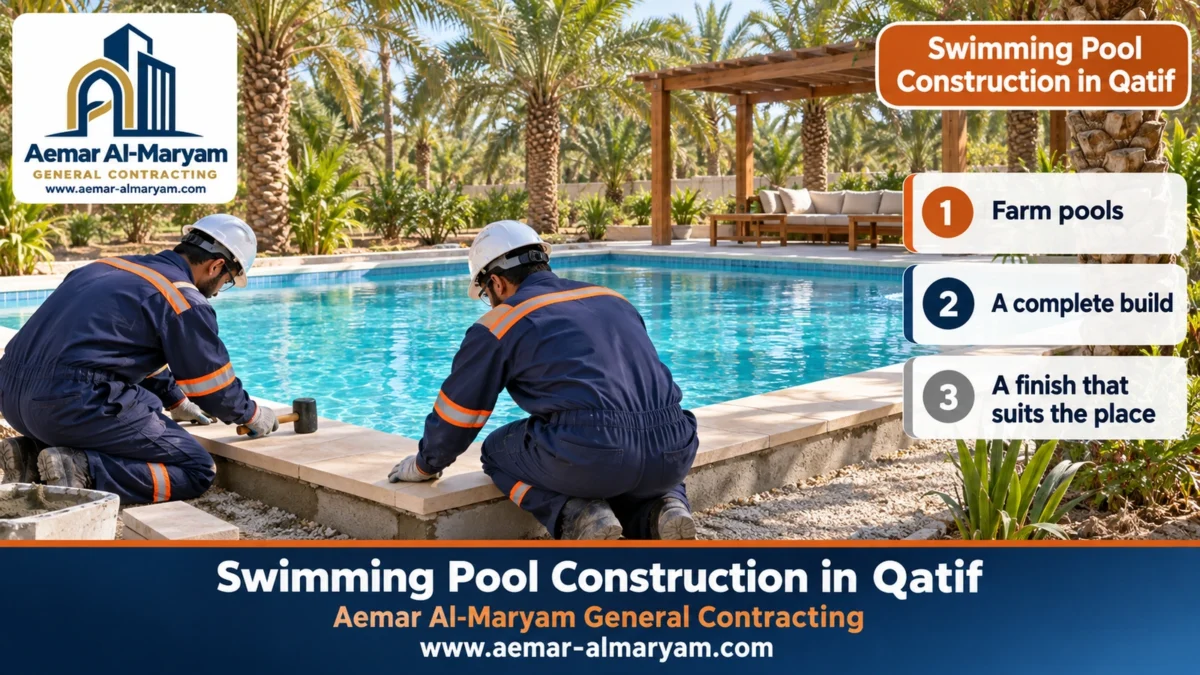
In Qatif, pool requests rarely come from the standard villa garden. They come from two very different places: a farm among the palm groves, where the owner wants a basin the family can gather round at the weekend, and an older house with an inner courtyard, where the family wants a small pool with clear steps that a mother and children can walk down safely. For us, swimming pool construction in Qatif means building the reinforced-concrete basin, waterproofing and tiling it, running its pipes, preparing its plant room, and, where the site needs it, building waterproofed and drained planters around it. Our smallest concrete pool starts from SAR 12,900 and a three-by-six-metre basin from SAR 19,400; treat both as estimates until we have visited and agreed the scope. Calls and WhatsApp: 0547879578.
From our Dammam base, Aemar Al-Maryam General Contracting covers the whole Qatif governorate, from the city and its districts to Tarout Island, Safwa, Al-Awamiyah, Al-Qudaih and Anak. This page starts with farm pools, moves to prices and a worked farm example, then pool steps in old courtyards, soil and groundwater, waterproofing and tiling, planters, water features and renovation. For every pool type and system in greater depth, read swimming pool construction in Dammam.
Qatif pools at a glance
- Farm pools: simple rectangles with pale coping and a shaded seat, set where they clear the palm trunks and irrigation runs.
- Old-courtyard pools: small basins with a wide internal staircase and a dark edge on each tread that shows under water.
- Planters: blockwork, render, internal waterproofing, a gravel layer, drainage fabric and weep holes at the foot of the wall; priced at inspection.
- Pool prices: SAR 12,900 for the smallest, 19,400 for three by six, 29,500 at nine metres, 38,800 at ten and a half, 60,000 for overflow.
- Travel: Qatif lies outside our Dammam, Al Khobar and Dhahran zone, so travel is set at inspection, and bundling jobs into one visit softens it.
- What we need: photos of the site, rough sizes and where the palms or house walls are, on WhatsApp 0547879578.
A farm pool among the palms in Qatif: where it goes and how we protect it
A farm pool in Qatif is built on land with a life of its own: palms with dense root masses, irrigation channels or pipes crossing the ground, soil that may be wetter than a house yard, and fronds dropping on the water all year. So on a farm our work starts with a walk round with the owner before anything is measured: where people usually sit, where cars come in, where the irrigation runs, and which palms must not be touched.
- ✓Clearance from the palms: we choose an open spot between rows of palms rather than one hard against the trunks, so we cut fewer roots and fronds do not pile into the water.
- ✓Irrigation routes: buried pipes and channels are located and diverted before digging, and irrigation water is never left running towards the pool wall.
- ✓Basin level: the coping sits slightly above the surrounding farm ground so that when the land is irrigated the muddy runoff stays out of the pool.
- ✓Fill water: we ask where the water to fill the pool will come from; irrigation water on some farms is not drinking water and can be very salty, which affects sanitising and equipment.
- ✓Skimmer and fronds: a farm skimmer basket fills faster, so we place it where the wind drives the leaves and suggest a cover when the pool is not in use.
Farm and rest-house pools serve more guests than a house pool, so we usually suggest a wide shallow area for children and a deeper part for adults, a shaded seat by the water, and a slip-resistant surface from the basin to the sitting area. If you would like a majlis or an annex with a washroom next to the farm pool, the building side is covered on annex and majlis builder in Qatif.
Swimming pool construction prices in Qatif
The cost of building a pool in Qatif begins at SAR 12,900 for the smallest concrete basin we build, roughly 2.5 m wide, 4.5 m long and near a metre deep, followed by SAR 19,400 for a three-by-six-metre basin with a graded depth, which is the size farms ask for most. Included: digging in ordinary ground without rock, casting the basin in reinforced concrete, lining it, tiling it in pool ceramics, laying its pipes once they pass testing, and readying a spot for the pump. The pump, filter and sanitiser are chosen with a specialist supplier and added afterwards.
| What you ask for | Charged per | Price starts at |
|---|---|---|
| Small concrete courtyard basin (about 2.5 by 4.5 m) | pool | SAR 12,900 |
| Farm pool, three by six metres, skimmer | pool | SAR 19,400 |
| Pool about nine metres long and four wide | pool | SAR 29,500 |
| Rest-house pool about ten and a half metres long | pool | SAR 38,800 |
| Overflow with a concrete balance tank | pool | SAR 60,000 |
| Two-coat flexible cementitious lining | square metre | SAR 74 |
| PVC membrane lining | square metre | SAR 92 |
| Epoxy pool coating | square metre | SAR 138 |
| Fixing tiles or mosaic inside the basin | square metre | SAR 92 |
| Glass mosaic, supply only | square metre | SAR 110 |
| Sitting-area and walkway tiling, labour | square metre | SAR 37 |
| Lifting old pool tiles | square metre | SAR 14 |
| Stainless ladder | piece | SAR 460 |
| Check on an existing pool | visit | SAR 140 |
| Built planters | — | at inspection |
| Pool equipment from the supplier | — | at inspection |
| Travel to Qatif and its towns | — | at inspection |
| Rooftop, indoor or infinity pool | — | at inspection |
Every figure here is provisional until the site visit and our agreement. Travel is set once we know the location and the number of jobs, and each job carries less of it when the pool, planters and sitting area are done on the same visit. Our other services are listed on the price list.
Worked example: a 3×6 m farm pool with mosaic and a wide surround
For illustration only: a farm in Qatif, a skimmer pool three metres by six, shallow end 0.9 m and deep end 1.5 m, glass mosaic chosen instead of ceramics, and a tiled walkway one and a half metres wide around it because there are many guests.
| Item | How it is worked out | Amount |
|---|---|---|
| Farm basin, three by six | base price | SAR 19,400 |
| Upgrade to glass mosaic | floor 18 + walls 18 × 1.2 = 39.6 m² × 110 | SAR 4,356 |
| Walkway 1.5 m wide around the pool | (6 × 9) − 18 = 36 m² × 37 | SAR 1,332 |
| Stainless ladder | one piece | SAR 460 |
| Estimated total | SAR 25,548 |
Not included: equipment from the supplier, the walkway tiles themselves, travel, and any planters round the seating, all of which are set after we visit the farm. Fixing the mosaic is already in the basic pool price, so the upgrade only adds the cost of the material.
Pool construction company in Qatif: what we do with our own hands
A pool construction company in Qatif should be judged on what it actually builds, not on what it advertises. We are a general contractor, and our own crews build everything structural in the pool. The equipment comes from a specialist pool supplier who sizes it to the water volume, and we install and commission it with them. That split is written into our very first estimate so the owner is never surprised by an item nobody priced.
■ Excavation
Machine digging on farms, and hand digging or a mini excavator in narrow courtyards, with the spoil taken away.
■ Concrete and steel
A reinforced shell to an engineer’s drawing, in salt-resistant concrete water-cured for at least a week.
■ Pipes
Main drains, skimmer, return inlets and the run to the plant room, pressure-tested before they are closed in.
■ Waterproofing and tiles
A flexible lining inside, bitumen outside where the ground is wet, and then ceramics or mosaic finished with coping.
■ Planters and seating
Built, waterproofed planters and tiled walkways and seating areas around the pool.
■ Water features
Cascade walls, rock features and fountain basins, lined, piped and fitted with their own small pump.
Soil and groundwater in Qatif: what they mean for pool excavation
Pool excavation in Qatif needs a look at the ground before the machine comes in. A study of one site in Qatif found expansive clay, ground that grows in volume as it takes up water and contracts as it loses it. It would be wrong to assume this of every plot in the governorate, but it is reason enough for us to see the soil ourselves and leave the engineer to decide on the base and any soil replacement. Across the Eastern Province the groundwater is generally shallow and salty, and on farms it can be shallower still because of irrigation.
- If water appears in the pit: we pump it from a low sump throughout excavation and pouring, and never pour into standing water.
- Concrete: sulfate-resisting cement with a low water ratio, because salts attack both concrete and steel from the outside.
- External tanking: bitumen brushed or rolled onto the outside of the walls ahead of backfill keeps salty water off the concrete.
- Valve in the floor: should the pool ever be emptied, a hydrostatic relief valve admits groundwater instead of letting pressure heave the basin.
Fully draining a farm pool can break its floor
When the groundwater around a pool stands only about 45 cm higher than the water inside, that can be enough to lift some types of empty basin or crack the floor. For maintenance we drain part of the water, or bring the surrounding water level down first, and never rely on the valve alone.
Building a concrete pool in Qatif, stage by stage
Pool building in Qatif is a chain of stages, and none starts before the one before it has been checked:
- 1Site walk
We choose the spot with the owner, measure, and look at the soil, water, palms, irrigation and access. - 2Drawing
An engineering office designs thicknesses and reinforcement and checks whether a permit is needed. - 3Digging and keeping the pit dry
Excavation to level, pumps for groundwater when it shows, and spoil carried off the farm. - 4Floor and walls
Blinding, then floor and wall steel, with drain, skimmer and return pipes set in place. - 5Pouring and curing
Pours in the early morning in summer, then spraying and covering for at least a full week. - 6Testing the shell
Filling the bare shell, letting it soak, then measuring the level for three days. - 7Waterproofing and finishes
Internal and external waterproofing, then tiles, steps, coping and the walkway. - 8Start-up
Equipment fitted with the supplier, a slow fill over several days, and water balancing.
Hot-weather pouring, cooling the mix and cube samples are explained on concrete pouring in Qatif. A medium farm pool usually takes one to two months, longer if groundwater turns up or the owner picks a patterned mosaic.
Pool steps in an old courtyard house in Qatif
A courtyard pool in an old Qatif house is small by nature, and its most important part is the staircase: it is where adults and children get in, and where most slips happen. So we design wide steps inside the basin instead of a narrow metal ladder, and we lay a dark tile along the edge of each tread in a colour that contrasts with the rest of the step, so the eye can see where each one ends under the water.
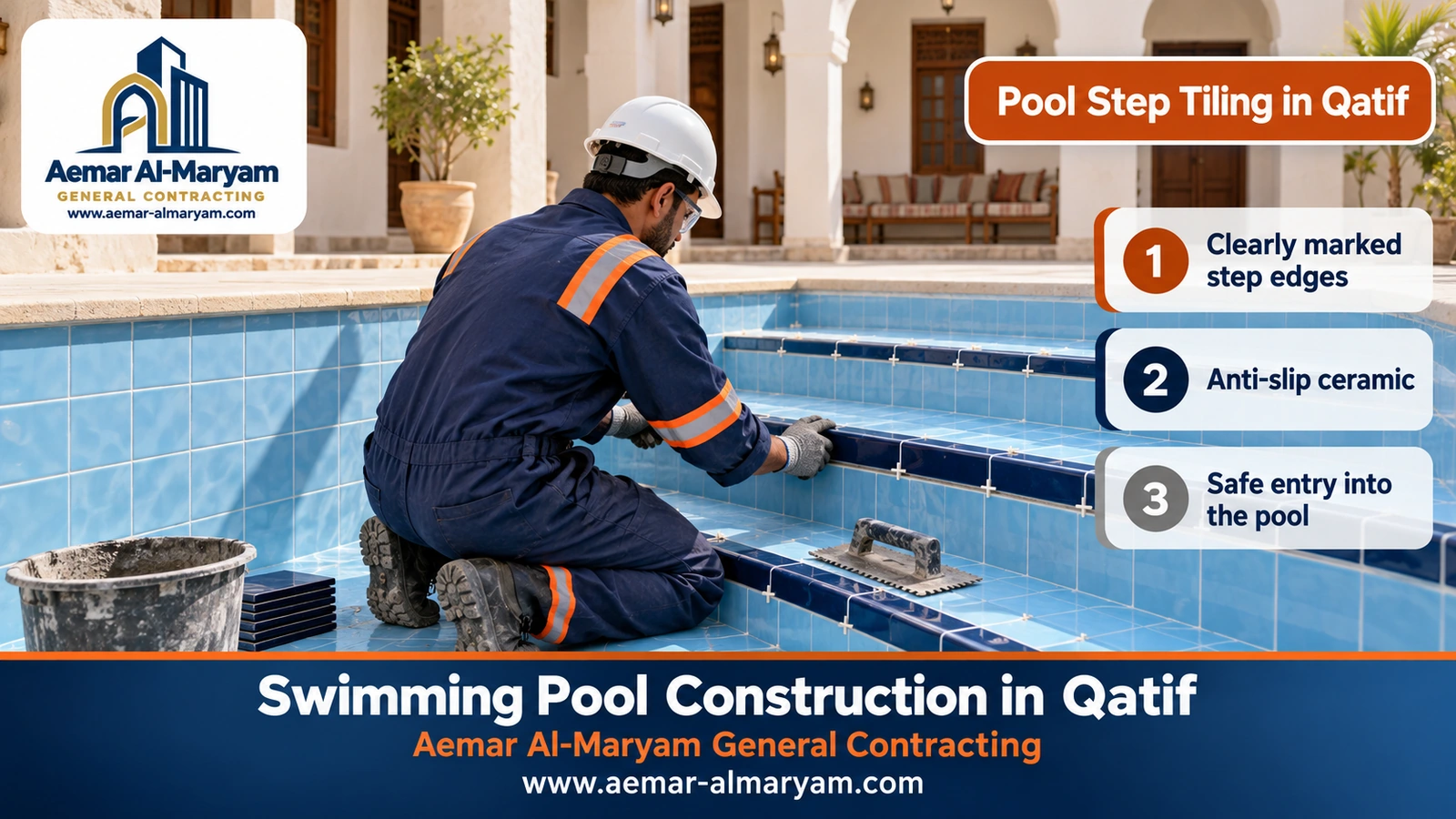
The dimensions we work to come from international guidance for pool steps: risers of no more than about 19 cm, treads of at least about 25 cm, and handrails, where fitted, at roughly 76 to 97 cm high. The step tiles are slip-resistant and their edges rounded rather than sharp.
Working inside an old courtyard
- Access: most courtyards will not take a large machine, so we dig by hand or with a mini excavator and barrow the spoil out to the street.
- The house walls: we leave a clearance set by the engineer between the pool pit and the surrounding wall footings, and never dig under an existing wall base.
- Heritage houses: a house built of mud or old stone needs specialists and official approval before any digging; our work is in houses built of concrete and blockwork.
- A shallow pool: in a courtyard a depth close to one metre, or less in the children’s area, is usually enough, with a tiled bench under the water.
If the courtyard itself needs renovating before the pool, such as new render or flooring, start with renovation contractor in Qatif; if a wider opening has to be cut in a concrete wall to get a machine in, see concrete cutting in Qatif.
Concrete pools in Qatif: skimmer or overflow?
Farm or house, every Qatif basin we build is reinforced concrete. Out on a farm, skimmers usually do the job: the waterline stays just under the coping and the surface is pulled off through an opening in the wall, which keeps building and maintenance simple. An overflow pool, where water spills into a channel around the basin and then into a balance tank, gives a surface flush with the stone but needs space and a waterproofed concrete tank, and it starts from SAR 60,000. We do not build basins from blockwork alone, because block cannot resist the push of water and soil the way reinforced concrete does.
Pool waterproofing and tiling in Qatif
Pool waterproofing in Qatif comes only after the shell has proved itself in a fill test: we fill the bare concrete, let it soak for three days, then follow the level for three more with a container of water beside the pool to measure evaporation. The reference we use for concrete water-retaining structures accepts a daily loss of around 0.05% of the water volume. Once it passes we apply a two-coat flexible cementitious lining with mesh at the corners and around fittings (from SAR 74 per m²), or a PVC membrane (from 92), or epoxy (from 138), and on the outer face of the walls a bituminous layer before backfilling where the ground is damp.
Then come the tiles: low-absorption pool ceramics or glass mosaic, an immersion-rated adhesive covering the whole back of each piece, epoxy grout where needed, and movement joints where the wall meets the floor. Tiles are left for some days before grouting, then the whole pool rests for about three weeks before it is filled, slowly and over several days. Ordinary floor tiling in the house is a different job, covered on tile installer in Qatif, and roof and tank waterproofing is on roof waterproofing in Qatif.
Built planters in Qatif: waterproofing and drainage before the soil
Built planters around a pool seating area or in a Qatif courtyard look good only as long as they keep irrigation water to themselves. A planter built from block and filled straight with soil becomes, after a few months, a source of damp and salts on the house wall and the seating floor. So we build it as a structure that holds water and drains it.
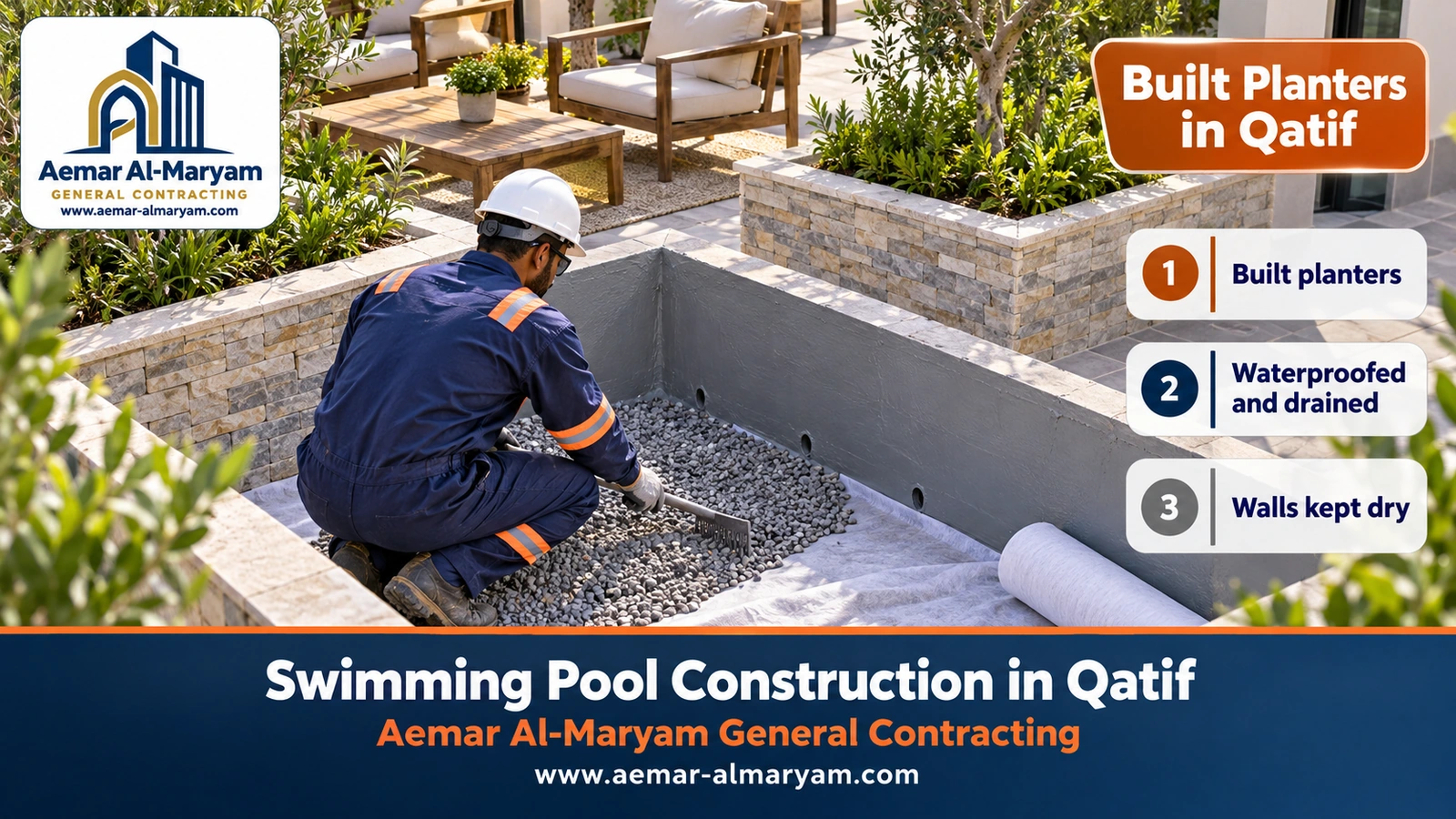
- 1Base and walls
A concrete base to carry the weight of wet soil, then block walls to the height required, rendered. - 2Drainage openings first
Weep holes at the foot of the wall and an overflow outlet go in before waterproofing, never drilled through it afterwards. - 3Internal waterproofing
A coating suited to wet soil over the floor and walls, up past the soil line. - 4Drainage layer
Gravel on the floor, then drainage fabric so soil cannot clog the gravel and holes. - 5Root barrier and soil
A barrier to keep roots off the waterproofing, then soil to a level that does not leave the coating exposed to sun. - 6Outer face
Finished in stone, tile or paint to match the seating.
A planter never borrows the house wall: it gets its own wall, or a gap is left and the house wall is tanked, which keeps watering from soaking through indoors. Planting and choosing plants is not our work, so we hand the planter over ready for the gardener. Each planter is quoted after the visit, depending on its run, its height and its finish, and rendering their walls is the same work described on plastering contractor in Qatif.
Waterfalls and fountains in Qatif
A waterfall on a farm or in a courtyard is a closed water loop: a small pump in a lower basin lifts water through a hidden pipe, it runs over the stone or off a lip in the wall, and falls back into the basin. Our crew raises the wall or rockwork and casts the basin, lines both before cladding, run the pipe and power, and fit the pump. A fountain works the same way except that the water rises from a nozzle and falls back.
| Type | Starts from |
|---|---|
| Ground-level rock waterfall in natural stone, medium | SAR 7,400 |
| Small wall waterfall about one metre wide | SAR 3,700 |
| Wall waterfall about two metres wide | SAR 6,450 |
| Large wall waterfall three metres wide or more | SAR 11,000 |
| Modern corner waterfall | SAR 5,500 |
| Large waterfall with pond and lighting | SAR 13,900 |
| Underwater lights for a feature | SAR 460 |
| Fountain for a home, small or medium | SAR 3,200 |
On farms we advise against filling a waterfall basin with salty irrigation water, because the salts settle on the stone and nozzles and wear the pump, and the level in the basin should always stay above the pump so it never runs dry.
Pipework, electrics and safety for Qatif pools
The plant room for a farm pool is usually a small block room near the basin, and Qatif’s humidity makes its position and ventilation important: the electrical panel and pump do not like damp, salty air, so we raise the panel off the floor, choose an enclosure suited to damp locations and leave ventilation openings. No buried pipe is backfilled until it has held test pressure, as in the work of a plumber in Qatif.
- ✓Low-voltage lighting: lights in the water run on 12 V from a transformer kept well away from the pool, nearby metalwork is bonded, and a 30 mA RCD protects the circuit; outdoor circuits are detailed on electrician in Qatif.
- ✓A fence on the farm: a farm is open to children and guests, so we recommend a fence round the pool at least 1.2 m high and a self-closing gate.
- ✓Safe drains: at least two main drains per pump, 0.9 m or more apart, with covers that prevent hair entrapment.
- ✓Seating floor: rough, slip-resistant tiles or stone that fall away from the water.
Looking after a farm pool in Qatif between visits
A farm pool in Qatif is not used every day the way a house pool is, and that changes how it is cared for. During weeks away, fronds and dust build up, and in summer the water warms and algae grow quickly if sanitising stops. So we suggest farm owners keep the pump on a timer that runs it for some hours daily even when nobody is there, cover the basin with a suitable cover, and ask whoever visits the farm to empty the skimmer basket once or twice a week.
- Before the weekend: test the water the day before guests arrive; home-pool guidance from US health authorities puts pH between 7.0 and 7.8 and free chlorine at 1 ppm or more.
- After a dust storm: lift out leaves and sand first, backwash the filter, and hold off adding chlorine until the water clears.
- Topping up: summer evaporation is faster, so top up from the water source we agreed on, not from the irrigation channel.
- Salt systems: they generate chlorine, but you still need to test the water and clean baskets and filter.
In the short rainy spells we make sure the walkway falls carry muddy rainwater away from the pool and that the weep holes in neighbouring planters are open, so mud does not wash into the water.
Pool renovation in Qatif: falling mosaic and what lies beneath
Pool renovation in Qatif starts with one question: why did the tiles come off? In older pools we often find mosaic falling because the adhesive was not rated for immersion, or because the waterproofing behind it failed and the render became saturated, or because the shell itself is cracked. New tiles laid over an old cause fall off again. So we inspect first (a check-up visit starts from SAR 140), then decide: re-waterproof and re-tile, treat cracks and then waterproof, or call for an engineer’s report if the structure is damaged.
- A bucket comparison: put a filled bucket on the top step, pencil both waterlines (in the bucket and on the pool wall), and come back the next day; if the pool has dropped clearly more than the bucket, a leak is likely.
- Cracks: they are treated before waterproofing, as described on crack repair in Qatif.
- Removing an old pool: if the owner decides to fill it in and turn the space into a seating area, breaking out and backfilling are on demolition contractor in Qatif.
- Prices: lifting old tiles from SAR 14 per m², re-waterproofing from 74, tiling from 92, and mosaic supply from 110.
Does a pool in Qatif need a permit?
Because a pool adds structure to a property, the permit question goes to a licensed engineering office before we dig. For a house that already stands, the usual route is the Balady service covering added or altered building components; it requires an existing building permit plus an engineering office, and is normally processed within ten days. In a new build, the pool goes into the original permit drawings. Farms are a different case depending on the land deed and its use, which the engineering office settles with the competent authority.
Areas of Qatif where we build pools
We work in Qatif city and its districts, including Al-Rida, Al-Sawari, Al-Fath, Al-Shati and Al-Sadafah; in the Tarout Island towns of Al-Zour, Darin, Al-Rabiyah, Sanabis and Tarout; and in Safwa, Anak, Al-Awamiyah and Al-Qudaih. When requests cluster we fit nearby towns into one day. Our Qatif page brings together our services in the governorate. For side-yard pools in neighbouring Saihat read swimming pool construction in Saihat, and for long villa lap pools swimming pool construction in Dhahran. Farm and yard paths in interlock are on interlock paving in Qatif.
Why Qatif families choose Aemar Al-Maryam for their pools
- ✓We start from the place: palms, irrigation, the courtyard and old walls shape the design before the size does.
- ✓Steps you can see under water: dark nosings and step dimensions suited to children and older people.
- ✓Planters that do not leak: waterproofing and drainage before the soil, and a wall separate from the house wall.
- ✓Tested before tiles: the shell is water-tested, the pipes held under pressure, and everything photographed before it is buried.
- ✓Clear starting figures: and a travel item agreed before work starts, not afterwards.
How to order a pool in Qatif
The quickest way is to send these five things to WhatsApp 0547879578, and we will come back to you with a first idea and an estimate before we visit:
- 1Photos of the site
the farm or courtyard from more than one angle, with the gate or passage. - 2A rough size
the space available and the distance to the palms or house walls. - 3Location
the town or district, or a map pin. - 4What you want around the pool
seating, planters, a waterfall, shade. - 5Who will use it
children, older relatives, farm guests.
Send us the farm or courtyard
We sketch the pool position, size, steps and an estimated cost, then agree a date to come and see it.
More for Qatif homeowners
Tags