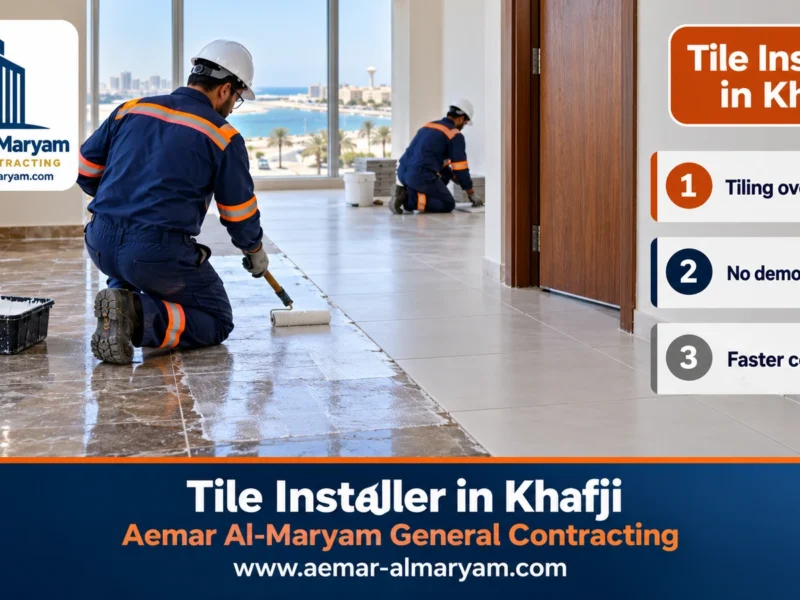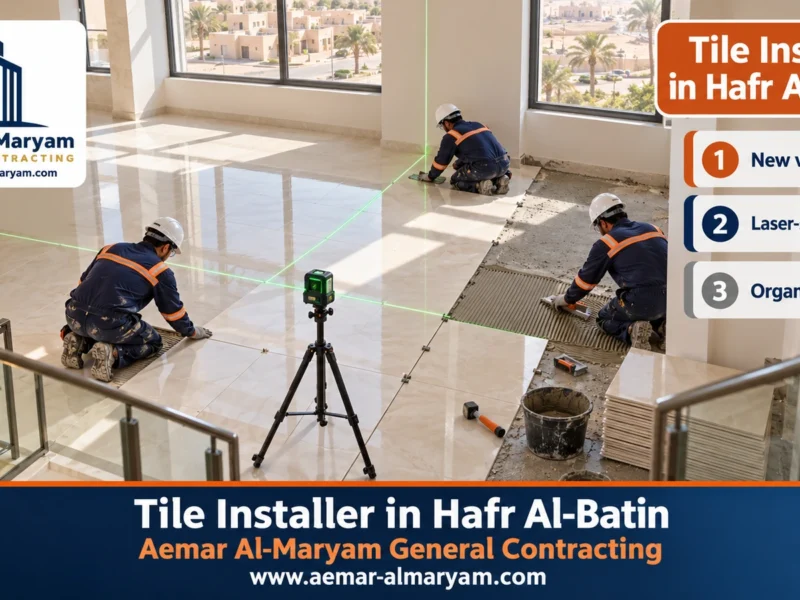
A tile installer in Dhahran for villas and residential compounds: we lay large-format marble-look porcelain in halls and majlis rooms, clad facades in natural stone on mechanical fixings, pave garden paths and courtyards with falls and joints that cope with the sun, and retile bathrooms, kitchens and stairs. Behind this page is Aemar Al-Maryam General Contracting; our base is next door in Dammam, which puts Dhahran on our daily route. For fixing labour, small porcelain (60×60 and below) begins at SAR 32 a square metre, long 60×120 slabs at SAR 37, square 100 and 120 cm slabs at SAR 46, garden paths laid to falls at SAR 37, and natural marble or granite at SAR 92. Treat these as opening figures that we confirm after seeing the villa; to talk it through, ring or message 0547879578.
What villa owners in Dhahran ask for is different from a typical flat job. They want a living room whose floor reads as one continuous sheet of marble with no lipped edges; a stone facade that stays put for years under strong sun and humid air; and a garden path from the gate to the front door that never holds sprinkler water and never turns slippery. All three demand more precision than ordinary tiling. A long slab exposes every dip in the floor underneath it, heavy stone on a facade should not be left hanging on mortar alone, and outdoor tiles expand in the afternoon heat and shrink again at night. The sections below walk through each of these jobs, the tolerances worth knowing, what they cost to start with, and how to judge the finished floor yourself.
In short: tiling for Dhahran villas with Aemar Al-Maryam
- Indoor floors: marble-look porcelain in 60×120 and 120×120 on an improved adhesive with full coverage and a levelling-clip system, or natural marble and granite for entrances and formal majlis rooms.
- Facades: natural stone cladding on stainless-steel brackets with an air gap behind the panels, priced on inspection according to the stone and the fixing method.
- Gardens and courtyards: heavy non-glossy outdoor slabs over a base sloping 1–2%, broken into bays by soft joints no more than about 3.5 m apart; labour from SAR 37 a square metre.
- Opening prices: per square metre, SAR 23 for floor ceramics, 27 for wall ceramics, 32 for bedroom porcelain, 37 for long slabs, 46 for big square slabs and 92 for marble or granite; skirting is SAR 14 a running metre.
- Before and after the tiles: levelling and strip-out each begin at SAR 14 a square metre, polishing at 14 (dropping to 9 beyond 200 m²), and re-bedding a few hollow tiles at SAR 92.
- To book: a few photos of the hall, facade or garden plus rough sizes and the tile you like, sent to 0547879578 on WhatsApp.
Tile installer in Dhahran for villas and compounds: what we install
Our tile installers in Dhahran work in three zones of the same villa, and each zone has its own materials and method. Inside, there are the halls, majlis rooms, bedrooms, bathrooms and kitchens. On the facade, there is stone and heavy marble. Outside, there are courtyards, garden paths, pool surrounds and car entrances. Many projects combine more than one zone.
■ Villa halls and majlis rooms
Large-format marble-look porcelain with the veining arranged across the slabs and matching skirting.
■ Entrances and stairs
Marble or granite for the entrance and the internal and external stairs, with bevelled or grooved nosings.
■ Stone facades
Natural stone panels on mechanical fixings, set out around window and door openings.
■ Garden paths
Thick outdoor tiles on a concrete base laid to fall towards the lawn or the drains, held by a fixed edging.
■ Bathrooms and kitchens
Retiling with waterproofing and a water test, and wall ceramics cut neatly around every outlet.
■ Polishing and repairs
Marble polishing to bring back its shine, and replacement of hollow or cracked tiles with as little disturbance as possible.
The marble and tiles service page gives a short description of the service, and the Dhahran page gathers our other services here. This article goes into the detail that villas in particular need.
A tiler in Dhahran or a tiling contractor?
A good individual tiler knows how to set a tile. A villa project, however, needs someone who decides what happens before and after the tile goes down. Can the old floor take large porcelain, or does it need levelling first? Who works out the quantities and the vein layout before anything is bought? Who coordinates the plumber, the electrician and the facade brackets? With a general contractor, all of that sits with one party. The skilled tiler still does the setting, but within a written plan agreed before work begins.
If you have already chosen and bought your tiles, we install them on a labour-only basis. Before we start we check the batch numbers, shade codes and sizes printed on the boxes, because mixing two production batches in one hall produces a colour difference that cannot be fixed once the tiles are down.
Porcelain installation in Dhahran: why villas choose marble-look porcelain
Marble-look porcelain is the most requested finish in Dhahran villa halls today, because it gives the look of white marble with grey veining without the weak points of natural marble in daily use. Porcelain is pressed and fired so densely that it soaks up no more than half a percent of its weight in water, and it is not marked by lemon juice, vinegar or acidic cleaners, which leave dull etched spots on natural marble.
| Material | Where it suits a villa | What you should know |
|---|---|---|
| Marble-look porcelain | Halls, majlis rooms, bedrooms, corridors | Absorption ≤ 0.5%, unaffected by acids; needs a very flat floor and an improved adhesive |
| Standard ceramic | Bathroom and kitchen walls, service rooms | Lighter and easier to cut; fine for walls and light use |
| Natural marble | Entrances, formal majlis rooms, internal stairs | Etched by acids, and sealing does not stop that; some light marbles need white adhesive |
| Granite | External entrances, outdoor stairs, kitchen worktops | Harder and far less affected by acids; suits heavy use |
| Thick outdoor porcelain | Garden paths, courtyards, pool surrounds | Matt or textured anti-slip surface, laid on a base with falls |
120×120 porcelain in Dhahran: the floor comes before the slab
Before a 120×120 or 60×120 slab goes down in a Dhahran villa, a three-metre aluminium rule laid on the floor must not show a gap deeper than 3 mm anywhere. The American installation standard sets that limit for any tile with a side of roughly 38 cm or more, and lets smaller tiles off with double the gap. A long slab will not bend to follow the floor, so a dip leaves a hollow void and a hump lifts its edge.
So every hall gets a survey first: the rule and a laser go across it in several directions and we mark the low and high spots before any box is opened. The slabs are then bedded in a C2 (improved) cement adhesive, combed onto the floor and also spread thinly on the back of each slab, so that almost no void is left. The standard asks for four-fifths of the tile back to be in contact on dry indoor floors and 95% in wet or outdoor areas, with corners and edges never left unsupported. Clips and wedges between neighbouring slabs keep their edges flush until the bed has set.
With marble-look porcelain we also care about something ordinary tiles never raise: the direction of the veins. We lay the slabs out on the floor before fixing and arrange them so the veining flows naturally and two identical faces never sit side by side. We start the setting-out from the centre of the hall or from the axis of the entrance, so the cut pieces against opposite walls come out equal.
⚠ Ask about the route before buying large slabs
A 120×120 slab needs at least two people and a suction frame to carry it, and a path from the street to the room without tight turns. In some villas the slabs come in through the garden door rather than the front door, and on upper floors they may not fit the lift or the stair. We check this during the site visit before you buy; slabs larger than 120 cm are priced on inspection because they need extra labour and equipment.
Floor and wall tile installation in Dhahran
Laying ceramic on a Dhahran floor costs from SAR 23 a square metre in labour, and on a wall from SAR 27. The method differs between floors and walls. On floors we focus on flatness, falls and the gaps left at the walls. On walls we focus on the first horizontal line, which everything above it is built on: we fix a level batten slightly above the finished floor height and start from it, then fit the bottom course after the floor is tiled so the two meet at a clean joint.
Ceramic tile installation in Dhahran for kitchens and bathrooms
Wall ceramics in Dhahran kitchens and bathrooms need a flat, dry render underneath; adhesive will not correct a wavy wall. A rule held against the wall shows how true it is; where the plaster is drummy or loose we have it put right first by our plastering contractor in Dhahran. We also mark the electrical outlets and water valves on the wall before we start, so each lands in the middle of a tile or on a joint rather than leaving a sliver of tile two fingers wide that is almost impossible to cut cleanly.
Tile adhesive or sand-cement mortar?
In short: an improved cementitious adhesive on a flat substrate for porcelain, large formats, bathrooms and outdoor paths, and a traditional sand-cement bed where the floor level has to be raised or corrected under ordinary ceramic. The letters on the sack tell you a lot: C is a cement-based product, the digit after it (1 or 2) is its grip strength with 2 the stronger, T marks a mix that holds tiles on a wall without sagging, E one that stays workable longer once spread, and S1 or S2 one that flexes. Paths baking in the Dhahran sun get a flexible S-rated mix.
Marble installation in Dhahran for entrances and majlis rooms
Fixing marble in Dhahran costs from SAR 92 a square metre, and owners usually want it for the villa entrance, the formal majlis and the stair landing. Natural marble is heavier and more sensitive than porcelain, so we change three things when laying it: the setting material, the cutting method and the protection afterwards.
- ✓Setting material: pale marble goes down on white adhesive; a grey bed can bleed through the stone and leave shadowy blotches a few weeks on.
- ✓Stones that react to water: a few green or white marbles bow or change colour when a slow, wet bed sits under them, so they get a fast-curing or epoxy bed, after we confirm the stone type with whoever sold it.
- ✓Cutting: with water and a diamond saw rather than a snap cutter, keeping every arris sharp and unchipped.
- ✓Protection: the finished marble is covered until painting and joinery are complete, since a ladder scratch or a dropped paint tin leaves a mark that only polishing removes.
Granite installation in Dhahran for external entrances
Granite suits external entrances, outdoor stairs and heavy-traffic areas in Dhahran better than marble, because its minerals do not dissolve in weak acids, so salty water and cleaners do not mark it the way they mark marble. Outside we choose a flamed, textured or honed finish, since polished granite becomes slippery when wet.
Marble stairs in Dhahran
Cladding a Dhahran staircase in marble costs from SAR 46 for each square metre of tread and riser face, and you pick the stone. One point many people miss when cladding an existing stair is that the marble and its bedding add a few centimetres to every step. If that is not planned for, the first or the last step ends up higher than the others, and that is exactly what makes people trip. The international code that the Saudi building code grew out of caps the step height in a dwelling at 20 cm, wants at least 25 cm of tread depth, and tolerates only 9.5 mm between the tallest and shortest step of any flight. So we measure the whole stair before cutting, spread the difference across the steps so they come out equal, and give each nosing a bevel or grooves to reduce slipping.
Stone facade cladding in Dhahran
Stone facade cladding on our Dhahran villas is done by mechanical fixing: stainless-steel brackets and anchors are fixed into the wall, the stone panel is hung on them, and an air gap of 2–5 cm is left behind it. This is safer than sticking heavy panels on with mortar alone, because hung stone does not rely on a bond that heat and humidity can weaken over time, and the gap lets the stone move while keeping moisture from the mortar from staining its face.
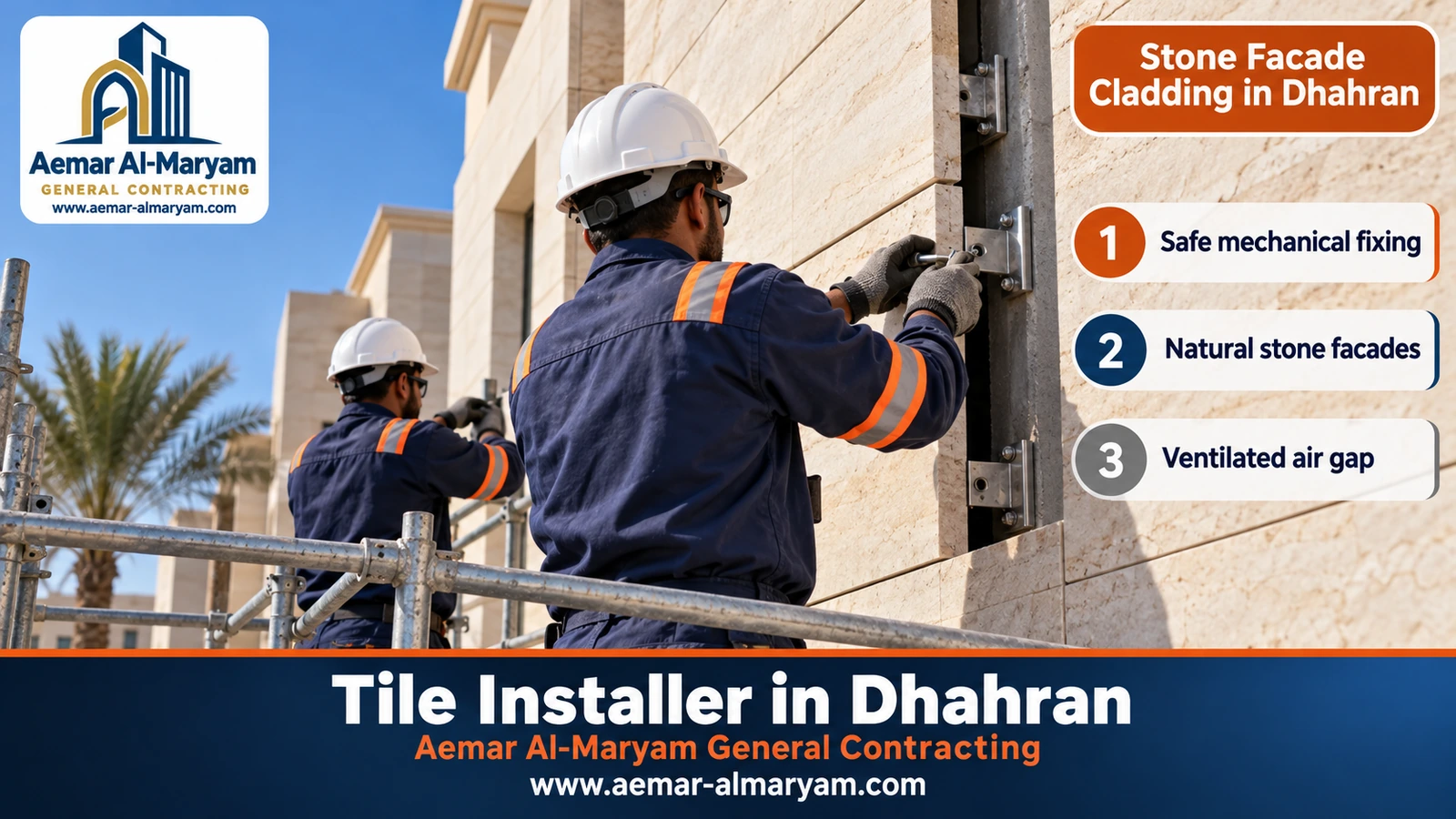
Before cladding we check the wall itself. Is it concrete or blockwork? Anchors go into concrete walls and columns one way, and into hollow blockwork another way or via a supporting metal frame. We set out the courses so the joints line up with the window and door edges, and we leave vertical and horizontal joints that are filled with a flexible sealant. Because the cost depends on the type of stone, its thickness and weight, the facade height and the scaffolding, this item is priced on inspection: send a photo of the facade, its approximate dimensions and the stone you have in mind on WhatsApp 0547879578 for an estimate. If the existing facade needs repair first, see our renovation contractor in Dhahran.
Never hang stone on a weak wall
If the existing facade render is loose or cracked, cladding over it only hides the problem until something falls. We treat the cracks first; the method is explained in crack repair in Dhahran.
Garden path tiling in Dhahran
Paving a garden path in Dhahran costs from SAR 37 a square metre with the falls built in, and the job differs from indoor tiling at every layer. A path sits in direct sun for long hours, gets irrigation water every day, has tree roots pushing beneath it and carries foot traffic and small trolleys. So we build it on a compacted concrete base over stable ground and give the surface a fall of 1–2% towards the lawn or a drain, so sprinkler water does not sit on it and leave white salts in the joints.
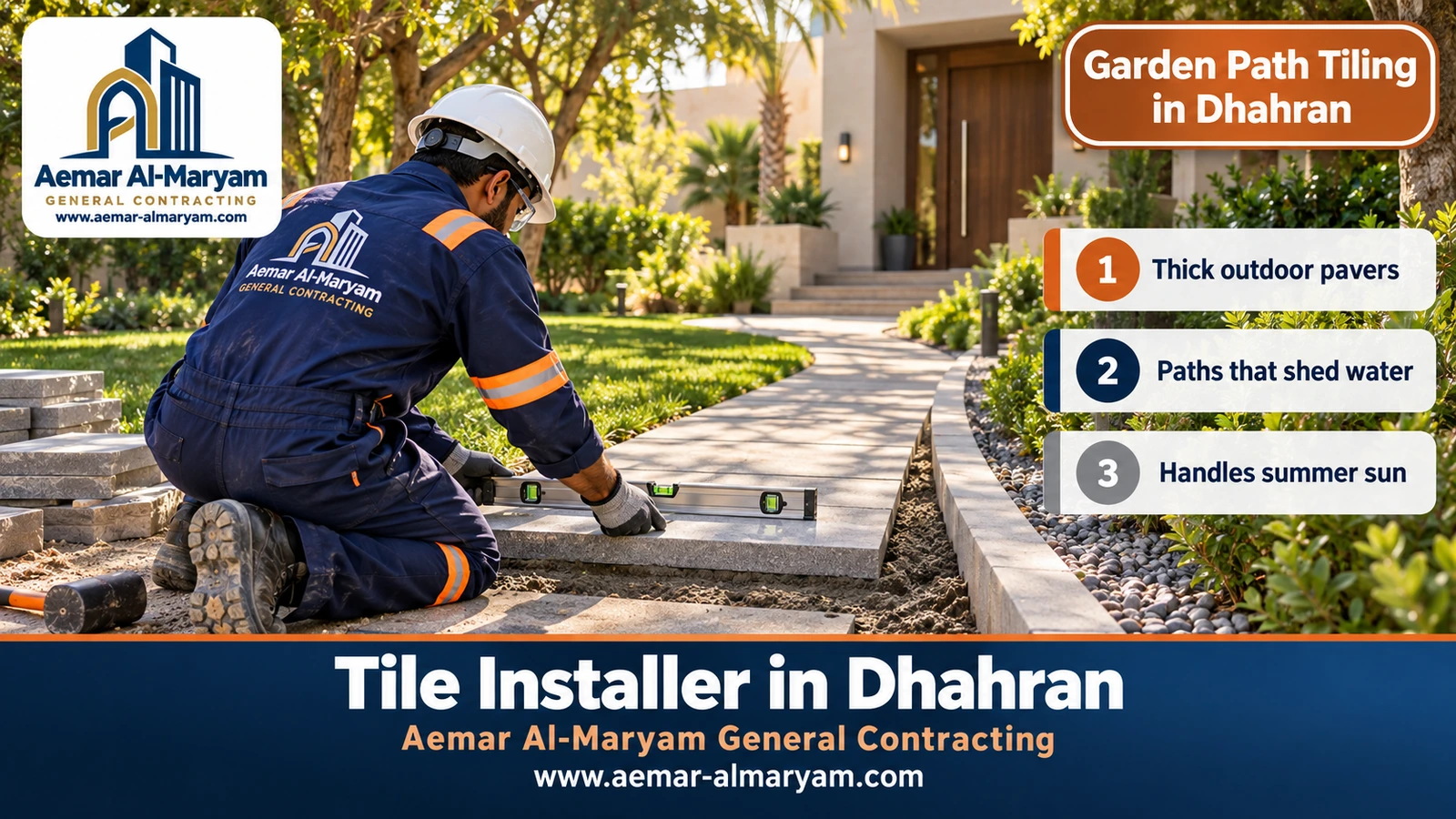
For the path we choose a thick outdoor porcelain with a matt or textured surface, because a glossy face becomes a hazard once it is wet. For flat indoor floors that get wet, the American slip test sets 0.42 as the lowest acceptable wet-friction reading; a garden path should grip better still. We also fix a stone or concrete edging along the side to hold the path, so the outer tiles cannot creep towards the soil.
The joints are what keep a path sound for years. We break a sun-baked Dhahran path into bays with soft joints roughly every two and a half to three and a half metres along and across it, and add one wherever it butts a wall, a step or the pool coping. Without them the tiles lift into a tent shape or crack in summer.
Courtyard tiles in Dhahran: replacing and repairing them
We usually renew courtyard tiles in Dhahran for one of two reasons: water standing in a corner because the falls are wrong, or tiles that have lifted and cracked because no joints were left. In both cases changing the tiles alone achieves nothing. We remove the old tiles, correct the base and the falls towards the drains, and relay with movement joints. If white salts keep appearing on the surface, the source is water rising from the ground or irrigation water getting under the tiles, and we deal with that source before the new tiles go down.
Joints and movement joints in Dhahran villas
Grout width in a Dhahran villa is a technical choice as much as a style one. The rule is to make it no narrower than three times the real dimensional spread between the tiles in the boxes; in practice that tends to land near 3 mm for factory-squared (rectified) porcelain and near 5 mm for standard pressed tiles. Movement joints are something else: soft joints filled with a silicone or polymer sealant instead of grout. We place them at all walls and around columns, inside large interior areas roughly every 7.6 m, closer to 3.6 m where direct sun comes through glazed facades, and between 2.4 and 3.6 m outside.
Can tiles be laid without joints?
Not safely. No two slabs are exactly alike, and concrete grows and shrinks with the heat of the day, so there must be some gap. The trick is a hairline joint, as tight as the slab tolerances permit, filled with grout matched to the porcelain so the eye reads one seamless surface.
Bathroom tile replacement in Dhahran
Taking a small Dhahran bathroom back to bare concrete and rebuilding it with waterproofing and budget tiles costs from SAR 2,300; tiling labour on its own runs from SAR 36 per square metre of floor and wall. Whatever tile you pick, the order never changes: break out everything to the slab, look over the pipework while it is visible, screed the floor to falls, lay the membrane and lap it up the walls, then fill the room with water for a day or two to prove it before tiling.
Under the shower the floor drops 2 cm in every metre towards the outlet, never steeper than 4 cm; elsewhere in the room half a centimetre to a centimetre per metre is enough. For checking the pipework before tiling we coordinate with our plumber in Dhahran, and for waterproofing and the flood test see roof waterproofing and insulation in Dhahran, which also covers bathrooms. For a full bathroom refit with sanitaryware and lighting, see the bathroom and kitchen renovation service.
Marble polishing and porcelain care in Dhahran
Polishing marble in Dhahran costs from SAR 14 a square metre, falling to SAR 9 once the job passes 200 m², and we bring the abrasives. Polishing is not the same as cleaning. It removes a very thin layer of the marble surface with diamond pads, starting coarse (grits 50–200) to remove lippage between pieces and deep scratches, then medium (400–800), then fine (1,500–3,000) until the shine returns, with water at every stage. The “crystallisation” that polishing companies talk about is a final shine treatment; it is no substitute for grinding when the surface is scratched.
| What you see on your floor | What it means | The fix |
|---|---|---|
| Dull spots on marble near the kitchen or tables | Acid etching from lemon, vinegar or cleaners | Local honing and re-polishing, not stronger cleaners |
| Fine scratches along corridors | Abrasion from sand and shoes | Polishing with medium then fine grits |
| Edges between pieces you can feel underfoot | Lippage left from installation | Coarse grinding to flatten, then refining |
| Polished porcelain that has lost its sparkle | A film of dirt or cleaner residue | Deep cleaning; porcelain is not ground like marble |
| Grey stains inside white marble | Grey adhesive underneath | Polishing will not fix it; the pieces must be lifted and refixed |
Repairing hollow and broken tiles in Dhahran
Re-bedding a handful of drummy tiles in Dhahran costs from SAR 92, more if there are many. A hollow sound when you tap a tile means a void underneath it: adhesive applied in dabs instead of covering the whole back, adhesive that skinned over before the tile was set, dust on the substrate, or a sand fill under a ground floor that was never compacted. We map them with a tapping rod, ease them out without chipping the tiles around them, scrape both the floor and the tile backs clean, and set them again on a full bed.
Laying new tiles over old tiles in Dhahran
New tiles can go over old ones under certain conditions: the old tiles must be fully bonded with no hollow spots, clean and abraded, and an improved adhesive must be used. But the floor rises by about a centimetre and a half or more, so doors need trimming and thresholds and drain covers need adjusting. In a bathroom whose membrane nobody can vouch for, or over drummy tiles, we advise against it: the hidden fault just travels up into the new finish.
Tile installation prices in Dhahran
Dhahran pays Dammam and Al Khobar rates with nothing added for travel, beginning at SAR 23 a square metre to lay floor ceramics. Read the table as starting points we firm up after a visit; the tile and its size, the state of the floor, how much there is, which storey and how easy it is to get materials in all move the final figure:
| Job | From | Charged per | In Dhahran villas |
|---|---|---|---|
| Ceramic floor labour | SAR 23 | square metre | Service rooms and annexes |
| Ceramic wall labour | SAR 27 | square metre | Kitchens, basin areas and laundry rooms |
| Bedroom porcelain up to 60×60 | SAR 32 | per m² | Bedrooms and internal corridors |
| Long-format porcelain 60×120 | SAR 37 | square metre | Marble-look halls with continuous veining |
| Big square slabs, 100 or 120 cm | SAR 46 | per m² | Wide halls; anything over 120 cm is estimated after the visit |
| Bathroom floor together with its walls | SAR 36 | square metre | Hand labour, tiles not included |
| Economy tiles supplied, fixed and bonded | SAR 37 | square metre | Economy materials are in the figure |
| Garden paths and courtyards with their falls | SAR 37 | square metre | Any concrete base is estimated after the visit |
| Natural marble or granite | SAR 92 | square metre | Entrances and formal majlis rooms |
| Stair cladding in tile or marble | SAR 46 | m² of stair surface | The marble is priced on your choice |
| Skirting along the walls | SAR 14 | linear metre | Usually cut from the hall porcelain itself |
| Levelling ahead of large porcelain | SAR 14 | square metre | Deep fills are estimated after the visit |
| Lifting old tiles and their bedding | SAR 14 | square metre | Without hauling debris long distances |
| Fixing hollow or cracked pieces | SAR 92 | limited job | Rises with the number of pieces |
| Polishing entrance or majlis marble | SAR 14 | square metre | Polishing materials in the figure |
| Polishing 200 m² or more | SAR 9 | square metre | Polishing materials in the figure |
| A small bathroom fully retiled | SAR 2,300 | bathroom | Strip-out, waterproofing and economy tiles |
| Stone or marble facade | After inspection | — | Stone type, facade height and brackets |
| Granite kitchen worktop | After inspection | — | Sizes and stone |
Rows marked “after inspection” can still get a rough figure from photos, dimensions and the tile name sent to 0547879578. Swimming-pool tiling sits with our pools and fountains team, and every other service is on the prices page.
What does a Dhahran tiler charge per square metre?
With us, SAR 23 a metre for floor ceramics, SAR 27 on walls and SAR 32 for porcelain no bigger than 60×60. The rate climbs with big slabs, because each one takes two people, a truer floor and clips; with vein-matching on marble-look porcelain, because sorting the slabs takes time; and with diagonal or patterned layouts, because cutting and wastage increase.
Is the tile itself in the Dhahran per-metre rate?
Usually not. The per-metre price tilers advertise is labour only and excludes the tiles, adhesive, grout, levelling and removal of old tiles, which is why our table has a column showing what each line includes. In villas most owners buy the porcelain or marble themselves because they want to choose the design, so we give them the quantity needed, with a wastage allowance, before they buy.
Worked example: a villa hall and a garden path
Suppose a villa owner in Dhahran wants a 7 × 8 m hall in 120×120 marble-look porcelain with skirting, plus a garden path 1.2 m wide and 25 m long in outdoor porcelain, and the floors are ready with no levelling needed:
- ✓Hall area: 7 × 8 = 56 m², and porcelain labour 56 × 46 = SAR 2,576.
- ✓Skirting: hall perimeter 30 m less two door openings totalling 2 m = 28 m, and 28 × 14 = SAR 392.
- ✓Path: 1.2 × 25 = 30 m², and 30 × 37 = SAR 1,110 including falls.
- ✓Estimated labour total: 2,576 + 392 + 1,110 = SAR 4,078, before tiles, adhesive and any levelling or concrete base for the path.
This example is illustrative only; the final figure is fixed after the floor has been checked with a straightedge and the condition of the path base is known.
Working inside residential compounds and occupied villas in Dhahran
Many Dhahran residents live in residential compounds with gates, access systems and set working hours for contractors. In that case the resident asks the compound management for an access permit for our team and equipment, and before the appointment we send the workers’ names, vehicle numbers and the expected number of days. We keep to the permitted hours and waste points.
In occupied villas we phase the work so the house never has to be emptied: we start with one room or wing, seal the work zone off from the rest of the house with polythene, cut tiles in the garden or courtyard on a wet saw that keeps dust down, and cover doors, balustrades and fixed furniture. We also give you, in writing, the days the new floor must not be walked on.
Tile handover in your villa: what to check
- ✓Flatness: run a straightedge or a long level in several directions; your foot should not feel any edge standing above its neighbour.
- ✓Tap test: knock across the floor with a coin or the butt of a screwdriver and listen for one even, solid note; a papery or drum-like sound marks a void.
- ✓Veining and batch: no shade difference from one area to another, and no two identical faces side by side in marble-look porcelain.
- ✓Water: pour water in the bathroom and on the outdoor path and watch it run to the drain or the lawn without standing.
- ✓Movement joints: make sure they exist at the walls under the skirting and along outdoor paths, filled with a flexible sealant rather than grout.
- ✓Cuts: clean cuts at doors, corners and outlets, with no tiny slivers in visible places.
- ✓Spares: a stack of leftover slabs from the same production run stored somewhere dry.
If you would like to see earlier work before agreeing, our projects page shows photos from site.
How to book a tile installer in Dhahran
- 1Send photos
Photograph the hall, bathroom, facade or garden from more than one angle and send them on WhatsApp 0547879578. - 2Add the sizes
Rough room dimensions or total area, the slab you have in mind, and whether it is already bought. - 3Describe the situation
Bare screed or old tiles? Family living in? Inside a compound with gate passes? - 4Site visit
We come to the villa, test the floor for flatness and falls, and send you a written list of items and inclusions. - 5Work and handover
We work in the agreed sequence, then hand over the floor with you item by item using a straightedge, a tap test and a water test.
Prefer a form? Ask for a visit here.
Why Aemar Al-Maryam in Dhahran?
■ Genuinely close
Our crews pass through Dhahran daily from Dammam, so no travel surcharge is added.
■ Precision with large slabs
Straightedge and laser checks, improved adhesive, full coverage and edge-levelling clips.
■ The whole villa
Inside, outside, facade, stairs and bathrooms, with plumbing, waterproofing and renovation from one party.
■ Clarity before work starts
Written items and what each price covers, and a handover with clear checks.
In Dhahran we also link the tiling to other work you may need alongside it: demolition in Dhahran to remove old tiles and walls, renovation when tiling is part of a wider refurbishment, and an electrician in Dhahran to move outlets and add garden lighting before paths are tiled.
Dhahran districts we serve
Our Dhahran visits take in South Dana and North Dana, South Doha and North Doha, Al Qusur and Al Haras Al Watani, along with the other neighbourhoods and compounds of the city; see the Dhahran page. Beyond the city we cover Dammam, Al Khobar and the wider Eastern Province. The long-form guide to every tiling job is our Dammam tiling page; for renewing older homes and majlis marble go to tiling in Qatif, and for flats, roofs and bathrooms to tiling in Saihat.
A hall, a facade or a garden path in Dhahran?
Photos, rough sizes and the tile you like are enough for us to suggest a method and a first figure before visiting.
More for your Dhahran villa
Tags